Mary Sutherland Maxwell was born on 8 August 1910 in the Hahnemann Hospital, later known as The Fifth Avenue Hospital, in New York City. She was the only child of May Bolles, one of the foremost disciples of ‘Abdu’l-Bahá, and Sutherland Maxwell, a distinguished Canadian architect, whose home in Montreal had long been known as a place of culture and spiritual vitality. When Mary was just seven months old, in March 1911, ‘Abdu’l-Bahá wrote a Tablet to her mother, saying, “In the garden of existence a rose hath bloomed with the utmost freshness, fragrance and beauty. Educate her according to the divine teachings so that she may grow up to be a real Bahá’í and strive with all thy heart, that she may receive the Holy Spirit.” May took these injunctions to heart, striving to educate her precious, God-given daughter according to the divine teachings.

She had a full, free and happy childhood. Her only sorrows at this time, which she would speak of until late in life, were the periods of separation from her beloved mother. May Maxwell was a devoted and dedicated servant of the Cause, a member of several Bahá’í administrative bodies, as well as one of the star teachers of the Faith. She suffered greatly from the extreme cold of Montreal and her ill health would often keep her away from her home for two or more months at a time. She would go to New York or Wilmette to attend meetings, would become ill and then could not return home for several weeks. The physical attachment and spiritual kinship that connected mother and daughter was singular and strong. Rúhíyyih Khánum often said, “If Bahá’ís believed in such things as ‘soul mates’, my mother and I would be like that.”
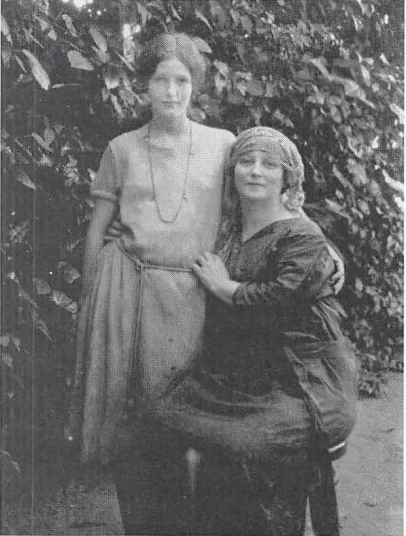
daughter Mary in Ramleh,
Egypt, in 1923.
‘Abdu’l-Bahá visited the Maxwell home for three days during the fall of 1912, when Mary was two years old. There is an especially touching story about this visit, told by ‘Abdu’l-Bahá Himself to His companions and recorded in the memoirs of A. A. Nakhjavani. ‘Abdu’l-Bahá told them: “Today I was resting on the chaise longue in my bedroom and the door opened. The little girl came in to me and pushed my eyelids up with her small finger and said, ‘Wake up, ‘Abdu’l-Bahá!’ I took her in my arms and placed her head on my chest and we both had a good sleep.” When Rúhíyyih Khánum repeated this story in later years she used to say that once when her mother complained to ‘Abdu’l-Bahá that she was naughty, the Master had said,
“Leave her alone. She is the essence of sweetness.”
The traditional educational methods of the time tended to be rigid and authoritarian, narrow-minded and dictatorial, and May was concerned to provide her daughter with the “freedom” which ‘Abdu’l-Bahá had prescribed. For Mary’s early training, May established the first Montessori school in Canada in the Maxwell home. Mary also had a year of schooling in Montreal, a few months in Chevy Chase Country Day School in Maryland, another year in Weston High School in Montreal, and was tutored at home by governesses and private teachers. Later she became a part-time student at McGill University.
Despite these inconsistencies of education she was to become a well-read and knowledgeable person, with a consuming interest in a variety of subjects. Her thirst for acquiring knowledge was insatiable and throughout her life she clipped articles from the daily papers which caught her attention because they reflected Bahá’í themes or subjects of particular interest to her. And however arbitrary and independent may have been her formal intellectual education, there are clear indications that her spiritual training was pursued with rigour and unrelenting discipline. It was a training whose hallmark was love and whose main characteristic was obedience to the Covenant.
As the years of ‘Abdu’l-Bahá’s ministry were drawing to a close with WWI, and as a precursor to His Will and Testament, He sent the Tablets of the Divine Plan to the Bahá’í s of the West. Nine young girls were chosen to draw aside the curtains covering the original handwritten Tablets of ‘Abdu’l-Bahá. Mary Maxwell and her best childhood friend, Elizabeth Coristine of Montreal, were privileged to unveil the first and second of these Tablets for Canada in a tableau vivant at the Hotel McAlpin in New York on 29 April 1919. It was shortly before Mary’s ninth birthday and the end of the Heroic Age of the Faith of Bahá’u’lláh.
The passing of ‘Abdu’l-Bahá, in November 1921, devastated the whole Bahá’í community. May Maxwell was so shattered and shaken in body and soul that she may have become a permanent invalid had not Mr. Maxwell convinced her to visit the Shrines in the Holy Land and meet the Guardian face to face. He thought Mary should go with her. They set sail from New York for the Holy Land, on 29 April 1923. This first pilgrimage left an indelible impression on her, and in later years she recalled, in a personal letter, how she was touched by “the spirit of service” she discovered in Haifa, saying “… a Queen or a beggar woman would be met with the same loving sweetness. Indeed it was this divine normality that really confirmed me here as a little girl of twelve years.”
This was the first time she met the Guardian, and she often described the meeting with a sweet pleasure in the remembrance. She and her mother were installed in the Old Western Pilgrim House at the end of Persian Street and May, who had not been able to walk for over a year, was resting in bed. Since her nights were frequently sleepless and her nerves delicate, Mary had learned from an early age to protect her from intrusion. She was in the hallway of the Pilgrim House when the door suddenly opened and a young man stepped in, with a swift, deft movement, and asked if he could see Mrs. Maxwell. She was a tall girl for her age, fully grown and physically well-developed. She said she pulled herself up to her full height and, looking him squarely in the eyes with considerable dignity and aplomb, asked to know who it was who wished to see Mrs. Maxwell. The young gentleman meekly replied, “I am Shoghi Effendi.” Upon which she turned tail and fled into her mother’s room in mortified embarrassment. Hiding her head, as she used to say “like a puppy”, beneath her mother’s pillows, she could only point to the door and gasp, “He – he – is there!” when her mother asked her what the matter was. And when May Maxwell found out who it was behind the door, she said, “Pull yourself together, Mary, and go and invite him in.”
When May returned to North America almost a year later, she was filled with joy and restored to health, redoubling her efforts in the teaching work and educating the friends in the Bahá’í Administration, in which Shoghi Effendi had carefully instructed her.
Two years later, Mary made a second pilgrimage, in the company of two of her mother’s friends. Back in Canada afterwards, she threw herself eagerly into all kinds of youth activities, both within the Bahá’í administration and elsewhere. Shortly before she was 16, she became a member of the Executive Committee of The Fellowship of Canadian Youth for Peace, serving as its Treasurer. From then on she was continuously involved in membership on committees and in her efforts to promote the cause of racial amity. Soon after she turned 21, she was elected to the Local Spiritual Assembly of Montreal.
Her training in oratory and public speaking began when she was almost 16. Increasingly, she began to accompany her mother on teaching trips, during which she had occasion not only to observe her mother’s manner of giving Bahá’í talks but also to learn how to lecture herself, in the Bahá’í spirit. Just before her nineteenth birthday, she spoke at the National Bahá’í Convention in a manner that touched many peoples’ hearts and minds. At the age of twenty, she delivered a lecture at the Friends’ Meeting House in New York City on “Mysticism in the Bahá’í Religion.” The other speakers at this Congress were all seasoned lecturers and famous orators, including Syud Hossain, the editor of “The New Orient,” who was billed as an “incomparable lecturer on the Orient, world peace and international relations.” After her lecture she received a standing ovation, and on that same day was given the following cable: “HEARTY CONGRATULATIONS ON YOUR BEAUTIFUL CONSCIENTIOUS AND ABLE PRESENTATION OF A GREAT AND DIFFICULT THEME I AM HAPPY AND PROUD OF YOU—SYUD HOSSAIN”.
In addition to lecturing, she wrote books and plays and poetry, developing that diversity and range of skills that would serve to make of her a perfect instrument of service in the hands of her beloved Guardian, who noted her progress with keen interest. Her highest hope was to one day become an author. Her study of the translation of Nabíl’s Narrative, The Dawn-Breakers, which was encouraged by Shoghi Effendi, resulted in the article entitled ‘The Re-florescence of Historical Romance in Nabil’, later published in The Bahá’í World, Volume V (1932–34). The ardent, youthful enthusiasm that it reveals must have informed the lectures she gave on the Heroic Age of the Cause in Montreal, Green Acre, Louhelen, and Esslingen in Germany.
Shoghi Effendi closely followed the development and spiritual training of this remarkable young woman, writing to May Maxwell:
I feel that she should, while pursuing her studies, devote her energies to an intensive study of, & vigorous service to, the Cause, of which I hope & trust she will grow to become a brilliant and universally honoured exponent. I am sure, far from feeling disappointed or hurt at my suggestion, she will redouble in her activities & efforts to approach & attain the high standard destined for her by the beloved Master. Your plan of travelling with her throughout Canada in the service of the Cause is a splendid one & highly opportune. Kindly assure her & her dear father of my best wishes & prayers for their happiness welfare & success.
Your true & affectionate brother,
Shoghi
In May 1933, Mary spent several weeks in Washington, D.C., teaching the Faith and concentrating her efforts on finding ways to draw the two opposing races together, for the cause of racial unity was close to her heart and the rights and responsibilities of both races was a subject that touched her keenly throughout her life. She also attended official functions with her father in Montreal during her early twenties, meeting the Governor General of Canada at events such as the Royal Canadian Academy’s Fifty-Fourth Exhibition. This balance between her obligations to the Bahá’í community in particular and society at large served her well in later years. She always had the ability to mingle with officialdom and humble folk with equal ease; her support of local Bahá’í teaching work as well as social issues at the international level was equally enthusiastic throughout her life.
She very much wanted to learn Spanish, but when, in 1935, civil war threatened her plans to go to Spain, she was induced to accompany her cousins Jeanne and Randolph Bolles to Germany, where she taught and helped the Bahá’ís for the next year and a half, while May spent most of her time in France and Belgium. She became enamoured of the country and learned the language with fluency.
At the end of their extended stay in Europe, she and her mother received a warm invitation to come to the Holy Land. In a letter addressed to Mary Maxwell in late January 1936, the Guardian’s secretary wrote:
Before your coming to Haifa Shoghi Effendi would advise you to visit the centers in Germany and if possible to extend your trip to Austria and the Balkans where we have now a chain of active and prosperous communities that link the Western with the Eastern part of Europe. He would even suggest that you follow that route when you come to Haifa, as this would be of great interest to you, and of invaluable encouragement to the friends in these new and somewhat isolated centers.
Shoghi Effendi added, in his postscript:
Dear and valued co-worker:
I wish to assure you in person of a hearty welcome to visit the Holy Land and lay your head on the sacred Threshold after having rendered valuable services in the Faith in both America and Europe. For those you have asked me to pray, in your letters, I will supplicate the blessings of Bahá’u’lláh. Rest assured. Your true brother,
Shoghi
Mary Maxwell fulfilled the Guardian’s injunctions, travelling to every community in Germany and meeting every isolated believer, group, or Assembly. By the time she had accomplished this task, a year had passed and the rumblings of war were upon them. It was impossible now to travel through the Balkans or Austria, and she and her mother were then urged by Shoghi Effendi to come to the Holy Land directly.
One day during this pilgrimage, which began in 12 January 1937, another chapter opened in the life of Mary Maxwell when the mother of Shoghi Effendi told May Maxwell of Shoghi Effendi’s offer of marriage to her daughter.
The wedding took place on 24 March 1937, in Haifa, and it was on this occasion that the beloved Guardian gave her the name Rúhíyyih Khánum. In The Priceless Pearl, she described her wedding day, when she went with Shoghi Effendi to Bahjí, saying, “I remember I was dressed, except for a white lace blouse, entirely in black for this unique occasion, and was a typical example of the way oriental women dressed to go out into the streets in those days, the custom being to wear black.” The ring, which was a simple Bahá’í ring in the shape of a heart, had been given to her the day Shoghi Effendi proposed. He had asked her then to wear it on a chain around her neck, and on the day of their marriage, in the Shrine of Bahá’u’lláh, he took it from her and put it on her finger himself. It was a ring that had been given to Shoghi Effendi by the Greatest Holy Leaf, and Rúhíyyih Khánum later had one made exactly like it for the beloved Guardian. They were both buried with their rings on their fingers. After the recital of the marriage vow in the room of the Greatest Holy Leaf, the mother of Shoghi Effendi placed Rúhíyyih Khánum’s hand in the hand of her son, according to the old Persian tradition of dast be dast.
News of the marriage electrified the Bahá’í world, both in the East and the West. Cables composed by the Guardian and signed by his mother were sent to the National Spiritual Assembly of Iran and the National Spiritual Assembly of the United States and Canada. The one to the West, dated 27 March 1937, read as follows:
ANNOUNCE ASSEMBLIES CELEBRATION MARRIAGE BELOVED GUARDIAN STOP INESTIMABLE HONOUR CONFERRED UPON HANDMAID OF BAHA’U’LLAH RUHIYYIH KHANUM MISS MARY MAXWELL STOP UNION OF EAST AND WEST PROCLAIMED BY BAHA’I FAITH CEMENTED.
(Signed) Ziaiyyih, mother of the Guardian.
For Rúhíyyih Khánum the period of adjustment that followed was a training time that could not have been easy. She was parted from her beloved parents, living a great distance from her familiar life in Montreal, and plunged into an oriental household together with all her in-laws under one roof. This must have been difficult for a young woman raised with a degree of freedom that was unusual even in the West at that time. Another difficulty was the language. Although the members of ‘Abdu’l-Baha’s family all spoke English, they communicated with each other in Persian. It was only natural, when comments were passed and jokes were shared which she did not understand, that she would have felt left out. Were it not for her beloved, Rúhíyyih Khánum may well have been bereft.
But there were greater tests than mere loneliness and far greater trials than cultural isolation. In those early years of her marriage, one by one, the Guardian’s family fell away from faithfulness, until she was alone in that house at the side of her beloved. “Shoghi Effendi held me tight under his protective arms,” she used to say, and she, in turn, became his shield and his sole support. It was also during this turbulent period that Shoghi Effendi pulled her up short one day, and gesturing to her hand, said, “Your destiny is in the palm of your own hand.” This was a great shock for her and made her realize that she was not immune to her own tests of faith. “When Shoghi Effendi married me,” she used to say, “I felt safe and snug and thought I had nothing more to worry about, my destiny was in his hand. But when he said that, there it was, back in my own hand.” She would always make us laugh when she finished this very serious tale.
Her firmness in the Covenant, a manifestation of her deep faith, was her greatest protection in those early years of marriage. Perhaps the outpouring of her heart years later, in her poem “This is Faith”, written on April 4, 1954, exemplifies the depth of her understanding of this subject.
THIS IS FAITH
To walk where there is no path
To breathe where there is no air
To see where there is no light –
This is Faith.
To cry out in the silence,
The silence of the night,
And hearing no echo believe
And believe again and again –
This is Faith.
To hold pebbles and see jewels
To raise sticks and see forests
To smile with weeping eyes –
This is Faith.
To say: “God, I believe” when others deny,
“I hear” when there is no answer,
“I see” though naught is seen –
This is Faith.
And the fierce love in the heart,
The savage love that cries
Hidden Thou art yet there!
Veil Thy face and mute Thy tongue
Yet I see and hear Thee, Love,
Beat me down to the bare earth,
Yet I rise and love Thee, Love!
This is Faith.
A year after her marriage, Rúhíyyih Khánum wrote to her mother, “If anyone asked me what my theme was in life I should say, ‘Shoghi Effendi’.” It is clear from this that she had thrown herself with heart and soul into her destiny, and her task required a rigorous discipline. Under Shoghi Effendi’s strict tutelage she applied herself to conscientious study. Although she was an autodidact by nature and preferred to teach herself, rather than receive instruction—a habit she applied to many subjects in later life—he was, in effect, her principal teacher.
The reciprocity between Rúhíyyih Khánum and her parents was preserved despite the difficulties of distance and separation. She believed that service to the Cause performed by any one of them was a shared blessing for them all and of direct consequence to each, a theme echoed by May Maxwell in December 1939, when she wrote, “It is not only thru my passionate love for this great Bahá’í Faith, but thru my love for her, and yearning to be more worthy of her, that I have considered going to South America to teach.” And so it was that May Maxwell, seventy years old, with a weak heart and in very poor health, decided to make her supreme sacrifice. She arrived in Buenos Aires at the end of February, accompanied by her young niece, Jeanne Bolles, and the next day, on 1 March 1940, she died of a massive heart attack.
This was a terrible shock to Rúhíyyih Khánum. She received the devastating news from the Guardian, who told her, “Now I will be your mother” and comforted her with infinite compassion and patience. To Sutherland Maxwell, he cabled:
GRIEVED PROFOUNDLY YET COMFORTED ABIDING REALIZATION BEFITTING ONE SO NOBLE SUCH VALIANT EXEMPLARY SERVICE CAUSE BAHA’U’LLAH STOP RUHIYYIH THOUGH ACUTELY CONSCIOUS IRREPARABLE LOSS REJOICES REVERENTLY GRATEFUL IMMORTAL CROWN DESERVEDLY WON HER ILLUSTRIOUS MOTHER STOP ADVISE INTERMENT BUENOS AIRES STOP HER TOMB DESIGNED BY YOURSELF ERECTED BY ME SPOT SHE FOUGHT FELL GLORIOUSLY WILL BECOME HISTORIC CENTRE PIONEERS BAHA’I ACTIVITY STOP MOST WELCOME ARRANGE AFFAIRS RESIDE HAIFA STOP BE ASSURED DEEPEST LOVING SYMPATHY.
On 4 March, Rúhíyyih Khánum cabled the National Spiritual Assembly of the Bahá’ís of the United States and Canada, saying:
HUMBLY GRATEFUL BELOVED MOTHER ANSWERED GUARDIAN’S CALL TURNED SOUTHWARD SACRIFICED LIFE HOLY FAITH. BEG PRAYERS DAUGHTER MAY FOLLOW HER FOOTSTEPS.
Mr. Maxwell joined the Guardian and Rúhíyyih Khánum in Rome in the summer of 1940, but their return to Palestine was prevented by the war. They did, however, manage to reach France and cross over to England on the last boat before the German army closed the borders. Eventually they were able to sail to South Africa and then travel north to the Holy Land via Egypt.
The war years were filled with activity and great achievements at the World Centre. During this period Shoghi Effendi commissioned Sutherland Maxwell to make the drawings for the superstructure of the Shrine of the Báb, and their love and collaboration was the greatest source of joy to Rúhíyyih Khánum. She used to say, “I really learned to know and appreciate my father through Shoghi Effendi.” Also during this time, Rúhíyyih Khánum assisted the beloved Guardian in the proofreading of his masterpiece, God Passes By.
One of the most outstanding services performed by Rúhíyyih Khánum during her twenty years at the side of the Guardian, was her role as his secretary, a task she undertook almost immediately after her marriage. From 1941, when she became Shoghi Effendi’s principal secretary in English, until 1957, she wrote thousands of letters on his behalf. She frequently described how Shoghi Effendi trained her to be a good secretary. In the early years, he would write down the points he wanted her to incorporate in pencil at the bottom of the letter he had received, but later on, when he saw how well she wrote, he would just tell her what to answer verbally. However, she always stressed the fact that he read every single letter she wrote for him before appending his own postscript. In later years, she wrote not only his personal letters but also his official correspondence with National Spiritual Assemblies.
Rúhíyyih Khánum told us that Shoghi Effendi encouraged her to write, and once, as she was copying her own favourite poems in a book, he asked to see them for himself. The next day he gave her book back saying, “I read them all. They are beautiful, they made me cry.” At Shoghi Effendi’s suggestion she wrote an article on the interment of the remains of the Purest Branch and his mother, Navváb, on Mt. Carmel next to the resting-place of the Greatest Holy Leaf, which was published in volume VIII of The Bahá’í World. His encouragement was also the main reason she wrote the book Prescription For Living. She often said she felt so sad for the young men who returned, confused and disillusioned, from World War II to a changed and unfamiliar world. She wanted to give them some light, some direction, and a way to see hope for the future.
In The Priceless Pearl Rúhíyyih Khánum refers to the war in the Holy Land prior to the formation of the State of Israel, as gunfire echoed between sea and mountain, while she remained calm in the heart of the storm with Shoghi Effendi as her example. After the formation of the State, the situation changed and Rúhíyyih Khánum enjoyed a degree of freedom that had not been possible for her before. Her social life became more varied and lively, and she gave wonderful dinner parties and soirées for the dignitaries of Haifa.
During the 1940’s her father became severely ill, and in 1950 it was decided that Mr. Maxwell should go to Canada with his Swiss nurse until the situation improved in Israel. When they parted at the end of that summer, it was the last time Rúhíyyih Khánum saw her dear father. He died two years later in Montreal.
When the first International Bahá’í Council was formed in 1951, Rúhíyyih Khánum was a member and its chosen liaison with the Guardian. Then, in 1952, after the passing of Sutherland Maxwell, Shoghi Effendi sent a cable dated March 26th to the National Spiritual Assembly of the United States announcing that “mantle Hand Cause now falls shoulders his distinguished daughter Amatu’l Baha Ruhiyyih who already rendered still rendering manifold no less meritorious self sacrificing services World Centre Faith Bahá’u’lláh”. The following year, the Maxwell home in Montreal was declared a Shrine, marking not only the great gift bestowed by ‘Abdu’l-Baha on the Canadian Bahá’í community but also the unique services of William Sutherland, May and Mary Maxwell.
On 15 December 1952, the beloved Guardian announced that five Intercontinental Conferences would be held during the course of the Holy Year, and designated Rúhíyyih Khánum to be his representative at the one in Wilmette. She was, in his words, to
DELIVER MY OFFICIAL MESSAGE ASSEMBLED BELIEVERS ELUCIDATE CHARACTER PURPOSES IMPENDING DECADE LONG SPIRITUAL WORLD CRUSADE RALLY PARTICIPANTS ENERGETIC SUSTAINED ENTHUSIASTIC PROSECUTION COLOSSAL TASKS AHEAD.
She was also delegated by him to dedicate the Temple in North America on his behalf and
UNVEIL OCCASION COMPLETION CONSTRUCTION MOTHER TEMPLE WEST PRIVILEGED ATTENDANTS WILMETTE CONFERENCE MOST PRIZED REMEMBRANCE AUTHOR FAITH NEVER BEFORE LEFT SHORES HOLY LAND TO BE PLACED BENEATH DOME CONSECRATED EDIFICE STOP MOREOVER ASSIGNING HER TASK ACT MY DEPUTY HISTORIC CEREMONY MARKING OFFICIAL DEDICATION HOLIEST MASHRIQUL ADHKAR BAHAI WORLD REARED EVERLASTING GLORY HONOUR MOST GREAT NAME HEART NORTH AMERICAN CONTINENT [signed] SHOGHI
She had left North America eighteen years before, when she was a young Bahá’í and was known as the daughter of May Maxwell. Now she was returning as Amatu’l-Bahá Rúhíyyih Khánum, the consort of the beloved Guardian and a Hand of the Cause of God. In Wilmette, she rose to speak like the queen she was, her delicate, gauzy mantilla framing her lovely young face, and even from the photographs it is easy to see how she would have made an unforgettable impression on the Bahá’ís, as well as on the non-Bahá’í seekers and distinguished speakers. After attending the 1953 Forty-fifth Annual Convention, the Bahá’í Dedication of the Temple, and the public Dedication the next day, she attended the All-America Intercontinental Conference from 3 to 6 May.

Wilmette, Illinois, in 1953.
Then, accompanied by Amelia Collins, a Hand of the Cause and Vice-President of the International Bahá’í Council, Rúhíyyih Khánum went to Montreal to visit her father’s resting-place. A memorial gathering was held at the graveside on 10 May and that evening she spoke at a public meeting at the Ritz-Carlton Hotel. While in Montreal, she also sorted out her parents’ belongings and, with Shoghi Effendi’s consent, shipped her personal furniture to the Master’s House in Haifa, where she created an exquisite library, which she used for special dinner parties, and a beautiful drawing room. In an act that pleased the Guardian immensely, she gave her Montreal home to the Faith, and it is now registered in the name of the National Spiritual Assembly of Canada.
In 1952, when some degree of safety and order was restored to Israel, Shoghi Effendi re-opened the opportunity for pilgrimage. Groups of nine pilgrims, from both the East and the West, began to arrive. To welcome them, to cater to their needs, and respond to their concerns was a task that consumed not only many hours of the Guardian’s time but those of Rúhíyyih Khánum, who planned and prepared the pilgrims’ meals in the face of great shortages of all kinds of essential foods in the post-war years.
In 1957, the beloved Guardian and Rúhíyyih Khánum left together for their summer vacation for the last time. The Guardian was very tired. As usual, he maintained all his correspondence and carried with him all his notes for his map of the Ten Year Crusade, which was approaching its mid-way point. In August that year he thrilled the Bahá’ís of the world with a two-fold message. The first part was the announcement of five Intercontinental Conferences to celebrate this mid-way point of the Crusade, and the second was his appointment of eight more Hands of the Cause in different continents. Everyone was filled with anticipation. Everyone looked forward to jubilation and celebration ahead. We in Uganda were thrilled beyond belief, for we had learned with awe and excitement that our precious Amatu’l-Bahá Rúhíyyih Khánum had been designated by the beloved Guardian to represent him at the African Conference in Kampala. She was going to come to us!
And then, on 4 November, the cataclysmic news of Shoghi Effendi’s passing rocked the Bahá’í world. He had died in London, we heard in disbelief. The community that had for thirty-six years looked to him for guidance, for encouragement, for leadership and, above all, for his encompassing love, was bereft. There was no one to turn to but Amatu’l-Bahá, although she was the most forlorn of all at that time. It was up to her to take the next step to ascertain what should be done. The fulfilment of all the Guardian’s hopes and aspirations for the Ten Year Crusade became of uppermost importance to her. His good pleasure became the goal and object of her existence. From that moment to the end of her life her priorities never wavered.
In the face of her own immeasurable personal loss, it is remarkable to consider with what self-abnegation her heart turned to her fellow believers at that critical time of trial. All around her, friends were prostrate with grief, helpless with sorrow, leaving her to rise alone to the painful task in front of her, for the sake of her beloved Shoghi Effendi. She had to inform the Hands of the Cause and the Bahá’í world of this tragic event in such a manner as might lessen as much as possible the shock waves it was bound to cause. She had to tell the heart-broken believers to come to his funeral and bid their Guardian a last farewell. She went around London looking for a befitting burial ground and found it. She searched for a shroud and chose the casket and bought it. She saw to every detail in the sad days that followed. And the day after the funeral, when she was driving away from the graveside, she saw in her mind’s eye a vision of a column, an eagle and a globe, and she conceived the monument above his grave. She remembered how fond Shoghi Effendi had been of beautiful columns, and how he had said it was a pity that in his gardens there was no place for a single column. With this thought in mind, she designed the graceful column rising over his grave and placed the globe on it, surmounted by the symbol of his victories: the majestic eagle, with its wings open.
On 15 November Rúhíyyih Khánum arrived in Haifa, and three days later the first Conclave of the Hands of the Cause began in Bahjí. They searched for the will of Shoghi Effendi but did not find it, and so the Hands of the Cause informed the community that they must turn to the explicit directives in The Dispensation of Bahá’u’lláh, which Shoghi Effendi had referred to as his Will and Testament, to complete the goals of the Ten Year Crusade and to arrange for the election of the Universal House of Justice at the end of that period.
The Hands of the Cause were strong individuals from both the East and the West whose primary aim was to direct and hold together the affairs of the Cause of God. Amatu’l-Bahá played a vital role in their early Conclaves, serving as a bridge between cultures and languages – a Westerner imbued with Eastern understanding, whose horizons had been widened and stretched by Shoghi Effendi. Her deep sense of fairness and her ability to see clearly both sides of an argument facilitated the narrowing and negotiating of the gaps between the different Hands.
During that first year after Shoghi Effendi’s passing, Rúhíyyih Khánum spent most of her time in Bahj̤í and slept in the Mansion. Apart from carrying out all her heavy administrative duties, she threw herself into physical work, cleaning the Shrine and working in the gardens. She could not bear the emptiness and the loneliness of her apartment in Haifa. The next five or six years were perhaps the saddest and hardest in her entire life. But she demonstrated her own, immediate commitment to service when she accepted to attend the first of the series of the Intercontinental Bahá’í Conferences called by the beloved Guardian to mark and celebrate the mid-way point of the Ten Year Crusade. Initially, her grief was so intense that she did not want to go, but her fellow Hands convinced her that since it had been the wish of Shoghi Effendi, she must do so.
Although Rúhíyyih Khánum was in mourning and wore black for one year after Shoghi Effendi’s passing, she altered this custom for the duration of her trip to Africa. She told me afterwards that all her clothes for that Conference had been seen and approved by the Guardian the previous summer, and this was one of the reasons why she did not come to Kampala in mourning clothes. She also wanted to create a sense of jubilation during this Conference, the way Shoghi Effendi had anticipated it should be.
Over nine hundred people stood up in sorrowful awe as she entered the conference hall in Kampala on 24 January 1958. And then, four hundred African Bahá’ís raised their voices and began to sing “Alláh-u-Abhá”, softly and spontaneously. The air was so charged with love, so pent-up with emotion as Amatu’l-Bahá walked up the central aisle, that we were all shaken. When she stood before us to address the Conference, her voice broke and tears came to her eyes several times. But the waves of deep love and sympathy in that audience were tangible; they enveloped and caressed her, and at the end assuaged her sorrow. Her love for the Africans and their continent became a permanent part of her life afterwards. She brought to that Conference a wider perspective, a global outlook, an all-embracing point of view that we had been lacking, and she went back from it recharged with hope and courage to continue, travelling to different conferences and to the Dedications of both Mother Temples of Africa and Australasia during the Custodianship of the Hands.
In 1961, the election of the International Bahá’í Council took place. This precursor of the Universal House of Justice greatly assisted the Hands in the preparation for that first International Bahá’í Convention, and Rúhíyyih Khánum, who had been tasked by the Hands with the completion of the interior of the International Archives Building, turned for assistance to the Council’s younger members. Beautiful Chinese and Japanese furniture purchased by Shoghi Effendi during the last year of his life for the purpose of decorating and displaying the holy relics, had to be carefully arranged and meticulously prepared for their precious contents. Artistry, a sense of proportion, a strict adherence to the placement of the objects according to the priority of their importance—all these guided Amatu’l-Bahá in her task.
The conclusion of the Ten Year Crusade, in April of 1963, was crowned by the election of the long-awaited Universal House of Justice in Haifa. The election took place in the House of ‘Abdu’l-Bahá, which had played such a significant role in the unfoldment of the Administrative Order of Bahá’u’lláh. To befittingly honour the occasion, Rúhíyyih Khánum had ordered thousands of roses and carnations to carpet the inner rooms of all three Shrines. She opened that International Bahá’í Convention and every successive one until that of April 1998. Then, after the election of the Supreme Body, Rúhíyyih Khánum and the Hands of the Cause of God rejoiced with 7,000 Bahá’ís in Albert Hall in London, England, at the first Bahá’í World Congress. Amatu’l-Bahá invited a number of indigenous Bahá’ís from Africa, South America and Australia to attend this historic event as her personal guests. Her deeply moving and thought-provoking talk on Shoghi Effendi’s life was a masterpiece of eloquence and poignancy, as we brought his Ten Year Crusade to its triumphal close.
Rúhíyyih Khánum’s systematic travels around the globe began in the year 1964. Many times, she talked about the genesis of these unique trips, recounting an incident in the lifetime of Shoghi Effendi. One day, as he was passing by her desk, he stopped and looked at her and said, “What will become of you after I die?” She was shattered by this unexpected remark and began to weep, saying, “Oh, Shoghi Effendi, don’t say such terrible things. I don’t want to live without you.” He paid no attention, however, and after a pause continued, “I suppose you will travel and encourage the friends.” She said that this was the only remark he ever made about what she should do with her life after his passing. And so it was that, when she was somewhat freed from her arduous administrative duties and the affairs of the Cause were placed under the infallible guidance of the Universal House of Justice, she took these words as his last instructions to her and did her utmost to fulfil his hopes.
In the course of her long life she travelled to 185 countries, dependencies and major islands of the globe. While she visited just 31 countries in her first 54 years, she travelled in all the rest between 1964 and 1997. When I tried to count the number of territories she visited in these 34 years, I came up with the astounding figure of 154. Many of these countries were visited more than once, and some, like India, were honoured by her presence as many as nine times. Her trips were of such a variety that the best way to look at them is through the range of activities that they involved.
Her role as Ambassador of the Bahá’í Faith, for example, was remarkable in itself. Everywhere she went she met with Heads of State and high-ranking authorities at the national, local or even village levels, moving with complete ease from one class of society to another. Although she herself was in every way queenly and worthy of honour and respect, she always approached these emblems of material power and political authority with deference and a natural humility. She would explain that her visit was in the nature of a courtesy call, and nothing more, stating that she had come from the World Centre of the Bahá’í Faith and was visiting the Bahá’ís in that country, who were a strictly a-political and non-partisan people, well-wishers of the government and obedient to its laws. In all her encounters, she strove to be positive and looked for every opportunity to offer praise and appreciation in her dealings with state officials, even if very little was called for.
In Africa alone she met with seventeen Heads of State and was instrumental in helping the Bahá’ís achieve many of their legal goals. The highest in rank and the leader she most valued meeting in all her travels was Emperor Haile Selassie of Ethiopia. She greatly admired his nobility, his courage and his uprightness. The Head of State whose meeting brought her the greatest joy and pride was His Highness Malietoa Tanumafili II of Western Samoa, the first ruling monarch to embrace the Cause of Bahá’u’lláh.
She always maintained a high standard of propriety, and when she shared the platform or sat at dinner with such people as Prince Philip of Great Britain or the Archbishop of Canterbury, with Governors-General and Ambassadors, she invariably won their admiration and respect, not only for herself but most importantly for the Cause of Bahá’u’lláh. This was her ultimate concern. Rúhíyyih Khánum truly had no personal ambition; she was not in the least interested in meeting or moving in such company for its own sake or her pleasure. It was only for the Cause that she would accept any appointments and invitations of this kind.
Another activity which she undertook in the course of her many travels was contact with the representatives of the media. She must have had hundreds of newspaper, radio and television interviews, in the capital cities around the world as well as in the large and small towns of every country she visited. Before going to meet a journalist or be filmed in a studio she would always pray and ask for God’s guidance, His assistance and, above all, His protection. She used to tell the friends that when they met the representatives of the media, their principal aim should be to create a good impression of the Faith. “If these people only remember one thing, that the word ‘Bahá’í’ means something good, you have achieved your purpose,” she used to say.
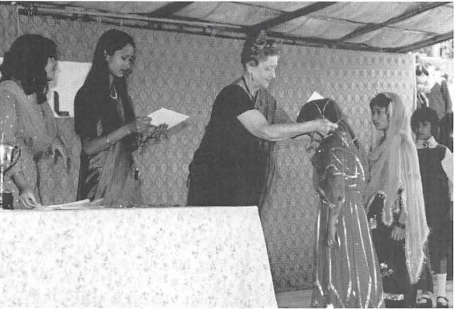
Another vital service rendered by Amatu’l-Bahá in the course of her many travels was her role as the representative of the Universal House of Justice at national and international Bahá’í Conferences across the planet. Standing on platforms on behalf of the Sacred Institution she served, in the course of Bahá’í Conventions at Ridván, at youth conferences and Native gatherings, at inaugurations of Bahá’í Temples and other great historical events to which the Bahá’ís streamed from all the quarters of the globe, she was erect and regal and forever memorable, the essence of dignity and beauty. Her mastery of just the right word on each of these occasions, her ability to draw out her audience and touch people’s hearts, her clear and simple logic, and, above all, her wit and her bewitching sense of humour—these qualities endeared her to and charmed her audiences. When asked, she attributed her power of public speaking to the fact that at the beginning of her marriage Shoghi Effendi had recommended that she memorize the beautiful prayer of ‘Abdu’l-Bahá which begins, “O Lord, my God and my Haven in my distress! My shield and my Shelter in my woes! …” and which concludes with the poignant sentence: “Loose my tongue to laud Thy name amidst Thy people, that my voice may be raised in great assemblies and from my lips may stream the flood of thy praise.” She also attributed it to the advice given by ‘Abdu’l-Bahá to May Maxwell, to turn her heart to Him, pray, and then speak, for Rúhíyyih Khánum herself followed this advice faithfully. She gave talks with the same degree of resourcefulness in French, in German, and in Persian.
One of the most memorable services in the course of Amatu’l-Bahá’s many travels was the time she spent and the attention she gave to perfectly ordinary people in the peripheries of society. When asked what was her favourite spot, she would often say that it was in the villages and jungles of the world. She rarely missed the opportunity to validate people in far flung and remote places whom few had heard of and whose simple actions none might ever know.
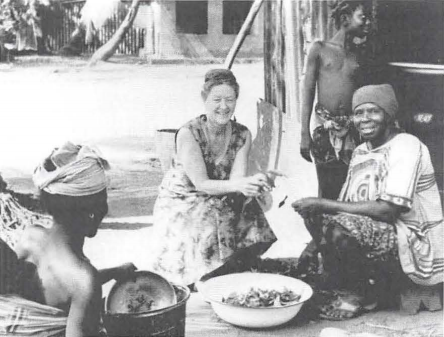
How often in the course of these forty years by her side did I witness shy, unsure, sometimes dejected human beings uplifted by her genuine kindness, her praise and patience. Her instinct was to approach people with an open, candid heart, simply and unself-consciously. It was to look for positive qualities in people and verbalize these. But though she was the perfect diplomat in some respects, she was also very direct and often said things frankly and outspokenly. The driving impulse in all her encounters with the Bahá’ís was to stir them to action and rouse them up so that they would teach the Faith. And often, even when she was critical of individuals, her intent was to protect the Cause. If her manner may at times have appeared abrupt, and initially formidable to those who approached her, it was often the result of her own innate shyness, which few people guessed, for she was disconcerted, to the end of her life, by effusiveness and adulation.
Seldom did Rúhíyyih Khánum travel, especially on her longer trips, without a pet. Her love for animals was such that she would gladly accept the extra hardship of tending and cleaning her pets for the simple joy of their company. Her motto was, “You only live once; why not get clean joy out of it?”
Rúhíyyih Khánum was one of the most hardworking human beings that I have ever met, and she never asked anyone to do anything that she had not or could not also have done herself. Much of her hard work was centred on her home in Haifa, which was the hub of continuous activity until the last two and a half years of her life. She kept a regular entourage around her as busy as herself and trained them rigorously in the arts of practical maintenance.
Her first and foremost concern was always the upkeep and care of the Shrines. Her constant reminder was to keep these precious Holy Shrines exactly the way Shoghi Effendi had arranged them. “This is not a place of innovation, but preservation” was her advice to all. She also undertook periodically to inspect and keep all the Holy Places in order, framing pictures, replacing the frayed and worn out fabrics, keeping an eagle eye on any deviation from the Guardian’s ways. The renovation and furnishing of the House of ‘Abdu’lláh Páshá engrossed her interest for several years.
One of Amatu’l-Bahá’s important social activities in Haifa was her role as hostess. She loved setting a beautiful table, arranging flowers and overseeing every detail of the event. Apart from formal dinners, she would also give many informal parties. After returning from India, every now and then she would be so homesick for that country that she would throw an “Indian Night” party. She would dress the few ladies working at that time in Haifa in her beautiful saris, trace the floors with exquisite patterns made of coloured flour, play Indian music, and we would all enjoy delicious, spicy Indian food under her hospitable roof. And also do the cleaning up with her afterwards! Or there were her exciting “African Nights” when all the friends who were either African or connected to the work in Africa were invited to her home, usually outside in her beautiful garden, and after a scrumptious dinner would drum and sing to their hearts’ content. How exhilarating were her dinner parties for the new Counsellors, too, where the guests, numbering over 90 at times, were squeezed into the main hall, as she would say, “with a shoe horn.” Many hundreds of the friends who met Amatu’l-Bahá on her travels, enjoyed her delightful hospitality and loving attention when visiting Haifa.
There was, of course, a stream of regular nine-day pilgrims with whom she also met, twice a month for nine months of the year. This was a custom and responsibility which went back to her earliest years at the side of Shoghi Effendi, and which she dutifully maintained until the last years of her life. She met with about 2000 pilgrims each year in the main hall of the Master’s House, giving talks that provided guidance and inspiration for many. She also kept up a voluminous correspondence, encouraging institutions and individuals and responding to questions and requests.
Two particular events at the World Centre stand out, during which many hundred of pilgrims flocked through the doors of the Master’s House. In 1968, the Centenary of the arrival of Bahá’u’lláh in the Holy Land brought two thousand Bahá’ís to Haifa and ‘Akká, and in 1992 three thousand Bahá’ís came for the commemoration of the Centenary of the passing of Bahá’u’lláh. On the afternoon of 28 May at Bahjí, they witnessed Amatu’l-Bahá place the cylinder containing the Roll of Honour of the Knights of Bahá’u’lláh at the entrance of the Most Holy Shrine. On the night of Bahá’u’lláh’s Ascension, after a devotional program in the Haram-i-Aqdas, we all circumambulated the Shrine, which Rúhíyyih Khánum had carpeted with thousands of rose buds and carnations.
When one contemplates the fullness of her days and years, many of which were spent in travel, one is filled with wonder at how she managed to do so much writing. Throughout the years Amatu’l-Bahá penned The Priceless Pearl, Manual for Pioneers, The Desire of the World, The Ministry of the Custodians, and Poems of the Passing, an outpouring of her broken heart after the death of Shoghi Effendi, which was printed in 1996. Furthermore, her legacy also includes the production of two important films. The first, her two-hour documentary film “The Green Light Expedition,” was the fruit of her six months’ journey in 1975 through the Amazon Basin, the Peruvian and Bolivian altiplano, to the Bush Negroes of Suriname. Her second film, “The Pilgrimage”, offers a visual pilgrimage to the Bahá’í Holy Places in Haifa and ‘Akká, with Amatu’l-Bahá as guide.
Rúhíyyih Khánum touched and filled the lives of numerous people everywhere around the world, but the primary source of her comfort and happiness in the last decades of her life was her love for the Universal House of Justice and her bond with this Institution and its individual members. When all nine members of the Universal House of Justice came to her home for the last time three weeks before her passing and paid their respects, when she was quite frail and in bed, such a deep sense of happiness and contentment enveloped her that it was tangible, like sunlight, in the room after they left. She lingered quietly in that light a moment, and then said, “I felt their love; they are my closest friends.” This bond, which symbolized her total dedication to the Covenant throughout her life, was strong and vibrant to the end – and always reciprocal.
Her funeral was held in the central hall of the Master’s House. The two Hands of the Cause were present, together with members of the Universal House of Justice, the International Teaching Centre Counsellors, and twenty-four Continental Counsellors from all over the world. Also attending were her family members and representatives from seventy-six National Spiritual Assemblies, senior officials from the Canadian and United States embassies, representatives of the Israeli government, the mayors of Haifa and ‘Akká, other prominent Israeli citizens, and a number of special invited guests. Following the readings and the chanting of the Prayer for the Dead, she left for the last time that house which she had entered as a bride sixty-three years before. Her coffin was carried out by members of the Universal House of Justice, then borne across the street and lowered into its vault by believers representing a variety of ethnic origins. Almost one thousand people, including pilgrims and volunteers serving at the Bahá’í World Centre, stood outside her home, in the closed-off street, and in the garden where her grave had been prepared. The interior of the grave was carpeted on all sides with hundreds of roses and carnations, just as she had arranged for her beloved Shoghi Effendi forty-two years before. And as the rain poured down, more prayers were recited and chanted before her casket was lowered into the ground. The rainstorm that had begun on the night she passed away finally subsided to a drizzle as her precious remains were laid to rest.
I think, to sum up such a life, there are no adequate words but those expressed in the message of the Universal House of Justice to the Bahá’í world after her passing:
19 January 2000
To the Bahá’ís of the World
In the early hours of this morning, the soul of Amatu’l-Bahá Rúhíyyih Khánum, beloved consort of Shoghi Effendi and the Bahá’í world’s last remaining link with the family of ‘Abdu’l-Bahá, was released from the limitations of this earthly existence. In the midst of our grief, we are sustained by our confidence that she has been gathered to the glory of the Concourse on High in the presence of the Abhá Beauty.
For all whose hearts she touched so deeply, the sorrow that this irreparable loss brings will, in God’s good time, be assuaged in awareness of the joy that is hers through her reunion with the Guardian and with the Master, Who had Himself prayed in the Most Holy Shrine that her parents be blessed with a child. Down the centuries to come, the followers of Bahá’u’lláh will contemplate with wonder and gratitude the quality of the services—ardent, indomitable, resourceful—that she brought to the protection and promotion of the Cause.
In her youth, Amatu’l-Bahá had already distinguished herself through her activities in North America, and later, both with her dear mother and on her own, she had rendered valuable service to the Cause in Europe. Her twenty years of intimate association with Shoghi Effendi evoked from his pen such accolades as “my helpmate”, “my shield”, “my tireless collaborator in the arduous tasks I shoulder.” To these tributes he added in 1952 his decision to elevate her to the rank of Hand of the Cause of God, after the death of her illustrious father.
The devastating shock of the beloved Guardian’s passing steeled her resolve to lend her share, with the other Hands of the Cause, to the triumph of the Ten Year Crusade, and subsequently to undertake, with characteristic intrepidity, her historic worldwide travels.
A life so noble in its provenance, so crucial to the preservation of the Faith’s integrity, and so rich in its dedicated, uninterrupted and selfless service, moves us to call for befitting commemorations by Bahá’í communities on both national and local levels, as well as for special gatherings in her memory in all Houses of Worship.
With yearning hearts, we supplicate at the Holy Threshold for infinite heavenly bounties to surround her soul, as she assumes her rightful and well-earned position among the exalted company in the Abhá Kingdom.
The Universal House of Justice

Part III: The Collective Dimension of Spirituality
1. The Social Matrix of Individual Growth
Until now in our discussion, we have viewed the process of spiritual growth as being primarily an individual one, a process which effects changes within the individual and in his behavior towards his social and natural environment. However, it is obvious that individual spiritual growth does not and cannot take place in a vacuum. It takes place within the context of a given society that is bound to have a profound influence on the individual in his pursuit of spirituality. Indeed, there are many intricate, subtle, and complex interactions between any society and each of the individuals composing it. These interactions produce reciprocal influences that operate on different levels of behavior, life experience, and consciousness. It is therefore more accurate to view the spiritual growth process as an organically social one having several identifiable but related components. Some of these are: (1) an individual component, which has been the main focus of our discussion in the previous sections, (2) a collective or global component, involving the evolution of society as a whole, and (3) an interactive component, involving the relationship between the individual and society. In this section, the global and interactive dimensions of the spiritual growth process will be briefly examined.
The Bahá’í Writings make clear that, just as the individual has a basically spiritual purpose to his existence, so society also has a spiritual raison d’être. The spiritual purpose of society is to provide the optimal milieu for the full and adequate spiritual growth and development of the individuals in that society. In the Bahá’í view, all other aspects of social evolution, such as technological innovations, institutional structures, decision-making procedures and the exercise of authority, group interactions, and the like, are to be judged positive or negative according to whether they contribute to or detract from the goal of fostering a favorable milieu for spiritual growth.
Such a concept of society and its meaning is certainly a radical departure from the commonly held view that society serves primarily as a vehicle for economic activity to provide for the conditions of material existence. However, the inherent limitations of this common viewpoint become readily apparent when one reflects that nature itself already provides the basic conditions for material existence. Therefore, providing such conditions can hardly be the fundamental purpose of human society, for society then becomes redundant at best and possibly harmful.
Of course, economic activity is an important part of society’s function since a certain level of material well-being and stability provides opportunities for spiritual growth. A social milieu in which large segments of the population are starving or living in other such extreme conditions is hardly a milieu which is favorable to the full and adequate spiritual development of its members, although spiritual growth can take place under such conditions. Also, a just, well-organized, and efficient economy can serve to free man, at least partially, from boring and excessive labor and thus provide time for higher intellectual and artistic pursuits.
Another spiritual implication of economic activity is that it requires intense human interaction and therefore provides many of the challenges and opportunities necessary to stimulate spiritual growth among its participants. It is in the market place that questions of justice, compassion, honesty, trust, and self-sacrifice become living reality and not just abstract philosophy. We therefore cannot safely neglect the “outer” dimension of society in the name of our basic preoccupation with spiritual growth. Indeed, if the prevailing structures and behavioral norms of society are such as to inhibit or discourage spiritual growth, the individual will be impeded in his personal growth process. The occasional moral hero will succeed in spiritualizing his life against all odds, but the vast majority will eventually succumb to the prevailing negative influences.
Also, one of the important characteristics of personal spiritual maturity is a highly developed social conscience. The spiritually-minded individual has become intensely aware of the many ways he depends on society and has a keen sense of social obligation. Society thus benefits from the spiritualized individuals within its fold because of the unselfish quality of their service to the collectivity, and because their particular talents and capacities are relatively well-developed. At the same time, the individual spiritual seeker’s relative dependence on society fosters his humility, and the energy and effort he contributes towards the solution of social problems helps prevent the (necessary) attention he gives to his inner spiritual struggles from leading to an unhealthy degree of self- preoccupation. Bahá’u’lláh has said that the individual in the pursuit of spirituality should be anxiously concerned with the needs of the society in which he lives and that “All men have been created to carry forward an ever- advancing civilization.”1Bahá’u’lláh, Gleanings from the Writings of Bahá’u’lláh (Wilmette: Bahá’í Publishing Trust, 1971), p. 215.
2. Unity
In our discussion of the principles governing individual spiritual growth, we have seen that certain attitudes and behavior patterns are conducive to spiritual growth whereas others are not. In the same way, certain social norms and types of social structures are conducive to the spiritual growth process whereas others are not. One of the fundamental features of the Bahá’í Faith is that its teachings include detailed prescriptions regarding social structures and their relationship to spiritual growth. Broadly speaking, Bahá’u’lláh teaches that those social and economic structures which favor co-operation and unity are conducive to the spiritual growth process while those structures based on competition, conflict, power-seeking, and dominance-seeking hierarchies are destructive to the growth process. The unity taught by Bahá’u’lláh is not simply a formal juxtaposition of disparate parts, but an organic unity based on a spiritual quality of relationship between groups and among individuals working within a given group. Nor is it a uniformity or homogeneity, but a “unity in diversity,” a unity in which the particular qualities of the co-operating components are respected in a way that enables these qualities to contribute to the unity of the whole rather than detracting from it as so often happens in the case of social structures based on competition and dominance-seeking.
The Bahá’í focus on unity, and the attention which the Bahá’í Writings give to the social and collective dimension of the spiritual growth process probably represent the most original contributions of the Bahá’í Faith to the collective spiritual consciousness of mankind, for the individual dimension of the spiritual growth process has been a part of every revealed religion. Indeed, some revelations, for example those of Jesus and Buddha, have focused almost entirely on the individual. Other revelations, such as those of Moses and Muhammad, have treated the social dimension to a greater degree, giving laws governing the behavior of groups as well as that of individuals. However, in the case of the Bahá’í Faith, we see for perhaps the first time in religious history the spiritual growth process in its full collective dimension.
3. Social Evolution; World Order
In the Bahá’í view, the whole of mankind constitutes an organic unit which has undergone a collective growth process similar to that of the individual. Just as the individual achieves his maturity in stages, gradually developing his abilities and enlarging the scope of his knowledge and understanding, so mankind has passed through different stages in the as yet unfinished process of achieving its collective maturity. According to Bahá’u’lláh, each occurrence of revelation has enabled mankind to achieve some particular step forward in its growth process. Of course, every revelation has contributed in a general way to man kind’s spiritual awareness by restating and elaborating those eternal spiritual truths which are the very basis of human existence. But Bahá’u’lláh affirms that, besides this general and universal function common to all revelations, there is a specific function by which each revelation plays its particular and unique role in the spiritual growth process. Here are some of the ways that these two dimensions of revelation are described in the Bahá’í Writings:
The divine religions embody two kinds of ordinances. First those which constitute essential or spiritual teachings of the Word of God. These are faith in God, the acquirement of the virtues which characterize perfect manhood, praiseworthy moralities, the acquisition of the bestowals and bounties emanating from the divine effulgences; in brief the ordinances which concern the realm of morals and ethics. This is the fundamental aspect of the religion of God and this is of the highest importance because knowledge of God is the fundamental requirement of man. … This is the essential foundation of all the divine religions, the reality itself, common to all. …
Secondly: Laws and ordinances which are temporary and non-essential. These concern human transactions and relations. They are accidental and subject to change according to the exigencies of time and place.2‘Abdu’l-Bahá, Faith For Every Man (London: Bahá’í Publishing Trust, 1972), p. 43.
God’s purpose in sending His Prophets unto men is twofold. The first is to liberate the children of men from the darkness of ignorance, and guide them to the light of true understanding. The second is to ensure the peace and tranquility of mankind, and provide all the means by which they can be established.3Bahá’u’lláh, Gleanings from the Writings of Bahá’u’lláh (Wilmette: Bahá’í Publishing Trust, 1971), pp. 79-80.
These Manifestations of God have each a twofold station. One is the station of pure abstraction and essential unity …If thou wilt observe with discriminating eyes, thou wilt behold Them all abiding in the same tabernacle, soaring in the same heaven, seated upon the same throne, uttering the same speech, and proclaiming the same Faith. …
The other station is the station of distinction, and pertaineth to the world of creation, and to the limitations thereof. In this respect, each Manifestation of God hath a distinct individuality, a definitely prescribed mission, a predestined revelation, and specially designated limitations. Each one of them is known by a different name, is characterized by a special attribute, fulfils a definite mission, and is entrusted with a particular Revelation.4Bahá’u’lláh, Gleanings from the Writings of Bahá’u’lláh (Wilmette: Bahá’í Publishing Trust, 1971), pp. 50-52.
Bahá’u’lláh associates His “particular revelation” with the transition from adolescence to adulthood in the collective life of mankind. He affirms that the social history of mankind from its primitive beginnings in the formation of small social groups until the present day represents the stages of infancy, childhood, and adolescence of mankind. Mankind now stands poised on the brink of maturity, and the current turbulence and strife in the world are analogous to the turbulence of the ultimate stages of preadulthood in the life of the individual.
The long ages of infancy and childhood, through which the human race had to pass, have receded into the background. Humanity is now experiencing the commotions invariably associated with the most turbulent stage of its evolution, the stage of adolescence, when the impetuosity of youth and its vehemence reach their climax, and must gradually be superseded by the calmness, the wisdom, and the maturity that characterize the stage of manhood.5Shoghi Effendi, The World Order of Bahá’u’lláh (Wilmette: Bahá’í Publishing trust, 1955), p. 202.
The principle of the Oneness of Mankind—the pivot round which all the teachings of Bahá’u’lláh revolve—is no mere outburst of ignorant emotionalism or an expression of vague and pious hope. … Its message is applicable not only to the individual, but concerns itself primarily with the nature of those essential relationships that must bind all the states and nations as members of one human family. … It implies an organic change in the structure of present-day society, a change such as the world has not yet experienced. …
It represents the consummation of human evolution—an evolution that has had its earliest beginnings in the birth of family life, its subsequent development in the achievement of tribal solidarity, leading in turn to the constitution of the city-state, and expanding later into the institution of independent and sovereign nations.
The principle of the Oneness of Mankind, as proclaimed by Bahá’u’lláh, carries with it no more and no less than a solemn assertion that attainment to this final stage in this stupendous evolution is not only necessary but inevitable, that its realization is fast approaching, and that nothing short of a power that is born of God can succeed in establishing it.6Shoghi Effendi, The World Order of Bahá’u’lláh (Wilmette: Bahá’í Publishing trust, 1955), pp. 42-43.
Because Bahá’u’lláh conceived His fundamental mission to be that of realizing world unity, His teachings contain detailed proposals for the establishment of institutions and social forms conducive to that end. For example, He proposes the establishment of a world legislature and a world court having final jurisdiction in all disputes between nations. He proposes the adoption of a universal auxiliary language, of universal obligatory education, of the principle of equality of the sexes, and of an economic system which would eliminate the extremes of poverty and wealth. All of these institutions and principles He sees as essential to building a society that encourages and promotes the full spiritual growth of its members.
The emergence of a world community, the consciousness of world citizenship, the founding of a world civilization and world culture—all of which must synchronize with the initial stages in the unfoldment of the Golden Age of the Bahá’í Era—should, by their very nature, be regarded, as far as this planetary life is concerned, as the furthermost limits in the organization of human society, though man, as an individual, will, nay must indeed as a result of such a consummation, continue indefinitely to progress and develop.7Shoghi Effendi, The World Order of Bahá’u’lláh (Wilmette: Bahá’í Publishing trust, 1955), p. 163.
Bahá’u’lláh gave the term “world order” to the new system He envisaged. Bahá’ís believe that the establishment of this new world order is ultimately the only answer to the quest for spiritual growth. For if the stability, harmony, and morally progressive character of human society are not assured, the individual’s goal of achieving spiritual development will be frustrated and his basic purpose in life thereby undermined.
The change in focus which results from this global perspective on the spiritual growth process is succinctly and clearly expressed by Shoghi Effendi:
… the object of life to a Bahá’í is to promote the oneness of mankind. The whole object of our lives is bound up with the lives of all human beings; not a personal salvation we are seeking, but a universal one…. Our aim is to produce a world civilization which will in turn react on the character of the individual. It is, in a way, the inverse of Christianity which started with the individual unit and through it reached out to the conglomerate life of men.8Shoghi Effendi, quoted in The Spiritual Revolution (Thornhill, Ontario: Canadian Bahá’í Community, 1974), p. 9.
4. The Bahá’í Community
The social structure and behavioral norms of present-day society are largely those we have inherited from the past. For the most part, they have not been consciously chosen by the collectivity through some deliberate process, but rather have evolved in response to various temporary and sometimes contradictory exigencies. They most certainly have not been chosen according to the criterion of fostering spiritual growth.
Especially in the industrialized West, but even in more technologically primitive societies, the currently existing social forms are largely based on competition and on dominance-seeking hierarchies. Such social forms tend to promote disunity, conflict, aggressive behavior, power-seeking behavior, and excessive preoccupation with purely material success. The following passage from the Writings of Bahá’u’lláh powerfully conveys the destructive effects mankind has suffered as a result of these social forms and behavior patterns:
And amongst the realms of unity is the unity of rank and station. It redoundeth to the exaltation of the Cause, glorifying it among all peoples. Ever since the seeking of preference and distinction came into play, the world hath been laid waste. It hath become desolate. Those who have quaffed from the ocean of divine utterance and fixed their gaze upon the Realm of Glory should regard themselves as being on the same level as the others and in the same station. Were this matter to be definitely established and conclusively demonstrated through the power and might of God, the world would become as the Abhá Paradise.9Quoted in a letter from the Universal House of Justice published in Bahá’í Canada, June-July 1978, p. 3.
Given Bahá’u’lláh’s affirmation that unity is the necessary social basis for spiritual growth, it follows that we are now living in a society which is largely indifferent and in many ways detrimental to the spiritual growth process. Indeed, the historical events of the twentieth century and the moral quality of our day to day lives provide powerful confirmations of this hypothesis. The social structures of present-day society are vestiges of past forms which may have been helpful in stimulating certain kinds of growth during previous stages of mankind’s spiritual evolution but which have now outlived their usefulness.
This situation obviously poses a deep problem to any individual who is serious in his pursuit of spiritual growth. Even if one accepts Bahá’u’lláh’s model of world order and is willing to strive to bring it about as the best hope for mankind, how is one to pursue successfully the spiritual growth process in a milieu that is so unconcerned with it?
The answer the Bahá’í Faith offers to this dilemma is the Bahá’í community. Bahá’u’lláh has not only offered a vision and a hope for the future, He has established a living community which already functions on the basis of the unity principles. This community is conceived as a prototype or an embryo of the future world society. By relating properly to this community and participating in it, the individual finds himself capable of developing his spiritual capacities in a significant way, even if the enveloping society-at-large remains indifferent to the growth process. Bahá’ís view the Bahá’í community established by Bahá’u’lláh as a precious and necessary tool for this transition period from the old to the new social order. At the same time, the growth and development of the Bahá’í community are part of the progressive establishment of the world order itself. Moreover, the Bahá’í community functions as an entity and as a constructive force within the larger community to stimulate the movement of society as a whole towards unity.
The individual’s participation in the Bahá’í community is not passive. There is no priesthood, clergy, or ecclesiastical hierarchy in the Bahá’í Faith. Spiritual growth is a self-initiated, self-responsible process, and the individual’s participation in the Bahá’í community in no way diminishes his responsibility for his personal development.
In order to understand more clearly how participation in the Bahá’í community fosters spiritual development, let us focus for a moment on the spiritually negative features of modern-day society. It is in the contrast between the Bahá’í community, based on unity and co-operation, and the larger society based on competition and dominance- seeking, that we can gain insight into the interactive dimension of the spiritual growth process.
It is the essence of the relationship between the individual and the society to which he belongs that the individual is strongly motivated to succeed according to the prevailing norms of success in the given society. Security, status, material well-being, social acceptance, and approval are the main things the individual seeks from society, and success in satisfying societal norms yields these rewards. Society wants the individual’s productive effort, his collaboration and support in the realization of collective goals. Society applies both incentives and threats to induce the individual to accept social norms and goals.
To say that an individual accepts the norms and goals of a society means that he uses his understanding capacity to learn the skills necessary for success. He must also cultivate those emotional patterns, attitudes, and aspirations which characterize socially successful individuals in the given society. Finally, he must act in a way conducive to success. Such a pattern of behaviour will involve producing certain goods or services as well as a certain kind of relationship with other members of the society.
The norms of modern industrialized society largely revolve around material success through competition, dominance-seeking and power-seeking. The goal is usually a high level of economic productivity coupled with a high ranking and status in the social hierarchy. To succeed, the individual must learn those skills and techniques which enable him to best others in competitive struggle and to obtain power over them. He must learn how to manipulate, control, and dominate others. The knowledge which is useful to these ends is often diametrically opposed to the kind of knowledge involved in spiritual growth. We have earlier seen that the self-knowledge which is equivalent to the knowledge of God amounts to knowing how to submit to the will of God: The individual must learn how to be the conscious instrument of a force that is his moral and spiritual superior. Thus, virtually all the skills he develops in the pursuit of social success in a power-oriented society will be useless and, in fact, detrimental to his spiritual growth. The spiritually sensitive individual in modern society is therefore faced with a dilemma. He will either become a split personality, trying to be spiritual part of the time and to manipulate others for the remainder, or else he will ultimately have to choose between the two goals of social success and spiritual progress.10Success in the pursuit of dominance must be distinguished from success in the pursuit of excellence. Striving for excellence is highly encouraged in the Bahá’í Writings. That the two pursuits are different, and that competitive struggle with others is not necessary to attain excellence, are important spiritual and psychological insights.
It is not only the development of the knowing capacity that is falsified by the pursuit of success in competition, but the heart’s feeling capacity as well. One must continually give priority to one’s own needs and desires and become increasingly insensitive to the needs of others. Genuine compassion towards and love for other individuals undermines the will to dominate because such empathetic emotions lead one to identify with and to experience the feelings of the dominated one.
IV. SUMMARY AND CONCLUSION
In the Bahá’í conception, spirituality is the process of the full, adequate, proper, and harmonious development of the spiritual capacities of each human being and of the collectivity of human beings. These spiritual capacities are capacities of a nonphysical, indivisible and eternally lasting entity called the soul. The soul of each individual, with its particular characteristics, is formed at the moment of the conception of the physical body. The process of spiritual development is eternal, continuing in other dimensions of existence after the death of the physical body. The body and its physical capacities serve as instruments for this process of spiritual growth during the period of earthly life when the body and soul are linked together.
All of man’s initially given capacities, both physical and spiritual, are good and potentially helpful to the spiritual growth process. However, there is a certain tension between the body’s physical needs and the metaphysical needs of the soul. Physical needs and desires must therefore be disciplined (not suppressed) if they are to contribute to the process of spiritual development in an effective way. Through the misuse or improper development of his initially given capacities, man can acquire unnatural or inordinate capacities and needs inimical to the spiritual growth process.
Among the basic spiritual capacities to be developed are the understanding or knowing capacity, the heart or feeling capacity, and the will, which represents the capacity to initiate and sustain action. The beginning stage of the process of spiritual development in childhood is one in which the individual is primarily the passive recipient of an educational process initiated by others. As the individual attains the full development of his physical capacities in adolescence, he becomes the active and self-responsible agent of his own growth process.
The goal of the development of the knowing capacity is the attainment of truth, which means that which is in conformity with reality. The ultimate reality to be known is God, and the highest form of knowledge is the knowledge of Him. God is the self-aware and intelligent force (Creator) responsible for man and his development. This knowledge of God takes the form of a particular kind of self-knowledge which enables the individual to become a conscious, willing, and intelligent instrument for God and for his purposes.
The goal of the development of the heart capacity is love. Love represents the energy necessary to pursue the goal of spiritual development. It is experienced as a strong attraction for and attachment to God and the laws and principles He has established. It also expresses itself as an attraction to others and in particular to the spiritual potential they have as beings like ourselves. Love thereby creates within us the desire to become instruments for the growth process of others.
The goal of the development of the will capacity is service to God, to others, and to ourselves. Service is realized by a certain kind of intentionality (good will) which is dramatized through appropriate action (good works). All of these basic capacities must be developed systematically and concomitantly, or else false or improper development (unspirituality) will result.
Our condition during the period of earthly life is one in which we have direct access to material reality but only indirect access to spiritual reality. The proper relationship to God is therefore established by means of recognizing and accepting the Manifestations or prophetic figures Who are superhuman beings sent by God for the purpose of educating and instructing mankind. These Manifestations are the link between the visible world of material reality and the invisible, but ultimately more real world of spiritual reality. Acceptance of the Manifestations and obedience to the laws They reveal are seen to constitute an essential prerequisite for the successful prosecution of the spiritual growth process.
The human race constitutes an organic unit whose fundamental component is the individual. Mankind undergoes a collective spiritual evolution analogous to the individual’s own growth process. The periodic appearance of a Manifestation of God is the motive force of this process of social evolution. Human society is currently at the stage of the critical transition from adolescence to adulthood or maturity. The practical expression of this yet-to-be-achieved maturity is a unified world society based on a world government, the elimination of prejudice and war, and the establishment of justice and harmony among the nations and peoples of the world. The particular mission of the revelation of Bahá’u’lláh is to provide the basis for this new world order and the moral impetus to effect this transition in the collective life of mankind. Relating effectively to this present stage of society’s evolution is essential to the successful prosecution of the spiritual growth process in our individual lives. Participation in the world-wide Bahá’í community is especially helpful in this regard.
Such, in its barest outlines, is the process of individual and collective spiritual growth as found in the Bahá’í Writings. Undoubtedly, what remains to be discovered and understood in the vast revelation of Bahá’u’lláh is infinitely greater than what we can now understand and greater still than what we have been able to discuss in the present article. But the only intelligent response to this perception of our relative ignorance is not to wait passively until such future time as these deeper implications will have become evident, but rather to act vigorously and decisively on the basis of our limited understanding. Indeed, without such a response to the revelation of Bahá’u’lláh, we may never arrive at the point where we will be able to penetrate the more subtle and deeper dimensions of the spiritual growth process.
No true knowledge is purely intellectual, but spiritual knowledge is unique in the breadth of its experiential dimension: it must be lived to become part of us. Nowhere does this truth appear more clearly than in the succinct and powerful coda to Bahá’u’lláh’s Hidden Words:
I bear witness, O friends! that the favor is complete, the argument fulfilled, the proof manifest and the evidence established. Let it now be seen what your endeavors in the path of detachment will reveal.11Bahá’u’lláh, The Hidden Words (Wilmette: Bahá’í Publishing Trust, 1954), pp. 51-52.
1. Prerequisites for Spiritual Growth
Spirituality is the process of the proper development of man’s innate spiritual capacities. But how does this process start and how is it carried on? What is the relationship between spiritual development and other kinds of development processes (e.g. format schooling)? Why do there seem to have been so few people who have thus conceived the purpose of their lives and dedicated themselves to the pursuit of spirituality? Answers to these and other similar questions are given in the Bahá’í Writings, but we need to proceed systematically to gain perspective.
Clearly the prime condition for embarking on the process of spiritual development is the awareness that the process is useful, necessary, and realistically possible: the individual must become fully alert to the objective existence of the spiritual dimension of reality. Since such spiritual realities as God, the soul, and the mind are not directly observable, man has no immediate access to them. He has only indirect access through the observable effects that these spiritual realities may produce. The Bahá’í Writings acknowledge this situation and affirm that the Manifestation (or Prophet) of God is the most important observable reality which gives man access to intangible reality:
The door of the knowledge of the Ancient of Days being thus closed in the face of all beings, the Source of infinite grace …hath caused those luminous Gems of Holiness to appear out of the realm of the spirit, in the noble form of the human temple, and be made manifest unto all men, that they may impart unto the world the mysteries of the unchangeable Being, and tell of the subtleties of His imperishable Essence. These sanctified Mirrors, these Day-springs of ancient glory are one and all the Exponents on earth of Him Who is the central Orb of the universe, its Essence and ultimate Purpose.1Bahá’u’lláh, The Kitáb-Íqán (Wilmette: Bahá’í Publishing Committee, 1954), pp. 99-100.
In another passage, ‘Abdu’l-Bahá has said:
The knowledge of the Reality of the Divinity is impossible and unattainable, but the knowledge of the Manifestations of God is the knowledge of God, for the bounties, splendors and divine attributes are apparent in Them. Therefore, if man attains to the knowledge of the Manifestations of God, he will attain to the knowledge of God; and if he be neglectful of the knowledge of the Holy Manifestations, he will be bereft of the knowledge of God.2‘Abdu’l-Bahá, Some Answered Questions (Wilmette: Bahá’í Publishing Trust, 1981), p. 222.
Thus, the Manifestations constitute that part of observable reality which most readily leads man to the knowledge and awareness of the spiritual dimension of existence. Of course, only those living in the lifetime of a Manifestation can observe Him at first hand, but His revelation and His Writings constitute permanent observable realities which enable us to maintain objective content in our beliefs, concepts and practices:
Say: The first and foremost testimony establishing His truth is His own Self. Next to this testimony is His Revelation. For whoso faileth to recognize either the one or the other He hath established the words He hath revealed as proof of His reality and truth.3Bahá’u’lláh, Gleanings from the Writings of Bahá’u’lláh (Wilmette: Bahá’í Publishing Trust, 1971), p. 105.
Elsewhere in the Bahá’í Writings, it is explained that everything in observable reality, when properly perceived, reveals some aspect of God, its Creator. However, only a conscious, willing, intelligent being such as man can reflect (to whatever limited degree) the higher aspects of God. The Manifestations of God, being the “most accomplished, the most distinguished, and the most excellent”4Bahá’u’lláh, Gleanings from the Writings of Bahá’u’lláh (Wilmette: Bahá’í Publishing Trust, 1971), p. 179. of men, endowed by God with transhuman spiritual capacities, represent the fullest possible expression of the divine in observable reality.
Thus, the first step in the path of spiritual growth is to become as intensely aware as possible of the reality of the spiritual realm of existence. The principle key to such an awareness is knowledge of the Manifestations of God.
Indeed, since the Manifestations constitute such a unique link between man and the unseen world of spiritual reality, knowledge of the Manifestations is the foundation of the whole process of spiritual development.5In this regard, Bahá’u’lláh has said: ‘Neither the candle nor the lamp can be lighted through their own unaided efforts, nor can it ever be possible for the mirror to free itself from its dross. It is clear and evident that until a fire is kindled the lamp will never be ignited, and unless the dross is blotted out from the face of the mirror it can never represent the image of the sun nor reflect its light and glory.’ Gleanings, p. 66. He goes on to point out that the necessary ‘fire’ and ‘light’ are transmitted from God to man through the Manifestations. This is not to say that real spiritual progress cannot take place before one recognizes and accepts the Manifestation.6
In one of His works, Bahá’u’lláh describes the stage leading up to the acceptance of the Manifestations as ‘the valley of search.’ It is a period during which one thinks deeply about the human condition, seeks answers to penetrating questions, and sharpens and develops one’s capacities in preparation for their full use. It is a period of increasing restlessness and impatience with ignorance and injustice. However, the Bahá’í Writings do affirm that in order to progress beyond a certain level on the path of spirituality, knowledge of the Manifestation is essential. Sooner or later (in this world or the next), knowledge and acceptance of the Manifestation must occur in the life of each individual.
The question naturally arises as to what step or steps follow the recognition of the Manifestation. Here again Bahá’u’lláh is quite clear and emphatic:
The first duty prescribed by God for His servants is the recognition of Him Who is the Day Spring of His Revelation and the Fountain of His laws, Who representeth the Godhead in both the Kingdom of His Cause and the world of creation. Whoso achieveth this duty hath attained unto all good; and whoso is deprived thereof, hath gone astray, though he be the author of every righteous deed. It behoveth every one who reacheth this most sublime station, this summit of transcendent glory, to observe every ordinance of Him Who is the Desire of the world. These twin duties are inseparable. Neither is acceptable without the other.7Bahá’u’lláh, Gleanings from the Writings of Bahá’u’lláh (Wilmette: Bahá’í Publishing Trust, 1971), pp. 330-331.
Thus, even though the recognition of the Manifestation is described as equal to “all good,” recognition alone is not a sufficient basis for spiritual growth. The effort to conform oneself to the standards of behavior, thought, and attitude expressed by the various laws ordained by the Manifestation is also an intrinsic, inseparable part of the8Bahá’u’lláh and ‘Abdu’l-Bahá stress that mankind has undergone a collective process of evolution by which it has now arrived at the threshold of maturity. God now requires more of man, in particular that he assume responsibility for the process of self-development: ‘For in this holy Dispensation, the crowning of bygone ages, and cycles, true Faith is no mere acknowledgement of the Unity of God, but the living of a life that will manifest all the perfections implied in such belief.’ ‘Abdu’l-Bahá in Divine Art of Living (Wilmette: Bahá’í Publishing Trust, 1974), p. 25. process. The idea that great effort is necessary to the prosecution of the spiritual growth process occurs throughout the Bahá’í Writings:
The incomparable Creator hath created all men from one same substance, and hath exalted their reality above the rest of His creatures. Success or failure, gain or loss, must, therefore, depend upon man’s own exertions. The more he striveth, the greater will be his progress.9Bahá’u’lláh, Gleanings from the Writings of Bahá’u’lláh (Wilmette: Bahá’í Publishing Trust, 1971), pp. 81-82.
Know thou that all men have been created in the nature made by God, the Guardian, the Self-Subsisting. Unto each one hath been prescribed a pre-ordained measure, as decreed in God’s mighty and guarded Tablets. All that which ye potentially possess can, however, be manifested only as a result of your own volition.10Bahá’u’lláh, Gleanings from the Writings of Bahá’u’lláh (Wilmette: Bahá’í Publishing Trust, 1971), p. 149.
… He hath entrusted every created thing with a sign of His knowledge, so that none of His creatures may be deprived of its share in expressing, each according to its capacity and rank, this knowledge. This sign is the mirror of His beauty in the world of creation. The greater the effort exerted for the refinement of this sublime and noble mirror, the more faithfully will it be made to reflect the glory of the names and attributes of God, and reveal the wonders of His signs and knowledge…
There can be no doubt whatever that, in consequence of the efforts which every man may consciously exert and as a result of the exertion of his own spiritual faculties, this mirror can be so cleansed …as to be able to draw nigh unto the meads of eternal holiness and attain the courts of everlasting fellowship.11Bahá’u’lláh, Gleanings from the Writings of Bahá’u’lláh (Wilmette: Bahá’í Publishing Trust, 1971), p. 262.
Personal effort is indeed a vital prerequisite to the recognition and acceptance of the Cause of God. No matter how strong the measure of Divine grace, unless supplemented by personal, sustained and intelligent effort it cannot become fully effective and be of any real and abiding advantage.12Shoghi Effendi in The Bahá’í Life (Toronto: National Spiritual Assembly of the Bahá’ís of Canada, undated), p. 6.
This last statement, from Shoghi Effendi, the Guardian of the Bahá’í Faith from 1921 until his death in 1957, makes clear that recognition of and faith in the Manifestation of God are not simply unidirectional “gifts” from God to man. Rather, both involve a reciprocal relationship requiring an intelligent and energetic response on the part of the individual. Nor is true faith based on any irrational or psychopathological impulse.13See ‘Abdu’l-Bahá. Bahá’í World Faith, 2nd ed. (Wilmette: Bahá’í Publishing Trust, 1956), pp. 382-383, where faith is defined to be conscious knowledge: “By faith is meant, first, conscious knowledge, and second, the practice of good deeds.” Of course, whenever man gains knowledge which contradicts his preconceived notions, he experiences inner conflict and may therefore initially perceive the new knowledge (and thus the new faith) as irrational in that it contradicts what he previously assumed to be true. But this initial perception is gradually overcome as continued experience further confirms the new knowledge, finally leading to an integration of the new with whatever was correct and healthy in the old. But this model of faith stands in significant contrast to the widely-held view that religious faith is essentially or fundamentally irrational (and blind) in its very nature.
2. The Nature of the Process
We have seen how the spiritual growth process may begin by acceptance of the Manifestation and obedience to his laws and principles. We need now to gain a measure of understanding of the nature of the process itself.
We have characterized spiritual growth as an educational process of a particular sort for which the individual assumes responsibility and by which he learns to feel, think, and act in certain appropriate ways. It is a process through which the individual eventually becomes the truest expression of what he has always potentially been.
Let us consider several further quotations from the Bahá’í Writings which confirm this view of the spiritual growth process.
Whatever duty Thou hast prescribed unto Thy servants of extolling to the utmost Thy majesty and glory is but a token of Thy grace unto them, that they may be enabled to ascend unto the station conferred upon their own inmost being, the station of the knowledge of their own selves.14Bahá’u’lláh, Gleanings from the Writings of Bahá’u’lláh (Wilmette: Bahá’í Publishing Trust, 1971), pp. 4-5.
Here the “duties” which God has prescribed for man are seen not as ends in themselves but rather as “tokens,” in other words, as symbols for and means towards another, ultimate end. This end is characterized as being a particular kind of knowledge, here called self-knowledge.
In the following, Bahá’u’lláh speaks similarly of self-knowledge:
O My servants! Could ye apprehend with what wonders of My munificence and bounty I have willed to entrust your souls, ye would, of a truth, rid yourselves of attachment to all created things, and would gain a true knowledge of your own selves—a knowledge which is the same as the comprehension of Mine own Being.15Bahá’u’lláh, Gleanings from the Writings of Bahá’u’lláh (Wilmette: Bahá’í Publishing Trust, 1971), pp. 326-327.
One significant aspect of this passage is that true knowledge of self is identified with knowledge of God. That knowledge of God is identical with the fundamental purpose of life for the individual is clearly stated by Bahá’u’lláh in numerous passages. For example:
The purpose of God in creating man hath been, and will ever be, to enable him to know his Creator and to attain His Presence. To this most excellent aim, this supreme objective, all the heavenly Books and the divinely-revealed and weighty Scriptures unequivocally bear witness.16Bahá’u’lláh, Gleanings from the Writings of Bahá’u’lláh (Wilmette: Bahá’í Publishing Trust, 1971), p. 70. See also note 9.
Thus, while acceptance of the Manifestation of God and obedience to His ordinances is a necessary step which each individual must accomplish at some point in the spiritual growth process, these and other such duties are means to an ultimate end which is described as true self-knowledge. This quality of self-knowledge is equated with knowledge of God, and knowledge of God is considered by Bahá’u’lláh as constituting the essential reason for man’s existence.
All of this would seem to say that religion, in the final analysis, represents a cognitive discipline of some sort. But what kind of cognitive discipline could involve the full development of all of man’s spiritual capacities, and not just the mind? What kind of knowledge is meant by the true knowledge of self and how can such knowledge be tantamount to knowledge of God?
Bahá’u’lláh gives the key to answering these important questions in an explicit statement clearly describing the highest form of knowledge and development accessible to man:
Consider the rational faculty with which God hath endowed the essence of man. Examine thine own self, and behold how thy motion and stillness, thy will and purpose, thy sight and hearing, thy sense of smell and power of speech, and whatever else is related to, or transcendeth, thy physical senses or spiritual perceptions, all proceed from, and owe their existence to, this same faculty.…
Wert thou to ponder in thine heart, from now until the end that hath no end, and with all the concentrated intelligence and understanding which the greatest minds have attained in the past or will attain in the future, this divinely ordained and subtle Reality, this sign of the revelation of the All-Abiding, All-Glorious God, thou wilt fail to comprehend its mystery or to appraise its virtue. Having recognized thy powerlessness to attain to an adequate understanding of that Reality which abideth within thee, thou wilt readily admit the futility of such efforts as may be attempted by thee, or by any of the created things, to fathom the mystery of the Living God, the Day Star of unfading glory, the Ancient of everlasting days. This confession of helplessness which mature contemplation must eventually impel every mind to make is in itself the acme of human understanding, and marketh the culmination of man’s development.17Bahá’u’lláh, Gleanings from the Writings of Bahá’u’lláh (Wilmette: Bahá’í Publishing Trust, 1971), pp. 164-165.
This passage seems to indicate that the ultimate form of knowledge available to man is represented by his total awareness of certain limitations which are inherent in his very nature or at least in the fundamental relationship between his nature and the phenomena of existence (including his own being and that of God). In particular, man must assimilate in some profound way the truth that the absolute knowledge of God and even of his own self lie forever beyond his reach. His realization of this truth is consequent to his having made a profound and accurate appraisal of his God-created capacities and potentialities. Thus, in the last analysis, true self-knowledge appears as a deep and mature knowledge of both the limitations and the capacities of the self. Let us recall that attaining to this knowledge is said to require strenuous effort on the part of man and to involve the development of “all the potential forces with which his inmost true self hath been endowed.”18Also quoted in Section 1.2. Bahá’u’lláh, Gleanings from the Writings of Bahá’u’lláh (Wilmette: Bahá’í Publishing Trust, 1971), p. 68.
To gain a broader perspective on this question, let us compare the self-knowledge described here with human knowledge in general, hoping that such a comparison will help us to understand more clearly what is particular to true self-knowledge. In general terms, a “knowing situation” involves a subjectivity (in this case that of man), some phenomenon which is the object of knowledge, and finally those means and resources which the subject can mobilize in order to obtain the understanding he seeks. If we agree to lump these last aspects of the knowing process under the general term “method,” we arrive at the following schema:

Quite clearly, the knowledge which is ultimately obtained from this process will depend on all three fundamental aspects of the knowing situation. It will depend on the nature of the phenomenon being studied (e.g., whether it is easily observable and accessible, whether it is complex or simple), on both the capacities and limitations of the knowing subject, and on the method used. In particular, the knowledge which results from this process will necessarily be relative and limited unless the knowing subject possesses some infallible method of knowledge. In this regard, it is important to note that the Bahá’í Writings stress repeatedly that human beings (other than the Manifestations) have no such infallible method of knowledge and that human understanding of all things is therefore relative and limited.19It is interesting that modern science and modern scientific philosophy take essentially the same view of human knowledge. I have elsewhere treated this theme at some length (see Bahá’í Studies, vol. 2, ‘The Science of Religion,’ 1980), but will not enter into the discussion of such questions here.
For example, in a talk given at Green Acre near Eliot, Maine in 1912, ‘Abdu’l-Bahá discusses the different criteria “by which the human mind reaches its conclusions.”20He explicitly mentions sense experience, reason, inspiration or intuition, and scriptural authority. After a discussion of each criterion, showing why it is fallible and relative, ‘Abdu’l-Bahá states: “Consequently, it has become evident that the four criteria or standards of judgement by which the human mind reaches its conclusions are faulty and inaccurate.” He then proceeds to explain that the best man can do is to use systematically all of the criteria at his disposal.21‘Abdu’l-Bahá, The Promulgation of Universal Peace (Wilmette, Ill.: Bahá’í Publishing Trust, 1982), pp. 253-255.
In another passage, ‘Abdu’l-Bahá affirms:
Knowledge is of two kinds. One is subjective and the other objective knowledge—that is to say, an intuitive knowledge and a knowledge derived from perception.
The knowledge of things which men universally have is gained by reflection or by evidence—that is to say, either by the power of the mind the conception of an object is formed, or from beholding an object the form is produced in the mirror of the heart. The circle of this knowledge is very limited because it depends upon effort and attainment.22‘Abdu’l-Bahá, Some Answered Questions (Wilmette: Bahá’í Publishing Trust, 1981), p. 157.
‘Abdu’l-Bahá then explains that the first kind of knowledge, that which is subjective and intuitive, is the special consciousness of the Manifestations: “Since the Sanctified Realities, the supreme Manifestations of God, surround the essence and qualities of the creatures, transcend and contain existing realities and understand all things, therefore, Their knowledge is divine knowledge, and not acquired—that is to say, it is a holy bounty; it is a divine revelation.”23Abdu’l-Bahá, Some Answered Questions (Wilmette: Bahá’í Publishing Trust, 1981), pp. 157-158.
Here again we see that ‘Abdu’l-Bahá expresses the limited character of all human knowledge (in contrast to the unlimited knowledge of the Manifestations deriving from their special superhuman nature). In yet another passage ‘Abdu’l-Bahá puts the matter thus:
Know that there are two kinds of knowledge: the knowledge of the essence of a thing and the knowledge of its qualities. The essence of a thing is known through its qualities; otherwise, it is unknown and hidden.
As our knowledge of things, even of created and limited things, is knowledge of their qualities and not of their essence, how is it possible to comprehend in its essence the Divine Reality, which is unlimited?
… Knowing God, therefore, means the comprehension and the knowledge of His attributes, and not of His Reality. This knowledge of the attributes is also proportioned to the capacity and power of man; it is not absolute.24Abdu’l-Bahá, Some Answered Questions (Wilmette: Bahá’í Publishing Trust, 1981), pp. 220-221.
It would seem clear from these and other similar passages from the Bahá’í Writings that whatever distinctive characteristics the true knowledge of self (or, equivalently, the knowledge of God) may have, it does not differ from other forms of knowledge with regard to degree of certainty. It is not less certain than other forms of knowledge since all human knowledge (including the knowledge of God and of “created and limited things”) is relative and limited. Nor does it differ from these other forms of knowledge by being more certain, as is clear from the passage above and from the passages of Bahá’u’lláh previously cited.25Some mystics and religious philosophers have contended that our knowledge of God is absolute and for that reason superior to the relative and limited knowledge obtained by science. Such thinkers offer mysticism as an alternative discipline to science. It is important to realize that the Bahá’í Faith does not lend support to such a view. In particular, concerning the inherent limitations of the individual’s intuitive powers, however disciplined and well-developed. Shoghi Effendi has said: “With regard to your question as to the value of intuition as a source of guidance for the individual; implicit faith in our intuitive powers is unwise, but through daily prayer and sustained effort one can discover, though not always and fully, God’s Will intuitively. Under no circumstances, however, can a person be absolutely certain that he is recognizing God’s Will, through the exercise of his intuition. It often happens that the latter results in completely misrepresenting the truth, and thus becomes a source of error rather than of guidance …”
However, if we compare knowledge of God with other forms of knowledge, not from the point of view of degrees of certainty, but rather from the standpoint of the relationship between man as knowing subject on the one hand, and the phenomenon which is the object of study on the other, we can immediately see that there is a tremendous difference. In all sciences and branches of knowledge other than religion, the object of study is a phenomenon which is either inferior to man in complexity and subtlety (in the case of physics and chemistry) or on a level with man (in the case of biology, psychology, and sociology). In either case, for each of these sciences the human knower is in a position of relative dominance or superiority which enables him to manipulate to a significant degree the phenomenon being studied. We can successfully use these phenomena as instruments for our purposes. But when we come to knowledge of God, we suddenly find ourselves confronted with a phenomenon which is superior to us and which we cannot manipulate. Many of the reflexes and techniques learned in studying other phenomena no longer apply. Far from learning how to manipulate God, we must learn how to discern expressions of God’s will for us and respond adequately to them. It is we who must now become (consciously acquiescing) instruments for God’s26In particular, the Manifestations of God represent objective and universally accessible expressions of God’s will. Humanity’s interaction with the Manifestations provides an important opportunity to experience completely a phenomenon which man cannot manipulate or dominate. The Manifestations likewise provide a challenge to each individual’s capacity to respond adequately to the divine will. purposes.
Viewed in this perspective, the distinctive characteristic of knowing God, as compared with all other forms of human knowledge, is that the human knower is in a position of inferiority with respect to the object of knowledge. Rather than encompassing and dominating the phenomenon by aggressive and manipulative techniques, man is now encompassed by a phenomenon more powerful than himself.
Perhaps, then, one of the deep meanings of the true knowledge of self (which is equivalent to the knowledge of God) that we are here confronted with the task of learning novel, and initially unnatural, patterns of thought, feeling, and action. We must retrain ourselves in a wholly new way. We must not only understand our position of dependence on God, but also integrate that understanding into our lives until it becomes part of us, and indeed until it becomes us, an expression of what we are.
In other words, the full, harmonious, and proper development of our spiritual capacities means developing these capacities so that we may respond ever more adequately, and with increasing sensitivity and nuance, to the will of God: The process of spiritual growth is the process by which we learn how to conform ourselves to the divine will on ever deeper levels of our being.27Another important dimension of spirituality is service to the collectivity. The development of one’s spiritual and material capacities makes one a more valuable servant. More will be said about this in a later section.
From this viewpoint, conscious dependence upon God and obedience to His will is not a capitulation of individual responsibility, a sort of helpless “giving up,” but rather an assumption of an even greater degree of responsibility and self-control. We must learn through deep self-knowledge, how to be responsive to the spirit of God.
The ability to respond to God in such a whole-hearted, deeply intelligent and sensitive way is not part of the natural gift of any human being. What is naturally given to us is the capacity, the potential to attain to such a state. Its actual achievement, however, is consequent only to a persistent and strenuous effort on our part. The fact that such effort, and indeed suffering, are necessary to attain this state of spirituality makes life often difficult.28Concerning the necessity of such suffering in the pursuit of spirituality, ‘Abdu’l-Bahá has said: “Everything of importance in this world demands the close attention of its seeker. The one in pursuit of anything must undergo difficulties and hardships until the object in view is attained and the great success is obtained. This is the case of things pertaining to the world. How much higher is that which concerns the Supreme Concourse!” Divine Art of Living, p. 92. But the fact that it is truly possible makes of life a spiritual adventure a hundredfold more exciting than any other physical or romantic adventure could ever possibly be.
George Townshend, a Bahá’í renowned for the spiritual quality of his personal life, has given a description of this state of spiritual-mindedness. One senses that Townshend’s statement is based on deep personal experience as well as intelligent contemplation:
When the veils of illusion which hide a man’s own heart from himself are drawn aside, when after purgation he comes to himself and attains self-knowledge and sees himself as he truly is, then at the same moment and by the same act of knowledge he beholds there in his own heart His Father who has patiently awaited His son’s return.
Only through this act of self-completion, through this conclusion of the journey which begins in the kingdom of the senses and leads inward through the kingdom of the moral to end in that of the spiritual, does real happiness become possible. Now for the first time a man’s whole being can be integrated, and a harmony of all his faculties be established. Through his union with the Divine Spirit he has found the secret of the unifying of his own being. He who is the Breath of Joy becomes the animating principle of his existence. Man knows the Peace of God.29George Townshend, The Mission of Bahá’u’lláh (Oxford: George Ronald, 1952), pp. 99-100.
One of Bahá’u’lláh’s major works, The Book of Certitude, is largely devoted to a detailed explanation of the way in which God has provided for the education of mankind through the periodic appearance in human history of a God-sent Manifestation or Revelator. At one point in His discussion of these questions, Bahá’u’lláh gives a wonderfully explicit description of the steps and stages involved in the individual’s progress towards full spiritual development. This portion of The Book of Certitude has become popularly known among Bahá’ís as the “Tablet to the True Seeker,” although Bahá’u’lláh does not Himself designate the passage by this or any other appellation.
In general terms, a “true seeker” is anyone who has become aware of the objective existence of the spiritual dimension of reality, has realized that spiritual growth and development constitute the basic purpose of existence, and has sincerely and seriously embarked on the enterprise of fostering his spiritual progress. It is quite clear from the context of the passage that Bahá’u’lláh is primarily addressing those who have already reached the stage of accepting the Manifestation of God and obeying His commandments.
Bahá’u’lláh begins by describing in considerable detail the attitudes, thought patterns, and behavior patterns that characterize a true seeker. He mentions such things as humility, abstention from backbiting and vicious criticism of others, kindness and helpfulness to those who are poor or otherwise in need, and the regular practice of the discipline of prayer and of meditation. He concludes this description by saying “These are among the attributes of the exalted, and constitute the hall-mark of the spiritually-minded …When the detached wayfarer and sincere seeker hath fulfilled these essential conditions, then and only then can he be called a true seeker.”30Bahá’u’lláh, The Kitáb-Íqán (Wilmette: Bahá’í Publishing Committee, 1954), p. 195. He then continues by describing both the quality of effort necessary to the attainment of spirituality and the state of being which this attainment secures to the individual:
Only when the lamp of search, of earnest striving, of longing desire, of passionate devotion, of fervid love, of rapture, and ecstasy, is kindled within the seeker’s heart, and the breeze of His loving-kindness is wafted upon his soul, will the darkness of error be dispelled, the mists of doubts and misgivings be dissipated, and the lights of knowledge and certitude envelop his being. At that hour will the mystic Herald, bearing the joyful tidings of the Spirit, shine forth from the City of God resplendent as the morn, and, through the trumpet-blast of knowledge, will awaken the heart, the soul, and the spirit from the slumber of negligence. Then will the manifold favors and outpouring grace of the holy and everlasting Spirit confer such new life upon the seeker that he will find himself endowed with a new eye, a new ear, a new heart, and a new mind. He will contemplate the manifest signs of the universe, and will penetrate the hidden mysteries of the soul. Gazing with the eye of God, he will perceive within every atom a door that leadeth him to the stations of absolute certitude. He will discover in all things the mysteries of divine Revelation and the evidences of an everlasting manifestation.31Bahá’u’lláh, The Kitáb-Íqán (Wilmette: Bahá’í Publishing Committee, 1954), pp. 195-196. Bahá’u’lláh’s reference in the passage to ‘absolute certitude’ might be perceived at first as contradicting the strong statements regarding the limitations on human knowledge which we have earlier quoted. However, this superficial perception is relieved when we reflect that ‘certitude’ refers to a (psychological) state of being whereas the notion of ‘degree of certainty’ (and in particular the question of whether knowledge is relative or absolute) is concerned rather with the criteria of verification available to man as knowing subject. Thus, Bahá’u’lláh would seem to be saying that man can attain to a sense of absolute certitude even though his criteria of verification, and thus his knowledge, remain limited. Also, it is clear that such phrases as ‘the eye of God’ should be taken metaphorically and not literally. This metaphor, together with other such phrases as ‘new life’ and ‘absolute certitude,’ convey a strong sense of the discontinuity between the respective degrees of understanding possessed by the individual before and after his attainment of true self-knowledge.
Nor should the achievement of such a degree of spiritual development be considered an ideal, static configuration from which no further change or development is possible, as the following two passages from the Writings of ‘Abdu’l-Bahá make clear:
As the divine bounties are endless, so human perfections are endless. If it were possible to reach a limit of perfection, then one of the realities of the beings might reach the condition of being independent of God, and the contingent might attain to the condition of the absolute. But for every being there is a point which it cannot overpass—that is to say, he who is in the condition of servitude, however far he may progress in gaining limitless perfections, will never reach the condition of Deity. …
For example, Peter cannot become Christ. All that he can do is, in the condition of servitude, to attain endless perfections …32‘Abdu’l-Bahá, Some Answered Questions (Wilmette: Bahá’í Publishing Trust, 1981), pp. 230-231.
Both before and after putting off this material form, there is progress in perfection but not in state…. There is no other being higher than a perfect man. But man when he has reached this state can still make progress in perfections but not in state because there is no state higher than that of a perfect man to which he can transfer himself. He only progresses in the state of humanity, for the human perfections are infinite. Thus, however learned a man may be, we can imagine one more learned.
Hence, as the perfections of humanity are endless, man can also make progress in perfections after leaving this world.33‘Abdu’l-Bahá, Some Answered Questions (Wilmette: Bahá’í Publishing Trust, 1981), p. 237.
3. The Dynamics of the Spiritual Growth Process
After contemplating Bahá’u’lláh’s description of the state of being resulting from the attainment of true self- knowledge, it would be only natural to wish that this state could be achieved instantaneously, perhaps through some supreme gesture of self-renunciation, or whatever. However, the Writings of the Bahá’í Faith make it plain that this is not possible. By its very nature, true spirituality is something which can only be achieved as the result of a certain self-aware and self- responsible process of development.
‘Abdu’l-Bahá often responded to Bahá’ís who felt overwhelmed by the task of refining their character by stressing the necessity of patience and daily striving. “Be patient, be as I am,” He would say.34The Dynamic Force of Example (Wilmette: Bahá’í Publishing Trust, 1974), p. 50. Spirituality was to be won “little by little; day by day.”35The Dynamic Force of Example (Wilmette: Bahá’í Publishing Trust, 1974), p. 51. And again:
He is a true Bahá’í who strives by day and by night to progress and advance along the path of human endeavor, whose most cherished desire is to live and act as to enrich and illuminate the world, whose source of inspiration is the essence of Divine virtue, whose aim in life is so to conduct himself as to be the cause of infinite progress. Only when he attains unto such perfect gifts can it be said of him that he is a true Bahá’í.36Divine Art of Living (Wilmette: Bahá’í Publishing Trust, 1974), p. 25.
This last passage in particular would seem to indicate that one of the signs of an individual’s maturity is his acceptance of the gradual nature of the process of spiritual growth and of the necessity for daily striving. Indeed, psychology has established that one important measure of maturity is the capacity to delay gratification, i.e., to work for goals whose attainment is not to be had in the short term. Since spirituality is the highest and most important goal anyone can possibly have, it is natural that its achievement should call forth the greatest possible maturity on the part of the individual.37This point of view on spirituality is in sharp contrast with the viewpoint found in many contemporary cults and sects which stress instant gratification and irresponsibility in the name of honesty and spontaneity.
In a similar vein, Shoghi Effendi has said that the Bahá’ís:
… should not look at the depraved condition of the society in which they live, nor at the evidences of moral degradation and frivolous conduct which the people around them display. They should not content themselves merely with relative distinction and excellence. Rather they should fix their gaze upon nobler heights by setting the counsels and exhortations of the Pen of Glory as their supreme goal. Then it will be readily realized how numerous are the stages that still remain to be traversed and how far off the desired goal lies—a goal which is none other than exemplifying heavenly morals and virtues.38The Bahá’í Life (Toronto: National Spiritual Assembly of the Bahá’ís of Canada, undated), p. 2.
In describing the experience of the individual as he progresses towards this goal, ‘Abdu’l-Bahá has said: “Know thou, verily, there are many veils in which the Truth is enveloped; gloomy veils; then delicate and transparent veils; then the envelopment of Light, the sight of which dazzles the eyes. …”39Divine Art of Living (Wilmette: Bahá’í Publishing Trust, 1974), p. 51. Indeed, one of Bahá’u’lláh’s major works, The Seven Valleys, describes in poetic and powerfully descriptive language the different stages of spiritual perception through which an individual may pass in his efforts to attain to the goal of spirituality.40Bahá’u’lláh, The Seven Valleys and the Four Valleys (Wilmette: Bahá’í Publishing Committee, rev. ed., 1954). In the Tablet of Wisdom, Bahá`u’lláh says simply: “Let each morn be better than its eve and each morrow richer than its yesterday.”41Bahá’u’lláh, Tablets of Bahá’u’lláh (Haifa, Israel: compiled by the Research Department of the Universal House of Justice, 1978), p. 138. Elsewhere, Bahá’u’lláh has urged man to live in such a way that each day his faith increases over the previous day. All of these passages strongly reinforce the notion that spirituality is to be won only through a gradual process and is not to be attained by any once-and-for-all act of faith.
We want now to understand the dynamics of this process. How do we even take one step forward? Also, we need to understand how a gradual process can produce a change as radical as that described by Bahá’u’lláh in the passage quoted in the previous section (see note 41).
The answer to this last consideration is that the rate of change produced by the process is not constant. In technical language, the process is exponential and not linear. To say that a growth process is linear means that the rate of growth is unchanging. In an exponential process, on the other hand, the rate of growth is very small in the beginning but gradually increases until a sort of saturation point is reached. When this point is passed, the rate of growth becomes virtually infinite, and the mechanism of the process becomes virtually automatic. There is, so to speak, an “explosion” of progress.42In an exponential process, the rate of growth at any given stage of the process is directly proportional to the total growth attained at that stage. Thus, as the process develops and progress is made, the rate of progress increases. An example would be a production process such that the total amount produced at any given stage is double the total amount produced at the previous stage (imagine a reproduction process in which bacteria double each second, starting with one bacterium). Since the double of a large number represents a much greater increase than the double of a small number, doubling is an example of an exponential law of progress. As we examine the dynamics of the process of spiritual development we will see precisely how the exponential nature of the process can be concretely understood. Let us turn, then, to an examination of these dynamics.
The main problem is to understand how the various capacities of the individual—mind, heart, and will—are to interact in order to produce a definite step forward in the path towards full development. Basic to our understanding of this obviously complex interaction are two important points that Bahá’u’lláh and ‘Abdu’l-Bahá both stress regarding the growth process. The first is that no one faculty acting alone is sufficient to produce results.43Bahá’u’lláh has stressed that the merit of all deeds is dependent upon God’s acceptance (cf. A Synopsis and Codification of the Kitáb-i-Aqdas of Bahá’u’lláh, [Haifa, Israel: the Universal House of Justice, 1973], p. 52), and ‘Abdu’l-Bahá has said that “good actions alone, without the knowledge of God, cannot be the cause of eternal salvation, everlasting access, and prosperity, and entrance into the Kingdom of God.’ Some Answered Questions, p. 238. On the other hand, knowledge without action is also declared to be unacceptable: ’Mere knowledge of principles is not sufficient. We all know and admit that justice is good but there is need of volition and action to carry out and manifest it.” ‘Abdu’l-Bahá in Foundations of World Unity (Wilmette: Bahá’í Publishing Trust, 1945). p, 26. At the same time, love and sincere good intentions alone are also insufficient for spiritual progress, for they need to be guided by knowledge and wisdom and expressed through action. Moreover, without true self-knowledge we may sometimes mistake physical attraction or self-centered emotional need as love and act upon it with negative results. The second point is that there is a hierarchical relationship between these faculties in which knowledge is first, love is second, and will is third. Let us discuss each of these points in turn.
As we have seen in Section 1 on the nature of man, each individual has certain basic, innate spiritual capacities, but in a degree and in a proportion which are unique to him. Moreover, the initial development of these innate capacities takes place under conditions over which the individual has very little control (e.g., the conditions of the family into which he is born, the social and physical surroundings to which he is exposed). An important consequence of this universal, existential situation is that each one of us arrives at the threshold of adulthood having developed a more or less spontaneous and unexamined pattern of responses to life situations. This pattern, unique to each individual, is an expression of his basic personality at that stage of his development.44At this point in our development, it is difficult if not impossible to know how much of our mode of functioning is due to our innate qualities and how much is due to the cumulative influence of external conditions. Thus, our spontaneous response pattern may be a reasonably authentic expression of our true selves or it may contain significant distortions. It is only by moving on to the next stage of self-aware, self-directed growth that we can gain insight into this question.
Given the limited and relative nature of our innate spiritual capacities as well as the conditions under which they will have developed up to this point in our lives, our personal response pattern will necessarily involve many imbalances, immaturities and imperfections. Moreover, because of the largely spontaneous and unselfconscious nature of our pattern, we will be unaware of many aspects of it. Thus, our attainment of true self-knowledge will involve our becoming acutely aware of the internal psychic mechanisms of our response pattern. We must take stock of both the strengths and the weaknesses of our pattern and make deliberate efforts to bring it into harmony, balance, and full development. We must also begin to correct false or improper development.
This is the beginning of a transformation or growth process for which we assume responsibility. Until this point in our lives, our growth and development has been primarily in the hands of others. Though we have collaborated in the process with some degree of consciousness, nevertheless the major part has been beyond our control and indeed beyond our awareness. We have been the relatively passive recipients of a process to which we have been subjected by others. Now we must become the agents and prime movers of our own growth process. This self-directed process is a continuation of the previously unconscious one, but it represents a new and significant stage in our lives.
This new, self-directed growth process is going to take time. Moreover, it is sometimes going to be painful, and in the beginning stages at least, very painful. The new, more balanced functioning for which we begin to strive will appear at first to be unnatural since the spontaneous pattern we will have previously developed is the natural expression of our (relatively undeveloped and immature) selves.
In fact, one of the major problems involved in starting the process of spiritual growth is that we initially feel so comfortable with our spontaneous and unexamined mode of functioning. This is why it often happens that an individual becomes strongly motivated to begin the spiritual growth process only after his spontaneous system of coping has failed in some clear and dramatic way.
The realization that failure has occurred may come in many different forms. Perhaps we are faced with a “test,” a life situation that puts new and unusual strain on our defective response system and thus reveals to us its weakness. We may even temporarily break down, i.e., become unable to function in situations which previously caused no difficulties. This is because we have become so disillusioned by our sudden realization of our weakness that we put the whole framework of our personalities into doubt. Perceiving that things are wrong, but not yet knowing just how or why, we suspend activity until we can gain perspective on what is happening.45If a person has been fortunate in the quality of spiritual education he has received during his formative years, his spontaneous system of functioning may be very good indeed compared with others in less fortunate circumstances. If his spiritual education has been especially good, he will have already learned and understood the necessity of assuming the responsibility for his own spiritual growth process (and will have already begun to do so as an adolescent). In such cases as these, the individual will not need any test or dramatic setback in order to awaken him to spiritual realities of which he is already aware. Indeed, the Bahá’í Writings explain that the very purpose of the spiritual education of children and youth is to lead them to such an understanding of spiritual realities that, upon reaching adulthood, they will be naturally equipped to take charge of their own lives and spiritual growth processes. Spiritual education of this quality is extremely rare (in fact virtually nonexistent) in our society today, but the Bahá’í Writings contain many principles and techniques for the spiritual education of children and affirm that the application of these principles will, in the future, enable the majority of people to attain the age of adulthood with a clear understanding of the dynamics of the spiritual growth process. Though this state of affairs will not eliminate all human suffering (in particular suffering which comes from physical accident or certain illnesses), it will eliminate that considerable proportion of human suffering which is generated by the sick, distorted, and destructive response patterns and modes of functioning widespread in current society.
Or, the perception of the inadequacy of our spontaneous system of functioning may result from our unanticipated failure at some endeavor. We are then led to wonder why we anticipated a success that we were unable to deliver.46The answer may be that our expectations were unreasonable to begin with. In this way, failure to obtain some particular external goal can lead to success in gaining valid knowledge and insight into our internal processes, thus fostering spiritual growth. Indeed, there is very little that happens to us in life that cannot be used to give us new self-insight and hence contribute to fulfilling the basic purpose of prosecuting the spiritual growth process. It sometimes happens that a person whose spontaneous level of functioning is quite weak and defective is soon led to discover this fact while a person whose spontaneous level of functioning is rather high (due to favorable circumstances in early life or to exceptional natural endowments) persists for many years in his spiritually unaware state, making no spiritual progress whatever. In this way, the person whose spontaneous level of functioning is weak may take charge of his growth process much sooner than others and thereby eventually surpass those with more favorable natural endowments or initial life circumstances.
The frequency with which the perception of inadequacy and the consequent motivation to change is born through fiery ordeal has led some to build a model of spiritual growth in which such dramatic failures and terrible sufferings are considered to be unavoidable and necessary aspects of the growth process. The Bahá’í Writings would appear to take a middle position on this question. On the one hand, they clearly affirm that tests, difficulties, and sufferings are inevitable, natural concomitants of the spiritual growth process. Such painful experiences, it is explained, serve to give us deeper understanding of certain spiritual laws upon which our continued growth depends.47Regarding the spiritual meaning and purpose of suffering, ‘Abdu’l-Bahá has said: “Tests are benefits from God, for which we should thank Him. Grief and sorrow do not come to us by chance, they are sent to us by the Divine mercy for our own perfecting … The mind and spirit of man advance when he is tried by suffering … suffering and tribulation free man from the petty affairs of this worldly life until he arrives at a state of complete detachment. His attitude in this world will be that of divine happiness … Through suffering (one) will attain to an eternal happiness which nothing can take from him … To attain eternal happiness one must suffer. He who has reached the state of self-sacrifice has true joy. Temporal joy will vanish.” Divine Art of Living, pp. 89-90. On the other hand, many instances of human suffering are simply the result of careless living and are therefore potentially avoidable. Bahá’ís are taught to pray to God for preservation from violent or extreme tests. Moreover, the Bahá’í Writings strictly forbid asceticism and any other similar philosophies or disciplines which incite the individual actively to seek pain or suffering in the path of spiritual growth. The growth process itself involves enough pain without our seeking more through misguided or thoughtless living. But the deep sufferings and dramatic setbacks are potentially there for everyone who feels inclined to learn the hard way.48Naturally, it is heartening to see examples of murderers, thieves, rapists, or drug addicts who turn themselves around and become useful members of society and occasionally morally and intellectually superior human beings. But one can also deplore the fact that people with such potential and talents must waste so many years and cause so much suffering to themselves and others before realizing their potential.
Of course, even dramatic failures and sufferings may sometimes not be enough to convince us of our weaknesses and immaturities. We may put up various “defenses,” i.e., we may resist seeing the truth of the matter even when it is plain to everyone but ourselves. We engage in such strategies of self-illusion primarily when, for whatever reason, we find some particular bit of self-revelation unusually hard to take. If we do not learn the lesson from the situation, we may blindly and adamantly persist in the same behavior or thought patterns which continue to produce new and perhaps even more painful situations. We are then in a “vicious circle” in which our resistance to accepting the truer picture of reality actually increases with each new bit of negative feedback. Regarding such vicious circle situations, ‘Abdu’l-Bahá has said:
Tests are a means by which a soul is measured as to its fitness, and proven out by its own acts. God knows its fitness beforehand, and also its unpreparedness, but man, with an ego, would not believe himself unfit unless some proof were given to him. Consequently his susceptibility to evil is proven to him when he falls into tests, and the tests are continued until the soul realizes its own unfitness, then remorse and regret tend to root out the weakness.49Quoted in Daniel Jordan, The Meaning of Deepening (Wilmette: Bahá’í Publishing Trust, 1973), p. 38.
Let us sum up. We start the process of conscious spiritual development by becoming aware of how we function at our present level of maturity. We assess as realistically as possible the level of intellectual, emotional, and behavioral maturity we have attained at present. As we perceive imbalanced development, underdevelopment, or improper development, we begin the job of correcting the perceived inadequacies.
It is at this stage, in particular, that the Bahá’í view of the nature of man becomes so important in fostering our spiritual growth and progress.50Of course, if our parents and educators have also had the Bahá’í viewpoint of the nature of man, this will have contributed to our development during our formative years. However, our future growth and development will depend on whatever attitudes and viewpoints we personally maintain. Nevertheless, we will continue to be significantly affected by our interactions with others and therefore by the attitudes and viewpoints which they have. More will be said about this point in a later section. Suppose we perceive, for example, that we have a tendency to be very willful, aggressive, and dominant in our relations with others. From the Bahá’í viewpoint, we would not consider the negative features of this pattern as inherently evil or sinful or as arising from some evil part of ourselves, a part which must be despised and suppressed. We are free to recognize the positive potential of this aspect of our character. After examination, we might find that we have not sufficiently developed our feeling capacity and are, therefore, sometimes insensitive to the needs and feelings of others. Or perhaps we often act impulsively and need to develop also our understanding capacity so as to act more reflectively and wisely. Or again, we might find that our mode of relating to others represents an attempt to satisfy in an illegitimate way some need within us (a need for security or self-worth perhaps) that we have not succeeded in meeting legitimately. We will then understand that we have been engaging in an improper (and unproductive) use of will and must, therefore, set about redeploying our psychic forces in a more productive manner. As we gradually succeed in doing this, we will satisfy our inner need legitimately and improve our relationships with others at the same time.51Of course, if our parents and educators have also had the Bahá’í viewpoint of the nature of man, this will have contributed to our development during our formative years. However, our future growth and development will depend on whatever attitudes and viewpoints we personally maintain. Nevertheless, we will continue to be significantly affected by our interactions with others and therefore by the attitudes and viewpoints which they have. More will be said about this point in a later section.
In other words, the model of human spiritual and moral functioning offered by the Bahá’í Faith enables us to respond creatively and constructively once we become aware that change is necessary. We avoid wasting precious energy on guilt, self-hatred, or other such unproductive mechanisms. We are able to produce some degree of change almost immediately. This gives us positive feedback, makes us feel better about ourselves, and helps generate courage to continue the process of change we have just begun.
We now come to the important question of the mechanism by which we can take a step forward in the path of spiritual progress. What we need to consider is the hierarchical relationship between knowledge, love, and action.
4. Knowledge, Love, and Will
A close examination of the psychology of the spiritual growth process as presented in the Bahá’í Writings indicates that the proper and harmonious functioning of our basic spiritual capacities depends on recognizing a hierarchical relationship among them. At the apex of this hierarchy is the knowing capacity.
First and foremost among these favors, which the Almighty hath conferred upon man, is the gift of understanding. His purpose in conferring such a gift is none other except to enable His creature to know and recognize the one true God—exalted be His glory. This gift giveth man the power to discern the truth in all things, leadeth him to that which is right, and helpeth him to discover the secrets of creation. Next in rank, is the power of vision, the chief instrument whereby his understanding can function. The senses of hearing, of the heart, and the like, are similarly to be reckoned among the gifts with which the human body is endowed. … These gifts are inherent in man himself. That which is preeminent above all other gifts, is incorruptible in nature, and pertaineth to God Himself, is the gift of Divine Revelation. Every bounty conferred by the Creator upon man, be it material or spiritual, is subservient unto this.52Bahá’u’lláh, Gleanings from the Writings of Bahá’u’lláh (Wilmette: Bahá’í Publishing Trust), 1971, pp. 194-195.
In the last chapter of Some Answered Questions, ‘Abdu’l-Bahá elaborates even further on this theme. He explains that right actions and moral behavior are not in themselves sufficient for spirituality. Alone, such actions and behavior constitute “… a body of the greatest loveliness, but without spirit.”53Abdu’l-Bahá, Some Answered Questions (Wilmette: Bahá’í Publishing Trust, 1981), p. 300-302. He then explains: “. . . that which is the cause of everlasting life, eternal honor, universal enlightenment, real salvation and prosperity is, first of all, the knowledge of God.”54‘Abdu’l-Bahá, Some Answered Questions (Wilmette: Bahá’í Publishing Trust, 1981), p. 300-302. He continues, affirming: “Second, comes the love of God, the light of which shines in the lamp of the hearts of those who know God …”55‘Abdu’l-Bahá, Some Answered Questions (Wilmette: Bahá’í Publishing Trust, 1981), p. 300-302. and “The third virtue of humanity is the goodwill which is the basis of good actions . . . though a good action is praiseworthy, yet if it is not sustained by the knowledge of God, the love of God, and a sincere intention, it is imperfect.”56‘Abdu’l-Bahá, Some Answered Questions (Wilmette: Bahá’í Publishing Trust, 1981), p. 300-302.
In another passage, ‘Abdu’l-Bahá expresses the primacy of knowledge with respect to action as follows: “Although a person of good deeds is acceptable at the Threshold of the Almighty, yet it is first “to know” and then “to do”. Although a blind man produceth a most wonderful and exquisite art, yet he is deprived of seeing it…. By faith is meant, first, conscious knowledge, and second, the practice of good deeds.”57‘Abdu’l-Bahá in Bahá’í World Faith (Wilmette: Bahá’í Publishing Trust, 1956), pp. 382-383. In yet another passage, ‘Abdu’l-Bahá describes the steps towards the attainment of spirituality:
By what means can man acquire these things? How shall he obtain these merciful gifts and powers? First, through the knowledge of God. Second, through the love of God. Third, through faith. Fourth, through philanthropic deeds. Fifth, through self-sacrifice. Sixth, through severance from this world. Seventh, through sanctity and holiness. Unless he acquires these forces and attains to these requirements he will surely be deprived of the life that is eternal.58Divine Art of Living (Wilmette: Bahá’í Publishing Trust, 1974), p. 19.
In the above passages, and in many others not quoted, the hierarchical ordering of spiritual faculties is the same: Knowledge leads to love which generates the courage to act (i.e., faith) which forms the basis of the intention to act (i.e., motive and good will) which in turn leads to action itself (i.e., good deeds).Of course, the knowledge which starts this psycho-spiritual chain reaction is not just any kind of knowledge, but the knowledge of God which is equivalent to true self-knowledge.
As we begin to take charge of our own spiritual growth process, one of the main problems we face is that our existing perception of ourselves—of what we are and of what we should be—is bound to be distorted and inadequate in various ways, for his self-perception (or self-image) is the very basis of the spontaneous response pattern we have inherited from our childhood and early youth. Indeed, our mode of functioning at any given stage of our development is largely just a dramatization of our basic self-image; it is the projection of this self-image onto the various life situations we encounter. Thus, our self-image is, in many ways, the key to our personalities.
In any case, to the degree that our self-concept is false we will experience unpleasant tensions and difficulties as we become involved in various life situations. The false or unrealistic parts of our self-image will be implicitly judged by our encounter with external reality. We will sense this and begin to perceive, at first vaguely and uncomfortably but then more sharply, that something is wrong. Even though this feedback information from external reality may be from neutral sources and devoid of any value-judgemental quality, we may nevertheless perceive it as a threat or even an attack. If the feedback is not neutral but comes, say, in the form of blatantly negative criticism from others, our sense of being threatened will certainly be much greater.
Moreover, we will perceive the source of these threats as being somewhere outside ourselves. It will not naturally occur to us that the source lies rather within ourselves in the form of an illusory and unrealistic self-concept. Therefore, our instinctive reaction to the negative feedback information will be to resist, to defend our self-image and to strive to maintain it. In defending our self-image, we believe we are defending our selves because we do not view ourselves as a mosaic of true and false, real and unreal. We see only the seamless, undifferentiated whole of “I” or “me.” The result is that we begin to bind up more and more of our psychic energies in the defence of our self- image. We confuse egotistic pride, which is our attachment to our limited and distorted self-concept, with self- respect and honour, which are expressions of the deep spiritual truth that we are created in the image of God with an intrinsic value given by Him and without any essentially evil or sinful part.
The “binding energy” involved in our defence of our self-concept is frequently experienced as various negative emotions like fear, rage, jealousy, or aggression. These emotions are all expressions of our attempt to locate the source of our irritation outside ourselves in objective, external reality. We are also liable to experience considerable anxiety as we cling more and more desperately to whatever false part of ourselves we cannot relinquish. Clearly, the greater the pathology of our self-image and the greater our attachment to it, the stronger will be our sense of being threatened and attacked, and the greater will be the amount of psychic energy necessary to maintain and defend the false part of our self-image.
At this point, an increase in self-knowledge will be represented by some insight into ourselves which enables us to discard a false part of our self-image. This act of self-knowledge is the first stage in the mechanism involved in taking a single step forward in the process of spiritual growth. Such an increment in self-knowledge has one immediate consequence: It instantly releases that part of our psychic energy which was previously bound up in defending and maintaining the false self-concept. The release of this binding energy is most usually experienced as an extremely positive emotion, a sense of exhilaration and of liberation. It is love. We have a truer picture of our real (and therefore God-created) selves, and we have a new reservoir of energy which is now freed for its God-intended use in the form of service to others.
Following this release of energy will be an increase in courage. We have more courage partly because we have more knowledge of reality and have therefore succeeded in reducing, however slightly, the vastness of what is unknown and hence potentially threatening to us. We also have more courage because we have more energy to deal with whatever unforeseen difficulties may lie ahead. This new increment of courage is an increase in faith.
Courage generates within us intentionality, i.e., the willingness and the desire to act. We want to act because we are anxious to experience the sense of increased mastery that will come from dealing with life situations which previously appeared difficult or impossible but which now seem challenging and interesting. And we are also eager to seek new challenges, to use our new knowledge and energy in circumstances we would have previously avoided. And, most importantly, we have an intense desire to share with others, to serve them and to be an instrument, to whatever possible extent, in the process of their spiritual growth and development.
Finally, this intentionality, this new motivation, expresses itself in concrete action. Until now everything has taken place internally, in the inner recesses of our psyche. No external observer could possibly know that anything significant has taken place. But when we begin to act, the reality of this inner process is dramatized. Action, then, is the dramatization of intentionality and therefore of knowledge, faith, and love. It is the visible, observable concomitant of the invisible process that has occurred within us.
We have taken a step forward in our spiritual development. We have moved from one level to another. However small the step may be, however minimal the difference between the old level of functioning and the new, a definite transition has taken place.
Whenever we act, we affect not only ourselves but also our physical and social environment. Our action thereby evokes a reaction from others. This reaction is, of course, just a form of the feedback information mentioned above. But the difference is that our action has now been the result of a conscious and deliberate process. We know why we acted the way we did. Thus, we will perceive the reaction in a different way, even if it is negative (our good intentions certainly do not guarantee that the reaction will be positive). We will welcome the reaction because it will help us evaluate our actions. In short, the reaction to our actions will give us new knowledge, new self-insight. In this way, the cycle starts again and the process of taking another step along the path of spiritual growth is repeated. We represent this by the following diagram:
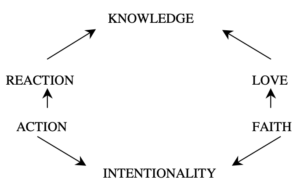
As is the case with any new discipline, so it is with learning spiritual growth. Our first steps forward are painfully self-conscious and hesitant. We are acutely aware of each detail, so much so that we wonder whether we will ever be able to make it work. We are elated at our first successes, but we tend to linger on the plateaus, becoming sufficiently motivated to take another step only when negative pressures begin to build up intolerably, forcing us to act.
Yet, as we pursue the process, we become more adept at it. Gradually, certain aspects become spontaneous and natural (not unconscious). They become part of us to the point of being reflex actions. The feedback loop resulting from our actions becomes more and more automatic. The rate of progress begins to pick up. The steps merge imperceptibly. Finally, the process becomes almost continuous. In other words, the rate of progress increases as we go along because we are not only making progress but also perfecting our skill at making progress.
‘Abdu’l-Bahá has said:
It is possible to so adjust one’s self to the practice of nobility that its atmosphere surrounds and colours every act. When actions are habitually and conscientiously adjusted to noble standards, with no thought of the words that might herald them, then nobility becomes the accent of life. At such a degree of evolution one scarcely needs try any longer to be good—all acts are become the distinctive expression of nobility.59‘Abdu’l-Bahá, Star of the West, Vol. 17, p. 286.
A process in which the rate of progress is proportional to the amount of progress made is exponential (see note 52). Thus, an analysis of the mechanism of the spiritual growth process allows us to understand why this process, though remaining a gradual one, is exponential: It is because we perfect the process of growing spiritually as we grow, thereby increasing the rate at which growth occurs.
The above diagram, and the detailed analysis of each stage of the mechanism involved in the hierarchical relationship between knowledge, love, and will, should not lead us to forget the other fundamental point, namely that all of our spiritual faculties must function together at each stage of the mechanism. In order to gain self-insight, we must will to know the truth about ourselves, and we must be attracted towards the truth. When we act, we must temper our actions with the knowledge and wisdom we have already accumulated at that given point in our development.
Moreover, when we begin the process of conscious, self-directed spiritual growth we do not start from absolute emptiness but rather from the basis of whatever knowledge, love, faith, and will we have developed at that point in our lives. Thus, the spiritual growth process is lived and dramatized by each individual in a way which is unique to him even though the basic mechanism of progress and the rules which govern it are universal.
5. Tools for Spiritual Growth
Our understanding of the process of spiritual growth and its dynamics does not guarantee that we will be successful in our pursuit of spirituality. We stand in need of practical tools to help us at every turn. The Bahá’í Writings give a clear indication of a number of such tools. In particular, prayer, meditation and study of the Writings of the Manifestations, and active service to mankind are repeatedly mentioned. For example, in a letter written on behalf of Shoghi Effendi it is stated:
When a person becomes a Bahá’í, actually what takes place is that the seed of the spirit starts to grow in the human soul. This seed must be watered by the outpourings of the Holy Spirit. These gifts of the spirit are received through prayer, meditation, study of the Holy Utterances and service to the Cause of God …service in the Cause is like the plough which ploughs the physical soil when seeds are sown.60Excerpt from a letter written on behalf of Shoghi Effendi in The Bahá’í Life, p. 20.
Some of the points mentioned briefly in the above passage are amplified in the following statement from the same source:
How to attain spirituality is indeed a question to which every young man and woman must sooner or later try to find a satisfactory answer.…
Indeed the chief reason for the evils now rampant in society is the lack of spirituality. The materialistic civilization of our age has so much absorbed the energy and interest of mankind that people in general do no longer feel the necessity of raising themselves above the forces and conditions of their daily material existence. There is not sufficient demand for things that we call spiritual to differentiate them from the needs and requirements of our physical existence.…
The universal crisis affecting mankind is, therefore, essentially spiritual in its causes … the core of religious faith is that mystic feeling which unites Man with God. This state of spiritual communion can be brought about and maintained by means of meditation and prayer. And this is the reason why Bahá’u’lláh has so much stressed the importance of worship. … The Bahá’í Faith, like all other Divine Religions, is thus fundamentally mystic in character. Its chief goal is the development of the individual and society, through the acquisition of spiritual virtues and powers. It is the soul of man which has first to be fed. And this spiritual nourishment prayer can best provide.61Excerpt from a letter written on behalf of Shoghi Effendi in Directives from the Guardian (New Delhi: Bahá’í Publishing Trust), pp. 86-87.
With regard to meditation, the Bahá’í Writings explain that it has no set form and each individual is free to meditate in the manner he finds most helpful. Statements by ‘Abdu’l-Bahá describe meditation as a silent contemplation, a sustained mental concentration or focusing of thought:
Bahá’u’lláh says there is a sign (from God) in every phenomenon: the sign of the intellect is contemplation and the sign of contemplation is silence, because it is impossible for a man to do two things at one time—he cannot both speak and meditate. …
Meditation is the key for opening the doors of mysteries. In that state man abstracts himself: in that state man withdraws himself from all outside objects; in that subjective mood he is immersed in the ocean of spiritual life and can unfold the secrets of things-in-themselves.62‘Abdu’l-Bahá, Paris Talks (London: Bahá’í Publishing Trust, 1979), pp. 174-175.
‘Abdu’l-Bahá leaves no doubt concerning the importance of meditation as a tool for spiritual growth:
You cannot apply the name “man” to any being void of this faculty of meditation; without it he would be a mere animal, lower than the beasts. Through the faculty of meditation man attains to eternal life; through it he receives the breath of the Holy Spirit—the bestowal of the Spirit is given in reflection and meditation.63‘Abdu’l-Bahá, Paris Talks (London: Bahá’í Publishing Trust, 1979), p. 175.
And Bahá’u’lláh has said that “One hour’s reflection is preferable to seventy years of pious worship.”64Bahá’u’lláh, The Kitáb-Íqán (Wilmette: Bahá’í Publishing Committee, 1954),p. 238. These strong statements of Bahá’u’lláh and ‘Abdu’l-Bahá concerning meditation should not, however, be taken as implying an absolute faith in man’s intuitive powers. See note 39.
The Bahá’í Writings suggest that the words and teachings of the Manifestations provide a helpful focus for meditation. Also, while giving considerable freedom to the individual concerning prayer, they likewise suggest that the prayers of the Manifestations are especially useful in establishing a spiritual connection between the soul of man and the Divine Spirit. Prayer is defined as conversation or communion with God:
The wisdom of prayer is this, that it causes a connection between the servant and the True One, because in that state of prayer man with all his heart and soul turns his face towards His Highness the Almighty, seeking His association and desiring His love and compassion. The greatest happiness for a lover is to converse with his beloved, and the greatest gift for a seeker is to become familiar with the object of his longing. That is why the greatest hope of every soul who is attracted to the kingdom of God is to find an opportunity to entreat and supplicate at the ocean of His utterance, goodness and generosity.65‘Abdu’l-Bahá in Divine Art of Living, p. 27.
‘Abdu’l-Bahá has elsewhere explained that the spirit in which one prays is the most important dimension of prayer. A ritualistic mumbling of words or a mindless repetition of syllables is not prayer. Moreover, the Bahá’í Writings enjoin the spiritual seeker to make of his whole life, including his professional activities, an act of worship:
In the Bahá’í Cause arts, sciences and all crafts are counted as worship. The man who makes a piece of notepaper to the best of his ability, conscientiously, concentrating all his forces on perfecting it, is giving praise to God. Briefly, all effort put forth by man from the fullness of his heart is worship, if it is prompted by the highest motives and the will to do service to humanity. Thus is worship: to serve mankind and to minister to the needs of the people. Service is prayer. …66 ‘Abdu’l-Bahá in Divine Art of Living, p. 65.
Thus, it is the spirit and motive of service to others which makes external activity a tool for spiritual progress. In order to pursue the goal of spirituality, one must therefore maintain a persistently high level of motivation. Prayer, meditation, and study of the Words of the Manifestations are essential in this regard:
The first thing to do is to acquire a thirst for spirituality, then Live the Life! Live the Life! Live the Life! The way to acquire this thirst is to meditate upon the future life. Study the Holy Words, read your Bible, read the Holy Books, especially study the Holy Utterances of Bahá’u’lláh. Prayer and Meditation, take much time for these two. Then will you know the Great Thirst, and then only can you begin to Live the Life!67Abdu’l-Bahá in Bahá’í Magazine, vol. 19, no. 3, 1928.
Thus, while the quality and maturity of one’s relationship to others remain the best measure of spiritual progress and growth, acquiring the capacity for such mature relationships depends essentially on an intense inner life and self-development. Moreover, the individual’s actions are experienced both by himself and by others, whereas inner life is experienced only by the individual and is thereby more properly “his.” The sense of “that mystic feeling which unites Man with God” becomes to the spiritual seeker the most precious of experiences. It is that part of spirituality which lies at the center of his heart and soul.
In this inner dimension, spirituality becomes a sort of dialogue between the human soul and the Divine Spirit as channeled through the Manifestation. It is within this subjective but nevertheless real dimension of inner spirituality that one finds all the passion, the exaltation of spirit, as well as the terrible but somehow precious moments of despair, of utter helplessness and defeat, of shame and repentance. It is here that one learns with the deeply certain knowledge only personal experience can bestow, that the ultimate category of existence, the absolute and transcendent God who guides and oversees our destiny, is an infinitely loving and merciful Being.
The Writings of ‘Abdu’l-Bahá are the fruit of more than half a century of prolific labour from His early twenties to the seventy-eighth and final year of His life. Their full volume is as yet unknown; and much remains to be done in gathering, analyzing, and collating His literary legacy.
His Writings consist of personal correspondence, general tablets, tablets on specific themes, books, prayers, poems, public talks, and recorded conversations. Approximately four-fifths of ‘Abdu’l-Bahá’s Writings are in Persian; the rest – with the exception of a very small number of prayers and letters in Turkish – are in Arabic. ‘Abdu’l-Bahá was both fluent and eloquent in these three languages. Transcriptions of His extemporaneous speeches are often indistinguishable from His Writings. In a culture that placed a high premium on rhetoric ‘Abdu’l-Bahá was recognized by friend and foe, Arab and Persian, as a paragon of distinctive style and eloquence.
It is the intent of this article to touch upon the character of that style and to present an overview of ‘Abdu’l-Bahá’s Writings in various genres and categories. Discussion of the language and style is inherently limited, as it must be attempted across twin barriers of culture and tongue; the attempt at categorization is necessarily arbitrary and is meant to serve only as a catalogue. Obviously any number of criteria, such as chronological, thematic and linguistic, can provide different sets of categories. Furthermore, some works cited as examples of certain categories could easily be put under others.
‘Abdu’l-Bahá was, of course, not a prophet and at no time claimed to have received direct revelation from God. But the Centre of the Covenant of Bahá’u’lláh, and the appointed Interpreter of His Revelation, ‘Abdu’l-Bahá, Bahá’ís believe, was divinely inspired and guided. His Writings, therefore, constitute for the Bahá’ís at once a part and an interpretation of their Scriptures.
The question of divinely inspired language has traditionally posed a dilemma and given rise to baseless dogma in the religions of the past. In their literal-minded zeal to aver the authenticity of their Holy Writ, devotees of traditional religions have often insisted on the divine authorship of the very lexical and syntactic form of that Writ. This view not only reduces God to the use of particular and different human tongues, but it also attempts to isolate religious writings from the body of the language in which they were written. It equates divine origin with absolute linguistic and literary originality. Those who uphold this view tend to be resentful of any comparison and precedence, and through their unwarranted notion of originality they completely miss the often striking literary originality of holy books that can only be perceived in the light of traditions in their languages. By ignoring the literary traditions, conceptual methods, cultural associations – in short by denying the life of the language – they reduce rather than enhance comprehension and true appreciation of holy scriptures.
‘Abdu’l-Bahá’s two primary languages have vigorous and highly developed literary traditions with more than a thousand years of life. Only the briefest mention of facets of these traditions that are germane to the Writings of ‘Abdu’l-Bahá’ is possible here. Since most of ‘Abdu’l-Bahá’s Writings are in Persian, the main focus here is on Persian literary traditions. But so many of these are shared with Arabic – indeed in many cases they are reflections of Arabic norms in Persian – that the observations will generally be true of the Arabic literary traditions as well.
For nearly a thousand years since the formulation and the crystallization of classical criteria in Arabic and Persian literature there has existed a preoccupation with and a primacy of form. Needless to say, tightly metered and fully rhymed poetry, as the most formal of literary arts, has been the master art form for the Arabs and the Persians. Prose writers from their aesthetically inferior position have attempted to ennoble their work with qualities of poetry, evolving a technique known as saj’. It introduces the basic poetic ingredients of rhyme and rhythm into prose without actually transforming it into equal-footed lines. A symmetry of expression is achieved by use of lexical devices such as synonyms, antonyms, and homonyms giving prose an architectural plasticity and rendering it memorable. This style of writing in Persian reached its apex during the thirteenth century A.D. and declined rapidly thereafter. By the end of the eighteenth century it had reached a nadir of artificial verbosity and lost its power to communicate.
The style of ‘Abdu’l-Bahá is the outward mode of His inspiration and expression. The animus is the Revelation of Bahá’u’lláh. The clay is the Persian language with its characteristics. The mystery of His person forms it into a unique style. It is distinctive, unmistakably personal, and therefore original. Yet it is in the purest mould of literary tradition. It is a new flowering of saj’. ‘Abdu’l-Bahá has breathed new life into a familiar form; but by harmonizing form and content He has banished contrived artifice.
In the Writings of ‘Abdu’l-Bahá form is an approach to the content. He makes use of poetic imagery and of a vast range of rhetorical and literary devices such as metaphors, similes, symbols, allegories, alliterations, assonances, and dissonances, not in order to draw a veil around the subject, but to expand the reader’s mind by refraction of the same reality through different planes of perception, cognition and intuition. This is the difference between sterile formality and organic integrity of form in a truly creative sense.
Two brief examples may illustrate this harmony of form and content in the Writings of ‘Abdu’l-Bahá. First is the phrase “the Sun of Reality” which occurs frequently in His Writings both as a metaphor and a symbol for the Revelation of Bahá’u’lláh. There is mutual illumination of the concrete and the abstract here – at once self-evident, life-giving, and pervasive. But it also can remind us of creatures that avoid the sun. How often ‘Abdu’l-Bahá referred to the Sun of Reality dawning over gatherings of bats! The other example is the imagery evoked in His own Tablet of Visitation: “… Give me to drink from the chalice of selflessness; with its robe clothe me…” The paragraph is made of a series of related cultural images of admittance to court, proffering of the cup of favour, and granting of the ceremonial bejewelled robe: all evoke the ceremony of a royal audience and the bestowal of high rank – traditionally an occasion of pomp, pride and vanity. By this dramatic inversion of images, ‘Abdu’l-Bahá has underlined the nobility of servitude and humility.
This use of artistic form for the expression of meanings and purpose is a hallmark of ‘Abdu’l-Bahá’s Writings. To cultivate an appreciation of the poetic qualities of His Writings is to enhance one’s understanding of His meaning.
It must be admitted that the same qualities place an enormous burden on the translator; and much can be lost in inadequate hands. Fortunately, Shoghi Effendi, particularly in his translations of some of ‘Abdu’l-Bahá’s prayers, has left us a true standard. The foregoing should not lead the reader to infer that the style of ‘Abdu’l-Bahá, although at all times recognizable and personal, is unvarying. His subjects, ranging from philosophical treatises to meditative poems, are expressed in language appropriate to them. Before proceeding to the differentiation of the various categories of ‘Abdu’l-Bahá’s Writings it might be helpful to clarify the traditional term Tablet (lawh) which is applied to the majority of His Works. It designates all His Writings that are addressed to specific individuals or groups. As such it is applied to everything from His personal correspondence to such fundamental documents as the Tablets of the Divine Plan and the Will and Testament of ‘Abdu’l-Bahá.
- For purposes of analysis ‘Abdu’l-Bahá’s Writings can be divided into twelve groups of which personal correspondence (Tablets to individuals) constitutes by far the largest segment, despite the undoubted fact that a portion of this precious heritage has been irretrievably lost, and a portion remains in non-Baha’i hands. ‘Abdu’l-Bahá’s letters are masterpieces of Persian epistolary genre. They are marked by directness, intimacy, warmth, love, humour, forbearance, and a myriad other qualities that reveal the exemplary perfection of His personality. ‘Abdu’l-Bahá addresses everyone as an equal in the service of Bahá’u’lláh. His letters often open with an invocation of the quality of faith of the recipient rather than his name or identity – epithets such as “O the Firm One in the Covenant”, “O Lover of the Blessed Beauty”. (Later when the Persians were required by law to adopt family names, many Bahá’ís chose as surnames words of address from the Tablets of ‘Abdu’l-Bahá to themselves or to their fathers.)In subject matter, ‘Abdu’l-Bahá’s letters range from responses to the personal and ephemeral requests of His correspondents to profound elaborations, elucidations and interpretations of the Bahá’í Revelation. But mostly they are concerned with direction and exhortation of the friends to spread the Teachings.
- Tablets of specific topical or thematic significance addressed to individuals are perhaps best exemplified by the Tablet to Professor Auguste Forel which is in fact a philosophical treatise written by ‘Abdu’l-Bahá in September, 1921, in answer to questions put to Him by the noted Swiss psychologist.
- Tablets addressed to Bahá’í communities in various parts of the world chronicle ‘Abdu’l-Bahá’s loving and vigorous leadership of the Cause of Bahá’u’lláh and its propagation from a handful of countries in the Near and the Middle East to some thirty-five countries in every continent on the globe. The most important in this group are undoubtedly the series of the Tablets of the Divine Plan, written at the close of the first World War.
- Among the Tablets written to world groups or congresses, the best known is the Tablet sent in 1919 to the Central Organization for a Durable Peace at the Hague.
- The Will and Testament of ‘Abdul’-Bahá is a unique document, written in three parts, that constitutes the charter1“The Charter which called into being, outlined the features and set in motion the processes of, this Administrative Order is none other than the Will and Testament of ‘Abdu’l-Bahá, His greatest legacy to posterity, the brightest emanation of His mind and the mightiest instrument forged to insure the continuity of the three ages which constitute the component parts of His Father’s Dispensation.” Shoghi Effendi, God Passes By, p. 325, Wilmette ed. of the Bahá’í Administrative Order. Although undated, it is clear from its contents that the first part was written in 1906/7 during the most perilous and yet most prolific period of His life.
- The next category is that of prayers. The Arabic and Persian languages distinguish between what is translated in English as prayer (munáját) and obligatory prayer (salát). The prayers of ‘Abdu’l-Bahá are munáját. Approximately one half of these are in Persian and the other in Arabic, with a very few in Turkish. The term munáját has a history in Persian literature beginning with Khwájih ‘Abdu’llah-i-Ansárí, a Súfí mystic of the eleventh century A.D. The munáját of Ansárí are highly stylized epigrammatic forms of communion with God. From a literary point of view these brief evocative compositions bear only the slightest generic resemblance to the munáját of Bahá’u’lláh and ‘Abdu’l-Bahá, which, although called by the same name, are clearly a literary innovation and original creations in the Persian and Arabic languages. Their chief distinguishing quality is the sustained and expanding expression of man’s experience of the Holy by means of poetic language.The prayers of ‘Abdu’l-Bahá, particularly, partake in the fullest measure of poetic qualities. Some actually include fragments or lines of metrical verse which are indistinguishable from the texture of the whole prayer. The purity and sanctity of natural imagery reveal a state of cosmic harmony. The musicality of some of them transcends limitations of language. Poetry is made to serve the ultimate goal of rising above “the murmur of syllables and sounds”. The emotional intensity of some of ‘Abdu’l-Bahá’s prayers, especially those that recall the sufferings of and separation from Bahá’u’lláh is unrivalled.
- Prayers written for special occasions such as meetings of Spiritual Assemblies, or embarking on teaching trips, focus upon overcoming of self and reliance upon confirmations from God.
- Tablets of Visitation, virtually all written in Arabic, are primarily for commemoration of individual heroes and martyrs of the Faith, and are to be chanted when visiting their graves. The majority were written in the final years of ‘Abdu’l-Bahá’s life and are another testimony of His abiding love and faithfulness to the memory of those who sacrificed themselves for the Cause of God.
- ‘Abdu’l-Bahá’s poems are few in number, and mostly in Mathnaví (rhymed couplet) form. His love for this form – universally associated with the great spiritual masterpiece of the thirteenth century poet Rúmí – and His love for Rúmí’s poetry are further evinced by frequent quotations of lines from the latter’s works in His Writings.
- Books and treatises, of which ‘Abdu’l-Bahá left three, are The Secret of Divine Civilization, written in 1875 (also known as A Treatise on Civilization); A Traveller’s Narrative, written about 1886; and a short volume entitled A Treatise on Politics, written in 1893. The first two have been translated into English. The latter, available only in Persian, may be considered a sequel in subject and purpose to The Secret of Divine Civilization. The fundamental theme is the generative force of religion and the degenerative role of priestly power in human affairs. The first book is addressed to the Persian nation as a whole; the second is directed to the Baha’i community in that land.Their import obviously transcends the historical aims and the immediate occasion of their writing, but they also constitute significant documents within that context.The Secret of Divine Civilization, particularly, occupies a pre-eminent historical position among the literature of modernization in Persia. Seen in the light of the unfolding Bahá’í Revelation, it is, of course, ‘Abdu’l-Bahá’s elaboration of the principles enunciated by Bahá’u’lláh in His Tablets to the rulers of the earth. But read in the light of modern analytical literature on the nature and problems of modernization, it is a unique document of equally profound implications. In it ‘Abdu’l-Bahá presents a coherent programme for the regeneration of Persian society. The programme is predicated on universal education and eradication of ignorance and fanaticism. It calls for responsibility and participation of the people in government through a representative assembly. It seeks to safeguard their rights and liberties through codification of laws and institutionalization of justice. It argues for the humane benefits of modern science and technology. It condemns militarism and underscores the immorality of heavy expenditures for armaments. It promulgates a more equitable sharing of the wealth of the nation.Of the long list of indictments that could be brought against the one hundred and twenty five years of Qájár misrule of Persia, few could be as damaging as their neglect of this blueprint in 1875. Not until nearly twenty years later do some of these ideas appear piecemeal and unrelated in the writings of other so-called reformers and modernists in Persia. But the significance of The Secret of Divine Civilization is not merely that it represents the earliest and the only coherent scheme for the modernization of Persia. We have come to recognize as the fatal flaw of nearly all reformist ideas and modernizing efforts of the last hundred years (not only in Persia but in many parts of the world), a naive imitation of effects without grasping the causes – superficial borrowing of forms unrelated to their underlying values. Everything in ‘Abdu’l-Bahá’s proposals is firmly based upon the validity and potency of divine guidance. It is not westernization of the East that He advocates. He has as much to say to the spiritually impoverished societies of the West as to the people of Persia. Through a revivification of the spiritual and moral potentialities of man ‘Abdu’l-Bahá seeks to create new institutions and viable political forms – to lay the foundation of a truly divine civilization.A Traveller’s Narrative, which is a history of the episode of the Báb, was written for the seeker and the curious. It presents a brief and dispassionate account of that portentous dispensation in a simple and moving narrative style. Like The Secret of Divine Civilization, this book was published anonymously. It may be another indication of ‘Abdu’l-Bahá’s humility before Bahá’u’lláh that He did not place His name on the two books He wrote for the public beyond the Bahá’í community during the lifetime of His Father. He also wished to emphasize, as He points out in The Secret of Divine Civilization, that He had no expectation of personal gain from His efforts.
- ‘Abdu’l-Bahá’s discourses are extensive transcriptions of His utterances on various topics. The two major examples of the genre are Some Answered Questions and Memorials of the Faithful. The generic affinity of these two works is, however, strictly formal; for in subject matter they are widely different. The final written versions of both were examined by ‘Abdu’l-Bahá and approved for publication.Some Answered Questions is a compilation of the table talks of ‘Abdu’l-Bahá in response to questions put to Him by Laura Clifford Barney on spiritual tenets of the Bahá’í Faith and on the Bahá’í understanding of some Christian beliefs. The conversations, their recording, editing, and authentication occurred in the difficult years immediately preceding ‘Abdu’l-Bahá’s relative freedom in 1908. The compilation was first published in 1907.Memorials of the Faithful, which has only lately (1971) been translated into English, is a compendium of ‘Abdu’l-Bahá’s remembrances of some seventy early believers, spoken to gatherings of Bahá’ís in Haifa during the early years of World War I. These were compiled, and ‘Abdu’l-Bahá’s permission for their publication was granted in 1915 but due to the strictures of wartime the book was not published until 1924 when it was again authorized by Shoghi Effendi.The outward form of Memorials of the Faithful is a collection of brief biographical sketches. Its title in the original, Tadhkiratu’l-Vafá, places it in a Persian literary tradition some nine centuries old. It brings to mind the Tadhkiratu’l-Awliyá (Remembrance of Saints) of the twelfth century mystic poet ‘Attár. The spiritual and cultural impulses that have given rise to the literary form of tadhkirib have little to do with the particular, the personal and the ephemeral aspects of human life. It is the quality of soul, the attributes of spirit, the quintessential humanity and the reflection of the divine in man that is the focus here.
The root word dhikr in the title means prayerful mention – reverent remembrance. It implies that it is not the biographer nor the reader who memorializes a human life, but rather the quality of that life which has earned immemorial lustre and sheds light on all who remember that quality. Quite literally this book is a remembrance of vafá – faithfulness – not just memories of individual lives, but remembrance of that essential quality which was the animating force of all those lives.The people whose “lives” are depicted here all share one thing in common. They are propelled by their love for Bahá’u’lláh. So great is this magnetic force in their lives that they literally travel vast distances and overcome every barrier to be with Him. Some of them arrive virtually with their dying breath, to expire happily after having seen the face of their Beloved; some die on the arduous path. Despite the peculiarities of time and place, it should not take the reader long to recognize a gallery of timeless and universal human types in this book.
The spoken language of ‘Abdu’l-Bahá is figurative and almost indistinguishable from His written style. He makes use of a rich fund of literary devices – rhymed phrases, symmetrical forms, alliterations, assonances, metaphors, similes, and allusions – that, far from sounding contrived and artificial, are naturally matched to the subject matter: the essence of faithfulness. With concrete images He describes spiritual states and psychic levels of consciousness, as if to assert the primacy and reality of the realm of spirit. Should the reader experience difficulty with the style, let him savour it slowly, allowing the unfamiliar language to create its own spirit and breathe life into its allusions. Let the words of ‘Abdu’l-Bahá trace in his mind the shape of the valley of love and faithfulness.
In His usual self-effacing way ‘Abdu’l-Bahá’ says almost nothing about Himself in this book. But occasional events in the lives of these companions are interwoven with His own. In these passages we have some thrilling glimpses of that essence of humanity and humility that was ‘Abdu’l-Bahá. - Next to His personal correspondence, talks comprise the largest segment of ‘Abdu’l-Bahá’s recorded words. One may distinguish between talks given to Bahá’ís and addresses to the general public, such as societies, groups, universities and congregations. Generally they have the same literary marks and rhetorical patterns that are characteristic of ‘Abdu’l-Bahá’s Writings.This vast body of Writing, boundless in its wisdom, consummate in form, generous and loving in spirit and rich in significance, is ‘Abdu’l-Bahá’s literary legacy, a legacy that, like His own prayer, rises “above words and letters” and transcends “the murmur of syllables and sounds”. It is the reality of ‘Abdu’l-Bahá so far as we the grateful readers are capable of perceiving.
Today, people who seek to stress the spiritual basis of peace and justice among men, or who dare to accent the necessity for the regeneration of human hearts and characters as the first step to needed social change, are usually rebuffed by those who immediately cry out, “Oh, you must be practical and realistic.”
This is because so many folk think that the only practical approach to human problems is one which deals immediately with outward evidences of what is desirable. They do not see human needs beyond the specific projects devised for education and security. Outwardly these matters do represent the things which separate the “Haves” from the “Have Nots” in human society, and if you look at them in this light, they may seem to be the sole issues which have all along produced restlessness, division and strife among men.
However, any social program which is to operate for true world betterment must of necessity go beyond outward evidences, if it is to be really practical. The best plans for social cooperation and peace are always limited by the kind of human beings who must use and apply them. There is no more realistic force in the world today than the Bahá’í Faith. In its teachings and its social program there are profoundly realistic approaches to the fundamental social changes which must be the basis of any real and lasting unity for mankind.
The Bahá’í Faith is first of all a Faith which harmonizes the inward incentives and outward procedures to unity. Outward procedures give the means for unity and inward incentives give the heart for unity. There is great difference between folk who have the means for unity and the folk who have the heart for unity.
Legislation and the interplay of conflicting social interests may furnish a kind of means for unity, and even a certain state of outward compliance. However, legislation and the pressures of expediency have never been able to get at the inward fears, jealousies, greeds and animosities of men. And it is these which furnish the vicious inner motives which can browbeat the intelligence of men and make mockery of outward social compliance. Nearly every day we see tragic instances of failure where social change depends upon means alone. Instances where people nullify and obstruct legislation, where they sabotage social effort or fail to produce and support the kind of courageous policies and action needed for the patterns and standards consistent with just and enlightened ideals. The means for unity is there, but legislation is killed or evaded; communities lose their moral integrity in compromise with policies of hatred and division, and people excuse themselves from honest upright action by saying, “Law is not the way to do this.” “The time is not ripe” or “This is the right policy, but we must work up to it gradually.” Now, all such people are really saying is, “I have not the heart to do this thing” or “The people whose opinion I fear have not the heart for forthright action about this, and I do not know how to reach them.”
The religion of Bahá’u’lláh, founder of The Bahá’í Faith, begins with that essential spiritual regeneration of the human being which creates a heart for brotherhood and impels action for the unity of mankind. Bahá’u’lláh has made it very plain that the test of Faith is its social force. Principle and social planning are useless until they are rendered dynamic by the stamina and will of men to enforce and apply spiritual ethics to human affairs.
The second great realism of the Bahá’í faith is that it provides new patterns for the application of spiritual principle to the social problems of humanity.
When Bahá’u’lláh first proclaimed some eighty years ago, “This is the hour of the coming together of all the races and nations and classes. This is the hour of unity among the sons of men,” the prophecy was a far fetched ideal to the world of jealous politics and cultural isolation which received it. But the unity of mankind today is no mere social ideal. Human strife has made it a social necessity.
It is not surprising then to see that human unity is an increasingly popular subject for liberal thought and action. Nor is it surprising that programs to foster unity are being launched on every hand. Yet so many of the bona fide efforts for unity are being fatally compromised because they must be launched through the established social patterns which preserve old disunities. Do people learn brotherhood and the spiritual attitudes and social cooperation which brotherhood involves by lectures or hesitant compromising ventures, which leave untouched and unchanged the separate education, separate worship, separate security, separate social planning which shape every phase of their community living—embittering separations made in terms of differences of race, creed, culture and nationality? Any social pattern which elaborately preserves and accents these outward differences and their resultant inward animosities must of necessity crucify the objective of social unity.
The Bahá’í Teachings not only destroy without equivocation the fallacies which have nourished social strife and disunity, but they provide new patterns of social living and development through which men learn brotherhood by performance.
And what realistic way is there, you may ask, to deal with the ancient bitter diversities of race, religion and culture? What can be done with the changing pressures of unstable economics and the conflicting education of the world’s peoples?
The Bahá’í Faith provides for the diversities of religion, that long needed center of reconciliation, which can produce harmonious understanding of its varying prophets and systems. Bahá’u’lláh has shown us in the Bahá’í Revelation that the great revealed religions of the world are like lamps which carry the pure light of Divine Truth providing social teaching and discipline for humanity. But as that lamp is borne by human hands, there are periods when conflicting interpretations of the Divine Word, dogmas and superstitions, alienate and divide men. Periods when the temptations of material power pervert religion into an instrument for the exploitation and suppression of human development. It is because of this that new lamps have always come and will always come. Each of the great lamps tests the social force of the others. In this men should find source for progress, not reason for strife. God in His mercy has provided in the Divine Faiths a continuous and successive renewal of Universal Spiritual Truth.
The Bahá’í learns the relation and ordered unfoldment of Truth in all Divine Religions. Thus Spiritual Faith is lifted above the period differences of its various names and systems. Is it unrealistic that in a world so in need of spiritual regeneration, Jews, Christians, Moslems and Believers of all Divine Faiths should be given that which will relate their spiritual purposes and development and thus enable them to travel harmoniously a wide free path to greater social demonstration and understanding of the Truth? Is this not a more effective way to create the heart for unity than the elaborate separations and the jealous fencing off of Religious paths? Today men so preserve and concentrate upon their symbolic differences that the common goal is lost in confusion and animosity.
There are really no diversities of race to those who truly accept the fact that all mankind is God’s creation. Yet the outward differences of color, physiognomy and culture have annoyed and divided us. When members of the human family meet each other who have striking differences in appearance and manners, they resort very naturally to reactions of fear, distaste and derision, which grow out of the human complex for conformity and the fear of strangeness. Unity of mankind is not only a basic principle in the Bahá’í Faith, but it is also the basis of a new social pattern in terms of which Bahá’ís worship, work, educate themselves and contribute their capacities to civilization. Living in a Bahá’í community is a matter of learning differences, appreciating them and achieving with them great loyalties to human welfare, which are above the narrow confinements of race, creed and class, color and temperament. The most practical knowledge in the world is the knowledge that the world can never become what so many people like to believe; a world in which we make other people look, act, and understand in terms of that with which we are familiar. That kind of world is neither possible nor desirable. What we really want is a world of harmonized differences, where a man can make his contribution with other men for the good of all mankind. This is the world of the Bahá’í Community, a community covering seventy-eight national backgrounds and thirty-one racial origins and Heaven knows how many temperaments and cultural backgrounds in this first one hundred years. A growing Community which operates with every possible human difference to take into consideration, yet its members through practicing and perfecting their practice of the Bahá’í Teachings, have achieved a unity of objectives through which entirely new social patterns, standards and virtues are being evolved.
People do not like to mention religion and economics in the same breath. The problem is that of the economically disinherited who in bitter restless upsurge change periodically the pressures and controls of this world’s unstable economics. It is practical to talk of trade policies, of commerce regulations and spheres of influence, now. However, the world must soon face the fact that economic instability and the bitter struggle and suffering which go on because of it, have a question of human motives, human development, behind them. Motives behind the failure to use opportunity, or the use of it to selfishly acquire and control wealth, goods, and services, constitute the real factors causing the unhealthy inequalities, the exploitation and suppression in human society. Bahá’u’lláh stressed the need of a spiritual basis as the first step in the development of stable world economics. The extremes of poverty and vast wealth are not only matters of material opportunity and education, they are also matters of greed and slothfulness in human characters.
Material education and spiritual enlightenment must be applied to bring the kind of economic adjustments which will make possible responsible efforts for all people and insure a just distribution of wealth, goods and services for all people.
Until then, we are all, regardless of our skins, creeds and countries, caught economically between the evil extremes which are produced by the Jeeter Lesters and those masters of selfish financial genius, who, like a cancerous growth, feed upon and weaken the earth’s human and material resources.
Nothing but the wholesome regeneration of human hearts and establishment of new social objectives for the efforts and acquisitions of men, will in the final analysis remedy these ills.
The great realisms of the Bahá’í Faith lie in its new spiritual teachings and in the new social patterns which they provide for needed development of mankind; a development which will turn men from the beliefs and superstitions which are destructive to human solidarity and create in them the heart to initiate and perfect new standards, new morals and new undertakings for a great new era of civilization.
These achievements are possible when man is afforded that perfect combination of Human and Spiritual Unity. ‘Abdu’l-Bahá, the great expounder of the Bahá’í Teachings, has described it in these words:
Human unity or solidarity may be likened to the body, whereas unity from the breaths of the Holy Spirit is the spirit animating the body. This is a perfect unity. It creates such a condition in mankind that each one will make sacrifices for the other and the utmost desire will be to forfeit life and all that pertains to it in behalf of another’s good. It is the unity which through the influence of the Divine Spirit is permeating the Bahá’ís, so that each offers his life for the other and strives with all sincerity to attain His good pleasure. This is the unity that caused twenty thousand people in Írán to give their lives in love and devotion to it. It made the Báb the target of a thousand arrows and caused Bahá’u’lláh to suffer exile and imprisonment for forty years. This unity is the very spirit of the body of the world.
The past hundred years bring to view many great changes in the sociology of American life, especially with respect to the progress of justice and freedom. During this period the nation has vastly expanded in area and population. And being a part of something big tends to expand individual ideas. This century also witnessed the abolition of chattel slavery; the conferring of citizenship upon the Negro and more recently upon the Indian; the granting of the suffrage to women; the fusing of the national unity through the sacrifices of sectional strife, and the attainment of the nation to a place of almost commanding influence among the nations of the earth.
During the recent period of the great pandemic upheaval, and especially since this country has been drawn into it, progress in race unity has been accelerated, although it is yet far from complete. A few of the signs of progress are the yielding of economic barriers based upon color and creed, etc.; a change in the attitude of the press, magazines, books, and speeches, recognizing the common needs and the humanity and loyalty of minorities; the revolt of youth from the superstitions and prejudices of the past; the increasing influence of women who, struggling for their own freedom, see its value for others; the resolute stand taken by recognized leaders and the wane in the influence of demagogues; the pliants of discredited old systems, which fancy that stable peace can be maintained only by permanent injustice; the readiness of minorities, in the face of better opportunities, to forget their wrongs; and the fusion of the nation into unity in view of a common danger.
“In any land where there’s a slave
There’s no one really free or brave!”
The clear insight of the poet expresses what men of discernment the world over see, that in the end oppression is far more burdensome to the oppressor than to the oppressed. But even freedom, as commonly understood, has its limitations and dangers. The problem, then, is to make men really free. Seeking this universal relief, man must turn to his Creator Who knows the needs, structure and capacities of all His creatures. There is in this the assurance that the new Prometheus has come bringing the Fires of Heaven to earth. Only this Celestial Flame of Divine Fire can consume the veils and forever banish the causes of strife from the earth.
Know, all men who would discover the secret of changes far and wide, on a lesser or greater scale, that Bahá’u’lláh, the Fountain Head of Revelation, has annulled racial and religious differences; that ‘Abdu’l-Bahá, the Center of His Covenant, some thirty years ago brought in person the Great Message to America; and that Shoghi Effendi, the Guardian of the Faith, has in recent years sent us his illuminating letters, “The Advent of Divine Justice” and “The Promised Day Is Come,” wherein he summarizes the Divine Teachings bearing upon the state of the world and makes their application to human needs today.
Lovers of the divine ideal of the oneness of humanity found instruction, interest and inspiration in the two Race Unity conferences held at Green Acre, Bahá’í school at Eliot, Maine, during the past two years.
Horace Holley, chairman at the opening of the first conference, read from “Prayers and Meditations,” “Many a chilled heart has been set ablaze by the fire of Thy Love…”
After voicing a loving welcome, he referred to the visit to America of ‘Abdu’l-Bahá, following His long period of prison and exile. He came to a world dissevered and sought those who could penetrate the glamor of the day and see men deprived of God and practicing inhumanity to man. He drew within the circle of his friends all who were ready to advance, unfolding a love flowing from on High. He did not inquire about backgrounds, but unfolded the world of oneness, inviting both colored and white, that they might abandon their age-old differences. He stimulated all to continue the work so nobly begun, even making this ideal unity “an assurance of the world’s peace.” Let us therefore enter into a new realization of oneness, overcoming differences between East and West, North and South, black and white. The Great Peace will bring a healing to the tragic ills of the day, assuring reconciliation of man to man and man to God. These meetings have been arranged in many cities to emphasize the oneness of mankind. While the world may have many interracial movements, all the bridges implied in them cross a yawning chasm. A bridge separates as well as unites. But the Bahá’í plan removes the bridge and closes the chasm. It dwells not upon mere formalities, but lives the ideal in the oneness of a common faith. Bahá’í activities gather the friends in a oneness of spirit that is destined to prove what religion can accomplish. This Flame of Divine Guidance will spread, not only throughout this country of ours, but over the twenty-one republics of the Western Hemisphere, and anon, unite mankind the world over. The great remedy is the union of all. It is our real task and great privilege to be the means of bringing the hearts of men to the Throne of Bahá’u’lláh.
Miss Lorna B. Tasker was introduced to speak of “Racial Adjustment in Latin America.” Latin America believes in racial equality. This is a fertile field for the spread of the Bahá’í Teachings. A literary light of Brazil recently protested religious bigotry. It cannot find a pasture here. He also espoused the idea of a cosmic race. Law and custom readily accept a mixed system, avoiding many of the conflicts caused by other attitudes. Latin Americans are of three stocks, Iberian, Indian and Negro. This mingling of various elements is somewhat a heritage from Spain, which from earliest days was cosmopolitan through the mingling of various strains, such as the Carthagenian, Moorish, and others. Later it became permeated with Oriental thought. Moorish influence from Cordoba, Granada and Andalusia came to America, mingling with ancient Indian culture of Toltecs, Mayas and Aztecs.
The Spanish conquerors were not moved by race prejudice, but sought the gold of the Indians. They gave the Indians the same political rights as those given whites. Most Latin Americans feel that the Indian culture should not be lost. Of historical interest is the aid Haiti gave to Simon Bolivar, the great South American patriot and liberator. The Negroes are being absorbed by intermarriage into the general population, and are described as a new racial flower to adorn the breast of the world. The population of Brazil suggests a human mosaic. It is loath to welcome immigrants who will not favor the general policy of fusion.
The chairman read from the letter of Shoghi Effendi, written in 1939, wherein it is stated that the eyes of their sister Bahá’í communities are fixed upon the American friends. Although trials are ahead, yet great is their work for the redemption of mankind.
Mrs. Annamarie Kunz Honnold was the next speaker: The emergence of the New World Order of Bahá’u’lláh reveals a tremendous transformation, made evident in the fields of religion, race and economics. Power to change conditions comes through the Creative Word. Future generations will not mention “race.”
It is difficult for the majority to understand minority groups, she said. We know not what it means to be trampled upon because of race. This condition is more apparent since the great war began. It is a discrimination in all phases of life. Southerners refuse to apply the titles for lady and gentlemen to people of dark skin, however highly cultivated they may be! What would be our feelings if we were persecuted that way? Although the matter is absurd, yet it holds!
Bahá’u’lláh taught the oneness and unity of mankind. He directed that all should root out the source of contention and strife. Mankind should be thought of as a great chord in which there is the need of many notes to make a perfect blend. Freedom from racial prejudice must be the watchword. All must work with love and concord, with gratitude and appreciation. Great discoveries are being made in the natural sciences. They bring to light that no essential differences exist among races. Apparent differences are but due to environment and training. The distinguished psychologist, Julian Huxley, declares that race means nothing. Mrs. Honnold then related many striking illustrations of eminent people produced by minority groups despite the prejudices which hinder their advancement. She praised the new policy of the national government in its order forbidding discrimination in employment in government enterprises, because of color, race, or creed. Bahá’ís approve such forward actions because they see, not many races, but one. A wide scientific study, reinforced by the Word of God, will efface all barriers of prejudice.
The addresses of ‘Abdu’l-Bahá at Howard University and before the Bethel Literary Historical Society at Washington, also selections from Dunbar, Negro poet, were read by Mrs. Mary R. Swift. Mrs. Mary Coristine spoke of the changed conditions through destructive agencies at work. The acceptance of human oneness is the essential foundation for the new world structure and for prevention of chaos. She quoted the wonderful Words of ‘Abdu’l-Bahá: “This is a new cycle of human power and the world will become a garden and a paradise.”
Norman Smith spoke of the Chinese, who long ago were made known to Europe by Marco Polo, Italian explorer. Chinese arcs aided the demise of feudalism and the development of nations. It is unfortunae that our knowledge of the Chinese is so limited. Their country has vast natural resources which should be cultivated. The present crises will be the means of drawing all races together. The Chinese have aided us in the past and will in the future. Still stronger will be the bond between East and West. It is greatly to the credit of the Chinese that they wish to hate no one, even those with whom they fight, but who are to be their neighbors hereafter.
Matthew W. Bollock stated the pleasure that he had in reading the Bahá’í Teachings over a number of years. He felt honored to be in such a gathering. He regretted the lack of knowledge of Negro history found in the educational curricula of America and stated some of the most interesting phases of Negro aid to exploration and contribution to the development of America. Such knowledge, if spread, would have its value in overcoming prejudices. Wars occur because people fail to recognize the oneness of mankind.
Miss May Jacobs, American Indian, mentioned the kindness of the Indians to the Pilgrim fathers, who would have been so discouraged as to return to Europe had it not been for the encouragement and welcome accorded them by the Indians.
Mrs. Dorothy Baker addressed the conference on “The Spiritual Bond of Unity.” She told a symbolic story to illustrate how the animal nature of man may be transformed into the etherial world and “soar in the atmosphere of realities” by acquiring the virtues of the Kingdom. Souls are now finding, through spirituality, the resurrection and a new marriage feast. A great scientist has recently said that in view of the world’s great upheaval, only the Spirit can now help us. Eternal unity is now God’s plan. Only lesser forms of unity are promised by the world. Any race, in developing, will strive to maintain its own unity; but this should not become a menace to mankind. Even as the human body, to maintain its unity and escape dissolution, needs a soul, so the body of humanity may attain complete unity by the bounty of the Holy Spirit.
Why do Bahá’ís so definitely believe in God? Because they see the oneness of His Holy Messengers, the Prophetic succession of the ages. In each cycle a new civilization has been given to the world. The blessings of the Jewish, Christian and Islamic civilizations were traced, as, ever expanding, ever unfolding they told the great love story of God to man. If we turn our hearts to the Gift of the Holy Spirit revealed in this great day by Bahá’u’lláh, the little horned devil of prejudice , separation and animosity may be overcome. Racialism, nationalism and communism, the three major causes of strife today, may be entirely subdued by the potency of the Revelation of knowledge given by Bahá’u’lláh.
The Guardian’s expressed wishes have united our activities with all races. ‘Abdu’l-Bahá has said,
“That meeting is blessed when the colored and the white people meet together with spiritual love and heavenly harmony. When such gatherings are established, the angels of the Supreme Concourse bless them and the Beauty of Bahá’u’lláh addresses them: Blessed are ye! And again and again, Blessed are ye!” To the youth of the world we would say, extend your supply lines as far as possible. May the jungle of the world become a paradise through your efforts. Unity, divine unity, is in the making by the power of the Holy Spirit.
Among others making valuable contributions of thought were Mrs. Hilbert Dahl, Curtis D. Kelsey, Mrs. Edith Ingliss, Mr. and Mrs. M. C. Oglesby and Mrs. Ludmila Bechtold. Mrs. Harriet M. Kelsey directed the musical program.
The spirit of the conference was summarized by Horace Holley: The old order is being shattered and no groupings can remain constant, not even those of hate. All such are but illusions. Only in peace and amity can any state be permanent. Existence itself is now threatened by strife. The ultimate clue is spirituality. This alone can place mankind above the level of conflict. This is a fundamental law. We have left the old world behind. We cannot return to the faith of our fathers. It is necessary to rise above the level of the past and build in our hearts a super-conscious reservation of strength. There is a perfect judgment from a Higher Power. Today we are called upon to be a part of the universal unity. Laws in future will give forth universal values. The cycle of separation is ended and now may we all swim in the great Ocean of Unity.
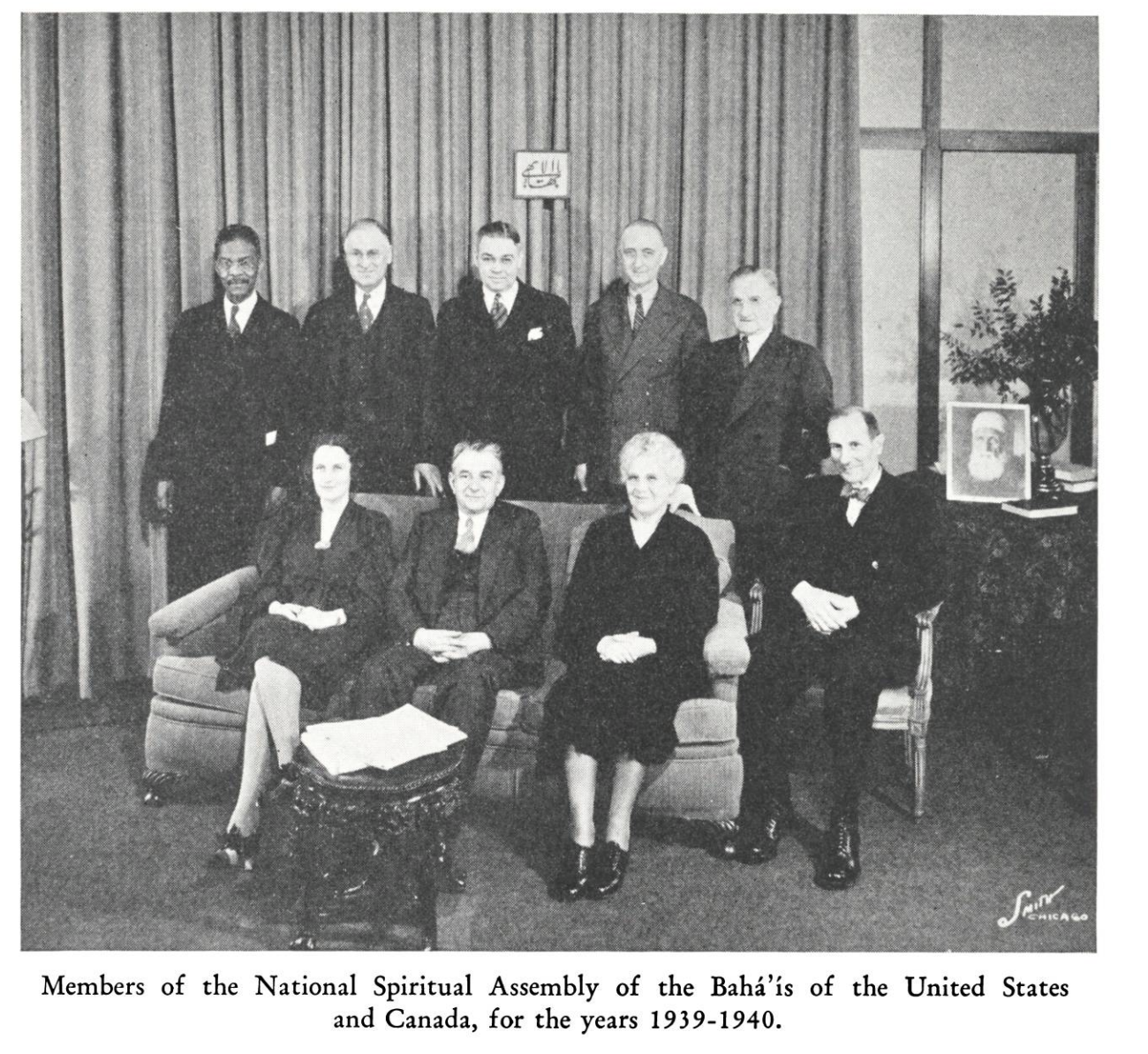
Back row: Louis Gregory, Harlan F. Ober, Leroy Ioas, Horace Holley, Siegfried Schopflocher. Front row: Dorothy Baker, Allen B. McDaniel, Amelia Collins, Roy Wilhelm.
Friends, old and new, met in the same beautiful place a year later, with the same theme of universal unity in their minds and hearts, for a conference of five sessions . The chairmen of the various meetings were Horace Holley, ‘Ali-Kuli Khan, N. D., Miss Lorna B. Tasker, Matthew W. Bullock, and Harlan F. Ober. These friends gave of their noble talents, keeping the gatherings upon a high plane of dignity, light, love, happiness and spirituality.
The Portsmouth Herald, published in the nearby City of Portsmouth, gave the following report and summary of the conference:
“The Racial Amity Conference ended its three day session at Green Acre Sunday. Mrs. Dorothy Baker gave addresses at three sessions, her subjects being, ‘The Causes and Cure of Prejudice’; ‘The Talents of Minority Groups’; and ‘Sharing Civilization.’ She advocated a better adjustment among nations and classes, universal education, spiritual as well as scientific, and a far more universal outlook for mankind.
“Another feature was the address of Miss Mabel I. Jenkins of Kittery on ‘Two Great American Poets.’ One of these was Phyllis Wheatley, the black slave girl who was a contemporary of George Washington and won high praise from him and also from other illustrious people, both at home and abroad. She was called the poet laureate of Greater Boston in her day. The second poet mentioned was James Weldon Johnson, author of ‘God’s Trombones’ and the ‘Negro National Anthem.’ The speaker told something of the life story of each, read from their poems and exhibited a collection of books by Negro poets.”
Matthew W. Bullock of Boston, chairman of the Sunday morning meeting , voiced the spirit of racial amity and read selections from the addresses of ‘Abdu’l-Bahá delivered during his tour of America in 1912, at which time he indicated to his friends some of the great happenings of today.
The afternoon forum, final meeting of the conference, was conducted by Harlan F. Ober of Beverly, Massachusetts. Among the speakers were Mrs. Doris McKay, Moncton, Canada; Mrs. Harold Hunt, Washington, D. C., who spoke for the Jewish minority; and Louis G. Gregory, presenting for discussion the subject of proper names for minonties. The musical program of the conference was presented by Mrs. Eula Fritz, Schenectady, N. Y., and Miss Monaver Bechtold, Brooklyn, N. Y.
One of the clearest signs of divine favor which attended these conferences and all similar efforts on the part of the Bahá’ís at different times of the year and over regions far and wide is their uniform confirmation and success.
The body lies crushed into a well, with rocks over it, somewhere near the center of Ṭihrán. Buildings have gone up around it, and traffic passes along the road near where the garden was. Bushes push donkeys to one side, automobiles from across the world graze the camels’ packs, carriages rock by. Toward sunset men scoop up water from a stream and fling it into the road to lay the dust. And the body is there, crushed into the ground, and men come and go, and think it is hidden and forgotten.
Beauty in women is a relative thing. Take Laylí, for instance, whose lover Majnún had to go away into the desert when she left him, because he could no longer bear the faces of others; whereupon the animals came, and sat around him in a circle, and mourned with him, as any number of poets and painters will tell you—even Laylí was not beautiful. Sa’dí describes how one of the kings of Arabia reasoned with Majnún in vain, and how finally “It came into the king’s heart to look upon the beauty of Laylí, that he might see the face that had wrought such ruin. He bade them seek through the tribes of Arabia and they found her and brought her to stand in the courtyard before him. The king looked at her; he saw a woman dark of skin and slight of body, and he thought little of her, for the meanest servant in his harem was fairer than she. Majnún read the king’s mind, and he said, ‘O king, you must look upon Laylí through the eyes of Majnún, till the inner beauty of her may be manifest.'” Beauty depends on the eyes that see it. At all events we know that Ṭáhirih was beautiful according to the thought of her time.
Perhaps she opened her mirror-case one day—the eight-sided case with a lacquer nightingale singing on it to a lacquer rose—and looked inside, and thought how no record of her features had been made to send into the future. She probably knew that age would never scrawl over the face, to cancel the beauty of it, because she was one of those who die young. But perhaps, kneeling on the floor by the long window, her book laid aside, the mirror before her she thought how her face would vanish, just as Laylí’s had, and Shírín’s, and all the others. So that she slid open her pen-case, and took out the reed pen, and holding the paper in her palm, wrote the brief self-portrait that we have of her: “Small black mole at the edge of the lip—A black lock of hair by either cheek-” she wrote; and the wooden pen creaked as she drove it over the paper.
Ṭáhirih loved pretty clothes, and perfumes, and she loved to eat. She could eat sweets all day long. Once, years after Ṭáhirih had gone, an American woman traveled to ‘Akká and sat at ‘Abdu’l-Bahá’s table; the food was good, and she ate plentifully, and then asked the Master’s forgiveness for eating so much. He answered: Virtue and excellence consist in true faith in God, not in having a small or a large appetite for food. … Jinab-i-Ṭáhirih had a good appetite. When asked concerning it, she would answer, “It is recorded in the Holy Traditions that one of the attributes of the people of paradise is ‘partaking of food, continually.’ ”
When she was a child, instead of playing games, she would listen to the theological discussion of her father and uncle, who were great ecclesiastics in Qazvín. Soon she could teach Islam down to the last ḥadíth! Her brother said, “We, all of us, her brothers, her cousins, did not dare to speak in her presence, so much did her knowledge intimidate us.” This from a Persian brother, who comes first in everything, and whose sisters wait upon him. As she grew, she attended the courses given by her father and uncle; she sat in the same hall with two or three hundred men students, but hidden behind a curtain, and more than once refuted what the two old men were expounding. In time some of the haughtiest ‘ulamás consented to certain of her views.
Ṭáhirih married her cousin and gave birth to children. It must have been the usual Persian marriage, where the couple hardly met before the ceremony, and where indeed the suitor was allowed only a brief glimpse of the girl’s face unveiled. Love marriages were thought shameful, and this must have been pre-arranged in the proper way. No, if she ever cared for anyone with a human love, we like to think it was Quddús, whom she was to know in later years; Quddús, who was a descendant of the Imám Ḥasan, grandson of the Prophet Muḥammad. People loved him very easily, they could hardly turn their eyes away from him. He was one of the first to be persecuted for his Master’s Faith on Persian soil—in Shíráz, when they tortured him and led him through the streets by a halter. Later on, it was Quddús who commanded the besieged men at Shaykh Ṭabarsí, and when the Fort had fallen through the enemy’s treachery, and been demolished, he was given over to the mob, in his home city of Bárfurúsh. He was led through the marketplace in chains, while the crowds attacked him. They fouled his clothing and slashed him with knives, and in the end they hacked his body apart and burned what was left. Quddús had never married; for years his mother had lived in the hope of seeing his wedding day; as he walked to his death, he remembered her and cried out, “Would that my mother were with me, and could see with her own eyes the splendor of my nuptials!”
So Ṭáhirih lived in Qazvín, the honey colored city of sunbaked brick, with her slim, tinkling poplars, and the bands of blue water along the yellow dust of the roads. She lived in a honey colored house round a courtyard, cool like the inside of an earthen jar, and there were niches in the whitewashed walls of the rooms, where she set her lamp, and kept her books, wrapped up in hand-blocked cotton cloth. But where other women would have been content with what she had, she could not rest; her mind harried her; and at last she broke away and went over the mountains out of Persia, to the domed city of Karbilá, looking for the Truth.
Then one night she had a dream. She saw a young man standing in the sky; He had a book in His hands and He read verses out of it. Ṭáhirih wakened and wrote down the verses to remember them, and later, when she found the same lines again in a commentary written by the Báb, she believed in Him. At once she spoke out. She broadcast her conversion to the Faith of the Báb, and the result was open scandal. Her husband, her father, her brothers, begged her to give up the madness; in reply she proclaimed her belief. She denounced her generation, the ways of her people, polygamy, the veiling of women, the corruption in high places, the evil of the clergy. She was not one of those who temporize and walk softly. She spoke out; she cried out for a revolution in all men’s ways; when at last she died it was by the words of her own mouth, and she knew it.
Nicolas tells us that she had “an ardent temperament, a just, clear intelligence, remarkable poise, untameable courage.” Gobineau says, “The chief characteristic of her speech was an almost shocking plainness, and yet when she spoke … you were stirred to the bottom of your soul, and filled with admiration, and tears came from your eyes.” Nabíl says that “None could resist her charm; few could escape the contagion of her belief. All testified to the extraordinary traits of her character, marveled at her amazing personality, and were convinced of the sincerity of her conviction.”
Most significant is the memory of ‘Abdu’l-Bahá . When He was a child, Ṭáhirih held Him on her lap while she conversed with the great Siyyid Yaḥyá-i-Dárábí, who sat outside the door. He was a man of immense learning. For example, he knew thirty thousand Islamic traditions by heart; and he knew the depths of the Qur’án, and would quote from the Holy Text to prove the truth of the Báb. Ṭáhirih called out to him, “Oh Siyyid! If you are a man of action, do some great deed!” He listened, and for the first time he understood; he saw that it was not enough to prove the claim of the Báb, but that he must sacrifice himself to spread the Faith. He rose and went out, and traveled and taught, and in the end he laid down his life in the red streets of Nayríz. They cut off his head, and stuffed it with straw, and paraded it from city to city.
Ṭáhirih never saw the Báb. She sent Him a message, telling her love for Him:
The effulgence of Thy face flashed forth and the rays of Thy visage arose on high;
Then speak the word “Am I not your Lord” and “Thou art, Thou art,” we will all reply.
The trumpet-call “Am I not” to greet how loud the drums of affliction beat!
At the gates of my heart there tramp the feet and camp the hosts of calamity…
She set about translating into Persian the Báb’s Commentary on the Súrih of Joseph. And He made her one of the undying company, the Letters of the Living.
We see her there in Karbilá, in the plains where more than a thousand years before, Imám Ḥusayn, grandson of the Prophet, had fallen of thirst and wounds. We see her on the anniversary of his death, when all the town was wailing for him and all had put on black in his memory, decked out in holiday clothing to celebrate the birthday of the Báb. This was a new day, she told them; the old agonies were spent. Then she traveled in her howdah, a sort of curtained cage balanced on a horse, to Baghdád and continued her teaching. Here the leaders of the Shí’ih and Sunní, the Christian and Jewish communities sought her out to convince her of her folly; but she astounded them and routed them and in the end she was ordered out of Turkish territory, and she traveled toward Persia, gathering disciples for the Báb. Everywhere princes, ‘ulamás, government officials crowded to see her; she was praised from a number of pulpits; one said, “Our highest attainments are but a drop compared to the immensity of her knowledge.” This of a woman, in a country of silent, shadow-women, who lived their quiet cycle behind the veil: marriage and sickness and childbirth, stirring the rice and baking the flaps of bread, embroidering a leaf on a strip of velvet, dying without a name.
Karbilá, Baghdád, Kirmánsháh, Hamadán. Then her father summoned her home to Qazvín, and once she was back in his house, her husband, the mujtahid, sent for her to return and live with him. This was her answer: “Say to my presumptuous and arrogant kinsman … ‘If your desire had really been to be a faithful mate and companion to me, you would have hastened to meet me in Karbilá and would on foot have guided my howdah all the way to Qazvín. I would … have aroused you from your sleep of heedlessness and would have shown you the way of truth. But this was not to be. … Neither in this world nor in the next can I ever be associated with you. I have cast you out of my life forever.’ ” Then her uncle and her husband pronounced her a heretic, and set about working against her night and day.
One day a mullá was walking through Qazvín, when he saw a gang of ruffians dragging a man along the street; they had tied the man’s turban around his neck for a halter, and were torturing him. The bystanders said that this man had spoken in praise of two beings, heralds of the Báb; and for that, Ṭáhirih’s uncle was banishing him. The mullá was troubled in his mind. He was not a Bábí, but he loved the two heralds of the Báb. He went to the bazar of the swordmakers, and bought a dagger and a spearhead of the finest steel, and bided his time. One dawn in the mosque, an old woman hobbled in and spread down a rug. Then Ṭáhirih’s uncle entered alone, to pray on it. He was prostrating himself when the mullá ran up and plunged the spearhead into his neck; he cried out, the mullá flung him on his back, drove the dagger deep into his mouth and left him bleeding on the mosque floor.
Qazvín went wild over the murder. Although the mullá confessed, and was identified by his dying victim, many innocent people were accused and made prisoner. In Ṭihrán, Bahá’u’lláh suffered His first affliction—some days’ imprisonment—because He sent them food and money and interceded for them. The heirs now put to death an innocent man, Shaykh Ṣáliḥ, an Arab from Karbílá. This admirer of Ṭáhirih was the first to die on Persian soil for the Cause of God; they killed him in Ṭihrán; he greeted his executioner like a well-loved friend, and his last words were, “I discarded . … the hopes and beliefs of men from the moment I recognized Thee, Thou Who art my hope and my belief!”
The remaining prisoners were later massacred, and it is said that no fragments were left of their bodies to bury.
But still the heirs were not content. They accused Ṭáhirih. They had her shut up in her father’s house and made ready to take her life; however, her hour was not yet come. It was then that a beggar-woman stood at the door and whined for bread; but she was no beggar-woman—she brought word that one sent by Bahá’u’lláh, was waiting with three horses near the Qazvín gate. Ṭáhirih went away with the woman, and by daybreak she had ridden to Ṭihrán, to the house of Bahá’u’lláh. All night long, they searched Qazvín for her, but she had vanished.
The scene shifts to the gardens of Badasht. Mud walls enclosing the jade orchards, a stream spread over the desert, and beyond, the sharp mountains cutting into the sky. The Báb was in His prison at Chihríq — “The Grievous Mountain.” He had two short years to live.
And now Bahá’u’lláh came to Badasht, with eighty-one leading Babís as His companions. His destiny was still unguessed. He, the Promised One of the Báb—of Muḥammad, of Christ, of Zoroaster, and beyond Them of prophet after prophet down into the centuries—was still unknown. How could they tell, at Badasht, that His name would soon be loved around the world? How could they hear it called upon, in cities across the earth; strange, unheard of places: San Francisco, Buenos Aires, Adelaide? How could they see the unguessed men and women that would arise to serve that name? But Ṭáhirih saw. “Behold,” she wrote, “the souls of His lovers dancing like motes in the light that has flashed from His face!”
It was in this village of Badasht that the old laws were broken. Up to these days, the Babís had thought that their Master was come to enforce Islám; but here one by one they saw the old laws go. And their confusion mounted, and their trouble, and some held to the old ways and could not go forward into the new.
Then one day, as they sat with Bahá’u’lláh in the garden, an unbearable thing came to pass. Ṭáhirih suddenly appeared before them, and she stood in their presence with her face unveiled. Ṭáhirih so holy; Ṭáhirih, whose very shadow a man would turn his eyes from; Ṭáhirih, the most venerated woman of her time, had stripped the veil from her face, and stood before them like a dancing girl ready for their pleasure. They saw her flashing skin, and the eyebrows joined together, like two swords, over the blazing eyes. And they could not look. Some hid their faces in their hands, some threw their garments over their heads. One cut his throat and fled shrieking and covered with blood.
Then she spoke out in a loud voice to those who were left, and they say her speech came like the words of the Qur’án. “This day,” she said, “this day is the day on which the fetters of the past are burst asunder—I am the Word which the Qá’im is to utter, the Word which shall put to flight the chiefs and nobles of the earth!” And she told them of the old order, yielding to the new, and ended with a prophetic verse from the Holy Book: “Verily, amid gardens and rivers shall the pious dwell in the seat of truth, in the presence of the potent King.”
Ṭáhirih was born in the same year as Bahá’u’lláh, and she was thirty-six when they took her life. European scholars have known her for a long time, under one of her names, Qurratu’l-‘Ayn, which means “Solace of the Eyes.” The Persians sing her poems, which are still waiting for a translator. Women in many countries are hearing of her, getting courage from her. Many have paid tribute to her. Gobineau says, after dwelling on her beauty, “(but) the mind and the character of this young woman were much more remarkable.” And Sir Francis Younghusband: ” … she gave up wealth, child, name and position for her Master’s service. … And her verses were among the most stirring in the Persian language.” And T. K. Cheyne, ” … one is chiefly struck by her fiery enthusiasm and by her absolute unworldliness. This world was, in fact, to her, as it was … to Quddús, a mere handful of dust.”
We see her now at a wedding in the Mayor’s house in Ṭihrán. Her curls are short around her forehead, and she wears a flowered kerchief reaching cape-wise to her shoulders and pinned under her chin. The tight-waisted dress flows to the ground; it is handwoven, trimmed with brocade and figured with the tree-of-life design. Her little slippers curl up at the toes. A soft, perfumed crowd of women pushes and rustles around her. They have left their tables, with the pyramids of sweets in silver dishes. They have forgotten the dancers, hired to stamp and jerk and snap their fingers for the wedding feast. The guests are listening to Ṭáhirih, she who is a prisoner here in the Mayor’s house. She is telling them of the new Faith, of the new way of living it will bring, and they forget the dancers and the sweets.
This Mayor, Maḥmúd Khán, whose house was Ṭáhirih’s prison, came to a strange end. Gobineau tells us that he was kind to Ṭáhirih and tried to give her hope, during those days when she waited in his house for the sentence of death. He adds that she did not need hope. That whenever Maḥmúd Khán would speak of her imprisonment, she would interrupt, and tell him of her Faith; of the true and the false; of what was real, and what was illusion. Then one morning, Maḥmúd Khán brought her good news; a message from the Prime Minister; she had only to deny the Báb, and although they would not believe her, they would let her go.
“Do not hope,” she answered, “that I would deny my Faith … for so feeble a reason as to keep this inconstant, worthless form a few days longer. … You, Maḥmúd Khán, listen now to what I am saying. … The master you serve will not repay your zeal; on the contrary, you shall perish, cruelly, at his command. Try, before your death, to raise your soul up to knowledge of the Truth.”1Gobineau, Comte de, Les Religions et les Philosophies dans l’Asie Centrale, p. 242. He went from the room, not believing. But her words were fulfilled in 1861, during the famine, when the people of Ṭihrán rioted for bread.
Here is an eye-witness’ account of the bread riots of those days; and of death of Maḥmúd Khán: “The distress in Ṭihrán was now culminating, and, the roads being almost impassable, supplies of corn could not reach the city. … As soon as a European showed himself in the streets he was surrounded by famishing women, supplicating assistance … on the 1st of March … the chief Persian secretary came in, pale and trembling, and said there was an émeute, and that the Kalántar, or mayor of the city, had just been put to death, and that they were dragging his body stark naked through the bazars. Presently we heard a great tumult, and on going to the windows saw the streets filled with thousands of people, in a very excited state, surrounding the corpse, which was being dragged to the place of execution, where it was hung up by the heels, naked, for three days.
“On inquiry we learned that on the 28th of February, the Sháh, on coming in from hunting, was surrounded by a mob of several thousand women, yelling for bread, who gutted the bakers’ shops of their contents, under the very eyes of the king. … Next day, the 1st of March … the Shah had ascended the tower, from which Hajji Baba’s Zainab was thrown, and was watching the riots with a telescope. The Kalántar … splendidly dressed, with a long retinue of servants, went up to the tower and stood by the Sháh who reproached him for suffering such a tumult to have arisen. On this the Kalántar declared he would soon put down the riot, and going amongst the women with his servants, he himself struck several of them furiously with a large stick. … On the women vociferously calling for justice, and showing their wounds, the Shah summoned the Kalántar and said, ‘If thou art thus cruel to my subjects before my eyes, what must be thy secret misdeeds!’ Then turning to his attendants, the king said, — ‘Bastinado him, and cut off his beard.’ And again, while this sentence was being executed, the Shah uttered that terrible word, Tanáb! ‘Rope! Strangle him!’”
One night Ṭáhirih called the Kalántar’s wife into her room. She was wearing a dress of shining white silk; her hair gleamed, her cheeks were delicately whitened. She had put on perfume and the room was fragrant with it.
“I am preparing to meet my Beloved,” she said. “… the hour when I shall be arrested and condemned to suffer martyrdom is fast approaching.”
After that, she paced in her locked room, and chanted prayers. The Kalántar’s wife stood at the door, and listened to the voice rising and falling, and wept. “Lord, Lord,” she cried, “turn from her … the cup which her lips desire to drink.” We cannot force the locked door and enter. We can only guess what those last hours were. Not a time of distributing property, of saying good-bye to friends, but rather of communion with the Lord of all peoples, the One alone Beloved of all men. And His chosen ones, His saints and His Messengers, They all were there; They are present at such hours; she was already with Them, beyond the flesh.
She was waiting, veiled and ready, when they came to take her. “Remember me,” she said as she went, “and rejoice in my gladness.” She mounted a horse they had brought and rode away through the Persian night. The starlight was heavy on the trees, and nightingales rustled. Camel-bells tinkled from somewhere. The horses’ hooves thudded in the dust of the road.
And then bursts of laughter from the drunken officers in the garden. Candles shone on their heavy faces, on the disordered banquet-cloth, the wine spilling over. When Ṭáhirih stood near them, their chief hardly raised his head. “Leave us!” he shouted. “Strangle her!” And he went back to his wine.
She had brought a silk handkerchief with her; she had saved it for this from long ago. Now she gave it to them. They twisted it round her throat, and wrenched it till the blood spurted. They waited till her body was quiet, then they took it up and laid it in an unfinished well in the garden. They covered it over and went away, their eyes on the earth, afraid to look at each other.
Many seasons have passed over Ṭihrán since that hour. In winter the mountains to the north have blazed with their snows, shaken like a million mirrors in the sun. And springs came on, with pear blossoms crowding the gardens, and blue swallows flashing. Summertimes, the city lay under a dust-cloud, and people went up to the moist rocks, the green clefts in the hills. And autumns, when the boughs were stripped, the dizzy space of plains and sky circled the town again. Much time has passed, almost a hundred years since that night.
But today there are a thousand voices where there was one voice then. Words in many tongues, books in many scripts, and temples rising. The love she died for caught and spread, till there are a thousand hearts offered now, for one heart then. She is not silent, there in the earth. Her lips are dust, but they speak.
I am happy to speak to you this evening about one of the greatest young women in the world, one of the most spiritual, one of the greatest poets of Írán, and the first woman of her time in Central Asia to lay aside the veil and work for the equal education of the girl and the boy. She was the first suffrage martyr in Central Asia. The woman suffrage movement did not begin with Mrs. Pankhurst in the West, but with Ṭáhirih, also often called Qurratu’l-‘Ayn of Írán. She was born in Qazvín, Persia, in 1817.
Picture to your mind one of the most beautiful young women of Írán, a genius, a poet, the most learned scholar of the Qur’an and the traditions, for she was born in a Muhammadan country; think of her as the daughter of a jurist family of letters, daughter of the greatest high priest of her province and very rich, enjoying high rank, living in an artistic palace, and distinguished among her young friends for her boundless, immeasurable courage. Picture what it must mean for a young woman like this, still in her twenties, to arise for the equality of men and women, in a country where, at that time, the girl was not allowed to learn to read and write!
The Journal Asiatic of 1866 presents a most graphic view of Ṭáhirih, the English translation of which is this: “How a woman, a creature so weak in Írán, and above all in a city like Qazvín where the clergy possess such a powerful influence, where the ‘Ulamás, the priests, because of their number and importance and power hold the attention of the government officials and of the people, how can it be that in such a country and district and under such unfavourable conditions a woman could have organized such a powerful party of heretics? It is unparalleled in past history.”
As I said, in her day girls were not permitted to learn to read and write, but Ṭáhirih had such a brilliant mind, and as a child was so eager for knowledge that her father, one of the most learned mullás of Írán, taught her himself and later had a teacher for her. This was most unusual, for in her day girls had no educational opportunities. She outdistanced her brothers in her progress and passed high in all examinations. Because she was a woman they would not give her a degree. Her father often said what a pity she had not been born a son, for then she could have followed in his career as a great mullá of the Empire.
Ṭáhirih was married when she was thirteen years old to her cousin, the son of the Imám-Juma, a great mullá who leads the prayers at the mosque on Fridays. She had three children, two sons and one daughter. She became a very great poet and was deeply spiritual, she was always studying religion, always seeking for truth. She became profoundly interested in the teachings of Shaykh Aḥsá’í and Siyyid Káẓím Rashti, who were liberalists and said great spiritual reforms would come. Her father was very angry with her because she read their books and her father-in-law was too. But she continued to study their books and she heard about the Báb and Bahá’u’lláh, and their teachings for universal peace and the equal education of the girl and the boy. She believed in these principles whole-heartedly and declared herself a believer.
This great young woman of Qazvín laid aside the veil which Muhammadan women wear; she didn’t put it aside altogether, but she many times let it slip from her face when she lectured. But she declared that women should not wear the veil, should not be isolated, but should have equal rights and opportunities. She quoted her great teacher, Bahá’u’lláh, that man and woman are as the two wings of the bird of humanity, and this bird of humanity cannot attain its highest, most perfect flight until the two wings are equally poised, equally balanced. She was too far ahead of her time, and like other pioneers of great progressive movements, she was imprisoned. Instead of putting her into jail, they made her a prisoner in the home of the Kalantar, that means the Mayor of Ṭihrán. Here several poets and some of the greatest women of the capital came to call, and every one was charmed by her presence. The Sháh-in-Sháh of Persia sent for her to be brought to his palace, and when he saw her he said: “I like her looks, leave her and let her be.”
Náṣiri’d-Dín-Sháh, the ruler, sent her a letter asking her to give up her very advanced ideas and telling her if she did, he would make her his bride, the greatest lady in the land. On the back of his letter she wrote her reply in verse declining his magnificently royal offer. Her words were:
“Kingdom, wealth and ruling be for thee,
Wandering, becoming a poor dervish and calamity be for me.
If that station is good, let it be for thee.
And if this station is bad, I long for it, let it be for me!”
She was a prisoner in the Mayor’s home for more than three years and during all this time the women of Írán came to love her more and more, and all people were enchanted with her poetry, and many came to believe as she did, that this is the dawn of a great new universal epoch when we must work for the oneness of mankind, for the independent investigation of truth, for the unity of religions and for the education of the girl equally with that of the boy. The orthodox clergy were afraid of these new progressive ideals and as they were the power behind the government, it was decided to put Ṭáhirih to death. They had to do it secretly because they knew how many hundreds of the most important people in Ṭihrán loved her.
They decided upon September 15, 1852, for her death. With her prophetic soul she must have divined it for she wrote in one of her poems: “At the gates of my heart I behold the feet and the tents of hosts of calamity.” That morning she took an elaborate bath, used rosewater, dressed herself in her best white dress. She said good-bye to everyone in the house, telling them that in the evening she was leaving to go on a long journey. After that she said she would like to be alone, and she spent the day, as they said, talking softly to herself, but we know she was praying. They came for her at night and she said to them, “I am ready!” The Mayor had them throw his own cloak about her so that no one would recognize her, and they put her upon his own horse. In a roundabout way through smaller streets they took her to a garden and had her wait in a servant’s room on the ground floor. The official called a servant and ordered him to go and kill the woman downstairs. He went but when Ṭáhirih spoke to him he was so touched by her sweetness and holiness, that he refused to strangle her, and carried the handkerchief again upstairs. The official dismissed him, called a very evil servant, gave him liquor to drink, then handed him a bag of gold as a present, put the handkerchief into his hands and said, “Go down and kill that woman below and do not let her speak to you.” The servant rushed in, brutally strangled her with the handkerchief, kicked her and while she was still living threw her into a dry well and filled it up with stones.
But they could not bury her there! Her influence had gone around the whole world. Ṭáhirih, Qurratu’l-‘Ayn, has become immortal in the minds of millions of men and women, and her spirit of love and heroism will be transmitted to millions yet unborn.
I should like to explain to you what her names mean. One of her teachers, Káẓím Rashti gave her the name of Qurratu’l-‘Ayn, which means “Consolation of the Eyes,” because she was so young, so beautiful, so spiritual. Bahá’u’lláh gave her the name Ṭáhirih, which means “The Pure One.” While still in the twenties she began to preach the equal rights of men and women, she was martyred at the age of thirty-six years, and yet today, eighty-seven years after her cruel martyrdom, the women of Írán and of many other countries of the Islámic world no longer are allowed to wear the veil, and girls are receiving education. She did not die in vain. Ṭáhirih’s courageous deathless personality forever will stand out against the background of eternity, for she gave her life for her sister women. The sweet perfume of her heroic selflessness is diffused in the whole five continents. People of all religions and of none, all races, all classes, all humanity, cherish the memory of Ṭáhirih and weep tears of love and longing when her great poems are chanted.
When I was in Vienna, Austria, a few years ago, I had an interview with the mother of the President of Austria, Mrs. Marinna Hainisch, the woman who has done most for woman’s education in Austria, that nation of great culture. Mrs. Hainisch established the first high schools for girls in her land. She told me that the inspiration of all her lifework had been Ṭáhirih of Írán. Mrs. Hainisch said: “I was a young girl, only seventeen years old when I heard of the martyrdom of Ṭáhirih, and I said, ‘I shall try to do for the girls of Austria what Ṭáhirih tried to do and gave her life to do, for the girls of Írán.’” She told me: “I was married, and my husband too, was only seventeen; everybody was against education for girls, but my young husband said: ‘If you wish to work for the education of girls, you can.’” I mentioned this interview over in Aligrah, India, a short time ago when I spoke to the university students at the home of Professor Ḥabíb, and at the close of my talk another guest of honor arose, a woman professor of Calcutta University, and asked if she could speak a few words. She said, “I am Viennese, I was born in Vienna and I wish to say that Mrs. Marinna Hainisch established the first college for the higher education of girls in Austria and I was graduated from the college.” This is a proof of the influence of Ṭáhirih. Mrs. Hainisch had said to me, “It is so easy for you, Miss Root, to go all around the world and be given the opportunity to speak on the equal education of the girl and the boy. It was so hard for me to interest people in this new idea in my day, but I remembered Ṭáhirih and I tried. Poor Ṭáhirih had to die for these very ideals which today the world accepts!”
When I was in Cawnpore, India, and spoke in a girls’ college on Ṭáhirih’s life the founder and the donor of that great college arose and said: “It is my hope that every girl in this school will become a Ṭáhirih of India.”
Sir Rai Bahadur Sapru of Allahabad, one of India’s greatest lawyers, said to me: “I love Ṭáhirih’s poems so much that I have named my favorite little granddaughter Ṭáhirih. I have tried for years to get her poems, and now today you give them to me.” When I was in the Pemberton Club in London one evening, a well known publisher said to me: “I shall get Ṭáhirih’s poems collected and publish them at a great price.” But he could never get them. I should like to tell you, dear listeners on the air, that the day after the martyrdom of Ṭáhirih, the authorities burned her clothing, her books, her poems, her birth certificate; they tried to wipe out every trace of her life; but other people had some of her poems, and a friend of mine worked for years to gather them together, copied them in longhand and gave them to me as a present when I was in Írán in 1930. Another friend in India, Mr. Isfandiar K. B. Bakhtiari of Karachi, has twice published one thousand copies of these poems for people in India. In my book Ṭáhirih the Pure, Írán’s Greatest Woman, published July, 1938, I included her poems and published three thousand copies. Two of these poems are translated into English, but the original poems are all in the Persian language. They would be very beautiful sung in the Persian language over your radio.
Professor Edward G. Browne of Cambridge University, in his book A Traveller’s Narrative, wrote: “The appearance of such a woman as Ṭáhirih, Qurratu’l-‘Ayn, is in any country and in any age a rare phenomenon, but in such a country as Persia it is a prodigy, nay, almost a miracle. Alike in virtue of her marvelous beauty, her rare intellectual gifts, her fervid eloquence, her fearless devotion and her glorious martyrdom, she stands forth incomparable amidst her countrywomen. Had the Bábí religion no other claim to greatness, this were sufficient, that it produced a heroine like Qurratu’l-‘Ayn.”
And now dear listeners, that we have heard of Ṭáhirih, Qurratu’l-‘Ayn, this first woman suffrage martyr, this first woman in Central Asia to work for the education of girls, what will our own endeavors show forth in this twentieth century?
Today you have equal education for girls and boys in Australia, and you have suffrage for women; but you in Australia and we in the United States and in all other parts of the globe are born into this world to work for universal peace, disarmament, a world court and a strong international police force to ensure arbitration. We are born into this world to work for universal education, a universal auxiliary language, for unity in religion and for the oneness of mankind. Our lives, our world, need strong spiritual foundations, and one of the finest traits of Ṭáhirih, and one that helped the world most, was her fidelity in searching for truth! She began as a little girl and continued until the very day of her passing from this world.
O Ṭáhirih, you have not passed out, you have only passed on! Your spiritual, courageous life will forever inspire, ennoble and refine humanity; your songs of the spirit will be treasured in innumerable hearts. You are to this day our living, thrilling teacher!
1.
Religious bigotry and prejudice are chiefly due to religions being viewed as historical rather than as functional events. The followers of every great world religion tend to look upon their own revelation and the institutions built around it as unique in the history of the planet and consequently to deny the authenticity of other world religions. Hence a bitter rivalry has arisen between religions making such monopolistic claims.
When, however, we take a scientific view of a religion as functional in the development of humanity we are able to look not only with tolerance but with sympathy at other religions than our own. Wherever a sincere spiritual force is effective in the lives of a people, there we see a religion which we may respect. When, however religious expression degenerates into institutionalism either at home or abroad, we may know that religion is no longer performing its normal function.
The function of religion is: first, to make humanity God-conscious; second, to make humanity obedient to the Divine Will (this implies today the unifying of humanity); and third, to bring to each human being the understanding of how to make use of prayer and guidance and thus take advantage of the inestimable privileges offered man by the Divine Power in the way of communion and help.
2.
Religions do not come into being by accident. No great historic epoch and no section of the world has been deprived by Destiny of the opportunity to acquire the priceless treasures of true religion. The spiritual evolution of the human race is as much a part of the majestic plan of the Creator as is the evolution of solar systems. Were it not for the instructive, stimulative and inspirational power of religion upon the heart and conscience of humanity, men would remain morally on a level with animals. In other words they would be unmoral, without the refined conscience which spiritual man possesses. They would be creatures of impulse and of instinct, following the law of the herd but not recognizing that as the only law outside themselves to be obeyed.
Religion brings to man a new conscience, instructing him in the higher laws of living which make for harmony, happiness and prosperity both in an individual and a collective sense. Through religion man is enabled to transcend to himself to become nobler than his biologically inherent animal qualities would permit. Through religion he is trained to sublimate all of these animal qualities – qualities perfectly legitimate in their own field but obstructive to the development of a catholic and harmonious human society.
Through religion man is made aware of his spiritual potentiality. He learns that his soul can aspire in the realm of spirit and need not be dragged and weighted down by all the heavy burdens of carnality. Like a young child learning to walk, he begins to realize powers which he can put into practice. In the use of faith, prayer and spiritual guidance he becomes more and more proficient, growing daily nearer to the full stature of spiritual manhood for which he is destined.
Can any one deny that these are the purposes and these the effects of religion? Any unbiased scientific study of the history of religion as a moral, social and spiritual force in the life of humanity will substantiate the foregoing statements.
3.
But whence does religion spring? Here we come to a much mooted question. We are told by the Founders of the world’s great religions that the truth which they teach is revealed to them from the Divine Source itself; that they are but channels for the Divine instruction and power to flow through; and that their word is, indeed, the Word of God.
Such is the claim of all the great Revelators. But the attitude of science during the last century has been to disparage such super-human claims. From the scientific point of view there seems little chance of objectively proving the claims of revelation. The scientific mind can investigate everything in the phenomenal universe, but it cannot investigate the Mind and Ways of God. Here is a field distinctly barred to the scientific approach. There is only one standpoint from which the claims of revelation might be investigated, appraised and corroborated. This standpoint is the field of actual religious achievement.
When we study the force which inheres in every great world religion – a force definite and unique, a force which, while its sources may be beyond our investigation, as regards its workings and effects lies clearly within the field of scientific investigation – what do we see? History shows that every great religion in the days of its purity – before institutionalism and human dogma begin their taints – exerts a terrific force upon human conduct and human character, a force unparalleled in the history of human morals as regards its contagiousness, its miraculous power to change character, and its quality of sustained application to the art of living on the part of the individual adherent. This force of religion is indeed mysterious – as mysterious as is the force of electricity.
Can we reasonably conceive that such a force can emanate from a source no higher than human mentality? Are these Founders of religion simply spiritual geniuses who are but a few degrees loftier in moral and spiritual insight than their fellows? If so, how could they produce these magical effects upon human nature, both individually and collectively? Effects which last not for a day, but for milleniums. Effects which no founders of schools of philosophies, not even the greatest, have ever been able even in the slightest degree to approximate. Secondly, we should have to assume that in their claims of revelation the Founders of the great world religions were either using deliberate falsehood or suffering under hallucinations. Both of these points of view have been taken. Previous to the religious tolerance of the twentieth century it had been the custom for earnest adherents of Christianity to accuse the founders of other world religions as being hypocrites, falsifiers or emissaries of evil. The theological doctrine of the uniqueness of Christianity induced this attitude. But as scientific liberalism made inroads into Christian theology and the history of religion came to be studied without prejudice of sectarianism, it became apparent to scientific historical observation that such characters as Confucius, Buddha, Zoroaster and Muhammad were not uttering deliberate falsehoods when they claimed to be channels of Divine communication to humanity. They were at least sincere, there could be no question about that. Ergo – assuming the impossibility of substantiating this claim of divine revelation – certain materialistically inclined scholars of comparative religion, abnormal psychologists, and other secularists were led to the conclusion that these claimants to divine revelation were suffering from hallucinations.
Has not science, in its materialistic scepticism, brought itself here into a ridiculous dilemma? Those beings so pure and sinless in character, so noble in their self-sacrificing lives that no other humans can even be put in the same category; those beings who have expressed lofty truths which humanity has intuitively accepted as a perfect pattern for human behavior; those beings the power of whose exemplary lives and exalted teachings has influenced humanity more than any other force, – can it be that these great souls were merely insane? That their conception of the nature of their mission and the source of their wisdom was not only fallacious but the expression of psychologically diseased natures? Marching these Revealers of noble faith and living against opinions of modernistic secularists, I cannot see how the verdict of thoughtful people can be cast in favor of the materialistic psychologist.
4.
Is the idea of revelation, then, so impossible from the scientific point of view? The painter, the poet, the composer feel that their inspirations come from some source greater than themselves. Plato, the greatest creative thinker and literary artist the world has ever produced, had a definite theory as to where his inspirations came from. The artist, he states, is but a channel for images and truths which come to him from the World of the Ideal. The soul of the great artist is able to contact this higher archetypal world where perfection already exists, and thus bring to earth artistic revelations, creative ideas, and discoveries in the realm of truth. Since Plato was himself such a colossally creative thinker, we must acknowledge at least some importance to this theory of his regarding the nature of inspiration and creation.
Many a great artist, thinker, and inventor since the day of Plato has felt this same way about the nature of inspiration. Their greatest works have seemed to them not so much the manufacture of their own limited mentality as a projection, through the sensitivity of their being, of truth or beauty from some world outside themselves.
In fact, so disparate from their creator are the greatest achievements of the creative soul that he must look with a feeling of awe upon these creations emanating through him and enjoy them in a purely impersonal relation, receiving from them an inspiration as from a force totally and miraculously outside of his own personality.
Now if it is a possibility for any creative person to receive all inspiration from some mysterious source outside himself, it is certainly possible for the prophetic soul of a great world Saviour to become a channel for those Divine Forces which seek to guide and stimulate this planet into higher spiritual evolution.
Not only do these Teachers of religion proclaim a truth greater than they themselves could originate, but they are born into the world already destined for such a mission. Their station is above that of ordinary mortals, as the station of the ambassador of a great emperor is peerless in whatever country he may officially abide. “They are the Treasuries of divine knowledge, and the Repositories of celestial wisdom. Through them is transmitted a grace that is infinite, and by them is revealed the light that can never fade.”1Bahá’u’lláh, The Kitáb-i-Íqán. Available at www.bahai.org/r/077907308
5.
These great messengers of God are an essential part of the Divine plan for the evolution of humanity. Biological evolution has gone as far as it is able to go when it has produced “homo sapiens” – man with the power of thought. The further evolution of man in the way of development of his creative intelligence and his spiritual progress depend upon forces from a higher plane. Religion is this force absolutely essential to man’s spiritual evolution, to the awakening and training of potential qualities which elsewise would never come into active expression.
Evolution now ceases to be a something which operates on man apart from his own conscious effort. Progress beyond primitive man he can make only by voluntary conscious effort. It is to awaken and aid this effort toward higher spiritual self-development of humanity that these great Teachers come to earth. Without the inspiration of their teachings and the dynamic stimulus to spiritual progress which they give to man by means of a tremendous outpouring of that cosmic, spiritual, creative force which has been called the Holy Spirit, man would remain on the moral and mental level of the animal.
“Further evolution, if it takes place,” says P. D. Ouspensky in his “Tertium Organum,” “cannot be an elemental and unconscious affair, but will result solely from conscious efforts toward growth. Man, not striving toward evolution, not conscious of its possibility, not helping it, will not evolve. And the individual who is not evolving does not remain in a static condition, but goes down, degenerates. This is the general law.”
6.
An important point to consider here is that the revelations of religion do not come by chance. They are part of a continuous plan for the spiritual evolution of humanity. They are a special communication and dispensation of that great creative and guiding Force of the universe which we call God, and they are revealed through spiritualized beings who are special channels for the flow of this creative force.
Humanity, like a battery which has to be recharged, is under the necessity of fresh spiritual impulse at stated intervals. Fortunately for the spiritual evolution of humanity, at every epoch when one religion has been outgrown a new religion has magically arisen – a religion full of vital hope and promise and charged with the power to remold and to remake the lives of its communicants.
In their essence all these religions are one. Spiritual Truth cannot, indeed, be different and conflicting. The aims of all the great prophets were one: to bring human beings into the Divine Consciousness, to advance their spiritual development, and to effect better conditions of organized living.
Nor can the great Founders of religions be supposed to exist in any sort of rivalry one to the other. Their purpose is one. Their devotion to Divinity is one. Their devotion to humanity is one. There can be no possibility of rivalry between these great Souls whose first requisite is abnegation of self, whose words and deeds are guided by divine inspiration, and whose lives serve no other purpose than to mirror Divinity to man.2Cobb, Security for a Failing World.
From this point of view it will be seen that no religion is final. As humanity develops, it acquires capacity for new and higher revelations. At the same time that its capacity to comprehend is constantly increased, its ability to lead a spiritual life periodically diminishes (as has already been shown), thus necessitating a regular and definite reoccurrence of spiritual revelation.
Each Founder of a great religion gives warning of this to His followers. He speaks of a Return, and warns them to be open and receptive to Truth when it returns again, as return it must when the gradual crystallization and degeneration of established religion takes place through institutionalism and the natural carnal proclivities of man.
7.
Today it is apparent that all over the world religion is in great need of renewal. The spiritual consciousness of humanity is suffering eclipse. This is true not only of Christianity but also of every other great world religion – Confucianism, Buddhism, Zoroastrianism, Judaism, and Muhammadanism. With the normal restraints of religion removed, with man’s spiritual conscience obscured as his scientific intelligence is accentuated, we see taking place a rapidly growing chaos and a threatened disintegration of world civilization.
Clearly the time is ripe for a renewal of man’s spiritual consciousness, and that renewal is already offered the world in the Revelation of Bahá’u’lláh. Here we find not only a renewal of all the spiritual beauty and dynamic force of previous revelations, but also pronouncements especially adapted to the advanced needs of this day. We have not only general moral laws, but their definite application to individual and collective living. We have a comprehensive set of principles upon which the establishment of a great world order is predicated, and a great world civilization of a perfection such as the past has hardly ventured to dream of.
8.
Of all the teachings of Bahá’u’lláh, perhaps none is so needed as the clear enunciation which He gives regarding the continuity of religion. As we have pointed out at the beginning of this article, the lack of such realization has been the cause of the crystallization of religious thought and expression and its disintegration into religious rivalries and hostilities never intended by the Divine Power from whose great Purpose for humanity all religions emanate.
Bahá’u’lláh makes clear not only that His Revelation is a renewal of spiritual truth and potency necessitated by the decline of spiritual consciousness throughout the world; but also that, just as other religions have faded and declined, so the religious expression built around His message is also destined to decadence, in the course of time. Thus He definitely prepares His followers and safeguards them against the dangers of bigotry, of religious smugness, and of blindness to the just and verifiable claims of a new Revelator when His day arrives.
How refreshing is this view of religion, which is now seen as a part of the normal functioning of our planetary life, as necessarily recurrent as are the seasons. Indeed each religion passes through its phases of growth comparable to the seasons – its springtime of blossoming and rejuvanescence, its summer of growth, its autumn of rich fruitage, and its winter of crystallization and decline.
And now again a spiritual springtime has appeared, and the Holy Spirit is pouring down Its rays upon this planet with a potency that is stirring everything to rapid motion and renewed growth. And as in the springtime old forms of vegetation, which in their sear and withered stiffness have lingered through the winter, become broken up by the actinic force of the sun and give way to marvelous new growths whose nourishment they help to furnish by their own decay, so today ancient institutions are falling and every old form is yielding ground to a marvelous newness, which, however disconcerting it may be to unprepared minds, is the breath of life and hope to those who can see beyond the present moment.
…when the holy Manifestation of God, Who is the Sun of the world of creation, casts His splendour upon the world of hearts, minds, and spirits, a spiritual springtime is ushered in and a new life is unveiled. The power of the matchless springtide appears and its marvellous gifts are beheld. Thus you observe that, with the advent of each of the Manifestations of God, astonishing progress was attained in the realm of human minds, thoughts, and spirits. Consider, for example, the progress that has been achieved in this divine age in the world of minds and thoughts—and this is only the beginning of the dawn! Erelong you will witness how these renewed bounties and heavenly teachings have flooded this darksome world with their light and transformed this sorrow-laden realm into the all-highest Paradise.”3Abdu’l-Bahá, Some Answered Questions. Available at www.bahai.org/r/726404644. Note that the original text has been modified to reflect the newest translation of this work.