Human history has witnessed the birth, proliferation, and death of countless religions, belief systems, and philosophies. Though the generating impulse for each of these systems is undoubtedly related to numerous particular cultural and psychological factors, there runs through virtually all of them the common idea that man is not, in his naturally given human state, whole or complete. The concomitant to this belief is the idea that man must undergo some process of completion, some discipline of self-definition. Such a process is usually regarded by its exponents as the basic purpose of man’s existence, for through it man is seen to acquire or develop what is essential and universal, and not merely accidental and local, within the range of human potentiality. By this process, he defines what he truly is by becoming what he most truly can be. The process is often described as one of “salvation”, of being lifted above the condition of unregeneration (or spiritual death) to the plane of a superior reality.
The revealed religions have been major sources of such salvation concepts, spiritual philosophies, and spiritual disciplines. Historically, the revealed religions would seem to be united in affirming, each in its own particular way, that there is an objectively real spiritual dimension to the universe, and that this spiritual dimension of existence is for man the most fundamental and the most important aspect of reality. However, the revealed religions also appear, at least at first glance, to exhibit a disturbing degree of difference in their respective views of the exact nature of this spiritual reality and of how man should relate properly to it. Moreover, most of the traditional systems of religious belief appear now to have crystallized into rigid social patterns and dogmatic attitudes of thought and belief with which the modern ethos of rapid social and intellectual change seems incompatible.
The changes in modern-day society are being wrought primarily by a highly efficient, powerful, and established science which owes little or nothing to established religion. Whereas the religions, for the most part, continue to press harder and harder their mutually contradictory claims each to possess an absolute and unchanging truth which admits no compromise, science is based squarely on the idea that truth is relative and progressive, that what is useful and productive in the realm of ideas and techniques today may be obsolete and unproductive tomorrow. Thus, traditional religion has come to abhor and fear change while science thrives upon it.
Yet, science and technology have not given man the sense of wholeness he has so long been seeking, even though they have given him a vastly increased power to control and manipulate his physical environment. The sense of incompleteness and the conscious need for transcendence, for contact with some deep spiritual reality, are widespread in our society. Indeed, hardly at any other time of history or in any other culture has the sense of spiritual inadequacy been so acute as is currently the case in industrialized, high-technology, Western culture. But if contemporary man turns to religion for enlightenment, he too often finds dogmatism, which his mind cannot accept, or mindless emotionalism, which is not worthy of acceptance.
From the modern perspective, each of the great religions appears as a system which was largely successful in satisfying the spiritual and social needs of a certain people or culture during a previous era of history, but which is no longer adequate to meet the needs of humanity in the present critical period of history. Thus, modern man is caught in a serious dilemma with regard to fundamental spiritual questions. On the one hand, the highly efficient science he has so successfully developed serves in part to deepen his moral and spiritual needs—needs that science alone cannot satisfy.1For example, powerful new techniques for manipulating such things as the human genetic endowment raise novel and acute ethical questions concerning their proper and responsible use. On the other hand, most of the traditional religious forms, attitudes and concepts now appear obsolete and irrelevant.
This modern dilemma is addressed by several of the fundamental principles of the historically recent Bahá’í Faith. The Bahá’í principle of the unity of science and religion holds that religious truth, like scientific truth (or truth in general), is relative and progressive. It accepts unreservedly that “If religious beliefs and opinions are found contrary to the standards of science they are mere superstitions and imaginations….”2‘Abdu’l-Bahá in Bahá’í World Faith (Wilmette: Bahá’í Publishing Trust, 1956), p. 240. In particular, with regard to spiritual questions the Bahá’í Faith rejects a dogmatic approach: It affirms that there are spiritual realities governed by lawful relationships, and it invites each individual to assume a scientific attitude and to seek out and test for himself these spiritual truths.3The present monograph consists in a rather detailed discussion of certain aspects of the Bahá’í conception of these spiritual truths and realities, but with little or no attempt to explain the basis upon which such a conception rests. This latter task was the objective of a previous effort of the present writer, published as “The Science of Religion,” Bahá’í Studies, vol. 2, rev. ed., 1980.
Concerning the great world religions, the Bahá’í Faith teaches that they all derive from one common source, namely, that one, ultimate, creative force responsible for the phenomena of the universe, that force we call God. Bahá’ís hold that the founding figures of those great religious systems (e.g., Moses, Buddha, Jesus, Zoroaster, Muhammad) were all chosen channels or true spokesmen for this unique God, and that differences in Their teachings are due primarily to the varying requirements of the cultures and ages in which these systems were originally promulgated. Other significant doctrinal differences among these systems, as they are currently elaborated, are attributed to inaccuracies and distortions gradually introduced by their followers in the course of their evolution as social systems after the death of their founders.4Also, one should not forget that, except for the more historically recent of these systems (such as Islám), we have no direct access to the exact words or the pure form of the original teachings as given by the Founder. Moreover, the various interpretations which the theologians and thinkers have subsequently attached to those written records which do exist are conditioned and limited by various cultural factors and cannot, therefore, be regarded as surely authentic representations of the thought of the Founder. However, the essential spiritual message of these systems is affirmed to be universal and common to all.
The Bahá’í Faith views itself as deriving from the most recent of these revelation events, as the latest chapter in the (unending) book of religion, so to speak. Bahá’u’lláh (1817-1892), Founder of the Bahá’í Faith, put forth these and other teachings in a series of over 100 books and manuscripts written primarily between 1853 and His death in 1892. Thus, Bahá’ís feel that traditional religions are perceived by modern man as so unsatisfactory partly because some of their teachings are laden with culture-bound patterns and concepts (e.g., the dietary and penal laws of Judaism and Islám) and partly because of man-made distortions and corruptions which have crept in over the years. Religious dogmatism represents the arrogant attempt to transform a relative and partial conception of truth into an absolute and unchanging system, binding the whole of mankind for all human history. According to the Bahá’í understanding of the dynamics of God-created human nature, no such fixed system could ever be adequate for mankind. The Bahá’í system itself is viewed as responding to the needs of mankind in the present hour, but not for all future history.
Bahá’ís hold that the basic spiritual message common to the revealed religions is progressively elaborated and more fully articulated in each successive revelation. One would therefore expect that the Bahá’í Faith, if it is indeed the most recent divinely inspired articulation of spiritual truth to mankind, would contain a fuller elaboration and deeper expression of this truth.
I believe that such is the case, and in the following pages I have quoted liberally, and sometimes at length, from the Bahá’í Writings in an effort to convey to the reader some of the incredible spiritual riches they contain. Yet, all the ideas and opinions expressed herein should be strictly regarded as nothing beyond the attempt of one mind to grasp some of the deeper meanings latent in the profound Writings of Bahá’u’lláh, ‘Abdu’l-Bahá, and Shoghi Effendi. In an effort to limit the scope of this monograph to reasonable proportions and to achieve an orderly exposition, I have consistently focused on the concept of spirituality, that is, on an intellectual and logical understanding of spirituality. This work does not attempt in any way to be a manual for attaining spirituality but seeks only to gain, insofar as is possible, a clearer conception of what is implied in attaining it.
Of course, attaining any goal is easier when we have a clear conception of what its attainment involves. I have offered the present text for publication only in the hope that it may contribute in some measure to the common task we all have of trying to express our spiritual understanding to each other, especially as I have already richly benefited from the insights and reflections of so many in this regard.
I. THE NATURE OF MAN
1. The Basic Components of Man’s Character
The Bahá’í writings articulate a model of human nature and functioning which sees man as the product of two basic conditions, the physical (material) and the spiritual (non-material). The physical dimension of man’s existence derives from his genetic endowment, determined at conception, plus the interaction of this configuration with the environment. This interaction produces an internal, physical milieu which is unique to each individual, though sharing common features with all members of the human species. The spiritual dimension of man’s nature derives from the existence of a non-material entity, the soul, which is individualized, it is explained, at the moment of conception. Just as the physical body of man has various physical capacities, so the soul has its capacities, called spiritual capacities of man. Among the most important spiritual capacities mentioned in the Bahá’í Writings as characteristic of man are those of the intellect or understanding, the heart or feeling capacity, and the will (the capacity to initiate and sustain action).
The interactions of the individual with his environment affect not only his body but his soul as well. They develop both the genetically given physical capacities and the initially given spiritual capacities. These interactions may be called learning or education, and they give rise to a third aspect of man’s total character, an aspect that is both physical and spiritual.
In sum, there are three essential aspects of the character of man: his genetic endowment, which is surely physical; his soul and its capacities, which are purely spiritual; and education, which is both physical and spiritual.5According to the Bahá’í conception, the soul of each individual is eternal while the body, composed as it is of elements, is subject to physical decomposition, i.e., death. Thus, the soul is the true source of the individual’s consciousness, personality, and self. The soul does not depend on the body but rather the body is the instrument of the soul during the period of earthly existence when the soul and the body are linked together. The Bahá’í Writings also make unequivocally clear the Bahá’í belief that each human soul is not preexistent but is “individualized” at the moment of conception. Bahá’ís do not, therefore, believe in reincarnation—the doctrine that the same individual soul returns in different bodies to live different or successive earthly lives. It is explained rather that the soul’s progress after the death of the physical body is towards God and that this progression takes place in other, purely spiritual (i.e. nonmaterial) realms of existence.
Of course, we cannot see the soul since it is not physical, but we can deduce its existence from the observable effects it produces. Roughly speaking, we can observe that the physical endowments of the higher apes, and, in particular, their central nervous systems, do not differ substantially from man’s. Yet such beings seem incapable of the conscious, self-aware, deliberate intellection which characterizes man. At best, they seem capable only of “reactive” conditioned response rather than the imaginative, self-initiated thought of man, involving as it does long chains of deduction, and anticipation of and adaptation to imagined future events (i.e., hypotheses).
In Some Answered Questions, ‘Abdu’l-Bahá speaks of these three basic aspects of man’s character:
He [man] has the innate character, the inherited character, and the acquired character which is gained by education.
With regard to the innate character, although the divine creation is purely good, yet the variety of natural qualities in man come from the difference of degree; all are excellent, but they are more or less so, according to the degree. So all mankind possesses intelligence and capacities, but the intelligence, the capacity and the worthiness of men differ. …
The variety of inherited qualities comes from strength and weakness of constitution—that is to say, when the two parents are weak, the children will be weak; if they are strong, the children will be robust. …
But the difference of the qualities with regard to culture is very great, for education has great influence …Education must be considered as most important, for as diseases in the world of bodies are extremely contagious, so, in the same way, qualities of spirit and heart are extremely contagious. Education has a universal influence, and the differences caused by it are very great.6‘Abdu’l-Bahá, Some Answered Questions (Wilmette: Bahá’í Publishing Trust, 1981), pp. 212-214.
From this, and other similar passages in the Bahá’í Writings, it is clear that the innate character derives from the capacities of the soul while the inherited character derives from the individual’s genetic endowment. Once fixed, these two elements of man’s character remain unchanged, but the process of education enables man to develop these capacities either to a relatively high degree or to a relatively low degree, thus producing significant differences in character not attributable solely either to heredity or to innate spiritual capacity.
2. Spirituality Defined
We have used the word “capacity” in referring both to the spiritual and to the physical endowments of the individual. The word connotes a potential, something to be fulfilled or accomplished (and something that is capable of fulfillment and accomplishment). Indeed, it is clear that the individual, at his birth into this world, is capable of manifesting very few of the qualities possessed by the mature adult human being. We know, moreover, that unless the infant is properly cared for and provided with a host of support systems and a growth-inducing milieu, he will never exhibit such qualities. Life, then, is a growth process. Man begins the process as a little bundle of potential and proceeds, for better or worse, to develop his potential through the process of education (considered broadly as the sum of all environmental influences on the individual plus the individual’s reaction to these influences).
According to Bahá’í teachings, the very purpose of man’s life is the proper, harmonious, and full development of spiritual capacities. This is the most worthwhile possible goal since spiritual capacities, being part of the immortal soul (see note 1), will eternally endure while the body and its capacities will not. However, the body is the instrument of the soul’s development in this earthly life, and so physical health and development cannot be safely neglected but rather must be made to serve the primary goal of fostering the soul’s progress.
Bahá’u’lláh expresses this truth succinctly and powerfully:
Through the Teachings of this Day Star of Truth [The Manifestation or Prophet of God] every man will advance and develop until he attaineth the station at which he can manifest all the potential forces with which his inmost true self hath been endowed. It is for this very purpose that in every age and dispensation the Prophets of God and His chosen Ones have appeared amongst men, and have evinced such power as is born of God and such might as only the Eternal can reveal.7Bahá’u’lláh, Gleanings from the Writings of Bahá’u’lláh (Wilmette: Bahá’í Publishing Trust, 1971), p. 68.
The process of developing one’s spiritual capacities is called spiritual growth or simply spirituality. We can thus formulate a working (operational) definition of the concept of spirituality as follows: Spirituality is the process of the full, adequate, proper, and harmonious development of one’s spiritual capacities. Unspirituality, by contrast, is either the lack of development of these capacities, their imbalanced or inharmonious development (e.g., the development of one to the exclusion of others), or else the false (improper) development and/or use of these capacities.
With this definition of spirituality in mind, we can also formulate a working definition of Bahá’í morality: That which fosters and advances the process of spiritual development is good, and that which tends to inhibit it is bad. Every law, counsel or behavioral norm contained in the Writings of the Bahá’í Faith can be understood in large measure from this perspective.
3. The Duality of Human Nature
The only component of man’s character capable of change is that which is acquired through education, where the latter term is understood broadly to mean the sum of all influences on the individual resulting from his encounters with and reactions to his environment. However, the human situation is such that not every influence, and most certainly not every one of our reactions to these influences, is conducive to spiritual progress. Thus, the process of spiritual growth involves learning how to make appropriate responses to various circumstances and how to initiate certain kinds of actions: spiritual growth is an educational process of a particular sort.
The experience of our life during the period when the body and the soul are linked is one of a tension between contradicting and opposing forces. ‘Abdu’l-Bahá explains that this tension results from the duality of the physical and the spiritual in man’s nature. On the one hand, man’s body has legitimate physical needs which cry for satisfaction: food, shelter, companionship, and protection from threatening forces. However, in seeking to satisfy these needs, man is easily led to be possessive, aggressive, and insensitive to the needs of others. On the other hand, man’s soul also has intrinsic needs that demand satisfaction. These needs are metaphysical and intangible. They incite the individual to seek meaning and purpose in life and to establish the proper relationship with God, with himself, and with his fellow humans. Though this proper relationship may, and indeed must, be expressed through physical means, it also is essentially intangible. It involves submission to the will of God, the acceptance of our dependence on a power higher than themselves. It implies self-knowledge, the discovery both of our limitations and of our particular talents and capacities. And it requires recognition of and respect for the rights of others. This means that we realize and understand that all other men have needs similar to our own and that we accept all the implications of this fact in our relations with and actions towards others.
Of course, the Bahá’í Faith is certainly not the first belief system to recognize this duality in man’s nature. But the Bahá’í view of this duality is significantly different from certain views frequently attributed to other belief systems, for the Bahá’í Faith does not superimpose an absolute (good-evil) value judgement upon the duality, viewing all things spiritual as good and all things material as bad. The Bahá’í Writings make clear that man can misuse his spiritual faculties just as easily as he can misuse his material ones. At the same time, the material faculties of man (indeed all of man’s natural capacities) are viewed as God-given and therefore intrinsically (metaphysically) good. As moral categories, good and evil are relative terms: A given action on the part of an individual is relatively less good than another action if that other action would have been more favorable to the process of spiritual growth. Moreover, the Bahá’í Writings lead us to understand that God judges human actions only with regard to those actions which are truly logically possible for the individual in the given circumstances. To judge otherwise would be tantamount to requiring of man that which is beyond his capabilities or, paraphrasing words of Bahá’u’lláh, to tasking a soul beyond its power.8See Bahá’u’lláh, Gleanings from the Writings of Bahá’u’lláh (Wilmette: Bahá’í Publishing Trust, 1971), p. 106.
In other words, only the direction of the spiritual growth process is given absolutely: it is towards the (unattainable) ideal of God-like perfection. But the process itself is lived relatively by each individual according to his spiritual and material endowments plus the free will choices he makes in dealing with the particular circumstances of his life. Since only God knows truly what these endowments and circumstances are for any individual, only God can judge the degree of moral responsibility of the individual in any situation.9This observation explains the time-honored injunction expressed by virtually all religious prophets and thinkers that no man is capable of judging the spiritual or moral worth of any other individual. This has nothing to do with society’s right to protect itself against antisocial behavior whether perpetrated deliberately by morally insensitive individuals, or involuntarily by sick or misguided individuals.
Here is the way that ‘Abdu’l-Bahá explains the essential and intrinsic goodness of all of man’s capacities, material or spiritual:
In creation there is no evil; all is good. Certain qualities and natures innate in some men and apparently blameworthy are not so in reality. For example, from the beginning of his life you can see in a nursing child the signs of greed, of anger and of temper. Then, it may be said, good and evil are innate in the reality of man, and this is contrary to the pure goodness of nature and creation. The answer to this is that greed, which is to ask for something more, is a praiseworthy quality provided that it is used suitably. So if a man is greedy to acquire science and knowledge, or to become compassionate, generous and just, it is most praiseworthy. If he exercises his anger and wrath against the bloodthirsty tyrants who are like ferocious beasts, it is very praiseworthy; but if he does not use these qualities in a right way, they are blameworthy.
Then it is evident that in creation and nature evil does not exist at all; but when the natural qualities of man are used in an unlawful way, they are blameworthy. 10‘Abdu’l-Bahá, Some Answered Questions (Wilmette: Bahá’í Publishing Trust, 1981), p. 215.
Thus, the main function of the body is to serve as an instrument of the soul during the time the immortal soul is linked to the mortal body. This period constitutes the first stage of an eternal growth process. The body’s capacities, when properly used, contribute to the process of spiritual growth. These material capacities are no more intrinsically bad than the capacities of the soul itself. Both material and spiritual capacities become harmful if they are misused through false or improper development.
However, Bahá’u’lláh and ‘Abdu’l-Bahá do stress the fact that the material capacities must be rigorously disciplined (not suppressed) if they are to serve their intended purpose as vehicles for spiritual growth. Since satisfying our physical needs can easily incite us to become aggressive towards others and insensitive to their needs, the individual must engage in a daily struggle with himself to maintain the proper perspective on life and its spiritual meaning.11Also, the Bahá’í Writings make totally clear the Bahá’í disbelief in the objective existence of Satan or of any such evil power or force (cf. Some Answered Questions, ‘The Nonexistence of Evil,’ pp. 263-264). It is explained that what man perceives as evil within himself is simply the absence of some positive quality (which lack is perhaps perceived in a particularly acute way if the individual suddenly finds himself in a situation where the missing quality would have been very useful). Similarly, strong or irrational urges are not, it is affirmed, the result of the action on us of some extrinsic evil force, but rather of subjectives desires arising from within ourselves, possibly due either to a prior lack of proper discipline or to the existence of some deep need which we may have neglected to fulfil in a healthy way (or which has not, in any case, been properly fulfilled). ‘Abdu’l-Bahá explains that improper development can pervert our intrinsically good, natural (God-given) capacities into negative and destructive acquired capacities: “… capacity is of two kinds: natural capacity and acquired capacity. The first, which is the creation of God, is purely good … but the acquired capacity has become the cause of the appearance of evil. For example, God has created all men that they are benefited by sugar and honey and harmed and destroyed by poison. This nature and constitution is innate, and God has given it equally to all mankind. But man begins little by little to accustom himself to poison by taking a small quantity each day, and gradually increasing it, until he reaches such a point that he cannot live without a gram of opium each day. The natural capacities are thus completely perverted. Observe how much the natural capacity and constitution can be changed until by different habits and training they become entirely perverted. One does not criticize vicious people because of their innate capacities and nature, but rather for their acquired capacities and natures.’ Some Answered Questions, pp. 214-215.
More will be said later about the nature of this daily spiritual discipline. The main point here is that the tension between the material and spiritual in man is a creative tension purposely given by God, a tension whose function it is constantly to remind the individual of the necessity of making an effort in the path of spiritual growth. Moreover, the existence of the physical body with its needs provides daily opportunities for the individual to dramatize through action the degree of spirituality he has attained and to assess realistically his progress.12For example, since everyone knows what the physical sensation of hunger is like, anyone who willingly sacrifices his own physical well-being to help feed others commands a certain respect and communicates a spiritual reality to others in a way that far transcends preaching or philosophical discourse.
If man did not have the spiritual-material duality in his nature, he would be spared the unpleasant tension that often accompanies the struggle to take a step along the path of spiritual growth, but he would also be denied the opportunities for growth provided by this very duality.
4. Metaphysical Considerations
We have seen how the Bahá’í concept of spirituality flows naturally and logically from a coherent concept of the nature of man and of God’s purpose for man. It must be admitted, however, that a paradox seems to be at the heart of this process, or at least of our experience of the process during this earthly life. The paradox is that God has given man immediate and easy access to material reality while denying him such immediate access to spiritual realities. This seems a curious thing for God to have done if, in fact, the most important aspect of reality is the spiritual one and if our basic purpose in life is spiritual. If the spiritual dimension of man’s existence is ultimately the most real, then why are we given immediate perception only of the less substantial portion of total reality? Why, in short, are we called upon by God to pursue a spiritual purpose while being immersed in a sea of materiality?
To many people, this basic perception of our human condition is not just a paradox but an outright contradiction. It is impossible, they say, that there could be a world of unseen and unobservable spiritual realities so much less accessible than the world of material reality: the most obvious explanation for the inaccessibility of spiritual reality is that it does not exist. Whether or not the paradox is stated this strongly, it remains the basic stumbling block to atheists, agnostics, materialists, and positivists of whatever philosophical stripe in their approach to spiritual questions. For, even if one becomes convinced that there is a significant, nonmaterial dimension to objective reality, the rationale for its having been deliberately hidden from immediate access by a God who nevertheless holds us responsible for relating properly to it remains obscure.
Fortunately for our attempts to grasp the deeper significance of the Bahá’í concept of spirituality, Bahá’u’lláh has explained in clear terms the divine purpose underlying this fundamental feature of the human situation. The explanation lies in the principle of ‘separation and distinction’ by which God wishes individual moral and spiritual attainment to be the result of the individual’s self-responsible and self-directed efforts. Bahá’u’lláh affirms unequivocally that God could certainly have rendered spiritual truth and spiritual reality as irrefutably evident and as immediately accessible to our spiritual senses as is material reality to our physical senses. But, had He done so, all men would have been forever bereft of one important experience: the experience of the state of spiritual deprivation. As the universe is now ordered, everyone can have the experience of moving from a position of relative doubt, insecurity, uncertainty, and fear towards a position of relative certitude, security, knowledge and faith.
On this journey, we learn important lessons which would otherwise be denied us. We value true spirituality the more for having experienced, to whatever degree, its lack, and we are grateful for the privilege of having participated in and contributed to the process of its attainment. All of this would not be possible if spiritual knowledge and perfection were simply our natural state of being from the moment of our creation.
Here is one passage in which Bahá’u’lláh explains the principle of separation and distinction:
The purpose of God in creating man hath been, and will ever be, to enable him to know his Creator and to attain His Presence. … Whoso hath recognized the Day Spring of Divine guidance and entered His holy court hath drawn nigh unto God and attained His Presence. … Whoso hath failed to recognize Him will have condemned himself to the misery of remoteness, a remoteness which is naught but utter nothingness and the essence of the nethermost fire. Such will be his fate, though to outward seeming he may occupy the earth’s loftiest seats and be established upon its most exalted throne.
He Who is the Day Spring of Truth is, no doubt, fully capable of rescuing from such remoteness wayward souls and of causing them to draw nigh unto His court and attain His Presence. “If God had pleased He had surely made all men one people.” His purpose, however, is to enable the pure in spirit and the detached in heart to ascend, by virtue of their own innate powers, unto the shores of the Most Great Ocean, that thereby they who seek the Beauty of the All-Glorious may be distinguished and separated from the wayward and perverse. Thus hath it been ordained by the all-glorious and resplendent Pen. …
That the Manifestations of Divine justice, the Day Springs of heavenly grace, have when they appeared amongst men always been destitute of all earthly dominion and shorn of the means of worldly ascendancy, should be attributed to this same principle of separation and distinction which animateth the Divine Purpose. Were the Eternal Essence to manifest all that is latent within Him … none would be found to question His power or repudiate His truth. Nay, all created things would be so dazzled and thunderstruck by the evidences of His light as to be reduced to utter nothingness.13Bahá’u’lláh, Gleanings from the Writings of Bahá’u’lláh (Wilmette: Bahá’í Publishing Trust, 1971), pp. 70-72.
From this passage, we can understand that the intangibility of spiritual realities is not an accident but rather a deliberate and fundamental aspect of God’s purpose for man. Of course, if God had created us with no spiritual inclinations or perceptions whatever, if He had denied us immediate access to any part of reality, material or spiritual, or if He had created us with spiritual and metaphysical longings impossible of genuine fulfillment, we would be unable to succeed in our basic task. By starting the eternal spiritual growth process as spiritual-material hybrids, having immediate access to material reality and being endowed with significant physical and intellectual powers, we are able to learn the subtleties of spiritual development gradually. By experiencing first-hand the order and the lawfulness of the physical creation, we come to understand that the unseen spiritual realm is similarly ordered and governed by lawful, cause-and-effect relationships. At first intuitively, then explicitly and intellectually, and finally through genuine spiritual experience and inner development, we learn to participate consciously in this spiritual order of things. It becomes a day-to-day reality having an immediacy equal to and even greater than the immediacy of physical experience. Indeed, as Bahá’u’lláh explains, if we fulfill our responsibilities and learn our lessons well, we will be ready at the time of our physical death to pass easily into the purely spiritual realm. We will already have become familiar with its basic laws and modes of functioning and will therefore be prepared to take up our lives in that new realm and proceed with our growth process in a harmonious and satisfying manner:
The Prophets and Messengers of God have been sent down for the sole purpose of guiding mankind to the straight Path of Truth. The purpose underlying Their revelation hath been to educate all men, that they may, at the hour of death, ascend, in the utmost purity and sanctity and with absolute detachment, to the throne of the Most High.14Bahá’u’lláh, Gleanings from the Writings of Bahá’u’lláh (Wilmette: Bahá’í Publishing Trust, 1971), pp. 156-157. For a parallel discussion of some of these points see ‘The Metaphorical Nature of Physical Reality’, by John S. Hatcher, Bahá’í Studies, vol. 3, 1977.
Parts 2 and 3 of this article are re-published separately on this website and can be found in the Library.
The Prayers and Meditations by Bahá’u’lláh which the beloved Guardian has given us is in large measure an intimate remembrance of the Redeemer’s sufferings. And Bahá’u’lláh wished us to meditate on these sufferings. In the Tablet of Aḥmad He says: ‘Remember My days during thy days, and My distress and banishment in this remote prison.’
In a great poem known as the Fire Tablet He records at length the tale of His calamities and writes at the close:
‘Thank the Lord for this Tablet whence thou canst breathe the fragrance of My meekness and know what hath beset Us in the path of God.’ He adds: ‘Should all the servants read and ponder this, there shall be kindled in their veins a fire that shall set aflame the world.’
True religion in all ages has called on the faithful to suffer. On the one hand it brings to mankind a happiness in the absolute and the everlasting which is found nowhere but in religion. No unbeliever knows any joy which in its preciousness can be compared to the joys of religion. ‘The true monk,’ it has been said, ‘brings nothing with him but his lyre.’
On the other hand Heaven is walled about with fire. This bliss must be bought at a great price. So it has ever been in all religions of mankind.
An ancient hymn of lndia proclaims a truth as real now as it was in distant times:
The way of the Lord is for heroes. It is not meant for cowards.
Offer first your life and your all. Then take the name of the Lord.
He only tastes of the Divine Cup who gives his son, his wife, his wealth and his own life.
He verily who seeks for pearls must dive to the bottom of the sea, endangering his very existence.
Death he regards as naught; he forgets all the miseries of mind and body.
He who stands on the shore, fearing to take the plunge, attains naught.
The path of love is the ordeal of fire. The shrinkers learn from it.
Those who take the plunge into the fire attain eternal bliss.
Those who stand afar off, looking on, are scorched by the flames.
Love is a priceless thing only to be won at the cost of death.
Those who live to die, those attain; for they have shed all thoughts of self.
Those heroic souls who are rapt in the love of the Lord, they are the true lovers.
All the founders of religions have had to endure rejection and wrong, and as mankind grew more and more mature and the victory of God nearer, these wrongs, these sufferings have grown more and more severe continually.
We read little if anything of martyrdom in the Old Testament. But the New opens with Herod’s slaughter of the innocents, his beheading of John the Baptist; its central figure is a Man of Sorrows acquainted with grief. The Gospels close with the agony in Gethsemane and with the Cross, the Nails, the Spear, and history follows with the martyrdom of all the eleven apostles. The Báb Himself was martyred and His followers gave up their lives for love of Him, not by dozens only but by hundreds and by thousands. In establishing the victory of God Bahá’u’lláh and ‘Abdu’l-Bahá drank the cup of suffering to the dregs.
It is said there are three kinds of martyrdom: one is to stand bravely and meet death unflinchingly in the path of God without wavering or under torture denying for an instant one’s faith. The second is little by little to detach one’s heart entirely from the world, laying aside deliberately and voluntarily all vanities and worldly seductions, letting every act and word become a speaking monument and a fitting praise for the Holy Name of Bahá’u’lláh. The third is to do the most difficult things with such self-sacrifice that all behold it as your pleasure. To seek and to accept poverty with the same smile as you accept fortune. To make the sad, the sorrowful your associates instead of frequenting the society of the careless and gay. To yield to the decrees of God and to rejoice in the most violent calamities even when the suffering is beyond endurance. He who can fulfill these last conditions becomes a martyr indeed.
None can attempt to delineate the variety or to analyze the nature of the afflictions which were poured upon Bahá’u’lláh. Repeatedly He has Himself summarized them in a few brief powerful sentences. In one place He calls our particular attention to the fact that it was not the Black Dungeon of Ṭihrán, for all its horrors and chains, which He named the Most Great Prison. He gave that name to ‘Akká. We are left to surmise why, and we reflect that in the Black Pit His sufferings were chiefly personal and physical; His enemies were external foes, the hope of redeeming the Cause was still with Him. But when He went down to ‘Akká in 1868, the traitor Mírzá Yaḥyá had done his deadly work; the kings and leaders had definitely rejected the Message, He was definitely cast out and silenced. Not He Himself alone but the Cause of God was in prison.
We can never imagine what numberless possibilities of immediate redemption the mad, sad, bad world had wantonly flung away; nor can our less sensitive natures know what the anguish of this frustration must have been to the eager longing of a heart as divinely centered, divinely loving as His.
But this much is abundantly plain; that the pains, the griefs, the sorrows, the sufferings, the rejections, the betrayals, the frustrations which were the common lot of all the High Prophets reached their culmination in Him.
Yet through all He remained calm, confident, His courage unshaken, His acquiescence forever radiant.
No one is to imagine that the excess of His tribulations means that at any time the power of evil had prevailed against Him. Pondering as He would have us to do, over the significance of these afflictions, we are shown that the truth is quite otherwise. He reveals:
‘Had not every tribulation been made the bearer of Thy wisdom, and every ordeal the vehicle of Thy providence, no one would have dared oppose Us, though the powers of heaven and earth were to be leagued against Us.’ He writes that God had sacrificed Him that men might be born anew and released from their bondage to sin. He praises God for His sufferings, He welcomes them, and even prays that for God’s sake the earth should be dyed with His blood and His head raised on a spearpoint. He continually protests that with every fresh tribulation heaped upon Him He manifests a fuller measure of God’s Cause and exalts more highly still God’s Word.
How bitterly felt were His tribulations, how acute His anguish, how real His grief and pain is shown a hundred times in His laments. His high divinity did not protect Him from human sensibility, but never did He quail nor blanch, never did He show resentment.
Many of His laments are not over His woes themselves but over the effect they produce on the faithful whose hearts they sorely shook or on the enemies of the Cause whom they fill with joy.
Nothing could exhaust His patience nor dampen His spirit. ‘Though My body be pained by the trials that befall Me, though it be afflicted by the revelation of Thy decree, yet My soul rejoiceth.’ He affirms that the tribulations that He and the faithful are made to endure are such as no pen in the entire creation can record, nor anyone describe. Yet ‘We swear by Thy Might, every trouble that toucheth us in our love for Thee is an evidence of Thy tender mercy, every fiery ordeal a sign of the brightness of Thy light, every woeful tribulation a cooling draught, every toil a blissful repose, every anguish a fountain of gladness.’
How then is it that ‘by Thy stripes we are healed?’
It is because the intensity, the magnitude, the volume of the sufferings of Bahá’u’lláh called forth the fullest possible expression and outpouring of the infinite mercy and love of God.
Wrongs done to the founder of a religion have two inevitable effects: one is that of retribution against the wrong done—the severity of which we may judge from the two thousand year exile of the Jewish people. The other is that of reward to the High Prophet whom they enable to release fresh powers of life that would have otherwise lain latent, to pour forth Divine energies which in their boundlessness will utterly overwhelm the forces of evil and empower Him to say: ‘Be of good cheer. I have overcome the world.’
The sufferings of Bahá’u’lláh enable us in some degree to measure the immensity of His love for mankind, to appreciate the sacrifice He made for love of us. The story of them enables us to keep in remembrance the heinous blackness and cruelty of the world of man from which He saved us; it enables us to realize the meaning and the need of Divine redemption, it proves to us the invincibility of God and the lone majesty of God’s victory over evil.
It is for the sake of learning more fully the love and the glory and the might of God that we contemplate this story of Bahá’u’lláh’s tribulations.
In that spirit we are to read it, and as a proof of His triumphant inviolable love He keeps the picture before us in many forms that we may be fortified and uplifted in our poor human struggle with the tests and afflictions of life.
The Fire Tablet adds all the poignancy and impassioned power of divine poetry to the story of the boundless suffering He and His beloved followers had to endure. In language of torrential eloquence He tells of the longing of the faithful for reunion with God being ungratified, He tells of the casting out of those most near to His heart, of dying bodies, of frustrated lovers left afar to perish in loneliness, of Satan’s whisperings in every human ear, of infernal delusions spreading everywhere, of the triumph of calamity, darkness, and coldness of heart. He tells of the sovereignty in every land of hate and unbelief while He Himself is forbidden to speak, left in the loneliness of His anguish, drowning in a sea of pain with no rescue ship to come and save Him. The lights of honour and loyalty and truth are put out; slander prevails and no avenging wrath of an outraged God descends to destroy the wicked and vindicate God’s messenger.
He calls to God for an answer. And the answer comes, showing the inner significance of God’s seeming to forsake His righteous ones.
Man’s evil sets off God’s goodness. Man’s coldness of heart sets off the warmth of God’s love.
Were it not for the night, how would the sun of the Prophet’s valour show forth the splendour of its radiance? Through His loneliness, the unity of God was revealed; through His banishment, the world of divine singleness grew fair.
‘We have made misery,’ said God to Him, ‘the garment of Thy glory, and sorrow the beauty of Thy temple. O Thou treasure of the worlds! Thou seest the hearts are filled with hate, and shalt absolve them, Thou Who dost hide the sins of all the worlds! Where the swords flash, go forward; Where the shafts fly, press onward, O Thou victim of the worlds.’
In that battle which we—all of us—wage with pain and suffering and sorrow, those are God’s last words to us:
‘Where the swords flash, go forward; Where the shafts fly, press onward.’
For love is a priceless thing, only to be won at the cost of death. Those who live to die, those attain; for they have lost all thoughts of self. Those heroic souls who are rapt in the love of the Lord, they are the true lovers.
Strive, O people, to gain admittance into this vast Immensity for which God ordained neither beginning nor end, in which His voice hath been raised, and over which have been wafted the sweet savors of holiness and glory.1Gleanings from the Writings of Bahá’u’lláh, LII. Available at www.Bahái.org/r/348389522
It is impossible for the reader of such words to remain detached, for he is a seeker as soon as he begins to read. Faced with the vast immensity of the written Revelation of Bahá’u’llah, he responds like a lover to its imagery, like a servant to its exhortations, and like a passionate believer to its message of Divine Unity. Indeed, the Writings of Bahá’u’llah are some of the mightiest gates through which the seeker can strive to gain admittance into the courts of God, for here one can clearly catch the accents of that voice and can sense the sweet savours of understanding from its melodies; here one can discover, through the mysterious affinity shared by Books and Gates in this Dispensation, the symbolic archetype of the many metaphorical and literal gates that stand wide open in this Day, summoning mankind unto them.
From its inception this Cause has taught man the ways of worship through the medium of language which is alike the channel of his praise and the expression of his service: the Báb, through His Name “The Primal Point,” is both the Gate and the Initiator of language, in its most profound sense of divine revelation, and from the Bayán, “the Mother Book,” proceeds the inspiration that forms the Letters of the Living, those motions of spirit and sacrifice in the world of creation. The mystical harmony between the language of pen and spirit found in the Writings reflects the link between word and deed in the lives of men:
I render Thee thanks … that Thou hast taught Thy servants how to make mention of Thee and revealed unto them the ways whereby they can supplicate Thee through Thy most holy and exalted tongue and Thy most august and precious speech.2Prayers and Meditations by Bahá’u’lláh, CLXXVI. Available at www.bahai.org/r/721015589
The reconciliation of word and deed is likewise reflected in the mingling of justice and mercy in relation to the Writings, for while a single letter from the mouth of God is the “mother of all utterances”3Prayers and Meditations by Bahá’u’lláh, CLIII. Available at www.bahai.org/r/360017873 and the “begetter of all creation,”4Prayers and Meditations by Bahá’u’lláh, CLIII. Available at www.bahai.org/r/360017873 it can also decide “between all created things, causing them who are devoted to Thee to ascend unto the summit of glory and the infidels to fall into the lowest abyss.”5Prayers and Meditations by Bahá’u’lláh, CLXXX. Available at www.bahai.org/r/169155682 At the same time words are the repositories of God’s infinite grace; the sheer abundance and poetry of Bahá’u’lláh’s language is an affirmation of the statement that “from eternity the door of Thy grace hath remained wide open.”6Prayers and Meditations by Bahá’u’lláh, CLIII. Available at www.bahai.org/r/573843764 Such words are tokens of His immeasurable bounty:
Through the power released by these exalted words He hath lent afresh impulse and set a new direction to the birds of men ‘s hearts and hath obliterated every trace of restriction and limitation from God’s Holy Book.7Tablets of Bahá’u’lláh. Available at www.bahai.org/r/354019569
“O Comrades,” He cries to those who whether reading or seeking stand before the vast immensity of His Cause, “the gates that open on the Placeless stand wide”8Bahá’u’lláh, The Hidden Words. Available at www.bahai.org/r/304654598 … “This,” He attests, “is verily an evidence of His tender mercy unto men.”9Gleanings from the Writings of Bahá’u’lláh, LII. Available at www.bahai.org/r/043258227
To enter such gates requires both strength and submission: the strength of dichotomies and the submission to the widening wonder of paradox. The angels are of fire and snow; the food of them who haste to meet Him is the fragments of their broken hearts; the true believer is both a river of life eternal and a flame of fire. He must at one moment be consumed and also rise phoenix-like from the flame to become the source of another’s attraction. The reader struggles against the limitations of antithesis in his mind in order to resolve them through action, and yearns like the angels, the lovers, and the believers, to translate these words into acts of praise and dedication, to sing aloud of His glory, to circle with deeds of love around Him and stand in servitude before His throne. The traditional dichotomy between words and deeds is strangely transformed so that words become deeds, for the reader cannot remain static in this vast immensity but must be characterized by the forward striving of a life as well as a mind. The understanding and insight he receives from the language of Bahá’u’lláh demands expression in his acts. Anything less would belittle the nature of the initial invitation to strive; anything else would indeed be blasphemy
O miserable me! Were I to attempt merely to describe Thee, such an attempt would itself be an evidence of my impiety, and would attest my heedlessness in the face of the clear and resplendent tokens of Thy oneness.10Prayers and Meditations by Bahá’u’lláh, CXIV. Available at www.bahai.org/r/954407631
Since limitation is the hallmark of any human endeavor, it might be in keeping with the nature of this article to begin with a necessarily limited consideration of dust as a symbol of that state in the Writings. Again and again the circumference of the human heart, like the surface of earth, is stressed as a fixed condition, one that may not be transcended. Bahá’u’lláh writes unequivocally that men “can never hope to pass beyond the bounds which by Thy behest and decree have been fixed within their own hearts.”11Prayers and Meditations by Bahá’u’lláh, CXL. Available at www.bahai.org/r/383694989 We are children of dust, weeds that spring out of that dust, moving forms of dust, and sons of earth. Easily overwhelmed by “shades of utter loss,”12Bahá’u’lláh, The Hidden Words. Available at www.bahai.org/r/944463388 man keeps turning and returning to “water and clay.”13Bahá’u’lláh, The Hidden Words. Available at www.bahai.org/r/944463388 Content “with transient dust”14Bahá’u’lláh, The Hidden Words. Available atwww.bahai.org/r/775010913 he sinks into “the slough of heedlessness”15Bahá’u’lláh, The Hidden Words. Available at www.bahai.org/r/775010913; the meadows of his heart too readily become a “pastures of desire and passion.”16 His hands are too easily soiled by the dust of “self and hypocrisy.”16Bahá’u’lláh, The Hidden Words. Available at www.bahai.org/r/810818726 Within him and about him threatens the abyss of his limitations as he moves with stumbling slowness across the “dust-heap of a mortal world.”17Bahá’u’lláh, The Hidden Words. Available at www.bahai.org/r/921804077
The possibilities within these limits, however, are boundless. Once the reader recognizes his kinship with it, the metaphor invites him further. He realizes that both in the language itself and in the reality of his own being there lies a path across his earth-nature that beckons him beyond those gates he has already seen shimmering before him, a path upon which the particles of dust appear to gleam like gems. His dusty limitations become the expression of his most perfected virtues along these paths of service and ways of sanctity; his humility is his diadem on this highway of love and this pathway of “Thy loved ones.” The essence of his being is molded and sustained by the clay of love and grace, and words—the written expression of man both as mystery and limitation—like atoms of dust hold within them “a door that leadeth … to the station[s] of absolute certitude.”18Bahá’u’lláh, The Kitáb-i-Íqán. Available at www.bahai.org/r/729558295 Through such words “the rivers of Divine utterance”19Gleanings from the Writings of Bahá’u’lláh, XVIII. Available at www.bahai.org/r/425325847 have flowed and caused the “tender herbs of wisdom and understanding”20Gleanings from the Writings of Bahá’u’lláh, XVIII. Available at www.bahai.org/r/425325847 to spring from the soil of his heart, and from such soil the hyacinths of a greater knowledge may also grow. Indeed, such a heart is not merely “a garden of eternal delight”21Bahá’u’lláh, The Hidden Words. Available at www.bahai.org/r/921804077 but a throne sanctified for His descent, a Sinai upon which His mysteries are vouchsafed, a place whose loftiness and dignity should never be defiled.
At the heart of this lofty station, however, lies the paradox of humility, for the earth can only be of such a transcendent nature when “ennobled by the footsteps of Thy chosen ones in Thy Path.” To be “a martyr in My path and shed thy life-blood on the dust” are fragments of the ideal evinced by the earth itself: “witness with what absolute submissiveness I allow myself to be trodden beneath the feet of men.” The actions of men must be of such humility that “every atom dust beneath their feet attest the depth of their devotion” and their words be of such quality “that these same atoms of dust will be thrilled by its influence.” Humility, therefore, is the station towards which one strives in approaching the immensity of service.
Having stepped forward onto this path and recognized the paradox inherent within the very dust upon which one treads, the motion forward both for the reader and the seeker is most simply conveyed by the imagery of courts and thresholds, steps and portals, canopies and shelters. The progress (if one can convey so multitudinous an approach by so flat a word) guides the reader through courts of ever increasing beauty and gardens of intoxicating nearness, like the worshipper in his approach towards the Shrines. Shoghi Effendi, in his creation of these literal gardens was not only providing a protection and establishing a respect around the holy places, but was also interpreting exquisitely the Words of Bahá’u’lláh; for these gardens reflect with haunting accuracy the shimmering presence of inner and outer courts, of marble steps that ever rise, and gates that ever open to the seeking spirit of the reader in his parallel progress through the language of Bahá’u’lláh. It is a language that is replete with the concept of kingship. This is the underlying theme that reverberates within the splendid architecture of courts and finds its nearest resolution in its references to the awe, the beauty and the fragrance of the King Who occupies them. Both His Person and His courtly surroundings are metaphors of approach, degree and perspective by which the reader can comprehend the nature of attainment in this Cause.
To begin with he finds himself among those who “stand(s) at the gate of the city of Thy nearness”22Prayers and Meditations by Bahá’u’lláh. LXXXIII. Available at www.bahai.org/r/906443921 and is granted the inestimable bounty of approaching the courts of His presence, the canopy of His majesty and the precincts of His mercy. By the light of God “concealed in the well-hidden pavilions” he is able to see the path clearly enough before him and watch as it ascends “into the loftiest chambers of paradise.” With his whole being poised to follow in the direction of this insight, he sets himself towards “the adored sanctuary of Thy Revelation and of Thy Beauty”23Prayers and Meditations by Bahá’u’lláh. CL. Available at www.bahai.org/r/424129344 and is able to draw nearer “the habitation of Thy throne.”24Prayers and Meditations by Bahá’u’lláh. LXXI. Available at www.bahai.org/r/877249228 Finally, in his blessedness, he finds that he has “entered Thy presence and caught the accents of Thy voice.”25Prayers and Meditations by Bahá’u’lláh. LXXI. Available at www.bahai.org/r/877249228
It is here, in this dazzling proximity where he can cling to the hem of His Robe, smell the musk-scented perfume of His hair and hear the Words that flow from His “sugar-shedding lips,”26Bahá’u’lláh, The Hidden Words. Available at www.bahai.org/r/725404749 that the reader confronts another paradox. He realizes that his considered proximity is nothing but remoteness in relation to the magnitude beyond the metaphor:
Now that Thou hast made them to abide under the shade of the canopy of Thy mercy, do Thou assist them to attain what must befit so august a station. Suffer them not, O my Lord, to be numbered with them who, though enjoying near access to Thee, have been kept back from recognizing Thy face, and who, though meeting with Thee, are deprived of Thy presence …27Prayers and Meditations by Bahá’u’lláh. LXXXV. Available at www.bahai.org/r/337730441
It is by now a familiar paradox and has been met before, but the relative simplicity of its presence in a single word such as “dust” is further enhanced and its orbit of association and implication widened as the complexity of the language forces the reader to reconsider his original discovery through the application of a whole metaphor. Then again, within the image itself, are a number of layers of comprehension which the reader might approach. The topical allusions alone, with their disturbing reference to the treachery and egoism which constantly surrounded the Blessed Beauty both from within and without His household, are a disconcerting enough interpretation of this paradox. But there is also an uneasy immediacy in these words which applies to the present instant in which they are being read, and implicates the reader as he stands preoccupied by his reading and is equally threatened by his preoccupation “from having near access to Thee and from attaining the court of Thy glory.”28Prayers and Meditations by Bahá’u’lláh. LXXXV. Available at www.bahai.org/r/832218644
An abrupt return to a reconsideration of one’s abject limitations seems a necessary prerequisite to the motion of “circling” that must accompany any step towards proximity along this path. The gulf of separation that yawns between the servant and his King, the lover and his Beloved, the reader and the Goal of his desire, is a measure of this process:
Others were able to approach Thee but were kept back from beholding Thy face. Still others were permitted in their eagerness to look upon Thee, to enter the precincts of Thy court, but they allowed the veils of the imaginations of Thy creatures and the wrongs inflicted by the oppressors among Thy people to come in between them and Thee.29Prayers and Meditations by Bahá’u’lláh. LXXXV. Available at www.bahai.org/r/832218644
Separation also has its own perverse architecture, for below the ascending tiers of court and pavilion that provide the pedestrian mind of the reader with a measure of the proximity of his Goal, there is a converse motion possible, down into “this darksome well which the vain imaginations of Thine adversaries have built, down farther into this blind pit which the idle fancies of the wicked among Thy creatures have digged.”30Prayers and Meditations by Bahá’u’lláh. CLXXVI. Available at www.bahai.org/r/909084691 Suffocated by remoteness in the stale and cavernous dungeons of his separation from God the reader might also be dwelling “in a place within whose walls no voice can be heard except the sound of the echo, a place of thick darkness”31Prayers and Meditations by Bahá’u’lláh. LXV. Available at www.bahai.org/r/283879331 in which “the croaking of the raven”32Gleanings from the Writings of Bahá’u’lláh, CLXI. Available at www.bahai.org/r/851820312 obliterates the melodies of the very Words he reads. The Most Great Prison and the Síyáh-Chál become symbols of the contingent world bearing down upon the soul aspiring towards God. Just as gates were the means of literal and metaphorical approach and were always open, always beckoning, so prisons and the constraint of chains and veils are also always present, threatening and denying the seeker access to his Beloved. This separation, whether imposed from within or from without, is significantly felt at the instant when proximity seems imminent. “This is the Day,” Bahá’u’llah states, “whereon every atom of the earth hath been made to vibrate and cry out: ‘O Thou Who art the Revealer of signs and the King of creation! I, verily, perceive the fragrance of Thy presence. …’”33Prayers and Meditations by Bahá’u’lláh. CLXXVI. Available at www.bahai.org/r/740818506 But within the same passage this very atom declares:
I know not, however, O Thou the Beloved of the world and the Desire of the nations, the place wherein the throne of Thy majesty hath been established, nor the seat which hath been made Thy footstool, and been illumined with the splendors of the light of Thy face.34Prayers and Meditations by Bahá’u’lláh. CLXXVI. Available at www.bahai.org/r/740818506
The “unknowing” that must always impose itself between the reader and the Writings of Bahá’u’lláh is an ancient formless tradition in mystical poetry and finds its most tangible expression in the imagery of this Revelation. What was a cloud in an earlier dispensation is transformed by Bahá’u’lláh’s pen, and through the metaphors of separation, becomes an intensely felt, almost physical anguish. At the instant that the reader grasps the significance of the Words he reads, he becomes overwhelmed by his devastating unworthiness to approach such meaning. He realizes, moreover, that the meaning he has grasped is necessarily puny and pathetic, a play of shadows, a feeble echo of “the Kingdom of Thy Names” which is far above his comprehension and is itself “created through the movement of Thy fingers and trembleth for fear of Thee.”35Prayers and Meditations by Bahá’u’lláh. CLXXVI. Available at www.bahai.org/r/684005534 The burst of praise that rises to his lips is a mere reflection of those same limitations against which he has striven with such zeal:
Whatsoever hath been adorned with the robe of words is but Thy creation which hath been generated in Thy realm and begotten through the operation of Thy will and is wholly unworthy of Thy highness and falleth short of Thine excellence.36Prayers and Meditations by Bahá’u’lláh. CLXXVI. Available at www.bahai.org/r/062387424
And finally this anguish is stretched to its limits through the added dimension afforded to the reader of the presence, within the Words, of the Author Himself. He is not only, through His bounty and grace, speaking on behalf of man as his advocate with words of tender compassion that can be echoed; He is also speaking in His Own capacity, with His Own personal anguish, so that the separation experienced is that of the Manifestation from the source of His light:
And at whatever time my pen ascribeth glory to any one of Thy names, methinks I can hear the voice of its lamentation in its remoteness from Thee, and can recognize its cry because of its separation from Thy Self.37Prayers and Meditations by Bahá’u’lláh. LXXVI. Available at www.bahai.org/r/344214198
To the frail reader standing on the furthest shores of this vast immensity, dazzled by orb within orb of light, it might seem that his initial presumption to strive can only set him adrift without direction on this luminous ocean, for failures are his sole means of measuring any attempt to progress. Even when he thinks he has finally grasped, on the most superficial level, the rise and fall of the metaphors and can at least stay afloat upon the waves of language, he discovers that:
It should be remembered in this connection that the one true God is in Himself exalted above proximity and remoteness. His reality transcends such limitations. His relationship to His creatures knoweth no degrees. That some are near and others are far is to be ascribed to the manifestations themselves.38Gleanings from the Writings of Bahá’u’lláh, XCIII. Available at www.bahai.org/r/235886968
And with this new paradox, this new return to a contemplation of limitation as a means of reaching towards his Goal, the reader draws nearer than he ever has before to an understanding of the nature of Bahá’u’lláh’s language.
Since God must remain unknowable and above all degree, and since the language of limitation is the only means whereby man can either know or express his unknowing, it becomes clear that the Manifestation becomes the spiritual reality of words, of metaphors and of language. He is the Word, the Primal Point, the song of the Nightingale; He holds within Him both extremes of proximity and remoteness in their most perfect balance; He is the vivid and acute stillness at the heart of all the polarities experienced by the reader, the seeker, the lover and believer. The palpable remoteness that lay couched in the imagery of dust all the way from the path through the gates to the Placeless, the play of attraction that resonated in the language of the lover, the tangible space that existed throughout the vast architecture of courts and kingship, all compel the reader to recognize his reliance on language as his only means of understanding, and recognize at the same time that any language other than that of the Manifestation, any word other than that most mighty Word, and any name that is not the King of Names, cannot hope to transcend the limitations of dust. This recognition or confession of the reader’s powerlessness to strive beyond the limits of his understanding, or travel further than the Words themselves will go, constitutes “the utmost limit to which they who lift their hearts to Thee can rise”39Prayers and Meditations by Bahá’u’lláh. LVIII. Available at www.bahai.org/r/556699770; it is the highest station afforded both reader and seeker, for in this condition they come closest to discovering the “hidden gift” in the written storehouse of the Manifestation of God, and admit to “their impotence to attain the retreats of Thy Sublime Knowledge.”
It is so intrinsic to the original desire of the reader to strive towards the unknown that he finds the intimate voice of the Manifestation uttering his most poignant thoughts:
Where can separation from Thee be found, O my God, so that reunion with Thee may be clearly recognized at the appearance of the light of Thy unity and the revelation of the splendors of the Sun of Thy oneness?40Prayers and Meditations by Bahá’u’lláh. CLXXVI. Available at www.bahai.org/r/581711640
Now at this stage, something wholly mysterious transpires. Even as the reader glimpses his longed-for reunion shimmering before him in the Words of the Manifestation, even as he recognizes, simultaneously, how far he is, how remote he is from grasping the full beauty of those Words, he experiences a miracle. Depending on his sincerity, of course, about which an entire other chapter could be written, he is transfigured by the very pull and push of the hyperbole into something comparable to an angel. He may, by the grace of God, approach the condition of one of those embodiments of integration and disintegration, of harmony and conflict, of snow and of fire that hang suspended above their own extremes of sorrow and joy. In this condition of helplessness and dependency upon the Words, the reader finds himself, like those same angels, protected again from both extremities of reunion and separation by the merciful structure of Bahá’u’lláh ‘s language. Instead of extinguishing his precarious being by the expression of a climax, by an arrival as it were at the furthermost reaches of his understanding, Bahá’u’lláh controls the reader’s inward state by presenting this climactic discovery not as an end in itself but rather as a means towards an end which, for his own protection, must still remain out of sight. In other words, instead of the powerlessness of man, his limitation, his weakness, his dependence upon grace being the focal point of the prayer, it becomes the grounds for his beseeching:
I, therefore, beseech Thee, by this very powerlessness which is beloved of Thee, and which Thou hast decreed as the goal of them that have reached and attained Thy court … not to deprive them that have set their hopes on Thee of the wonders of Thy mercy, nor to withhold from such as have sought Thee the treasures of Thy grace.41Prayers and Meditations by Bahá’u’lláh. LVIII. Available at www.bahai.org/r/556699770
Part of the mysterious subtlety and power of Bahá’u’lláh’s language lies in the contrapuntal relationship between the grounds of His beseeching and its appeal. Often, as in the beautiful Dawn Prayer for the Fast, one cannot comprehend the object for which one is beseeching without listening more closely to the grounds on which one’s appeal is raised. In this case the reader calls for grace to support and protect his limitations “by this very powerlessness which is beloved of Thee.”42Prayers and Meditations by Bahá’u’lláh. LVIII. Available at www.bahai.org/r/556699770
He seems to have come full circle. The limitations against which he struggled earlier now become the means of his attainment. Here in the vulnerability of his essence is couched the ageless Covenant of God; here in the midmost heart of his humility reposes the eternal promise of the Beloved, assuring him that he will be graced, he will be visited again and again, in spite of his weakness and because of his unworthiness. Here as he stands, small and insignificant on the edge of the vast immensity of his relationship with the Writings of Bahá’u’lláh, the reader finds himself protected from utter loss by the promise that within this immensity may be found His footsteps also, and may be seen the lineaments of His blessed Face. And here again the cherished sweetness of this Covenant becomes the grounds of his beseeching and resolves the original exhortation that had challenged the reader to set out on this endless discovery:
I entreat Thee, by Thy footsteps in this wilderness, and by the words “Here am I. Here am I.” which Thy chosen Ones have uttered in this immensity, and by the breaths of Thy Revelation and the gentle winds of the Dawn of Thy Manifestation, to ordain that I may gaze on Thy Beauty and observe whatsoever is in Thy Book.43Prayers and Meditations by Bahá’u’lláh. CLXXXIII. Available at www.Bahái.org/r/382716458
In this article from Volume XV of the Bahá’í World (1968-1973), Adib Taherzadeh looks at the extraordinary period of Revelation immediately after Bahá’u’lláh’s imprisonment in Akká.
At this particular juncture in the history of the Formative Age of the Faith, when the followers of Bahá’u’lláh in most parts of the world have, under the unerring guidance of the Universal House of Justice, embarked upon extensive programmes of proclamation designed to bring the Faith out of obscurity into the notice of the generality of mankind, it is most appropriate that we turn our hearts and souls to the events of a century ago when the King of Kings was issuing the remainder of His majestic summons to the kings and rulers of the world from the prison of ‘Akká.
In the summer of 1868, through the intrigues of the Persian Ambassador in Turkey and the hostility of ‘Álí Páshá, Grand Vizir of the Sultan (of Turkey), Bahá’u’lláh was imprisoned in the barracks of ‘Akká and confined to a small room which looked desolate and depressing. This room, the interior of which today is kept in good condition and is visited by innumerable pilgrims from all the world over, was, in the days of Bahá’u’lláh, uninhabitable and dilapidated. He Himself mentions in a Tablet that its floor was covered with thick dust, and what plaster remained on the ceiling was often falling down.
A number of officials, ill disposed, hateful, and unaccommodating, were commissioned to guard and isolate Him from the outside world. Thus Bahá’u’lláh, the Supreme Manifestation Of God, He at Whose advent “the hearts of the entire company” of God’s “Messengers and Prophets were proved”, “Whose presence” Moses “hath longed to attain”, for “Whose love” the spirit of Jesus “ascended to heaven”, “the beauty of Whose countenance” Muhammad “had yearned to behold”, and “for Whose sake” the Báb had “sacrificed” Himself—the Bearer of such a mighty Revelation, fallen into the hands of a perverse generation, being wronged and afflicted with calamities, was now secluded within the walls of a barracks designated by Him as the “Most Great Prison”.
The Cause He revealed, however, had by then been well established in the land of His birth. His followers after years of misfortune and uncertainty were reinvigorated, their faith strengthened and their souls galvanized.
At the time of Bahá’u’lláh’s arrival in the prison city of ‘Akká, well nigh six years had elapsed since the Most Great Festival had been ushered in through Bahá’u’lláh’s declaration in the Garden of Riḍván, when the whole creation was “immersed in the sea of purification” and the splendours of the light of His countenance broke upon the world.
The Cause of God had by then witnessed a prodigious outpouring of divine Revelation for five years in Adrianople, culminating in the historic proclamation of His Message in that land. The Súriy-i-Mulúk (Súrih of the Kings) had been revealed in a language of authority and power; through it the clarion call of a mighty King had been sounded and His claims fully asserted.
The Tablet described by Him as “the rumbling” of His proclamation, addressed to Náṣiri’d-Dín Sháh of Persia, had been revealed though not yet delivered.
His first Tablet to Napoleon III, in which the sincerity of that monarch concerning His statement in defence of the oppressed among the Turks was tested, had been dispatched and received. The Súriy-i-Ra’ís (Arabic), in which ‘Álí Páshá had been severely rebuked, and about which Baha’u’llah had testified that from the moment of its revelation “until the present day, neither hath the world been tranquilized, nor have the hearts of its people been at rest,” had been revealed and the prophecies it contained had been noted with awe and wonder.
Now in ‘Akká, though confined to a cell and cut off from the body of the believers, the outpourings of Bahá’u’lláh’s Revelation did not cease. The ocean of His utterance continued to surge, and the “Tongue of Grandeur” spoke with authority and might. The Pen of the Most High directed its warnings and exhortations first to His immediate persecutors and then to some of the more outstanding monarchs of the world at that time.
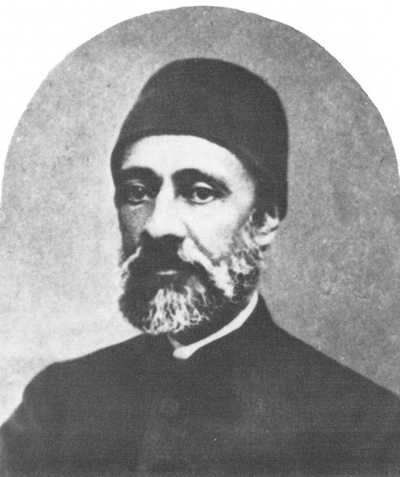
BAHÁ’U’LLÁH WARNS ‘ÁLÍ PÁSHÁ
Soon after His confinement in the prison barracks in 1868, Bahá’u’lláh addressed another Tablet of tremendous importance to ‘Álí Páshá, who had been an implacable enemy and the prime instigator of His banishment to the prison of ‘Akká, and who previously had been addressed by Him as Ra’ís (i.e. Chief).
In this second Tablet (Persian), known as the Lawḥ-i-Ra’ís, Bahá’u’lláh recounts with much tenderness and resignation the hardships and sufferings to which He and His companions had been subjected on their arrival in ‘Akká; describes very movingly the cruelties perpetrated by the guards in the prison; reminds the Grand Vizir that the Manifestations of God in every age had suffered at the hands of the ungodly; narrates a story for him of His own childhood, portraying in a dramatic way the instability and futility of this earthly life; counsels him not to rely on his pomp and glory as they would come to an end soon; reveals to him the greatness of this Revelation; points out his impotence to quench the fire of the Cause of God; admonishes him for the iniquities he had perpetrated; emphatically warns him that God’s chastisement would assail him from every direction and confusion overtake his peoples and government; and affirms that the wrath of God had so surrounded him that he would never be able to repent or make amends.
On this last point Mírzá Áqá Ján, Bahá’u’lláh’s amanuensis, asked Bahá’u’lláh what would happen if ‘Álí Páshá changed his attitude and truly repented. Bahá’u’lláh’s emphatic response was that whatever had been revealed in the Lawḥ-i-Ra’ís would inevitably be fulfilled, and if the whole world were to join together in order to change one word of that Tablet they would be impotent to do so.
A majestic contrast took place one hundred years later when passages from this very Tablet, depicting the rigours and hardships of the Most Great Prison, were chanted in the vicinity of Bahá’u’lláh’s Most Holy Tomb, in the presence of over two thousand of His followers gathered from every corner of the world to commemorate the centenary of the arrival in ‘Akká of the One Whom the world had wronged.
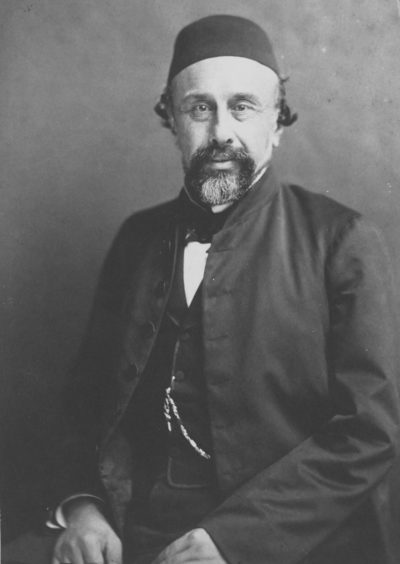
THE TABLET OF FU’ÁD
Another Tablet of great significance, the The Tablet of Fu’ád, was revealed in 1869, soon after the premature death in Nice, France, of Fu’ád Pasha, the foreign minister of the Sultan and a faithful accomplice of the Prime Minister in bringing about the exile of Bahá’u’lláh to ‘Akká. It was revealed in honour of one of Bahá’u’lláh’s most devoted apostles, Shaykh Káẓim-i-Samandar (father of the late Hand of the Cause of God Ṭaráẓu’lláh Samandarí). The following passage from it contains the clear prediction of the downfall of ‘Álí Páshá and the Sultan himself: “Soon will We dismiss the one who was like unto him (i.e. ‘Álí Páshá), and will lay hold on their Chief (i.e. the Sultan) who ruleth the land, and l, verily, am the Almighty, the All-Compelling.” Soon after the revelation of the Tablet, ‘Álí Páshá: was dismissed from his post, and two years later he died.
In those days the believers in Persia often referred to Baha’u’llah’s newly revealed Tablets to the kings and rulers of the world, and many non-Bahá’ís made their acceptance of the Faith conditional upon the fulfilment of the warnings they contained.
A notable example is the case of Mírzá Abu’l-Faḍl, the greatest of Bahá’í scholars. He was renowned for his knowledge and learning among the divines of lslam, and was the head of the Theological College in Tihran. His first contact with the Faith was through meeting a blacksmith who was a Bahá’í at his shop in the outskirts of Tihran. Never before had Mírzá Abu’l-Faḍl been so humiliated as on this occasion, when, with all his knowledge, he was utterly confounded by the amazing force of the argument of this illiterate Bahá’í. The blacksmith immediately reported this whole episode to a Bahá’í friend, ‘Abdu’l-Karím, who, although he did not belong to the learned class, pursued Mírzá Abu’l-Faḍl and eventually succeeded in bringing him to his house to discuss the Faith.
At this meeting, and subsequent ones, Mírzá Abu’l-Faḍl, confronted with some simple Bahá’ís who were not of his calibre, found himself over and over again incapable of refuting the clear proofs and arguments put forward by his uneducated Bahá’í teachers. He marvelled at these men who answered his difficult and abstruse questions so simply and so brilliantly. From there on he visited more often the house of ‘Abdu’l-Karim. He read many of the Writings of Bahá’u’lláh and met many learned Bahá’ís, but his immense knowledge was a barrier and a veil.
One day in 1876 he met Ḥájí Muḥammad Ismá‘íl-i-Káshání, surnamed Anís. Mírzá Abu’l-Faḍl was handed the original copy of this Súrih in the very handwriting of Mírzá Áqá Ján, Bahá’u’lláh’s amanuensis; the Tablet wherein Baha’u’llah foretells that Adrianople will pass out of the Sultan’s hand and that confusion will overtake his kingdom. He was also given the Tablet of Fu’ád, in which the downfall of the Sultan is clearly prophesied. Upon seeing these two Tablets Mírzá Abu’l-Faḍl made his acceptance of the Faith conditional upon the fulfilment of these prophecies.
His Bahá’í friends pursued him no longer. A few months passed and the news of the assassination of Sulṭán ‘Abdu’l-‘Azíz reached Tihran. On hearing the news Abu’l-Faḍl became very agitated. His soul was yearning for confirmation of the truth of this Cause, and yet his heart was not touched by the light of faith. He sat the whole night, read some Tablets of Bahá’u’lláh, and prayed with absolute sincerity until his eyes were opened and he knew the truth of the Cause of God. At the hour of dawn he went to the house of that faithful friend ‘Abdu’l-Karím, and when the door was opened he kissed the threshold of that house and prostrated himself at the feet of the man who, through perseverance and love, had given him the gift of the Faith and led him to the truth.
It is no exaggeration to say that among the apostles of Baha’u’llah there was no one who surpassed Mírzá Abu’l-Faḍl in his knowledge, his humility and self-effacement. Ali-Kuli Khan, a well-known and learned Bahá’í who was commissioned by ‘Abdu’l-Bahá to serve Mírzá Abu’l-Faḍl in America and act as his interpreter, has described him so well in these few lines: “If I had never seen ‘Abdu’l-Bahá and Shoghi Effendi, I would consider Mírzá Abu’l-Faḍl the greatest being I ever laid eyes on.”
THE DOWNFALL OF A MONARCH AND A POPE
Let us turn our thoughts again to Bahá’u’lláh. Though captive in the hands of His enemies and cut off from the outside world, the Supreme Pen wrote many more Tablets in the prison of ‘Akká. In the year 1869 two important Tablets were revealed and delivered; one addressed to Napoleon III, in which Bahá’u’lláh explicitly foretells his extinction; the other to Pope Pius IX. Within almost a year’s time Napoleon, the most powerful monarch of his time in Europe, was driven into exile and suffered an ignominious death, while in the same year the supreme Pontiff’s temporal powers which had existed for many centuries, were seized from him and his vast dominion was reduced to the tiny Vatican State.
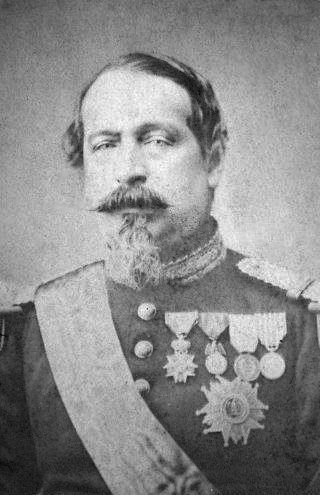
Parallel with these events and indeed, ever since Bahá’u’lláh had been sent to the prison of ‘Akká, the believers in Persia were desperately trying to establish contact with Him. Many travelled on foot all the way, but could not gain admittance to that city. The officials had taken many precautions in order to prevent the Bahá’ís from entering. The few Azalís, headed by the notorious Siyyid Muḥammad-i-Iṣfahání, who is described by the beloved Guardian as the “embodiment of wickedness”, were housed in a certain room overlooking the landgate. One of their functions was to watch for any Bahá’í who might wish to enter the city and to inform the guards. This they did with great zeal and enthusiasm. Many believers, even though they had disguised themselves, were recognized by these men and were not allowed to enter.
Every day a party consisting of a small number of Baha’u’llah’s companions, including ‘Abdu’l-Bahá, was allowed out of the barracks in order to purchase food and other necessities in the markets of ‘Akká. The first time that the people of ‘Akká took notice of ‘Abdu’l-Bahá was in a butcher’s shop. While waiting to be served He noticed that a Christian and a Muslim were discussing their faiths, but the Muslim was being defeated. Thereupon, ‘Abdu’l-Bahá simply and eloquently proved the authenticity and truth of Islam for the Christian. The news of this spread and warmed the hearts of many people of ‘Akká towards the Master; this was the beginning of His immense popularity among the inhabitants of that city.
During these daily visits, the people of ‘Akká came in touch with the person of ‘Abdu’l-Bahá. They felt His genuine love and compassion and were attracted to His magnetic personality. Gradually their fear and animosity towards Bahá’u’lláh and His followers were removed, and many became sympathetic to the Faith and its Founder. Some of these people who were attracted to the Faith tried, at times to help the believers, who were refused entry, by lowering ropes and pulling the believers up over the walls of the city—attempts which however were foiled by the guards.
The first two believers who managed to get into the city were Ḥájí Sháh Muḥammad and Ḥájí Abu’l-Ḥasan, both from the province of Yazd. The former was the first Trustee of Bahá’u’lláh, and was martyred. The latter, known also as Ḥájí Amín who succeeded him, lived to an old age and continued to be the Trustee of the Ḥuqúqu’lláh during the ministry of ‘Abdu’l-Bahá and part of that of the Guardian. The dominating factor in the lives of these two heroes of the Faith was a passionate love for Bahá’u’lláh. In order to enter the city they bought some camels and disguised themselves as Arabs. No one recognized them as Bahá’ís, and they were allowed in.
In the city they met ‘Abdu’l-Bahá, and the news of their arrival was conveyed to Baha’u’lláh. Arrangements were made for them to meet Bahá’u’lláh in the public bath, but with the strict instructions that they show no signs of recognition or emotion. However, on beholding the face of his Beloved, Ḥájí Amín was so overwhelmed that his body began to tremble. He fell to the ground and hit his head on a stone, was badly injured, and was hurriedly carried out by his friend.
The arrival in ‘Akká of these two souls, and a few others who managed to get in afterwards, established a vital link between the Community of the Most Great Name and its exalted Founder, from Whom they were so cruelly cut off. Letters from the believers began to pour in, and Tablets were sent out. This process, which called for acts of sacrifice and heroism on the part of the many believers who risked their lives in order to maintain a two-way communication channel, continued throughout Bahá’u’lláh’s life. Men like Shaykh Salmán, honoured by the appellation of “the Messenger of the Merciful”, who in previous years had carried Bahá’u’lláh’s Tablets from ‘Iráq and Adrianople, continued in this arduous task, travelling on foot between ‘Akká and Persia, and, in the utmost poverty, eating mostly bread and onions for sustenance. This great hero of the Cause, though illiterate, stands out among the disciples of Bahá’u’lláh as one of the spiritual giants of this Dispensation.
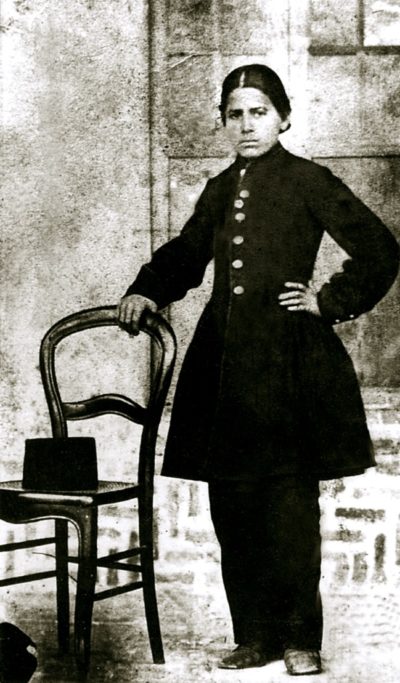
BADÍ—THE HANDFUL OF DUST
About a year after Bahá’u’lláh’s arrival in ‘Akká, a young Persian, aged seventeen, by the name of Áqá Buzurg, disguised himself as an Arab and entered the city. Although his father, a survivor of the upheaval of Shaykh Ṭabarsí, had been a devoted Bahá’í, Áqá Buzurg had shown no interest in the Faith until he met Nabil in the city of Níshápúr, in northeast Persia, and was converted. He then decided to go and attain the presence of Bahá’u’lláh.
Upon his arrival in the city of ‘Akká in 1869 he began to roam around until he came to a mosque where he saw a few Persians and recognized the Master among them. He wrote a note, in which he declared his faith, and handed it to ‘Abdu’l-Bahá, Who greeted him warmly and took him along with the party straight to the barracks, where he was ushered into the presence of Bahá’u’lláh.
In a Tablet Mírzá Áqá Ján mentions that Áqá Buzurg was summoned twice to meet Bahá’u’lláh alone. It was in the course of these momentous audiences that the hands of Bahá’u’lláh created a new being and bestowed upon him the title of Badí‘ (i.e. wonderful). For more than two years Bahá’u’lláh had been waiting for a devoted soul to arise and deliver His Tablet to Náṣiri’d-Dín Sháh of Persia. While in Adrianople He had written some passages on the cover of the Tablet, anticipating that the Almighty would cause one of His servants to arise, detach himself from all earthly things, adorn his heart with the ornament of courage and strength, take the Tablet, walk all the way to the capital of Persia, hand it in the manner described by Him to the King, and in the end be prepared to give his life, if necessary, with great joy and thankfulness. “We took a handful of dust,” is Bahá’u’lláh’s own testimony referring to Badí‘, “mixed it with the waters of might and power and breathed into it the spirit of assurance.”
In a Tablet revealed in honour of the father of Badí‘, who was also martyred a few years later, the Pen of the Most High, in great detail, portrays the manner in which this new creation came into being. He describes that when the appointed time had arrived the Tongue of Grandeur uttered “one word” which caused his whole being to tremble, and that were it not for God’s protection he would have been dumbfounded. Then the Hand of Omnipotence began creating the new creation, and “breathed into him the spirit of might and power”. So great had been the infusion of this might, as attested by Bahá’u’lláh, that, single and alone, Badí‘ could have conquered all that is on earth and in heaven. Bahá’u’lláh mentions that when this new creation came into being, Badí‘ had smiled in His presence and manifested such steadfastness that the Concourse on high was deeply moved and uplifted.
In the same Tablet, referring to the loftiness of the station of Badí‘, He states that no Tablet can convey its significance nor any pen describe its glory. Badí‘ left the Most Great Prison and went to Haifa. Baha’u’llah entrusted Ḥájí Sháh Muḥammad Amín (His Trustee) with a small case and a Tablet to be delivered into the hands of Badí‘ at Haifa. The following is the story as recounted by this Trustee to an eminent Bahá’í historian.
I was given a small case and was instructed to hand it to Badi‘ at Haifa together with some money. I did not know anything about the contents of the case. I met him at Haifa and gave him the glad tidings that he had been honoured with a trust . . . we left the town and walked up Mount Carmel where I handed him the case. He took it into his hands, kissed it, and knelt with his forehead to the ground; he also took the sealed envelope, walked twenty to thirty paces away from me, sat down facing ‘Akká, read it, and again knelt with his forehead to the ground. The rays of ecstasy and the signs of gladness and joy appeared on his face.
I asked him if I could read the Tablet also. He replied, ‘There is no time’. I knew it was a confidential matter. But what it was I had no idea—l could not imagine such a mission.
I mentioned that we had better go to Haifa, in order that, as instructed, I might give him some money. He declined to go with me, but suggested that I could go alone and bring it to him.
When I returned, in spite of much searching, I could not find him. He had gone. . . We had no news of him until we heard of his martyrdom in Ṭihrán. Then I knew that the case contained the Tablet of Bahá’u’lláh to the Sháh, and the sealed envelope, a holy Tablet containing the glad tidings of the future martyrdom of the one who was the essence of steadfastness and strength.
The same chronicler has written the following account given by a certain believer who met Badí‘ on his way to Persia and travelled with him for some distance.
. . he was very happy and smiling, patient, thankful, gentle, and humble. All that we knew was that he had attained the presence of Bahá’u’lláh and was now returning to his home in Khurásán. Many a time he could be seen to have walked about a hundred steps, leaving the road in either direction, turning his face towards ‘Akká, kneeling with his forehead to the ground and could be heard saying, ‘O God! Do not take back, through Thy justice, what Thou hast vouchsafed unto me through Thy bounty, and grant me the strength for its protection.’
Thus Badí‘ travelled on foot all the way to Ṭihrán and did not meet with anyone there. On arrival he discovered that the King was staying at his summer residence. He made his way to that area and sat on the top of the hill overlooking the Sháh’s palace at Níyávarán. The King on successive days, looking through his binoculars, saw the same man dressed in white, sitting in the same position on the hill. He ordered his men to find out who he was and what he wanted.
Badí‘ told them that he had a letter from a very important personage for the Sháh and must hand it personally to him. After searching him they brought him to the King.
Only those who are well versed in the history of Persia in the nineteenth century can appreciate the immense dangers which faced an ordinary person like Badí‘ wishing to meet a palace official, let alone the King. For at that time the King enjoyed absolute power and was surrounded by ruthless officials who would put to the sword anyone who would dare to utter one word, or raise a finger, against the established institutions of that oppressive regime. The loud voice of the “herald” who announced to the public in the streets the approach of the King’s carriage, shouting, “Everyone die! Everyone go blind!” would strike terror into the hearts of the citizens who, with eyes cast to the ground, stood motionless and still as their King and his men passed by.
Being invested by Bahá’u’lláh with tremendous powers, this young man of seventeen, assured and confident, stood straight as an arrow, face to face with the King. Calmly and courteously he handed him the Tablet and in a loud voice called out the celebrated Arabic phrase: “O King! I have come to thee from Sheba with a weighty message.”
The King sent the Tablet to the divines of Ṭihrán and commanded them to write an answer to Bahá’u’lláh. Finding themselves incapable of doing so, they evaded the issue and put forward some excuses which displeased the King immensely.
Badí‘ was arrested, and brutally tortured. His endurance and fortitude amazed the executioner and other officials. They took a photograph of him as he sat in front of a brazier containing hot bars of iron with which he was branded. Eventually his head was beaten to a pulp and his body thrown into a pit. This was July 1870.
For three years after the martyrdom of Badí‘, Bahá’u’lláh referred in His Tablets to his steadfastness and sacrifice, extolled his station, and bestowed upon him the title “Pride of Martyrs”.

THE TABLET TO THE SHÁH
For over two decades the people of Persia had witnessed memorable acts of heroism performed by a small band of God-intoxicated heroes, whose devotion and self-sacrifice had lit a great conflagration throughout that country. The Message of the Báb, the accounts of His martyrdom, and the transforming power of His Cause had already reached to every corner of that land; and from there its reverberations had echoed to the Western world. And yet, as attested by Bahá’u’lláh, not until this momentous Tablet was delivered to the King had the nature of the Cause of God or the claims of its Founder, or its principles and teachings, been clearly enunciated to those who held the reins of power in their hands.
In the annals of the Faith, Badí‘ stands out among the first heroic souls to arise for the proclamation of the Cause of Bahá’u’lláh. He joyously sacrificed himself in His path.
This sacrifice was not in vain. The Cause of Bahá’u’lláh—which, from the time of its inception, had been suppressed; whose adherents in the land of its birth had been so cruelly persecuted and at times mowed down in thousands; whose very name, as anticipated by Náṣiri’d-Dín Sháh and the divines of Persia, was to have been obliterated from the pages of history—has, in spite of much opposition, tremendously expanded during the last hundred years. Its light has been systematically diffused to all the continents of the world. The army of its pioneers and teachers, recruited from every race, class and colour, proclaiming to mankind the advent of the Lord of Hosts, has encircled the globe. The rising institutions of its divinely guided Administrative Order have been established, and within its World Centre, in the vicinity of its Holy Shrines, the crowning Edifice of that same Order (The Universal House of Justice)—the only refuge for the world’s tottering civilization —has been majestically erected.
This glorious unfoldment of the Cause in the Formative Age and its future sovereignty in the Golden Age are the direct consequences, on the one hand, of the outpourings of Bahá’u’lláh’s Revelation and, on the other, of the mysterious power generated by the sacrifice of countless martyrs, whose precious blood has flowed in great profusion during the Heroic Age of the Faith.

We drove through the newer part of ‘Akká down to the great sweep of sandy beach where a stormy wind lashed the great breakers and drove them as far into the old city as possible. We turned left and wound our way over the hill down into the old city again. The wind blew everyone’s coat collar up around the neck. The day was still gray, misty and chill. The cold crashing of the surf punctuated the silent spots in our conversation as we stood, our backs to the sea wall, gazing across the way at the House of ‘Abbúd.
The sea, the wind, the swirling mist, none could cool down the ardor that stirred inside the pilgrim as he looked upon this gray shell of a house that once sheltered the Supreme Prophet of God. This was once the sanctuary of the Supreme Pen. Its walls had resounded to the words of the Most Great Book, the Mighty Aqdas. Here were formed the laws which would stand inviolate and unaltered for a thousand years. Here were fashioned the provisions which would lay the foundation for the greatest structure in the social history of mankind. Here, those ancient prophetic words had come true, “The Government shall be upon His shoulders.” Here, the Author of the Bahá’í Faith, protected by these blessed walls from the stinging winds of the sea, had poured out the fairest fruit of all His Revelation, the Aqdas—pre-eminent among all the writings which had streamed forth in a never-ending river from His holy pen.
What a plain, unimposing structure. Two stories in height with a small balcony around the second floor front, drab gray in color, bleak in appearance, beautiful to the believer.
We were all staring silently up at the balcony which surrounds the bedroom of Bahá’u’lláh. Many long hours He had paced this balcony, looking out over the sea and down upon the very earth where we were standing. This small balcony, which can be crossed in less than ten paces, furnished almost the only outside exercise for Bahá’u’lláh in seven long years of imprisonment within the walls of this house.

Before entering the House, we walked to the small public square in the rear. Our gracious host, Leroy Ioas, holding his hat and coat-collar against a wind that whirled tiny cyclones of ‘Akká dust across the courtyard, showed us the exact spot where the Master had stood and distributed alms and food to the poor.
Salah led us back between the houses and into the side door of the House of ‘Abbúd. We crossed an inner court and started up a flight of stairs, turning to the right twice and continuing to climb until we reached the living quarters of the Holy Family. We saw the small room that held thirteen believers the first night spent in this house. We saw the upper shelf which one of the friends had slept upon that first night and, rolling over too far to one side, had toppled down upon the Master.

We removed our shoes and walked across another room of soft carpets, through a small hallway and then turned left into Bahá’u’lláh’s bedroom. Against the wall on the sea-side of the room was a long cushioned bench. Upon the south end, toward Haifa, rested the táj of Baha’u’llah, marking the place where He often would sit. A few feet away, along the south wall, was a rocking chair which He used. Upon the floor, a carpet brought with them all the way from Adrianople.
As I write this now in Johannesburg, I am back there again. I can feel my pulse accelerate and my heart beat stronger. The atmosphere of these holy places never leaves you. It comes rushing back whenever you turn to ‘Akká and Haifa. Hour after hour, month after month, year upon year, Bahá’u’lláh had moved back and forth in this room. At times He would turn left in the doorway and go out on the balcony which runs across the front of the house. After Salah chanted a prayer, we followed Bahá’u’lláh’s path to the balcony and looked out upon the turbulent sea. The wind, it seemed to us, was still whipping up the indifferent Mediterranean and driving it toward the shore, where in mighty rollers it bowed and prostrated itself before the throne of Majesty.
The room of revelation (where Baha’u’llah revealed the Aqdas) is quite different from the others. This was also ‘Abdu’l-Bahá’s bedroom. It is paneled in wood which is to be found in other places associated with Him. This bedroom is in the back corner of the House. We could look down into the back courtyard. … We saw many of the books of ‘Abdu’l-Bahá, His writing equipment, papers, the simple iron bed—many things that were much loved by Him and are revered by all who look upon them.
Above all else, the mind tries to take in the truth that here in this room, a room that is simplicity itself, was revealed the Book of Laws, the Most Great Book, the mightiest written testimony since the beginning of our recorded times. Its Author would cast His Shadow of guidance for five hundred thousand years!
It is too much to understand. The mind willingly surrenders and turns to examine the surroundings, the little things it can comprehend. ‘Abdu’l-Bahá sat here, He walked here, He knelt here, He looked out this window. But irresistibly your thoughts keep coming back to that one inescapable fact—it was here that Bahá’u’lláh revealed the Aqdas.
Emptying yourself of every single thing to which the mind can cling, you ask Almighty God to pour into your heart a true appreciation of this experience you are undergoing. … The presence and significance of these holy places are like hammer-blows to those of us who have lived in a world so remote from the spirit.
Those veritably spiritual thunderbolts the Shrine of Bahá’u’lláh, of the Báb, and of ‘Abdu’l-Bahá, the room at Bahjí where Bahá’u’lláh passed away, the mansion of Mazra‘ih, the Garden of Riḍván—all had numbed the senses until the cup could not contain the flood.
Each of us said a prayer before departing from this cradle of future civilization. When we made our way downstairs, there was additional conversation, but none of it registers. The hearing was working, but the comprehension and recording instruments were unable to function. This was a mercy of God. The body must be much like an electrical system. It can successfully carry its normal “load” of power, but when subjected suddenly to an incredibly strong current, it “blows out” the fuse at its point of protection. A similar phenomenon happens to the pilgrim, several times, in fact. Something breaks the connection and permits no more impulses to register. The system cannot bear them. (Bahá’u’lláh has written of this spirit, saying of the wine of revelation that it is so inebriating to the Prophet, Himself, that the pen is stilled and can move no more.)
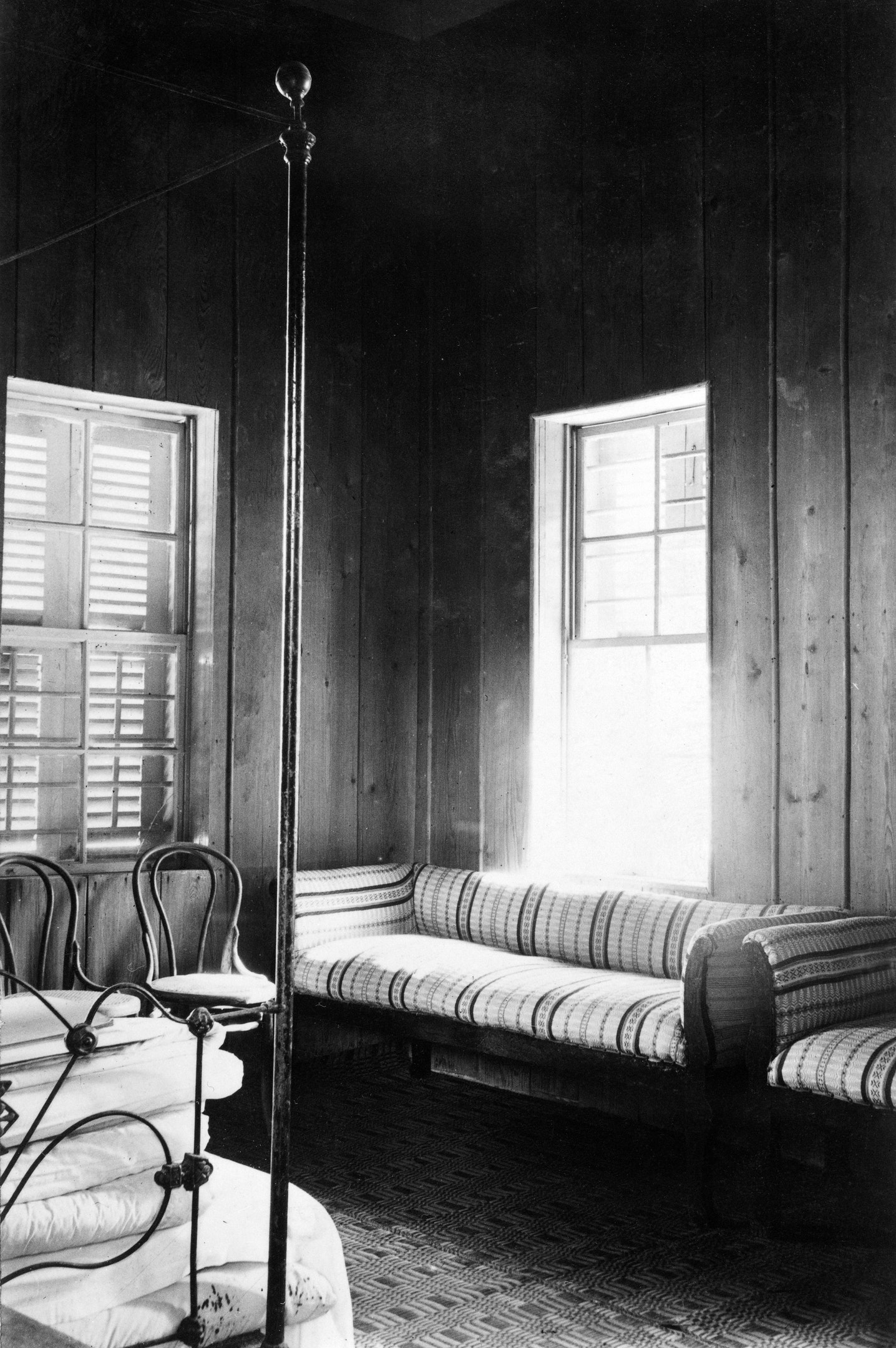
The sun came out gaily for a brief moment, for the first time, as we strolled through the picturesque streets of “Old ‘Akká.” It splashed against the drab earth-colored walls and transformed them into a happy tan. We traced our way along many of the favorite walks of the Master.
We paused and took photographs in the doorway of the house of the former Mufti of ‘Akká. He had been a bitter enemy of Bahá’u’lláh. Salah, caretaker at Bahjí, told us the story of the two attempts on the life of Bahá’u’lláh made by this Mufti while Bahá’u’lláh was still in prison. Once with a hidden dagger, but Baha’u’llah before admitting him to His presence said, “Let him first cleanse his hands.” A second time, the Mufti planned to strangle the Blessed Beauty, and Bahá’u’lláh said before admitting him, “First let him cleanse his heart.” The Mufti became an ardent believer and collected all the “traditions” to be found in the Faith about ‘Akká.
What a delightful city “Old ‘Akká” is to visit. Salah, who was born within its walls, greeted almost everyone. He told us many intriguing stories about its non-Bahá’í history as well. We entered a small door built in one of the lower walls of the prison, walked to the center of a cellar-like cavern. Below us excavation had been started. How strange to know that beneath the prison lies this famous church built by Richard, the Lion-hearted. The packed earth on which we stood was high up toward the top of the Gothic arches. The pillars were buried many, many feet in the solid earth below us.
Salah pointed out the house to which Bahá’u’lláh had been taken in custody when some of His followers had disobeyed His commands, quarreled with three enemies of the Faith and slew them. Bahá’u’lláh was dictating Tablets to His secretary when troops surrounded His house. Crowds gathered quickly. They shouted at Bahá’u’lláh as the Governor, sword in hand, led Him away for questioning. His innocence was established and Bahá’u’lláh was freed; the Governor apologized for his own bad behavior.
We began our approach to the prison itself. The steps up which Bahá’u’lláh had walked to enter the fortress that first time have been taken down. They have left their scar across the body of the prison wall. We all stopped and gazed up at the marks of that old stairway. This was as far as we could retrace the steps of banishment. In order to enter the prison, we had to drive around the city to the front by the sea wall.
We parked by the gate, passed the guards, and walked about three hundred yards up to the prison entrance. As you cross the small bridge over the moat, you can see the cannon balls of Napoleon embedded in the walls. They are splashed with red paint to make them easily visible. Passing through a small arched entrance, we approached the courtyard.
The prison is now a hospital for the insane and feeble-minded. You can see them exercising in the very courtyard where the believers were herded together that first day. There was a sound of heavy keys rattling in a metal door, the door swung open, and you entered the prison barracks. Passing through an ante-room of poor, unfortunate sick ones, you enter the cell-block. In the far left-hand corner is a plaque which reads: Bahá’í Holy Place. . . . This is the cell of Baha’u’llah. The plaque is written in both English and Hebrew.
We removed our shoes outside the great door, and then entered the prison cell where for over two years Bahá’u’lláh had been shut away from the world. This was the heart of the “Most Great Prison.” Even that Black Pit in Ṭihrán, the Siyáh-Chál, a place foul beyond comparison, a dungeon wrapped in thick darkness, so dreadful that no tongue could describe its loathsome smell, had not been called by such a name.
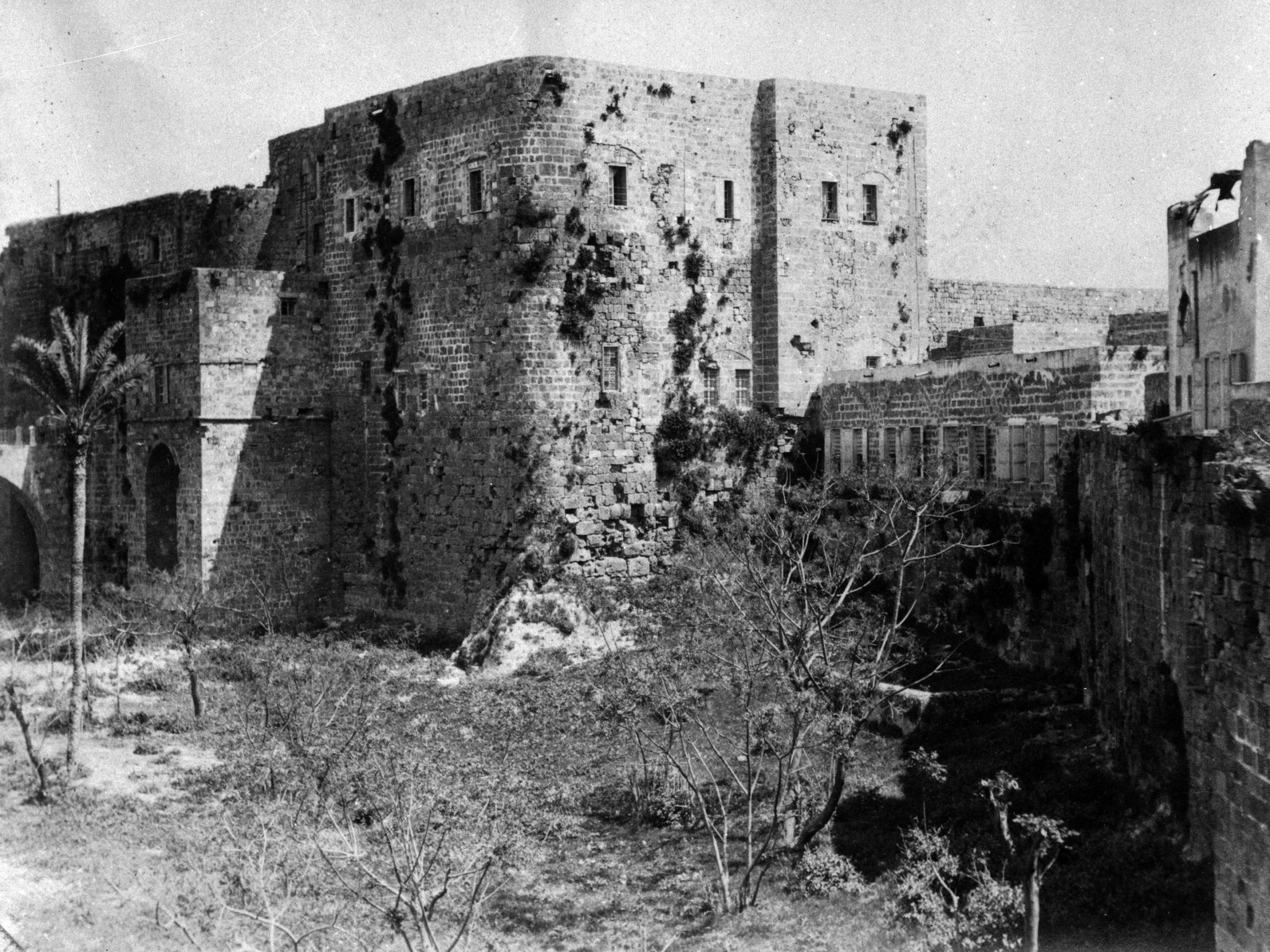
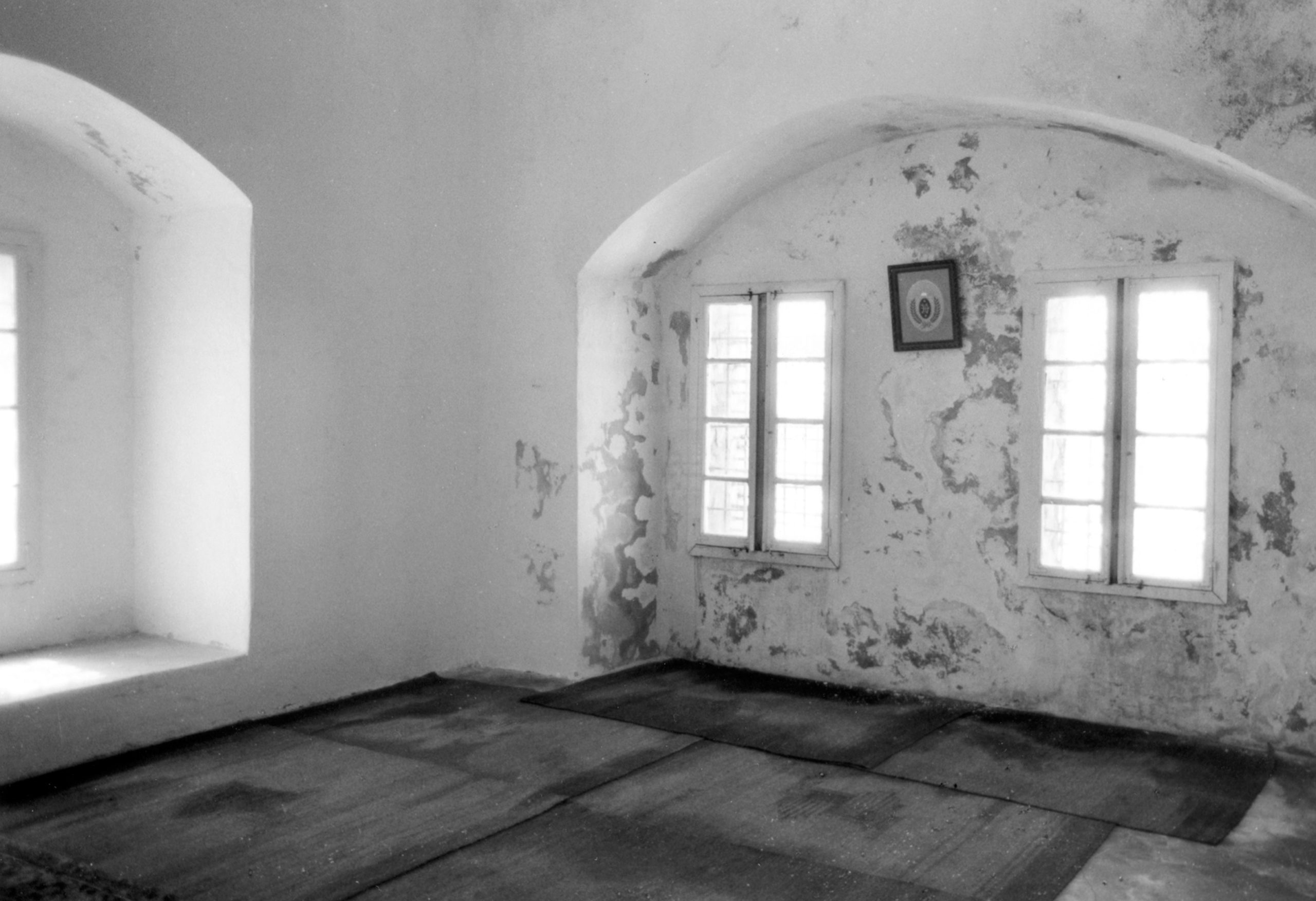
The cell was barren and desolate in Bahá’u’lláh’s day. Now there is a Persian carpet in the corner where He used to sit. There are five straight-backed chairs upon which the pilgrims sit. One window looks out upon the old ‘Akká. The other two windows look out upon the sea. These are the windows shown in most of the photographs.
From here Bahá’u’lláh would look out toward that spot beyond the moat where His followers would stand hoping for a glimpse of His hand waving from the window. We all stood and peered out at that same spot and to the white-capped sea beyond it. Later we walked out to that place of bliss and sorrow and looked up at these two forlorn windows. The face of the prison is bruised and scarred from shell-fire.

Inside the prison-cell itself, the heart is touched and saddened by the sight of that bleak, unfragrant room. True, it has been cleaned and restored, but here and there upon the floor were small fragments of paint and plaster which had fallen from the ceiling and walls. These are a grim reminder of the chilling dampness of this dismal place.
Here in this cell, where but a few paces carry you from end to end, Bahá’u’lláh spent over two years of His precious life. Here it was that Baha’u’llah, Himself, said that His sufferings had reached their culmination.
Our eyes bestowed loving prayers upon each of these places of anguish. After all these years, and even with the reformations, it is still unsanitary and foul in these barracks. The mind refuses to try to picture the misery and abomination that must have surrounded Bahá’u’lláh upon His arrival here. We know that they were herded together, deprived of food and drink, that malaria, dysentery, and the sickening heat added to their sorrows. All were ill but two.
It was here that the two brothers died the same night locked in each other’s arms. Bahá’u’lláh sold His carpet to provide for their winding sheets and burial, but the guards had kept the money and cast them into a pit unwashed and unshrouded.
This is where Bahá’u’lláh’s young son, Mírzá Mihdí, the Purest Branch, was killed. He was pacing the roof at twilight reciting his prayers. He fell through an unguarded skylight on a wooden crate below which pierced his ribs and took his life in less than a day. It was here that this sweet son pleaded with his Father, Bahá’u’lláh, that his life be not saved, but that it be offered as a ransom so that the pilgrims, who so longed for His healing Presence, might be permitted to attain their hearts’ desire. At his tomb in the Monument gardens, we repeated the words of Baha’u’llah written about him:
“Thou art the trust of God and His treasure in this land. Erelong will God reveal through thee that which He hath desired.”
From here Bahá’u’lláh wrote many of His tablets to the kings of the earth, proclaiming that the only remedy for the ills of the world was the union of all its peoples in one common faith, and that only a divine, inspired Physician could bring this to pass.
Many were the wholesome truths that flowed from that Supreme Pen within this prison cell. Each of these tablets and writings took on a new force since we had come to the scene of their origin.
The doors that did not open for Bahá’u’lláh for two years, swing wide for you, then grind closed upon their hinges. We put on our shoes, everyone silent, lost in the weight of thoughts which held words down, unformed.
This was the last stop in ‘Akká. We were grateful. We wanted no conversation; no invasion of that place the mind had set aside for reflecting upon this unequaled experience.
There was no receptiveness left to truly appreciate the stories told as we descended the stairs; the room below where the rest of the pilgrims had been quartered, the place where the Master had made broth for all—made broth with little more than air for ingredients. His words spoken in London sent another sliver of pain into the body. He had made so much broth in those days, He said, that He could make a very good broth with a very little. How the Master loved His wonderful Father. He told of this loathsome prison. How Bahá’u’lláh would call the pilgrims together, would make them laugh at their troubles, until they forgot their stone beds, the lack of food and water. He banished the pain of their illness and the ravages of their fever. He would tell them stories and lift their hearts. He would start them to laughing so loudly that they must be cautioned for fear the sentinels would believe they were mad if they could laugh and enjoy themselves in these conditions of utter dreadfulness.
What tenderness must have been in the Master’s eyes as He placed His graceful hand upon the luxurious furniture of the Western world and said, “We had no chairs such as this in the prison of ‘Akká; no soft beds to lie upon; no delicious food to nourish us. But I would not exchange all of these days for one moment of the sweetness of those hours in the presence of the Blessed Beauty.”

Seeing these poor, unfortunate inmates of the asylum for the last time, one thinks: How like the entire world is this prison barracks. These pitiful wretches, unbalanced, living in another dead world (like all humanity) are within but a few paces of the Holy Place of Bahá’u’lláh‘ Healer of all ills.
We crossed the moat and walked out into the open air. The clouds were gone. The sun was out ruling the blue sky all by itself. The sea, a deeper blue, was still charging up to the old sea wall and plunging against its rocks. There was a queer, mingled feeling in possession of me. It was half of joy and half of sadness, gladness and heavy-heartedness, happiness and sorrow. Perhaps it was the accumulation of the day’s emotions, unsettled and unabsorbed within me. Each experience taking charge of my being at alternate intervals, just as the sea sent alternate breakers against the wall.
I did not look back. It was all locked forever in my heart.
THE UNIVERSE OF PALOMAR
The largest telescope yet designed has been raised by scientists on a mountain under the clear California sky. Its lens, measuring sixteen feet eight inches in diameter, gathers light with so much more intensity than the human eye that its reflected image discloses an endless heaven hung with brilliant orbs. Its power is so encompassing that it extends human vision to bodies whose distance from the earth, measured by the time required for the travel of a ray of light, is not less than one billion years.

Since the speed of light is 186,000 miles a second, no terrestrial system of measurement can contain this utter remoteness or translate it into ordinary human meaning.
The universe of Palomar engulfs the small and familiar worlds sustained by the imagination of the poet, the shepherd and the mariner of ancient times. Its infinity of space and time can never be subjective to hope or fear. It is a motion we cannot stay, a direction we cannot divert, a peace we cannot impair, a power we cannot control. Here existence realizes the fulness of its purpose. The design and the material, the means and the end, the law and the subject, seem wholly one.
At Palomar the mind of man, standing on tiptoe, can behold the cosmic spectacle and grow by the eternal majesty it feeds on, but searching east or west or north or south one finds here no candle lighted to welcome the errant human heart.
“This nature,” the Bahá’í teachings observe, “is subjected to an absolute organization, to determined laws, to a complete order and a finished design, from which it will never depart; to such a degree, indeed, that if you look carefully and with keen sight, from the smallest invisible atom up to such large bodies of the world of existence as the globe of the sun or the other great stars and luminous spheres, whether you regard their arrangement, their composition, their form or their movement, you will find that all are in the highest degree of organization, and are under one law from which they will never depart.
“But when you look at nature itself, you see that it has no intelligence, no will … Thus it is clear that the natural movements of all things are compelled; there are no voluntary movements except those of animals, and above all, those of man. Man is able to deviate from and to oppose nature, because he discovers the constitution of things, and through this he commands the forces of nature; all the inventions he has made are due to his discovery of the constitution of things …
“Now, when you behold in existence such organizations, arrangements, and laws, can you say that all these are the effects of nature, though nature has neither intelligence nor perception? If not, it becomes evident that this nature, which has neither perception nor intelligence, is in the grasp of Almighty God Who is the Ruler of the world of nature; whatever He wishes He causes nature to manifest.”1‘Abdu’l-Bahá. Some Answered Questions. p.3.
Another passage states: “Know that every created thing is a sign of the revelation of God. Each, according to its capacity, is, and will ever remain, a token of the Almighty . . . So pervasive and general is this revelation that nothing whatsoever in the whole universe can be discovered that does not reflect His splendor . . . Were the Hand of Divine Power to divest of this high endowment all created things, the entire universe would become desolate and void.’’2Bahá’í World Faith. p.97.
The Bahá’í teachings also declare: “Earth and heaven cannot contain Me; what can alone contain Me is the heart of him that believes in Me, and is faithful to My Cause.”3Bahá’í World Faith. p.98.
MAN’S INNER WORLD
From man’s inner world of hope and fear the cry for help has never been raised so desperately nor so generally across the whole earth. Civilization is in conflict with the man of nature. Civilization betrays the man of understanding and feeling. The individual has become engulfed in struggles of competitive groups employing different weapons to attain irreconcilable ends. The beginning and the end of his actions lie concealed in the fiery smoke of furious, interminable debate. His personal world has been transformed into an invaded area he knows not how to defend.
Sickness of soul, like physical ailment, manifests itself in many forms. It need not be a localized pain nor an acute sense of shock and disability. An ailment can produce numbness as well as torment, or it can spare the victim’s general health but deprive him of sight, hearing or the use of a limb.
Soul sickness that goes deep into the psychic organism seldom finds relief in hysteria or other visible adjustments to ill-being. It expresses itself in successive re-orientations to self and to society, each of which results in a conviction representing a definite choice or selection between several possibilities. When the conviction hardens, all possibilities but one are denied and dismissed. If individuals come to realize that effort to express certain qualities through their daily lives is continuously unsuccessful, they will, in the majority of cases, abandon the exercise of that quality and concentrate on others. If individuals find that their civilization makes demands on them for the exercise of qualities they personally condemn, in most cases the necessary adjustment is made.
The modern individual is in the same position as the mountain climber bound to other climbers by a rope. At all times he is compelled to choose between freedom and protection—to balance his rights and his loyalties, and compromise between his duty to protect others and his duty to develop something unique and important in himself. As long as the route and the goal are equally vital to all the climbers, the necessary adjustments can be made without undue strain. But modern life binds together in economic, political and other arrangements groups of people who never entered into a pact of mutual agreement, who inwardly desire and need diverse things. The rope that binds them is a tradition, a convention, an inherited obligation no longer having power to fulfill.
Here, in essence, is the tragic sickness of modern man. What he sows he cannot reap. What he reaps he cannot store until a new harvest ripens. He feeds on another’s desire, he wills to accomplish an alien task, he works to destroy the substance of his dearest hope. Moral standards stop at the frontier of the organized group. Partisan pressures darken the heavens of understanding.
Humanity is undergoing a complete transformation of values. The individual is being transplanted from his customary, sheltered traditional way of life to the vast and disruptive confusions of a world in torment. The institutions which have afforded him social or psychic well-being are themselves subject to the same universal dislocation. The label no longer identifies the quality or purpose of the organization. One cannot retreat into the isolation of primitive simplicity; one cannot advance without becoming part of a movement of destiny which no one can control nor define.
Where can a new and creative way of life be found? How can men attain knowledge of the means to justify their legitimate hope, fulfill their normal emotions, satisfy their intelligence, unify their aims and civilize their activities? The astronomer has his polished lens of Palomar to reveal the mysteries of the physical universe. Where can mankind turn to behold the will and purpose of God?
CONSCIENCE: THE MIRROR HUNG IN A DARKENED ROOM
Many persons feel that in man there is a power of conscience that will unfailingly, like the compass needle, point to the right goal. If in any individual case, this conception believes, the power of conscience fails to operate, it is because the human being himself has betrayed his own divine endowment. He has heard the voice but refused to heed. He has seen the right course of action but preferred to take the evil path.
If we examine this contention as applied to ourselves and others familiar to us over a considerable period of time, we find that conscience, as a faculty, cannot be understood by reference to any such naive and conventional view.
The individual has no private wire to God. The dictates or impulses we call conscience indicate different courses of action at different times. The truth, the law, the appropriate principle or the perfect expression of love is not when wanted conveyed to our minds like a photograph printed from a negative developed in the subconscious self. No individual can afford to rely for guidance in all vital affairs on the testimony offered from within.
Individual conscience appears to be compounded of many ingredients at this stage of mass development: childhood training, personal aptitude, social convention, religious tradition, economic pressure, public opinion and group policy.
It is when we examine individual conscience in the area of social action and public responsibility that its limitations become clear. Public policy is the graveyard in which the claim to perfect personal guidance lies interred. In every competitive situation involving social groups, conscientious persons are found on both sides of the struggle. The conscience of one leads to a definition of value or a course of action which stultifies the other. Conscientious persons in the same group seldom agree on matters affecting the whole group. Individual conscience retreats to the realm of the private person when it cannot share or alter the conscience and conviction of others.
The result is that while theoretical exaltation of conscience is seldom abandoned, the operation of conscience, outside the small area controlled by personal will, is continuously suppressed. Policy is the conscience of the group, and dominant groups sanction collective actions frequently abhorrent to the individual. Our dominant groups are the successors to the primitive tribes in which the individual was once completely submerged. Like the primitive tribe, their basic policy is to survive.
So helpless has the individual become under pressure of world-shaking events that leaders of revolution dismiss his moral worth entirely from their considerations. The individual ceases to be a person. He is made subject to mass regulation under penalty of punishment for disobedience and, if obedient, under hope of his share of a mass award. Societies have arisen composed of this unmoral mass of human beings, the nature of which resembles the physical monsters terrorizing the earth aeons ago.
Between the naive spiritual conception of conscience as divine spark, and the naive rational view that conscience is automatic response to external stimuli, the actual truth undoubtedly lies.
Human conscience is a quality existing in different stages of development. In the child it makes for obedience to the power by which the child is protected. It can manifest as an expression of the instinct of self-survival or self-development. It can inspire loyalty to the group. It can subject the individual to complete sacrifice for the sake of his group or for the truth he most reveres.
Moral attitudes become established through social education and discipline conducted over long periods of time. The moral worth of the individual consists in his capacity to share in a process of endless evolution. Though at times he seems bogged down in the swamp of evil, the ladder of development stands close to his hand and he can ascend it rung by rung. His moral responsibility can never be disclaimed by him nor voided by others on his behalf, since the principle of cause and effect operates throughout all life. No man and no society exists in a universe shaped to the pattern of human desire.
Conscience is not a form of wisdom or knowledge. It cannot be dissociated from the development of the individual or from the condition of his society. But one may say that conscience is a mirror hung in a room. If the room is darkened the mirror reflects but dimly. Light is needed—the light of truth and love. Then will the mirror of spiritual awareness disclose to the individual the essential nature of his own problem of choice, and open for him the door that leads from the private person to mankind. The helplessness of the individual today is due to the absence of light.
“When man allows the spirit, through his soul, to enlighten his understanding, then does he contain all creation; because man, being the culmination of all that went before and thus superior to all previous evolutions, contains all the lower world within himself. Illuminated by the spirit through the instrumentality of the soul, man’s radiant intelligence makes him the crowning-point of creation.
“But on the other hand when man does not open his mind and heart to the blessing of the spirit, but turns his soul towards the material side, towards the bodily part of his nature, then is he fallen from his high place and he becomes inferior to the inhabitants of the lower animal kingdom. In this case the man is in a sorry plight! For if the spiritual qualities of the soul, open to the breath of the Divine Spirit, are never used, they become atrophied, enfeebled, and at last incapacitated; while the soul’s material qualities alone being exercised, they become terribly powerful, and the unhappy, misguided man becomes more savage, more unjust, more vile, more cruel, more malevolent than the lower animals themselves.
“If, on the contrary, the spiritual nature of the soul has been so strengthened that it holds the material side in subjection, then does the man approach the divine; his humanity becomes so glorified that the virtues of the celestial assembly are manifest in him; he radiates the mercy of God, he stimulates the spiritual progress of mankind, for he becomes a lamp to show light on their path.”4Compiled by Horace Holley. The Reality of Man. p.6.
In such words the Bahá’í teachings describe the two paths which open before each human being, choice of which he himself is free to make.
SECTARIANISM—FROM CREATION TO CHAOS
If individual conscience cannot illumine from man’s inner world the nature of basic social problems, what of religion? Have the traditional faiths such command of spiritual truth that they can serve as the guide and conscience of mankind? Do these sects and denominations constitute the moral Palomar bestowing vision upon a divided, a desperate humanity? Has God spoken to our age from these minarets, these temples, mosques, chapels and churches which represent the meaning and purpose of religion to the masses in East and West?
The world of sectarian religion is not a universe, ordered by one central creative will, but the fragments of a world which no human authority has power to restore. There are the main bodies of ancient, revealed religion: Hinduism, Buddhism, Zoroastrianism, Judaism, Muhammadanism and Christianity, standing apart like continents separated by the salt, unplumbed sea. There are in each of these bodies a large number of independent, mutually exclusive subdivisions. Their diverse claims to organic sovereignty maintain in the realm of faith the same condition which exists among nations, principalities, kingdoms and empires. They deal with one another by treaty and truce; there are conquests and seizures, colonies and alliances, plans and strategies, wars and revolutions, all without control of the greater and vital movements of society or even foreknowledge of what was and is to come.
This is why mankind has suffered two world wars, social dislocation and a plague of immorality, faithlessness, materialism and discontent. No universal religious body has existed to stay the swift descent of our age into the gloom of savage strife. Events do not wait upon doctrinal readjustments. When peace does not exist in the world of the soul it cannot exist in any other realm of human intercourse and experience. The masses have been given no moral unity, no common purpose which, stamped with divine authority, could raise them above the fatal disunities and conflicts distilled by their economic and political institutions.
Yet each of these faiths was divinely revealed, imbued with a universal spirit, charged with a high creative mission, and established itself through the sacrifice and heroism of those early believers who beheld the Word of God. Each faith has reconsecrated human life and by its lifeblood nourished great progress in civilization. What has happened to the first, true vision? What has extinguished the flame upon the altar of worship?
The superhuman character of revelation has gradually undergone dilution and admixture. The human explanation of a truth has been substituted for the truth itself. The performance of ceremonial rites has come to occupy the place held by the mystery of spiritual rebirth. Obligation to a professionalized institution has weakened the duty laid upon individuals to serve society and mankind. The aim of a regenerated, righteous, peaceful civilization inspired by the founders of religion has become diverted into hope for the victory of the church. Sectarianism in essence is not freedom of religion. It is an opportunity to abandon the way of life revealed from on high and substitute belief for sacrifice, ritual for virtue, creed for understanding, and a group interest for the basic rights of mankind.
All things exist in a process of life and death, growth and development, extinction and renewal. The fact that what men devise as a counterfeit for truth is eventually destroyed, does not confirm the rejection of religion by the cynic or the materialist. On the contrary, the succession of faiths throughout the period of known history points to a complete vindication of faith in God, since He divides truth from error, the spirit from the letter. He punishes and He rewards. For every death He sends a new life.
“O army of life!” the Bahá’í teachings warn, “East and West have joined to worship stars of faded splendor and have turned in prayer unto darkened horizons. Both have utterly neglected the broad foundation of God’s sacred laws, and have grown unmindful of the merits and virtues of His religion. They have regarded certain customs and conventions as the immutable basis of the Divine Faith, and have firmly established themselves therein. They have imagined themselves as having attained the glorious pinnacle of achievement and prosperity when, in reality, they have touched the innermost depths of heedlessness and deprived themselves wholly of God’s bountiful gifts.
“The cornerstone of the Religion of God is the acquisition of the Divine perfections and the sharing in His manifold bestowals. The essential purpose of faith and belief is to ennoble the inner being of man with the outpourings of grace from on high. If this be not attained, it is indeed deprivation itself. It is the torment of infernal fire.”5‘Abdu’l-Bahá. Selected Writings of ‘Abdu’l-Bahá. p.43.
And even more definitely: “Superstitions have obscured the fundamental reality, the world is darkened and the light of religion is not apparent. This darkness is conducive to differences and dissensions; rites and dogmas are many and various; therefore discord has arisen among the religious systems whereas religion is for the unification of mankind. True religion is the source of love and agreement amongst men, the cause of the development of praiseworthy qualities; but the people are holding to the counterfeit and imitation, negligent of the reality which unifies, so they are bereft and deprived of the radiance of religion.”6Bahá’í World Faith. p.237.
“When the lights of religion become darkened the materialists appear. They are the bats of night. The decline of religion is their time of activity; they seek the shadows when the world is darkened and the clouds have spread over it.”7Bahá’í World Faith. p.238.
“If the edifice of religion shakes and totters, commotion and chaos will ensue and the order of things will be utterly upset.”8Bahá’í World Faith. p.289.
“Religious fanaticism and hatred,” the Bahá’í teachings affirm, “are a world-devouring fire, whose violence none can quench. The Hand of Divine Power can alone deliver mankind from this desolating affliction.”9Bahá’u’lláh. Gleanings from the Writings of Bahá’u’lláh. p.288.
INTERNATIONALISM: THE END OF AN ERA
When changes take place in the spiritual life of a people, they produce effects not only upon the realm of personal conscience or upon the definitions of denominational faith—their results flow forth throughout the civilization. Society, indeed, is the outer surface of human action, as religion is the inner surface. The persons who are impressed with certain values from the religious teaching of their childhood, strive to fulfill them as adults in their civilization. The nations of the world are not composed of a separate race of human beings called citizens or subjects; all this mass of humanity who serve as citizens or subjects are at the same time members of different racial groups and members of different religious bodies.
Since religious training has for the most part been based upon pre-rational states of childhood, the vital assumptions of faith or theology continue from generation to generation without analysis or investigation. The child assumes that his religion sets him off in some mysterious but inevitable and justifiable manner from those people who belong to a different religion. This pre-rational experience becomes an imperative directing his activities in other fields, all the more effective because it works behind his conscious and rational thought. Religion has thus prepared the way for the spirit of exclusive nationalism, class competition and other self-centered types of social institution. The pre-rational experience of justifiable division matures in the irrational attitudes of partisan loyalty which set people off from one another in political and economic matters, eventuating in strife and ruin.
The modern nation represents the most powerful and effective social unity ever achieved. It has coordinated the human qualities and possibilities to an unprecedented degree, liberating people from servitude to nature and laying the foundations of orderly progress by reconciling the political claims of the state with the social and cultural needs of the individual. But like every human institution, the nation cannot become an end unto itself. It cannot draw arbitrary lines and decree that human evolution must stop short at this line or that. The nation cannot reduce all questions of human relations to political principle, and solve them by a formal relationship to the state.
The movement of life is irresistible. When the modern nation had organized its area and completed the creation of the necessary institutions, it became mature and incurred obligation to establish useful relationships with other nations. The nation became more and more involved in activities and affairs outside its boundaries and beyond its jurisdiction. Internationalism has been the principle of civilization for more than a hundred years, but the nations could not realize themselves as means to an end, as instruments called upon, for the sake of humanity, to create a sovereignty of and for the entire world. This moral resolution has been lacking.
Denied fulfilment in world order, modern internationalism has organized the nations for their own destruction. The social organism made an end unto itself becomes self-consuming. First there has been an interval of spiritual blindness, a miscalculation of the essential nature of human life; then a denial of the obligation to join with other nations for the sake of peace, then a denunciation of some threatening foe, and, finally, a plunge into the maelstrom where every trend toward world unity is accelerated faster than the public intelligence can comprehend.
Power to make permanent and workable decisions has been temporarily lost. Our international relations rest upon formal agreements which have not yet become translated into world relationships and hence remain subject to abrupt dissolution if the strains of social dislocation go to the breaking point. In this condition of crisis humanity stands, unable to return to the simpler societies of the past and unable to generate sufficient power for true unity in a world civilization. The races and peoples meet in a fateful encounter, each cherishing its separateness as a duty and a right. One may say that humanity does not yet exist, for men are not directed by a world consciousness or impelled by a mutual faith.
“Today the world of humanity,” the Bahá’í teachings stated a generation ago, “is in need of international unity and conciliation. To establish these great fundamental principles a propelling power is needed. It is self-evident that unity of the human world and the Most Great Peace cannot be accomplished through material means. They cannot be established through political power, for the political interests of nations are various and the policies of peoples are divergent and conflicting. They cannot be founded through racial or patriotic power, for these are human powers, selfish and weak. The very nature of racial differences and patriotic prejudices prevents the realization of this unity and agreement. Therefore it is evidenced that the promotion of the oneness of the kingdom of humanity, which is the essence of the teachings of all the Manifestations of God, is impossible except through the divine power and the breaths of the Holy Spirit. Other powers are too weak and are incapable of accomplishing this.”10‘Abdu’l-Bahá. Selected Writings of ‘Abdu’l-Bahá. p.5.
“Among the teachings … is man’s freedom, that through the ideal Power he should be free and emancipated from the captivity of the world of nature; for as long as man is captive to nature he is a ferocious animal, as the struggle for existence is one of the exigencies of the world of nature. This matter of the struggle for existence is the fountainhead of all calamities and is the supreme affliction.”11Bahá’í World Faith. p.288.
“Universal peace is a matter of great importance, but unity of conscience is essential, so that the foundation of this matter may became secure, its establishment firm and its edifice strong.”12Bahá’í World Faith. p.285.
In the Bahá’í writings, peace is revered because in essence it is a spiritual mystery in which humanity has been invited in our day, for the first time, to partake. Peace is a divine creation; a reconciliation of human and divine purpose. Peace appears first as a universal religion; as its influence gathers force and its principles spread then peace can permeate the body of society, redeeming its institutions and its activities and consecrating its aims.
“Universal peace,” these writings promise, “is assured … as a fundamental accomplishment of the religion of God; that peace shall prevail among nations, governments and peoples, among religions, races and all conditions of mankind. This is one of the special characteristics of the Word of God revealed in this Manifestation.”13Bahá’í World Faith. p.247.
SPIRITUAL EDUCATION—THE INSTRUMENT OF PEACE
The issues of human existence turn upon the axis of education. Education alone can overcome the inertia of our separateness, transmute our creative energies for the realization of world unity, free the mind from its servitude to the past and reshape civilization to be the guardian of our spiritual and physical resources.
The true purposes of education are not fulfilled by the knowledge conferred through civil education, since this knowledge ends with the purposes of the individual or the needs of the state. They are not fulfilled by sectarian education, since sectarian knowledge excludes the basic principle of the continuity and progressiveness of revelation. The true purposes of education are not achieved by independent pursuit of knowledge undertaken through study of the classics, the great philosophies or even the religious systems of the past. Such education enhances the individual capacity and deepens the insight of a group. It opens the door to a world of superior minds and heroic accomplishment. But that world is the reflection of the light of truth upon past conditions and events. It is not the rising of the sun to illumine our own time, inspire a unified world movement, and regenerate withered souls.
But that world is the reflection of the light of truth upon past conditions and events. It is not the rising of the sun to illumine our own time, inspire a unified world movement, and regenerate withered souls.
Nor may we hope that psychology can develop the necessary transforming power for a dislocated society, a scientific substitute for the primitive offices of religion. The explorer in the world of the psyche sees the projection of his own shadow, finds the answer determined by his own question. He can prove mechanistic determinism or demonstrate the freedom and responsibility of the soul. The area within which he works is suitable for the development of personal healing. He can learn the habitual reactions of persons in a group or of groups in a society, but this knowledge is statistical until applied by a comprehensive organ of intelligence on a world scale.
“The human spirit which distinguishes man from the animal,” the Bahá’í teachings state, “is the rational soul; and these two names—the human spirit and the rational soul—designate one thing. This spirit, which in the terminology of the philosophers is the rational soul, embraces all beings, and as far as human ability permits discovers the realities of things and becomes cognizant of their peculiarities and effects, and of the qualities and properties of beings. But the human spirit, unless assisted by the spirit of faith, does not become acquainted with the divine secrets and the heavenly realities. It is like a mirror which, although clear, polished and brilliant, is still in need of light. Until a ray of the sun reflects upon it, it cannot discover the heavenly secrets.”
This significant comment is also found: “With the love of God all sciences are accepted and beloved, but without it, are fruitless; nay, rather, the cause of insanity. Every science is like unto a tree; if the fruit of it is the love of God, that is a blessed tree. Otherwise it is dried wood and finally a food for fire.”
A new and universal concept of education is found in the literature of the Bahá’í Faith.
“When we consider existence, we see that the mineral, vegetable, animal and human worlds are all in need of an educator.
“If the earth is not cultivated it becomes a jungle where useless weeds grow; but if a cultivator comes and tills the ground, it produces crops which nourish living creatures. It is evident, therefore, that the soil needs the cultivation of the farmer …
“The same is true with respect to animals: notice that when the animal is trained it becomes domestic, and also that man, if he is left without training becomes bestial, and, moreover, if left under the rule of nature, becomes lower than an animal, whereas if he is educated he becomes an angel. …
“Now reflect that it is education that brings the East and the West under the authority of man; it is education that produces wonderful industries; it is education that spreads glorious sciences and arts; it is education that makes manifest new discoveries and laws. If there were no educator there would be no such things as comforts, civilization, facilities, or humanity. …
“But education is of three kinds: material, human and spiritual. Material education is concerned with the progress and development of the body, through gaining its sustenance, its material comfort and ease. This education is common to animals and man.
“Human education signifies civilization and progress: that is to say, government, administration, charitable works, trades, arts and handicrafts, sciences, great inventions and discoveries of physical laws, which are the activities essential to man as distinguished from the animal.
“Divine education is that of the Kingdom of God: it consists in acquiring divine perfections, and this is true education; for in this estate man becomes the center of divine appearance, the manifestation of the words, ‘Let us make man in our image and after our likeness.’ This is the supreme goal of the world of humanity.
“Now we need an educator who will be at the same time a material, human and spiritual educator, and whose authority will be effective in all conditions . . .
“It is clear that human power is not able to fill such a great office, and that the reason alone could not undertake the responsibility of so great a mission. How can one solitary person without help and without support lay the foundations of such a noble construction? He must depend on the help of the spiritual and divine power to be able to undertake this mission. One Holy Soul gives life to the world of humanity, changes the aspect of the terrestrial globe, causes intelligence to progress, vivifies souls, lays the foundation of a new existence, establishes the basis of a marvelous creation, organizes the world, brings nations and religions under the shadow of one standard, delivers man from the world of imperfections and vices, and inspires him with the desire and need of natural and acquired perfections. Certainly nothing short of a divine power could accomplish so great a work.’’14‘Abdu’l-Bahá. Some Answered Questions. p.8.
Who is this educator? “The holy Manifestations of God, the divine prophets, are the first teachers of the human race. They are universal educators and the fundamental principles they have laid down are the causes and factors of the advancement of nations. Forms and imitations which creep in afterward are not conducive to that progress. On the contrary these are destroyers of the human foundations laid by the heavenly educators.’’15Bahá’í World Faith. p.250.
“Religion is the outer expression of the divine reality. Therefore it must be living, vitalized, moving and progressive. If it be without motion and non-progressive it is without the divine life; it is dead. The divine institutes are continuously active and evolutionary; therefore, the revelation of them must be progressive and continuous.”16Bahá’í World Faith. p.224.
THE MANIFESTATION OF GOD
The focal point of the Bahá’í teachings is clarification of man’s relationship to God. As long as peoples differ, or are unaware, or accept a substitute for this relationship, we cannot distinguish between truth and error, or discriminate between principle and superstition. Until we apprehend human beings in the light of the creative purpose, it is impossible to know ourselves or others. Social truth is merely experiment and hypothesis unless it forms part of a spiritual reality.
The founders of revealed religions, who have been termed prophets, messengers, messiahs and saviours, in the Bahá’í teachings are designated Manifestations of God. These beings, walking on earth as men, stand in a higher order of creation and are endowed with powers and attributes human beings do not possess. In the world of truth they shine like the sun, and the rays emanating from that sun are the light and the life of the souls of men.
The Manifestation is not God. The Infinite cannot be incarnated. God reveals His will through the Manifestation, and apart from what is thus manifested His will and reality remain forever unknown. The physical universe does not reveal the divine purpose for man.
“Every one of them,” the Bahá’í teachings state, “is the Way of God that connects this world with the realms above, and the standard of His truth, unto every one in the kingdoms of earth and heaven. They are the Manifestations of God amidst men, the evidences of His truth, and the signs of His glory.”17Bahá’í World Faith. p.21.
What almighty power is exercised by a will manifested through a person who has been flouted, denied, imprisoned, tortured and crucified? No human authority could survive such savage onslaughts as have greeted each messenger who has come from the heavenly realm to this lowest of worlds. The divine power expresses itself by compulsion in the kingdoms of nature. In the kingdom of man the divine power operates in such a manner that men are free to accept and adore, or repudiate and condemn. The divine power compels that from age to age men must come to a decision, but the decision itself is free. By that decision, when the prophet has revealed the will of God, men separate into two organic companies: those who believe and those who deny.
The whole pattern and process of history rests upon the succession of dispensations by which man’s innate capacities are developed and by which the course of social evolution is sustained. The rise and fall of civilizations proceed as the effect of prior spiritual causation. An ancient civilization undergoes moral decadence; by division of its own people and attack from without its power and authority are destroyed; and with that destruction collapses the culture and the religious system which had become parasites upon its material wealth. Concurrently, a new creative spirit reveals itself in the rise of a greater and better type of society from the ruins of the old.
The critical point in this process is the heroic sacrifice offered the Prophet by those who see in Him the way to God, and His official condemnation by the heads of the prevailing religious system. That condemnation, because men cannot judge God, recoils back upon the religion and the civilization itself. They have condemned themselves. In the same manner, the small and weak minority who have seen the Face of God in His Manifestation grow from strength to strength. The future is with them. In their spiritual fellowship the seeds of the new civilization are watered and its first, tender growth safeguarded by their heart’s blood.
Through the Manifestation of God the power of the Holy Spirit accomplishes the will of God. Nothing can withstand that power. Because its work is not instantaneous, a darkened age cannot perceive the awful process of cause and effect—the divine will as cause, and human history as effect—guiding human destiny from age to age.
But the Bahá’í teachings penetrate farther into the mystery when they affirm that in spirit and in aim the successive prophets are one being, one authority, one will. This teaching on the oneness of the Manifestations of God is the essential characteristic of a revelation which represents religion for the cycle of man’s maturity and the creation of world peace.
“There can be no doubt whatever that the peoples of the world, of whatever race or religion, derive their inspiration from one heavenly Source and are the subjects of one God. The difference between the ordinances under which they abide should be attributed to the varying requirements of the age in which they were revealed.”18Bahá’u’lláh. Gleanings from the Writings of Bahá’u’lláh. p.217.
Those who deny and condemn the Prophet, therefore, are not defending the divine purpose from sinister betrayal by one who introduces new laws and principles; on the contrary, since the Manifestation in Himself is one, they condemn their own Prophet when He returns to regenerate the world and advance the true Faith of God. Thus is the moral nature of human life, and man’s responsibility to God, sustained throughout the devious course of history. Faith is no mere belief, but a connection with the only power that confers immortality on the soul and saves humanity as a whole from complete self-destruction.
“A man who has not had a spiritual education,” the Bahá’í writings attest, “is a brute.”19‘Abdu’l-Bahá. Some Answered Questions. p.135. “We have decreed, O people, that the highest and last end of all learning be the recognition of Him Who is the Object of all knowledge; and yet behold how ye have allowed your learning to shut you out, as by a veil, from Him Who is the Dayspring of this Light, through Whom every hidden thing hath been revealed.”20Bahá’u’lláh. Epistle to the Son of the Wolf. p.129.
The oneness of the Manifestations has been thus established in the Bahá’í writings: “In the Word of God there is … unity, the oneness of the Manifestations of God, His Holiness Abraham, Moses, Jesus Christ, Muhammad, the Báb and Bahá’u’lláh. This is a unity divine, heavenly, radiant, merciful; the one reality appearing in successive manifestations. For instance, the sun is one and the same but its points of dawning are various. During the summer season it rises from the northern point of the ecliptic; in winter it appears from the southern point of rising. Although these dawning points are different, the sun is the same sun which has appeared from them all. The significance is the reality of prophethood which is symbolized by the sun, and the holy Manifestations are the dawning-places or zodiacal points.”21Bahá’í World Faith. p.259.
The coming of the Manifestation in this age signalizes the termination of a long epoch in human history, the prophetic era in which mankind was gradually prepared for the promised day of universal peace. In Bahá’u’lláh the spirit of faith is renewed and given expression in teachings which affirm the organic unity of the whole human race. Nothing sacred and valid revealed in former dispensations is denied, but the spirit of faith has been endowed with a worldwide and universal meaning.
The Bahá’í teachings overcome prejudices of race, nation and sect by inspiring sentiment of brotherhood. They create not only a pure well of feeling but constitute also a unified body of knowledge in which the power of reason can be fulfilled. They connect social truth with the truth of worship, and broaden the field of ethics to include right relationships of races as well as individual persons. They formulate law and principle which will bring order into international affairs. “In this present age the world of humanity,’’ the teachings declared before the first World War (anticipating the conditions of today) “is afflicted with severe sicknesses and grave disorders which threaten death. Therefore His Holiness Bahá’u’lláh has appeared. He is the real physician bringing divine remedy and healing to the world of man.”22‘Abdu’l-Bahá. Selected Writings of ‘Abdu’l-Bahá. p.12.
“The first teaching of Bahá’u’lláh is the investigation of reality. Man must seek the reality himself, forsaking imitations and adherence to mere hereditary forms. As the nations of the world are following imitations in lieu of truth and as imitations are many and various, differences of belief have been productive of strife and warfare. So long as these imitations remain the oneness of the world of humanity is impossible. Therefore we must investigate the reality in order that by its light the clouds and darkness may be dispelled. If the nations of the world investigate reality they will agree and become united.”23Bahá’í World Faith. p.238.
“The source of all learning is the knowledge of God, exalted be His glory, and this cannot be attained save through the knowledge of His divine Manifestation.”24Bahá’í World Faith. p.140. This knowledge offers to men the substance of the education needed for the establishment of a society worthy of the blessings of justice and peace.
Today, people who seek to stress the spiritual basis of peace and justice among men, or who dare to accent the necessity for the regeneration of human hearts and characters as the first step to needed social change, are usually rebuffed by those who immediately cry out, “Oh, you must be practical and realistic.”
This is because so many folk think that the only practical approach to human problems is one which deals immediately with outward evidences of what is desirable. They do not see human needs beyond the specific projects devised for education and security. Outwardly these matters do represent the things which separate the “Haves” from the “Have Nots” in human society, and if you look at them in this light, they may seem to be the sole issues which have all along produced restlessness, division and strife among men.
However, any social program which is to operate for true world betterment must of necessity go beyond outward evidences, if it is to be really practical. The best plans for social cooperation and peace are always limited by the kind of human beings who must use and apply them. There is no more realistic force in the world today than the Bahá’í Faith. In its teachings and its social program there are profoundly realistic approaches to the fundamental social changes which must be the basis of any real and lasting unity for mankind.
The Bahá’í Faith is first of all a Faith which harmonizes the inward incentives and outward procedures to unity. Outward procedures give the means for unity and inward incentives give the heart for unity. There is great difference between folk who have the means for unity and the folk who have the heart for unity.
Legislation and the interplay of conflicting social interests may furnish a kind of means for unity, and even a certain state of outward compliance. However, legislation and the pressures of expediency have never been able to get at the inward fears, jealousies, greeds and animosities of men. And it is these which furnish the vicious inner motives which can browbeat the intelligence of men and make mockery of outward social compliance. Nearly every day we see tragic instances of failure where social change depends upon means alone. Instances where people nullify and obstruct legislation, where they sabotage social effort or fail to produce and support the kind of courageous policies and action needed for the patterns and standards consistent with just and enlightened ideals. The means for unity is there, but legislation is killed or evaded; communities lose their moral integrity in compromise with policies of hatred and division, and people excuse themselves from honest upright action by saying, “Law is not the way to do this.” “The time is not ripe” or “This is the right policy, but we must work up to it gradually.” Now, all such people are really saying is, “I have not the heart to do this thing” or “The people whose opinion I fear have not the heart for forthright action about this, and I do not know how to reach them.”
The religion of Bahá’u’lláh, founder of The Bahá’í Faith, begins with that essential spiritual regeneration of the human being which creates a heart for brotherhood and impels action for the unity of mankind. Bahá’u’lláh has made it very plain that the test of Faith is its social force. Principle and social planning are useless until they are rendered dynamic by the stamina and will of men to enforce and apply spiritual ethics to human affairs.
The second great realism of the Bahá’í faith is that it provides new patterns for the application of spiritual principle to the social problems of humanity.
When Bahá’u’lláh first proclaimed some eighty years ago, “This is the hour of the coming together of all the races and nations and classes. This is the hour of unity among the sons of men,” the prophecy was a far fetched ideal to the world of jealous politics and cultural isolation which received it. But the unity of mankind today is no mere social ideal. Human strife has made it a social necessity.
It is not surprising then to see that human unity is an increasingly popular subject for liberal thought and action. Nor is it surprising that programs to foster unity are being launched on every hand. Yet so many of the bona fide efforts for unity are being fatally compromised because they must be launched through the established social patterns which preserve old disunities. Do people learn brotherhood and the spiritual attitudes and social cooperation which brotherhood involves by lectures or hesitant compromising ventures, which leave untouched and unchanged the separate education, separate worship, separate security, separate social planning which shape every phase of their community living—embittering separations made in terms of differences of race, creed, culture and nationality? Any social pattern which elaborately preserves and accents these outward differences and their resultant inward animosities must of necessity crucify the objective of social unity.
The Bahá’í Teachings not only destroy without equivocation the fallacies which have nourished social strife and disunity, but they provide new patterns of social living and development through which men learn brotherhood by performance.
And what realistic way is there, you may ask, to deal with the ancient bitter diversities of race, religion and culture? What can be done with the changing pressures of unstable economics and the conflicting education of the world’s peoples?
The Bahá’í Faith provides for the diversities of religion, that long needed center of reconciliation, which can produce harmonious understanding of its varying prophets and systems. Bahá’u’lláh has shown us in the Bahá’í Revelation that the great revealed religions of the world are like lamps which carry the pure light of Divine Truth providing social teaching and discipline for humanity. But as that lamp is borne by human hands, there are periods when conflicting interpretations of the Divine Word, dogmas and superstitions, alienate and divide men. Periods when the temptations of material power pervert religion into an instrument for the exploitation and suppression of human development. It is because of this that new lamps have always come and will always come. Each of the great lamps tests the social force of the others. In this men should find source for progress, not reason for strife. God in His mercy has provided in the Divine Faiths a continuous and successive renewal of Universal Spiritual Truth.
The Bahá’í learns the relation and ordered unfoldment of Truth in all Divine Religions. Thus Spiritual Faith is lifted above the period differences of its various names and systems. Is it unrealistic that in a world so in need of spiritual regeneration, Jews, Christians, Moslems and Believers of all Divine Faiths should be given that which will relate their spiritual purposes and development and thus enable them to travel harmoniously a wide free path to greater social demonstration and understanding of the Truth? Is this not a more effective way to create the heart for unity than the elaborate separations and the jealous fencing off of Religious paths? Today men so preserve and concentrate upon their symbolic differences that the common goal is lost in confusion and animosity.
There are really no diversities of race to those who truly accept the fact that all mankind is God’s creation. Yet the outward differences of color, physiognomy and culture have annoyed and divided us. When members of the human family meet each other who have striking differences in appearance and manners, they resort very naturally to reactions of fear, distaste and derision, which grow out of the human complex for conformity and the fear of strangeness. Unity of mankind is not only a basic principle in the Bahá’í Faith, but it is also the basis of a new social pattern in terms of which Bahá’ís worship, work, educate themselves and contribute their capacities to civilization. Living in a Bahá’í community is a matter of learning differences, appreciating them and achieving with them great loyalties to human welfare, which are above the narrow confinements of race, creed and class, color and temperament. The most practical knowledge in the world is the knowledge that the world can never become what so many people like to believe; a world in which we make other people look, act, and understand in terms of that with which we are familiar. That kind of world is neither possible nor desirable. What we really want is a world of harmonized differences, where a man can make his contribution with other men for the good of all mankind. This is the world of the Bahá’í Community, a community covering seventy-eight national backgrounds and thirty-one racial origins and Heaven knows how many temperaments and cultural backgrounds in this first one hundred years. A growing Community which operates with every possible human difference to take into consideration, yet its members through practicing and perfecting their practice of the Bahá’í Teachings, have achieved a unity of objectives through which entirely new social patterns, standards and virtues are being evolved.
People do not like to mention religion and economics in the same breath. The problem is that of the economically disinherited who in bitter restless upsurge change periodically the pressures and controls of this world’s unstable economics. It is practical to talk of trade policies, of commerce regulations and spheres of influence, now. However, the world must soon face the fact that economic instability and the bitter struggle and suffering which go on because of it, have a question of human motives, human development, behind them. Motives behind the failure to use opportunity, or the use of it to selfishly acquire and control wealth, goods, and services, constitute the real factors causing the unhealthy inequalities, the exploitation and suppression in human society. Bahá’u’lláh stressed the need of a spiritual basis as the first step in the development of stable world economics. The extremes of poverty and vast wealth are not only matters of material opportunity and education, they are also matters of greed and slothfulness in human characters.
Material education and spiritual enlightenment must be applied to bring the kind of economic adjustments which will make possible responsible efforts for all people and insure a just distribution of wealth, goods and services for all people.
Until then, we are all, regardless of our skins, creeds and countries, caught economically between the evil extremes which are produced by the Jeeter Lesters and those masters of selfish financial genius, who, like a cancerous growth, feed upon and weaken the earth’s human and material resources.
Nothing but the wholesome regeneration of human hearts and establishment of new social objectives for the efforts and acquisitions of men, will in the final analysis remedy these ills.
The great realisms of the Bahá’í Faith lie in its new spiritual teachings and in the new social patterns which they provide for needed development of mankind; a development which will turn men from the beliefs and superstitions which are destructive to human solidarity and create in them the heart to initiate and perfect new standards, new morals and new undertakings for a great new era of civilization.
These achievements are possible when man is afforded that perfect combination of Human and Spiritual Unity. ‘Abdu’l-Bahá, the great expounder of the Bahá’í Teachings, has described it in these words:
Human unity or solidarity may be likened to the body, whereas unity from the breaths of the Holy Spirit is the spirit animating the body. This is a perfect unity. It creates such a condition in mankind that each one will make sacrifices for the other and the utmost desire will be to forfeit life and all that pertains to it in behalf of another’s good. It is the unity which through the influence of the Divine Spirit is permeating the Bahá’ís, so that each offers his life for the other and strives with all sincerity to attain His good pleasure. This is the unity that caused twenty thousand people in Írán to give their lives in love and devotion to it. It made the Báb the target of a thousand arrows and caused Bahá’u’lláh to suffer exile and imprisonment for forty years. This unity is the very spirit of the body of the world.
The past hundred years bring to view many great changes in the sociology of American life, especially with respect to the progress of justice and freedom. During this period the nation has vastly expanded in area and population. And being a part of something big tends to expand individual ideas. This century also witnessed the abolition of chattel slavery; the conferring of citizenship upon the Negro and more recently upon the Indian; the granting of the suffrage to women; the fusing of the national unity through the sacrifices of sectional strife, and the attainment of the nation to a place of almost commanding influence among the nations of the earth.
During the recent period of the great pandemic upheaval, and especially since this country has been drawn into it, progress in race unity has been accelerated, although it is yet far from complete. A few of the signs of progress are the yielding of economic barriers based upon color and creed, etc.; a change in the attitude of the press, magazines, books, and speeches, recognizing the common needs and the humanity and loyalty of minorities; the revolt of youth from the superstitions and prejudices of the past; the increasing influence of women who, struggling for their own freedom, see its value for others; the resolute stand taken by recognized leaders and the wane in the influence of demagogues; the pliants of discredited old systems, which fancy that stable peace can be maintained only by permanent injustice; the readiness of minorities, in the face of better opportunities, to forget their wrongs; and the fusion of the nation into unity in view of a common danger.
“In any land where there’s a slave
There’s no one really free or brave!”
The clear insight of the poet expresses what men of discernment the world over see, that in the end oppression is far more burdensome to the oppressor than to the oppressed. But even freedom, as commonly understood, has its limitations and dangers. The problem, then, is to make men really free. Seeking this universal relief, man must turn to his Creator Who knows the needs, structure and capacities of all His creatures. There is in this the assurance that the new Prometheus has come bringing the Fires of Heaven to earth. Only this Celestial Flame of Divine Fire can consume the veils and forever banish the causes of strife from the earth.
Know, all men who would discover the secret of changes far and wide, on a lesser or greater scale, that Bahá’u’lláh, the Fountain Head of Revelation, has annulled racial and religious differences; that ‘Abdu’l-Bahá, the Center of His Covenant, some thirty years ago brought in person the Great Message to America; and that Shoghi Effendi, the Guardian of the Faith, has in recent years sent us his illuminating letters, “The Advent of Divine Justice” and “The Promised Day Is Come,” wherein he summarizes the Divine Teachings bearing upon the state of the world and makes their application to human needs today.
Lovers of the divine ideal of the oneness of humanity found instruction, interest and inspiration in the two Race Unity conferences held at Green Acre, Bahá’í school at Eliot, Maine, during the past two years.
Horace Holley, chairman at the opening of the first conference, read from “Prayers and Meditations,” “Many a chilled heart has been set ablaze by the fire of Thy Love…”
After voicing a loving welcome, he referred to the visit to America of ‘Abdu’l-Bahá, following His long period of prison and exile. He came to a world dissevered and sought those who could penetrate the glamor of the day and see men deprived of God and practicing inhumanity to man. He drew within the circle of his friends all who were ready to advance, unfolding a love flowing from on High. He did not inquire about backgrounds, but unfolded the world of oneness, inviting both colored and white, that they might abandon their age-old differences. He stimulated all to continue the work so nobly begun, even making this ideal unity “an assurance of the world’s peace.” Let us therefore enter into a new realization of oneness, overcoming differences between East and West, North and South, black and white. The Great Peace will bring a healing to the tragic ills of the day, assuring reconciliation of man to man and man to God. These meetings have been arranged in many cities to emphasize the oneness of mankind. While the world may have many interracial movements, all the bridges implied in them cross a yawning chasm. A bridge separates as well as unites. But the Bahá’í plan removes the bridge and closes the chasm. It dwells not upon mere formalities, but lives the ideal in the oneness of a common faith. Bahá’í activities gather the friends in a oneness of spirit that is destined to prove what religion can accomplish. This Flame of Divine Guidance will spread, not only throughout this country of ours, but over the twenty-one republics of the Western Hemisphere, and anon, unite mankind the world over. The great remedy is the union of all. It is our real task and great privilege to be the means of bringing the hearts of men to the Throne of Bahá’u’lláh.
Miss Lorna B. Tasker was introduced to speak of “Racial Adjustment in Latin America.” Latin America believes in racial equality. This is a fertile field for the spread of the Bahá’í Teachings. A literary light of Brazil recently protested religious bigotry. It cannot find a pasture here. He also espoused the idea of a cosmic race. Law and custom readily accept a mixed system, avoiding many of the conflicts caused by other attitudes. Latin Americans are of three stocks, Iberian, Indian and Negro. This mingling of various elements is somewhat a heritage from Spain, which from earliest days was cosmopolitan through the mingling of various strains, such as the Carthagenian, Moorish, and others. Later it became permeated with Oriental thought. Moorish influence from Cordoba, Granada and Andalusia came to America, mingling with ancient Indian culture of Toltecs, Mayas and Aztecs.
The Spanish conquerors were not moved by race prejudice, but sought the gold of the Indians. They gave the Indians the same political rights as those given whites. Most Latin Americans feel that the Indian culture should not be lost. Of historical interest is the aid Haiti gave to Simon Bolivar, the great South American patriot and liberator. The Negroes are being absorbed by intermarriage into the general population, and are described as a new racial flower to adorn the breast of the world. The population of Brazil suggests a human mosaic. It is loath to welcome immigrants who will not favor the general policy of fusion.
The chairman read from the letter of Shoghi Effendi, written in 1939, wherein it is stated that the eyes of their sister Bahá’í communities are fixed upon the American friends. Although trials are ahead, yet great is their work for the redemption of mankind.
Mrs. Annamarie Kunz Honnold was the next speaker: The emergence of the New World Order of Bahá’u’lláh reveals a tremendous transformation, made evident in the fields of religion, race and economics. Power to change conditions comes through the Creative Word. Future generations will not mention “race.”
It is difficult for the majority to understand minority groups, she said. We know not what it means to be trampled upon because of race. This condition is more apparent since the great war began. It is a discrimination in all phases of life. Southerners refuse to apply the titles for lady and gentlemen to people of dark skin, however highly cultivated they may be! What would be our feelings if we were persecuted that way? Although the matter is absurd, yet it holds!
Bahá’u’lláh taught the oneness and unity of mankind. He directed that all should root out the source of contention and strife. Mankind should be thought of as a great chord in which there is the need of many notes to make a perfect blend. Freedom from racial prejudice must be the watchword. All must work with love and concord, with gratitude and appreciation. Great discoveries are being made in the natural sciences. They bring to light that no essential differences exist among races. Apparent differences are but due to environment and training. The distinguished psychologist, Julian Huxley, declares that race means nothing. Mrs. Honnold then related many striking illustrations of eminent people produced by minority groups despite the prejudices which hinder their advancement. She praised the new policy of the national government in its order forbidding discrimination in employment in government enterprises, because of color, race, or creed. Bahá’ís approve such forward actions because they see, not many races, but one. A wide scientific study, reinforced by the Word of God, will efface all barriers of prejudice.
The addresses of ‘Abdu’l-Bahá at Howard University and before the Bethel Literary Historical Society at Washington, also selections from Dunbar, Negro poet, were read by Mrs. Mary R. Swift. Mrs. Mary Coristine spoke of the changed conditions through destructive agencies at work. The acceptance of human oneness is the essential foundation for the new world structure and for prevention of chaos. She quoted the wonderful Words of ‘Abdu’l-Bahá: “This is a new cycle of human power and the world will become a garden and a paradise.”
Norman Smith spoke of the Chinese, who long ago were made known to Europe by Marco Polo, Italian explorer. Chinese arcs aided the demise of feudalism and the development of nations. It is unfortunae that our knowledge of the Chinese is so limited. Their country has vast natural resources which should be cultivated. The present crises will be the means of drawing all races together. The Chinese have aided us in the past and will in the future. Still stronger will be the bond between East and West. It is greatly to the credit of the Chinese that they wish to hate no one, even those with whom they fight, but who are to be their neighbors hereafter.
Matthew W. Bollock stated the pleasure that he had in reading the Bahá’í Teachings over a number of years. He felt honored to be in such a gathering. He regretted the lack of knowledge of Negro history found in the educational curricula of America and stated some of the most interesting phases of Negro aid to exploration and contribution to the development of America. Such knowledge, if spread, would have its value in overcoming prejudices. Wars occur because people fail to recognize the oneness of mankind.
Miss May Jacobs, American Indian, mentioned the kindness of the Indians to the Pilgrim fathers, who would have been so discouraged as to return to Europe had it not been for the encouragement and welcome accorded them by the Indians.
Mrs. Dorothy Baker addressed the conference on “The Spiritual Bond of Unity.” She told a symbolic story to illustrate how the animal nature of man may be transformed into the etherial world and “soar in the atmosphere of realities” by acquiring the virtues of the Kingdom. Souls are now finding, through spirituality, the resurrection and a new marriage feast. A great scientist has recently said that in view of the world’s great upheaval, only the Spirit can now help us. Eternal unity is now God’s plan. Only lesser forms of unity are promised by the world. Any race, in developing, will strive to maintain its own unity; but this should not become a menace to mankind. Even as the human body, to maintain its unity and escape dissolution, needs a soul, so the body of humanity may attain complete unity by the bounty of the Holy Spirit.
Why do Bahá’ís so definitely believe in God? Because they see the oneness of His Holy Messengers, the Prophetic succession of the ages. In each cycle a new civilization has been given to the world. The blessings of the Jewish, Christian and Islamic civilizations were traced, as, ever expanding, ever unfolding they told the great love story of God to man. If we turn our hearts to the Gift of the Holy Spirit revealed in this great day by Bahá’u’lláh, the little horned devil of prejudice , separation and animosity may be overcome. Racialism, nationalism and communism, the three major causes of strife today, may be entirely subdued by the potency of the Revelation of knowledge given by Bahá’u’lláh.
The Guardian’s expressed wishes have united our activities with all races. ‘Abdu’l-Bahá has said,
“That meeting is blessed when the colored and the white people meet together with spiritual love and heavenly harmony. When such gatherings are established, the angels of the Supreme Concourse bless them and the Beauty of Bahá’u’lláh addresses them: Blessed are ye! And again and again, Blessed are ye!” To the youth of the world we would say, extend your supply lines as far as possible. May the jungle of the world become a paradise through your efforts. Unity, divine unity, is in the making by the power of the Holy Spirit.
Among others making valuable contributions of thought were Mrs. Hilbert Dahl, Curtis D. Kelsey, Mrs. Edith Ingliss, Mr. and Mrs. M. C. Oglesby and Mrs. Ludmila Bechtold. Mrs. Harriet M. Kelsey directed the musical program.
The spirit of the conference was summarized by Horace Holley: The old order is being shattered and no groupings can remain constant, not even those of hate. All such are but illusions. Only in peace and amity can any state be permanent. Existence itself is now threatened by strife. The ultimate clue is spirituality. This alone can place mankind above the level of conflict. This is a fundamental law. We have left the old world behind. We cannot return to the faith of our fathers. It is necessary to rise above the level of the past and build in our hearts a super-conscious reservation of strength. There is a perfect judgment from a Higher Power. Today we are called upon to be a part of the universal unity. Laws in future will give forth universal values. The cycle of separation is ended and now may we all swim in the great Ocean of Unity.
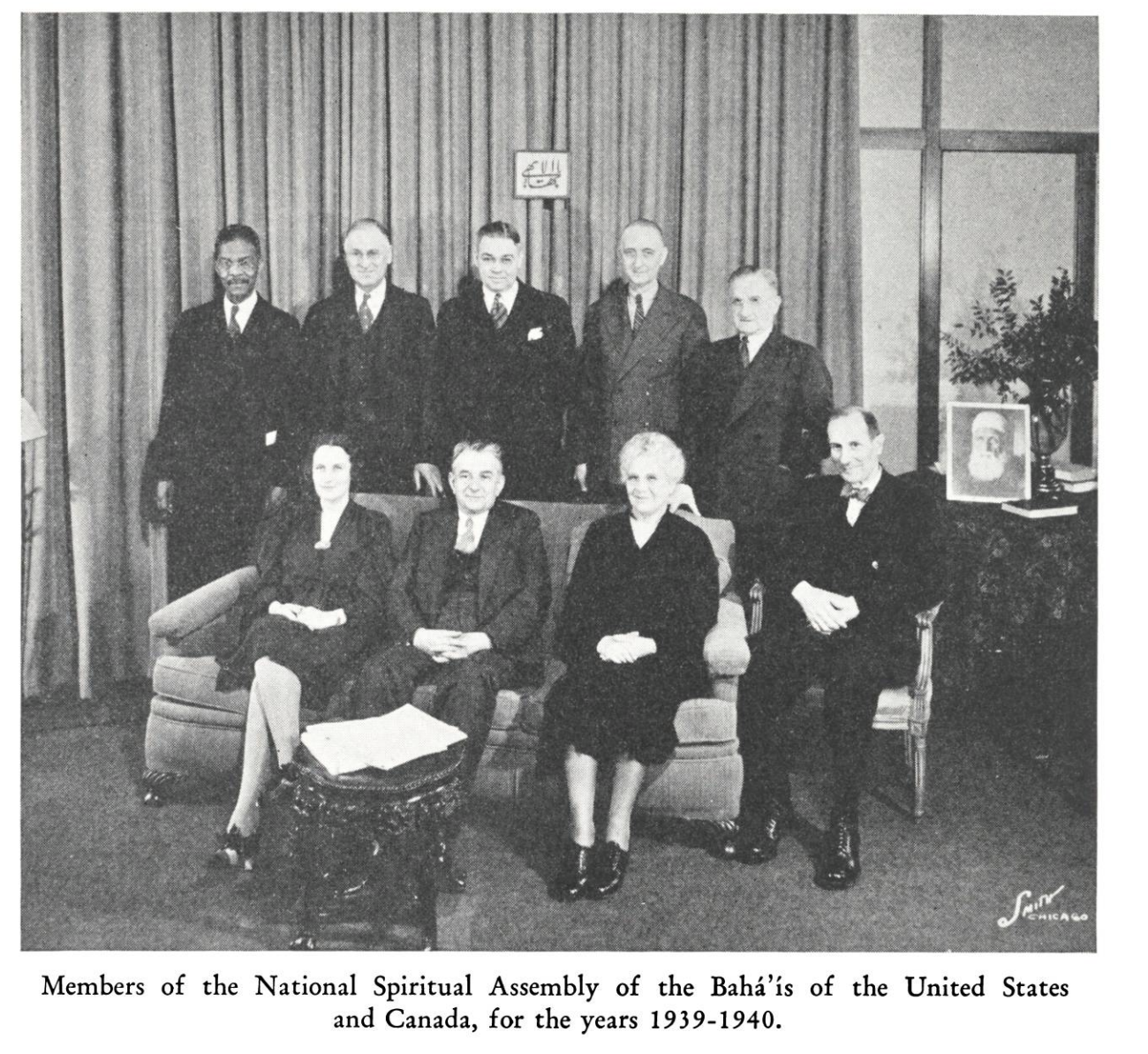
Back row: Louis Gregory, Harlan F. Ober, Leroy Ioas, Horace Holley, Siegfried Schopflocher. Front row: Dorothy Baker, Allen B. McDaniel, Amelia Collins, Roy Wilhelm.
Friends, old and new, met in the same beautiful place a year later, with the same theme of universal unity in their minds and hearts, for a conference of five sessions . The chairmen of the various meetings were Horace Holley, ‘Ali-Kuli Khan, N. D., Miss Lorna B. Tasker, Matthew W. Bullock, and Harlan F. Ober. These friends gave of their noble talents, keeping the gatherings upon a high plane of dignity, light, love, happiness and spirituality.
The Portsmouth Herald, published in the nearby City of Portsmouth, gave the following report and summary of the conference:
“The Racial Amity Conference ended its three day session at Green Acre Sunday. Mrs. Dorothy Baker gave addresses at three sessions, her subjects being, ‘The Causes and Cure of Prejudice’; ‘The Talents of Minority Groups’; and ‘Sharing Civilization.’ She advocated a better adjustment among nations and classes, universal education, spiritual as well as scientific, and a far more universal outlook for mankind.
“Another feature was the address of Miss Mabel I. Jenkins of Kittery on ‘Two Great American Poets.’ One of these was Phyllis Wheatley, the black slave girl who was a contemporary of George Washington and won high praise from him and also from other illustrious people, both at home and abroad. She was called the poet laureate of Greater Boston in her day. The second poet mentioned was James Weldon Johnson, author of ‘God’s Trombones’ and the ‘Negro National Anthem.’ The speaker told something of the life story of each, read from their poems and exhibited a collection of books by Negro poets.”
Matthew W. Bullock of Boston, chairman of the Sunday morning meeting , voiced the spirit of racial amity and read selections from the addresses of ‘Abdu’l-Bahá delivered during his tour of America in 1912, at which time he indicated to his friends some of the great happenings of today.
The afternoon forum, final meeting of the conference, was conducted by Harlan F. Ober of Beverly, Massachusetts. Among the speakers were Mrs. Doris McKay, Moncton, Canada; Mrs. Harold Hunt, Washington, D. C., who spoke for the Jewish minority; and Louis G. Gregory, presenting for discussion the subject of proper names for minonties. The musical program of the conference was presented by Mrs. Eula Fritz, Schenectady, N. Y., and Miss Monaver Bechtold, Brooklyn, N. Y.
One of the clearest signs of divine favor which attended these conferences and all similar efforts on the part of the Bahá’ís at different times of the year and over regions far and wide is their uniform confirmation and success.
Not the least of the treasures which Bahá’u’lláh has given to the world is the wealth of His prayers and meditations. He not only revealed them for specific purposes, such as the Daily Prayers, the prayers for Healing, for the Fast, for the Dead, and so on, but in them He revealed a great deal of Himself to us. At moments it is as if, in some verse or line, we are admitted into His Own heart, with all its turbulent emotions, or catch a glimpse of the workings of a mind as great and deep as an ocean, which we can never fathom, but which never ceases to enrapture and astonish us.
If one could be so presumptuous as to try and comment on a subject so vast and which, ultimately, is far beyond the capacity of any merely mortal mind to analyse or classify, one might say that one of His masterpieces is the long prayer for the Nineteen Day Fast. I do not know if He revealed it at dawn, but He had, evidently, a deep association with that hour of the day when the life of the world is repoured into it. How could He not have? Was He not the Hermit of Sar-Galú, where He spent many months in a lonely stone hut perched on a hilltop; the sunrise must have often found Him waiting and watching for its coming, His voice rising and falling in the melodious chants of His supplications and compositions. At how many dawns He must have heard the birds of the wilderness wake and cry out when the first rays of the sun flowed over the horizon and witnessed in all its splendor the coming alive of creation after the night.
In this prayer it is as if the worshipper approaches the sun while the sun is approaching its daybreak. When one remembers that the sun, the lifegiver of the earth, has ever been associated with the God Power, and that Bahá’u’lláh has always used it in His metaphors to symbolize the Prophet, the prayer takes on a mystical significance that delights and inspires the soul. Turning to the budding day He opens His supplication:
“I beseech Thee, O my God, by Thy mighty Sign (the Prophet), and by the revelation of Thy grace amongst men, to cast me not away from the gate of the city of Thy presence, and to disappoint not the hopes I have set on the manifestations of Thy grace amidst Thy creatures.” Who has not, in order to better visualize himself in relation to the Kingdom of God, seen his own soul as a wanderer, weary and hopeful, standing at the Gates of the Heavenly City and longing for admittance? The worshipper gazes at the brightening sky in the east and waits, expectant of the mercy of God. He hears the “most sweet Voice” and supplicates that by the “most exalted Word” he may draw ever nearer the threshold of God’s door and enter under the shadow of the canopy of His bounty—a canopy which is already spreading itself, in mighty symbolic form, over the world in crimson, gold, and gray clouds.
The day waxes; the oncoming sun, in the prayer of Bahá’u’lláh, becomes the face of God Himself to which He turns, addressing words of infinite sweetness and yearning: “I beseech Thee, O my God, by the splendor of Thy luminous brow and the brightness of the light of Thy countenance, which shineth from the all-highest horizon, to attract me, by the fragrance of Thy raiment, and make me drink of the choice wine of Thine utterance.”
The soft winds of dawn, which must have often played over His face and stirred His black locks against His cheek, may have given rise to this beautiful phrase in His prayer: “I beseech Thee, O my God, by Thy hair which moveth across Thy face, even as Thy most exalted pen moveth across the pages of Thy tablets, shedding the musk of hidden meanings over the kingdom of Thy creation, so to raise me up to serve Thy Cause that I shall not fall back, nor be hindered by the suggestions of them who have cavilled at Thy signs and turned away from Thy face.” How deep, how poetical, how sincere are His words! The playing of the strands of hair recall to Him the fine tracing of the Persian script, revealing words from God that shed a divine fragrance in the lives of men. But that is not all. In His communion all the love and loyalty of His heart is roused, He supplicates to be made of the faithful, whom naught shall turn aside from the Path that leads them to their Lord.
The sun has risen, as if in answer to the cry of the worshipper to “enable me to gaze on the Day-Star of Thy Beauty. …” And as he continues his prayer it seems as if all nature were moving in harmony with it: “I beseech Thee, O my God, by the Tabernacle of Thy majesty on the loftiest summits, and the Canopy of Thy Revelations on the highest hills, to graciously aid me to do what Thy will hath desired and Thy purpose hath manifested.” North and south the glory spreads, a faint echo of that celestial beauty visible to the eye of Baha’u’llah and which He says: “shineth forth above the horizon of eternity.” So deeply does it penetrate the heart that it evokes the desire to “die to all that I possess and live to whatsoever belongeth unto Thee,” The soul is moved; all earthly things pale before the vision which, as symbolized in the sunrise, it beholds in the inner world; God, the “Well-beloved” seems to have drawn very near.
The winds flit over the land; some tree calls to the Prophet’s mind, as it shivers and stirs, the Tree of Himself that over-shadows all mankind: “I beseech Thee, O my God, by the rustling of the Divine Lote-Tree and the murmur of the breezes of Thine utterance in the kingdom of Thy names, to remove me far from whatsoever Thy will abhorreth, and draw me nigh unto the station wherein He who is the Day-Spring of Thy signs hath shone forth.” Bahá’u’lláh puts the words into our mouths whereby we may draw nigher to God and receive from Him the heavenly gifts: “I beseech Thee … to make known unto me what lay hid in the treasuries of Thy knowledge and concealed within the repositories of Thy wisdom.” “I beseech Thee … to number me with such as have attained unto that which Thou hast sent down in Thy Book and manifested through Thy will.” “I beseech Thee … to write down for me what Thou hast written down for Thy trusted ones. …”
And finally, in words designed for those countless worshippers for whom He wrote this glorious Fasting Prayer, He asks God to “ write down for every one who hath turned unto Thee, and observed the fast prescribed by Thee, the recompense decreed for such as speak not except by Thy leave, and who forsook all chat they possessed in Thy path and for love of Thee.” He asks that the silence of the good may descend upon them-both the silence and the speech of chose who are wholly dedicated to that Divine Will which alone can lead men to their highest destiny. The last thought of all is that those who have obeyed the decrees of God may be forgiven their trespasses.
This majestic prayer is composed of fourteen verses, each opening with the words “I beseech Thee …” and closing with the same refrain: “Thou seest me, O my God, holding to Thy Name, the Most Holy, the Most Luminous, the Most Mighty, the Most Great, the Most Exalted, the Most Glorious, and clinging to the hem of the robe to which have clung all in this world and in the world to come.” The rhythmical emphasis on the thoughts contained in these words is not only very powerful but very artistic—if one may borrow the term for lack of a better one–and the sense that all creatures living, and chose gone before into the invisible realms of God, are clinging to the skirt of His mercy, dependent on Him and Him alone, exerts a profound influence on one’s mind, particularly so when taken in conjunction with what one beholds at this hour of the day: The sky kindling with light, the brush of the wind gently over the face of nature; the whole world waking to the casks of living on all sides; all things dependent on God; they always have and they always will be. This is a little of what this long prayer conveys to the those who partake of it.
Another unique prayer of Bahá’u’lláh is His congregation prayer for the Dead. His Revelation throughout has aimed at doing away with every form of ritual; He has abolished priesthood; forbidden ceremonials, in the sense of church services with a set form; reduced the conduct of marriages to a naked simplicity, with a minimum uniform rite required of those concerned. The one exception to this general policy is the Prayer for the Dead, portions of which are repeated while all present are standing. Prayers such as this and the one for the Fast, can never be properly appreciated by merely reading them. They are living experiences. The difference is as great as looking at a brook while you are not thirsty, and drinking from it when you are. If you lose some one you love and then read aloud the glorious words, you come to know what “living waters” are:
“This is Thy servant … deal with him, O Thou Who forgivest the sins of men and concealest their faults, as beseemeth the heaven of Thy bounty and the ocean of Thy grace. Grant him admission within the precincts of Thy transcendent mercy that was before the foundation of earth and heaven. …” Simple words, words which follow our loved one out into the spaces where we may not follow. But the profound experience of this prayer is in the refrain, each sentence of which is repeated 19 times. “We all, verily, worship God. We all, verily, bow down before God. We all, verily, are devoted unto God. We all, verily, give praise unto God. We all, verily, yield thanks unto God. We all, verily, are patient in God.”
The very strength of the prayer is in the repetition. It is so easy to say just once, “We … bow down before God” or “We yield thanks unto God” or “We are patient in God”; the words slip off our minds swiftly and leave them much as before. But when we say these things over and over, they sink very deep, they go down into the puzzled, the rebellious, the grief stricken or numbly resigned heart and stir it with healing powers; reveal to it the wisdom of God’s decrees, seal it with patience in His ways,—ways which run the stars in their courses smoothly and carry us on to our highest good.
No form of literature in the whole world is less objective than prayers. They are things of motion, not of repose. They are speeches addressed to a Hearer; they are medicine applied to a wound; they stir the worshipper and set something in his heart at work. That is their whole purpose. Teachings, discourses, even meditations, can be read purely objectively and critically, but the man who can read a real prayer in the cold light of reason alone, has indeed strayed far from his own innate human nature, for all men, everywhere, at every period in their evolution, have possessed the instinct of supplication, the necessity of calling out to something, some One, greater than themselves, whether in their abasement it was a stone image, thunder or fire, or, in their glory, the invisible God of all men that they called upon, the instinct was there just as deeply.
Many wonderful prayers exist in all languages and all religions; but the prayers of Bahá’u’lláh possess a peculiar power and richness all their own. He calls upon God in terms of the greatest majesty, of the deepest feeling; sometimes with awe; sometimes with pathos; sometimes in a voice of such exultation that we can only wonder what transpired within his soul at such moments. He uses figures of speech that strike the imagination, stir up new concepts of the Divinity and expand infinitely our spiritual horizons. Much, no doubt, of their perfection is lost in translation as He often employed the possibilities and peculiarities of the Arabic and Persian languages to their fullest. Some of His prayers, following the style of the Súrihs of the Qur’án, end every sentence in rhyme—though they are not poems—and the custom of alliterating words, thus imparting a flowing sense of rhythm to the sentences, is very often resorted to in all His writings, including His prayers. Nevertheless the original charm and beauty pervades the translations and none of the lyric quality of the following prayer seems to have been lost. It rises like a beautiful hymn which lifts the soul on wings of song:
“From the sweet-scented streams of Thine eternity give me to drink, O my God, and of the fruits of the tree of Thy being enable me to taste, O my Hope! From the crystal springs of Thy love suffer me to quaff, O my Glory, and beneath the shadow of Thine everlasting providence let me abide, O my Light! Within the meadows of Thy nearness, before Thy presence, make me able to roam, O my Beloved, and at the right hand of the throne of Thy mercy, seat me, O my Desire! From the fragrant breezes of Thy joy let a breath pass over me, O my Goal, and into the heights of the paradise of Thy reality let me gain admission, O my Adored One! To the melodies of the dove of Thy oneness suffer me to hearken, O Resplendent One, and through the spirit of Thy power and Thy might quicken me, O my Provider! In the spirit of Thy love keep me steadfast, O my Succorer, and in the path of Thy good pleasure set firm my steps, O my Maker! Within the garden of Thine immortality, before Thy countenance, let me abide for ever, O Thou Who art merciful unto me, and upon the seat of Thy glory stablish me, O Thou Who art my Possessor! To the heaven of Thy loving-kindness lift me up, O my Quickener, and unto the Daystar of Thy guidance lead me, O Thou my Attractor! Before the revelations of Thine invisible spirit summon me to be present, O Thou Who art my Origin and my Highest Wish, and unto the essence of the fragrance of Thy beauty, which Thou wilt manifest, cause me to return, O Thou Who art my God!
“Potent art Thou to do what pleaseth Thee. Thou art, verily, the Most Exalted, the All-Glorious, the All-Highest.”
At times Bahá’u’lláh put words into the mouth of the worshipper according to his need: He writes a supplication for a child, for one who is ill, one who is sad, one who is pregnant, one who is a sinner, one who pours forth his heart to God—capturing the whole gamut of human emotions in His various communions. But at times it is obvious the prayer is His own. We read it, but we cannot be the speaker, or mortal feet cannot tread the path that lay between His soul—the soul of the Prophet Himself—and the God Who sent Him here among men to labor and suffer for them. “I know not,” He declares, “what the water is with which Thou hast created me, or what the fire Thou hast kindled within me, or the clay wherewith Thou hast kneaded me. The restlessness of every ocean hath been stilled, but not the restlessness of this Ocean which moveth at the bidding of the words of Thy will. The flame of every fire hath been extinguished, except the Flame which the hands of Thine omnipotence have kindled, and whose radiance Thou hast, by the power of Thy name, shed abroad before all that are in Thy heaven and that are on Thy earth. As the tribulations deepen, it waxeth hotter and hotter.” The Holy fire that burned within His being is not for us, frail creatures that we are, to comprehend. We can only gaze into its heart and marvel at its shifting hues and beauty, much as we marvel at the flames that leap and dance on our own hearth fires, though we may not approach or touch them.
Bahá’u’lláh exalts the being and nature of God, in His addresses to Him, as no other Prophet ever has. He defines His relation to Him; He gives us glimpses of the forces surging within His soul; He lay bare the emotions that stir within His turbulent breast. In words of honey He cries out: “Thou beholdest, O my God, how every bone in my body soundeth like a pipe with the music of Thine inspiration. …” A love far beyond our ken burns in His heart for the One God who sent Him down amongst men: “Thou seest, O Thou Who art my All-Glorious Beloved, the restless waves that surge within the ocean of my heart in my love for Thee. …” “Thou art, verily, the Lord of Bahá and the Beloved of his heart, and the Object of his desire, and the Inspirer of his tongue, and the Source of his Soul.” “Lauded be Thy name, O Thou Who art my God and throbbest within my heart!” “O would that they who serve Thee could taste what I have tasted of the sweetness of Thy love!” How keenly His soul thrilled with appreciation for the aid that poured into His inmost being from the Invisible Source: “Were I to render thanks unto Thee for the whole continuance of Thy kingdom and the duration of the heaven of Thine omnipotence, I would still have failed to repay Thy manifold bestowals.” How ardent is His gratitude to His Lord for raising Him up to serve His fellowmen: “How can I thank Thee for having singled me out and chosen me above all Thy servants to reveal Thee, at a time when all have turned away from Thy beauty!”
Ever and again He confesses His readiness, nay, His eagerness, to bear every trial and hardship for the sake of shedding the light of God upon this darkened world, and in order to demonstrate the greatness of the love He feels for His Creator: “I yield Thee thanks for that Thou hast made me the target of diverse tribulations and manifold trials in order that Thy servants may be endued with new life and all Thy creatures may be quickened.” “I yield Thee thanks, O my God, for that Thou hast offered me up as a sacrifice in Thy path … and singled me out for all manner of tribulation for the regeneration of Thy people.” “I swear by Thy glory! I have accepted to be tried by manifold adversities for no purpose except to regenerate all that are in Thy heaven and on Thy earth.” “How sweet is the thought of Thee in times of adversity and trial, and how delightful to glorify Thee when compassed about by the fierce winds of Thy decree.” “Every hair of my head proclaimeth: ‘But for the adversities that befall me in Thy path how could I ever taste the divine sweetness of Thy tenderness and love?’”
With what passion and majesty He testifies to the unquenchable power and purpose of His Lord—the Lord Whom He called His “Fire” and His “Light”—which burned within His breast: “Were all that are in the heavens and all that are on the earth to unite and seek to hinder me from remembering Thee and from celebrating Thy praise, they would assuredly … fail … And were all the infidels to slay me, my blood would … lift up its voice and proclaim: ‘There is no God but Thee, O Thou Who Art all my heart’s desire!’ And were my flesh to be boiled in the cauldron of hate, the smell which it would send forth would rise towards Thee and cry out: ‘Where art Thou, O Lord of the Worlds, the One Desire of them that have known Thee!’ And were I to be cast into fire, my ashes would—I swear by Thy glory—declare: ‘The Youth hath, verily, attained that for which he had besought His Lord the All-Glorious, the Omniscient.’”
Reading such testimonials that sprang in moments of who knows what exaltation?—from the heart of the prophet, we cannot but marvel at the mighty and strange bond that binds such a Being to the Source of all power. It is as if an invisible umbilical cord tied Him to His Creator; all His life, His motivations, His inspiration, His very words, flowed down this divine channel, as all the life, blood, and food of the babe flows in through that one bond it has with its mother. He throbbed in this mortal world with the vibrations of a celestial world; He set all things pulsating with Him, whether they knew it or not, and drew them up and closer to the throne of God. One of His most moving and sublime rhapsodies is included in a meditation in which He testifies to the power of the praise which He pours out to God, to transform and influence the hearts of others: “I yield Thee such thanks,” He declares, “as can direct the steps of the wayward towards the splendors of the morning light of Thy guidance. … I yield Thee such thanks as can cause the sick to draw nigh unto the waters of Thy healing, and can help those who are far from Thee to approach the living fountain of Thy presence …. I yield Thee such thanks as can stir up all things to extol Thee . . . and can unloose the tongues of all beings to … magnify Thy beauty … I yield Thee such thanks as can make the corrupt tree to bring forth good fruit … and revive the bodies of all beings with the gentle winds of Thy transcendent grace. … I yield Thee such thanks as can cause Thee to forgive all sins and trespasses, and to fulfill the needs of the peoples of all religions, and to waft the fragrances of pardon over the entire creation. … I yield Thee such thanks as can satisfy the wants of all such as seek Thee, and realize the aims of them that have recognized Thee. I yield thee such thanks as can blot out from the hearts of men all suggestions of limitation. …”
Poetic and stirring as these words are, we need not assume them to be merely the effusions of an exalted and over-filled heart. Bahá’u’lláh was never idle in His words. If He tells us that enshrined in the thanks He poured forth to His God is a power that can blot out every limitation from the hearts of men, it is so. The trouble is with us. How many Seers and Prophets, how many scientists and pioneers, have brought men tidings of truths and powers they knew not of and offered them to their generation, only to be spat upon, laughed to scorn, killed or ignored? And in the end a more enlightened people would take the key and open the door and find the wonders that the incredulous disbelieved, to be all true, ready at hand, waiting to be used for their good. The Prophets of God are intent on giving us both the good of this world and the one awaiting us after death, but most of the time we will not have it. We, blind and perverse, prefer our own ways! Did not Christ say: “O Jerusalem, Jerusalem, … how often would I have gathered Thy children together, even as a hen gathereth her chickens under her wings, and ye would not!” It is not a new story. Every Divine Manifestation has placed jewels in the hands of man, only to see them flung aside for some foolish toy of his choosing.
Yet each Prophet has assured us that God’s pity knows no bounds. “Thou art, in truth,” states Bahá’u’lláh in one of His prayers, “He Who mercy hath encompassed all the worlds, and Whose grace hath embraced all who dwell on earth and in heaven. Who is there who hath cried after Thee, and whose prayers hath remained unanswered? Where is he to be found who hath reached forth towards Thee, and whom Thou hast failed to approach? Who is he who can claim to have fixed his gaze upon Thee, and towards whom the eye of Thy loving-kindness hath not been directed? I bear witness that Thou hadst turned toward Thy servants ere they had turned toward Thee, and hadst remembered them ere they had remembered Thee.”
It is an education in divinity to read Bahá’u’lláh’s prayers. He maintained the unique nature of God, the utter impossibility of any creature approaching or comprehending Him, in a clear and graphic manner. The unseen God of Moses; the “Father” of Christ, unto Whom none cometh to but through the Son; the One of Whom Muhammad so beautifully said: “Eyes see Him not but He sees the eyes,” is exalted, one might say, to unimaginable heights by Him. “Thou art He Whom all things worship and Who worshipeth no one, Who is the Lord of all things and the vassal of none, Who knoweth all things and is known of none.” “From everlasting Thou hast existed alone with no one beside Thee, and wilt, to everlasting, continue to remain the same, in the sublimity of Thine essence and the inaccessible heights of Thy glory,” He declares. In a short and wonderful prayer He solemnly sets forth the fundamental doctrine of the nature of God with a lucidity and power that would, in any past dispensation, have gained it first place in the dogmas of the church:
“God testifieth to the unity of His Godhood and to the singleness of His Own Being. On the throne of eternity, from the inaccessible heights of His station, His tongue proclaimeth that there is none other God but Him. He Himself, independently of all else, hath ever been a witness unto His own oneness, the revealer of His own nature, the glorifier of His own essence. He, verily, is the All-Powerful, the Almighty, the Beauteous.
“He is supreme over His servants, and standeth over His creatures. In His hand is the source of authority and truth. He maketh men alive by His signs, and causeth them to die through His wrath. He shall not be asked of His doings and His might is equal unto all things. He is the Potent, the All-Subduing. He holdeth within His grasp the empire of all things, and on His right hand is fixed the Kingdom of His Revelation. His power, verily, embraceth the whole of creation. Victory and over-lordship are His; all might and dominion are His; all glory and greatness are His. He, of a truth, is the All-Glorious, the Most Powerful, the Unconditioned.”
The “Unconditioned.” That one word provides ample food for thought. Some of the adjectives Bahá’u’lláh uses for the Godhead are most striking and seem to plow up our minds and prepare them for an infinitely deeper and richer concept of the One on Whom we depend for everything we have, be it physical or spiritual. For instance: “O God Who art the Author of all Manifestations . . . the Fountain-Head of all Revelations, and the Well-Spring of all Lights.” As words are the tools of men’s thoughts, they are tremendously important. The “Well-Spring of all Lights,” though but another way of saying, that all the Prophets are generated by God, presents a tremendous mental picture to a man who has studied something of modern astronomy, of a universe which is light upon light, of matter which itself is the stuff of which light is made. Compare the mental picture this phase conjures up with that of an anthropomorphic God, bearded, stern and much like a human grandfather, who created the world in six days and took a rest on the seventh! Though no doubt when that metaphor was propounded it opened up men’s minds to a new and wider concept of the Divinity. A being Who could do all that in six days was worthy of worship and to be strictly obeyed!
Bahá’u’lláh calls God “the Pitier of thralls,” “the Pitier of the downtrodden,” “the Help in peril,” “the Great Giver,” “the Restorer”—words which sink into our hearts these dark days with an added comfort as we see so many of our fellow-men downtrodden, in deadly danger, despoiled and broken. He tells us that this “King of Kings,” this “Quickener of every mouldering bone,” this “Enlightener of all creation” Who is the “Lord of all mankind” and the “Lord of the Judgment Day” is the One “Whom nothing whatsoever can frustrate.” Such a God will right all wrongs and rule the world for the good of man! Grievous, on the other hand, as are our sins, as testified by these words: “Wert Thou to regard Thy servants according to their deserts … they would assuredly merit naught except Thy chastisement …” He yet assures us, in the words He addresses to God, that: “All the atoms of the earth testify that Thou art the Ever-Forgiving, the Benevolent, the Great Giver …” and that “the whole universe testifieth to Thy generosity.” Even though He be the Lord “Whose strength is immense, Whose decree is terrible,” yet we can confidently turn to Him, and, in Bahá’u’lláh’s words declare: “A drop out of the ocean of Thy mercy sufficeth to quench the flames of hell, and a spark of the fire of Thy love is enough to set ablaze a whole world.”
Our world is steadily sinking into ruin. We have waxed proud and forgotten our God—as many a people has before us to its soul’s undoing—and turned away from Him, disbelieved in Him, followed proudly our own fancies and desires. No Being that was not such a Being as Bahá’u’lláh depicts would still hold open His door to us! And yet in how many passages such as these the way back, the way we once trod but have now, for the most part, forgotten, is pointed out to us and words placed in our mouths that are food for our sick hearts and souls: “Cleanse me with the waters of Thy Mercy, O my Lord, and make me wholly Thine. …” “I am all wretchedness, O my Lord, and Thou art the Most Powerful, the Almighty!” “Thy Might, in truth, is equal to all things!” “Whosoever has recognized Thee will turn to none save Thee, and will seek for naught else except Thyself.” “Help me to guard the pearls of Thy love, which by Thy decree, Thou hast enshrined in my heart.” “‘Many a chilled heart, O my God, hath been set ablaze with the fire of Thy Cause, and many a slumberer hath been awakened by the sweetness of Thy voice.”
Of such stuff as these is the treasury of prayers which Bahá’u’lláh has left us. They are suited to the child before he goes to sleep at night, to the mystic, to the busy man of practical outlook, to the devout. An instance of the comprehension and tolerance with which He viewed human nature is the fact that He revealed a choice of three daily, and obligatory, prayers. While imposing on men the obligation of turning to their Creator once, at least, during every day, He provided a means of doing so suited to widely different natures. One takes about thirty seconds to recite and is to be said at the hour of noon; one is longer and is to be used three times during the day; and the third is very long and profound, accompanied by many genuflexions, and may be used any time during the twenty-four hours of the day. The Divine Physician provided us with what we might call a spiritual polish with which to brighten our hearts. We need this renewal which comes through turning to the Sun of Eternal Truth—as every bird and beast, be it ever so humble, responds to the light of the physical sun at dawn—but he gave latitude to the individual state of development and temperament.
Some Westerners have found the long Daily Prayer very strange; no doubt this is because the present generation has ceased to feel intimate with its God. For a man to stand alone in his room and stretch his arms out to nothingness, or kneel down before a blank wall, in the midst of familiar objects, seems to him unnatural and even foolish. This is because he has lost the sense of the “living God.” God, far from being to him, as the Qur’án says, “nearer than his life’s vein,” has become more of an X in some vast equation. And yet men that we honor and men that we long to emulate have not felt shy before their God. Many a burly crusader knelt on the stones of Jerusalem where he felt His Lord’s feet might have trod, and the Pilgrim Fathers did not feel self-conscious on their knees when turning to God who had led them to a new and freer homeland. The prayers of Bahá’u’lláh will help lead us back to that warm sense of the reality and nearness of God, through use. He makes no compulsion, He takes our hand and guides us into the safe road trodden by our forefathers.
No survey, however cursory and inadequate, of His Prayers would be complete without quoting one of the most passionate and moving of them all, one associated with probably the saddest hours of His whole life. After His banishment from Persia to ‘Iráq the initial signs of envy and hatred began to be apparent from His younger brother, Mírzá Yaḥyá. In order to avoid open rupture and the consequent humiliation of the Faith in the eyes of the non-believers, Bahá’u’lláh retired for two years to the wilderness of Kurdistan and lived, unknown, as a dervish among its people.
During His absence the situation, far from improving, now that the field was left open and uncontested to Mírzá Yaḥyá, steadily deteriorated. Shameful acts took place and conditions became so acute that the believers sent a messenger in search of Baha’u’llah to report to Him and beseech His return. Reluctantly He turned His face towards Baghdad. He was going back to mount the helm; storms lay ahead of Him of a severity and bitterness no other Prophet had ever known; behind Him, once and for all, He left a measure of peace and seclusion. For two years He had communed with His own soul. He had written wonderful poems and revealed beautiful prayers and treatises. Now He headed back into the inky blackness of an implacable hatred and jealousy, where attempts against His very life were to be plotted and even prove partially successful. As He tramped along through the wilderness, beautiful in its dress of spring, the messenger that had gone to fetch Him back testified that He chanted over and over again this prayer. It rolled forth like thunder from His agonized heart:
“O God, my God! Be Thou not far from me, for tribulation upon tribulation hath gathered about me. O God, my God! Leave me not to myself, for the extreme of adversity hath come upon me. Out of the pure milk, drawn from the breasts of Thy loving-kindness, give me to drink, for my thirst hath utterly consumed me. Beneath the shadow of the wings of Thy mercy shelter me, for all mine adversaries with one consent have fallen upon me. Keep me near to the throne of Thy majesty, face to face with the revelations of the signs of Thy glory, for wretchedness hath grievously touched me. With the fruits of the tree of Thine Eternity nourish me, for uttermost weakness hath overtaken me. From the cups of joy, proffered by the hands of Thy tender mercies, feed me, for manifold sorrows have laid mighty hold upon me. With the broidered robe of Thine omnipotent sovereignty attire me, for poverty hath altogether despoiled me. Lulled by the cooing of the Dove of Thine Eternity, suffer me to sleep, for woes at their blackest have befallen me. Before the throne of Thy oneness, amid the blaze of the beauty of Thy countenance, cause me to abide, for fear and trembling have violently crushed me. Beneath the ocean of Thy forgiveness, faced with the restlessness of the leviathan of glory, immerse me, for my sins have utterly doomed me.”