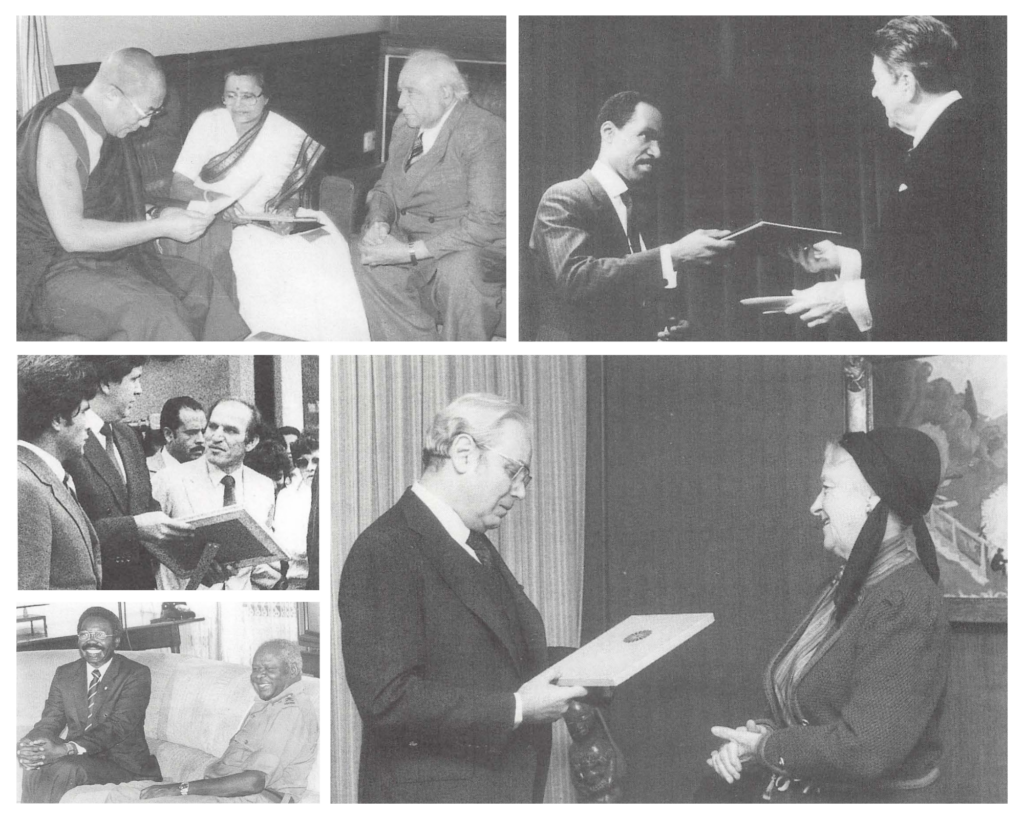
Forty years ago, the Universal House of Justice addressed the peoples of the world in a statement of notable moral clarity entitled The Promise of World Peace. Released in October 1985, it was transmitted to heads of state and governments across the globe and translated into dozens of languages. It was not a diplomatic communiqué or a policy brief, but rather a document that the Universal House of Justice itself described as a message directed to all of humanity at a moment when the question of peace had become a vital issue confronting humanity.1The Promise of World Peace, bahai.org/r/883867984.
The historical moment in which the message was produced was one of division, but also of a certain degree of hope. The Cold War continued to divide the world between two nuclear-armed superpowers, while proxy conflicts raged across Central America, Southern Africa, and Southeast Asia. In the span of just a few decades, the international community had witnessed both the founding of the United Nations and the repeated frustration of its promise to build a less violent global order. The prevailing mood was thus one of heightened danger combined with an emerging global consciousness in a growing sense that humanity could not continue along its present path without catastrophic consequences, and that it therefore needed to reflect on fundamental moral choices.
Four decades later, the world has changed in ways both expected and surprising. The Cold War ended, bringing with it a brief wave of euphoric hope for a new global order in the 1990s. That hope gradually receded with the rise of terrorism, transnational organized crime, and, more recently, the intense return of interstate conflicts affecting societies in Europe, the Middle East, and Central Asia. Running alongside these ills has been the steady growth of inequality in its most extreme forms, even as absolute poverty has declined in some populated regions like China and Brazil. What has followed is, in many respects, a recurrence of familiar pathologies in new forms: nationalism is again gaining momentum, multilateral institutions are under increasing stress, and the normalization of violence in public discourse—political, digital, and armed—has reached levels that would have alarmed even the most pessimistic observers of 1985.
This is precisely why returning to The Promise of World Peace is not an exercise in nostalgia or institutional self-celebration. Rather, it reflects an effort to engage seriously with a message that anticipated, with notable clarity, the structural conditions that continue to obstruct the progress of peace. More than that, it articulated a conceptual framework that remains relevant to challenges that secular social science has yet to fully address, grounded in the oneness of humanity, the transformation of character, and the moral prerequisites for collective security.
The main argument of this article is that the preconditions for peace identified in 1985 still have not been met. These conditions are based on the recognition of human oneness and a transformation of collective assumptions about human nature, and they are increasingly relevant in a world of rising nationalism, structural violence, and fragmented global governance. To develop this argument, this article starts by comparing the world of 1985 and now and follows examining the foundational principle of human oneness. Then, it discusses the challenges posed by the culture of violence and reflects on institutional limitations. The analysis concludes by considering the implications of the 2019 message of the Universal House of Justice,2Universal House of Justice to the Bahá’ís of the world, 18 January 2019, bahai.org/r/276724432. which expanded and deepened the 1985 framework presented in The Promise of World Peace.
A WORLD ON THE BRINK, THEN AND NOW
The Promise of World Peace was issued into a world living under the shadow of nuclear annihilation. The arms race between the United States and the Soviet Union had reached levels of destructive capacity that made mutual annihilation not merely possible but, under certain plausible scenarios, virtually automatic. Shoghi Effendi had earlier described the forces of the age as both disintegrative and integrative, pulling humanity simultaneously toward fragmentation and toward an emergent global consciousness.3The World Order of Bahá’u’lláh, bahai.org/r/536052373. The 1985 message addressed precisely that dual dynamic, insisting that the integrative forces were not incidental but constitutive of a genuine historical trajectory toward peace.
The structural parallels with our present moment are impossible to ignore. The twenty-first century has produced a reconfiguration of geopolitical risk that mirrors, in many respects, the multipolar instabilities of the pre-1945 order. The erosion of the liberal international order, expressed in the weakening of multilateral institutions, the rise of nationalist populism across both hemispheres, and the breakdown of shared epistemic frameworks that once made diplomacy possible, now recalls the fractured world the 1985 statement sought to address. The Universal House of Justice observed in 2019 that “many of the dominant currents in societies everywhere are pushing people apart, not drawing them together” and that “the forces of disintegration regroup and gain ground.”418 January 2019, bahai.org/r/963030050. The intervening decades have not resolved the tensions of 1985; they have, in many ways, intensified them.
Inequality, another structural precondition of violence that the document identified, remains persistent. The global economy has delivered unprecedented aggregate wealth while simultaneously concentrating it in ways clearly recognized as incompatible with peace. Political and economic systems have enabled the enrichment of small circles with conspicuously excessive wealth, a condition the 2019 message described as one that “fuels fundamental instability in world affairs.”518 January 2019, bahai.org/r/963030050. This is not merely a matter of economic injustice, critical as that is; it is also a generator of the structural violence that peace researchers have long identified as an obstacle to positive peace.6Johan Galtung, “Violence, Peace, and Peace Research,” Journal of Peace Research 6, no. 3 (1969): 167–191, jstor.org/stable/422690. In other words, it is under conditions of inequality that certain populations become more exposed to a form of violence that does not necessarily kill outright but nevertheless produces hunger, precarious living conditions, and a systematic denial of human dignity.
The ecological dimension of peace, the recognition that no lasting social order can be built on the destruction of the planetary commons, was not yet clearly visible in 1985. Subsequently, the Bahá’í International Community has helped to reflect on this very question, as illustrated by its contributions to the COP30 conference in Belém, Brazil. There, representatives emphasized that the climate crisis is not merely a technical or economic challenge but a profoundly ethical and spiritual one, calling for a sense of shared responsibility across generations.
Yet amid this constellation of challenges, the core insight of The Promise of World Peace remains as clarifying as ever. Peace is not primarily a set of policies or treaties. It is a social and moral process grounded in the recognition of shared humanity. The Universal House of Justice understood that the instruments of peace, including international institutions, arms agreements, and diplomatic frameworks, are necessary but not sufficient. They require a corresponding transformation in human consciousness and in the structures that shape it. This is the dimension that has remained most underdeveloped, and it is also where the document’s contribution has been most consistently underestimated.
PRECONDITIONS FOR PEACE: THE ONENESS OF HUMANITY AS FOUNDATION
The conceptual heart of The Promise of World Peace is a claim both simple and radical: that a just world order “can be founded only on an unshakable consciousness of the oneness of mankind.”7Promise of World Peace, bahai.org/r/674456093. This is not a rhetorical flourish, but rather a concept presented as the organizing principle from which all other prerequisites for peace derive. The recognition of human oneness is presented not as a sentiment but as an ontological reality, one whose acknowledgment or denial has material consequences for the structures of society.
The principle is demanding in its implications. The document does not present it as an invitation to vague cosmopolitan benevolence; rather, it is a call to reorganize political, economic, and social structures in accordance with the recognition that every human being belongs, in the deepest sense, to a single community. Ultimately, our primary identity resides in the recognition that we are human beings, fruit of a single tree, and that elements of identity such as race, class, and gender, are secondary.
This means confronting the social ills that affect the recognition of the other as part of a single whole. One example is the need to overcome racism, which can be seen not as a regrettable social attitude but as a structural ordering of privilege and deprivation incompatible with peace, given it impairs one’s ability to recognize the other as part of the same humanity. It equally means pursuing the full emancipation of women not as a concession to equity but as a precondition for the maturation of civilization. It means rethinking national sovereignty in ways that make genuine collective security possible, setting aside the self that belongs to a single country and making room for a self connected to the world. And it means transcending the causes of religious strife by recognizing the underlying unity of the world’s great religious traditions.
It is striking to note that since the 1950s, the academic field of peace studies has arrived, through a different route, at overlapping conclusions. The field recognizes that the overcoming of violence in all its forms is a central factor for peace, for it allows us to affirm that no human being should have their dignity violated, whether by direct or indirect violence. Johan Galtung’s foundational work on structural violence established that peace cannot be reduced to the absence of armed conflict, since inequality, discrimination, and the systematic denial of human potential are themselves forms of violence.8“Violence, Peace, and Peace Research,” jstor.org/stable/422690. The field developed a conceptually rich vocabulary: negative peace, understood as the absence of direct violence, and positive peace, understood as the presence of conditions that enable human flourishing. Since then, peace studies has increasingly recognized that positive peace requires structural transformation, not merely conflict management.9David P. Barash and Charles P. Webel, Peace and Conflict Studies (SAGE, 2002).
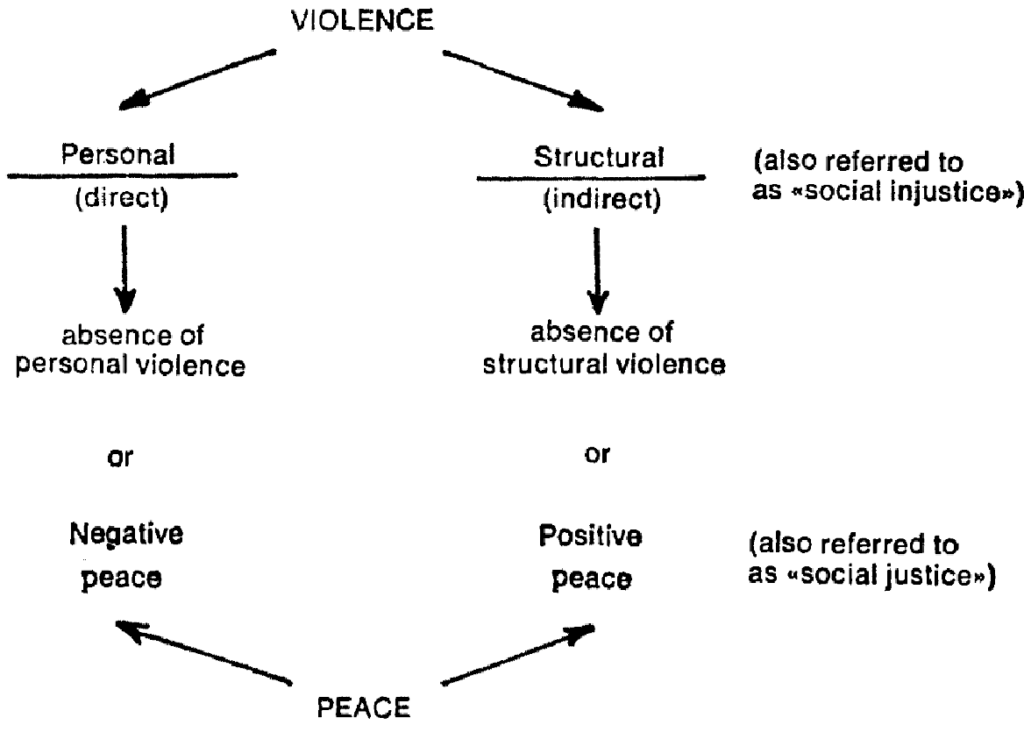
The Promise of World Peace arrives at a remarkably consonant position from a different epistemological starting point: one grounded in the spiritual reality of human oneness rather than in the empirical measurement of social inequality. What the 1985 message adds, which complements the development of peace studies, is a more explicit emphasis on the motivational foundations of structural transformation. Academic peace research is able to describe cultural and structural violence with precision, and it shares with the Bahá’í statement the same essential foundation: the recognition of the inherent dignity of every human being. Both frameworks ultimately call for the construction of lasting peace on the basis of unconditional respect for the humanity we share.10 Marcos Alana Ferreira, “Peace in Perspective: The Historical Development of Peace Studies and the Bahá’í Concept,” Journal of the Sociology and Theory of Religion 13 (2022): 297–321, doi.org/10.24197/jstr.1.2022.297-321.
Yet the statement devotes particular attention to a question that peace studies has explored more gradually: why would human beings choose to undertake the sacrifices that genuine structural transformation requires? Why would the recognition of shared humanity become not merely an intellectual position but a lived commitment? To answer these questions, one can reflect that this motivational problem cannot be resolved without engaging the spiritual dimension of human life. The reality that human beings have capacities for altruism, justice, and solidarity that are as authentically constitutive of human nature as the competitive and acquisitive instincts that dominant social theories have tended to emphasize.11Marcos Alan Ferreira and Michael Karlberg,“Bahá’í Faith,” in The SAGE Encyclopedia of War: Social Science Perspectives, ed. by Paul Joseph (SAGE, 2017), 131–133.
This argument resonates with a growing body of work in social psychology and behavioral economics that has challenged the assumption of universal self-interest as the basis of human motivation.12Kristen Renwick Monroe, The Heart of Altruism: Perceptions of a Common Humanity (Princeton University Press, 1996). But the document’s claim goes further when it places the development of altruistic capacities in an educational process grounded in spiritual values such as love, justice, generosity, and truthfulness, values that are not reducible to social incentives. In the statement’s own words, “the courage, the resolution, the pure motive, the selfless love of one people for another — all the spiritual and moral qualities required for effecting this momentous step towards peace are focused on the will to act.”13Promise of World Peace, bahai.org/r/347891062. In this respect, The Promise of World Peace anticipates a turn in peace studies scholarship that has recently begun to take seriously the role of moral and spiritual formation in the construction of peace.14 John Paul Lederach, The Moral Imagination: The Art and Soul of Building Peace (Oxford University Press, 2005).
Contemporary manifestations of the identity politics the document warned against have made this analysis more, not less, relevant. The 2019 letter described how countless permutations of “us” and “them” define group identities in ever-narrowing opposition. The fragmentation of public discourse along lines of ethnicity, nation, religion, class, and ideology reflects precisely the structural breakdown of shared identity that the 1985 statement diagnosed. The prescription remains the same. The document is explicit that diversity is a source of richness rather than a problem, so the goal is not the erasure of difference. What is required instead is the recognition of a shared humanity that is prior to and more fundamental than any of the partial identities that divide us.
DECONSTRUCTING A CULTURE OF VIOLENCE
As briefly presented above, one of the most intellectually distinctive contributions of The Promise of World Peace is its challenge to the conception of human nature that underlies most modern social institutions. The document explicitly rejects the view that human beings are “incorrigibly selfish and aggressive,” locating the persistence of violence not in an immutable human nature but in distorted social conditions and entrenched assumptions that have shaped institutional life.15Promise of World Peace, bahai.org/r/844922602. This claim converges with the Bahá’í conception of human nature as characterized by dual capacities for egoism and altruism, competition and cooperation—and the extent to which either develops is a function of education, cultural environment, and will.16Ferreira and Karlberg,“Bahá’í Faith.”
The significance of this claim extends beyond its contribution to peace theory. It has direct implications for how we understand and address what has come to be called the culture of violence—the normalization of violent behavior, violent discourse, and violent social arrangements as features of ordinary life rather than exceptional pathologies. A culture of violence is not sustained by individual moral failure alone, but it is reproduced through institutional structures, educational systems, media environments, and the implicit values encoded in economic and political life.17Johan Galtung, “Cultural Violence,” Journal of Peace Research 27, no. 3 (1990): 291–305. The 1985 document grasped this dynamic clearly, understanding courage, resolution, and selfless love as mighty forces in the establishment of peace that must be cultivated through sustained social processes, not assumed as natural givens.
Brazilian social reality offers a pointed illustration of how deeply embedded the culture of violence can be. The colonial foundations of Brazilian society established a hierarchy of violence—especially against indigenous peoples, enslaved Africans, and women—that has been reconstituted in different institutional forms across the centuries. Current data on femicide, on police lethality directed disproportionately at black Brazilians, and on the political mobilization of authoritarian discourse reveal the continuing force of structural and cultural violence in a society that has also, paradoxically, produced some of the world’s most creative experiments in community peacebuilding.18 Fórum Brasileiro de Segurança Pública, Anuário Brasileiro de Segurança Pública 2024 (FBSP, 2024). This paradox is not unique to Brazil; it is a condition of the transitional age the document described and can be seen in other societies in different continents.
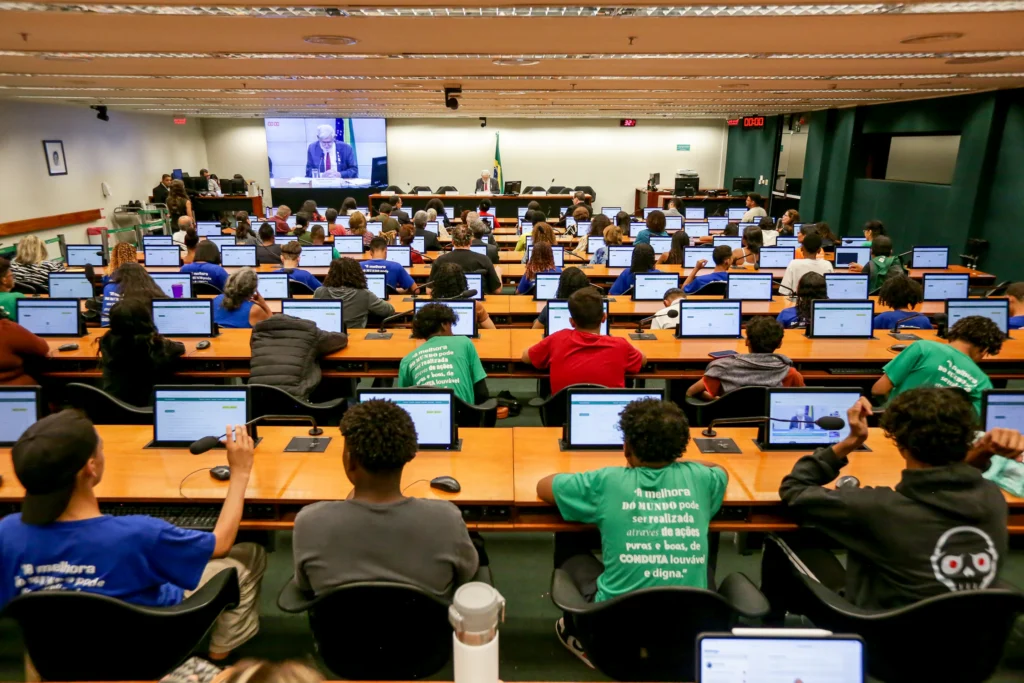
The connection between the framework delineated in the statement of the Universal House of Justice and contemporary scholarship on deconstructing cultures of violence is instructive. Galtung’s concept of cultural violence provides a useful vocabulary for what the document diagnoses. By cultural violence, Galtung means those aspects of the symbolic sphere of our existence, including religion, ideology, language, and art, that serve to justify or legitimize direct or structural violence.19Galtung, “Cultural Violence.” The Promise of World Peace identifies specific barriers that operate in this cultural sphere: racism, unbridled nationalism, religious strife, and the denial of women’s full equality. These are not merely regrettable attitudes but deep-seated cultural legitimizations of conflict. Yet the document’s response to this diagnosis is not primarily legislative or punitive. Instead, it is educational and spiritual. The transformation of consciousness, grounded in the recognition of the oneness of mankind and mediated through consultative action, constitutes the primary instrument of change. Thus, world order can be founded “only on an unshakable consciousness of the oneness of mankind,”20Promise of World Peace, bahai.org/r/674456093. a spiritual truth which all the human sciences confirm.
This is a point where the Bahá’í framework enriches rather than simply replicates the peace studies tradition. Peace research has developed sophisticated analyses of the causes of violence and proposed a range of institutional remedies. What it has engaged more tentatively is the question of how values change and how the moral imagination of communities can be transformed in ways that make alternative social arrangements not only theoretically conceivable but practically realizable.21Lederach, The Moral Imagination. The mode of operation of the Bahá’í community since the 1996 message—focused on the spiritual education of children and youth, on devotional and reflective community life, and on the constructive engagement of all institutions of society in the cultivation of peaceful values—suggests a program for moral and cultural transformation irreducible to policy reform alone, as is often suggested by institutionalist approaches to peace.22 Barash and Webel, Peace and Conflict Studies.
INSTITUTIONS, STRUCTURES, AND THE MORAL PRECONDITIONS OF PEACE
The Promise of World Peace is notable for the care with which it distinguishes between the practical instruments of peace—arms agreements, international institutions, legal frameworks—and the deeper structural and moral prerequisites without which those instruments cannot function. The document acknowledges the importance of a world authority adequate to ensure peace, and it endorses the principle of collective security that Bahá’u’lláh first articulated in the nineteenth century. But it insists with clarity that treaties and institutions are not self-executing. Actually, they depend for their effectiveness on the degree to which they are grounded in genuine, shared commitments and on the moral quality of the human beings and communities that sustain them.
This insight has been vindicated repeatedly by the history of international institutions since 1985. The United Nations, the most ambitious experiment in collective security yet attempted, has made real contributions to international stability. These contributions have been consistently supported and encouraged by the Bahá’í community, while also calling for the deep structural reforms that would allow the UN system to advance peace in a more just and functional manner.23Ferreira and Karlberg,“Bahá’í Faith.” But the UN’s limitations have been equally visible. It has been unable to prevent the resurgence of great power competition, the erosion of multilateral norms, or the instrumentalization of humanitarian language for purposes of national interest. The repeated paralysis of the Security Council has shown with painful clarity that institutional architecture alone is insufficient when it lacks corresponding political will. And that political will is itself a function of deeper moral and social conditions.
The document’s observation that statesmen of the world were faced with a crisis unprecedented in human history remains accurate in 2025, though the crisis has multiplied and intensified. The proliferation of non-state armed actors, the weaponization of information technology, the global ecological crisis, and democratic backsliding visible across multiple regions have added dimensions that the 1985 statement could not have fully anticipated. But the document’s core diagnosis retains its explanatory force. The international order is structurally inadequate because it has not been built on the recognition of the oneness of humanity as a prerequisite for a peaceful international order.
The Universal House of Justice’s 2019 message elaborated this institutional analysis in ways faithful to the 1985 framework while responsive to intervening developments. It observed that the forces of disintegration, including the resurgence of racism, nationalism, and partisanship, had undermined the willingness “to engage in international collective action” that had once “represented a powerful strain of thinking among world leaders.”24 18 January 2019, bahai.org/r/963030050. This regression, the message argued, was not permanent; but, it acknowledged with characteristic realism, the path to unity might be tortuous and the world might face further suffering before the necessity of a genuine new order became inescapable.
The implication for those committed to peace is not passivity but a clear-eyed understanding of where the leverage points for change actually lie. Institutions fail when they are not grounded in shared moral commitments. Therefore, the cultivation of those commitments through education, community life, public discourse, and constructive action is not a secondary activity that can await institutional reform. It is the precondition for institutional reform. In this sense, the promotion of peace is fundamentally a work of culture. It means changing what communities value, what they celebrate, what they teach their children, and what they regard as the non-negotiable commitments of shared life. This is a work that must take place at multiple levels, from the local to the international, and it must resonate with values that can overcome the different forms of violence that impact peace.
LESSONS FROM 2019 AND BEYOND: TOWARD A PRACTICE OF PEACE
The Universal House of Justice’s letter of January 2019, addressed to Bahá’ís around the world on the occasion of the centenary of the Paris Peace Conference, offered a sustained reflection on the state of the peace project and on the continuing responsibilities of those committed to it. It did not supersede The Promise of World Peace; it deepened it, taking into account the current affairs of the world. And in doing so, it shifted the emphasis in ways instructive for understanding what a practice of peace might look like in the present moment.
The 2019 message drew attention to the Bahá’í community’s four-decade project of patiently refining the social model implied by the 1985 statement, building and expanding a system of social organization based on Bahá’u’lláh’s teachings. Unlike the 1985 statement, which was primarily diagnostic and prescriptive, the 2019 letter showed that those conditions were not merely being advocated for but were being enacted through a learning process in communities that raise children without the contamination of racial or national prejudice, that pursue the full equality of women and men, that welcome the followers of every faith and of none to their devotional gatherings, and that develop the capacity to engage those around them, regardless of creed, culture, class, or ethnicity, in conversations about how to realize both the spiritual and material well-being of their communities.
This emphasis on community building as a contribution to peace is not merely a Bahá’í institutional claim; it reflects a growing recognition in peace scholarship that the construction of positive peace is a grassroots process that cannot be imposed from above or achieved through elite negotiation alone. John Paul Lederach’s work on peace practice has argued, with considerable empirical support, that sustainable peace requires the cultivation of moral imagination—the capacity of communities to envision and enact relationships that transcend the cycles of violence in which they are embedded.25Lederach, The Moral Imagination. Elise M. Boulding’s vision of a culture of peace similarly emphasized the primacy of everyday social relationships, family life, community bonds, and the practices of mutual care and respect in building the foundations of a peaceful world.26Cultures of Peace: The Hidden Side of History (Syracuse University Press, 2000). The Bahá’í understanding of peace as, in the first instance, an accomplishment of individuals and communities with institutions playing a supporting rather than a determining role, aligns with and enriches this tradition developed by scholars like Boulding and Lederach.
The 2019 message also underscored the importance of contributing to the discourses of society. This means Bahá’í individuals and communities engaging in the intellectual, cultural, and civic conversations that shape how societies understand themselves and their possibilities. Peace is not only built in communities. It is also advocated, narrated, and imagined. This engagement with narratives is itself a form of peace work. It determines what counts as normal, what counts as possible, and whose experiences are rendered visible. Organizations engaged in the deconstruction of violence in contexts like Brazil have recognized this dynamic. For example, they have learned that the battle for the narrative of public security is as important as any programmatic intervention. Hegemonic discourses of fear and force must be contested through the construction of alternative narratives grounded in hope, justice, and the dignity of local communities.27 Office of External Affairs of the Bahá’ís of Brazil, “Síntese da Coalizão Desconstrução da Violência” (2026); unpublished document circulated among civil society engaged in peace discourse.
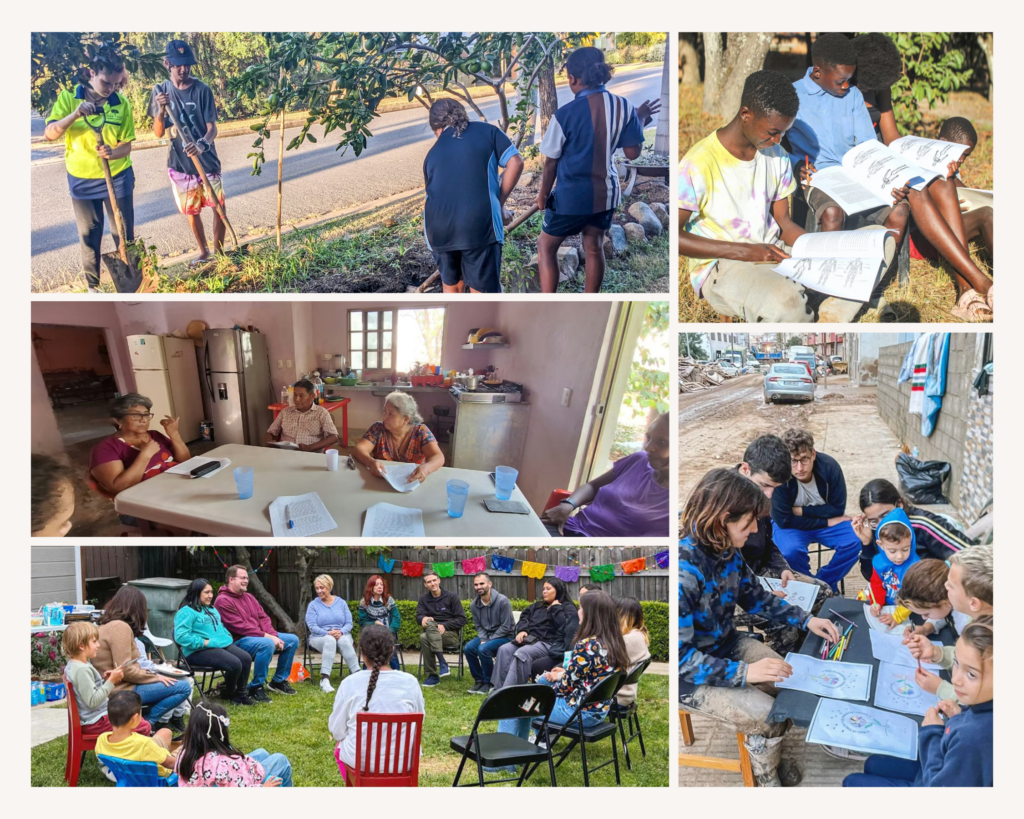
The 2019 letter’s emphasis on youth is similarly worth dwelling on. Young people distinguished by their commitment to a society built on peace and justice and their engagement in the work of building communities on that foundation are not merely a rhetorical constituency; they are the primary vehicle through which the transformation of culture across generations is achieved. The systematic cultivation of moral and spiritual capacities in children and adolescents is among the most consequential forms of peace work available to communities. This cultivation happens through educational processes that develop not only cognitive skills but also the virtues of truthfulness, empathy, justice, and solidarity.28 Ferreira, “Peace in Perspective,” doi.org/10.24197/jstr.1.2022.297-321.
THE PROMISE, STILL A PROJECT
The Promise of World Peace is now forty years old. Yet it continues to speak to concrete needs in today’s world. It speaks to the need to deconstruct violence and to build peace. The document understood that peace is a social and moral achievement, not merely a diplomatic arrangement. It understood that the structures of violence are reproduced through the values embedded in institutions, education systems, and cultural life. Transforming those structures requires attending to the moral and spiritual formation of persons and communities. And it understood that the recognition of the oneness of humanity is not a sentiment but an organizing principle with practical implications for every domain of social life.
What has changed in forty years is not the validity of these insights but the urgency with which they apply. The resurgence of nationalism, the intensification of structural inequality, the weaponization of digital information environments, the ecological crisis, and the persistent normalization of violence in politics and public life have made the document’s diagnosis more, not less, accurate. The questions posed in 1985 remain unanswered. Humanity must decide whether it will build a world order that reflects its deep interdependence and the spiritual reality of its oneness.
For peace researchers, the document offers resources that bring into focus an element still underexplored in much of the field: the importance of moral and spiritual values that cultivate peace, not merely institutional designs. It presents an account of human nature as genuinely dual, capable of both egoism and altruism—and the latter’s need to be developed for a peaceful society. It offers a conception of the motivational foundations of peace that takes seriously the spiritual dimension of human experience. And it provides a model of community life as a site of moral and cultural transformation rather than merely a setting for institutional interventions. For communities committed to peace work, the document offers something more immediate: the conviction that every act of building genuine human solidarity in families, neighborhoods, schools, and civic associations is a contribution to a historical process whose trajectory is, for all its tortuousness, ultimately assured.
Four decades after it was written, The Promise of World Peace remains what it was in 1985: not a prediction of how peace will come, but a map of what it will require. The work of realizing that promise is the work of our generation.
A central tenet of the Bahá’í perspective on history is that humanity has reached the point at which a lasting global peace is “not only possible but inevitable.”1Universal House of Justice, The Promise of World Peace (Bahá’í World Centre, 1985), bahai.org/r/981833506. Yet if peace is indeed inevitable, the path towards it has been neither straightforward nor uninterrupted. The twentieth century witnessed the establishment of unprecedented institutions of international cooperation, accompanied, at certain moments, by shifts in political culture and public consciousness that seemed to signify a new era in international relations. However, from a vantage point a quarter of the way through the twenty-first century, it is clear that the project of building a united and effective global order is far from complete, and indeed in some respects appears to be in reverse. As the Universal House of Justice observes:
For many decades following the second great war of the twentieth century, humanity moved, with fits and starts, toward the promise of a united world. The failure to complete the project of the unification of nations, however, left gaps in relations in which supranational problems could fester and threaten the security and well-being of peoples and states, leading to a recrudescence of prejudice, of divers expressions of factionalism, and of virulent nationalism that are the very negation of Bahá’u’lláh’s message of peace and oneness.2Letter written on behalf of the Universal House of Justice to an individual, 27 April 2017, bahai.org/r/362945323.
Within this political and historical context, this article explores two questions. First, why did previous attempts to reach for lasting peace not succeed? Second, what conceptual and moral shifts stand between humanity and this long-cherished goal? If the obstacles to peace were merely technical or institutional, they might have been overcome long ago. The persistence of conflict and division suggests that a deeper transformation is required. What might be among the fundamental adjustments necessary for the establishment of a durable peace?
Reaching for Peace
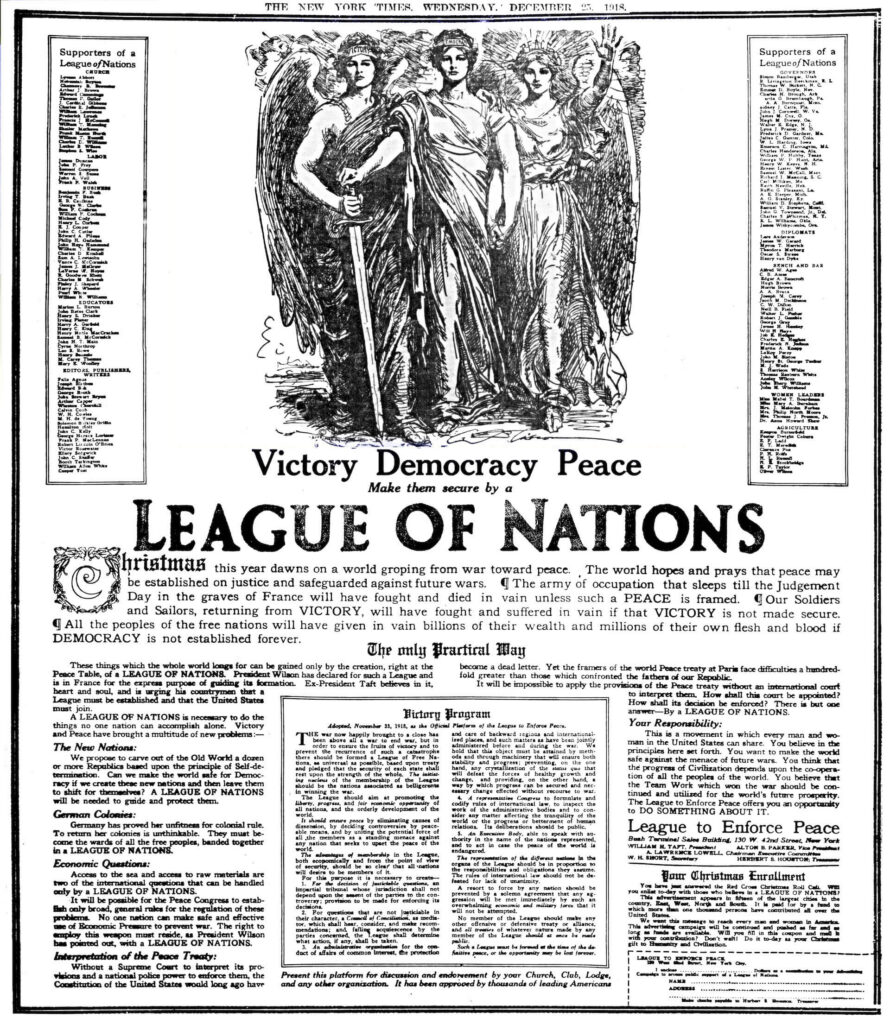
In a message dated 18 January 2019, the Universal House of Justice comments on the progress towards world peace that has been made over the past century, and analyzes some of the causes of the regressive steps of recent years. In the letter, the House of Justice identifies three moments in which mankind seemed to be “reaching for real, lasting peace, albeit always falling short”: the two periods immediately following the First and Second World Wars, and the post-Cold War period.3Letter of the Universal House of Justice to the Bahá’ís of the world, 18 January 2019, bahai.org/r/276724432. The first moment saw the establishment of the League of Nations after the First World War. This represented the earliest attempt at a global collective security mechanism in history, and was accompanied in the 1920s by treaties and statements from intergovernmental meetings that explicitly rejected war as an instrument of foreign policy—a novel development in international relations at the time.4These included the Locarno treaties and the 1928 Kellogg-Briand Pact which explicitly renounced war “as an instrument of national policy.” See avalon.law.yale.edu/20th_century/kbpact.asp. Tragically, of course, the League of Nations was hampered from birth by the non-participation of the United States, and by the harsh settlement imposed on the defeated powers from the First World War, sowing the seeds of resentment that would ignite a second global conflict two decades later.
The second attempt at peace initially appeared more promising. The United Nations and the series of accompanying economic institutions established in the wake of the Second World War were broader-based in their membership, and were accompanied by advances at the level of thought and political culture, with the creation and ratification of foundational agreements related to human rights and international law. What is interesting to note about this period is not only the list of institutions that were established, or the treaties signed, but the tenor of public discourse. During this period, following the bombings of Hiroshima and Nagasaki, a wide range of scientists, political figures, jurists, journalists, and authors advocated for a world state powerful enough to prevent nuclear destruction. Albert Einstein, for example, conducted an extended publicity tour advocating for global government, while his colleagues on the Emergency Committee of Atomic Scientists lobbied for integrated global control of nuclear weapons.5Dexter Masters and Katharine Way, eds., One World or None (McGraw-Hill, 1946). Multiple resolutions introduced in the US Congress supported the creation of a world federation or transformation of the United Nations along world state lines, and major hearings on world government proposals were held by foreign affairs committees in both the US House and Senate in 1949 and 1950. Elsewhere, public support for a union of Atlantic democracies was expressed in 1949 by the foreign ministers of Great Britain, Italy, the Netherlands, Norway, and Belgium, as well as by the Canadian Senate.6Daniel Deudney, “Greater Britain or Greater Synthesis? Seeley, Mackinder, and Wells on Britain in the Global Industrial Era,” Review of International Studies 27, no. 2 (2001): 187–208, jstor.org/stable/2009772. In India, Mohandas Gandhi and Jawaharlal Nehru made a world federal government central to the 1942 Quit India Resolution, framing it as a remedy for Western imperialism.7Luis Cabrera, “Global International Relations and Indian Visions of World Government,” Global Studies Quarterly 5, no. 3 (2025), doi.org/10.1093/isagsq/ksaf061. Several organizations were founded in this period to draft a “world constitution.”8Joseph Preston Baratta, The Politics of World Federation (Praeger, 2004). World federalism drew support not only from academic, scientific, economic, and political elites, but also from relatively broad cross-sections of the population (at least in surveyed countries). In June 1946, for example, a Gallup poll asked Americans: “Do you think the United Nations Organization should be strengthened to make it a world government with power to control the armed forces of all nations, including the United States?” The results showed 54% in favor and 24% opposed, with the remainder undecided.9Luis Cabrera, “World Government: Renewed Debate, Persistent Challenges,” European Journal of International Relations 16, no. 3 (2010): 511–30. Indeed, similar surveys across the period 1946-1949 showed substantial American support for strengthening the United Nations into a world government, with approval ratings ranging from 52-77%. One reason to highlight this example is that the US is now one of the countries where respondents are more skeptical than the global average regarding the desirability of world government.
If nothing else, these examples illustrate that the terrain of public discourse is not fixed and that what appear to be immovable boundaries in public opinion, or hard constraints of political possibility, can, and indeed do, change dramatically over time. In the case of the mid-century postwar moment, however, this upsurge in discourse around world government receded as attempts to strengthen global government, notably in response to the threat of nuclear war, failed in an atmosphere of growing tension between the United States and the Soviet Union. As a result, political, scholarly, and public attention drifted away from the idea and remained largely dormant until the end of the Cold War.
The Third Moment
The third moment of reaching for peace stands much closer to our present historical juncture. During the 1990s there was a significant expansion in the range and strength of systems designed to foster international cooperation, exemplified by a series of conferences on thematic issues organized under the auspices of the UN, various developments in the area of international law including the adoption of the Rome statute leading to the creation of the International Criminal Court, and the formulation of the Millennium Development Goals. These political developments were matched by an upsurge in scholarly attention to the question of global governance (and the emergence of this term in common academic parlance).10Thomas Weiss charts how the notion of “global governance” came to displace the language of “world government” in academic and policy discourse. See Thomas G. Weiss, “What Happened to the Idea of World Government,” International Studies Quarterly 53, no. 2 (2009): 253–71, jstor.org/stable/27735096.
Alongside the political optimism of the immediate aftermath of the Cold War, a prominent feature of intellectual discourse at the time was the assumption that an expanded global order would consist largely in the progressive extension of the achievements of the modern West around the world. Francis Fukuyama’s “end of history” thesis was totemic of this assumption. Fukuyama argued that following the collapse of Soviet communism liberal democratic capitalism had emerged as the final form of human government, with no viable ideological competitors remaining.11Francis Fukuyama, The End of History and the Last Man (Free Press, 1992). Fukuyama illustrates the tenor of public and scholarly discourse at the time. His argument is more sophisticated than saying that the West had simply “won” the Cold War—he provides a Hegelian argument that liberal democracy is uniquely attractive because it best satisfies fundamental human desires for recognition and dignity. Further, he does not claim that countries will inevitably become liberal democracies, only that it has no serious competitors as a normatively compelling philosophical position. Proposals for reforming political order in this period were thus often proposals for globalizing aspects of the economic and political model of the West.12Strobe Talbott, “America Abroad: The Birth of the Global Nation,” Time, 20 July 1992; David Held, Democracy and the Global Order (Polity Press, 1995); Bruce Russett, Grasping the Democratic Peace (Princeton University Press, 1993). In a 2005 Bahá’í World article, Michael Karlberg notes that critique of free-market capitalism is relatively widespread, including by voices within the West, but that the same has not hitherto been true of liberal democracy. The article goes on to analyze some of the limitations and pathologies of liberal democratic governance, including tendencies towards polarization, gridlock, oligarchic capture of political processes, and rising cynicism. See Michael Karlberg, “Western Liberal Democracy as New World Order?” The Bahá’í World (2005), bahaiworld.bahai.org/library/western-liberal-democracy-as-new-world-order/.
Yet against the optimism of many who assumed that liberal democracy would inexorably suffuse political systems worldwide, the first two decades of the twenty-first century have seen a series of cross-cutting trends that have undermined this narrative, and which seem to have eroded faith in the very idea of international governance. In some parts of the world, a “globalization backlash” has been expressed in phenomena such as member states withdrawing from international organizations and agreements, increasing trade protectionism, and more general protests against international institutions.13Stefanie Walter, “The Backlash Against Globalization,” Annual Review of Political Science 24 (2021): 421–42, doi.org/10.1146/annurev-polisci-041719-102405. These currents of dissatisfaction draw on a wide and sometimes contradictory range of sources—from populist nationalisms, to movements with anti-capitalist orientations, to postcolonial critiques centered on historical marginalization. Underlying many of these phenomena is a general concern that the structures and ideologies underpinning globalization serve only a small minority of the world’s population. Alongside these political developments, this period has also seen growing scholarly interest in marginalized traditions of thought, often with the goal of unmasking the “false universalism” of dominant liberal thought.14Dipesh Chakrabarty, Provincializing Europe: Postcolonial Thought and Historical Difference (Princeton University Press, 2000). Efforts to imagine an effective and legitimate global order have thus come to be constrained within the terms of an unpalatable dichotomy—between a “globalism” that embraces liberalism and free-market capitalism as its foundation and an “anti-globalism” that is suspicious of the very idea of a global order. Such suspicion reflects not only disillusionment with the prevailing model of globalization, but broader anxieties about cultural homogenization and the global concentration of power.
While social and intellectual trends have raised questions about the direction of globalization, the inherently cross-national challenges for which global institutions are designed have hardly disappeared. If anything, their intensity has grown. In the juxtaposition of these trends lies a key paradox. On the one hand, the forces propelling global integration are strengthening, and with them the necessity of global cooperation. On the other, consensus around the basis for a legitimate global order is eroding.
A Fundamental Prerequisite
Where, then, do we go from here? The vision of global integration built on liberal democratic capitalism has been criticized for its tendency to universalize particular political, cultural, and economic arrangements that themselves have not proven able to establish social harmony or justice, while a reactive skepticism of the entire project of building a unified world order offers no constructive path forward in the face of inherently transnational challenges. Neither pole offers a satisfactory response to the challenges humanity faces. The task, therefore, is twofold: to separate the notion of a unified global order from the simple extension of the methods and procedures of liberal democracy or market capitalism, and to move beyond solely critiquing a defective order by describing, with progressive clarity, what might take the place of the present “incomplete project” of the unification of nations.
Where might such an alternative foundation be identified? Each of the three historical moments examined above saw genuine advances in the machinery of international cooperation, yet none succeeded in establishing enduring peace. The post-Cold War period, in particular, demonstrated that even substantial institutional development proves insufficient when underlying questions about the nature and purpose of global society remain unresolved. The resulting dichotomy between globalism and anti-globalism reflects, at a deeper level, an absence of shared conviction about the foundations of human society capable of commanding broad allegiance. What appears to be missing are not only better mechanisms of coordination, but rather a conception of global society itself, one that can ground institutional arrangements in globally shared principles.
In examining Bahá’í contributions to public discourse on the question of peace, one idea stands out as a central conviction regarding both what is defective in the existing global order and what is required for the elusive goal of global peace and stability to be realized: the principle of the oneness of humanity. The principle not only informs visions of a future world civilization whose contours can scarcely be imagined, but also stands at the heart of contributions to contemporary discourse about what is to be done here and now.
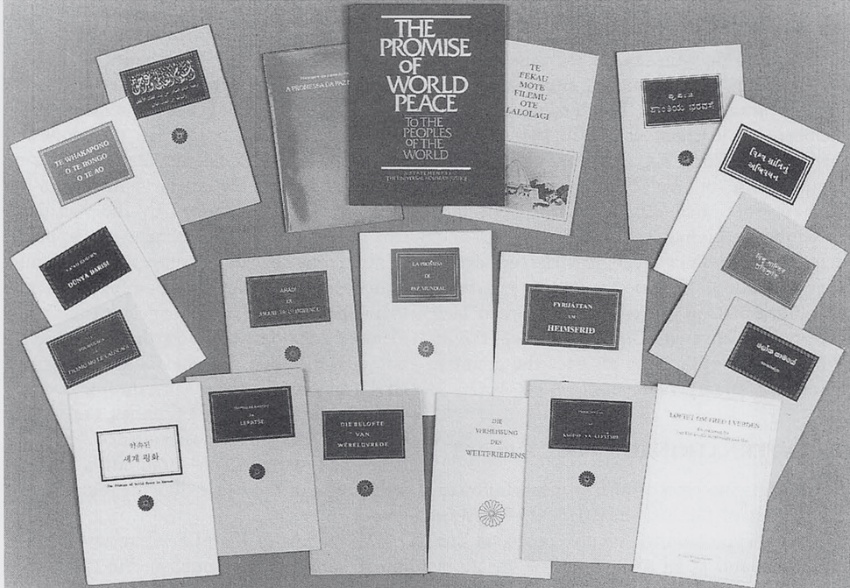
In a statement marking the seventy-fifth anniversary of the United Nations, for example, the Bahá’í International Community draws attention to the “profound convictions for our collective behaviour” that flow from the truth that “the human family is one.”15Bahá’í International Community, A Governance Befitting: Humanity and the Path Toward a Just Global Order (2020), bic.org/statements/governance-befitting-humanity-and-path-toward-just-global-order. The statement observes that the challenge of embedding the principle of oneness in the design and operation of the global order is not merely one of creating or reforming institutions, important as this is. Rather, there exists a pressing need for what the statement terms a “settled consensus” around “a set of common values and principles” capable of underpinning collective decision-making on issues affecting humanity as a whole.16Bahá’í International Community, A Governance Befitting. The Promise of World Peace, a 1985 message of the Universal House of Justice to the peoples of the world, similarly expresses this conviction, identifying the primary question confronting humanity as “how the present world, with its entrenched pattern of conflict, can change to a world in which harmony and cooperation will prevail.” Its answer: “World order can be founded only on an unshakable consciousness of the oneness of mankind….” Accepting the oneness of humanity, the message continues, represents “the first fundamental prerequisite for reorganization and administration of the world as one country, the home of humankind.”17Universal House of Justice, Promise of World Peace.
Yet what is meant by “oneness” in these contexts? And how does the principle of oneness take us beyond the familiar principles and institutions of the current discourse on global governance? Shoghi Effendi states:
The principle of the Oneness of Mankind—the pivot round which all the teachings of Bahá’u’lláh revolve—is no mere outburst of ignorant emotionalism or an expression of vague and pious hope. Its appeal is not to be merely identified with a reawakening of the spirit of brotherhood and good-will among men, nor does it aim solely at the fostering of harmonious cooperation among individual peoples and nations.18Shoghi Effendi, The World Order of Bahá’u’lláh (Bahá’í Publishing Trust, 1938), bahai.org/r/449204500.
In exploring the meaning of oneness, it is important to begin from the recognition that it would be premature to claim to comprehend anything but a fraction of its full import for the life of humanity. Clarity on what the principle of oneness entails for the next stage of social evolution will only emerge through sustained processes of learning and exploration. The full significance of the principle—including its implications for human consciousness and the very foundations of social existence—extends well beyond what any single line of inquiry can capture. The principle carries implications for many dimensions of social life, including questions of identity, the relations between diverse peoples and groups, the organization of economic life, and collective governance.19The implications of oneness for questions of identity—how we define ourselves and relate to others—have received insightful treatment recently in the pages of The Bahá’í World. See Shahrzad Sabet, “The Crisis of Identity,” The Bahá’í World, bahaiworld.bahai.org/library/the-crisis-of-identity/. This analysis follows the observation of the House of Justice in its message of 18 January 2019, that one obstacle to peace is humanity’s present “crisis of identity, as various peoples and groups struggle to define themselves, their place in the world, and how they should act.” Indeed, the promise of a global order grounded in oneness may extend beyond the achievement of more stable and just governance arrangements. As relationships among peoples are progressively reordered to reflect the reality of oneness, new horizons of possibility may emerge that cannot be anticipated at present. With all this in mind, and conscious of the constraints of inevitably limited vision, there is one particular idea this essay seeks to examine because of its relevance to current questions of political life and global order: what the concept of oneness tells us about the nature of society itself.
Conceptions of Society
Underlying most political and philosophical thought are conceptual models or metaphors which, though not literal descriptions of reality, generate distinctive conceptions of the body politic. One thinks of the market as a jungle in classical economics, the Confucian image of the extended family as a model for political relationships, or Plato’s image of the city-state as a ship requiring a wise captain. Such heuristic devices organize ideas and shape intuitions regarding the moral principles that ought to govern collective life, which in turn mold social norms and structures.
Of these various images, we can examine one in some depth as an example of how a guiding metaphor can shape the architecture of an entire tradition of political thought. The image of a social contract conceptualizes society as a collection of individuals who, despite divergent interests and beliefs, form a binding agreement to regulate social and political questions arising among them. This contract sets certain ground rules for ongoing coexistence and serves as a reference point in arbitrating disputes about what individuals owe to one another. From this deceptively simple starting point flow distinctive assumptions about persons, about what justice requires, and about the proper role of political institutions, assumptions that have also informed influential approaches to theorizing social and global order.
John Rawls’s influential theory of justice provides an instructive example of how this contractualist vision generates a framework of political principles. Rawls is a particularly helpful figure because he explicitly notes that conceptions of justice are “the outgrowth of different notions of society.”20John Rawls, A Theory of Justice (Harvard University Press, 1971), pp. 9–10. Rawls begins with a fundamental organizing conception of society as a system of cooperation between autonomous and equal individuals. He then creates the device of an “original position,” a hypothetical scenario in which parties deliberate about the terms of the social contract—the basic terms of social cooperation between them—while deprived of knowledge about morally arbitrary characteristics about themselves, such as their race, class, gender, or natural talents.
The original position serves as the mechanism for working out what free and equal individuals would agree to under conditions that model fairness. Parties in the original position are characterized by “mutual disinterest”—they are concerned with advancing their own conception of the good, but are not motivated by benevolence toward or envy of others. This assumption is not incidental: it ensures that the principles chosen are ones that individuals can accept as fair regardless of their particular conceptions of human flourishing or moral doctrines, and it models the separateness of persons that Rawls takes to be a basic fact about human beings.21Rawls is careful to distinguish between the motivation of parties in the original position and the motivation of actual persons, noting that mutual disinterest is a modeling device rather than a claim about human nature. He argues that the combination of mutual disinterest and the veil of ignorance achieves much the same purpose as benevolence, since it forces each party to take the good of others into account. See Rawls, Theory of Justice, pp. 128–29. This defense succeeds against the charge that his theory presupposes egoism. However, the choice to model fairness through mutually disinterested parties carries with it assumptions about the independent specifiability of agents’ interests that sit in tension with the idea of constitutive interdependence discussed later in this article. The framework treats others’ positions as possible locations for oneself, rather than recognizing that one’s own flourishing depends on the character of shared structures and relationships regardless of which position in society one occupies. From this architecture flows Rawls’s principles of justice. The first principle guarantees equal basic liberties for all citizens—freedoms such as political participation, expression, and conscience that rational agents would not risk losing regardless of their position in society. The second principle addresses social and economic inequalities, requiring that positions of advantage be open to all under conditions of fair equality of opportunity, and that any remaining inequalities work to the benefit of the least advantaged members of society.22John Rawls, A Theory of Justice, rev. ed. (Harvard University Press, 1999). Each element follows from what mutually disinterested parties, ignorant of their own circumstances, would rationally choose: they would secure fundamental freedoms, ensure fair access to opportunities, and, since they might find themselves among the worst off, insist that inequalities improve the prospects of those worst-off in society.
Rawls’s theory represents one example of sophisticated and nuanced contractualist thinking, which in many ways is sensitive to the balance of unity and diversity in society. The purpose here is not to criticize it, but rather to demonstrate that any such framework relies on a particular image of human nature and social order. The characterization of agents in this framework as mutually disinterested, the specification of interests prior to and independent of social relationships, and the modeling of fair agreement as that which emerges from a process of individual rational choice all form, and reinforce the notion that an individual’s core interests are understood to be independently constituted, and that social cooperation is merely an arrangement among such agents to secure fair terms despite potentially divergent interests. Importantly, the effects of contractualist thinking, of which Rawls’s view is one illustrative example, have not been confined to the academy. In direct and indirect ways, this conceptual model, which emerged during the Enlightenment and remains influential in contemporary political thought, has become embedded in the political, economic, and social lives of whole societies. Consider Rawls’s principles of justice. His first principle, guaranteeing equal basic liberties, finds expression in the broader liberal commitment that individual freedom can only be constrained in order to prevent harm to others.23It should be noted that several of the principles discussed here, including the harm principle, also have roots in non-contractualist liberal thought, such as the work of J. S. Mill. See John Stuart Mill, On Liberty (John W. Parker and Son, 1859). The purpose of the present analysis is not to claim that the social contract tradition is the sole source of these principles, but to illustrate how a particular conception of society can underpin and give coherence to a framework of political thought. The assumption of mutual disinterest, which ensures that principles are acceptable regardless of one’s particular conception of the good, underwrites the notion that the state should remain neutral between different visions of the good life rather than promoting any substantive account of human flourishing. And the architecture of the original position, modeling society as separate individuals who must find terms of cooperation despite divergent interests, reflects the prevalent belief that governance structures and social institutions exist primarily to arbitrate between potentially divergent claims rather than to cultivate shared purposes. These and similar principles have over time become codified in constitutional documents, embedded in popular consciousness, and expressed in legal precedent.
The point is not that such principles lack merit. It is rather that they emerge from a particular conception of society and the person. When this contractualist framework is extended to theorize global order, the parties sometimes shift from individuals to states, such that global society is conceptualized as a system populated by free (i.e. autonomous) and equal (i.e. sovereign) nation-states.24There have been a number of attempts to extend the Rawlsian picture of society to equivalent analysis of the global order, with some authors, such as Charles Beitz, attempting to extend the domestic Rawlsian original position by depriving parties of knowledge of their nationality, while others, including Rawls himself, prefer to conceptualize global society as a system of cooperation between “peoples” or societies rather than between individuals, generating principles of international order that emphasize national self-determination. See Charles Beitz, Political Theory and International Relations (Princeton University Press, 1979); John Rawls, The Law of Peoples (Harvard University Press, 1999). But core elements of the underlying conception remain: separate agents with divergent interests seeking mutually acceptable terms of cooperation. Beyond explicitly nationalist or statist extensions of the contractualist conception of society, if building a just and effective global order consisted, as many assumed in the post-Cold War period, in extending the Western social and political model worldwide, it would involve globalizing something like the contractual conception of society, embedding its assumptions about persons and social cooperation in political cultures and institutions around the world.
The purpose of the analysis above has simply been to make visible assumptions that often operate invisibly—to show that the contractual framework represents one possible starting point among others, not a neutral or inevitable foundation for political thought. This recognition opens space to ask what a conception of society informed by the principle of oneness might look like, and how it might differ from the models that currently predominate.
Oneness and Global Society
With this in mind, let us return to the idea of oneness. A conception of society, including global society, as a cooperative system characterized by an essential oneness would emphasize the extent and nature of interdependence between its constituent elements, in both an empirical and a normative sense. The empirical aspect observes that the well-being of individuals and societies is connected across borders, whether through economic systems, ecological processes, technological networks, or political structures.25While the focus here is the global level, this interdependence characterizes social reality at every scale—within communities and nations as much as between them. Yet the conception is not merely descriptive. The normative component asserts that these empirical interdependencies possess constitutive rather than merely instrumental significance for human flourishing. This normative dimension transcends enlightened self-interest, which would calculate the long-term advantages of cooperation while maintaining that agents affect one another’s well-being only instrumentally, and approaches that widen the scope of moral obligation while leaving the underlying conception of agents and their interests unchanged. Constitutive interdependence makes a stronger claim and implies a transformed understanding of what constitutes interest and well-being themselves: one’s capacity to flourish is inherently limited when others suffer. This is not simply because their suffering might eventually affect one’s interests from the outside, but because flourishing itself is partly constituted by the character of one’s relationships and the health of shared structures. To put the point positively, participation in relationships of genuine reciprocity and shared endeavor may unlock, or even itself constitute, a dimension of flourishing that no degree of isolated prosperity can provide.
Each conception of society carries with it an implicit or explicit view of the person—what agents are like, what motivates them, and what constitutes their flourishing. A contractualist conception would generally assume agents whose interests can be specified independently. A conception informed by oneness, by contrast, is likely to assume that agents’ capacity for flourishing is inherently relational. Human flourishing, on this view, inherently involves the quality of relationships and systemic conditions, not merely the accumulation of goods, the satisfaction of preferences, or even access to resources and the protection of basic rights, important as these are. From this perspective, the quality of social structures partially determines individual possibilities, and societal dysfunction constrains human flourishing even for those who appear temporarily insulated.
Understanding oneness in this way—as a principle informing our conception of global society—carries significant implications. If the capacity to flourish cannot be isolated from the health of shared structures and relationships, neither can peace; and this reframes conventional thinking about what peace requires, in terms of both scope and sequence. Regarding scope, it helps to explain the claim in The Promise of World Peace that achieving peace requires removing obstacles often seen as unrelated to peace: “…the abolition of war is not simply a matter of signing treaties and protocols; it is a complex task requiring a new level of commitment to resolving issues not customarily associated with the pursuit of peace.”26Universal House of Justice, Promise of World Peace. If oneness informs our foundational conception of society, then obstacles to peace such as racism, wealth inequality, tribal nationalism, and religious sectarianism are not discrete problems to be addressed separately. They are incompatible with oneness and therefore with a society capable of genuine peace; conceptualizing social order through the lens of oneness illuminates why these diverse phenomena share a common root. Regarding sequence, oneness reveals the limitations of the assumption that unity is “a distant, almost unattainable ideal to be addressed only after a host of political conflicts have been somehow resolved”: oneness is not the fruit of solving other problems; it is the prerequisite for solving them.27Bahá’í International Community, Who Is Writing the Future? Reflections on the Twentieth Century (1999), bahai.org/documents/bic-opi/who-writing-future.
A conception of society informed by oneness, like its contractual counterpart, would not be a mere abstraction, but would carry significant practical consequences. As the discussion of Rawls illustrated, conceptions of society inform the normative principles selected to regulate collective life, which in turn shape laws, policies, and institutions. Such a conception of global society would carry with it similarly distinctive implications, both empirical and normative.
The empirical dimension directs attention to the ways in which the major challenges defining contemporary global politics demonstrate this inherent interdependence. Climate change is one clear example: no amount of national wealth can insulate a society from atmospheric changes driven by global emissions. Similarly, pandemic preparedness, financial stability, and digital technologies create vulnerabilities that transcend national boundaries and cannot be addressed through isolated action. These are not marginal issues but increasingly define the parameters within which all other political and economic activity occurs. The principle of oneness also enables us to distinguish between narrow material accumulation and comprehensive flourishing. An individual or society might increase certain metrics—household wealth, GDP, territorial control—while experiencing degradation in the broader conditions that enable genuine well-being. Rising wealth inequality in many countries coinciding with deepening polarization and weakening social trust suggests that even apparent beneficiaries of economic inequality bear costs in other dimensions of life.28Richard Wilkinson and Kate Pickett, The Spirit Level: Why More Equal Societies Almost Always Do Better (Allen Lane, 2009); Eric M. Uslaner, The Moral Foundations of Trust (Cambridge University Press, 2002).
The normative dimension carries distinctive implications for what ought to be done about these interdependencies. Enlightened self-interest might recognize that assisting developing nations creates future markets or that environmental cooperation prevents future costs. But the idea of constitutive interdependence suggested by oneness makes a stronger and qualitatively different claim: one’s capacity to flourish cannot be separated from the flourishing of others within a system of social cooperation, because the quality of shared structures and relationships is not merely an external condition affecting well-being but partly constitutive of it. Appealing to oneness to justify and appraise laws or policies may imply, among other things, that the legitimacy of domestic policies be judged by reference to their global impacts and that self-interested bargaining in global politics represents not merely a moral failure but a fundamental misunderstanding of a nation’s own interests.29See Bahá’í International Community, A Governance Befitting. A central bank’s mandate, for instance, would be framed not purely in domestic terms but in terms of contributing to the stability and health of the international economic system, recognizing this as a condition of its own society’s prosperity.30Empirical evidence suggests, for example, that increases in US interest rates trigger economic effects of at least the same size in a significant number of foreign countries, as the effect in the US itself. See Matteo Iacoviello and Gaston Navarro, “Foreign Effects of Higher U.S. Interest Rates,” Journal of International Money and Finance 95 (2019): 232–50. Agricultural support policies would be designed to strengthen food systems both domestically and internationally—asking not only whether subsidies benefit domestic producers, but whether they contribute to food security worldwide and to the livelihoods of farming communities in other countries.31Bahá’í International Community, Just, Sustainable and Resilient Food Systems: Some Considerations for the AU–EU Partnership (June 28, 2023), bic.org/publications/just-sustainable-and-resilient-food-systems. Tax regimes would be oriented toward building the shared fiscal capacity to fund public goods in every country, rather than structured in ways that encourage nations to competitively undercut one another. In each case, a oneness-informed conception of international society does not merely add global well-being as an afterthought; it reframes the very question of what constitutes effective policymaking, directing attention not only to how outcomes are distributed but to the character of the relationships through which collective life is conducted.
Oneness beyond Collectivism
The foregoing has sought to articulate, in necessarily preliminary terms, what a conception of global society informed by oneness might involve and some of its implications. Yet for all its apparent relevance to the challenges of global order, such a conception of global society has not yet permeated political discourse, let alone become embedded in social structures. This is not to say the ideal of oneness is completely absent—one can identify latent expressions of the underlying sentiment in foundational international documents such as the UN Charter. Similarly, in the more diffuse realm of public consciousness, it is common to hear in discourse, from informal everyday conversation to formal statements in global forums, recognition that in matters of public health “no one is safe until everyone is safe,” or that on climate change “the world will succeed or fail as one.” All this notwithstanding, there are many aspects of the existing global political order that do not yet reflect, or align with, the implications of human oneness. Why might this be? Why has a conception of the essential nature of social order informed by oneness not been more widely adopted?
Clearly, one significant part of the answer is a gap between moral principle and action, and a lack of willingness to “put aside short-term self-interest” on the part of individuals, governing institutions, and indeed whole societies.32Letter of Universal House of Justice to the Bahá’ís of the world, 4 January 2022, bahai.org/r/845512230. But it would appear that insufficient commitment to recognized ideals is not all that is at work here. Sustained action in pursuit of moral principles is difficult without clarity about the kind of world those principles are meant to create. There are conceptual obstacles, at least in some prevalent traditions of thought, to embracing the reality of oneness as an essential characteristic of global society. These conceptual obstacles may, by furnishing rationales for behavior inconsistent with the principle of oneness, in turn weaken the connection between the force of moral principle and political practice. When, for instance, the separateness and divergent interests of nations is treated as a basic fact of international life, policies that prioritize narrow national advantage over global well-being appear not as moral failures but as rational responses to how the world is structured.
The conceptual concern regarding oneness, while not always articulated explicitly, can be presented as follows: conceptions of society that emphasize unity, including those which draw on organic metaphors (such as the use of the human body analogy in the Bahá’í writings), have historically been deployed in service of worldviews emphasizing hierarchy, homogeneity, or the priority of the collective over the individual. Karl Popper expresses the general intuition in contrasting the collectivist ‘closed’ society, which resembles a living organism and subordinates the individual to the group, with the ‘open’ society, defined by its commitment to individual rights and personal responsibility.33Karl Popper, The Open Society and Its Enemies (Routledge, 1945), 87-88, 152-53, 166.
Clearly, this is not what the principle of oneness from a Bahá’í perspective asserts. When the Bahá’í writings make reference to the human body as a model for social relationships, this is not an understanding of the body as simply an agglomeration of interchangeable cells, whose individual character is unimportant, but rather a complex web of interdependent systems, which requires the complementary operation of differentiated components.34Further, metaphors should not be confused with descriptions of reality in and of itself. Society is not, in fact, a human body, any more than it is a contractual agreement. Such metaphors are tools that attempt to approximate certain of reality’s features for the purposes of illuminating principles relevant to social organization. Their value is demonstrated by the fecundity of the traditions of thought derived from them over time, rather than by simplistic statements about their inevitable consequences. Extending the metaphor to social organization, diversity in political cultures and institutional arrangements enables experimentation with different governance approaches, creating opportunities for learning about distinctive knowledge and practices suited to varied contexts. Further, collectivism, in problematic forms, treats society as a unified agent possessing a single system of desire, a collective entity whose judgments and purposes override or subsume individual perspectives. A oneness-inspired conception of society need not make any such claim. It would make quite a different point: that pursuing self- or national interest in ways that systematically undermine global structures or the flourishing of other segments of society represents a misunderstanding of the conditions for one’s own flourishing.
Unreflective identification of ideals of interdependence or social unity with crude collectivism, then, may help to explain why a conceptualization of global society that emphasizes its essential oneness has not been the object of greater attention. Attempts to examine the potential of conceptual models other than those dominant within the liberal tradition have perhaps been hampered by the persistence of false dichotomies. The tendency to present social organization as a binary choice between collectivism and individualism, or between liberalism and authoritarianism, may be one conceptual obstacle that needs to be overcome.
Crisis and Possibility
The foregoing analysis of twentieth-century attempts to establish peace suggests that moments of crisis often precipitate a reexamination of inadequate frameworks. Conceptions of society exert a profound influence on the intuitions, norms, and structures that shape collective life. Yet fundamental shifts in how society is understood are rarely the product of conceptual argument alone. Liberal models of social organization, for example, emerged through an interplay between philosophical reflection and the social and political action of particular groups and movements. As they form, such conceptions become embedded not only in formal structures but in popular consciousness, social norms, and everyday relationships. It follows that the process of developing a new underlying basis for global order will necessarily involve the efforts of communities and peoples in diverse settings to explore what oneness means for patterns of social organization—efforts that will, over time, generate insights and demonstrate possibilities capable of informing broader discourse and institutional change. In this sense, every segment of the world’s population has agency in the process of redefining the conceptual foundations of global society.
While the immediate prospects for peace are uncertain, the historical record also demonstrates how dramatic shifts in the landscape of political possibility can and do occur. It is not possible to predict how the integrative and disintegrative forces shaping humanity’s trajectory towards peace will unfold in the near future. Yet if enduring peace requires not only institutional arrangements but a conception of global society capable of grounding them, the work of clarifying what oneness implies for our collective life may be indispensable to the peace humanity seeks.
The author is grateful to Vafa Ghazavi, Shahrzad Sabet, and Stephen Agahi-Murphy for their input.
The equality of women and men is a spiritual reality asserted by Bahá’u’lláh and a pillar of Bahá’í belief, as evidenced by many statements in the Bahá’í writings. This spiritual reality, Bahá’ís believe, must be manifested today in its fullness in social reality.
Equality is an indispensable element for the progress of humanity, a principle which requires that women and men move forward together in dynamic partnership. ‘Abdu’l-Bahá has stated that “As long as women are prevented from attaining their highest possibilities, so long will men be unable to achieve the greatness which might be theirs.”1Paris Talks, Part 2, 40. Reiterating the principle in a statement to the United Nations in 2015, the Bahá’í International Community described the equality of women and men as “a facet of human reality” and asserted, “That which makes human beings human—their inherent dignity and nobility—is neither male nor female. The search for meaning, for purpose, for community; the capacity to love, to create, to persevere, has no gender,” concluding that “Such an assertion has profound implications for the organization of every aspect of human society.”2Toward a New Discourse on Religion and Gender Equality: The Bahá’í International Community’s Statement to the 59th Session of the United Nations Commission on the Status of Women and the 20th Anniversary of the United Nations World Conference on Women (1 February 2015), 2.
The Bahá’í community has, as a matter of faith, pursued the application of this principle over the entire span of the Faith’s history, basing its actions on Bahá’u’lláh’s statement “Praised be God, the Pen of the Most High hath lifted distinctions from between His servants and handmaidens, and, through His consummate favours and all-encompassing mercy, hath conferred upon all a station and rank of the same plane”3From a Tablet translated from the Persian, in Women, comp. Research Department of the Universal House of Justice, https://www.bahai .org/r/608244224—an assertion that was reinforced and elaborated upon in many statements and writings of ‘Abdu’l-Bahá, such as the following: “… in the sight of Bahá, women are accounted the same as men, and God hath created all humankind in His own image, and after His own likeness. That is, men and women alike are the revealers of His names and attributes, and from the spiritual viewpoint there is no difference between them.”4Selections from the Writings of ‘Abdu’l-Bahá, 38.3–4, https://www.bahai.org/r/604842208. In their efforts to realize this vision, Bahá’í individuals, institutions, and communities around the world have striven to understand more deeply its implications and have engaged in discourses and actions to promote gender equality ranging from grassroots initiatives to contributions at international fora.5See “Towards the Goal of Full Partnership: One Hundred and Fifty Years of the Advancement of Women,” The Bahá’í World 1993–94 (Haifa: Bahá’í World Centre, 1994), 237–75.
Since the Bahá’í writings emphasize both the importance of women as equal partners in the advancement of civilization and the key role of mothers as the first educators of the next generation, it was natural that the earliest endeavors in Persia focused on encouraging families to provide for the education of their girl children and on establishing schools for girls. Throughout the past century and a half, the geographical scope and range of activities related to gender equality have both broadened, and over the past 25 years, in particular, the training and community-building endeavors in which Bahá’ís in all parts of the globe are engaged have given further momentum to, and provided additional settings for, the practical expression of this principle.
DEVELOPING WOMEN’S CAPACITIES AT THE GRASSROOTS
The Bahá’í community recognizes that, while tremendous efforts in the areas of policy have been made at the international level by organizations such as the United Nations, the advancement of women cannot be brought about or sustained merely through legislation or policy directives that give women additional power within existing, unbalanced structures and systems. And even if attempts to change those social structures are made, such changes will not be sufficient to create conditions that allow women and girls to develop fully; unhealthy values may continue to be held by men and women, as well as boys and girls, sustaining exploitative behaviors.6See Bahá’í International Community, Beyond Legal Reforms: Culture and Capacity in the Eradication of Violence against Women and Girls (July 2006), 4. To effect the profound changes needed, educational processes that help to develop spiritual as well as intellectual capacities, that uphold the oneness of humanity, and that promote the equality of women and men play a pivotal role in establishing patterns of relationships that meet the needs of this age.7See Bahá’í International Community, Developing New Dynamics of Power to Transform the Structures of Society: Statement to the 64th Commission on the Status of Women (2019).
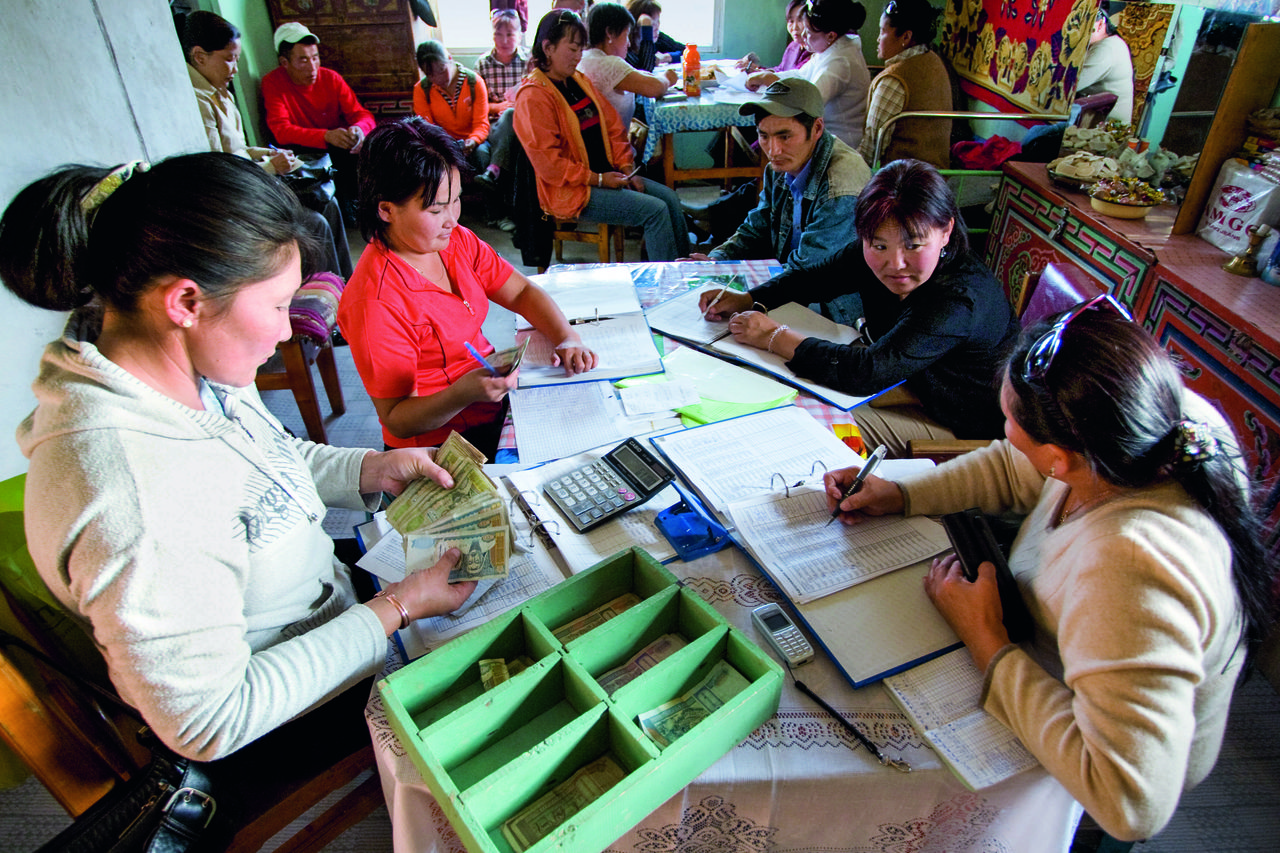
At the most basic level, the home is the nurturing ground of values such as truth or dishonesty, justice or injustice, kindness or violence. And from the home, behaviors rooted in these values radiate through society. For example, when boys are allowed to dominate their sisters within the family, what deters them from doing the same at their school or place of work—or even in national or international arenas? If, instead, sons and daughters are raised so that both participate in household duties and both participate in decision-making, these are the habits they will take out into the world as they grow to adulthood.8See Bahá’í International Community, Toward Prosperity: The Role of Women and Men in Building a Flourishing World Civilization— The Bahá’í International Community’s Contribution to the 61st United Nations Commission on the Status of Women (March 2017), 4. Efforts to nurture values that promote gender equality at the roots of community life are clearly key to change.
The purpose of the institute process which the Bahá’í community has been developing since 1996 (see “A New Institution of Learning,” in this volume) is to develop capacities in participants—women and men, boys and girls—to contribute to the spiritual and material advancement of their societies. The first quotation in the first book of the curriculum invites them to reflect on a statement of Bahá’u’lláh regarding their role as individuals: “The betterment of the world can be accomplished through pure and goodly deeds, through commendable and seemly conduct.”9Cited in Shoghi Effendi, The Advent of Divine Justice (Wilmette, Ill.: Bahá’í Publishing Trust, 1984), 24–25. The materials train participants to engage in behavior and facilitate activities that contribute directly to the advancement of the communities in which they live. Beyond the basic activities, participants acquire knowledge, skills and insights that equip them to participate in the discourses prevalent in their society and to engage in social action endeavors. Women have been at the heart of all these efforts. What is especially remarkable is that, in the aggregate, despite the vast inequalities between women and men in most societies, globally, women comprise half of those who have completed the first sequence of courses of the training institute—and in all except the first book, women outnumber men. This is also more dramatically the case in the higher sequence of courses where the ratio of women to men is around 60 percent. These remarkable statistics reflect the emphasis that the worldwide Bahá’í community places on the equality of women and men and the essential part that women play in social transformation.
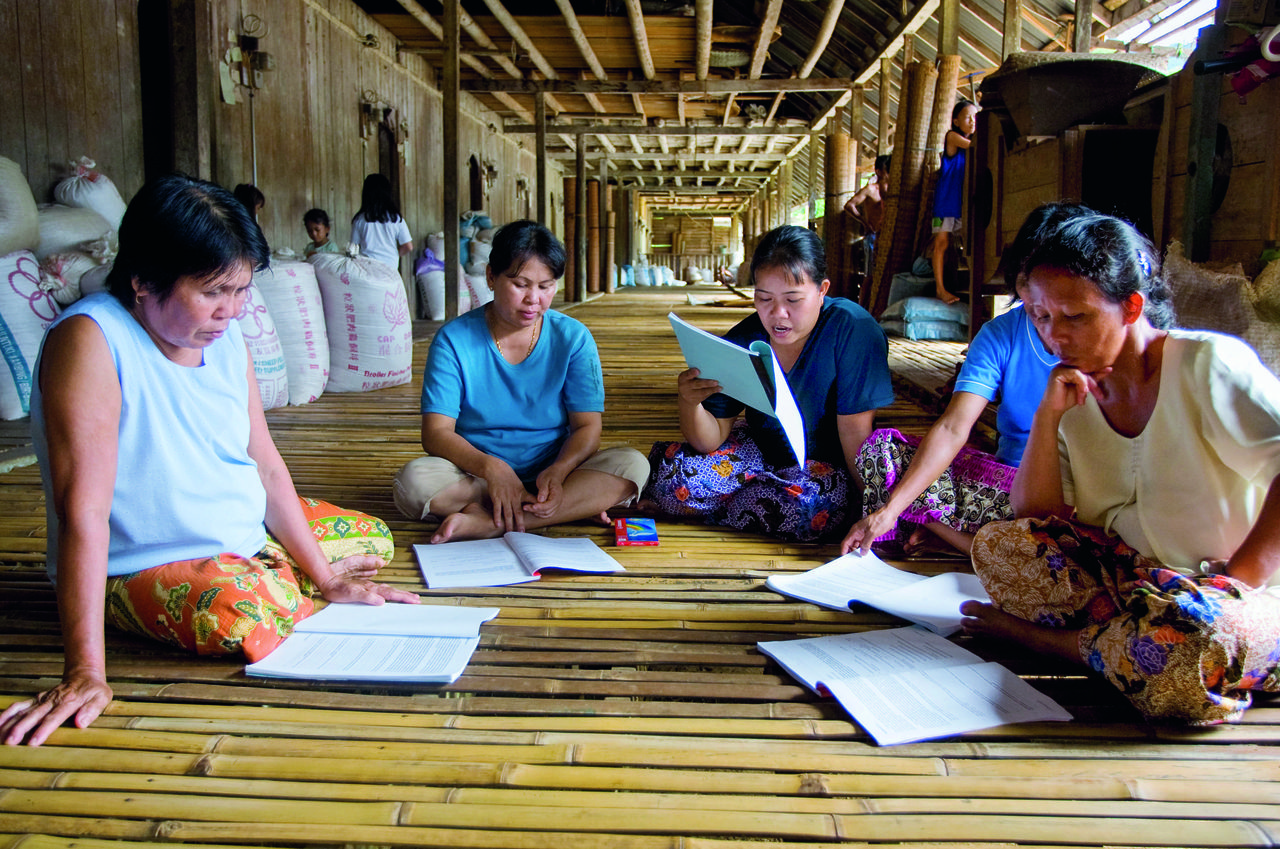
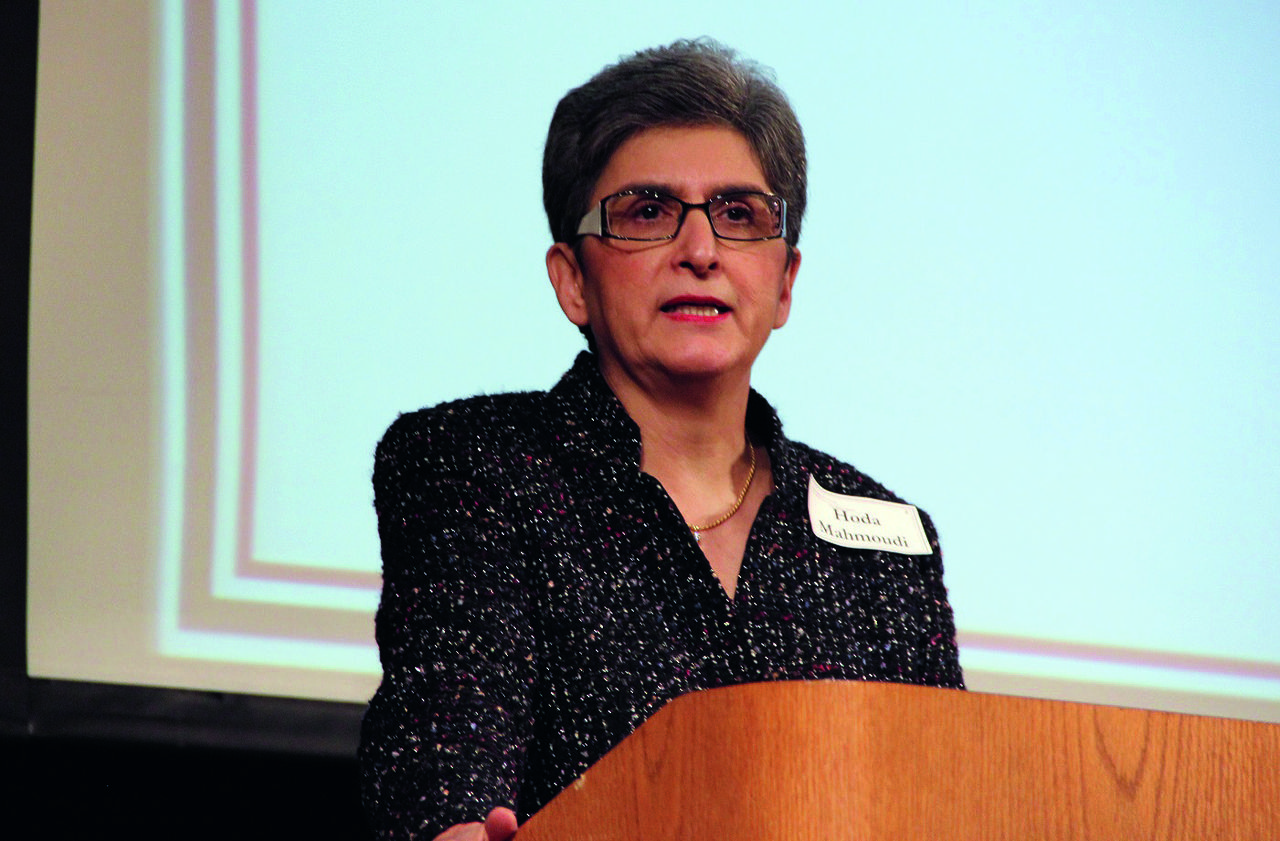
The percentage of women engaged in the educational processes of the institute reveals the central role they have played in promoting it in their own communities and in its dissemination to other parts of the world. Many of those who complete institute courses continue on to serve as tutors, teachers of children’s classes, and animators in the junior youth spiritual empowerment program. One example illustrating the level of female empowerment that has been achieved originates in the Central African Republic: In 2014, while only 20 percent of primary teachers in the national educational system were women, the percentage of primary teachers in community schools raised up through the training institute was 55 percent—rising to 60 percent in rural areas. Around the world, the level of women’s participation as animators and coordinators in the junior youth program is comparable. Such a level of engagement is a strong indicator of the effectiveness of the training institute in the enfranchisement of women and girls.
Specific attention is given to identifying, training, and accompanying women in their efforts, including practical actions related to program delivery. These include the decentralization of training seminars to allow women to participate close to home and the provision of childcare to mothers. Furthermore, the training institute materials themselves, as well as those developed for the junior youth spiritual empowerment program and other Bahá’í-inspired education programs, such as the Preparation for Social Action and community schools programs, all promote the principle of gender equality, whether explicitly or implicitly. For example, of the nine texts developed for the junior youth program by 2017, seven mention the equality of women, the advancement of women, or the education of girls, while more than half of the units in the Preparation for Social Action program make explicit reference to the theme.
Assisting women to develop capacities through collaborative study, action, and reflection helps change culture by breaking down prejudices of sex and gender. Experience with community schools in Africa and Asia has shown that those starting with female teachers are more sustainable over the first few years than those starting with men. Women have been better able to persevere through this unstable period with little remuneration, while pressure on men to provide for their families makes it difficult for them to sacrifice to that level. Beyond the obvious benefits of sustainable educational opportunities, village councils are now beginning to appoint women teachers to serve on community development and administrative committees—positions that were previously filled only by men.
Clearly, when women and men and boys and girls all become advocates for gender equality, everyone benefits. Sometimes the steps towards such change are dramatic, and sometimes they are incremental. For example, the holding of gatherings to join with others in prayer may seem like a simple activity, but in a village in India, these gatherings have provided rare community acceptance for women to leave their houses. As a result, the “long-standing system requiring women to seclude and isolate themselves is starting to give way” as participants realize that long-established customs are less important than educating children, consulting with each other to solve problems together—and allowing women to participate in community activities.10See Bahá’í International Community, Leadership for a Culture of Equality, in Times of Peril and Peace: A Statement of the Bahá’í International Community to the 65th session of the UN Commission on the Status of Women (February 2021), 4–5.
The proliferation of such efforts worldwide is helping to advance the creation of social environments and structures capable of meeting the needs of this age. Challenges such as social inequities, climate change, and global health emergencies, to mention a few, show in starker and starker relief the inadequacy of current outmoded customs and systems to deal with them. Advancing the role of women will undoubtedly serve to better equip humanity to address the ordeals it faces. As the Bahá’í International Community stated in 2021:
Against the backdrop of a world undergoing profound change, there is a growing recognition of the indispensable role that women in leadership play. In the early days of the coronavirus pandemic, nations in which women contributed more prominently to the leadership of society were seen to have generated a degree of stability across a variety of short-term indicators, including public health and economic security. At the community level, women continue to play an indispensable role—and often lead—in caring for the sick, educating the young, tending to the needy, and sustaining the social and economic fabric more broadly. Never has it been more clear how much humanity benefits when women’s leadership is embraced and promoted at every level of society, whether in the family or the village, the community or local government, the corporation or the nation.11Bahá’í International Community, Leadership, 1.
With regard to the issue of climate change, while it is true that women are greatly impacted by its negative effects on the natural environments from which they earn their living in many parts of the world, they are also equipped to respond to it. Experience is proving that participation in the institute courses has provided women with skills to deal with this issue at the grassroots level. For example, when a major cyclone hit Dili, in Timor-Leste, and cut off external assistance, participants in the training institute courses used the skills and networks they had formed through their collaborative study to assist more than 7,000 people across 13 villages and neighborhoods with access to food and other essentials. And in Okcheay, Cambodia, a tree-planting project that had been devised by youth participants protected roads in the area from soil erosion when severe flooding occurred several years later.

While difficult to live through, unstable periods provide humanity with opportunities to examine our collective values. Women, the Bahá’í writings assert, must have their rightful place as equals to men in every sphere of human endeavor, contributing at every level of decision making and bringing their capacities to bear on the fortunes of their communities, societies, and all of humankind.
DEVELOPING CAPACITIES AND ADMINISTRATIVE MEMBERSHIP
At the global level, experience has shown that increased emphasis on the education of women and girls results in a corresponding rise in the level of their participation in public life and community affairs.12See Bahá’í International Community, Toward a New Discourse, 5. Likewise, the Bahá’í community has witnessed, as a result of its efforts to develop the capacities of participants through its worldwide training institute process, a substantial increase in the membership of women on institutions within the Bahá’í community and their shouldering of administrative responsibilities.
The administrative order of the Bahá’í world community is composed of both elected and appointed arms. As of 20 April 2021, some 42 percent of those elected to serve on the 174 National Spiritual Assemblies around the world were women, rising from about 30 percent in 1994–95. The ratio of women serving as office-bearers rose to 35 percent, compared to 19 percent in 1983, and some 53 percent of those serving as the principal executive officer (titled “National Secretary”) were women. Membership of women on Regional Bahá’í Councils was about 46 percent. When considered in the global context of women’s representation in governing institutions, such a high percentage of membership is impressive. These figures are worldwide results, including numerous societies where equality may not yet be accepted even in principle. It indicates a growing embrace of the spiritual principle of gender equality by the men and women who elect their institutions through secret ballot as well as confidence in women’s administrative capacities.
On the appointed institutions, the percentage of women members is even higher—an indication of the attention given to identifying women of capacity and enlisting them to serve. As of April 2020, of the nine members comprising the International Teaching Centre, 56 percent were women, rising from 29 percent in 1973, when it was established. Of the 90 members of the Continental Boards of Counsellors, 47 percent were women (up from 19 percent in 1968 when the Continental Boards were created, and 52 percent of the 1,059 members of the Auxiliary Boards around the world were women.13Statistics supplied by the Department of Statistics at the Bahá’í World Centre.
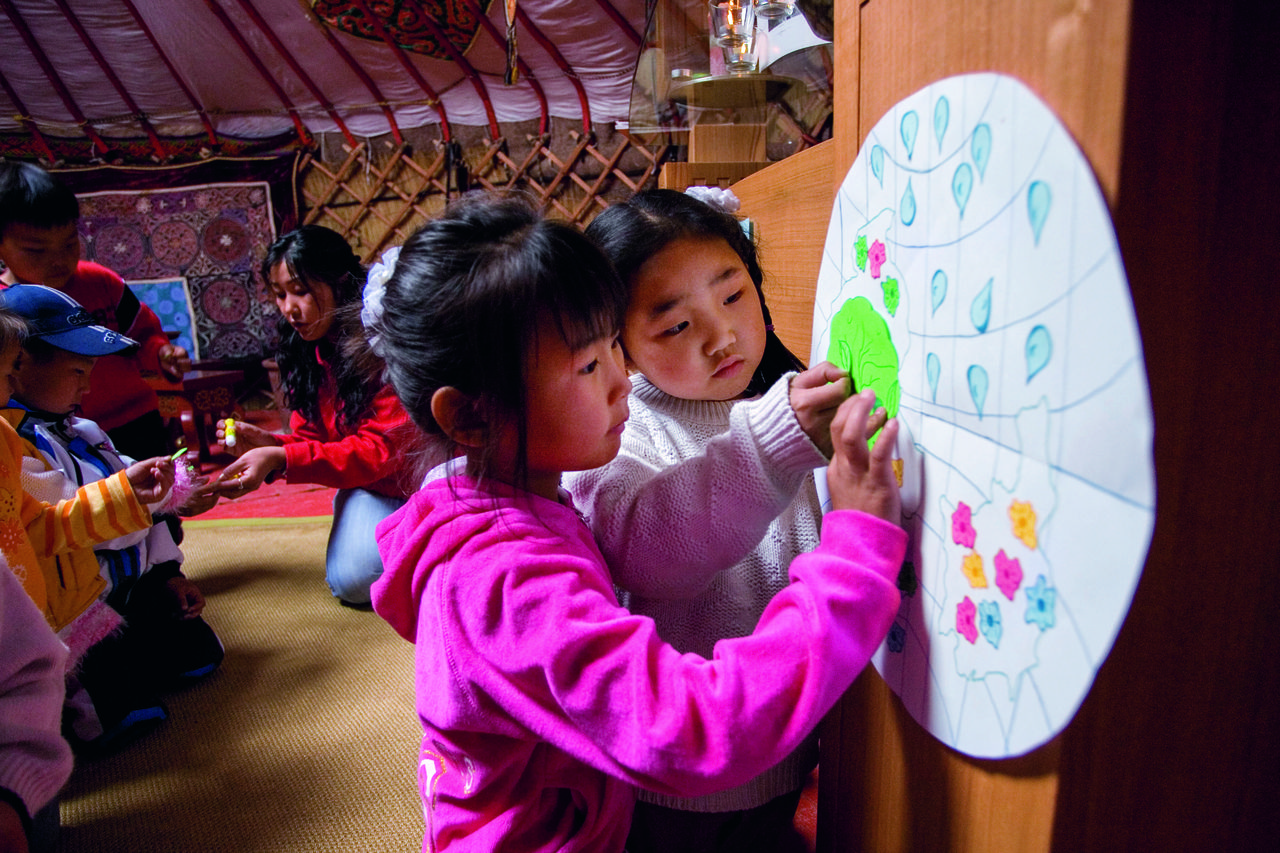
While there are variations among the continents in the percentage of women members, particularly on the elected institutions, the steady move towards more gender-balanced membership indicates an increased understanding of ‘Abdu’l-Bahá’s statement “Not until the world of women becomes equal to the world of men in the acquisition of virtues and perfections, can success and prosperity be attained as they ought to be.”14First Tablet to The Hague (17 December 1919), https://www.bahai.org/r/960386727.
ON THE INTERNATIONAL FRONT: PARTICIPATION IN DISCOURSES AT THE UNITED NATIONS
At the international level, the Bahá’í International Community (BIC) has advocated for the equality of women and men since the inception of the United Nations, making its first statement on gender equality in 1947. Shortly after it became an accredited non-governmental organization (NGO) in 1970, it began to advocate for the girl child. In 1974, as an NGO member of the UN Commission on the Status of Women, the BIC made a statement to the twenty-fifth Session of the Commission that recommended greater emphasis on the importance of educating girls. With regard to this topic, the Bahá’í International Community was ahead of its time. Over the decades, as the UN gave greater attention to the issue of the girl child and many other international organizations focused on it as a strategy for development, the BIC has continued to advocate for girls’ education and has made numerous official statements about it. The BIC has also collaborated with other NGOs and entities such as the United Nations Children’s Fund (UNICEF) and continues to serve on UNICEF’s NGO Working Group on Girls. The BIC was also one of the earliest proponents at the United Nations of the idea that men and boys play an important role in promoting gender equality, particularly that their full development depends upon the advancement of women, since a society based on gender equality serves the interests of both women and men.15See Bahá’í International Community, The Role of Men and Boys in Achieving Gender Equality—A Statement Prepared for the United Nations Commission on the Status of Women at its 48th Session Item 3a of the Provisional Agenda (2004).
In its statements and in discourses at the United Nations, the BIC has addressed topics as diverse as gender and leadership, violence against women and girls, the climate crisis as a catalyst for nurturing a more gender-balanced culture, the role of women as well as men in establishing a flourishing world civilization, transforming the structures of society, and religion and gender equality.
On this last theme, while acknowledging that religion has often been seen as a negative force, the Bahá’í International Community has urged the open examination of religion as “a basis for social and political mobilization” and has advocated for a discourse centered around three themes: the role of religious leaders in supporting gender equality, the role of men and boys in demonstrating “new understandings of masculinity,” and religious interpretations that discriminate against women and thus serve as an impediment to peace.16Toward a New Discourse, 6–7.
While it has always related its contributions to UN discussions on gender equality to spiritual principle, by 2008, the BIC began to draw as well on the rich experience of the Bahá’í community to contribute to the advancement of civilization. The film Glimpses into the Spirit of Gender Equality, produced on the twenty-fifth anniversary of the Beijing conference, combines footage from the United Nations, tracing the BIC’s efforts to advocate for the education of girls and for gender equality, with stories from the grass- roots.17The film is accessible at https://www. youtube.com/watch?v=lqOeUNMEpAI. 18. See Bahá’í International Community, Developing New Dynamics, 2. It showcases the experiences and initiatives of individuals, families, community members, and village leaders in Colombia, India, Malaysia, the United States, and Zambia, to illustrate how even small steps can contribute to change in a culture. The film offers insights gleaned from efforts made over the past 25 years to apply Bahá’u’lláh’s teachings regarding equality in different communities and settings. It conveys how the lessons being learned at the grassroots reinforce efforts being made in international fora for the advancement of women, providing a view of what has been learned thus far about building a civilization that values and nurtures both material and spiritual qualities in all its members.
CONCLUSION
In the long process of building a global civilization, sustained and coordinated action to establish gender equality is vital. While the Bahá’í community can take stock of its progress in this regard and the insights it has gleaned over almost 200 years in a growing variety of settings, the work is far from done. Efforts to nurture strong, vibrant communities in which women and men strive in dynamic partnership to build an equitable society must be extended and deepened.18 In this work, the community derives its vision and its impetus from statements such as the following, made by ‘Abdu’l-Bahá in 1912, during His travels in North America: “… until woman and man recognize and realize equality, social and political progress here or anywhere will not be possible. For the world of humanity consists of two parts or members: one is woman; the other is man. Until these two members are equal in strength, the oneness of humanity cannot be established, and the happiness and felicity of mankind will not be a reality.”18The Promulgation of Universal Peace no. 32, 2 May 1912.