A central tenet of the Bahá’í perspective on history is that humanity has reached the point at which a lasting global peace is “not only possible but inevitable.”1Universal House of Justice, The Promise of World Peace (Bahá’í World Centre, 1985), bahai.org/r/981833506. Yet if peace is indeed inevitable, the path towards it has been neither straightforward nor uninterrupted. The twentieth century witnessed the establishment of unprecedented institutions of international cooperation, accompanied, at certain moments, by shifts in political culture and public consciousness that seemed to signify a new era in international relations. However, from a vantage point a quarter of the way through the twenty-first century, it is clear that the project of building a united and effective global order is far from complete, and indeed in some respects appears to be in reverse. As the Universal House of Justice observes:
For many decades following the second great war of the twentieth century, humanity moved, with fits and starts, toward the promise of a united world. The failure to complete the project of the unification of nations, however, left gaps in relations in which supranational problems could fester and threaten the security and well-being of peoples and states, leading to a recrudescence of prejudice, of divers expressions of factionalism, and of virulent nationalism that are the very negation of Bahá’u’lláh’s message of peace and oneness.2Letter written on behalf of the Universal House of Justice to an individual, 27 April 2017, bahai.org/r/362945323.
Within this political and historical context, this article explores two questions. First, why did previous attempts to reach for lasting peace not succeed? Second, what conceptual and moral shifts stand between humanity and this long-cherished goal? If the obstacles to peace were merely technical or institutional, they might have been overcome long ago. The persistence of conflict and division suggests that a deeper transformation is required. What might be among the fundamental adjustments necessary for the establishment of a durable peace?
Reaching for Peace
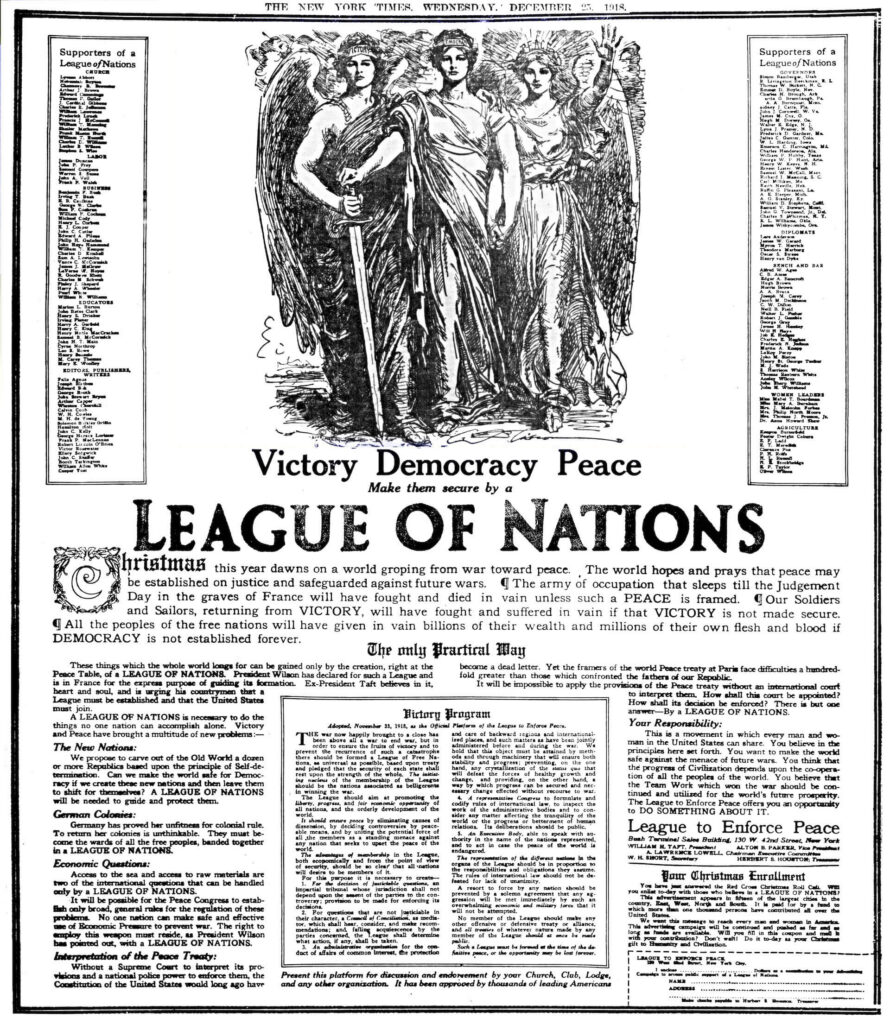
In a message dated 18 January 2019, the Universal House of Justice comments on the progress towards world peace that has been made over the past century, and analyzes some of the causes of the regressive steps of recent years. In the letter, the House of Justice identifies three moments in which mankind seemed to be “reaching for real, lasting peace, albeit always falling short”: the two periods immediately following the First and Second World Wars, and the post-Cold War period.3Letter of the Universal House of Justice to the Bahá’ís of the world, 18 January 2019, bahai.org/r/276724432. The first moment saw the establishment of the League of Nations after the First World War. This represented the earliest attempt at a global collective security mechanism in history, and was accompanied in the 1920s by treaties and statements from intergovernmental meetings that explicitly rejected war as an instrument of foreign policy—a novel development in international relations at the time.4These included the Locarno treaties and the 1928 Kellogg-Briand Pact which explicitly renounced war “as an instrument of national policy.” See avalon.law.yale.edu/20th_century/kbpact.asp. Tragically, of course, the League of Nations was hampered from birth by the non-participation of the United States, and by the harsh settlement imposed on the defeated powers from the First World War, sowing the seeds of resentment that would ignite a second global conflict two decades later.
The second attempt at peace initially appeared more promising. The United Nations and the series of accompanying economic institutions established in the wake of the Second World War were broader-based in their membership, and were accompanied by advances at the level of thought and political culture, with the creation and ratification of foundational agreements related to human rights and international law. What is interesting to note about this period is not only the list of institutions that were established, or the treaties signed, but the tenor of public discourse. During this period, following the bombings of Hiroshima and Nagasaki, a wide range of scientists, political figures, jurists, journalists, and authors advocated for a world state powerful enough to prevent nuclear destruction. Albert Einstein, for example, conducted an extended publicity tour advocating for global government, while his colleagues on the Emergency Committee of Atomic Scientists lobbied for integrated global control of nuclear weapons.5Dexter Masters and Katharine Way, eds., One World or None (McGraw-Hill, 1946). Multiple resolutions introduced in the US Congress supported the creation of a world federation or transformation of the United Nations along world state lines, and major hearings on world government proposals were held by foreign affairs committees in both the US House and Senate in 1949 and 1950. Elsewhere, public support for a union of Atlantic democracies was expressed in 1949 by the foreign ministers of Great Britain, Italy, the Netherlands, Norway, and Belgium, as well as by the Canadian Senate.6Daniel Deudney, “Greater Britain or Greater Synthesis? Seeley, Mackinder, and Wells on Britain in the Global Industrial Era,” Review of International Studies 27, no. 2 (2001): 187–208, jstor.org/stable/2009772. In India, Mohandas Gandhi and Jawaharlal Nehru made a world federal government central to the 1942 Quit India Resolution, framing it as a remedy for Western imperialism.7Luis Cabrera, “Global International Relations and Indian Visions of World Government,” Global Studies Quarterly 5, no. 3 (2025), doi.org/10.1093/isagsq/ksaf061. Several organizations were founded in this period to draft a “world constitution.”8Joseph Preston Baratta, The Politics of World Federation (Praeger, 2004). World federalism drew support not only from academic, scientific, economic, and political elites, but also from relatively broad cross-sections of the population (at least in surveyed countries). In June 1946, for example, a Gallup poll asked Americans: “Do you think the United Nations Organization should be strengthened to make it a world government with power to control the armed forces of all nations, including the United States?” The results showed 54% in favor and 24% opposed, with the remainder undecided.9Luis Cabrera, “World Government: Renewed Debate, Persistent Challenges,” European Journal of International Relations 16, no. 3 (2010): 511–30. Indeed, similar surveys across the period 1946-1949 showed substantial American support for strengthening the United Nations into a world government, with approval ratings ranging from 52-77%. One reason to highlight this example is that the US is now one of the countries where respondents are more skeptical than the global average regarding the desirability of world government.
If nothing else, these examples illustrate that the terrain of public discourse is not fixed and that what appear to be immovable boundaries in public opinion, or hard constraints of political possibility, can, and indeed do, change dramatically over time. In the case of the mid-century postwar moment, however, this upsurge in discourse around world government receded as attempts to strengthen global government, notably in response to the threat of nuclear war, failed in an atmosphere of growing tension between the United States and the Soviet Union. As a result, political, scholarly, and public attention drifted away from the idea and remained largely dormant until the end of the Cold War.
The Third Moment
The third moment of reaching for peace stands much closer to our present historical juncture. During the 1990s there was a significant expansion in the range and strength of systems designed to foster international cooperation, exemplified by a series of conferences on thematic issues organized under the auspices of the UN, various developments in the area of international law including the adoption of the Rome statute leading to the creation of the International Criminal Court, and the formulation of the Millennium Development Goals. These political developments were matched by an upsurge in scholarly attention to the question of global governance (and the emergence of this term in common academic parlance).10Thomas Weiss charts how the notion of “global governance” came to displace the language of “world government” in academic and policy discourse. See Thomas G. Weiss, “What Happened to the Idea of World Government,” International Studies Quarterly 53, no. 2 (2009): 253–71, jstor.org/stable/27735096.
Alongside the political optimism of the immediate aftermath of the Cold War, a prominent feature of intellectual discourse at the time was the assumption that an expanded global order would consist largely in the progressive extension of the achievements of the modern West around the world. Francis Fukuyama’s “end of history” thesis was totemic of this assumption. Fukuyama argued that following the collapse of Soviet communism liberal democratic capitalism had emerged as the final form of human government, with no viable ideological competitors remaining.11Francis Fukuyama, The End of History and the Last Man (Free Press, 1992). Fukuyama illustrates the tenor of public and scholarly discourse at the time. His argument is more sophisticated than saying that the West had simply “won” the Cold War—he provides a Hegelian argument that liberal democracy is uniquely attractive because it best satisfies fundamental human desires for recognition and dignity. Further, he does not claim that countries will inevitably become liberal democracies, only that it has no serious competitors as a normatively compelling philosophical position. Proposals for reforming political order in this period were thus often proposals for globalizing aspects of the economic and political model of the West.12Strobe Talbott, “America Abroad: The Birth of the Global Nation,” Time, 20 July 1992; David Held, Democracy and the Global Order (Polity Press, 1995); Bruce Russett, Grasping the Democratic Peace (Princeton University Press, 1993). In a 2005 Bahá’í World article, Michael Karlberg notes that critique of free-market capitalism is relatively widespread, including by voices within the West, but that the same has not hitherto been true of liberal democracy. The article goes on to analyze some of the limitations and pathologies of liberal democratic governance, including tendencies towards polarization, gridlock, oligarchic capture of political processes, and rising cynicism. See Michael Karlberg, “Western Liberal Democracy as New World Order?” The Bahá’í World (2005), bahaiworld.bahai.org/library/western-liberal-democracy-as-new-world-order/.
Yet against the optimism of many who assumed that liberal democracy would inexorably suffuse political systems worldwide, the first two decades of the twenty-first century have seen a series of cross-cutting trends that have undermined this narrative, and which seem to have eroded faith in the very idea of international governance. In some parts of the world, a “globalization backlash” has been expressed in phenomena such as member states withdrawing from international organizations and agreements, increasing trade protectionism, and more general protests against international institutions.13Stefanie Walter, “The Backlash Against Globalization,” Annual Review of Political Science 24 (2021): 421–42, doi.org/10.1146/annurev-polisci-041719-102405. These currents of dissatisfaction draw on a wide and sometimes contradictory range of sources—from populist nationalisms, to movements with anti-capitalist orientations, to postcolonial critiques centered on historical marginalization. Underlying many of these phenomena is a general concern that the structures and ideologies underpinning globalization serve only a small minority of the world’s population. Alongside these political developments, this period has also seen growing scholarly interest in marginalized traditions of thought, often with the goal of unmasking the “false universalism” of dominant liberal thought.14Dipesh Chakrabarty, Provincializing Europe: Postcolonial Thought and Historical Difference (Princeton University Press, 2000). Efforts to imagine an effective and legitimate global order have thus come to be constrained within the terms of an unpalatable dichotomy—between a “globalism” that embraces liberalism and free-market capitalism as its foundation and an “anti-globalism” that is suspicious of the very idea of a global order. Such suspicion reflects not only disillusionment with the prevailing model of globalization, but broader anxieties about cultural homogenization and the global concentration of power.
While social and intellectual trends have raised questions about the direction of globalization, the inherently cross-national challenges for which global institutions are designed have hardly disappeared. If anything, their intensity has grown. In the juxtaposition of these trends lies a key paradox. On the one hand, the forces propelling global integration are strengthening, and with them the necessity of global cooperation. On the other, consensus around the basis for a legitimate global order is eroding.
A Fundamental Prerequisite
Where, then, do we go from here? The vision of global integration built on liberal democratic capitalism has been criticized for its tendency to universalize particular political, cultural, and economic arrangements that themselves have not proven able to establish social harmony or justice, while a reactive skepticism of the entire project of building a unified world order offers no constructive path forward in the face of inherently transnational challenges. Neither pole offers a satisfactory response to the challenges humanity faces. The task, therefore, is twofold: to separate the notion of a unified global order from the simple extension of the methods and procedures of liberal democracy or market capitalism, and to move beyond solely critiquing a defective order by describing, with progressive clarity, what might take the place of the present “incomplete project” of the unification of nations.
Where might such an alternative foundation be identified? Each of the three historical moments examined above saw genuine advances in the machinery of international cooperation, yet none succeeded in establishing enduring peace. The post-Cold War period, in particular, demonstrated that even substantial institutional development proves insufficient when underlying questions about the nature and purpose of global society remain unresolved. The resulting dichotomy between globalism and anti-globalism reflects, at a deeper level, an absence of shared conviction about the foundations of human society capable of commanding broad allegiance. What appears to be missing are not only better mechanisms of coordination, but rather a conception of global society itself, one that can ground institutional arrangements in globally shared principles.
In examining Bahá’í contributions to public discourse on the question of peace, one idea stands out as a central conviction regarding both what is defective in the existing global order and what is required for the elusive goal of global peace and stability to be realized: the principle of the oneness of humanity. The principle not only informs visions of a future world civilization whose contours can scarcely be imagined, but also stands at the heart of contributions to contemporary discourse about what is to be done here and now.
In a statement marking the seventy-fifth anniversary of the United Nations, for example, the Bahá’í International Community draws attention to the “profound convictions for our collective behaviour” that flow from the truth that “the human family is one.”15Bahá’í International Community, A Governance Befitting: Humanity and the Path Toward a Just Global Order (2020), bic.org/statements/governance-befitting-humanity-and-path-toward-just-global-order. The statement observes that the challenge of embedding the principle of oneness in the design and operation of the global order is not merely one of creating or reforming institutions, important as this is. Rather, there exists a pressing need for what the statement terms a “settled consensus” around “a set of common values and principles” capable of underpinning collective decision-making on issues affecting humanity as a whole.16Bahá’í International Community, A Governance Befitting. The Promise of World Peace, a 1985 message of the Universal House of Justice to the peoples of the world, similarly expresses this conviction, identifying the primary question confronting humanity as “how the present world, with its entrenched pattern of conflict, can change to a world in which harmony and cooperation will prevail.” Its answer: “World order can be founded only on an unshakable consciousness of the oneness of mankind….” Accepting the oneness of humanity, the message continues, represents “the first fundamental prerequisite for reorganization and administration of the world as one country, the home of humankind.”17Universal House of Justice, Promise of World Peace.
Yet what is meant by “oneness” in these contexts? And how does the principle of oneness take us beyond the familiar principles and institutions of the current discourse on global governance? Shoghi Effendi states:
The principle of the Oneness of Mankind—the pivot round which all the teachings of Bahá’u’lláh revolve—is no mere outburst of ignorant emotionalism or an expression of vague and pious hope. Its appeal is not to be merely identified with a reawakening of the spirit of brotherhood and good-will among men, nor does it aim solely at the fostering of harmonious cooperation among individual peoples and nations.18Shoghi Effendi, The World Order of Bahá’u’lláh (Bahá’í Publishing Trust, 1938), bahai.org/r/449204500.
In exploring the meaning of oneness, it is important to begin from the recognition that it would be premature to claim to comprehend anything but a fraction of its full import for the life of humanity. Clarity on what the principle of oneness entails for the next stage of social evolution will only emerge through sustained processes of learning and exploration. The full significance of the principle—including its implications for human consciousness and the very foundations of social existence—extends well beyond what any single line of inquiry can capture. The principle carries implications for many dimensions of social life, including questions of identity, the relations between diverse peoples and groups, the organization of economic life, and collective governance.19The implications of oneness for questions of identity—how we define ourselves and relate to others—have received insightful treatment recently in the pages of The Bahá’í World. See Shahrzad Sabet, “The Crisis of Identity,” The Bahá’í World, bahaiworld.bahai.org/library/the-crisis-of-identity/. This analysis follows the observation of the House of Justice in its message of 18 January 2019, that one obstacle to peace is humanity’s present “crisis of identity, as various peoples and groups struggle to define themselves, their place in the world, and how they should act.” Indeed, the promise of a global order grounded in oneness may extend beyond the achievement of more stable and just governance arrangements. As relationships among peoples are progressively reordered to reflect the reality of oneness, new horizons of possibility may emerge that cannot be anticipated at present. With all this in mind, and conscious of the constraints of inevitably limited vision, there is one particular idea this essay seeks to examine because of its relevance to current questions of political life and global order: what the concept of oneness tells us about the nature of society itself.
Conceptions of Society
Underlying most political and philosophical thought are conceptual models or metaphors which, though not literal descriptions of reality, generate distinctive conceptions of the body politic. One thinks of the market as a jungle in classical economics, the Confucian image of the extended family as a model for political relationships, or Plato’s image of the city-state as a ship requiring a wise captain. Such heuristic devices organize ideas and shape intuitions regarding the moral principles that ought to govern collective life, which in turn mold social norms and structures.
Of these various images, we can examine one in some depth as an example of how a guiding metaphor can shape the architecture of an entire tradition of political thought. The image of a social contract conceptualizes society as a collection of individuals who, despite divergent interests and beliefs, form a binding agreement to regulate social and political questions arising among them. This contract sets certain ground rules for ongoing coexistence and serves as a reference point in arbitrating disputes about what individuals owe to one another. From this deceptively simple starting point flow distinctive assumptions about persons, about what justice requires, and about the proper role of political institutions, assumptions that have also informed influential approaches to theorizing social and global order.
John Rawls’s influential theory of justice provides an instructive example of how this contractualist vision generates a framework of political principles. Rawls is a particularly helpful figure because he explicitly notes that conceptions of justice are “the outgrowth of different notions of society.”20John Rawls, A Theory of Justice (Harvard University Press, 1971), pp. 9–10. Rawls begins with a fundamental organizing conception of society as a system of cooperation between autonomous and equal individuals. He then creates the device of an “original position,” a hypothetical scenario in which parties deliberate about the terms of the social contract—the basic terms of social cooperation between them—while deprived of knowledge about morally arbitrary characteristics about themselves, such as their race, class, gender, or natural talents.
The original position serves as the mechanism for working out what free and equal individuals would agree to under conditions that model fairness. Parties in the original position are characterized by “mutual disinterest”—they are concerned with advancing their own conception of the good, but are not motivated by benevolence toward or envy of others. This assumption is not incidental: it ensures that the principles chosen are ones that individuals can accept as fair regardless of their particular conceptions of human flourishing or moral doctrines, and it models the separateness of persons that Rawls takes to be a basic fact about human beings.21Rawls is careful to distinguish between the motivation of parties in the original position and the motivation of actual persons, noting that mutual disinterest is a modeling device rather than a claim about human nature. He argues that the combination of mutual disinterest and the veil of ignorance achieves much the same purpose as benevolence, since it forces each party to take the good of others into account. See Rawls, Theory of Justice, pp. 128–29. This defense succeeds against the charge that his theory presupposes egoism. However, the choice to model fairness through mutually disinterested parties carries with it assumptions about the independent specifiability of agents’ interests that sit in tension with the idea of constitutive interdependence discussed later in this article. The framework treats others’ positions as possible locations for oneself, rather than recognizing that one’s own flourishing depends on the character of shared structures and relationships regardless of which position in society one occupies. From this architecture flows Rawls’s principles of justice. The first principle guarantees equal basic liberties for all citizens—freedoms such as political participation, expression, and conscience that rational agents would not risk losing regardless of their position in society. The second principle addresses social and economic inequalities, requiring that positions of advantage be open to all under conditions of fair equality of opportunity, and that any remaining inequalities work to the benefit of the least advantaged members of society.22John Rawls, A Theory of Justice, rev. ed. (Harvard University Press, 1999). Each element follows from what mutually disinterested parties, ignorant of their own circumstances, would rationally choose: they would secure fundamental freedoms, ensure fair access to opportunities, and, since they might find themselves among the worst off, insist that inequalities improve the prospects of those worst-off in society.
Rawls’s theory represents one example of sophisticated and nuanced contractualist thinking, which in many ways is sensitive to the balance of unity and diversity in society. The purpose here is not to criticize it, but rather to demonstrate that any such framework relies on a particular image of human nature and social order. The characterization of agents in this framework as mutually disinterested, the specification of interests prior to and independent of social relationships, and the modeling of fair agreement as that which emerges from a process of individual rational choice all form, and reinforce the notion that an individual’s core interests are understood to be independently constituted, and that social cooperation is merely an arrangement among such agents to secure fair terms despite potentially divergent interests. Importantly, the effects of contractualist thinking, of which Rawls’s view is one illustrative example, have not been confined to the academy. In direct and indirect ways, this conceptual model, which emerged during the Enlightenment and remains influential in contemporary political thought, has become embedded in the political, economic, and social lives of whole societies. Consider Rawls’s principles of justice. His first principle, guaranteeing equal basic liberties, finds expression in the broader liberal commitment that individual freedom can only be constrained in order to prevent harm to others.23It should be noted that several of the principles discussed here, including the harm principle, also have roots in non-contractualist liberal thought, such as the work of J. S. Mill. See John Stuart Mill, On Liberty (John W. Parker and Son, 1859). The purpose of the present analysis is not to claim that the social contract tradition is the sole source of these principles, but to illustrate how a particular conception of society can underpin and give coherence to a framework of political thought. The assumption of mutual disinterest, which ensures that principles are acceptable regardless of one’s particular conception of the good, underwrites the notion that the state should remain neutral between different visions of the good life rather than promoting any substantive account of human flourishing. And the architecture of the original position, modeling society as separate individuals who must find terms of cooperation despite divergent interests, reflects the prevalent belief that governance structures and social institutions exist primarily to arbitrate between potentially divergent claims rather than to cultivate shared purposes. These and similar principles have over time become codified in constitutional documents, embedded in popular consciousness, and expressed in legal precedent.
The point is not that such principles lack merit. It is rather that they emerge from a particular conception of society and the person. When this contractualist framework is extended to theorize global order, the parties sometimes shift from individuals to states, such that global society is conceptualized as a system populated by free (i.e. autonomous) and equal (i.e. sovereign) nation-states.24There have been a number of attempts to extend the Rawlsian picture of society to equivalent analysis of the global order, with some authors, such as Charles Beitz, attempting to extend the domestic Rawlsian original position by depriving parties of knowledge of their nationality, while others, including Rawls himself, prefer to conceptualize global society as a system of cooperation between “peoples” or societies rather than between individuals, generating principles of international order that emphasize national self-determination. See Charles Beitz, Political Theory and International Relations (Princeton University Press, 1979); John Rawls, The Law of Peoples (Harvard University Press, 1999). But core elements of the underlying conception remain: separate agents with divergent interests seeking mutually acceptable terms of cooperation. Beyond explicitly nationalist or statist extensions of the contractualist conception of society, if building a just and effective global order consisted, as many assumed in the post-Cold War period, in extending the Western social and political model worldwide, it would involve globalizing something like the contractual conception of society, embedding its assumptions about persons and social cooperation in political cultures and institutions around the world.
The purpose of the analysis above has simply been to make visible assumptions that often operate invisibly—to show that the contractual framework represents one possible starting point among others, not a neutral or inevitable foundation for political thought. This recognition opens space to ask what a conception of society informed by the principle of oneness might look like, and how it might differ from the models that currently predominate.
Oneness and Global Society
With this in mind, let us return to the idea of oneness. A conception of society, including global society, as a cooperative system characterized by an essential oneness would emphasize the extent and nature of interdependence between its constituent elements, in both an empirical and a normative sense. The empirical aspect observes that the well-being of individuals and societies is connected across borders, whether through economic systems, ecological processes, technological networks, or political structures.25While the focus here is the global level, this interdependence characterizes social reality at every scale—within communities and nations as much as between them. Yet the conception is not merely descriptive. The normative component asserts that these empirical interdependencies possess constitutive rather than merely instrumental significance for human flourishing. This normative dimension transcends enlightened self-interest, which would calculate the long-term advantages of cooperation while maintaining that agents affect one another’s well-being only instrumentally, and approaches that widen the scope of moral obligation while leaving the underlying conception of agents and their interests unchanged. Constitutive interdependence makes a stronger claim and implies a transformed understanding of what constitutes interest and well-being themselves: one’s capacity to flourish is inherently limited when others suffer. This is not simply because their suffering might eventually affect one’s interests from the outside, but because flourishing itself is partly constituted by the character of one’s relationships and the health of shared structures. To put the point positively, participation in relationships of genuine reciprocity and shared endeavor may unlock, or even itself constitute, a dimension of flourishing that no degree of isolated prosperity can provide.
Each conception of society carries with it an implicit or explicit view of the person—what agents are like, what motivates them, and what constitutes their flourishing. A contractualist conception would generally assume agents whose interests can be specified independently. A conception informed by oneness, by contrast, is likely to assume that agents’ capacity for flourishing is inherently relational. Human flourishing, on this view, inherently involves the quality of relationships and systemic conditions, not merely the accumulation of goods, the satisfaction of preferences, or even access to resources and the protection of basic rights, important as these are. From this perspective, the quality of social structures partially determines individual possibilities, and societal dysfunction constrains human flourishing even for those who appear temporarily insulated.
Understanding oneness in this way—as a principle informing our conception of global society—carries significant implications. If the capacity to flourish cannot be isolated from the health of shared structures and relationships, neither can peace; and this reframes conventional thinking about what peace requires, in terms of both scope and sequence. Regarding scope, it helps to explain the claim in The Promise of World Peace that achieving peace requires removing obstacles often seen as unrelated to peace: “…the abolition of war is not simply a matter of signing treaties and protocols; it is a complex task requiring a new level of commitment to resolving issues not customarily associated with the pursuit of peace.”26Universal House of Justice, Promise of World Peace. If oneness informs our foundational conception of society, then obstacles to peace such as racism, wealth inequality, tribal nationalism, and religious sectarianism are not discrete problems to be addressed separately. They are incompatible with oneness and therefore with a society capable of genuine peace; conceptualizing social order through the lens of oneness illuminates why these diverse phenomena share a common root. Regarding sequence, oneness reveals the limitations of the assumption that unity is “a distant, almost unattainable ideal to be addressed only after a host of political conflicts have been somehow resolved”: oneness is not the fruit of solving other problems; it is the prerequisite for solving them.27Bahá’í International Community, Who Is Writing the Future? Reflections on the Twentieth Century (1999), bahai.org/documents/bic-opi/who-writing-future.
A conception of society informed by oneness, like its contractual counterpart, would not be a mere abstraction, but would carry significant practical consequences. As the discussion of Rawls illustrated, conceptions of society inform the normative principles selected to regulate collective life, which in turn shape laws, policies, and institutions. Such a conception of global society would carry with it similarly distinctive implications, both empirical and normative.
The empirical dimension directs attention to the ways in which the major challenges defining contemporary global politics demonstrate this inherent interdependence. Climate change is one clear example: no amount of national wealth can insulate a society from atmospheric changes driven by global emissions. Similarly, pandemic preparedness, financial stability, and digital technologies create vulnerabilities that transcend national boundaries and cannot be addressed through isolated action. These are not marginal issues but increasingly define the parameters within which all other political and economic activity occurs. The principle of oneness also enables us to distinguish between narrow material accumulation and comprehensive flourishing. An individual or society might increase certain metrics—household wealth, GDP, territorial control—while experiencing degradation in the broader conditions that enable genuine well-being. Rising wealth inequality in many countries coinciding with deepening polarization and weakening social trust suggests that even apparent beneficiaries of economic inequality bear costs in other dimensions of life.28Richard Wilkinson and Kate Pickett, The Spirit Level: Why More Equal Societies Almost Always Do Better (Allen Lane, 2009); Eric M. Uslaner, The Moral Foundations of Trust (Cambridge University Press, 2002).
The normative dimension carries distinctive implications for what ought to be done about these interdependencies. Enlightened self-interest might recognize that assisting developing nations creates future markets or that environmental cooperation prevents future costs. But the idea of constitutive interdependence suggested by oneness makes a stronger and qualitatively different claim: one’s capacity to flourish cannot be separated from the flourishing of others within a system of social cooperation, because the quality of shared structures and relationships is not merely an external condition affecting well-being but partly constitutive of it. Appealing to oneness to justify and appraise laws or policies may imply, among other things, that the legitimacy of domestic policies be judged by reference to their global impacts and that self-interested bargaining in global politics represents not merely a moral failure but a fundamental misunderstanding of a nation’s own interests.29See Bahá’í International Community, A Governance Befitting. A central bank’s mandate, for instance, would be framed not purely in domestic terms but in terms of contributing to the stability and health of the international economic system, recognizing this as a condition of its own society’s prosperity.30Empirical evidence suggests, for example, that increases in US interest rates trigger economic effects of at least the same size in a significant number of foreign countries, as the effect in the US itself. See Matteo Iacoviello and Gaston Navarro, “Foreign Effects of Higher U.S. Interest Rates,” Journal of International Money and Finance 95 (2019): 232–50. Agricultural support policies would be designed to strengthen food systems both domestically and internationally—asking not only whether subsidies benefit domestic producers, but whether they contribute to food security worldwide and to the livelihoods of farming communities in other countries.31Bahá’í International Community, Just, Sustainable and Resilient Food Systems: Some Considerations for the AU–EU Partnership (June 28, 2023), bic.org/publications/just-sustainable-and-resilient-food-systems. Tax regimes would be oriented toward building the shared fiscal capacity to fund public goods in every country, rather than structured in ways that encourage nations to competitively undercut one another. In each case, a oneness-informed conception of international society does not merely add global well-being as an afterthought; it reframes the very question of what constitutes effective policymaking, directing attention not only to how outcomes are distributed but to the character of the relationships through which collective life is conducted.
Oneness beyond Collectivism
The foregoing has sought to articulate, in necessarily preliminary terms, what a conception of global society informed by oneness might involve and some of its implications. Yet for all its apparent relevance to the challenges of global order, such a conception of global society has not yet permeated political discourse, let alone become embedded in social structures. This is not to say the ideal of oneness is completely absent—one can identify latent expressions of the underlying sentiment in foundational international documents such as the UN Charter. Similarly, in the more diffuse realm of public consciousness, it is common to hear in discourse, from informal everyday conversation to formal statements in global forums, recognition that in matters of public health “no one is safe until everyone is safe,” or that on climate change “the world will succeed or fail as one.” All this notwithstanding, there are many aspects of the existing global political order that do not yet reflect, or align with, the implications of human oneness. Why might this be? Why has a conception of the essential nature of social order informed by oneness not been more widely adopted?
Clearly, one significant part of the answer is a gap between moral principle and action, and a lack of willingness to “put aside short-term self-interest” on the part of individuals, governing institutions, and indeed whole societies.32Letter of Universal House of Justice to the Bahá’ís of the world, 4 January 2022, bahai.org/r/845512230. But it would appear that insufficient commitment to recognized ideals is not all that is at work here. Sustained action in pursuit of moral principles is difficult without clarity about the kind of world those principles are meant to create. There are conceptual obstacles, at least in some prevalent traditions of thought, to embracing the reality of oneness as an essential characteristic of global society. These conceptual obstacles may, by furnishing rationales for behavior inconsistent with the principle of oneness, in turn weaken the connection between the force of moral principle and political practice. When, for instance, the separateness and divergent interests of nations is treated as a basic fact of international life, policies that prioritize narrow national advantage over global well-being appear not as moral failures but as rational responses to how the world is structured.
The conceptual concern regarding oneness, while not always articulated explicitly, can be presented as follows: conceptions of society that emphasize unity, including those which draw on organic metaphors (such as the use of the human body analogy in the Bahá’í writings), have historically been deployed in service of worldviews emphasizing hierarchy, homogeneity, or the priority of the collective over the individual. Karl Popper expresses the general intuition in contrasting the “closed” and “open” society: “the open society rests on a strong commitment to individualism—to individual rights but also to individual responsibilities—and on a rejection of the “organic theory” that prioritizes the collective (the tribe, the nation, etc.) over the individual.”33Karl Popper, The Open Society and Its Enemies (Routledge, 1945), pp. 165–66.
Clearly, this is not what the principle of oneness from a Bahá’í perspective asserts. When the Bahá’í writings make reference to the human body as a model for social relationships, this is not an understanding of the body as simply an agglomeration of interchangeable cells, whose individual character is unimportant, but rather a complex web of interdependent systems, which requires the complementary operation of differentiated components.34Further, metaphors should not be confused with descriptions of reality in and of itself. Society is not, in fact, a human body, any more than it is a contractual agreement. Such metaphors are tools that attempt to approximate certain of reality’s features for the purposes of illuminating principles relevant to social organization. Their value is demonstrated by the fecundity of the traditions of thought derived from them over time, rather than by simplistic statements about their inevitable consequences. Extending the metaphor to social organization, diversity in political cultures and institutional arrangements enables experimentation with different governance approaches, creating opportunities for learning about distinctive knowledge and practices suited to varied contexts. Further, collectivism, in problematic forms, treats society as a unified agent possessing a single system of desire, a collective entity whose judgments and purposes override or subsume individual perspectives. A oneness-inspired conception of society need not make any such claim. It would make quite a different point: that pursuing self- or national interest in ways that systematically undermine global structures or the flourishing of other segments of society represents a misunderstanding of the conditions for one’s own flourishing.
Unreflective identification of ideals of interdependence or social unity with crude collectivism, then, may help to explain why a conceptualization of global society that emphasizes its essential oneness has not been the object of greater attention. Attempts to examine the potential of conceptual models other than those dominant within the liberal tradition have perhaps been hampered by the persistence of false dichotomies. The tendency to present social organization as a binary choice between collectivism and individualism, or between liberalism and authoritarianism, may be one conceptual obstacle that needs to be overcome.
Crisis and Possibility
The foregoing analysis of twentieth-century attempts to establish peace suggests that moments of crisis often precipitate a reexamination of inadequate frameworks. Conceptions of society exert a profound influence on the intuitions, norms, and structures that shape collective life. Yet fundamental shifts in how society is understood are rarely the product of conceptual argument alone. Liberal models of social organization, for example, emerged through an interplay between philosophical reflection and the social and political action of particular groups and movements. As they form, such conceptions become embedded not only in formal structures but in popular consciousness, social norms, and everyday relationships. It follows that the process of developing a new underlying basis for global order will necessarily involve the efforts of communities and peoples in diverse settings to explore what oneness means for patterns of social organization—efforts that will, over time, generate insights and demonstrate possibilities capable of informing broader discourse and institutional change. In this sense, every segment of the world’s population has agency in the process of redefining the conceptual foundations of global society.
While the immediate prospects for peace are uncertain, the historical record also demonstrates how dramatic shifts in the landscape of political possibility can and do occur. It is not possible to predict how the integrative and disintegrative forces shaping humanity’s trajectory towards peace will unfold in the near future. Yet if enduring peace requires not only institutional arrangements but a conception of global society capable of grounding them, the work of clarifying what oneness implies for our collective life may be indispensable to the peace humanity seeks.
The author is grateful to Vafa Ghazavi, Shahrzad Sabet, and Stephen Agahi-Murphy for their input.
At the heart of human experience lies an essential yearning for self-definition and self-understanding. Developing a conception of who we are, for what purpose we exist, and how we should live our lives is a basic impulse of human consciousness. This project—of defining the self and its place in the social order—expresses both a desire for meaning and an aspiration for belonging. It is a quest informed by ever-evolving and interacting narratives of identity.
Today, as the sheer intensity and velocity of change challenges our assumptions about the nature and structure of social reality, a set of vital questions confront us. These include: What is the source of our identity? Where should our attachments and loyalties lie? And if our identity or identities so impel us, how—and with whom—should we come together? And what is the nature of the bonds that bring us together?
The organization and direction of human affairs are inextricably connected to the future evolution of our identity. For it is from our identity that intention, action, and social development flow. Identity determines how we see ourselves and conceive our position in the world, how others see us or classify us, and how we choose to engage with those around us. “Knowing who we are,” the sociologist Philip Selznick observes, “helps us to appreciate the reach as well as the limits of our attachments.”1Philip Selznick, “Civility and Piety as Foundations of Community,” The Journal of Bahá’í Studies, Vol. 14, number ½, March-June 2004. Also see Philip Selznick, The Moral Commonwealth: Social Theory and the Promise of Community (Berkeley: University of California Press, 1992), pp. 388—9. Such attachments play a vital role in shaping our “authentic selves” and in determining our attitudes toward those within and outside the circle of our social relationships. Acting on the commitments implied by these attachments serves to amplify the powers of individuals in effecting societal well-being and advancement. Notions of personal and collective identity can thus exert considerable influence over the norms and practices of a rapidly integrating global community.
As we have many associational linkages, identity comes in a variety of forms. At times we identify ourselves by our family, ethnicity, nationality, religion, mother tongue, race, gender, class, culture, or profession. At other times our locale, the enterprises and institutions we work for, our loyalty to sports teams, affinity for certain types of music and cuisine, attachment to particular causes, and educational affiliations provide definitional aspects to who we are. The sources of identification which animate and ground human beings are immensely diverse. In short, there are multiple demands of loyalty placed upon us, and consequently, our identities, as Nobel laureate Amaryta Sen has noted, are “inescapably plural.”2Amartya Sen, Identity and Violence—The Illusion of Destiny (New York: W.W. Norton, 2006), p. xiii.
But which identity or identities are most important? Can divergent identities be reconciled? And do these identities enhance or limit our understanding of and engagement with the world? Each of us on a daily basis, both consciously and unconsciously, draws upon, expresses, and mediates between our multiple senses of identity. And as our sphere of social interaction expands, we tend to subsume portions of how we define ourselves and seek to integrate into a wider domain of human experience. This often requires us to scrutinize and even resist particular interpretations of allegiance that may have a claim on us. We therefore tend to prioritize which identities matter most to us. As the theorist Iris Marion Young stresses: “Individuals are agents: we constitute our own identities, and each person’s identity is unique…A person’s identity is not some sum of her gender, racial, class, and national affinities. She is only her identity, which she herself has made by the way that she deals with and acts in relation to others…”3Iris Marion Young, Inclusion and Democracy (Oxford: Oxford University Press, 2000), pp. 101—2. The matrix of our associations surely influences how we understand and interpret the world, but cannot fully account for how we think, act, or what values we hold. That a particular identity represents a wellspring of meaning to an individual need not diminish the significance of other attachments or eclipse our moral intuition or use of reason. Affirming affinity with a specific group as a component of one’s personal identity should not limit how one views one’s place in society or the possibilities of how one might live.
While it is undoubtedly simplistic to reduce human identity to specific contextual categories such as nationality or culture, such categories do provide a strong narrative contribution to an individual’s sense of being. “Around the world,” the philosopher Kwame Anthony Appiah writes, “it matters to people that they can tell a story of their lives that meshes with larger narratives. This may involve rites of passage into womanhood and manhood; or a sense of national identity that fits into a larger saga. Such collective identification can also confer significance upon very individual achievements.”4Kwame Anthony Appiah, The Ethics of Identity (Princeton: Princeton University Press, 2005), p. 68. Social, cultural, and other narratives directly impact who we are. They provide context and structure for our lives, allowing us to link what we wish to become to a wider human inheritance, thereby providing a basis for meaningful collective life. Various narratives of identity serve as vehicles of unity, bringing coherence and direction to the disparate experiences of individuals.
In the wake of extraordinary advances in human knowledge, which have deepened global interchange and contracted the planet, we now find ourselves defined by overlapping identities that encompass a complex array of social forces, relations, and networks. The same person, for instance, can be a Canadian citizen of African origin who descends from two major tribes, fluent in several languages, an engineer, an admirer of Italian opera, an alumnus of a major American university, a race-car enthusiast, a practitioner of yoga, an aficionado of oriental cuisine, a proponent of a conservative political philosophy, and an adherent of agnosticism who nevertheless draws on insights found in the spiritual traditions of his forebears. One can simultaneously be a committed participant in local community affairs such as improving elementary-level education and an ardent supporter of transnational causes like human rights and environmental stewardship. Such juxtapositions of identity illustrate how individuals increasingly belong to multiple “communities of fate” in which long-existing spatial boundaries are being entirely redrawn and reconceptualized.5David Held and Anthony McGrew, Globalization/Anti-Globalization (Cambridge, England: Polity Press, 2002), p. 91. Modernity has transformed identity in such a way that we must view ourselves as being not only in a condition of dependence or independence but also interdependence.
The recasting of longstanding narratives of identification and affiliation is giving rise to widespread anxiety, grievance, and perplexity. In the eyes of many, the circumstances of daily life lie beyond their control. In particular, “the nation-state…that preeminent validator of social identity—no longer assures well-being,” the anthropologist Charles Carnegie avers.6Charles Carnegie, Postnationalism Prefigured: Carribbean Borderlands (New Brunswick, NJ: Rutgers University Press), p. 1. Other established sources of social cohesion and expressions of collective intention are similarly diminished in their efficacy to ground the actions of populations around the planet, resulting in a sense of disconnection and alienation. The philosopher Charles Taylor attributes such disruption of customary social patterns to the “massive subjective turn of modern culture,” involving an overly atomistic and instrumental view of individual identity.7Charles Taylor, The Ethics of Authenticity (Cambridge, Harvard University Press, 2003), p. 26. This exaggerated individualism accompanies the dislocation from historic centers of collectivity that is a repercussion of the centrifugal stresses of globalization. Against this kaleidoscope of change, including the major migrations of peoples, the international nature of economic production, and the formation of communities of participation across territorial borders through the means of modern communications, the concept of citizenship, as membership in a confined geographic polity, is in need of reformulation.
Our connections to others now transcend traditional bounds of culture, nation, and community. The unprecedented nature of these connections is radically reshaping human organization and the scale and impact of human exchange. But globalization has been with us a long time; the movement of peoples, goods, and ideas is an inherent feature of human history and development. Virtually every culture is linked to others by a myriad ties.8For example, many important concepts in modern science and mathematics find their genesis in the work of Chinese and Indian thinkers, some of which were later elaborated and transmitted to the West by Muslim innovators. Asian culture and architecture was greatly influenced by the movements of the Mughals and Mongols. The Bantu migrations spread ironworking and new agricultural methods across Africa. The great distances covered across oceans by the Vikings and the Polynesians; the movements and engineering achievements of indigenous societies in the Americas; the existence of Ming china in Swahili graves; and the spread of the tomato and the chili from the Americas to Europe and Asia illustrate the extent of human migration and interchange throughout the ages.
Culture is neither static nor homogeneous. Anthropological and sociological research reveals that cultures cannot be seen as fixed, indivisible wholes. The various manifestations of “social belonging” exhibit a “constructed and pliable nature.”9 Charles Carnegie, Postnationalism Prefigured, p. 9. Cultural resiliency has much to do with heterogeneity, assimilation of outside ideas, and the capacity to adapt. “We should view human cultures as constant creations, recreations, and negotiations of imaginary boundaries between ‘we’ and the ‘other(s)’,” the political scientist Seyla Benhabib emphasizes.10Seyla Benhabib, The Claims of Culture: Equality and Diversity in the Global Era (Princeton, Princeton University Press, 2002), p. 8. The multifarious processes of integration now at work are serving to accentuate and accelerate such social, economic, and cultural interchange. Under these conditions, Benhabib adds, presumed lines of cultural demarcation are increasingly “fluid, porous and contested.”11Seyla Benhabib, The Claims of Culture: Equality and Diversity in the Global Era (Princeton, Princeton University Press, 2002), p. 184. To perceive cultures, then, as objects of stasis, immune from the complex dialogues and interactions of human existence, is a fundamental epistemological and empirical error. As Appiah maintains: “Societies without change aren’t authentic; they’re just dead.”12Kwame Anthony Appiah, “The Case for Contamination,” The New York Times Magazine, Jan. 1, 2006.
Often, the insistence that the essence of cultural distinctiveness is its putative immutability emerges from a sincere desire to preserve and honor the power of an existing collective narrative. What is at issue here is a legitimate fear that valued identities may be lost or overwhelmed by unfamiliar external forces. Although an advocate of cultural rights designed to prevent such unwanted change, the theorist Will Kymlicka notes that “most indigenous peoples understand that the nature of their cultural identity is dynamic…”13Will Kymlicka, cited in Appiah, The Ethics of Identity, p. 132. From this vantage point, Kymlicka believes that globalization “provides new and valued options by which nations can promote their interests and identities.”14 Will Kymlicka, Politics in the Vernacular: Nationalism, Multiculturalism, and Citizenship (Oxford: Oxford University Press, 2001), p. 323. This suggests that a balance must be sought between the requirements of self-determination and the possibility of defining an aspect of self-determination as participation in the construction of a broader collectivity. Participation of this kind by a diverse array of cultures and peoples offers the promise of enriching the entire fabric of civilized life.
Recognition of the reality of globalization, however, does not mean that the current inequities associated with the process—how resources, opportunities, and power are distributed—should go unchallenged. And perhaps more important, the exhausted ideologies and intellectual frameworks that allow such inequities to persist must also be directly confronted.15For a in-depth exploration of this point, see the Bahá’í International Community statements, “The Prosperity of Humankind”, 1995, and “Who is Writing the Future?”, 1999. It is here where the insights provided by diverse human traditions and value systems can engage with the constructive phenomena of contemporary change to open new frontiers of identity—frontiers offering a peaceful and just future.
In 1945, aware of the imminent test of the first atomic weapon, Franklin D. Roosevelt warned: “Today we are faced with the pre-eminent fact that, if civilization is to survive, we must cultivate the science of human relationships—the ability of all peoples, of all kinds, to live together and work together in the same world, at peace.”16These were among the last words penned by Roosevelt which, due to his death, were not delivered. See http://www.ibiblio.org/pha/policy/1945/450413b.html Clearly, the perceptions that human beings hold of themselves and each other matter. In a world convulsed by contention and conflict, conceptions of identity that feed the forces of prejudice and mistrust must be closely examined. Assertions that certain populations can be neatly partitioned into oppositional categories of affiliation deserve particular scrutiny. The notion of civilizational identity as the predominant expression of human allegiance is one such problematic example.17Samuel Huntington, in his seminal article “The Clash of Civilizations?”, posits that global stability will be determined by the interactions among what he calls Western, Hindu, Islamic, Sinic, African, Latin American, Buddhist, and Orthodox Christian civilizations. Huntington writes: “The clash of civilizations will dominate global politics. The fault lines between civilizations will be the battle lines of the future.” See Samuel Huntington, “The Clash of Civilizations?”, Foreign Affairs, Summer 1993. For Amartya Sen, such thinking leads to “conceptual disarray” that can undermine international stability.
To view the relationships between different human beings as mere reflections of the relations between civilizations is questionable on both logical and pragmatic grounds. First, civilizations themselves are not monolithic in character; indeed, their vast internal diversity is among their distinguishing features. Second, as we have seen, reducing personhood to a “singular affiliation” denies the essential variety and complexity of human experience.18Amartya Sen, Identity and Violence, p. 20. Of most concern, argues Sen, is the danger that assigning “one preeminent categorization” to human beings will exacerbate and harden conceptions of difference between peoples.19Amartya Sen, Identity and Violence, p. 16. This presumption of a “unique and choiceless identity,” that people are what they are because they have been born into a certain ethnic, cultural, or religious inheritance, is an “illusion” that underlies many of the “conflicts and barbarities in the world.”20Amartya Sen, Identity and Violence, p. xv. “Reasoned choice,” Sen believes, must be used to examine the intrinsic merit of our antecedent associations as well as the broader social ramifications of identity.21 Amartya Sen, Identity and Violence, p. 8.
“A tenable global ethics,” Kwame Anthony Appiah concurs, “has to temper a respect for difference with a respect for the freedom of actual human beings to make their own choices.”22Kwame Anthony Appiah, “The Case for Contamination,” The New York Times Magazine, Jan. 1, 2006. For this reason, there exists an intimate relationship between cultural diversity and liberty. A sustainable and authentic expression of collective development must be a freely chosen path pursued by the members composing the group in question; current generations cannot impose their vision of what a desirable form of life is upon future generations. Existing mores, practices, and institutions can inform, validate, and even ennoble the human condition, but cannot or should not foreclose new moral or social directions for individuals and communities. Indeed, collective learning and adjustment are defining characteristics of social evolution. Because our perceptions and experiences change, our understanding of reality necessarily undergoes change. So too, then, do our identities change. “The contours of identity are profoundly real,” Appiah states, “and yet no more imperishable, unchanging, or transcendent than other things that men and women make.”23Kwame Anthony Appiah, The Ethics of Identity, p. 113. At the same time, “if we create a society that our descendants will want to hold on to, our personal and political values will survive in them.”24wame Anthony Appiah, The Ethics of Identity, p. 137.
Significant portions of the world’s peoples, we know though, are deprived of the autonomy necessary to develop a plan of life or a corresponding identity that can inspire and assist them to realize life goals. The widespread subordinate social position of women and minorities restricts the latitude of their self-determination; members of these groups are frequently denied, in a systematic way, the chance to fully explore their individual potential and to contribute to the processes of cultural, social, and moral advancement. Constructions of identity can therefore be quite tenuous for marginalized groups or individuals whose personal characteristics fall outside received categories of classification. This can be especially true for persons of mixed ethnic, racial, or religious descent. Concepts of race and nation can serve as powerful instruments and symbols of unity, but can also lead to the isolation, dispossession, and “symbolic dismemberment” of minorities.25Charles Carnegie, Postnationalism Prefigured, p. 17. In this regard, Charles Carnegie’s call for a “new consciousness of belonging” seems vital.26Charles Carnegie, Postnationalism Prefigured, p. 9.
The prevalent stance that identity is about difference is untenable. Perceiving identity through the relativistic lens of separation or cultural preservation ignores compelling evidence of our common humanity and can only aggravate the forces of discord and disagreement now so pervasive in the world. The only alternative to this path of fragmentation and disunity is to nurture affective relationships across lines of ethnicity, creed, territory, and color—relationships that can serve as the warp and woof of a new social framework of universal solidarity and mutual respect. A one-dimensional understanding of human beings must be rejected. As Amartya Sen underscores: “The hope of harmony in the contemporary world lies to a great extent in a clearer understanding of the pluralities of human identity, and in the appreciation that they cut across each other and work against a sharp separation along one single hardened line of impenetrable division.”27Amartya Sen, Identity and Violence, p. xiv. This is an appeal for imagination in creating new ways of being and living; for a new vision of human nature and society—one that recognizes the unmistakable shared destiny of all peoples. The resolution of the problems now engulfing the planet demands a more expansive sense of human identity. As articulated by Bahá’u’lláh more than a century ago: “The earth is but one country, and mankind its citizens.”28Bahá’u’lláh, Gleanings from the Writings of Bahá’u’lláh. Available at www.bahai.org/r/696472436
The crucial need of the present hour is to determine the conceptual and practical steps that will lay the foundations of an equitable and harmonious global order. Effectively addressing the crises now disrupting human affairs will require new models of social transformation that recognize the deep interrelationship between the material, ethical, and transcendent dimensions of life. It is evident that such models can emerge only from a fundamental change in consciousness about who we are, how we regard others who enter our ambit—no matter how near or distant, and how we collectively design the structures and processes of social life, whether local or global.
Such observations lead to yet more questions. In a world of pluralistic identities and rapidly shifting cultural and moral boundaries, is a common understanding of human purpose and action possible? Can a genuine cosmopolitan ethic, one that fully embraces human diversity, emerge from the multiple experiences and perceptions of modernity?
A basis of an affirmative Bahá’í response to these questions can be found in Bahá’u’lláh’s exhortations to the world’s peoples to “set your faces towards unity, and let the radiance of its light shine upon you,”29Bahá’u’lláh, Gleanings from the Writings of Bahá’u’lláh. Available at www.bahai.org/r/407719266 and to “let your vision be world-embracing, rather than confined to your own self.”30 Bahá’u’lláh, Gleanings from the Writings of Bahá’u’lláh. Available at www.bahai.org/r/294539200 For Bahá’ís, though, such a perspective is not simply a matter of belief or hopeful aspiration, but is grounded in experience.
A conviction of the practicality of world unity and peace, coupled with an unwavering dedication to work toward this goal, is perhaps the single most distinguishing characteristic of the Bahá’í community. That this community is now representative of the diversity of the entire human race, encompassing virtually every national, ethnic, and racial group on the planet, is an achievement that cannot be casually dismissed. The worldwide Bahá’í community, as an organic whole, eschews dichotomies prevalent in public discourse today, such as “North” and “South,” and “developed” and “underdeveloped.” Bahá’ís everywhere, irrespective of the degree of material well-being of their nations, are striving to apply the teachings of Bahá’u’lláh to the process of building unified patterns of collective life. In this undertaking, every member of the community is a valued participant. In this respect, the roots of Bahá’í motivation and the formation of Bahá’í identity have a long history.
In the early part of the twentieth century, ‘Abdu’l-Bahá—Bahá’u’lláh’s son and appointed successor—urged the some 160 Bahá’í inhabitants of a small village in a remote part of Iran who were experiencing persecution to “regard every ill-wisher as a well-wisher.… That is, they must associate with a foe as befitteth a friend, and deal with an oppressor as beseemeth a kind companion. They should not gaze upon the faults and transgressions of their foes, nor pay heed to their enmity, inequity or oppression.”31Cited in Century of Light, Bahá’í World Centre, 2001. Available at www.bahai.org/r/031947140. And further, they should “show forth love and affection, wisdom and compassion, faithfulness and unity towards all, without any discrimination.”32Cited in Century of Light, Bahá’í World Centre, 2001. Available at www.bahai.org/r/690838011 But apart from enjoining upon them an attitude of remarkable forbearance and amity, ‘Abdu’l-Bahá did not address these followers as simple rural people with narrow parochial concerns. Rather, He affirmed their innate dignity by speaking to them as citizens of the world who had the capacity and the power to contribute to the advancement of civilization:
O ye beloved of the Lord! With the utmost joy and gladness, serve ye the human world, and love ye the human race. Turn your eyes away from limitations, and free yourselves from restrictions, for … freedom therefrom brings about divine blessings and bestowals…
Therefore, so long as there be a trace of life in one’s veins, one must strive and labour, and seek to lay a foundation that the passing of centuries and cycles may not undermine, and rear an edifice which the rolling of ages and aeons cannot overthrow—an edifice that shall prove eternal and everlasting, so that the sovereignty of heart and soul may be established and secure in both worlds.33Cited in Century of Light, Bahá’í World Centre, 2001. Available at www.bahai.org/r/416856683
In short, the perceptions, preferences, and assumptions of the denizens of this small, isolated village were radically transformed. Their identity had been remade. They no longer were concerned just with local matters, and even though they were far removed from the mainstream of intellectual and cultural exchange, they regarded themselves as “servants” of the “entire human race,” and as protagonists in the building of a new way of life. They understood their “ultimate sphere of work as the globe itself.”34Cited in Century of Light, Bahá’í World Centre, 2001. Available at www.bahai.org/r/463388482 That the broader Iranian Bahá’í community achieved, over the course of three generations, levels of educational advancement and prosperity well beyond the general population, even under conditions of severe religious discrimination, underscores the capacities that can be released when the moral and spiritual dimensions of human consciousness are awakened and purposively channeled.35Through adherence to and active implementation of spiritual precepts, the Iranian Bahá’í community effectively eliminated poverty and achieved universal literacy over the span of six to seven decades. Commitment to the principles of human equality and nobility, moral rectitude, collaborative decision-making, education—particularly of girls, of the exalted station of work, cleanliness and good hygiene, and respect for scientific knowledge as applied to agriculture, commerce and other avenues of human endeavor constituted the basis of a spiritually inspired process of social advancement. For additional perspective on the Bahá’í approach to social and economic progress see Bahá’í International Community, “For the Betterment of the World”, 2002; and In Service to the Common Good: The American Bahá’í Community’s Commitment to Social Change, National Spiritual Assembly of the Bahá’ís of the United States, 2004. For those interested in apprehending the sources and mechanisms of individual and community empowerment, it would be difficult to find a more compelling example of social transformation than the case of the Iranian Bahá’ís.
In response to Bahá’u’lláh’s call for the creation of a universal culture of collaboration and conciliation, Bahá’ís drawn from almost every cultural and religious tradition “have achieved a sense of identity as members of a single human race, an identity that shapes the purpose of their lives and that, clearly, is not the expression of any intrinsic moral superiority on their own part…”36One Common Faith, Bahá’í World Centre, 2005. Available at www.bahai.org/r/969956715 It is an accomplishment “that can properly be described only as spiritual—capable of eliciting extraordinary feats of sacrifice and understanding from ordinary people of every background.”37One Common Faith, Bahá’í World Centre, 2005. Available at www.bahai.org/r/969956715
So it is clear that from a Bahá’í perspective, a universal identity is a vital precursor to action that is universal in its effects—to the “emergence of a world community, the consciousness of world citizenship, the founding of a world civilization and culture.”38Shoghi Effendi, The World Order of Bahá’u’lláh. Available at www.bahai.org/r/580032274 In emphasizing our global identity, Bahá’u’lláh presents a conception of life that insists upon a redefinition of all human relationships—between individuals, between human society and the natural world, between the individual and the community, and between individual citizens and their governing institutions.39Bahá’í International Community, The Prosperity of Humankind, 1995. Humanity has arrived at the dawn of its maturity, when its “innate excellence”and latent creative capacities can at last find complete expression.40 Bahá’u’lláh, Gleanings from the Writings of Bahá’u’lláh. Available at www.bahai.org/r/494001842 Accordingly, new social forms and ethical precepts are enunciated in the Bahá’í teachings so that human consciousness can be freed from patterns of response set by tradition, and the foundations of a global society can be erected.
Bahá’u’lláh thus speaks to the reshaping and redirection of social reality. That all individual action and social arrangements must be informed by the principle of the oneness of human relationships, gives rise to a concept of moral and social order that safeguards personal dignity while deepening human solidarity. In recognition of this central insight, the Universal House of Justice, the international governing body of the Bahá’í community, urges all to “embrace the implications of the oneness of humankind, not only as the inevitable next step in the advancement of civilization, but as the fulfillment of lesser identities of every kind that our race brings to this critical moment in our collective history.”41Universal House of Justice, Letter to the World’s Religious Leaders, April 2002.
From the basic principle of the unity of the world’s peoples are derived virtually all notions concerning human welfare and liberty. If the human race is one, any assertion that a particular racial, ethnic, or national group is in some way superior to the rest of humanity must be dismissed; society must reorganize its life to give practical expression to the principle of equality for all its members regardless of race, creed, or gender;41 each and every person must be enabled to “look into all things with a searching eye” so that truth can be independently ascertained42Bahá’u’lláh emphatically states that “women and men have been and will always be equal in the sight of God.” He insists upon the emancipation of women from long-entrenched patterns of subordination and calls for the full participation of women in the social, economic, and political realms of civilized life. Women: Extracts from the Writings of Bahá’u’lláh, ‘Abdu’l-Bahá, Shoghi Effendi and the Universal House of Justice (Thornhill, Ontario: Bahá’í Canada Publications, 1986), No. 54. Concerning racial equality, Bahá’u’lláh counsels, “Close your eyes to racial differences, and welcome all with the light of oneness.” Cited in Shoghi Effendi, The Advent of Divine Justice. Available at www.bahai.org/r/486554855 ; and all individuals must be given the opportunity to realize their inherent capabilities and thereby foster “the elevation, the advancement, the education, the protection and the regeneration of the peoples of the earth.”43Bahá’u’lláh, Tablets of Bahá’u’lláh Revealed after the Kitáb-i-Aqdas. Available at www.bahai.org/r/473374410
In the Bahá’í view, social origin, position, or rank are of no account in the sight of God. As Bahá’u’lláh confirms, “man’s glory lieth in his knowledge, his upright conduct, his praiseworthy character, his wisdom, and not in his nationality or rank.”44Bahá’u’lláh, Tablets of Bahá’u’lláh Revealed after the Kitáb-i-Aqdas. Available at www.bahai.org/r/327958234. It should be noted, however, that the Bahá’í teachings recognize the need for authority and rank for the purpose of ensuring functionality in the pursuit of community goals. In this regard, all decision-making authority in the Bahá’í administrative system rests not with individuals but elected corporate bodies. A distinction is thus made between the moral and spiritual equality of all human beings and the differentiation that may exist in how individuals serve society. This emphatic declaration of the essential moral and spiritual worth of every human being is echoed in an epistle of Bahá’u’lláh’s to a devoted follower: “Verily, before the one true God, they who are the rulers and lords of men and they that are their subjects and vassals are equal and the same. The ranks of all men are dependent on their potential and capacity. Witness unto this truth are the words, ‘In truth, they are most honored before God who are most righteous.’”45 Bahá’u’lláh, provisional translation, courtesy of the Research Department of the Universal House of Justice. Hence, embedded in the Bahá’í understanding of human identity is a fundamental expectation of justice and equality of opportunity, as well as an imperative of striving for greater moral awareness and responsibility.
It must be stressed that the “watchword” of the Bahá’í community is “unity in diversity.”46Shoghi Effendi, The World Order of Bahá’u’lláh. Available at www.bahai.org/r/895919188 Oneness and diversity are complementary and inseparable: “That human consciousness necessarily operates through an infinite diversity of individual minds and motivations detracts in no way from its essential unity. Indeed, it is precisely an inherent diversity that distinguishes unity from homogeneity or uniformity.”47Bahá’í International Community, “The Prosperity of Humankind”, 1995. Available at www.bahai.org/r/406673721 Just as integration of the differentiated components of the human body makes possible the higher function of human consciousness, so too is global well-being dependent on the willing give and take, and ultimate collaboration, of humanity’s diverse populations.48The sociologist Emile Durkheim referred to such coordinated interaction among society’s diverse elements as “organic solidarity”—a solidarity governed by the “law of cooperation.” See Philip Selznick, The Moral Commonwealth, pp. 142-3. Acceptance of the concept of unity in diversity implies the development of a global consciousness, a sense of global citizenship, and a love for all of humanity. It induces every individual to realize that, “since the body of humankind is one and indivisible,” each member of the human race is “born into the world as a trust of the whole” and has a responsibility to the whole.49Bahá’í International Community, “The Prosperity of Humankind”, 1995. Available at www.bahai.org/r/616572370 It further suggests that if a peaceful international community is to emerge, then the complex and varied cultural expressions of humanity must be allowed to develop and flourish, as well as to interact with one another in ever-changing forms of civilization. “The diversity in the human family,” the Bahá’í writings emphasize, “should be the cause of love and harmony, as it is in music where many different notes blend together in the making of a perfect chord.”50‘Abdu’l-Bahá, Paris Talks. Available at www.bahai.org/r/268841058 More than creating a culture of tolerance, the notion of unity in diversity entails vanquishing corrosive divisions along lines of race, class, gender, nationality, and belief, and erecting a dynamic and cooperative social ethos that reflects the oneness of human nature.
The ideology of difference so ubiquitous in contemporary discourse militates against the possibility of social progress. It provides no basis whereby communities defined by specific backgrounds, customs, or creeds can bridge their divergent perspectives and resolve social tensions. The value of variety and difference cannot be minimized, but neither can the necessity for coexistence, order, and mutual effort. “The supreme need of humanity,” ‘Abdu’l-Bahá underscores, “is cooperation and reciprocity. The stronger the ties of fellowship and solidarity amongst men, the greater will be the power of constructiveness and accomplishment in all the planes of human activity.”51‘Abdu’l-Bahá, The Promulgation of Universal Peace: Talks Delivered by ‘Abdu’l-Bahá during His Visit to the United States and Canada in 1912. Available at www.bahai.org/r/322101001 Diversity by itself cannot be regarded as an “ultimate good.”52 Kwame Anthony Appiah, The Ethics of Identity, p. 153.
Unity, in contrast, “is a phenomenon of creative power.”53Cited in Century of Light. Available at www.bahai.org/r/202372160 To foster a global identity, to affirm that we are members of one human family is a deceptively simple but powerful idea. While traditional loyalties and identities must be appreciated and recognized, they are inadequate for addressing the predicament of modernity, and consequently, a higher loyalty, one that speaks to the common destiny of all the earth’s inhabitants, is necessary. And so, in our quest for solutions to the problems that collectively confront us, a first step must involve relinquishing our attachment to lesser loyalties. Yet, while Bahá’u’lláh is saying that at this moment in human social evolution a global identity is vital, an inherent aspect of such a universal identity is recognition of the spiritual reality that animates our inner selves. 54It should be noted that for one who does not arrive at a spiritual understanding of existence, Bahá’u’lláh urges that individual to “at least conduct himself with reason and justice.” Bahá’u’lláh, The Summons of the Lord of Hosts: Tablets of Bahá’u’lláh, Haifa: Bahá’í World Centre, 2002. Available at www.bahai.org/r/653038584 To be sure, a global identity grounded in awareness of our common humanness marks a great step forward from where humanity has been, but a strictly secular or material formulation of global identity is unlikely to provide a sufficient motivational basis for overcoming historic prejudices and engendering universal moral action. Establishing a global milieu of peace, prosperity, and fairness is ultimately a matter of the heart; it involves a change in basic attitudes and values that can only come from recognizing the normative and spiritual nature of the challenges before us. This is especially so given that the vast majority of the world’s peoples do not view themselves simply as material beings responding to material exigencies and circumstances, but rather as beings endowed with spiritual sensibility and purpose.
In light of ongoing social turmoil and the upheavals of the last century, it is simply no longer possible to maintain the belief that human well-being can arise from a narrow materialistic conception of life. The persistence of widespread human deprivation and despair speaks to the shortcomings of prevailing social theories and policies. Fresh approaches are required. A just social polity, Bahá’ís believe, will emerge only when human relations and social arrangements are infused with spiritual intent, an intent characterized by an all-embracing standard of equity, unconditional love, and an ethos of service to others. Addressing practical challenges through a spiritual lens is no easy task, but it is to this objective that Bahá’ís are firmly committed. Through recognition of the centrality of spiritual values and the deeds they inspire, “Minds, hearts and all human forces are reformed, perfections are quickened, sciences, discoveries and investigations are stimulated afresh, and everything appertaining to the virtues of the human world is revitalized.”55 ‘Abdu’l-Bahá, The Promulgation of Universal Peace. Available at www.bahai.org/r/008934837 The power of a spiritually-actuated identity in furthering human betterment cannot be overestimated, for those “whose hearts are warmed by the energizing influence of God’s creative love cherish His creatures for His sake, and recognize in every human face a sign of His reflected glory.”56Shoghi Effendi, The World Order of Bahá’u’lláh. Available at www.bahai.org/r/194578922
It is still regrettable that the identity of certain individuals or groups emerges from a shared experience of oppression—from being the victims of systematic discrimination or injustice. In addressing this dimension of human identity, Bahá’u’lláh speaks forcefully and repeatedly about the rights and dignity of all human beings, and the indispensability of creating mechanisms of social justice, but He also explains that spiritual oppression is the most serious of all: “What ‘oppression’ is more grievous than that a soul seeking the truth…should know not where to go for it and from whom to seek it?”57Bahá’u’lláh, Kitáb-i-Íqán. Available at www.bahai.org/r/621220243 From this standpoint, it is in the displacement of a transcendent understanding of life by an ascendant materialism that we find the source of the disaffection, anomie, and uncertainty that so pervades modern existence. All forms of oppression ultimately find their genesis in the denial of our essential spiritual identity. As Bahá’u’lláh earnestly counsels us: “Deny not My servant should he ask anything from thee, for his face is My face; be then abashed before Me.”58Bahá’u’lláh, The Hidden Words, Arabic No. 30. Available at www.bahai.org/r/172419670
These words tell us that we must choose who we wish to be; we must “see” with our “own eyes and not through the eyes of others.”59 Bahá’u’lláh, The Hidden Words, Arabic No. 2. Available at www.bahai.org/r/099947277 We must create our own sense of self and belonging. To have such power of choice affirms human nobility and is a sign of divine grace. Our different senses of identity consequently become fully realized through the development of our spiritual identity; they each provide a means for achieving our basic existential purpose—the recognition and refinement of the spiritual capacities latent within us. Through the tangible expression of such capacities—compassion, trustworthiness, humility, courage, forbearance, and willingness to sacrifice for the common good—we define a path of spiritual growth. In the end, though, whether we have attained our spiritual potential is enshrouded in mystery: “the inner being, the underlying reality or intrinsic identity, is still beyond the ken and perception of our human powers.”60‘Abdu’l-Bahá, The Promulgation of Universal Peace. Available at www.bahai.org/r/199999278
Connected with the idea of spiritual identity, then, is the inalienable sanctity of every human soul; that a unique destiny has been bestowed upon each of us by an all-loving Creator—a destiny which unfolds in accordance with the free exercise of our rational and moral powers. As Bahá’u’lláh indicates, “How lofty is the station which man, if he but choose to fulfill his high destiny, can attain!”61 Bahá’u’lláh, Gleanings from the Writings of Bahá’u’lláh. Available at www.bahai.org/r/397234171 This promise of new vistas of accomplishment for both the individual and society, is, for Bahá’ís, a source of enduring confidence and optimism. The forces now buffeting and recasting human life, Bahá’u’lláh attests, will serve to release the “potentialities inherent in the station of man,” thereby giving impetus to “an ever-advancing civilization.”62Bahá’u’lláh, Gleanings from the Writings of Bahá’u’lláh. Available at www.bahai.org/r/494001842
The Bahá’í belief in the spiritual nature of reality, and its underlying unity, sheds new light on the question of religious identity. In stressing that “the peoples of the world, of whatever race or religion, derive their inspiration from one heavenly Source, and are the subjects of one God,”63Bahá’u’lláh, Gleanings from the Writings of Bahá’u’lláh. Available at www.bahai.org/r/407719266 Bahá’u’lláh is confirming a basic intuition that the truth underpinning the world’s great religions is in essence one. This explicit rejection of exclusivity and superiority, which have so dominated religious thinking and behavior, and suppressed impulses to reconciliation and unity, clears the ground for a new ethos of mutual understanding. For indeed, to believe that one’s system of belief is somehow superior or unique, has only led humankind to misery, despair, and ruin. In warning His followers never to assume what their own spiritual end might be, Bahá’u’lláh plants the seeds of humility and spiritual maturity so necessary for the creation of a world of tolerance and tranquility. In recognizing the divine origin of the world’s great religions, and that they have each served to unlock a wider range of capacities within human consciousness and society, the Bahá’í Faith does not and cannot make any claim of religious finality, but rather a claim of paramount relevance to humanity’s current spiritual and social plight. Its role as a reconciler and unifier of religions is clearly anticipated by Bahá’u’lláh: “A different Cause…hath appeared in this day and a different discourse is required.”64 Bahá’u’lláh, The Tabernacle of Unity (Bahá’í World Centre, 2006). Available at www.bahai.org/r/855801133
Bahá’u’lláh clarifies that a moral logic pervades the fabric of human life, and that it is through observance of spiritual principles that the individual can realize the divinely intended goal of his or her existence. As beings capable of spiritual and moral development, our autonomy and welfare are not only determined by the laws and constraints of the natural world, but also by an objective spiritual world that is integrally related to it. To follow a moral path is not only to carry out the duties that we have to those around us, but is the only means for realizing true happiness and contentment. Our obligations to God, our inner selves, our family, and the wider community give definition to who we are and what our aims should be. For Bahá’ís, fulfillment of these obligations to the Divine will and to our fellow human beings ensures the emergence of a stable and progressive society. Moreover, by honoring such responsibilities, the nobility and rights of others are protected. In this sense, it is the requirement of individuals’ being able to meet primary spiritual and moral obligations that safeguards human rights.65This is not to suggest that duties prevail over or precede rights, but that the recognition and exercise of such duties provide the very framework for actualizing human rights. There is a complementary relationship between rights and duties. That individuals have specific entitlements or needs, informs us of particular duties that attach to other individuals or the broader society.
The Bahá’í teachings explain that moral insight is both transcendentally and dialogically derived. The values and ideals that bind human beings together, and give tangible direction and meaning to life, find their origins in the guidance provided by the Founders of the world’s great religious systems. At the same time, it is human action in response to such guidance that gives real shape to social reality. Bahá’u’lláh makes clear that all such action must be consultatively-inspired and directed. Given that human life has a “fundamentally dialogical character,” it is through interchange that individuals and the communities they compose are able to give definition to their identities and their long-term goals.66Charles Taylor, The Ethics of Authenticity, p. 33 Consultation can lead to the creation of new social meanings and social forms that reflect what is reasonable and fair for society to achieve. But any such process of collective deliberation and decision-making, the Bahá’í writings insist, must be devoid of adversarial posturing as well as dispassionate and fully participatory in spirit. It is through discourse which is inclusive and unifying that the religious impulse finds expression in the modern age.
Clearly, there can never be an absolutely objective or static understanding of what constitutes concepts such as social equity, human security, power, “the common good,” democracy, or community. There is an evolutionary aspect to social development—a dynamic process of learning, dialogue, and praxis in which social challenges and solutions are constantly redefined and reassessed. There are always multiple understandings of particular social questions and these diverse perspectives each typically contain some measure of validity. By building a broader framework of analysis that encompasses not only material and technical variables but the normative and spiritual dimensions of various social issues, new insights can emerge that enrich dialogues previously locked into narrow conceptual boundaries. A unifying sense of identity can obviously play an important role in facilitating and sustaining such a consultative path.
In many ways, the struggle to understand our identity is tied up with the question of meaning in modern life. Increasingly, calls are being made for rooting meaning and identity in community, but when the community is religiously, morally, and culturally pluralistic in character it is challenging for diverse voices to find common ground. It is here where the Bahá’í concepts of unity in diversity and non-adversarial dialogue and decision-making can offer a potent alternative vision of social advancement. Engaging in a cooperative search for truth will no doubt lead to the discovery and implementation of shared perspectives and values. Such open moral dialogue within and among variegated communities can lead to a process of action, reflection, and adjustment resulting in genuine social learning and progress.67The evolving international human rights discourse is one significant example of such cross-cultural moral exchange. As Bahá’u’lláh emphasizes, “No welfare and no well-being can be attained except through consultation.”68 Bahá’u’lláh, in Consultation: A Compilation (Wilmette: Bahá’í Publishing Trust, 1980), p. 3.
Meaning emerges from an independent search for truth and a chosen freedom grounded in social experience and social participation—a participation that leads to the enlargement of the self. Participation creates new identities and new solidarities. In Bahá’í communities around the globe, patterns of fellowship, knowledge-building, and collaboration among diverse peoples are giving rise to a new human culture. Bahá’ís have found that encouraging new modalities of association and participation is key to promoting meaningful social development and effective local governance that is democratic in spirit and method. Hence, Bahá’u’lláh’s statement that fellowship and sincere association “are conducive to the maintenance of order in the world and to the regeneration of nations.”69Bahá’u’lláh, Tablets of Bahá’u’lláh. Available at www.bahai.org/r/787830813
Human beings are social beings. The self, therefore, cannot evolve outside of human relationships. Indeed, the self develops principally through endeavors that are participatory in nature. Virtues such as generosity, loyalty, mercy, and self-abnegation cannot be manifested in isolation from others. The Bahá’í teachings affirm that the essential arena of moral choice is the autonomous person. But this autonomy is exercised within a broader social context, as well as an all-encompassing spiritual reality that informs the nature of that social context. The Bahá’í teachings thus offer a social conception of human identity in which the inner aspirations of the self are aligned with the goals of a just and creative global polity. In this way, the Bahá’í community is able to reconcile “the right” with the “good.”70In the vocabulary of moral philosophy, “the good” refers to a vision of happiness, human well-being, or a specific way of life. Thus, many conceptions of “the good” are possible. “The right” refers to types of principled or just action—binding duties, codes and standards that regulate and guide how individuals pursue their particular notions of “the good.” Modern liberal thought, going back to Immanuel Kant, places emphasis on “the right” over “the good.” Communitarians have critiqued this view, arguing that it has led to the exaggerated individualism of Western society.
Individual well-being is intimately tied to the flourishing of the whole. It is a reciprocated benevolence, founded on the ideals of service and selflessness, rather than utilitarian self-interest, that underlies the Bahá’í idea of social life. As ‘Abdu’l-Bahá states, “the honor and distinction of the individual consist in this, that he among all the world’s multitudes should become a source of social good.”71‘Abdu’l-Bahá, The Secret of Divine Civilization. Available at www.bahai.org/r/006593911 While preservation of “personal freedom and initiative” is considered essential, so too must the relational aspect of human existence be recognized. The “maintenance of civilized life,” the Universal House of Justice explains, “calls for the utmost degree of understanding and cooperation between society and the individual; and because of the need to foster a climate in which the untold potentialities of the individual members of society can develop, this relationship must allow ‘free scope’ for ‘individuality to assert itself’ through modes of spontaneity, initiative and diversity that ensure the viability of society.”72 Universal House of Justice, Individual Rights and Freedoms in the World Order of Bahá’u’lláh. Available at www.bahai.org/r/437022378
Given the social matrix of human reality, the quest for true self-determination and true identity involves finding one’s place within a moral order, not outside it. But in the Bahá’í view, such “ordered liberty” concerns the awakening of the soul to the capacities of integrity, kindness, and sincerity that lie within it. And spiritual growth of this kind must be fostered by the community in which the individual is embedded. Any conception of “the good”—an equitable society promoting the development of individual potential—must recognize the necessity of imbuing the concept of duty into society’s members. In this respect, laws and ethical standards are intended not to constrain but to liberate human consciousness so that a moral ethos can come into being. To a great degree, then, the emergence of the citizen devoted to a moral praxis results from the collective voice of the community. Although a path of social virtue and service must be freely chosen, the community must strive to cultivate and empower this voice.73 For more on this point, see Amitai Etzioni, The Monochrome Society (Princeton: Princeton University Press, 2001), pp. 221-45. The ultimate expression of this spiritually motivated moral voice is a culture where action flows not from externally imposed duties and rights but from the spontaneous love that each member of the community has for one another. From our shared recognition that we are all sheltered under the love of the same God comes both humility and the means for true social cohesion.
This spiritually-based conception of social life goes beyond notions of mutual advantage and prudence associated with the idea of the social contract. While the principle of self-interested, rational exchange implied by the social contract indisputably represents an advance over coercion as a basis for social existence, there surely exists a step beyond exchange. As the philosopher Martha Nussbaum states, the pursuit of “individual ends” must “include shared ends.”74Martha Nussbaum, Frontiers of Justice: Disability, Nationality, Species Membership (Cambridge, Mass.: Belknap and Harvard University Press, 2006), pp. 9-95. Social cooperation, as manifested through a “global society of peoples,” she argues, cannot be based on seeking mutual advantage, but can only result from recognizing that “a central part of our good is to live in a world that is morally decent, a world in which all human beings have what they need to live a life with dignity.”75Martha Nussbaum, Frontiers of Justice: Disability, Nationality, Species Membership (Cambridge, Mass.: Belknap and Harvard University Press, 2006), pp. 9-95. Yet, Nussbaum’s thoughtful critique of current social forms falls short in outlining a pathway for mediating among divergent identities and value systems so that unity on a global scale becomes a realistic possibility. For without a genuine, transcending love emanating from the heart of human consciousness and motivation, it is unlikely that contending peoples and cultures can come together to form a harmonious and interdependent whole. Under the pluralism of the social contract, however enlightened that pluralism may be, disunity reigns.76To acknowledge the limitations of pluralism, however, is not to deny the centrality of individual and group autonomy, civil rights, and democratic values to human well-being. What is being critiqued here is a pluralism that is unable to foster a definite vision of the common good.
Bahá’u’lláh instead offers a covenant of universal fellowship, a spiritually-empowered ethic of deep and abiding commitment, as the basis for collective life. As a result of this covenant of oneness, in the deprivation and suffering of others we see ourselves. Such a frame of reference opens the door to critical reflection and real social transformation. In the words of ‘Abdu’l-Bahá: “Let all be set free from the multiple identities that were born of passion and desire, and in the oneness of their love for God find a new way of life.”77‘Abdu’l-Bahá, Selections from the Writings of ‘Abdu’l-Bahá. Available at www.bahai.org/r/015747998
The Bahá’í concept of an inhering human diversity leading to higher forms of unity suggests that we can and must move beyond a liberal construction of pluralism that is unable to provide an overarching vision of human development. But rather than engaging in a quixotic quest to overcome the innumerable evils at work in society or right the “countless wrongs afflicting a desperate age,” Bahá’ís are devoting their energy to building the world anew.78Universal House of Justice, May 24, 2001. Available at www.bahai.org/r/413655933 As we have seen, recognizing the essential spiritual character of our identity is a defining feature of this project. Further, at this moment in our collective evolution, the appropriate locus for action is the globe in its entirety, where all members of the human family are joined together in a common enterprise of promoting justice and social integration. Here, it should be noted that the Bahá’í teachings envision social and political development unfolding in two directions: upward beyond the nation-state and downward to the grassroots of society. Both are vital and interlinked. In this regard, the Bahá’í community offers its own unique system of governance as a model for study.79Bahá’ís attach great importance to cooperative decision-making and assign organizational responsibility for community affairs to freely elected governing councils at the local, national, and international levels. Bahá’u’lláh designated these governing councils “Houses of Justice.” This administrative system devolves decision-making to the lowest practicable level—thereby instituting a unique vehicle for grassroots participation in governance—while at the same time providing a level of coordination and authority that makes possible collaboration and unity on a global scale. A unique feature of the Bahá’í electoral process is the maximum freedom of choice given to the electorate through the prohibition of nominations, candidature and solicitation. Election to Bahá’í administrative bodies is based not on personal ambition but rather on recognized ability, mature experience, and a commitment to service. Because the Bahá’í system does not allow the imposition of the arbitrary will or leadership of individuals, it cannot be used as a pathway to power. Decision-making authority rests only with the elected bodies themselves. All members of the Bahá’í community, no matter what position they may temporarily occupy in the administrative structure, are expected to regard themselves as involved in a learning process, as they strive to understand and implement the laws and principles of their Faith. Significantly, in many parts of the world, the first exercises in democratic activity have occurred within the Bahá’í community. Bahá’ís believe that this consultatively-based administrative system offers a useful example of the institutional structures necessary for global community life. For more on the underlying principles of the Bahá’í Administrative Order see Shoghi Effendi, The World Order of Bahá’u’lláh. 79Available at www.bahai.org/r/922842353.
Bahá’u’lláh provides us with a potent new moral grammar that allows us to appreciate and nurture human diversity while expanding our horizons beyond the parochial to a solidarity encompassing the boundaries of the planet itself. By extending human identity outward to embrace the totality of human experience, Bahá’u’lláh offers a vision of a comprehensive good that recognizes and values the particular while promoting an integrating framework of global learning and cooperation. His summons to unity articulates an entirely new ethics and way of life—one that flows from a spiritual understanding of human history, purpose, and development. He also gives us new tools that allow us to negotiate amongour diverse perceptions and construct unified modes of living without resorting to adversarial means and the culture of protest that heretofore have characterized even the most advanced democratic polities. He exhorts us to “flee” from “dissension and strife, contention, estrangement and apathy…”80 Bahá’u’lláh, Gleanings from the Writings of Baha’u’llah. Available at www.bahai.org/r/852608044
By redefining human identity, the Bahá’í teachings anticipate the moral reconstruction of all human practices—a process that involves the remaking of individual behavior and the reformulation of institutional structures. It entails the internalization of spiritual concepts so that the theory, assessment, and reformation of social affairs reflect the ideals of altruism, moderation, reciprocity, and justice. When society draws upon the spiritual mainspring of human identity and purpose, truly constructive avenues of social change can be pursued. “Among the results of the manifestation of spiritual forces,” ‘Abdu’l-Bahá confirms “will be that the human world will adapt itself to a new social form…and human equality will be universally established.”81‘Abdu’l-Bahá, Promulgation of Universal Peace. Available at www.bahai.org/r/841208804
In our very longing for a world free from violence and injustice, lie the seeds of hope. But such hope can only be sustained by the certitude conferred by faith. As the Universal House of Justice assures us: “The turmoil and crises of our time underlie a momentous transition in human affairs…That our Earth has contracted into a neighbourhood, no one can seriously deny. The world is being made new. Death pangs are yielding to birth pangs. The pain shall pass when members of the human race act upon the common recognition of their essential oneness. There is a light at the end of this tunnel of change beckoning humanity to the goal destined for it according to the testimonies recorded in all the Holy Books.”82Universal House of Justice, On the Occasion of the Official Opening of the Terraces of the Shrine of the Báb, May 22, 2001. Available at https://news.bahai.org/story/119/