Mary Sutherland Maxwell was born on 8 August 1910 in the Hahnemann Hospital, later known as The Fifth Avenue Hospital, in New York City. She was the only child of May Bolles, one of the foremost disciples of ‘Abdu’l-Bahá, and Sutherland Maxwell, a distinguished Canadian architect, whose home in Montreal had long been known as a place of culture and spiritual vitality. When Mary was just seven months old, in March 1911, ‘Abdu’l-Bahá wrote a Tablet to her mother, saying, “In the garden of existence a rose hath bloomed with the utmost freshness, fragrance and beauty. Educate her according to the divine teachings so that she may grow up to be a real Bahá’í and strive with all thy heart, that she may receive the Holy Spirit.” May took these injunctions to heart, striving to educate her precious, God-given daughter according to the divine teachings.

She had a full, free and happy childhood. Her only sorrows at this time, which she would speak of until late in life, were the periods of separation from her beloved mother. May Maxwell was a devoted and dedicated servant of the Cause, a member of several Bahá’í administrative bodies, as well as one of the star teachers of the Faith. She suffered greatly from the extreme cold of Montreal and her ill health would often keep her away from her home for two or more months at a time. She would go to New York or Wilmette to attend meetings, would become ill and then could not return home for several weeks. The physical attachment and spiritual kinship that connected mother and daughter was singular and strong. Rúhíyyih Khánum often said, “If Bahá’ís believed in such things as ‘soul mates’, my mother and I would be like that.”

daughter Mary in Ramleh,
Egypt, in 1923.
‘Abdu’l-Bahá visited the Maxwell home for three days during the fall of 1912, when Mary was two years old. There is an especially touching story about this visit, told by ‘Abdu’l-Bahá Himself to His companions and recorded in the memoirs of A. A. Nakhjavani. ‘Abdu’l-Bahá told them: “Today I was resting on the chaise longue in my bedroom and the door opened. The little girl came in to me and pushed my eyelids up with her small finger and said, ‘Wake up, ‘Abdu’l-Bahá!’ I took her in my arms and placed her head on my chest and we both had a good sleep.” When Rúhíyyih Khánum repeated this story in later years she used to say that once when her mother complained to ‘Abdu’l-Bahá that she was naughty, the Master had said,
“Leave her alone. She is the essence of sweetness.”
The traditional educational methods of the time tended to be rigid and authoritarian, narrow-minded and dictatorial, and May was concerned to provide her daughter with the “freedom” which ‘Abdu’l-Bahá had prescribed. For Mary’s early training, May established the first Montessori school in Canada in the Maxwell home. Mary also had a year of schooling in Montreal, a few months in Chevy Chase Country Day School in Maryland, another year in Weston High School in Montreal, and was tutored at home by governesses and private teachers. Later she became a part-time student at McGill University.
Despite these inconsistencies of education she was to become a well-read and knowledgeable person, with a consuming interest in a variety of subjects. Her thirst for acquiring knowledge was insatiable and throughout her life she clipped articles from the daily papers which caught her attention because they reflected Bahá’í themes or subjects of particular interest to her. And however arbitrary and independent may have been her formal intellectual education, there are clear indications that her spiritual training was pursued with rigour and unrelenting discipline. It was a training whose hallmark was love and whose main characteristic was obedience to the Covenant.
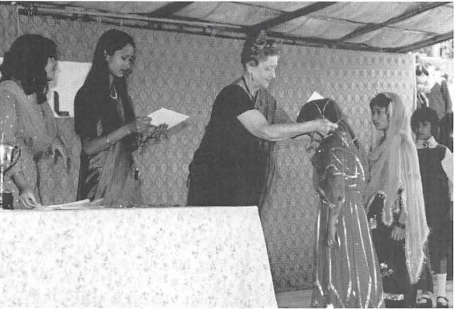
As the years of ‘Abdu’l-Bahá’s ministry were drawing to a close with WWI, and as a precursor to His Will and Testament, He sent the Tablets of the Divine Plan to the Bahá’í s of the West. Nine young girls were chosen to draw aside the curtains covering the original handwritten Tablets of ‘Abdu’l-Bahá. Mary Maxwell and her best childhood friend, Elizabeth Coristine of Montreal, were privileged to unveil the first and second of these Tablets for Canada in a tableau vivant at the Hotel McAlpin in New York on 29 April 1919. It was shortly before Mary’s ninth birthday and the end of the Heroic Age of the Faith of Bahá’u’lláh.
The passing of ‘Abdu’l-Bahá, in November 1921, devastated the whole Bahá’í community. May Maxwell was so shattered and shaken in body and soul that she may have become a permanent invalid had not Mr. Maxwell convinced her to visit the Shrines in the Holy Land and meet the Guardian face to face. He thought Mary should go with her. They set sail from New York for the Holy Land, on 29 April 1923. This first pilgrimage left an indelible impression on her, and in later years she recalled, in a personal letter, how she was touched by “the spirit of service” she discovered in Haifa, saying “… a Queen or a beggar woman would be met with the same loving sweetness. Indeed it was this divine normality that really confirmed me here as a little girl of twelve years.”
This was the first time she met the Guardian, and she often described the meeting with a sweet pleasure in the remembrance. She and her mother were installed in the Old Western Pilgrim House at the end of Persian Street and May, who had not been able to walk for over a year, was resting in bed. Since her nights were frequently sleepless and her nerves delicate, Mary had learned from an early age to protect her from intrusion. She was in the hallway of the Pilgrim House when the door suddenly opened and a young man stepped in, with a swift, deft movement, and asked if he could see Mrs. Maxwell. She was a tall girl for her age, fully grown and physically well-developed. She said she pulled herself up to her full height and, looking him squarely in the eyes with considerable dignity and aplomb, asked to know who it was who wished to see Mrs. Maxwell. The young gentleman meekly replied, “I am Shoghi Effendi.” Upon which she turned tail and fled into her mother’s room in mortified embarrassment. Hiding her head, as she used to say “like a puppy”, beneath her mother’s pillows, she could only point to the door and gasp, “He – he – is there!” when her mother asked her what the matter was. And when May Maxwell found out who it was behind the door, she said, “Pull yourself together, Mary, and go and invite him in.”
When May returned to North America almost a year later, she was filled with joy and restored to health, redoubling her efforts in the teaching work and educating the friends in the Bahá’í Administration, in which Shoghi Effendi had carefully instructed her.
Two years later, Mary made a second pilgrimage, in the company of two of her mother’s friends. Back in Canada afterwards, she threw herself eagerly into all kinds of youth activities, both within the Bahá’í administration and elsewhere. Shortly before she was 16, she became a member of the Executive Committee of The Fellowship of Canadian Youth for Peace, serving as its Treasurer. From then on she was continuously involved in membership on committees and in her efforts to promote the cause of racial amity. Soon after she turned 21, she was elected to the Local Spiritual Assembly of Montreal.
Her training in oratory and public speaking began when she was almost 16. Increasingly, she began to accompany her mother on teaching trips, during which she had occasion not only to observe her mother’s manner of giving Bahá’í talks but also to learn how to lecture herself, in the Bahá’í spirit. Just before her nineteenth birthday, she spoke at the National Bahá’í Convention in a manner that touched many peoples’ hearts and minds. At the age of twenty, she delivered a lecture at the Friends’ Meeting House in New York City on “Mysticism in the Bahá’í Religion.” The other speakers at this Congress were all seasoned lecturers and famous orators, including Syud Hossain, the editor of “The New Orient,” who was billed as an “incomparable lecturer on the Orient, world peace and international relations.” After her lecture she received a standing ovation, and on that same day was given the following cable: “HEARTY CONGRATULATIONS ON YOUR BEAUTIFUL CONSCIENTIOUS AND ABLE PRESENTATION OF A GREAT AND DIFFICULT THEME I AM HAPPY AND PROUD OF YOU—SYUD HOSSAIN”.
In addition to lecturing, she wrote books and plays and poetry, developing that diversity and range of skills that would serve to make of her a perfect instrument of service in the hands of her beloved Guardian, who noted her progress with keen interest. Her highest hope was to one day become an author. Her study of the translation of Nabíl’s Narrative, The Dawn-Breakers, which was encouraged by Shoghi Effendi, resulted in the article entitled ‘The Re-florescence of Historical Romance in Nabil’, later published in The Bahá’í World, Volume V (1932–34). The ardent, youthful enthusiasm that it reveals must have informed the lectures she gave on the Heroic Age of the Cause in Montreal, Green Acre, Louhelen, and Esslingen in Germany.
Shoghi Effendi closely followed the development and spiritual training of this remarkable young woman, writing to May Maxwell:
I feel that she should, while pursuing her studies, devote her energies to an intensive study of, & vigorous service to, the Cause, of which I hope & trust she will grow to become a brilliant and universally honoured exponent. I am sure, far from feeling disappointed or hurt at my suggestion, she will redouble in her activities & efforts to approach & attain the high standard destined for her by the beloved Master. Your plan of travelling with her throughout Canada in the service of the Cause is a splendid one & highly opportune. Kindly assure her & her dear father of my best wishes & prayers for their happiness welfare & success.
Your true & affectionate brother,
Shoghi
In May 1933, Mary spent several weeks in Washington, D.C., teaching the Faith and concentrating her efforts on finding ways to draw the two opposing races together, for the cause of racial unity was close to her heart and the rights and responsibilities of both races was a subject that touched her keenly throughout her life. She also attended official functions with her father in Montreal during her early twenties, meeting the Governor General of Canada at events such as the Royal Canadian Academy’s Fifty-Fourth Exhibition. This balance between her obligations to the Bahá’í community in particular and society at large served her well in later years. She always had the ability to mingle with officialdom and humble folk with equal ease; her support of local Bahá’í teaching work as well as social issues at the international level was equally enthusiastic throughout her life.
She very much wanted to learn Spanish, but when, in 1935, civil war threatened her plans to go to Spain, she was induced to accompany her cousins Jeanne and Randolph Bolles to Germany, where she taught and helped the Bahá’ís for the next year and a half, while May spent most of her time in France and Belgium. She became enamoured of the country and learned the language with fluency.
At the end of their extended stay in Europe, she and her mother received a warm invitation to come to the Holy Land. In a letter addressed to Mary Maxwell in late January 1936, the Guardian’s secretary wrote:
Before your coming to Haifa Shoghi Effendi would advise you to visit the centers in Germany and if possible to extend your trip to Austria and the Balkans where we have now a chain of active and prosperous communities that link the Western with the Eastern part of Europe. He would even suggest that you follow that route when you come to Haifa, as this would be of great interest to you, and of invaluable encouragement to the friends in these new and somewhat isolated centers.
Shoghi Effendi added, in his postscript:
Dear and valued co-worker:
I wish to assure you in person of a hearty welcome to visit the Holy Land and lay your head on the sacred Threshold after having rendered valuable services in the Faith in both America and Europe. For those you have asked me to pray, in your letters, I will supplicate the blessings of Bahá’u’lláh. Rest assured. Your true brother,
Shoghi
Mary Maxwell fulfilled the Guardian’s injunctions, travelling to every community in Germany and meeting every isolated believer, group, or Assembly. By the time she had accomplished this task, a year had passed and the rumblings of war were upon them. It was impossible now to travel through the Balkans or Austria, and she and her mother were then urged by Shoghi Effendi to come to the Holy Land directly.
One day during this pilgrimage, which began in 12 January 1937, another chapter opened in the life of Mary Maxwell when the mother of Shoghi Effendi told May Maxwell of Shoghi Effendi’s offer of marriage to her daughter.
The wedding took place on 24 March 1937, in Haifa, and it was on this occasion that the beloved Guardian gave her the name Rúhíyyih Khánum. In The Priceless Pearl, she described her wedding day, when she went with Shoghi Effendi to Bahjí, saying, “I remember I was dressed, except for a white lace blouse, entirely in black for this unique occasion, and was a typical example of the way oriental women dressed to go out into the streets in those days, the custom being to wear black.” The ring, which was a simple Bahá’í ring in the shape of a heart, had been given to her the day Shoghi Effendi proposed. He had asked her then to wear it on a chain around her neck, and on the day of their marriage, in the Shrine of Bahá’u’lláh, he took it from her and put it on her finger himself. It was a ring that had been given to Shoghi Effendi by the Greatest Holy Leaf, and Rúhíyyih Khánum later had one made exactly like it for the beloved Guardian. They were both buried with their rings on their fingers. After the recital of the marriage vow in the room of the Greatest Holy Leaf, the mother of Shoghi Effendi placed Rúhíyyih Khánum’s hand in the hand of her son, according to the old Persian tradition of dast be dast.
News of the marriage electrified the Bahá’í world, both in the East and the West. Cables composed by the Guardian and signed by his mother were sent to the National Spiritual Assembly of Iran and the National Spiritual Assembly of the United States and Canada. The one to the West, dated 27 March 1937, read as follows:
ANNOUNCE ASSEMBLIES CELEBRATION MARRIAGE BELOVED GUARDIAN STOP INESTIMABLE HONOUR CONFERRED UPON HANDMAID OF BAHA’U’LLAH RUHIYYIH KHANUM MISS MARY MAXWELL STOP UNION OF EAST AND WEST PROCLAIMED BY BAHA’I FAITH CEMENTED.
(Signed) Ziaiyyih, mother of the Guardian.
For Rúhíyyih Khánum the period of adjustment that followed was a training time that could not have been easy. She was parted from her beloved parents, living a great distance from her familiar life in Montreal, and plunged into an oriental household together with all her in-laws under one roof. This must have been difficult for a young woman raised with a degree of freedom that was unusual even in the West at that time. Another difficulty was the language. Although the members of ‘Abdu’l-Baha’s family all spoke English, they communicated with each other in Persian. It was only natural, when comments were passed and jokes were shared which she did not understand, that she would have felt left out. Were it not for her beloved, Rúhíyyih Khánum may well have been bereft.
But there were greater tests than mere loneliness and far greater trials than cultural isolation. In those early years of her marriage, one by one, the Guardian’s family fell away from faithfulness, until she was alone in that house at the side of her beloved. “Shoghi Effendi held me tight under his protective arms,” she used to say, and she, in turn, became his shield and his sole support. It was also during this turbulent period that Shoghi Effendi pulled her up short one day, and gesturing to her hand, said, “Your destiny is in the palm of your own hand.” This was a great shock for her and made her realize that she was not immune to her own tests of faith. “When Shoghi Effendi married me,” she used to say, “I felt safe and snug and thought I had nothing more to worry about, my destiny was in his hand. But when he said that, there it was, back in my own hand.” She would always make us laugh when she finished this very serious tale.
Her firmness in the Covenant, a manifestation of her deep faith, was her greatest protection in those early years of marriage. Perhaps the outpouring of her heart years later, in her poem “This is Faith”, written on April 4, 1954, exemplifies the depth of her understanding of this subject.
THIS IS FAITH
To walk where there is no path
To breathe where there is no air
To see where there is no light –
This is Faith.
To cry out in the silence,
The silence of the night,
And hearing no echo believe
And believe again and again –
This is Faith.
To hold pebbles and see jewels
To raise sticks and see forests
To smile with weeping eyes –
This is Faith.
To say: “God, I believe” when others deny,
“I hear” when there is no answer,
“I see” though naught is seen –
This is Faith.
And the fierce love in the heart,
The savage love that cries
Hidden Thou art yet there!
Veil Thy face and mute Thy tongue
Yet I see and hear Thee, Love,
Beat me down to the bare earth,
Yet I rise and love Thee, Love!
This is Faith.
A year after her marriage, Rúhíyyih Khánum wrote to her mother, “If anyone asked me what my theme was in life I should say, ‘Shoghi Effendi’.” It is clear from this that she had thrown herself with heart and soul into her destiny, and her task required a rigorous discipline. Under Shoghi Effendi’s strict tutelage she applied herself to conscientious study. Although she was an autodidact by nature and preferred to teach herself, rather than receive instruction—a habit she applied to many subjects in later life—he was, in effect, her principal teacher.
The reciprocity between Rúhíyyih Khánum and her parents was preserved despite the difficulties of distance and separation. She believed that service to the Cause performed by any one of them was a shared blessing for them all and of direct consequence to each, a theme echoed by May Maxwell in December 1939, when she wrote, “It is not only thru my passionate love for this great Bahá’í Faith, but thru my love for her, and yearning to be more worthy of her, that I have considered going to South America to teach.” And so it was that May Maxwell, seventy years old, with a weak heart and in very poor health, decided to make her supreme sacrifice. She arrived in Buenos Aires at the end of February, accompanied by her young niece, Jeanne Bolles, and the next day, on 1 March 1940, she died of a massive heart attack.
This was a terrible shock to Rúhíyyih Khánum. She received the devastating news from the Guardian, who told her, “Now I will be your mother” and comforted her with infinite compassion and patience. To Sutherland Maxwell, he cabled:
GRIEVED PROFOUNDLY YET COMFORTED ABIDING REALIZATION BEFITTING ONE SO NOBLE SUCH VALIANT EXEMPLARY SERVICE CAUSE BAHA’U’LLAH STOP RUHIYYIH THOUGH ACUTELY CONSCIOUS IRREPARABLE LOSS REJOICES REVERENTLY GRATEFUL IMMORTAL CROWN DESERVEDLY WON HER ILLUSTRIOUS MOTHER STOP ADVISE INTERMENT BUENOS AIRES STOP HER TOMB DESIGNED BY YOURSELF ERECTED BY ME SPOT SHE FOUGHT FELL GLORIOUSLY WILL BECOME HISTORIC CENTRE PIONEERS BAHA’I ACTIVITY STOP MOST WELCOME ARRANGE AFFAIRS RESIDE HAIFA STOP BE ASSURED DEEPEST LOVING SYMPATHY.
On 4 March, Rúhíyyih Khánum cabled the National Spiritual Assembly of the Bahá’ís of the United States and Canada, saying:
HUMBLY GRATEFUL BELOVED MOTHER ANSWERED GUARDIAN’S CALL TURNED SOUTHWARD SACRIFICED LIFE HOLY FAITH. BEG PRAYERS DAUGHTER MAY FOLLOW HER FOOTSTEPS.
Mr. Maxwell joined the Guardian and Rúhíyyih Khánum in Rome in the summer of 1940, but their return to Palestine was prevented by the war. They did, however, manage to reach France and cross over to England on the last boat before the German army closed the borders. Eventually they were able to sail to South Africa and then travel north to the Holy Land via Egypt.
The war years were filled with activity and great achievements at the World Centre. During this period Shoghi Effendi commissioned Sutherland Maxwell to make the drawings for the superstructure of the Shrine of the Báb, and their love and collaboration was the greatest source of joy to Rúhíyyih Khánum. She used to say, “I really learned to know and appreciate my father through Shoghi Effendi.” Also during this time, Rúhíyyih Khánum assisted the beloved Guardian in the proofreading of his masterpiece, God Passes By.
One of the most outstanding services performed by Rúhíyyih Khánum during her twenty years at the side of the Guardian, was her role as his secretary, a task she undertook almost immediately after her marriage. From 1941, when she became Shoghi Effendi’s principal secretary in English, until 1957, she wrote thousands of letters on his behalf. She frequently described how Shoghi Effendi trained her to be a good secretary. In the early years, he would write down the points he wanted her to incorporate in pencil at the bottom of the letter he had received, but later on, when he saw how well she wrote, he would just tell her what to answer verbally. However, she always stressed the fact that he read every single letter she wrote for him before appending his own postscript. In later years, she wrote not only his personal letters but also his official correspondence with National Spiritual Assemblies.
Rúhíyyih Khánum told us that Shoghi Effendi encouraged her to write, and once, as she was copying her own favourite poems in a book, he asked to see them for himself. The next day he gave her book back saying, “I read them all. They are beautiful, they made me cry.” At Shoghi Effendi’s suggestion she wrote an article on the interment of the remains of the Purest Branch and his mother, Navváb, on Mt. Carmel next to the resting-place of the Greatest Holy Leaf, which was published in volume VIII of The Bahá’í World. His encouragement was also the main reason she wrote the book Prescription For Living. She often said she felt so sad for the young men who returned, confused and disillusioned, from World War II to a changed and unfamiliar world. She wanted to give them some light, some direction, and a way to see hope for the future.
In The Priceless Pearl Rúhíyyih Khánum refers to the war in the Holy Land prior to the formation of the State of Israel, as gunfire echoed between sea and mountain, while she remained calm in the heart of the storm with Shoghi Effendi as her example. After the formation of the State, the situation changed and Rúhíyyih Khánum enjoyed a degree of freedom that had not been possible for her before. Her social life became more varied and lively, and she gave wonderful dinner parties and soirées for the dignitaries of Haifa.
During the 1940’s her father became severely ill, and in 1950 it was decided that Mr. Maxwell should go to Canada with his Swiss nurse until the situation improved in Israel. When they parted at the end of that summer, it was the last time Rúhíyyih Khánum saw her dear father. He died two years later in Montreal.
When the first International Bahá’í Council was formed in 1951, Rúhíyyih Khánum was a member and its chosen liaison with the Guardian. Then, in 1952, after the passing of Sutherland Maxwell, Shoghi Effendi sent a cable dated March 26th to the National Spiritual Assembly of the United States announcing that “mantle Hand Cause now falls shoulders his distinguished daughter Amatu’l Baha Ruhiyyih who already rendered still rendering manifold no less meritorious self sacrificing services World Centre Faith Bahá’u’lláh”. The following year, the Maxwell home in Montreal was declared a Shrine, marking not only the great gift bestowed by ‘Abdu’l-Baha on the Canadian Bahá’í community but also the unique services of William Sutherland, May and Mary Maxwell.
On 15 December 1952, the beloved Guardian announced that five Intercontinental Conferences would be held during the course of the Holy Year, and designated Rúhíyyih Khánum to be his representative at the one in Wilmette. She was, in his words, to
DELIVER MY OFFICIAL MESSAGE ASSEMBLED BELIEVERS ELUCIDATE CHARACTER PURPOSES IMPENDING DECADE LONG SPIRITUAL WORLD CRUSADE RALLY PARTICIPANTS ENERGETIC SUSTAINED ENTHUSIASTIC PROSECUTION COLOSSAL TASKS AHEAD.
She was also delegated by him to dedicate the Temple in North America on his behalf and
UNVEIL OCCASION COMPLETION CONSTRUCTION MOTHER TEMPLE WEST PRIVILEGED ATTENDANTS WILMETTE CONFERENCE MOST PRIZED REMEMBRANCE AUTHOR FAITH NEVER BEFORE LEFT SHORES HOLY LAND TO BE PLACED BENEATH DOME CONSECRATED EDIFICE STOP MOREOVER ASSIGNING HER TASK ACT MY DEPUTY HISTORIC CEREMONY MARKING OFFICIAL DEDICATION HOLIEST MASHRIQUL ADHKAR BAHAI WORLD REARED EVERLASTING GLORY HONOUR MOST GREAT NAME HEART NORTH AMERICAN CONTINENT [signed] SHOGHI
She had left North America eighteen years before, when she was a young Bahá’í and was known as the daughter of May Maxwell. Now she was returning as Amatu’l-Bahá Rúhíyyih Khánum, the consort of the beloved Guardian and a Hand of the Cause of God. In Wilmette, she rose to speak like the queen she was, her delicate, gauzy mantilla framing her lovely young face, and even from the photographs it is easy to see how she would have made an unforgettable impression on the Bahá’ís, as well as on the non-Bahá’í seekers and distinguished speakers. After attending the 1953 Forty-fifth Annual Convention, the Bahá’í Dedication of the Temple, and the public Dedication the next day, she attended the All-America Intercontinental Conference from 3 to 6 May.

Wilmette, Illinois, in 1953.
Then, accompanied by Amelia Collins, a Hand of the Cause and Vice-President of the International Bahá’í Council, Rúhíyyih Khánum went to Montreal to visit her father’s resting-place. A memorial gathering was held at the graveside on 10 May and that evening she spoke at a public meeting at the Ritz-Carlton Hotel. While in Montreal, she also sorted out her parents’ belongings and, with Shoghi Effendi’s consent, shipped her personal furniture to the Master’s House in Haifa, where she created an exquisite library, which she used for special dinner parties, and a beautiful drawing room. In an act that pleased the Guardian immensely, she gave her Montreal home to the Faith, and it is now registered in the name of the National Spiritual Assembly of Canada.
In 1952, when some degree of safety and order was restored to Israel, Shoghi Effendi re-opened the opportunity for pilgrimage. Groups of nine pilgrims, from both the East and the West, began to arrive. To welcome them, to cater to their needs, and respond to their concerns was a task that consumed not only many hours of the Guardian’s time but those of Rúhíyyih Khánum, who planned and prepared the pilgrims’ meals in the face of great shortages of all kinds of essential foods in the post-war years.
In 1957, the beloved Guardian and Rúhíyyih Khánum left together for their summer vacation for the last time. The Guardian was very tired. As usual, he maintained all his correspondence and carried with him all his notes for his map of the Ten Year Crusade, which was approaching its mid-way point. In August that year he thrilled the Bahá’ís of the world with a two-fold message. The first part was the announcement of five Intercontinental Conferences to celebrate this mid-way point of the Crusade, and the second was his appointment of eight more Hands of the Cause in different continents. Everyone was filled with anticipation. Everyone looked forward to jubilation and celebration ahead. We in Uganda were thrilled beyond belief, for we had learned with awe and excitement that our precious Amatu’l-Bahá Rúhíyyih Khánum had been designated by the beloved Guardian to represent him at the African Conference in Kampala. She was going to come to us!
And then, on 4 November, the cataclysmic news of Shoghi Effendi’s passing rocked the Bahá’í world. He had died in London, we heard in disbelief. The community that had for thirty-six years looked to him for guidance, for encouragement, for leadership and, above all, for his encompassing love, was bereft. There was no one to turn to but Amatu’l-Bahá, although she was the most forlorn of all at that time. It was up to her to take the next step to ascertain what should be done. The fulfilment of all the Guardian’s hopes and aspirations for the Ten Year Crusade became of uppermost importance to her. His good pleasure became the goal and object of her existence. From that moment to the end of her life her priorities never wavered.
In the face of her own immeasurable personal loss, it is remarkable to consider with what self-abnegation her heart turned to her fellow believers at that critical time of trial. All around her, friends were prostrate with grief, helpless with sorrow, leaving her to rise alone to the painful task in front of her, for the sake of her beloved Shoghi Effendi. She had to inform the Hands of the Cause and the Bahá’í world of this tragic event in such a manner as might lessen as much as possible the shock waves it was bound to cause. She had to tell the heart-broken believers to come to his funeral and bid their Guardian a last farewell. She went around London looking for a befitting burial ground and found it. She searched for a shroud and chose the casket and bought it. She saw to every detail in the sad days that followed. And the day after the funeral, when she was driving away from the graveside, she saw in her mind’s eye a vision of a column, an eagle and a globe, and she conceived the monument above his grave. She remembered how fond Shoghi Effendi had been of beautiful columns, and how he had said it was a pity that in his gardens there was no place for a single column. With this thought in mind, she designed the graceful column rising over his grave and placed the globe on it, surmounted by the symbol of his victories: the majestic eagle, with its wings open.
On 15 November Rúhíyyih Khánum arrived in Haifa, and three days later the first Conclave of the Hands of the Cause began in Bahjí. They searched for the will of Shoghi Effendi but did not find it, and so the Hands of the Cause informed the community that they must turn to the explicit directives in The Dispensation of Bahá’u’lláh, which Shoghi Effendi had referred to as his Will and Testament, to complete the goals of the Ten Year Crusade and to arrange for the election of the Universal House of Justice at the end of that period.
The Hands of the Cause were strong individuals from both the East and the West whose primary aim was to direct and hold together the affairs of the Cause of God. Amatu’l-Bahá played a vital role in their early Conclaves, serving as a bridge between cultures and languages – a Westerner imbued with Eastern understanding, whose horizons had been widened and stretched by Shoghi Effendi. Her deep sense of fairness and her ability to see clearly both sides of an argument facilitated the narrowing and negotiating of the gaps between the different Hands.
During that first year after Shoghi Effendi’s passing, Rúhíyyih Khánum spent most of her time in Bahj̤í and slept in the Mansion. Apart from carrying out all her heavy administrative duties, she threw herself into physical work, cleaning the Shrine and working in the gardens. She could not bear the emptiness and the loneliness of her apartment in Haifa. The next five or six years were perhaps the saddest and hardest in her entire life. But she demonstrated her own, immediate commitment to service when she accepted to attend the first of the series of the Intercontinental Bahá’í Conferences called by the beloved Guardian to mark and celebrate the mid-way point of the Ten Year Crusade. Initially, her grief was so intense that she did not want to go, but her fellow Hands convinced her that since it had been the wish of Shoghi Effendi, she must do so.
Although Rúhíyyih Khánum was in mourning and wore black for one year after Shoghi Effendi’s passing, she altered this custom for the duration of her trip to Africa. She told me afterwards that all her clothes for that Conference had been seen and approved by the Guardian the previous summer, and this was one of the reasons why she did not come to Kampala in mourning clothes. She also wanted to create a sense of jubilation during this Conference, the way Shoghi Effendi had anticipated it should be.
Over nine hundred people stood up in sorrowful awe as she entered the conference hall in Kampala on 24 January 1958. And then, four hundred African Bahá’ís raised their voices and began to sing “Alláh-u-Abhá”, softly and spontaneously. The air was so charged with love, so pent-up with emotion as Amatu’l-Bahá walked up the central aisle, that we were all shaken. When she stood before us to address the Conference, her voice broke and tears came to her eyes several times. But the waves of deep love and sympathy in that audience were tangible; they enveloped and caressed her, and at the end assuaged her sorrow. Her love for the Africans and their continent became a permanent part of her life afterwards. She brought to that Conference a wider perspective, a global outlook, an all-embracing point of view that we had been lacking, and she went back from it recharged with hope and courage to continue, travelling to different conferences and to the Dedications of both Mother Temples of Africa and Australasia during the Custodianship of the Hands.
In 1961, the election of the International Bahá’í Council took place. This precursor of the Universal House of Justice greatly assisted the Hands in the preparation for that first International Bahá’í Convention, and Rúhíyyih Khánum, who had been tasked by the Hands with the completion of the interior of the International Archives Building, turned for assistance to the Council’s younger members. Beautiful Chinese and Japanese furniture purchased by Shoghi Effendi during the last year of his life for the purpose of decorating and displaying the holy relics, had to be carefully arranged and meticulously prepared for their precious contents. Artistry, a sense of proportion, a strict adherence to the placement of the objects according to the priority of their importance—all these guided Amatu’l-Bahá in her task.
The conclusion of the Ten Year Crusade, in April of 1963, was crowned by the election of the long-awaited Universal House of Justice in Haifa. The election took place in the House of ‘Abdu’l-Bahá, which had played such a significant role in the unfoldment of the Administrative Order of Bahá’u’lláh. To befittingly honour the occasion, Rúhíyyih Khánum had ordered thousands of roses and carnations to carpet the inner rooms of all three Shrines. She opened that International Bahá’í Convention and every successive one until that of April 1998. Then, after the election of the Supreme Body, Rúhíyyih Khánum and the Hands of the Cause of God rejoiced with 7,000 Bahá’ís in Albert Hall in London, England, at the first Bahá’í World Congress. Amatu’l-Bahá invited a number of indigenous Bahá’ís from Africa, South America and Australia to attend this historic event as her personal guests. Her deeply moving and thought-provoking talk on Shoghi Effendi’s life was a masterpiece of eloquence and poignancy, as we brought his Ten Year Crusade to its triumphal close.
Rúhíyyih Khánum’s systematic travels around the globe began in the year 1964. Many times, she talked about the genesis of these unique trips, recounting an incident in the lifetime of Shoghi Effendi. One day, as he was passing by her desk, he stopped and looked at her and said, “What will become of you after I die?” She was shattered by this unexpected remark and began to weep, saying, “Oh, Shoghi Effendi, don’t say such terrible things. I don’t want to live without you.” He paid no attention, however, and after a pause continued, “I suppose you will travel and encourage the friends.” She said that this was the only remark he ever made about what she should do with her life after his passing. And so it was that, when she was somewhat freed from her arduous administrative duties and the affairs of the Cause were placed under the infallible guidance of the Universal House of Justice, she took these words as his last instructions to her and did her utmost to fulfil his hopes.
In the course of her long life she travelled to 185 countries, dependencies and major islands of the globe. While she visited just 31 countries in her first 54 years, she travelled in all the rest between 1964 and 1997. When I tried to count the number of territories she visited in these 34 years, I came up with the astounding figure of 154. Many of these countries were visited more than once, and some, like India, were honoured by her presence as many as nine times. Her trips were of such a variety that the best way to look at them is through the range of activities that they involved.
Her role as Ambassador of the Bahá’í Faith, for example, was remarkable in itself. Everywhere she went she met with Heads of State and high-ranking authorities at the national, local or even village levels, moving with complete ease from one class of society to another. Although she herself was in every way queenly and worthy of honour and respect, she always approached these emblems of material power and political authority with deference and a natural humility. She would explain that her visit was in the nature of a courtesy call, and nothing more, stating that she had come from the World Centre of the Bahá’í Faith and was visiting the Bahá’ís in that country, who were a strictly a-political and non-partisan people, well-wishers of the government and obedient to its laws. In all her encounters, she strove to be positive and looked for every opportunity to offer praise and appreciation in her dealings with state officials, even if very little was called for.
In Africa alone she met with seventeen Heads of State and was instrumental in helping the Bahá’ís achieve many of their legal goals. The highest in rank and the leader she most valued meeting in all her travels was Emperor Haile Selassie of Ethiopia. She greatly admired his nobility, his courage and his uprightness. The Head of State whose meeting brought her the greatest joy and pride was His Highness Malietoa Tanumafili II of Western Samoa, the first ruling monarch to embrace the Cause of Bahá’u’lláh.
She always maintained a high standard of propriety, and when she shared the platform or sat at dinner with such people as Prince Philip of Great Britain or the Archbishop of Canterbury, with Governors-General and Ambassadors, she invariably won their admiration and respect, not only for herself but most importantly for the Cause of Bahá’u’lláh. This was her ultimate concern. Rúhíyyih Khánum truly had no personal ambition; she was not in the least interested in meeting or moving in such company for its own sake or her pleasure. It was only for the Cause that she would accept any appointments and invitations of this kind.
Another activity which she undertook in the course of her many travels was contact with the representatives of the media. She must have had hundreds of newspaper, radio and television interviews, in the capital cities around the world as well as in the large and small towns of every country she visited. Before going to meet a journalist or be filmed in a studio she would always pray and ask for God’s guidance, His assistance and, above all, His protection. She used to tell the friends that when they met the representatives of the media, their principal aim should be to create a good impression of the Faith. “If these people only remember one thing, that the word ‘Bahá’í’ means something good, you have achieved your purpose,” she used to say.
Another vital service rendered by Amatu’l-Bahá in the course of her many travels was her role as the representative of the Universal House of Justice at national and international Bahá’í Conferences across the planet. Standing on platforms on behalf of the Sacred Institution she served, in the course of Bahá’í Conventions at Ridván, at youth conferences and Native gatherings, at inaugurations of Bahá’í Temples and other great historical events to which the Bahá’ís streamed from all the quarters of the globe, she was erect and regal and forever memorable, the essence of dignity and beauty. Her mastery of just the right word on each of these occasions, her ability to draw out her audience and touch people’s hearts, her clear and simple logic, and, above all, her wit and her bewitching sense of humour—these qualities endeared her to and charmed her audiences. When asked, she attributed her power of public speaking to the fact that at the beginning of her marriage Shoghi Effendi had recommended that she memorize the beautiful prayer of ‘Abdu’l-Bahá which begins, “O Lord, my God and my Haven in my distress! My shield and my Shelter in my woes! …” and which concludes with the poignant sentence: “Loose my tongue to laud Thy name amidst Thy people, that my voice may be raised in great assemblies and from my lips may stream the flood of thy praise.” She also attributed it to the advice given by ‘Abdu’l-Bahá to May Maxwell, to turn her heart to Him, pray, and then speak, for Rúhíyyih Khánum herself followed this advice faithfully. She gave talks with the same degree of resourcefulness in French, in German, and in Persian.
One of the most memorable services in the course of Amatu’l-Bahá’s many travels was the time she spent and the attention she gave to perfectly ordinary people in the peripheries of society. When asked what was her favourite spot, she would often say that it was in the villages and jungles of the world. She rarely missed the opportunity to validate people in far flung and remote places whom few had heard of and whose simple actions none might ever know.
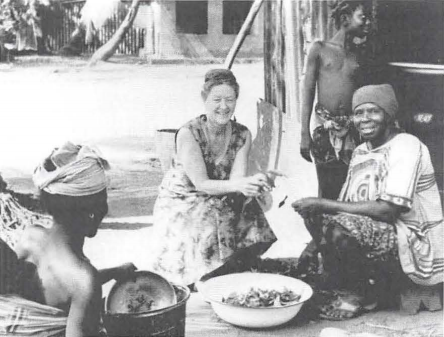
How often in the course of these forty years by her side did I witness shy, unsure, sometimes dejected human beings uplifted by her genuine kindness, her praise and patience. Her instinct was to approach people with an open, candid heart, simply and unself-consciously. It was to look for positive qualities in people and verbalize these. But though she was the perfect diplomat in some respects, she was also very direct and often said things frankly and outspokenly. The driving impulse in all her encounters with the Bahá’ís was to stir them to action and rouse them up so that they would teach the Faith. And often, even when she was critical of individuals, her intent was to protect the Cause. If her manner may at times have appeared abrupt, and initially formidable to those who approached her, it was often the result of her own innate shyness, which few people guessed, for she was disconcerted, to the end of her life, by effusiveness and adulation.
Seldom did Rúhíyyih Khánum travel, especially on her longer trips, without a pet. Her love for animals was such that she would gladly accept the extra hardship of tending and cleaning her pets for the simple joy of their company. Her motto was, “You only live once; why not get clean joy out of it?”
Rúhíyyih Khánum was one of the most hardworking human beings that I have ever met, and she never asked anyone to do anything that she had not or could not also have done herself. Much of her hard work was centred on her home in Haifa, which was the hub of continuous activity until the last two and a half years of her life. She kept a regular entourage around her as busy as herself and trained them rigorously in the arts of practical maintenance.
Her first and foremost concern was always the upkeep and care of the Shrines. Her constant reminder was to keep these precious Holy Shrines exactly the way Shoghi Effendi had arranged them. “This is not a place of innovation, but preservation” was her advice to all. She also undertook periodically to inspect and keep all the Holy Places in order, framing pictures, replacing the frayed and worn out fabrics, keeping an eagle eye on any deviation from the Guardian’s ways. The renovation and furnishing of the House of ‘Abdu’lláh Páshá engrossed her interest for several years.
One of Amatu’l-Bahá’s important social activities in Haifa was her role as hostess. She loved setting a beautiful table, arranging flowers and overseeing every detail of the event. Apart from formal dinners, she would also give many informal parties. After returning from India, every now and then she would be so homesick for that country that she would throw an “Indian Night” party. She would dress the few ladies working at that time in Haifa in her beautiful saris, trace the floors with exquisite patterns made of coloured flour, play Indian music, and we would all enjoy delicious, spicy Indian food under her hospitable roof. And also do the cleaning up with her afterwards! Or there were her exciting “African Nights” when all the friends who were either African or connected to the work in Africa were invited to her home, usually outside in her beautiful garden, and after a scrumptious dinner would drum and sing to their hearts’ content. How exhilarating were her dinner parties for the new Counsellors, too, where the guests, numbering over 90 at times, were squeezed into the main hall, as she would say, “with a shoe horn.” Many hundreds of the friends who met Amatu’l-Bahá on her travels, enjoyed her delightful hospitality and loving attention when visiting Haifa.
There was, of course, a stream of regular nine-day pilgrims with whom she also met, twice a month for nine months of the year. This was a custom and responsibility which went back to her earliest years at the side of Shoghi Effendi, and which she dutifully maintained until the last years of her life. She met with about 2000 pilgrims each year in the main hall of the Master’s House, giving talks that provided guidance and inspiration for many. She also kept up a voluminous correspondence, encouraging institutions and individuals and responding to questions and requests.
Two particular events at the World Centre stand out, during which many hundred of pilgrims flocked through the doors of the Master’s House. In 1968, the Centenary of the arrival of Bahá’u’lláh in the Holy Land brought two thousand Bahá’ís to Haifa and ‘Akká, and in 1992 three thousand Bahá’ís came for the commemoration of the Centenary of the passing of Bahá’u’lláh. On the afternoon of 28 May at Bahjí, they witnessed Amatu’l-Bahá place the cylinder containing the Roll of Honour of the Knights of Bahá’u’lláh at the entrance of the Most Holy Shrine. On the night of Bahá’u’lláh’s Ascension, after a devotional program in the Haram-i-Aqdas, we all circumambulated the Shrine, which Rúhíyyih Khánum had carpeted with thousands of rose buds and carnations.
When one contemplates the fullness of her days and years, many of which were spent in travel, one is filled with wonder at how she managed to do so much writing. Throughout the years Amatu’l-Bahá penned The Priceless Pearl, Manual for Pioneers, The Desire of the World, The Ministry of the Custodians, and Poems of the Passing, an outpouring of her broken heart after the death of Shoghi Effendi, which was printed in 1996. Furthermore, her legacy also includes the production of two important films. The first, her two-hour documentary film “The Green Light Expedition,” was the fruit of her six months’ journey in 1975 through the Amazon Basin, the Peruvian and Bolivian altiplano, to the Bush Negroes of Suriname. Her second film, “The Pilgrimage”, offers a visual pilgrimage to the Bahá’í Holy Places in Haifa and ‘Akká, with Amatu’l-Bahá as guide.
Rúhíyyih Khánum touched and filled the lives of numerous people everywhere around the world, but the primary source of her comfort and happiness in the last decades of her life was her love for the Universal House of Justice and her bond with this Institution and its individual members. When all nine members of the Universal House of Justice came to her home for the last time three weeks before her passing and paid their respects, when she was quite frail and in bed, such a deep sense of happiness and contentment enveloped her that it was tangible, like sunlight, in the room after they left. She lingered quietly in that light a moment, and then said, “I felt their love; they are my closest friends.” This bond, which symbolized her total dedication to the Covenant throughout her life, was strong and vibrant to the end – and always reciprocal.
Her funeral was held in the central hall of the Master’s House. The two Hands of the Cause were present, together with members of the Universal House of Justice, the International Teaching Centre Counsellors, and twenty-four Continental Counsellors from all over the world. Also attending were her family members and representatives from seventy-six National Spiritual Assemblies, senior officials from the Canadian and United States embassies, representatives of the Israeli government, the mayors of Haifa and ‘Akká, other prominent Israeli citizens, and a number of special invited guests. Following the readings and the chanting of the Prayer for the Dead, she left for the last time that house which she had entered as a bride sixty-three years before. Her coffin was carried out by members of the Universal House of Justice, then borne across the street and lowered into its vault by believers representing a variety of ethnic origins. Almost one thousand people, including pilgrims and volunteers serving at the Bahá’í World Centre, stood outside her home, in the closed-off street, and in the garden where her grave had been prepared. The interior of the grave was carpeted on all sides with hundreds of roses and carnations, just as she had arranged for her beloved Shoghi Effendi forty-two years before. And as the rain poured down, more prayers were recited and chanted before her casket was lowered into the ground. The rainstorm that had begun on the night she passed away finally subsided to a drizzle as her precious remains were laid to rest.
I think, to sum up such a life, there are no adequate words but those expressed in the message of the Universal House of Justice to the Bahá’í world after her passing:
19 January 2000
To the Bahá’ís of the World
In the early hours of this morning, the soul of Amatu’l-Bahá Rúhíyyih Khánum, beloved consort of Shoghi Effendi and the Bahá’í world’s last remaining link with the family of ‘Abdu’l-Bahá, was released from the limitations of this earthly existence. In the midst of our grief, we are sustained by our confidence that she has been gathered to the glory of the Concourse on High in the presence of the Abhá Beauty.
For all whose hearts she touched so deeply, the sorrow that this irreparable loss brings will, in God’s good time, be assuaged in awareness of the joy that is hers through her reunion with the Guardian and with the Master, Who had Himself prayed in the Most Holy Shrine that her parents be blessed with a child. Down the centuries to come, the followers of Bahá’u’lláh will contemplate with wonder and gratitude the quality of the services—ardent, indomitable, resourceful—that she brought to the protection and promotion of the Cause.
In her youth, Amatu’l-Bahá had already distinguished herself through her activities in North America, and later, both with her dear mother and on her own, she had rendered valuable service to the Cause in Europe. Her twenty years of intimate association with Shoghi Effendi evoked from his pen such accolades as “my helpmate”, “my shield”, “my tireless collaborator in the arduous tasks I shoulder.” To these tributes he added in 1952 his decision to elevate her to the rank of Hand of the Cause of God, after the death of her illustrious father.
The devastating shock of the beloved Guardian’s passing steeled her resolve to lend her share, with the other Hands of the Cause, to the triumph of the Ten Year Crusade, and subsequently to undertake, with characteristic intrepidity, her historic worldwide travels.
A life so noble in its provenance, so crucial to the preservation of the Faith’s integrity, and so rich in its dedicated, uninterrupted and selfless service, moves us to call for befitting commemorations by Bahá’í communities on both national and local levels, as well as for special gatherings in her memory in all Houses of Worship.
With yearning hearts, we supplicate at the Holy Threshold for infinite heavenly bounties to surround her soul, as she assumes her rightful and well-earned position among the exalted company in the Abhá Kingdom.
The Universal House of Justice

Throughout history, humanity has depended upon science and religion as the two principal knowledge systems that have propelled the advancement of civilization, guided its development, and channeled its intellectual and moral powers. The methods of science have allowed humanity to construct a coherent understanding of the laws and processes governing physical reality, and, to a certain degree, the workings of society itself, while the insights of religion have provided understanding relating to the deepest questions of human purpose and action.
The social role of knowledge as it relates to the building of a world civilization is of immense importance. In this context, the relation between science and religion, the two great systems of knowledge, assumes vital significance, as do issues surrounding the acquisition of knowledge by the individual, since according to the Bahá’í viewpoint, the highest goal of the individual is to be a source of social good
MATERIAL AND SPIRITUAL CIVILIZATION
According to the Bahá’í teachings, there are two facets to civilization: material and spiritual. Bahá’ís believe that for humanity to prosper these must be balanced. Adherence to a strictly materialistic viewpoint requires trying to understand civilization in terms of material complexity in the collective existence of the human species. In this paradigm, the complex structures of atoms and molecules and their interactions that constitute a human being and create in it the potentialities of the mind are seen as preludes to, or building blocks of, more complex entities such as the family, the group, the community, and society. When these higher collective structures come into being, they are viewed as having the potential of certain patterns of behavior associated with civilization.
The materialistic line of thinking, regardless of how many humanistic concepts are introduced into it, dictates acceptance of the idea that the force that pushes humanity towards these higher levels of organization—and, therefore, towards civilization—is the imperative to survive. Somehow the genetic code of every human being (itself the product of physical evolution) contains instructions that oblige the individual to work for the survival of humanity as a species. Thus, the various manifestations of civilization are explained in terms of their intrinsic value for survival, whether now or at some time in the distant past during some stage of evolution. The fact that human beings are attracted, for example, to beautiful works of art—indeed, the very fact that the concept of beauty exists in human thought—is the result of its utility somewhere in the process of physical evolution. In other words, being able to think the concept of beauty and react to it
in certain ways must have given some members of the species advantages in the struggle for survival over others who were not able to do so.
Within a worldview of this kind, it would be hard to grant knowledge a transcendental value that would not finally be reducible to some kind of material utility. It is not surprising, then, that as society becomes more and more materialistic, knowledge is increasingly regarded essentially as a commodity. While receiving the highest praise in an age proudly associated with its expansion, knowledge is more and more identified with information, and its generation and application are increasingly ruled by the exigencies of economic growth. This process of production and consumption of goods and services is considered central to humanity’s collective existence and progress.
The Bahá’í view of civilization is very different. Just as the individual has both a spiritual and a material nature, civilization is seen as having two similar aspects. It is an expression of humanity’s collective existence, the spiritual dimension of which is greater than and gives purpose to its material dimension. The Bahá’í writings state that both the life of the individual and that of humanity as a species have a purpose beyond mere existence and survival. The purpose of the individual’s life is to know and worship God, and the purpose of humanity’s collective life is to carry forward an ever-advancing civilization.
It is reasonable to believe that the generation and application of knowledge is the central process that propels the advancement of spiritual and material civilization. Furthermore, it can be affirmed that this knowledge is basically organized in two great systems: religion and science. Neither is static; one progresses through revelation and the other through scientific investigation. The writings of ‘Abdu’l-Bahá shed light on this subject, as seen in the following passage:
Religion is the light of the world, and the progress, achievement, and happiness of man result from obedience to the laws set down in the holy Books. Briefly, it is demonstrable that in this life, both outwardly and inwardly the mightiest of structures, the most solidly established, the most enduring, standing guard over the world, assuring both the spiritual and the material perfections of mankind, and protecting the happiness and the civilization of society is religion.1The Secret of Divine Civilization (Wilmette: Bahá’í Publishing Trust, 1994), 71–72.
Further, He says:
Creation is the expression of motion. Motion is life. A moving object is a living object, whereas that which is motionless and inert is as dead. All created forms are progressive in their planes, or kingdoms of existence, under the stimulus of the power or spirit of life. The universal energy is dynamic. Nothing is stationary in the material world of outer phenomena or in the inner world of intellect and consciousness.
Religion is the outer expression of the divine reality. Therefore, it must be living, vitalized, moving and progressive. If it be without motion and nonprogressive, it is without the divine life; it is dead.2The Promulgation of Universal Peace: Talks Delivered by ‘Abdu’l-Bahá during His Visit to the United States and Canada in 1912 (Wilmette: Bahá’í Publishing Trust, 1982), 140.
About science, ‘Abdu’l-Bahá states:
All the powers and attributes of man are human and hereditary in origin—outcomes of nature’s processes—except the intellect, which is supernatural. Through intellectual and intelligent inquiry science is the discoverer of all things. It unites present and past, reveals the history of bygone nations and events, and confers upon man today the essence of all human knowledge and attainment throughout the ages. By intellectual processes and logical deductions of reason, this superpower in man can penetrate the mysteries of the future and anticipate its happenings.
Science is the first emanation from God toward man. All created beings embody the potentiality of material perfection, but the power of intellectual investigation and scientific acquisition is a higher virtue specialized to man alone. Other beings and organisms are deprived of this potentiality and attainment. God has created or deposited this love of reality in man. The development and progress of a nation is according to the measure and degree of that nation’s scientific attainments. Through this means its greatness is continually increased, and day by day the welfare and prosperity of its people are assured.3Ibid., 49.
In sum, religion and science are the two knowledge systems that hold together the foundations of civilization. They are two forces that propel the advancement of civilization. They are two sets of practices that draw upon the higher powers of the human soul and must be in harmony. Understanding the nature of this harmony is essential if humanity is to generate and apply the kind of knowledge that will advance civilization in both its material and spiritual dimensions.
THE STANDARD OF MEASUREMENT
In a passage describing some of the gifts that God has vouchsafed unto humanity, such as understanding and vision, Bahá’u’lláh states:
These gifts are inherent in man himself. That which is preeminent above all other gifts, is incorruptible in nature, and pertaineth to God Himself, is the gift of Divine Revelation. Every bounty conferred by the Creator upon man, be it material or spiritual, is subservient unto this. It is, in its essence, and will ever so remain, the Bread which cometh down from Heaven. It is God’s supreme testimony, the clearest evidence of His truth, the sign of His consummate bounty, the token of His all-encompassing mercy, the proof of His most loving providence, the symbol of His most perfect grace. He hath, indeed, partaken of this highest gift of God who hath recognized His Manifestation in this Day.4Gleanings from the Writings of Bahá’u’lláh (Wilmette: Bahá’í Publishing Trust, 1994), 195.
In the Bahá’í view, divine revelation is the standard by which all understanding and all knowledge will finally have to be measured. It encompasses the knowledge of all reality and stands above the judgement of human beings, whatever the degree of their attainments. As Bahá’u’lláh says in the Kitáb-i-Aqdas, His Most Holy Book:
Weigh not the Book of God with such standards and sciences as are current amongst you, for the Book itself is the unerring Balance established amongst men. In this most perfect Balance whatsoever the peoples and kindreds of the earth possess must be weighed, while the measure of its weight should be tested according to its own standard, did ye but know it.5The Kitáb-i-Aqdas: The Most Holy Book (Wilmette: Bahá’í Publishing Trust, 1993), 56–57.
When religion, as a system of knowledge and practices pertaining to human beings, is in conformity with divine revelation and is not contaminated by elements such as superstition, speculation or emotionalism, then it is true religion and illuminates human understanding. It guards the individual against arrogance and conceit, which can turn knowledge into a barrier between him and God. In that way, the spirit of religion illuminates science and protects it from becoming dogmatic materialism.
Human understanding of divine revelation, as distinct from revelation itself, is innately limited, however, and can be mistaken. Religious belief held by individuals and communities needs, therefore, to be carefully examined in the light of scientific truth and of reason. ‘Abdu’l-Bahá states that religion must be reasonable
and that every religion which is not in accordance with established science is superstition.
6Promulgation of Universal Peace, 63. Bahá’u’lláh warns that the study of religion should not result in ignorant fanaticism and bigotry and explains that the literal interpretation of divine texts when a spiritual meaning is intended leads to false imaginings
and to straying from the infinite mercy of Providence.
Thus, in the same way that religion protects science from turning into materialistic dogma, science protects religion from turning into superstition.
Not all conceptions of science and religion hold these two systems to be in harmony, however. The present widespread belief in the intrinsic conflict between science and religion arose at a time in the history of Christendom when conceptions of science and religion were highly inadequate. Bahá’ís believe that a new concept of religion was given to humanity by Bahá’u’lláh, necessitating a reformulation of previously held ideas; similarly, popular notions about science should be informed by the latest developments in the field and by advances in the philosophy and history of science.
Widely held perceptions of science are based on notions that have, in recent decades, been proven either wrong or extremely inadequate. These notions are held not only by the majority of the world’s peoples, who see the magical results of scientific progress, but also by those who are engaged in narrow scientific activity without feeling the necessity to reflect in any depth on the nature of science and its offspring, modern technology. Many of these notions fall within a category that has been called naïve inductivism.
According to these perceptions, science begins with observation of things and occurrences. With an unprejudiced mind and with absolute objectivity scientists faithfully record what they experience through their senses. The resulting observation statements
form the basis from which the laws and theories of science can be derived.
The immediate results of observation are singular statements, which refer to particular events at particular times. When enough such statements are gathered on the basis of repeated observations, it is claimed, one can arrive at universal statements through a process of generalization that is entirely logical.
In order for such generalizations to be considered legitimate by the inductivist, a large number of observation statements must form the basis of each generalization, the observations must be repeated under a wide variety of conditions, and no observation statement should be found that contradicts the derived universal statement.
Induction—the process of going from a sufficiently large number of singular statements to universal statements—is not, however, ruled entirely by the laws of logic, contrary to what is often believed. Its shortcomings are encapsulated in the story about the turkey that was fed every day at 8 a.m. On 23 December, it decided that its observations were large enough in number to justify the conclusion reached by induction that it would always be fed at 8 a.m. Two days later it was being served to a happy group of people as part of their Christmas dinner.
Not even the popular view of science, of course, is so naïve as to depend on induction alone. With laws and theories at their disposal, scientists can derive from them various consequences that serve as explanations and predictions. These predictions and explanations are made through the process of deduction whose rationality, unlike that of induction, no one questions. For example, from the laws of planetary motion the existence of a new planet may be predicted, which, in turn, gives rise to new opportunities for experimentation that strengthen the existing theory or ask for its modification.
According to these views, then, scientific knowledge is built entirely upon observation. As the number of facts established by observation and experiment grows, and as the facts become refined through improvements in observational and experimental skills, more and more laws and theories of increasing generality and scope are constructed. The growth of science is thus continuous and cumulative.
Explanations of science such as this have led the world to the conviction that scientific knowledge is proven knowledge—objective and free of personal opinions, preferences and speculative imaginings. As objectively proven, it is therefore reliable. Language, however, can trick the thought processes. Objective,
proven,
and reliable
are not value-free words. Gradually they become synonymous with indisputably true,
and science says
becomes the final arbiter of every argument. As a consequence, science is regarded as the only source of indisputable truth; every other source of knowledge becomes less valuable, less reliable—and then valueless and unreliable. Under such conditions, who would dare to raise religion to a level at which it could be compared with science, and, further, who would dare to speak of harmony between science and religion?
Such perceptions of science are rudimentary at best. They do not stand the test of historical evidence, nor can they stand up to the results of innumerable observations made of scientific practice itself. For these reasons they must be left behind as early attempts to understand the scientific enterprise—attempts that, because they led to valuable insights, became popularized too quickly and gave rise to a general misconception of the nature of science.
BEYOND INDUCTION AND DEDUCTION
There are, of course, more sophisticated views of science and more valid explanations of the process of scientific investigation. Science, as a vast system of knowledge and activity, is made up of numerous components, including elements that are articles of faith—faith in the existence of order in the universe and in the ability of the human mind to make sense of that order and express it in a precise language. In the words of Einstein, …those individuals to whom we owe the greatest achievements of science were all of them imbued with the truly religious conviction that this universe of ours is something perfect and susceptible to the rational striving for knowledge.
In addition to observation statements, inductive conclusions, and deductive conclusions, another component of the science system consists of assumptions, some of which defy any attempt to be logically proven. They are simply acceptable to human reason and derive their value from the success of the models and theories to which they give rise. For example, for centuries people assumed that the laws governing objects on earth were different from laws governing heavenly bodies. The theories that were based on this assumption proved inadequate, and today one basic assumption of science is that gravity governs the behavior of space, time and matter everywhere in the universe. For the time being, the theories that are based on this assumption seem to explain whatever has been observed, justifying its widespread acceptance.
The practice of science also calls for spiritual qualities such as love for beauty, commitment to veracity, and honesty, and is dependent on such faculties of the human soul as intuition, creativity, and imagination, which are discounted by naïve perceptions of science. This does not mean that science is not rational, for the results of the application of these faculties must finally pass the tests of rationality.
Among the other components of science are the following: a highly complex language that seeks to be rational, unambiguous, and objective; mental processes such as the previously mentioned induction and deduction, as well as the construction of concepts, models and theories; rules and methods of observation that depend on the senses but are highly influenced by theory; and methods suitable to each object of study. Furthermore, scientific activity is carried out within specific research programs by scientific communities that exhibit the many complex types of behavior characteristic of communities of human beings.
Given all of these elements, the complexity and intricacy of the scientific enterprise and the need to abandon simplistic and mechanical explanations of the processes of science should be clear. This does not mean that science is haphazard and devoid of truth, or that scientific practice is arbitrary and driven by thirst for power and control as some would claim in this postmodern era. Science is a mighty system, highly structured and intimately connected to reality—a reality that exists and is not the product of imagination.
With an expanded, more comprehensive view of science, it is possible to approach the question of harmony between science and religion with little difficulty. Religion and science are clearly not the same, or it would be absurd to talk about harmony between them. But while statements about the two systems differ, everything said about science has a parallel in a similar description of religion. The language of religion, for example, does not have to be the same as that of science. Indeed, the language in which religious truth is expressed, while at times as objective and unambiguous as scientific language, often has to transcend the limitations of such language in order to offer insights into reality through the use of poetic imagery. Moreover, religion has access to the words of the Manifestation Himself—words that speak directly to the human heart and mind in ways that no others can.
HARMONY OF SCIENCE AND RELIGION
The harmony between science and religion should be understood as existing at more than one level. At the first level, it can be argued that the two are so distinct that there is no possibility of conflict between them. Science studies the material universe. The knowledge it generates becomes the basis for technological progress. But technology can be used for the good of humanity or to its detriment, for building civilization or for its destruction. Science in itself does not have the ability to determine to what use its products should be put.
Religion, on the other hand, is concerned with the spiritual dimension of human existence. It throws light on the inner life of the individual; it touches the roots of motivation and engenders the system of ethics and morality that directs human behavior. It can set the ethical framework within which technology can be developed and employed. In this sense, civilization needs both religion and science, and as long as each remains within the sphere of its own activities there is no reason to believe that they will come into conflict with each other.
This view of the harmony between science and religion is quite valid at the level of application of scientific results. Indeed, ‘Abdu’l-Bahá has used this depiction in His remarks to certain audiences. But most of the time He goes beyond such strict separation and presents a view of science and religion as highly interconnected. Attempts to understand the role of knowledge in the building of civilization should pay a great deal of attention to these interconnections and try to understand their nature.
In this regard, three conceptions have to be ruled out. One is of two entirely disjoint systems with nothing in common. The second is of religion with science as a subsystem, a conception that finally leads to the denial of science’s own processes of knowledge generation and the assertion that if one becomes spiritual enough these processes can be set aside. (According to this line of thinking, all necessary scientific knowledge can be discovered through reading religious text.) The third conception is one in which religion is a subset of science, which deals with it as a very complex social and psychological phenomenon to be respected and, if need be, used for the benefit of society.
With these three models discarded, one alternative is left: that of science and religion as two distinct but partially overlapping systems. The area of overlap covers many elements. Some are articles of faith and assumptions, although we must recognize that there are matters of faith and assumptions in each system that are distinct, sometimes simply because they are not needed in the other. These commonalities also extend to matters of method, the object of study, qualities and attitudes, and mental and social processes. This overlap is intrinsic to the two systems and originates in the fact that making a sharp division between matter and spirit is in itself impossible and undesirable. Although for many practical purposes it is possible and necessary to separate the two systems and allow their processes to run parallel to each other, attempts to deny their intimate interactions in the minds of human beings and in society rob them both of the extraordinary powers inherent in them.
In Bahá’í belief, the source of all knowledge, whether scientific or religious, is God. Religion is the direct child of divine revelation. ‘Abdu’l-Bahá writes: Read, in the school of God, the lessons of the spirit, and learn from love’s Teacher the innermost truths. Seek out the secrets of Heaven, and tell of the overflowing grace and favor of God.
7Selections from the Writings of ‘Abdu’l-Bahá (Wilmette: Bahá’í Publishing Trust, 1997), 116. Science also receives its impulse from the powers released by the Manifestation of God, as indicated in the following passage:
… the moment the word expressing My attribute The Omniscient
issueth forth from My mouth, every created thing will, according to its capacity and limitations, be invested with the power to unfold the knowledge of the most marvelous sciences, and will be empowered to manifest them in the course of time at the bidding of Him Who is the Almighty, the All-Knowing.8Gleanings from the Writings of Bahá’u’lláh, 142.
As the source of all knowledge is God, to reach and live in His presence is the object of all search. ‘Abdu’l-Bahá has written:
Although to acquire the sciences and arts is the greatest glory of mankind, this is so only on condition that man’s river flow into the mighty sea, and draw from God’s ancient source His inspiration. When this cometh to pass, then every teacher is a shoreless ocean, every pupil a prodigal fountain of knowledge.9Selections from the Writings of ‘Abdu’l-Bahá, 116.
THE INDIVIDUAL AND THE ACQUISITION OF KNOWLEDGE
For the individual believer, the acquisition of knowledge is a duty prescribed by Bahá’u’lláh: Knowledge is as wings to man’s life, and a ladder for his ascent. Its acquisition is incumbent upon everyone.
10Tablets of Bahá’u’lláh revealed after the Kitáb-i-Aqdas (Wilmette: Bahá’í Publishing Trust, 1994), 51. It is clear from numerous passages that both human learning and the knowledge of the teachings of God are intended: Let the loved ones of God, whether young or old, whether male or female, each according to his capabilities, bestir themselves and spare no efforts to acquire the various current branches of knowledge, both spiritual and secular, and of the arts.
11From a Tablet of ‘Abdu’l-Bahá, cited in the compilation Excellence in All Things (London: Bahá’í Publishing Trust, 1989), #24: 8.
With so many passages in the Bahá’í writings extolling the acquisition of knowledge, Bahá’ís are bound to pay a great deal of attention to learning, and, therefore, such questions as what to learn and how to learn are of paramount importance in the life of the individual. The first distinction that he or she must make is between knowledge and information. Facts and information are the raw materials of knowledge in the same way that sand and cement, earth, wood, metals and glass are some of the raw materials of a building. Just as these building materials do not in themselves constitute an edifice but must be shaped into a structure, so knowledge is a structured system that includes facts and information but must also contain other elements such as concepts, patterns, connections, and hierarchies.
Knowledge is only meaningful if accompanied by true understanding, as Bahá’u’lláh explains:
Know thou that, according to what thy Lord, the Lord of all men, hath decreed in His Book, the favors vouchsafed by Him unto mankind have been, and will ever remain, limitless in their range. First and foremost among these favors, which the Almighty hath conferred upon man, is the gift of understanding. His purpose in conferring such a gift is none other except to enable His creature to know and recognize the one true God—exalted be His glory. This gift giveth man the power to discern the truth in all things, leadeth him to that which is right, and helpeth him to discover the secrets of creation.12Gleanings from the Writings of Bahá’u’lláh, 194.
‘Abdu’l-Bahá elaborates:
God’s greatest gift to man is that of intellect, or understanding. The understanding is the power by which man acquires his knowledge of the several kingdoms of creation, and of various stages of existence, as well as of much which is invisible.
Possessing this gift, he is, in himself, the sum of earlier creations—he is able to get into touch with those kingdoms; and by this gift he can frequently, through his scientific knowledge, reach out with prophetic vision.13Paris Talks: Addresses given by ‘Abdu’l-Bahá in Paris in 1911 (London: Bahá’í Publishing Trust, 1995), 32.
In exploring the connection between knowledge and understanding, it is possible to claim that the knowledge of things is somehow associated with the things themselves and that the knowledge of the universe is encoded in the universe. But understanding is a power of the human soul. Nature is bereft of it. Nature is ordered but it is not conscious of that order; it behaves according to prescribed laws but it cannot see meaning in them. Understanding, a power of the higher nature of the human being, unravels not only the knowledge of the laws and of the order, but also penetrates the meaning that underlies their existence.
This latter point merits further explanation. Seen from a strictly materialistic viewpoint, knowledge is acquired only through the senses. Stimuli are received by the senses and processed by the brain. The brain itself is, in the final analysis, material—a collection of highly specialized cells communicating with one another through complex physical and chemical interactions. Collective activities of these cells are given names, such as short- and long-term memory, cognition, and affective responses, but there is nothing transcendent about any of them. In this worldview, then, the question of understanding would have to be reducible, at least in principle, to which configuration of atoms and molecules and what set of interactions receive the generic name understanding.
In the Bahá’í view, the reality of man is his soul, which is beyond material existence. Through its power the mind understands, imagines, and exerts influence. While the mind comprehends the abstract by the aid of the concrete, the soul has additional means through which it can achieve understanding. Thus, the search for knowledge should not be concerned only with the sharpening of the mind, but also with the development of the soul’s other faculties. The individual must be aware of the potentialities inherent in these other powers of the soul and have an idea of what they can accomplish. The Bahá’í writings are replete with references to these faculties, such as the inner eye, the inner ear, and the heart, as found in the following passages:
[W]e must thank God that He has created for us both material blessings and spiritual bestowals. He has given us material gifts and spiritual graces, outer sight to view the lights of the sun and inner vision by which we may perceive the glory of God.14The Promulgation of Universal Peace, 90.
He has designed the outer ear to enjoy the melodies of sound and the inner hearing wherewith we may hear the voice of our Creator.15Ibid., 90.
…O brother! kindle with the oil of wisdom the lamp of the spirit within the innermost chamber of thy heart, and guard it with the globe of understanding…16The Kitáb-i-Iqán (Wilmette: Bahá’í Publishing Trust, 1989), 61.
Awareness of the role that the various powers of the soul are to play in the search for knowledge and true understanding protects the individual from certain absurd dichotomies introduced in the prevalent intellectual discourse. Of special importance is the false dichotomy between the mind and the heart. It is, of course, legitimate to call certain powers of the soul the mind
and certain of its other powers the heart.
These designations enrich the language needed to comprehend such complex concepts as knowing, understanding, feeling, and conjuring up the will to act. But the powers of the soul cannot simply be easily separated and rigidly categorized as, for example, a mind that only thinks rationally and a heart that only feels irrational or super-rational sentiments. Such categorizations finally lead to dead ends those branches of science and philosophy that are concerned with knowledge. In daily life, too, the introduction of such concepts as mind person
and heart person
limits the possibilities of human interaction and stunts the development of human potential.
If it is accepted that to achieve true understanding the individual must draw on the many powers of the soul, then one of the most challenging tasks in the pursuit of knowledge and understanding is to purify one’s inner being. The opening passages of Bahá’u’lláh’s central theological treatise, the Kitáb-i-Íqán, speak to this point:
No man shall attain the shores of the ocean of true understanding except he be detached from all that is in heaven and on earth. Sanctify your souls, O ye peoples of the world, that haply ye may attain that station which God hath destined for you and enter thus the tabernacle which, according to the dispensations of Providence, hath been raised in the firmament of the Bayán.
The essence of these words is this: they that tread the path of faith, they that thirst for the wine of certitude, must cleanse themselves of all that is earthly—their ears from idle talk, their minds from vain imaginings, their hearts from worldly affections, their eyes from that which perisheth. They should put their trust in God, and, holding fast unto Him, follow in His way. Then will they be made worthy of the effulgent glories of the sun of divine knowledge and understanding, and become the recipients of a grace that is infinite and unseen ….17Ibid., 3.
When knowledge is accompanied by true understanding, it leads to wisdom, to which Bahá’u’lláh refers as humanity’s unfailing protector and the foremost teacher in the school of existence. One of the characteristics of wisdom is that it connects knowledge and action in a particular way, fitting the application of knowledge to the exigencies of each situation. As ‘Abdu’l-Bahá advises:
Follow thou the way of thy Lord, and say not that which the ears cannot bear to hear, for such speech is like luscious food given to small children. However palatable, rare and rich the food may be, it cannot be assimilated by the digestive organs of a suckling child. Therefore unto everyone who hath a right, let his settled measure be given ….
First diagnose the disease and identify the malady, then prescribe the remedy, for such is the perfect method of the skillful physician.18Selections from the Writings of ‘Abdu’l-Bahá, 281–82.
The Bahá’í writings clearly state that the essence of wisdom is the fear of God, and the beginning of wisdom is to acknowledge whatsoever God has clearly set forth.
Acquiring knowledge and seeking wisdom are goals that every Bahá’í pursues according to his or her talents and capacities. The pursuit of knowledge in a scholarly way by its members brings numerous benefits to the Bahá’í community and provides the means for those who excel in a field of human endeavor to influence that field and infuse it with the light of Bahá’u’lláh’s revelation. The Universal House of Justice has stated:
As the Bahá’í community grows, it will acquire experts in numerous fields—both by Bahá’ís becoming experts and by experts becoming Bahá’ís. As these experts bring their knowledge and skill to the service of the community and, even more, as they transform their various disciplines by bringing to bear upon them the light of the Divine Teachings, problem after problem now disrupting society will be answered.19From a letter dated 21 August 1977, written on behalf of the Universal House of Justice to an individual, cited in Messages from the Universal House of Justice 1963–1986 (Wilmette: Bahá’í Publishing Trust, 1996), 369.
Bringing the light of Bahá’u’lláh’s teachings to bear on a certain field is not a simple task. It cannot be achieved through mere criticism, nor through superficial appeals to spirituality, nor through embracing the propositions of pseudoscience. It calls for a rigorous study of the field in question, mastery of it, and then, from a position of knowledge, effort to influence its development.
In seeking to attain knowledge, understanding and wisdom, the individual should be cognizant of the characteristics that ‘Abdu’l-Bahá attributes to those who are to be considered as truly learned. Certain passages from His treatise The Secret of Divine Civilization are especially significant in this respect. In them, ‘Abdu’l-Bahá begins by asserting that for everything
God has created a sign and symbol, and established standards and tests by which it may be known. The spiritually learned must be characterized by both inward and outward perfections; they must possess a good character, an enlightened nature, a pure intent, as well as intellectual power, brilliance and discernment, intuition, discretion and foresight, temperance, reverence, and a heartfelt fear of God. For an unlit candle, however great in diameter and tall, is no better than a barren palm tree or a pile of dead wood.20The Secret of Divine Civilization, 33–34.
‘Abdu’l-Bahá then goes on to cite an authoritative tradition of Islam, which says: As for him who is one of the learned: he must guard himself, defend his faith, oppose his passions and obey the commandments of his Lord.
21Ibid., 34.
In His discourse on these various requirements that pertain to the truly learned, ‘Abdu’l-Bahá addresses the first, guarding oneself, in these words:
It is obvious that this does not refer to protecting oneself from calamities and material tests, for the Prophets and saints were, each and every one, subjected to the bitterest afflictions that the world has to offer, and were targets for all the cruelties and aggressions of mankind. They sacrificed their lives for the welfare of the people, and with all their hearts they hastened to the place of their martyrdom; and with their inward and outward perfections they arrayed humanity in new garments of excellent qualities, both acquired and inborn. The primary meaning of this guarding of oneself is to acquire the attributes of spiritual and material perfection.22Ibid., 34–35.
His comment on the second spiritual standard, namely, that the truly learned individual should be the defender of his faith, is this:
It is obvious that these holy words do not refer exclusively to searching out the implications of the Law, observing the forms of worship, avoiding greater and lesser sins, practicing the religious ordinances, and by all these methods, protecting the Faith. They mean rather that the whole population should be protected in every way; that every effort should be exerted to adopt a combination of all possible measures to raise up the Word of God, increase the number of believers, promote the Faith of God and exalt it and make it victorious over other religions.23Ibid., 41.
As to the third requirement, that of opposing one’s passions, ‘Abdu’l-Bahá says:
How wonderful are the implications of this deceptively easy, all-inclusive phrase. This is the very foundation of every laudable human quality; indeed, these few words embody the light of the world, the impregnable basis of all the spiritual attributes of human beings. This is the balance wheel of all behavior, the means of keeping all man’s good qualities in equilibrium.
For desire is a flame that has reduced to ashes uncounted lifetime harvests of the learned, a devouring fire that even the vast sea of their accumulated knowledge could never quench. How often has it happened that an individual who was graced with every attribute of humanity and wore the jewel of true understanding, nevertheless followed after his passions until his excellent qualities passed beyond moderation and he was forced into excess. His pure intentions changed to evil ones, his attributes were no longer put to uses worthy of them, and the power of his desires turned him aside from righteousness and its rewards into ways that were dangerous and dark. A good character is in the sight of God and His chosen ones and the possessors of insight, the most excellent and praiseworthy of all things, but always on condition that its center of emanation should be reason and knowledge and its base should be true moderation. Were the implications of this subject to be developed as they deserve the work would grow too long and our main theme would be lost to view.24Ibid., 59–60.
Finally ‘Abdu’l-Bahá refers to the fourth condition required of the learned, which is to be obedient to the commandments of their Lord, by saying:
It is certain that man’s highest distinction is to be lowly before and obedient to his God; that his greatest glory, his most exalted rank and honor, depend on his close observance of the Divine commands and prohibitions. Religion is the light of the world, and the progress, achievement, and happiness of man result from obedience to the laws set down in the holy Books.25Ibid., 71.
Other passages in the Bahá’í writings provide further insights into the characteristics of the learned. They state, for example, that the pursuit of knowledge should not lead to self-righteousness, which arises from an exaggerated regard for one’s own self and should not be confused with the highly desirable quality of righteousness. In fact, righteousness requires the individual to measure him- or herself scrupulously against the standards of the divine teachings and to exert every effort to overcome his or her shortcomings. As ‘Abdu’l-Bahá wrote:
It is my hope that you may consider this matter, that you may search out your own imperfections and not think of the imperfections of anybody else. Strive with all your power to be free from imperfections. Heedless souls are always seeking faults in others. What can the hypocrite know of others’ faults when he is blind to his own?26The Promulgation of Universal Peace, 244.
This injunction to measure one’s own behavior in the balance of the very high standards contained in the Bahá’í teachings goes hand in hand with the exhortation to show tolerance towards others. Bahá’u’lláh describes righteousness and tolerance as two qualities that need to complement each other:
The heaven of true understanding shineth resplendent with the light of two luminaries, tolerance and righteousness.
O my friend! Vast oceans lie enshrined within this brief saying. Blessed are they who appreciate its value, drink deep therefrom and grasp its meaning, and woe betide the heedless.27Tablets of Bahá’u’lláh revealed after the Kitáb-i-Aqdas, 169–70.
Regarding tolerance, Bahá’u’lláh has stated that one should not be too critical of the sayings and writings of men
but should approach them in a spirit of open-mindedness and loving sympathy. A letter written on behalf of Shoghi Effendi, the Guardian of the Bahá’í Faith, emphasizes the importance of tolerance in all aspects of community life:
The people of the world not only need the laws and principles of the Bahá’í Faith—they desperately need to see the love that is engendered by it in the hearts of its followers, and to partake of that atmosphere of tolerance, understanding, forbearance and active kindness which should be the hallmark of a Bahá’í community.28From a letter written on behalf of Shoghi Effendi to an individual believer, 5 December 1942 (unpublished).
Another important issue that arises regarding knowledge and wisdom concerns the individual’s motivation to pursue knowledge and engage in scholarly activity. In one of His tablets ‘Abdu’l-Bahá observes:
Glory be to God! What an extraordinary situation now obtains, when no one, hearing a claim advanced, asks himself what the speaker’s real motive might be, and what selfish purpose he might not have hidden behind the mask of words. You find, for example, that an individual seeking to further his own petty and personal concerns, will block the advancement of an entire people. To turn his own water mill, he will let the farms and fields of all the others parch and wither. To maintain his own leadership, he will everlastingly direct the masses toward that prejudice and fanaticism which subvert the very base of civilization.29The Secret of Divine Civilization, 103–04.
Motivation to pursue knowledge should not be the need to feel superior to others or the desire to advance oneself over others. Effort to distinguish oneself through deeds, words, and even through knowledge and wisdom is most praiseworthy, but there is another kind of distinction that should be avoided. Of it, Bahá’u’lláh wrote: Ever since the seeking of preference and distinction came into play, the world hath been laid waste. It has become desolate.
30From an unpublished Tablet of Bahá’u’lláh, quoted in a letter from the Universal House of Justice to all National Spiritual Assemblies, dated 27 March 1978, cited in the compilation, The Continental Boards of Counsellors (Wilmette: Bahá’í Publishing Trust, 1981), 59–60.
We live in a time when dominant social theories assign great value to aggression and unbridled competition. Such theories go as far as to assert that competition is the only means through which excellence can be achieved and that it is inherent in the human condition. In contrast, Bahá’u’lláh says: O Son of Dust! Verily I say unto thee: Of all men the most negligent is he that disputeth idly and seeketh to advance himself over his brother.
31The Hidden Words (Wilmette: Bahá’í Publishing Trust, 1981), 23–24.
In another passage He writes: It behoveth not, therefore, him who was created from dust, who will return unto it, and will again be brought forth out of it, to swell with pride before God, and before His loved ones, to proudly scorn them, and be filled with disdainful arrogance.
32Gleanings from the Writings of Bahá’u’lláh, 231. An indispensable quality of the learned is true humility, beginning with humility before God and leading to humility before His creatures, who are brought into being to reflect His names and attributes.
Although thirst for knowledge in itself should impel the individual to pursue knowledge, Bahá’ís can never separate their goals and desires from the central theme of their lives, which is service. Seeking knowledge, true understanding and wisdom is not, for them, a mere matter of personal satisfaction; it has a definite social purpose. As the Bahá’í writings state:
And the honor and distinction of the individual consist in this, that he among all the world’s multitudes should become a source of social good. Is any larger bounty conceivable than this, that an individual, looking within himself, should find that by the confirming grace of God he has become the cause of peace and well being, of happiness and advantage to his fellow men? No, by the one true God, there is no greater bliss, no more complete delight.33The Secret of Divine Civilization, 2–3.
An essential quality of the learned, then, is generosity of the soul, for without it, knowledge becomes a tool for control and even oppression.
CONCLUSION
The fundamental challenge before humanity at this stage in its development is the creation of a civilization in which all peoples and cultures can participate—a civilization that represents a fusion of the material and spiritual imperatives of life. In this endeavor, both individuals and communities have vital roles to play. The scale at which knowledge must be generated and applied if humanity is to be ushered into an age of true prosperity calls for society to develop the means for all its members to have access to knowledge. In this way, everyone can become meaningfully engaged in applying knowledge to create well-being. Recognizing that religion and science, as two interacting knowledge systems and two complementary sources evolving with human society itself, constitute the main forces that impel social progress, the Bahá’í worldview envisions a moderate approach, acceptable to both religion and science, in which the generation and application of knowledge form the central axis around which other processes of society are organized. Through such means all can contribute, according to their capacities, to the progress of knowledge and to an ever-advancing civilization.
It was Aristotle who first defined the word “community” as a group established by men having shared values. That initial definition has been refined and expanded through the years. We have come, for example, to recognize that people can belong to a number of different “communities” simultaneously—communities of place; cultural communities; communities of memory, in which people who may be strangers share “a morally significant history”; and psychological communities “of face-to-face personal interaction governed by sentiments of trust, co-operation, and altruism.”1Daniel Bell, Communitarianism and its Critics (Oxford: Clarendon Press, 1993), p. 14.
The world, we are repeatedly reminded, has contracted into a “global village.” One effect of this contraction is the bringing together of hitherto isolated peoples, allowing for the development of new patterns of civilization—but also creating new tensions. Thus, challenges now confront communities at local, national, and global levels. For example, new information technologies have created “networks” and “cybercommunities” in the world of the Internet that link individuals and organizations around the globe without regard for national boundaries; small communities around the planet are affected by urban migration or by degradation of the natural and built environment; the existence of national communities—nation states—is under threat from assaults by ethnic or tribal enclaves. Ironically, while the emergence of a global community wielding effective power is seen by many as a necessity in order to combat the ill effects of unfettered market economics, the whole idea that a real global community can ever come into existence is met with deep misgivings or complete skepticism by others. How, then, can we understand “community” at the end of the twentieth century—and what will its future be in the next millennium?
A number of significant challenges to community have arisen from developments in global information technologies. While pundits ponder whether or not Internet users form any kind of viable community as they sit at their computers in farflung corners of the world, a deeper and more serious issue is the manner in which the entire structure of computer networks undermines more traditional kinds of community organization.
As Jessica Mathews points out in her essay “Power Shift,” which appeared in a recent issue of Foreign Affairs, these new information technologies have challenged established societal hierarchies. They have empowered civil society, which in turn has allowed the world’s peoples generally to be more involved than previously in issues that were once the sole province of states and to forge new links between democracy, human rights, and international security. Yet, the technologies themselves are not always used to achieve constructive ends. They have, for example, also promoted the spread of global organized crime, and they have enabled individuals to cross borders easily to subvert governments and, at times, create new societal divisions.
The future of the state, in her view, is therefore uncertain. Information technologies, she points out “disrupt hierarchies, spreading power among more people and groups.” She continues,
In drastically lowering the costs of communication, consultation, and coordination, they favor decentralized networks over other modes of organization. In a network, individuals or groups link for joint action without building a physical or formal institutional presence. Networks have no person at the top and no center. Instead, they have multiple nodes where collections of individuals or groups interact for different purposes. Businesses, citizens organizations, ethnic groups, and crime cartels have all readily adopted the network model. Governments, on the other hand, are quintessential hierarchies, wedded to an organizational form incompatible with all that the new technologies make possible. 2Jessica T. Mathews, “Power Shift,” Foreign Affairs (January-February 1997), p. 52.
The technologies, she concludes, weaken community by empowering individuals, and her article contains this dire prediction:
The prophets of an internetted world in which national identities gradually fade, proclaim its revolutionary nature and yet believe the changes will be wholly benign. They won’t be. The shift from national to some other political allegiance, if it comes, will be an emotional, cultural, and political earthquake.3Jessica T. Mathews, “Power Shift,” Foreign Affairs (January-February 1997), p. 65.
Mathews raises important questions: What kind of community can be forged in an internetted world, where the structure of the technology promotes anarchy, with its emphasis on complete freedom of expression and lack of regard for authority? Does this spell the end of the nation-state and, if so, what other kind of political entity might arise in its stead? The challenges posed by the new information technologies may generate significant crises felt throughout the world, but such a development looms on the horizon.
There are, however, a number of current crises facing community. Loss of the sense of community based on “place” is a worldwide phenomenon. Millions of people all over the planet are being displaced from their homes. Some are refugees fleeing escalating political strife. Others are forced from their homes by economic necessity, such as farmers from rural China who are migrating to cities in vast numbers, searching for factory work. Such movement destroys families, undermines the traditional sense of trust found in community, increases feelings of isolation and dislocation, and creates a host of social problems.
Even where people still maintain their homes, there are challenges to the sense of place. A case in point is America, where planners are in revolt against the manner in which the built environment of communities has been shaped in the latter part of the twentieth century. A movement widely known by the name “new urbanism” protests against the “fantastic, awesome, stupefying ugliness” of “the gruesome, tragic suburban boulevards of commerce” so common in American towns and cities, contending that “this ugliness is the surface expression of deeper problems” and contributes substantially to the widely expressed sense of “loss of community” felt throughout the society.4James Howard Kunstler, “Home From Nowhere,” Atlantic Monthly (September 1996), p. 43.
The new urbanists posit that going back to the planning and design principles that shaped the traditional neighborhoods of America is a way of recapturing this lost sense of place and community, of reversing a pattern of development they see as “economically catastrophic, an environmental calamity, socially devastating, and spiritually degrading.” Discarding the zoning laws that segregate various activities, they seek to create neighborhoods (or hamlets or villages) of manageable size which, when clustered together, become towns and cities. Each neighborhood is constructed on a “human scale”; it contains both residential and commercial property and provides housing for people of different levels of income. The proposal is not fantastic. Many traditional European towns, for example, have preserved this element of “human design.” But to make such a change, citizens everywhere must take an active role in decisions regarding the environment in which they live:
Human settlements are like living organisms. They must grow, and they will change. But we can decide on the nature of that growth—on the quality and the character of it—and where it ought to go. We don’t have to scatter the building blocks of our civic life all over the countryside, destroying our towns and ruining farmland…. It is within our power to create places that are worthy of our affection.5James Howard Kunstler, “Home From Nowhere,” Atlantic Monthly (September 1996), p. 66.
Such loss of “community of place” can also bring loss of communities of memory and communities governed by trust. In the late nineteenth century Ferdinand Tönnies theorized that in the development of systems of culture, communities invariably move from a period of Gemeinschaft, where shared experience and likeness are most important, toward a period of Gesellschaft, where individuals exist in isolation from each other, there is a strong sense of competition, relationships are contractual, and monetary values prevail. Such a progression has been noted by others as well. In this century, Pitirim A. Sorokin, for example, saw societies moving through ideational, idealistic, and sensate stages, away from spiritual truth and values towards self-indulgence and material values. But is such a progression inevitable?
If we again take the case of America and look at it in Tönnies’ terms, we see that the society is in a period of Gesellschaft. William Leach, in his insightful 1993 volume Land of Desire, analyses the forces that have shaped modern America as “a distinct culture, unconnected to traditional family or community values, to religion in any conventional sense, or to political democracy…. The cardinal features of this culture were acquisition and consumption as the means of achieving happiness; the cult of the new; the democratization of desire; and money value as the predominant measure of all value in society.”6William Leach, Land of Desire: Merchants, Power, and the Rise of a New American Culture (New York: Random House, 1993), p. 3. As this culture grew, Leach writes, “Increasingly, the worth of everything—even beauty, friendship, religion, the moral life—was being determined by what it could bring in the market.”7William Leach, Land of Desire: Merchants, Power, and the Rise of a New American Culture (New York: Random House, 1993), p. 8.
Leach characterizes the dominant mode of interaction in twentieth century life as an amoral “brokering style,” the features of which are “repressing one’s own convictions and withholding judgment in the interest of forging profitable relationships.” Contending that it “occupies a preeminence in today’s political and moral economy,” he writes, “Brokers are now busy in nearly every sphere of activity, and they have helped inject into American culture a new amoralism essentially indifferent to virtue and hospitable to the ongoing inflation of desire.”8Leach, p. 11. Because America, with the collapse of communism, is now the world’s undisputed single superpower, its role as the leading exponent of Western capitalist values—which have been exported throughout the entire world—is crucial.
Indeed, some writers have gone so far as to characterize the current devotion to those values as a worldwide “religious” phenomenon. David Loy writes:
…our present economic system should also be understood as our religion, because it has come to fulfill a religious function for us. The discipline of economics is less a science than the theology of that religion, and its god, the Market, has become a vicious circle of ever-increasing production and consumption by pretending to offer a secular salvation. The collapse of communism—best understood as a capitalist “heresy”—makes it more apparent that the market is becoming the first truly world religion, binding all corners of the globe more and more tightly into a worldview and set of values whose religious role we overlook only because we insist on seeing them as “secular.”9David R. Loy, “The Religion of the Market,” Journal of the American Academy of Religion 62.2 (Summer 1997), p. 275.
George Soros shares this view, stating, “What used to be a medium of exchange has usurped the place of fundamental values…. The cult of success has replaced a belief in principles. Society has lost its anchor.”10George Soros, “The Capitalist Threat” in The Atlantic Monthly (February 1997), pp. 45-58. Concluding that “there is something wrong with making the survival of the fittest a guiding principle of civilized society,” he proposes an “open society” as the antidote to the havoc that laissez-faire capitalism and market values are wreaking in democratic society, where the guiding principles of “nonmarket values” are eclipsed by the influence of market values. Current confidence that “the unhampered pursuit of self-interest will bring about an eventual international equilibrium” is, in his view, “misplaced.” An “open society” would promote institutions that allow people to live together in peace, in spite of their different views, interests, and beliefs concerning what is true. He concludes, however, that there is currently no willingness to establish the means to preserve a global open society.
Another commentator, William Greider, in his book One World, Ready or Not: The Manic Logic of Global Capitalism, also contends that the widespread adoption of market economics does not and will not bring social and political stability, which have often been touted as long-term benefits. In fact, he says, the spread of market economics destroys the fabric of traditional societies and provides ideal conditions for contending political forces to fight each other for control.
In a response to Greider’s book in The Atlantic Monthly, Lester Thurow concurs, saying, “Capitalism is myopic and cannot make the long-term social investments in education, infrastructure, and research and development that it needs for its own future survival. It needs government help to make those investments, but its own ideology won’t allow it either to recognize the need for those investments or to request government help. That is the ideological paradox of our time.”11Lester Thurow, “The Revolution Upon Us” The Atlantic Monthly (March 1997), pp. 97-100.
According to Greider, we stand at a watershed in history: “A revolutionary principle is embedded in the global economic system, awaiting broader recognition: Human dignity is indivisible. Across the distances of culture and nations, across vast gulfs of wealth and poverty, even the least among us are entitled to dignity, and no justification exists for brutalizing them in the pursuit of commerce.”12William Greider, excerpted from One World: Ready or Not and published under the title “Planet of Pirates” in The Utne Reader (May-June 1997), pp. 72-73. He continues, “any prospect of developing a common global social consciousness will inevitably force people to reexamine themselves first and come to terms with their own national contradictions and hypocrisies. And just as Americans cannot claim a higher morality while benefiting from inhumane exploitation, neither can developing countries pretend to become modern `one world’ producers and expect exemption from the world’s social values.”13William Greider, excerpted from One World: Ready or Not and published under the title “Planet of Pirates” in The Utne Reader (May-June 1997), p. 102
While there is, as yet, no set of social values generally accepted by the world, attempts have recently been made to introduce an internationally accepted “Charter of Human Responsibilities.” This document would “provide a broader ethical context to the principles inherent within the Universal Declaration of Human Rights” to “accentuate those positive obligations each individual should assume in the service to humanity and the rest of creation.”14Taken from the Core Initiatives of “The State of the World Forum ’95.” The charter has not yet gained wide acceptance, but its formulation is a hopeful sign.
Values are also a main concern of Philip Selznick, a communitarian philosopher who contends not only that social justice must be the foundation of community but that it is the responsibility of both individuals and the collective. Thus, the communitarian concept of community is a “unity of unities”—a sort of “federal” unity that preserves the integrity of the parts by emphasizing individual moral autonomy as well as the moral bonds of civility, which are seen to be interdependence and reciprocity.15Philip Selznick, “Social Justice: A Communitarian Perspective,” in The Responsive Community 6.4 (Fall 1996), p. 15. For further discussion, see also Philip Selznick, The Moral Commonwealth: Social Theory and the Promise of Community (Berkeley: University of California Press, 1992), pp. 367-71. The concept of “stewardship” in governance further binds social power to moral ideals.16Philip Selznick, “Social Justice: A Communitarian Perspective,” in The Responsive Community 6.4 (Fall 1996), p. 15. For further discussion, see also Philip Selznick, The Moral Commonwealth: Social Theory and the Promise of Community (Berkeley: University of California Press, 1992), p. 22. It is a concept that looks outward rather than inward—or, as Selznick puts it, moves towards “the `we’ of humanity.”17Philip Selznick, “Social Justice: A Communitarian Perspective,” in The Responsive Community 6.4 (Fall 1996), p. 15. For further discussion, see also Philip Selznick, The Moral Commonwealth: Social Theory and the Promise of Community (Berkeley: University of California Press, 1992), p. 23. In this concept of community the balance of particularism and universalism is regarded as crucial, respecting diversity “without allowing its claims to override those of basic humanity and justice.”18Philip Selznick, “Social Justice: A Communitarian Perspective,” in The Responsive Community 6.4 (Fall 1996), p. 15. For further discussion, see also Philip Selznick, The Moral Commonwealth: Social Theory and the Promise of Community (Berkeley: University of California Press, 1992), p. 24.
It is not surprising that movements such as the communitarians have arisen to revisit the roots of Western society and to reexamine the values underpinning its culture. Their response to “the weakening of institutions, the blurred line between liberty and license, the widespread preference for short-run gains,” is to prescribe “more extensive responsibility in every aspect of personal experience and social life” as the antidote.19Philip Selznick, “Social Justice: A Communitarian Perspective,” in The Responsive Community 6.4 (Fall 1996), p. 15. For further discussion, see also Philip Selznick, The Moral Commonwealth: Social Theory and the Promise of Community (Berkeley: University of California Press, 1992), p. 13.
Two other communitarians have offered some valuable insights into a community-friendly, sustainable system of economics. In their book For the Common Good, Herman E. Daly and John B. Cobb, Jr., make a distinction between two different paradigms of economic behavior: chrematistics and oikonomia. Chrematistics, they say, “can be defined as the branch of political economy relating to the manipulation of property and wealth so as to maximize short-term monetary exchange value to the owner”—a model that conforms to Leach’s, Soros’ and Greider’s view of capitalism, as epitomized by the American system. In contrast, oikonomia “is the management of the household so as to increase its use value to all members of the household over the long run.” They continue, “If we expand the scope of household to include the larger community of the land, of shared values, resources, biomes, institutions, language, and history, then we have a good definition of `economics for community.'”20Herman E. Daly and John B. Cobb, Jr., For the Common Good: Redirecting the Economy Toward Community, the Environment, and a Sustainable Future (Boston: Beacon Press, 1989), p. 138.
The concept of oikonomia seems quite close to Selznick’s “stewardship.” Cobb and Daly’s assertion that “True economics concerns itself with the long-term welfare of the whole community”21Herman E. Daly and John B. Cobb, Jr., For the Common Good: Redirecting the Economy Toward Community, the Environment, and a Sustainable Future (Boston: Beacon Press, 1989), p. 159 posits a conception of humans as something quite different from mere consumers—and of community as something much different from a mere marketplace. They argue that seeing people only as beings “bent on optimizing utility or satisfaction through procuring unlimited commodities,”22Herman E. Daly and John B. Cobb, Jr., For the Common Good: Redirecting the Economy Toward Community, the Environment, and a Sustainable Future (Boston: Beacon Press, 1989), p. 159. which is the view underlying current economic theory, leads to “policies that weaken existing patterns of social relationships.”23Herman E. Daly and John B. Cobb, Jr., For the Common Good: Redirecting the Economy Toward Community, the Environment, and a Sustainable Future (Boston: Beacon Press, 1989), p. 163. They advocate, instead, that “economics should be refounded on the basis of a new concept of Homo economicus as person-in-community,”24Herman E. Daly and John B. Cobb, Jr., For the Common Good: Redirecting the Economy Toward Community, the Environment, and a Sustainable Future (Boston: Beacon Press, 1989), p. 164. recognizing that
the well-being of a community as a whole is constitutive of each person’s welfare…because each human being is constituted by relationships to others, and this pattern of relationships is at least as important as the possession of commodities. These relationships cannot be exchanged in a market. They can, nevertheless, be affected by the market, and when the market grows out of the control of a community, the effects are almost always destructive. Hence this model of person-in-community calls not only for provision of goods and services to individuals, but also for an economic order that supports the pattern of personal relationships that make up the community.25Daly and Cobb, pp. 164-165.
Daly and Cobb argue strongly for a conscious movement towards the adoption of social behavior and values that will enhance “the common good” and build the foundations of a community that will protect the environment and promote ways of living that provide for a sustainable future. Such an approach addresses some of the key challenges facing community.
At the broadest level of discussion, many contemporary thinkers, such as Daly and Cobb, see the global nature of environmental crises and the interconnectedness of national economies, for example, as leading inexorably towards the establishment of a global community of some sort. Others, however, see the whole idea as an utter impossibility. Some of the most provocative pieces to appear in print on this topic during the past several years have been authored by Samuel P. Huntington, whose essay “The Clash of Civilizations?” in Foreign Affairs sparked a firestorm of debate on his thesis that the emergence of a global civilization is a utopian fantasy. Huntington later expanded his position to a full-length book, notably dropping the question mark at the end of the title to read The Clash of Civilizations and the Remaking of World Order.
The phrase “world community” “has become the euphemistic collective noun (replacing `the Free World’) to give global legitimacy to actions reflecting the interests of the United States and other Western powers,”26Samuel P. Huntington, The Clash of Civilizations and the Remaking of World Order (New York: Simon and Schuster, 1996), p. 184. he contends. The West, whose system of liberal democracy has recently been touted as the pinnacle of social evolution and achievement, is not, in his view, a universal civilization. “What is universalism to the West is imperialism to the rest,” he states.27Samuel P. Huntington, The Clash of Civilizations and the Remaking of World Order (New York: Simon and Schuster, 1996), p. 184.
While Huntington focuses on “civilization,” which he defines as “the highest cultural grouping of people and the broadest level of cultural identity people have short of that which distinguishes humans from other species,” the elements he sees as shaping civilizations are quite similar to those generally accepted as characteristics of community: “common objective elements, such as language, history, religion, customs, institutions” and “the subjective self-identification of people.”28Samuel P. Huntington, The Clash of Civilizations and the Remaking of World Order (New York: Simon and Schuster, 1996), p. 43.
He is extremely skeptical that any kind of unified global civilization can ever develop. At the individual level, he asserts that there must always be “the civilizational `us’ and the extracivilizational `them'” because we fear and distrust people who are different; we experience difficulty in communicating with them; and we are unfamiliar with what motivates them, how they conduct social relationships, and so on.29Samuel P. Huntington, The Clash of Civilizations and the Remaking of World Order (New York: Simon and Schuster, 1996), p. 129. In opposition to Daly and Cobb, he states that “it is human to hate”; “for self-definition and motivation people need enemies: competition in business, rivals in achievement, opponents in politics. They naturally distrust and see as threats those who are different and have the capability to harm them.”30Samuel P. Huntington, The Clash of Civilizations and the Remaking of World Order (New York: Simon and Schuster, 1996), p. 130. This rivalry extends to the sphere of religion. As Huntington says, “Whatever universalist goals they may have, religions give people identity by positing a basic distinction between believers and nonbelievers, between a superior in-group and a different and inferior out-group.”31Samuel P. Huntington, The Clash of Civilizations and the Remaking of World Order (New York: Simon and Schuster, 1996), p. 97. Further, “if a universal civilization is emerging,” he asserts, “there should be signs of a universal language and a universal religion developing.” He concludes, “Nothing of the sort is occurring.”32Samuel P. Huntington, “The Many Faces of the Future,” The Utne Reader (May-June 1997), pp. 75-77.
Andrew Bard Schmookler, while also identifying “intersocietal anarchy” as “the overarching context of civilized life,” is somewhat more optimistic than Huntington about the development of a united global civilization. “As long as the human cultural system was fragmented into a multiplicity of separate units,” he asserts, “the problem of power remained insoluble.”33Andrew Bard Schmookler, The Parable of the Tribes: The Problem of Power in Social Evolution (Boston: Houghton Mifflin Co., 1984), p. 33. He contends that now “an escape from this fragmented system is beginning to emerge,” although dangers still remain:
For the first time, the world is becoming a single interdependent system in which all the world’s peoples are in contact. Meanwhile, the age-old struggle for power goes on and may annihilate us before we can create an order that controls power. But the centuries ahead give us the opportunity to place all human action within a structure that for the first time makes truly free human choice possible. Even so, it is far from clear how to get from here to there, or even what kind of world order “there” should be.34Andrew Bard Schmookler, The Parable of the Tribes: The Problem of Power in Social Evolution (Boston: Houghton Mifflin Co., 1984), pp. 33-34.
To avoid such conflict, he asserts that if we reflect on “higher ideals,”
we will discover that there is less difference between East and West than is often made out to be….The challenge at hand is to conceive a common vision of the future which goes beyond our current concerns and preoccupations, advancing toward the creation of a global community, dominated neither by the East nor the West, but dedicated to the ideals of both.35Anwar Ibrahim, “A Global Convivencia vs. The Clash of Civilizations,” excerpted in New Perspectives Quarterly (Summer 1997), p. 41.
To avoid such conflict, he asserts that if we reflect on “higher ideals,”
we will discover that there is less difference between East and West than is often made out to be….The challenge at hand is to conceive a common vision of the future which goes beyond our current concerns and preoccupations, advancing toward the creation of a global community, dominated neither by the East nor the West, but dedicated to the ideals of both.36Ibrahim, p. 41.
He advocates a “civilizational dialogue,” undertaken with the goal of achieving a “global convivencia—a harmonious and enriching experience of living together among people of diverse religions and cultures.”37Ibrahim, p. 42.
The uncertain hope expressed by Schmookler, the pessimism of Huntington, the fundamental structural changes described by Mathews, the ills outlined by Leach, Greider, Soros, and others, and the prescriptions advanced by Daly, Cobb, Selznick, and Ibrahim all provide differing perspectives on the strenuous debate currently taking place around the subject of community. Where the world will go from here remains uncertain. Various individuals and organizations have attempted to address the ills of society, which are generally perceived to be worldwide in scope, but, as Soros comments rather bitterly, no will exists to establish institutions and mechanisms that would effectively govern a global community. And certainly there is no wide agreement about what exactly the fundamental values of such a community should be.
It is clear from the number and variety of problems confronting humanity at this stage in its history that community development must be pursued at all levels, from the local to the global. Religion is one powerful means to address these problems, since it has traditionally been concerned with two broad questions: the purpose of existence and the nature of the community. In fact, the word “religion” itself is derived from religio, meaning “to bind together.”
Members of the world’s youngest independent religion, the Bahá’í Faith, who now number some five million souls from more than 2,000 tribes, races, and ethnic groups, have forged a united, dynamic community that is flourishing at the local, national, and global levels. The vision that unites this diverse group comes from Bahá’u’lláh, the Founder of the Bahá’í Faith. He taught that all people worship one God, Who has guided the development of humanity through successive Messengers Who have founded the world’s major religions. The human race, Bahá’u’lláh said, now stands at the threshold of maturity, and the time has come for the uniting of all peoples into a peaceful and integrated global society. His prescriptions for humanity all lead toward that end.
Bahá’ís are, therefore, deeply concerned with the process of community building. To help them advance in their understanding of this issue, the Universal House of Justice, the Faith’s international governing council, has offered a definition of “community,” which it characterizes as “more than the sum of its membership”:
it is a comprehensive unit of civilization composed of individuals, families and institutions that are originators and encouragers of systems, agencies and organizations working together with a common purpose for the welfare of people both within and beyond its own borders; it is a composition of diverse, interacting participants that are achieving unity in an unremitting quest for spiritual and social progress.38The Universal House of Justice, Ridvan letter to the Bahá’ís of the world, B.E. 153 (April 1996).
Because spiritual values have the power to simultaneously unite peoples and transform political order into a moral community, the Bahá’í Faith has tremendous capacities to promulgate the model of a healthy, dynamic community. Indeed, Shoghi Effendi, the Guardian of the Faith, writing about the Bahá’ís, once referred to “the society-building power which their Faith possesses.”39Shoghi Effendi, The World Order of Bahá’u’lláh: Selected Letters (Wilmette: Bahá’í Publishing Trust, 1991), p. 195.
The principle that has enabled the Bahá’í Faith to achieve an unprecedented level of unity as a world community and yet preserve local communities’ and individuals’ unique identities is that of “unity in diversity,” about which Shoghi Effendi offers this commentary:
The Faith of Bahá’u’lláh has assimilated, by virtue of its creative, its regulative and ennobling energies, the varied races, nationalities, creeds and classes that have sought its shadow, and have pledged unswerving fealty to its cause. It has changed the hearts of its adherents, burned away their prejudices, stilled their passions, exalted their conceptions, ennobled their motives, coordinated their efforts, and transformed their outlook. While preserving their patriotism and safeguarding their lesser loyalties, it has made them lovers of mankind, and the determined upholders of its best and truest interests. While maintaining intact their belief in the Divine origin of their respective religions, it has enabled them to visualize the underlying purpose of these religions, to discover their merits, to recognize their sequence, their interdependence, their wholeness and unity, and to acknowledge the bond that vitally links them to itself. This universal, this transcending love which the followers of the Bahá’í Faith feel for their fellow-men, of whatever race, creed, class or nation, is neither mysterious nor can it be said to have been artificially stimulated. It is both spontaneous and genuine. They whose hearts are warmed by the energizing influence of God’s creative love cherish His creatures for His sake, and recognize in every human face a sign of His reflected glory.40Shoghi Effendi, The World Order of Bahá’u’lláh, pp. 197-98.
This sense of spiritual unity that provides the basis of community structure pervades all aspects of Bahá’í community life. As one writer puts it,
…the meaning of Community is a meaning which can only be gradually unfolded as our experience in living the ideals of Community grows and evolves. Beyond our sense of friendship and fellowship and social interaction there is the reality of spiritual unity….
…unity is the essence of the Bahá’í Faith, because it is the principle of spiritual unity applied at a social level, a spiritual unity which has never before been realized in any community, a spiritual unity which flows from the communion of the individual soul with God and from the vision of God revealed in the soul of every other believer in that Community.41John Davidson, A Bahá’í Approach to Community: Process and Promise, Vol. 1, Bahá’í Studies in Australasia: Bahá’í Community and Institutions (Association for Bahá’í Studies-Australia, 1993), p. 36.
True civilization does not arise from material progress, but rather is founded on the transcendent values that hold society together. Bahá’ís believe that the theories and practices that promote self-indulgence and disrupt the connections among individuals must be directly challenged. Service to humanity and a commitment to a deeper level of engagement with each other and the problems of society are key motivating forces behind the Bahá’í community. As Bahá’u’lláh has written:
That one indeed is a man who, today, dedicateth himself to the service of the entire human race…. Blessed and happy is he that ariseth to promote the best interests of the peoples and kindreds of the earth…. It is not for him to pride himself who loveth his own country, but rather for him who loveth the whole world. The earth is but one country, and mankind its citizens.42Bahá’u’lláh, Gleanings from the Writings of Bahá’u’lláh (Wilmette: Bahá’í Publishing Trust, 1983), p. 250.
Such service is the hallmark of true religion. In the words of `Abdu’l-Bahá, son of Bahá’u’lláh:
Universal benefits derive from the grace of the Divine religions, for they lead their true followers to sincerity of intent, to high purpose, to purity and spotless honor, to surpassing kindness and compassion, to the keeping of their covenants when they have covenanted, to concern for the rights of others, to liberality, to justice in every aspect of life, to humanity and philanthropy, to valor and to unflagging efforts in the service of mankind. It is religion, to sum up, which produces all human virtues, and it is these virtues which are the bright candles of civilization.43Abdu’l-Bahá, The Secret of Divine Civilization (Wilmette: Bahá’í Publishing Trust, 1994), p. 98.
To support the spiritual unity and desire to serve humanity that form the basis of community in Bahá’u’lláh’s teachings, a structure to guard that unity and to promote acts of service is also explicitly laid out in the Faith’s sacred writings. As the eminent Bahá’í writer Horace Holley comments:
Faith alone, no matter how wholehearted and sincere, affords no basis on which the organic unity of a religious fellowship can endure…
The Bahá’í teaching has this vital distinction, that it extends from the realm of conscience and faith to the realm of social action. It confirms the substance of faith not merely as a source of individual development but as a definitely ordered relationship to the community.44Horace Holley, “Aims and Purposes of the Bahá’í Faith,” The Bahá’í World, Vol. XII (1950-54), p. 8.
He goes on to discuss the nature of the authority to which Bahá’ís commit themselves:
Sovereignty, in the Bahá’í community, is attributed to the Divine prophet, and the elected representatives of the believers in their administrative function look to the teachings of Bahá’u’lláh for their guidance, having faith that the application of His universal principles is the source of order throughout the community. Every Bahá’í administrative body feels itself a trustee, and in this capacity stands above the plane of dissension and is free of that pressure exerted by factional groups.45Horace Holley, “Aims and Purposes of the Bahá’í Faith,” The Bahá’í World, Vol. XII (1950-54), p. 9.
Here one finds an application of the concept of “stewardship,” as mentioned by Selznick. Indeed, as Holley says, the Local Spiritual Assembly, the council that is elected annually, “represents the collective conscience of the community with respect to Bahá’í activities.”46Horace Holley, “Aims and Purposes of the Bahá’í Faith,” The Bahá’í World, Vol. XII (1950-54), p. 9. In short,
Spiritual Assemblies, local and national, combine an executive, a legislative and a judicial function, all within the limits set by the Bahá’í teachings…. They are primarily responsible for the maintenance of unity within the Bahá’í community and for the release of its collective power in service to the Cause.47Horace Holley, “Aims and Purposes of the Bahá’í Faith,” The Bahá’í World, Vol. XII (1950-54), p. 9.
The administrative model conceived by Bahá’u’lláh promotes a concept of leadership embodying trustworthiness, wisdom, and willingness to sacrifice for the common good, and whose highest expression is service to the community. It also fosters collective decision making and collective action through a process called “consultation.” Conducted in a spirit of unity, its purpose is to search out the truth. Those engaged in the process are enjoined to express their views with “all freedom,” but at the same time “with the utmost devotion, courtesy, dignity, care, and moderation.”48Abdu’l-Bahá, cited in Consultation: A Compilation (Wilmette: Bahá’í Publishing Trust, 1980), #10, p. 6. In this way, participants can avoid antagonism and conflict, and all can freely express their views without fear of displeasing or alienating anyone. Here, one sees how the “right” of freedom of speech is balanced by the “responsibility” of moderate expression. Indeed, Bahá’u’lláh states that “Human utterance is an essence which aspireth to exert its influence and needeth moderation.” Its influence, He says, “is conditional upon refinement which in turn is dependent upon hearts which are detached and pure,” and its moderation should be “combined with tact and wisdom.”49Bahá’u’lláh, Tablets of Bahá’u’lláh Revealed after the Kitab-i-Aqdas (Wilmette: Bahá’í Publishing Trust, 1995), p. 143.
Because the Bahá’í community—just a century and a half old—is only “at the very beginning of the process of community building,” the House of Justice also provides, in its Ridvan 1996 letter, guidance regarding the elements necessary for healthy community growth. To facilitate the healthy growth of communities that can engage in an “unremitting quest for spiritual and social progress,” the House of Justice emphasizes that they must promote patterns of behavior “by which the collective expression of the virtues of the individual members and the functioning of the Spiritual Assembly are manifest in the unity and fellowship of the community and the dynamism of its activity and growth.” These patterns include the integration and inclusion of all the adults, youth, and children in “spiritual, social, educational and administrative activities,” as well as “local plans of teaching and development.” Another distinctive pattern of behavior is seen in the “collective will and sense of purpose” to establish and maintain Bahá’í administrative institutions, particularly evident in the annual election of Spiritual Assemblies in communities around the world. A final pattern involves “the practice of collective worship of God” through regular devotional meetings, seen as “essential to the spiritual life of the community.”
And indeed, the spirit of unity underlying their communities and the structures that govern them are not only for Bahá’ís, who believe that through time a unified global community will be forged, whether “reached only after unimaginable horrors precipitated by humanity’s stubborn clinging to old patterns of behavior” or “embraced now by an act of consultative will.”50The Universal House of Justice, The Promise of World Peace (Haifa: Bahá’í World Centre, 1985), p. 1. As Shoghi Effendi wrote,
Unification of the whole of mankind is the hall-mark of the stage which human society is now approaching. Unity of family, of tribe, of city-state, and nation have been successively attempted and fully established. World unity is the goal towards which a harassed humanity is striving. Nation-building has come to an end. The anarchy inherent in state sovereignty is moving towards a climax. A world, growing to maturity, must abandon this fetish, recognize the oneness and wholeness of human relationships, and establish once for all the machinery that can best incarnate this fundamental principle of its life.51Shoghi Effendi, The World Order of Bahá’u’lláh, p. 202.
Shoghi Effendi describes the global society promised in the Bahá’í sacred writings as follows:
A world community in which all economic barriers will have been permanently demolished and the interdependence of Capital and Labor definitely recognized; in which the clamor of religious fanaticism and strife will have been forever stilled; in which the flame of racial animosity will have been finally extinguished; in which a single code of international law—the product of the considered judgment of the world’s federated representatives—shall have as its sanction the instant and coercive intervention of the combined forces of the federated units; and finally a world community in which the fury of a capricious and militant nationalism will have been transmuted into an abiding consciousness of world citizenship—such indeed, appears, in its broadest outline, the Order anticipated by Bahá’u’lláh, an Order that shall come to be regarded as the fairest fruit of a slowly maturing age.52Shoghi Effendi, The World Order of Bahá’u’lláh, p. 41.
In the Bahá’í view, such a development is not a utopian vision; it is the next and highest step in the development of “an ever-advancing civilization,” “the furthermost limits in the organization of human society.”53Shoghi Effendi, The World Order of Bahá’u’lláh, p. 163.
A response to Huntington’s objection that there can be no global civilization because no universal religion or language is emerging is found within the Bahá’í Faith. First, it is a universal religion. As Bahá’u’lláh wrote over one hundred years ago,
There can be no doubt whatever that the peoples of the world, of whatever race or religion, derive their inspiration from one heavenly Source, and are the subjects of one God. The difference between the ordinances under which they abide should be attributed to the varying requirements and exigencies of the age in which they were revealed. All of them, except a few which are the outcome of human perversity, were ordained of God, and are a reflection of His Will and Purpose.54Bahá’u’lláh, Gleanings, p. 217.
Further, He states,
Verily I say, this is the Day in which mankind can behold the Face, and hear the Voice, of the Promised One…. Great indeed is this Day! The allusions made to it in all the sacred Scriptures as the Day of God attest its greatness. The soul of every Prophet of God, of every Divine Messenger, hath thirsted for this wondrous Day. All the divers kindreds of the earth have, likewise, yearned to attain it.55Bahá’u’lláh, Gleanings, pp. 10-11.
With regard to the choice or development of a single language, Bahá’u’lláh says in His book of laws:
O members of parliaments throughout the world! Select ye a single language for the use of all on earth, and adopt ye likewise a common script…. This will be the cause of unity, could ye but comprehend it, and the greatest instrument for promoting harmony and civilization, would that ye might understand!56Bahá’u’lláh, The Kitab-i-Aqdas: The Most Holy Book (Wilmette: Bahá’í Publishing Trust, 1993), p. 87, paragraph 189.
While all the elements necessary for the establishing of a global society are present in the Bahá’í sacred writings, the forging of a world community will, in the words of Shoghi Effendi, be a “gradual process.” The first step towards it will be the establishment of what Bahá’ís call “the Lesser Peace,” a political union reached by the nations of the world:
This momentous and historic step, involving the reconstruction of mankind, as the result of the universal recognition of its oneness and wholeness, will bring in its wake the spiritualization of the masses, consequently to the recognition of the character, and the acknowledgment of the claims, of the Faith of Bahá’u’lláh—the essential condition to that ultimate fusion of all races, creeds, classes, and nations which must signalize the emergence of His New World Order.57Shoghi Effendi, The Promised Day Is Come (Wilmette: Bahá’í Publishing Trust, 1980), p. 123.
“Then,” Shoghi Effendi continues, “will the coming of age of the entire human race be proclaimed and celebrated by all the peoples and nations of the earth.” The “Most Great Peace” will be established with the universal recognition of the message of unity brought by Bahá’u’lláh, following which “a world civilization [will] be born, flourish, and perpetuate itself, a civilization with a fullness of life such as the world has never seen nor can as yet conceive.”58Shoghi Effendi, The Promised Day Is Come (Wilmette: Bahá’í Publishing Trust, 1980), pp. 123-24.
The establishment of a world civilization, promoting an unimaginable “fullness of life,” is assured. With confidence in the eventual achievement of this aim, Bahá’ís face the uncertainty of the transition period in which we are now living.
While others are not so confident, even the more pessimistic express some vague hope that a peaceful world community will somehow arrive. At the end of his book The Ends of the Earth: A Journey at the Dawn of the 21st Century, Robert Kaplan asks a crucial question: “As a species, we can imagine justice and harmony. But how can justice and harmony be possible for much of humanity, given the evidence of history, plus the inflammatory potential of a fourfold increase in population since the nineteenth century, with antennas rising from mudhuts to allow the poor to see how the rich live?”59Robert D. Kaplan, The Ends of the Earth: A Journey at the Dawn of the 21st Century (New York: Random Books, 1996), p. 437. Kaplan has no answer to this question, but he closes his book with a quotation from the poem “Addressed to Haydon” by the visionary English poet John Keats:
And other spirits…are standing apart
Upon the forehead of the age to come;
These, these will give the world another heart,
And other pulses. Hear ye not the hum
Of mighty workings?—
Listen awhile ye nations, and be dumb.
Bahá’u’lláh delivered His message to humanity short years after Keats penned these lines. “The world’s equilibrium,” He stated, “hath been upset by the vibrating influence of this most great, this new World Order. Mankind’s ordered life hath been revolutionized through the agency of this unique, this wondrous System—the like of which mortal eyes have never witnessed.”60Bahá’u’lláh, The Kitab-i-Aqdas, p. 84, para. 181. Bahá’u’lláh called the peoples of the world together in unity; He delineated the structure of a community that can function unitedly on the local, national, and global levels to promote justice and build a peaceful world. When considering the challenges facing communities at the end of the twentieth century, thinking people would do well to study the model that has brought together, in some 153 years, more than five million people from extremely diverse backgrounds and has enabled them to establish a single, united global community that both nourishes the individual and safeguards the good of the whole. These are indeed, in Keats’ words, “mighty workings”: here is a model that can benefit all the inhabitants of the planet.
At the Habitat II conference in Istanbul , in June 1996, the Bahá’í International Community shared its vision of communities of the future—a vision that addresses many of the challenges facing us at the end of this turbulent century:
Communities that thrive and prosper in the new millennium will do so because they acknowledge the spiritual dimension of human nature and make the moral, emotional, and intellectual development of the individual a central priority. They will guarantee freedom of religion and encourage the establishment of places of worship. Their centers of learning will seek to cultivate the limitless potentialities latent in human consciousness and will pursue as a major goal the participation of all peoples in generating and applying knowledge. Remembering at all times that the interests of the individual and of society are inseparable, these communities will promote respect for both rights and responsibilities, will foster the equality and partnership of women and men, and will protect and nurture families. They will promote beauty, natural, and man-made, and incorporate into their design principles of environmental preservation and rehabilitation. Guided by the concept of unity in diversity, they will support widespread participation in the affairs of society, and will increasingly turn to leaders who are motivated by the desire to serve. In these communities the fruits of science and technology will benefit the whole society, and work will be available for all.
Communities such as these will prove to be the pillars of a world civilization—a civilization which will be the logical culmination of humanity’s community-building efforts over vast stretches of time and geography. Bahá’u’lláh’s statement that all people are “born to carry forward an ever-advancing civilization,” implies that every person has both the right and the responsibility to contribute to this historic and far-reaching, collective enterprise whose goal is nothing less than the peace, prosperity, and unity of the entire human family.61The Bahá’í International Community, Sustainable Communities in an Integrating World, a concept paper shared at the Second United Nations Conference on Human Settlements (Habitat II), Istanbul, Turkey, 3-14 June 1996.
The year 1994 marked the 150th anniversary of the declaration of His mission by the Báb (Siyyid ‘Alí-Muhammad, 1819–1850), one of the two Founders of the Bahá’í Faith. The moment invites an attempt to gain an overview of the extraordinary historical consequences that have flowed from an event little noticed at the time outside the confines of the remote and decadent society within which it occurred.
The first half of the 19th century was a period of messianic expectation in the Islamic world, as was the case in many parts of Christendom. In Persia a wave of millenialist enthusiasm had swept many in the religiously educated class of Shí‘ih Muslim society, focused on belief that the fulfillment of prophecies in the Qur’án and the Islamic traditions was at hand. It was to one such ardent seeker1Mullá Husayn-i-Bushru’í. that, on the night of 22–23 May 1844, the Báb (a title meaning Gate
) announced that He was the Bearer of a Divine Revelation destined not only to transform Islam but to set a new direction for the spiritual life of humankind.
During the decade that followed, mounting opposition from both clergy and state brought about the martyrdom of the Báb, the massacre of His leading disciples and of several thousands of His followers, and the virtual extinction of the religious system that He had founded. Out of these harrowing years, however, emerged a successor movement, the Bahá’í Faith, that has since spread throughout the planet and established its claim to represent a new and independent world religion.
It is to Bahá’u’lláh (Mírzá Husayn-‘Alí, 1817–1892), that the worldwide Bahá’í community looks as the source of its spiritual and social teachings, the authority for the laws and institutions that shape its life, and the vision of unity that has today made it one of the most geographically widespread and ethnically diverse of organized bodies of people on the planet. It is from Bahá’u’lláh that the Faith derives its name and toward Whose resting place in the Holy Land that the millions of Bahá’ís around the world daily direct their thoughts when they turn to God in prayer.
These circumstances in no way diminish, however, the fact that the new Faith was born amid the bloody and terrible magnificence surrounding the Báb’s brief mission, nor that the inspiration for its worldwide spread has been the spirit of self-sacrifice that Bahá’ís find in His life and the lives of the heroic band that followed Him. Prayers revealed by the Báb and passages from His voluminous writings are part of the devotional life of Bahá’ís everywhere. The events of His mission are commemorated as annual holy days in tens of thousands of local Bahá’í communities.2The anniversary of the birth of the Báb is commemorated on the day following the occurrence of the eighth new moon in the Bahá’í year, which moves between mid-October and mid-November; His declaration, 23 or 24 May; and His martyrdom, 9 or 10 July. On the slopes of Mount Carmel, the golden-domed Shrine where His mortal remains are buried dominates the great complex of monumental buildings and gardens constituting the administrative center of the Faith’s international activities.
In contemporary public awareness of the Bahá’í community and its activities, however, the life and person of Bahá’u’lláh have largely overshadowed those of the Báb. In a sense, it is natural that this should be the case, given the primary role of Bahá’u’lláh as the fulfillment of the Báb’s promises and the Architect of the Faith’s achievements. To some extent, however, this circumstance also reflects the painfully slow emergence of the new religion from obscurity onto the stage of history. In a perceptive comment on the subject, the British historian Arnold Toynbee compared the level of appreciation of the Bahá’í Faith in most Western lands with the similarly limited impression that the mission of Jesus Christ had succeeded in making on the educated class in the Roman Empire some 300 years after His death.3Arnold Toynbee, A Study of History, vol. 8 (London: Oxford, 1954). 117. Since most of the public activity of the Bahá’í community over the past several decades has focused on the demanding task of presenting Bahá’u’lláh’s message, and elaborating the implications of its social teachings for the life of society, the Faith’s 19th-century Persian origins have tended to become temporarily eclipsed in the public mind.
Indeed, Bahá’ís, too, are challenged by the implications of the extraordinary idea that our age has witnessed the appearance of two almost contemporaneous Messengers of God. Bahá’u’lláh describes the phenomenon as one of the distinguishing characteristics of the new religion and as a mystery central to the plan of God for the unification of humankind and the establishment of a global civilization.4Shoghi Effendi, The World Order of Bahá’u’lláh: Selected Letters, 2d rev ed (Wilmette: Bahá’í Publishing Trust, 1974), 123–24.
Fundamental to the Bahá’í conception of the evolution of civilization is an analogy to be found in the writings of both the Báb and Bahá’u’lláh. It draws a parallel between the process by which the human race has gradually been civilized and that whereby each one of its individual members passes through the successive stages of infancy, childhood, and adolescence to adulthood. The idea throws a measure of light on the relationship which Bahá’ís see between the missions of the two Founders of their religion.
Both the Báb and Bahá’u’lláh—the former implicitly and the latter explicitly—describe the human race as standing now on the brink of its collective maturity. Apart from the Báb’s role as a Messenger of God, His advent marks the fruition of the process of the refining of human nature which thousands of years of Divine revelation have cultivated. It can be viewed, in that sense, as the gateway through which humankind must pass as it takes up the responsibilities of maturity. Its brevity itself seems symbolic of the relative suddenness of the transition.5I owe this interesting suggestion to Dr. Hossain Danesh.
At the individual level, no sooner does one cross the critical threshold of maturity in his or her development than the challenges and opportunities of adulthood beckon. The emerging potentialities of human life must now find expression through the long years of responsibility and achievement: they must become actualized through marriage, a profession and family, and service to society. In the collective life of humanity, it is the mission of Bahá’u’lláh, the universal Messenger of God anticipated in the scriptures of all the world’s religions.

Even as late as the end of the 19th century, however, it was the Báb who figured as the central Personality of the new religion among most of those Westerners who had become aware of its existence. Writing in the American periodical Forum in 1925, the French literary critic Jules Bois remembered the extraordinary impact which the story of the Báb continued to have on educated opinion in Europe as the 19th century closed:
All Europe was stirred to pity and indignation … . Among the littérateurs of my generation, in the Paris of 1890, the martyrdom of the Báb was still as fresh a topic as had been the first news of His death in 1850. We wrote poems about Him. Sarah Bernhardt entreated Catulle Mendès for a play on the theme of this historic tragedy.6Shoghi Effendi, God Passes By (1944; reprint, Wilmette: Bahá’í Publishing Trust, 1974), 56, and The Bahá’í World, vol. 9, 1940–1944 (1945; reprint, Wilmette: Bahá’í Publishing Trust, 1981), 588.
Writers as diverse as Joseph Arthur de Gobineau, Edward Granville Browne, Ernest Renan, Aleksandr Tumanskiy, A.L.M. Nicolas, Viktor Rosen, Clément Huart, George Curzon, Matthew Arnold, and Leo Tolstoy were affected by the spiritual drama that had unfolded in Persia during the middle years of the 19th century. Not until the early part of our own century did the name the Bahá’í Cause,
which the new religion had already adopted for itself as early as the 1860s, replace the designation of Bábí movement
in general usage in the West.7Persistent use of the term Bábí in Iranian Muslim attacks on the Bahá’í Faith over the years has tended to be a reflection of the spirit of animosity incited by its original 19th-century clerical opponents.
That this should have been the case was no doubt a reflection of the degree to which the brief but incandescent life of the Báb seemed to catch up and embody cultural ideals that had dominated European thought during the first half of the 19th century, and which exercised a powerful influence on the Western imagination for many decades thereafter. The concept commonly used to describe the course of Europe’s cultural and intellectual development during the first five or six decades of the 19th century is Romanticism. By the century’s beginning, European thought had begun to look beyond its preoccupation with the arid rationalism and mechanistic certainties of the Enlightenment toward an exploration of other dimensions of existence: the aesthetic, the emotional, the intuitive, the mystical, the natural,
the irrational.
Literature, philosophy, history, music, and art all responded strongly and gradually exerted a sympathetic influence on the popular mind.
In England, where the tendency was already gathering force as the century opened, one effect was to produce perhaps the most spectacular outpouring of lyrical poetry that the language has ever known. Over the next two to three decades these early insights were to find powerful echoes throughout Western Europe. A new order of things, a whole new world, lay within reach, if man would only dare what was needed. Liberated by the intellectual upheaval of the preceding decades, poets, artists and musicians conceived of themselves as the voice of immense creative capacities latent in human consciousness and seeking expression; as prophets
shaping a new conception of human nature and human society. With the validity of traditional religion now shrouded in doubt, mythical figures and events from the classical past were summoned up to serve as vehicles for this heroic Ideal:
To suffer woes which Hope thinks infinite;
To forgive wrongs darker than Death or Night;
To defy Power which seems Omnipotent;
To love, and bear; to hope, till Hope creates
From its own wreck the thing it contemplates …
This alone is Life, Joy, Empire and Victory.8Percy Bysshe Shelley, Prometheus Unbound, bk. 4, ll. 569–78.
The same longings had awakened in America in the decades immediately preceding the Civil War and were to leave an indelible imprint on public consciousness. All of the transcendentalists became deeply attracted by the mystical literature of the Orient: the Bhagavad Gita, the Ramayana, and the Upanishads, as well as the works of the major Islamic poets, Rúmí, Háfiz, and Sa‘dí. The effect can be appreciated in such influential writings of Emerson as the Divinity School Address:
I look for the hour when that supreme Beauty which ravished the souls of those eastern Men, and chiefly those of the Hebrews, and through their lips spoke oracles to all time, shall speak in the West also … I look for the new Teacher that shall follow so far those shining laws that He shall see them come full circle; … shall see the world to be the mirror of the soul; shall see the identity of the law of gravitation with purity of heart; and shall show … that Duty is one thing with Science, with Beauty, and with Joy.9Ralph Waldo Emerson, The Divinity School Address, Selections from Ralph Waldo Emerson, S.E. Wricher, ed. (Boston: Houghton Mifflin, 1960), 115–16.
As the century advanced, the early Romantic optimism found itself increasingly mired in the successive disappointments and defeats of the revolutionary fervor it had helped arouse. Under the pressure of scientific and technological change, the culture of philosophical materialism to which enlightenment speculation had originally given rise gradually consolidated itself. The wars and revolutionary upheavals of the middle years of the century contributed further to a mood of realism,
a recognition that great ideals must somehow be reconciled with the obdurate circumstances of human nature.
Even in the relatively sober atmosphere of Victorian public discourse, however, Romantic yearnings retained a potent influence in Western consciousness. They produced a susceptibility to spiritual impulses which, while different from that which had characterized the opening decades of the century, now affected a broad public. If the revolutionary figure of Prometheus no longer spoke to English perceptions of the age, the Arthurian legend caught up the popular hope, blending youthful idealism with the insights of maturity, and capturing the imagination of millions precisely on that account:
The old order changeth, yielding place to new,
And God fulfils himself in many ways,
Lest one good custom should corrupt the world.10Alfred, Lord Tennyson, Idylls of the King: The Passing of Arthur, ll. 408–10.
It is hardly surprising that, on minds formed in this cultural milieu, the figure of the Báb should exert a compelling fascination, as Westerners became acquainted with His story in the latter years of the century. Particularly appealing was the purity of His life, an unshadowed nobility of character that had won the hearts of many among His fellow countrymen who had come as doubters or even enemies and stayed to lay down their lives in His cause. Words which the Báb addressed to the first group of His disciples suggest the nature of the moral standards He held up as goals for those who responded to His call:
Purge your hearts of worldly desires, and let angelic virtues be your adorning. … The days when idle worship was deemed sufficient are ended. The time is come when naught but the purest motive, supported by deeds of stainless purity, can ascend to the throne of the Most High and be acceptable unto Him. … Beseech the Lord your God to grant that no earthly entanglements, no worldly affections, no ephemeral pursuits, may tarnish the purity, or embitter the sweetness, of that grace which flows through you.11Muhammad-i-Zarandí (Nabil-i-A’zam), The Dawn-breakers: Nabil’s Narrative of the Early Days of the Bahá’í Revelation, translated from the Persian by Shoghi Effendi (1932; reprint, Wilmette: Bahá’í Publishing Trust, 1974), 93.
Purity of heart was coupled with a courage and willingness for self-sacrifice that Western observers found deeply inspiring. The commentaries of Ernest Renan and others drew the inescapable parallel with the life of Jesus Christ. As the extraordinary drama of His final moments convincingly demonstrated,12The Báb, together with a young follower, was suspended by ropes from a courtyard wall in the citadel in Tabriz, and an Armenian Christian regiment, whose commander had expressed great uneasiness about the assignment, was ordered to open fire on the prisoners. When the smoke from the 750 rifles had cleared, near pandemonium broke out among the crowd of spectators thronging the roofs and walls. The Báb’s companion was standing uninjured at the foot of the wall, and the Báb Himself had disappeared from view. The entire volley had done no more than sever the ropes. The Báb had returned to the room in which He had been held, in order to complete instructions to His amanuensis, which had been interrupted by His jailers. The Armenian regiment immediately left the citadel, refusing any further participation. It would have taken only a gesture of encouragement from the Báb for the crowd, now in a state of intense excitement aroused by what they regarded as a miracle, to have delivered Him from His captors. When He did not take advantage of this opening, the authorities eventually recovered their composure and summoned a regiment of Muslim soldiers who carried out the planned execution. Though dramatic, the incident was not an isolated event in the Báb’s ministry. Four years earlier, the wealthy and powerful Governor of Isfáhán, Manúchir Khán, who was the Báb’s host and warm admirer, had offered to march on the capital with his army and induce Persia’s feeble ruler, Muhammad Sháh, to meet the Báb and listen to His message. The offer was courteously declined, and Manúchir Khán’s subsequent death led directly to the Báb’s arrest, imprisonment and execution. the Báb could have at any moment saved Himself and achieved mastery over those who persecuted Him by taking advantage of the folly of His adversaries and the superstition of the general populace. He scorned to do so, and accepted death at the hands of His enemies only when satisfied that His mission had been completed in its entirety and in conformity with the Will of God. His followers, who had divested themselves of all earthly attachments and advantages, were barbarously massacred by adversaries who had sworn on the Qur’án to spare their lives and their honor, and who shamefully abused their wives and children after their deaths. Renan writes:
Des milliers de martyrs sont accourus pour lui avec l’allégresse au devant de la mort. Un jour sans pareil peut-être dans l’histoire du monde fut celui de la grande boucherie qui se fit des Bábís, à Téhéran. On vit ce jour-là dans les rues et les bazars de Téhéran,
dit un narrateur qui a tout su d’original, un spectacle que la population semble devoir n’oublier jamais. … Enfants et femmes s’avançaient en chantant un verset qui dit: En vérité nous venons de Dieu et nous retournons à Lui.
13Ernest Renan, Les Apôtres, translated from the French by William G. Hutchison (London: Watts & Co., 1905), 134. For his sake, thousands of martyrs flocked to their death. A day unparalleled perhaps in the world’s history was that of the great massacre of the Bábís at Teheran. ‘On that day was to be seen in the streets and bazaars of Teheran,’ says a narrator, who has first-hand knowledge, ‘a spectacle which it does not seem that the populations can ever forget…. Women and children advanced, singing a verse, which says: In truth we come from God, and unto him we return.’ The narrator referred to is J.A. de Gobineau, 3d ed., Les Religions et les Philosophies dan l’Asie Centrale (Paris: Ernest Leroux, 1900), 304 et seq.
Purity of heart and moral courage were matched by an idealism with which most Western observers could also readily identify. By the 19th century, the Persia to which the Báb addressed Himself and which had once been one of the world’s great civilizations, had sunk to an object of despair and contempt among foreign visitors. A population ignorant, apathetic, and superstitious in the extreme was the prey of a profoundly corrupt Muslim clergy and the brutal regime of the Qájár shahs. Shí‘ih Islam had, for the most part, degenerated into a mass of superstitions and mindless legalisms. Security of life and property depended entirely on the whims of those in authority.
Such was the society that the Báb summoned to reflection and self-discipline. A new age had dawned; God demanded purity of heart rather than religious formulae, an inner condition that must be matched by cleanliness in all aspects of daily life; truth was a goal to be won not by blind imitation but by personal effort, prayer, meditation, and detachment from the appetites. The nature of the accounts which Western writers like Gobineau, Browne, and Nicolas were later to hear from surviving followers of the Báb can be appreciated from the words in which Mullá Husayn-i-Bushrú’í described the effect on him of his first meeting with the Báb:
I felt possessed of such courage and power that were the world, all its peoples and its potentates, to rise against me, I would, alone and undaunted, withstand their onslaught. The universe seemed but a handful of dust in my grasp. I seemed to be the Voice of Gabriel personified, calling unto all mankind: Awake, for, lo! the morning Light has broken.
14The Dawn-breakers, 65.
European observers, visiting the country long after the Báb’s martyrdom, were struck by the moral distinction achieved by Persia’s Bahá’í community. Explaining to Western readers the success of Bahá’í teaching activities among the Persian population, in contrast to the ineffectual efforts of Christian missionaries, E.G. Browne said:
To the Western observer, however, it is the complete sincerity of the Bábís [sic], their fearless disregard of death and torture undergone for the sake of their religion, their certain conviction as to the truth of their faith, their generally admirable conduct towards mankind and especially towards their fellow-believers, which constitutes their strongest claim on his attention.15E.G. Browne, introduction to Myron H. Phelps, Life and Teachings of Abbas Effendi, 2d rev ed (New York; London: G.P. Putname’s Sons: The Knickerbocker Press, 1912), xvi.
The figure of the Báb appealed strongly also to aesthetic sensibilities which Romanticism had awakened. Apart from those of His countrymen whose positions were threatened by His mission, surviving accounts by all who met Him agree in their description of the extraordinary beauty of His person and of His physical movements. His voice, particularly when chanting the tablets and prayers He revealed, possessed a sweetness that captivated the heart. Even His clothing and the furnishings of His simple house were marked by a degree of refinement that seemed to reflect the inner spiritual beauty that so powerfully attracted His visitors.
Particular reference must be made to the originality of the Báb’s thought and the manner in which He chose to express it. Throughout all the vicissitudes of the 19th century, the European mind had continued to cling to the ideal of the ‘man of destiny’ who, through the sheer creative force of his untrammeled genius, could set a new course in human affairs. At the beginning of the century, Napoleon Bonaparte had seemed to represent such a phenomenon, and not even the disillusionment that had followed his betrayal of the ideal had discouraged the powerful current of individualism that was one of the Romantic movement’s principal legacies to the century and, indeed, to our own.
Out of the Báb’s writings emerges a sweeping new approach to religious truth. Its sheer boldness was one of the principal reasons for the violence of the opposition that His work aroused among the obscurantist Muslim clergy who dominated all serious discourse in 19th-century Persia. These challenging concepts were matched by the highly innovative character of the language in which they were communicated.
In its literary form, Arabic possesses an almost hypnotic beauty—a beauty which, in the language of the Qur’án, attains levels of the sublime which Muslims of all ages have regarded as beyond imitation by mortal man. For all Muslims, regardless of their sect, culture, or nation, Arabic is the language of Revelation par excellence. The proof of the Divine origin of the Qur’án lay not chiefly in its character as literature, but in the power its verses possessed to change human behavior and attitudes. Although, like Jesus and Muhammad before Him, the Báb had little formal schooling, He used both Arabic and His native Persian, alternately, as the themes of His discourse required.
To His hearers, the most dramatic sign of the Báb’s spiritual authority was that, for the first time in more than 12 centuries, human ears were privileged to hear again the inimitable accents of Revelation. Indeed, in one important respect, the Qur’án was far surpassed. Tablets, meditations, and prayers of thrilling power flowed effortlessly from the lips of the Báb. In one extraordinary period of two days, His writings exceeded in quantity the entire text of the Qur’án, which represented the fruit of 23 years of Muhammad’s prophetic output. No one among His ecclesiastical opponents ventured to take up His public challenge: Verily We have made the revelation of verses to be a testimony for Our message to you.
i.e., In the Qur’án God had explicitly established the miracle
of the Book’s power as His sole proof. Can ye produce a single letter to match these verses? Bring forth, then, your proofs ….
16The Báb, Selections from the Writings of the Báb (Haifa: Bahá’í World Centre, 1976), 43.
Moreover, despite His ability to use traditional Arabic forms when He chose to do so, the Báb showed no hesitancy in abandoning these conventions as the requirements of His message dictated. He resorted freely to neologisms, new grammatical constructions, and other variants on accepted speech whenever He found existing terms inadequate vehicles for the revolutionary new conception of spiritual reality He vigorously advanced. Rebuked by learned Shí‘ih mujtahids at His trial in Tabríz (1848) for violations of the rules of grammar, the Báb reminded those who followed Him that the Word of God is the Creator of language as of all other things, shaping it according to His purpose.17The Dawn-breakers, 321–22. Through the power of His Word, God says BE,
and it is.
The principle is as old as prophetic religion;—is indeed, central to it:
In the beginning was the Word, and the Word was with God, and the Word was God. … All things were made by him; and without him was not any thing made that was made. … He was in the world, and the world was made by him, and the world knew him not.18John 1:1–10, Authorized (King James) Version.
The implications for humanity’s response to the Messenger of God at His advent is touched on in a passage of one of Bahá’u’lláh’s major works, The Four Valleys. Quoting the Persian poet Rúmí, He says:
The story is told of a mystic knower who went on a journey with a learned grammarian for a companion. They came to the shore of the Sea of Grandeur. The knower, putting his trust in God, straightway flung himself into the waves, but the grammarian stood bewildered and lost in thoughts that were as words that are written on water. The mystic called out to him, Why dost thou not follow?
The grammarian answered, O brother, what can I do? As I dare not advance, I must needs go back again.
Then the mystic cried, Cast aside what thou hast learned from Síbavayh and Qawlavayh, from Ibn-i-Ḥájib and Ibn-i-Málik, and cross the water.
With renunciation, not with grammar’s rules, one must be armed:
Be nothing, then, and cross this sea unharmed.19Bahá’u’lláh, The Call of the Divine Beloved (Haifa: Bahá’í World Centre, 219), 88–89. At the time of this article’s original publication, an earlier translation of The Four Valleys was used. This article has been updated to reflect the new authorized translation of the work.
For the young seminarians who most eagerly responded to Him, the originality of the Báb’s language, far from creating an obstacle to their appreciation of His message, itself represented another compelling sign of the Divine mission He claimed. It challenged them to break out of familiar patterns of perception, to stretch their intellectual faculties, to discover in this new Revelation a true freedom of the spirit.
However baffling some of the Báb’s writings were to prove for His later European admirers, the latter also perceived Him to be a unique figure, one who had found within His own soul the vision of a transcendent new reality and who had acted unhesitatingly on the imperative it represented. Most of their commentaries tended to reflect the Victorian era’s dualistic frame of mind and were presented as scientifically motivated observations of what their authors considered to be an important religious and cultural phenomenon. In the introduction to his translation of A Traveler’s Narrative, for example, the Cambridge scholar Edward Granville Browne took pains to justify the unusual degree of attention he had devoted to the Bábí movement in his research work:
…here he [the student of religion] may contemplate such personalities as by lapse of time pass into heroes and demi-gods still unobscured by myth and fable; he may examine by the light of concurrent and independent testimony one of those strange outbursts of enthusiasm, faith, fervent devotion, and indomitable heroism—or fanaticism, if you will—which we are accustomed to associate with the earlier history of the human race; he may witness, in a word, the birth of a faith which may not impossibly win a place amidst the great religions of the world.20E.G. Browne, Introduction to A Traveler’s Narrative: Written to Illustrate the Episode of the Báb, by ‘Abdu’l-Bahá. Trans. E.G. Browne (New York: Bahá’í Publishing Committee, 1930), viii.
The electrifying effect that the phenomenon exerted, however—even on a cautious and scientifically trained European intellect and after the passage of several decades—can be appreciated from Browne’s concluding remarks in a major article in Religious Systems of the World, published in 1892, the year of Bahá’u’lláh’s passing:
I trust that I have told you enough to make it clear that the objects at which this religion aims are neither trivial nor unworthy of the noble self-devotion and heroism of the Founder and his followers. It is the lives and deaths of these, their hope which knows no despair, their love which knows no cooling, their steadfastness which knows no wavering, which stamp this wonderful movement with a character entirely its own. … It is not a small or easy thing to endure what these have endured, and surely what they deemed worth life itself is worth trying to understand. I say nothing of the mighty influence which, as I believe, the Bábí faith will exert in the future, nor of the new life it may perchance may breathe into a dead people; for, whether it succeed or fail, the splendid heroism of the Bábí martyrs is a thing eternal and indestructible.21E.G. Browne, Bábíism, Religious Systems of the World, 3d ed (London: Swan Sonnenschein & Co. and New York: MacMillan & Co., 1892), 352–53.
So powerful was this impression that most Western observers tended to lose sight of the Báb’s purpose through fascination with His life and person. Browne himself, whose research made him pre-eminent among the second generation of European authorities on the Bábí movement, largely failed to grasp the role the Báb’s mission played in preparing the way for the work of Bahá’u’lláh or, indeed, the way in which the achievements of the latter represented the Báb’s eventual triumph and vindication.22Browne’s objectivity appears to have been clouded, as well, by his hope that the Bábís would focus their energies on the political reform of Persia itself. Criticizing what he saw as Bahá’u’lláh’s diversion of Bahá’í energies from domestic politics to the cause of world unity, he complained that … just now it is men who love their country above all else that Persia needs. English introduction to the Nuqtatu’l-Káf, cited in H.M. Balyuzi, Edward Granville Browne and the Bahá’í Faith (London: George Ronald, 1970), 88. The French writer A.L.M. Nicolas was much more fortunate, in part simply because he lived long enough to benefit from a greater historical perspective. Initially antagonistic toward what he saw as Bahá’u’lláh’s supplanting
of the Báb, he came finally to appreciate the Bahá’í view that the Báb was one of two successive Manifestations of God whose joint mission is the unification and pacification of the planet.23The Bahá’í World, vol. 9, 1940–44 (Wilmette: Bahá’í Publishing Trust, 1945), 584–85.
This brief historical framework will be of assistance in understanding the thrust of the Báb’s teachings. In one sense, His message is abundantly clear. As He repeatedly emphasized, the purpose of His mission and the object of all His endeavors was the proclamation of the imminent advent of Him Whom God will make manifest,
that universal Manifestation of God anticipated in religious scriptures throughout the ages of human history. Indeed, all of the laws revealed by the Báb were intended simply to prepare His followers to recognize and serve the Promised One at His advent:
We have planted the Garden of the Bayán [i.e., His Revelation] in the name of Him Whom God will make manifest, and have granted you permission to live therein until the time of His manifestation; …24Selections from the Writings of the Báb, 135.
The Báb’s mission was to prepare humanity for the coming of an age of transformation beyond anything the generation that heard Him would be able to understand. Their duty was to purify their hearts so that they could recognize the One for Whom the whole world was waiting and serve the establishment of the Kingdom of God. The Báb was thus the Door
through which this long-awaited universal theophany would appear.
At the time of the appearance of Him Whom God will make manifest the most distinguished among the learned and the lowliest of men shall both be judged alike. How often the most insignificant of men have acknowledged the truth, while the most learned have remained wrapt in veils.25Ibid., 91.
Significantly, the initial references to the Promised Deliverer appear in the Báb’s first major work, the Qayyúmu’l-Asmá’, passages of which were revealed by Him on the night of the declaration of His mission. The entire work is ostensibly a collection of commentaries on the Súrih of Joseph in the Qur’án, which the Báb interprets as foreshadowing the coming of the Divine Joseph,
that Remnant of God
Who will fulfill the promises of the Qur’án and of all the other scriptures of the past. More than any other work, the Qayyúmu’l-Asmá’ vindicated for Bábís the prophetic claims of its Author and served, throughout the early part of the Báb’s ministry, as the Qur’án or the Bible of His community.
O peoples of the East and the West! Be ye fearful of God concerning the Cause of the true Joseph and barter Him not for a paltry price established by yourselves, or for a trifle of your earthly possessions, that ye may, in very truth, be praised by Him as those who are reckoned among the pious who stand nigh unto this Gate.26Selections from the Writings of the Báb, 49.
In 1848, only two years before His martyrdom, the Báb revealed the Bayán, the book which was to serve as the principal repository of His laws and the fullest expression of His theological doctrines. Essentially the book is an extended tribute to the coming Promised One, now invariably termed Him Whom God will make manifest.
The latter designation occurs some 300 times in the book, appearing in virtually every one of its chapters, regardless of their ostensible subject. The Bayán and all it contains depend upon His Will; the whole of the Bayán contains in fact nought but His mention
; the Bayán is a humble gift
from its Author to Him Whom God will make manifest; to attain His Presence is to attain the Presence of God. He is the Sun of Truth,
the Advent of Truth,
the Point of Truth,
the Tree of Truth
:27Persian Bayán, unpublished manuscript. References to units and chapters 7.1; 5.7; 4.1; and 7.11.
I swear by the most holy Essence of God—exalted and glorified be He—that in the Day of the appearance of Him Whom God shall make manifest a thousand perusals of the Bayán cannot equal the perusal of a single verse to be revealed by Him Whom God shall make manifest.28Selections from the Writings of Bahá’u’lláh, 104.
Some of the most powerful references to the subject are contained in tablets which the Báb addressed directly to Him Whom God would soon make manifest:
Out of utter nothingness, O great and omnipotent Master, Thou hast, through the celestial potency of Thy might, brought me forth and raised me up to proclaim this Revelation. I have made none other but Thee my trust; I have clung to no will but Thy Will. Thou art, in truth, the All-Sufficing and behind Thee standeth the true God, He Who overshadoweth all things.29Ibid., 59.
Apart from this central theme, the Báb’s writings present a daunting problem for even those Western scholars familiar with Persian and Arabic. To a considerable degree, this is due to the fact that the works often address minute matters of Shí‘ih Islamic theology which were of consuming importance to His listeners, whose minds had been entirely formed in this narrow intellectual world and who could conceive of no other. The study of the organizing spiritual principles within these writings will doubtless occupy generations of doctoral candidates as the Bahá’í community continues to expand and its influence in the life of society consolidates. For the Bábís, who received the writings at first hand, a great deal of their significance lay in their demonstration of the Báb’s effortless mastery of the most abstruse theological issues, issues to which His ecclesiastical opponents had devoted years of painstaking study and dispute. The effect was to dissolve for the Báb’s followers the intellectual foundations on which the prevailing Islamic theological system rested.
A feature of the Báb’s writings which is relatively accessible is the laws they contain. The Báb revealed what is, at first sight, the essential elements of a complete system of laws dealing with issues of both daily life and social organization. The question that comes immediately to the mind of any Western reader with even a cursory familiarity with Bábí history is the difficulty of reconciling this body of law which, however diffuse, might well have prevailed for several centuries, with the Báb’s reiterated anticipation that He Whom God will make manifest
would shortly appear and lay the foundations of the Kingdom of God. While no one knew the hour of His coming, the Báb assured several of His followers that they would live to see and serve Him. Cryptic allusions to the year nine
and the year nineteen
heightened the anticipation within the Bábí community. No one could falsely claim to be He Whom God will make manifest,
the Báb asserted, and succeed in such a claim.
It is elsewhere that we must look for the immediate significance of the laws of the Bayán. The practice of Islam, particularly in its Shí‘ih form, had become a matter of adherence to minutely detailed ordinances and prescriptions, endlessly elaborated by generations of mujtahids, and rigidly enforced. The sharí‘a, or system of canon law, was, in effect, the embodiment of the clergy’s authority over not only the mass of the population but even the monarchy itself. It contained all that mankind needed or could use. The mouth of God was closed until the Day of Judgment when the heavens would be cleft asunder, the mountains would dissolve, the seas would boil, trumpet blasts would rouse the dead from their graves, and God would come down
surrounded by angels rank on rank.
For those who recognized the Báb, the legal provisions of the Bayán shattered the clergy’s institutional authority at one blow by making the entire sharí‘a structure irrelevant.30The challenge came into sharp focus for the Báb’s leading followers at a conference held at the small hamlet of Badasht in 1848. Interestingly, the figure who took the lead in bringing about a realization of the magnitude of the spiritual and intellectual changes set in motion by the Báb was a woman, the gifted poetess Táhirih who was also later to suffer martyrdom for her beliefs. God had spoken anew. Challenged by a superannuated religious establishment which claimed to act in the name of the Prophet, the Báb vindicated His claim by exercising, in their fullness, the authority and powers that Islam reserved to the Prophets. More than any other act of His mission, it was this boldness that cost Him His life, but the effect was to liberate the minds and hearts of His followers as no other influence could have done. That so many laws of the Bayán should shortly be superseded or significantly altered by those laid down by Bahá’u’lláh in the Kitáb-i-Aqdas31The Most Holy Book, Bahá’u’lláh’s charter for a new world civilization, written in Arabic in 1873. was, in the perspective of history and in the eyes of the mass of the Bábís who were to accept the new Revelation, of little significance once the Báb’s purpose had been accomplished.
In this connection, it is interesting to note the way in which the Báb dealt with issues that had no part in His mission, but which, if not addressed, could have become serious obstacles to His work because they were so deeply and firmly imbedded in Muslim religious consciousness. The concept of jihád or holy war,
for example, is a commandment laid down in the Qur’án as obligatory for all able-bodied male Muslims and one whose practice has figured prominently in Islamic societies throughout the ages. In the Qayyúmu’l-Asmá’, the Báb is at pains to include a form of jihád as one of the prerogatives of the station which He claims for Himself. He made any engagement in jihád, however, entirely dependent on His own approval, an approval which He declined to give. Subsequently, the Bayán, although representing the formal promulgation of the laws of the new Dispensation, makes only passing reference to a subject which had so long seemed fundamental to the exercise of God’s Will. In ranging across Persia to proclaim the new Revelation, therefore, the Báb’s followers felt free to defend themselves when attacked, but their new beliefs did not include the old Islamic mandate to wage war on others for purposes of conversion.32In the Kitáb-i-Aqdas Bahá’u’lláh formally abolishes holy war as a feature of religious life. See William S. Hatcher and J. Douglas Martin, The Bahá’í Faith: The Emerging Global Religion (San Francisco: Harper & Row, Publishers, 1985), 13–14.
In the perspective of history, it is obvious that the intent of these rigid and exacting laws was to produce a spiritual mobilization, and in this they brilliantly succeeded. Foreseeing clearly where the course on which he was embarked would lead, the Báb prepared His followers, through a severe regimen of prayer, meditation, self-discipline, and solidarity of community life, to meet the inevitable consequences of their commitment to His mission.
The prescriptions in the Bayán extend, however, far beyond those immediate purposes. Consequently, when Bahá’u’lláh took up the task of establishing the moral and spiritual foundations of the new Dispensation, He built directly on the work of the Báb. The Kitáb-i-Aqdas, the Mother Book
of the Bahá’í era, while not presented in the form of a systematic code, brings together for Bahá’ís the principal laws of their Faith. Guidance that relates to individual conduct or social practice is set in the framework of passages which summon the reader to a challenging new conception of human nature and purpose. A 19th-century Russian scholar who made one of the early attempts to translate the book compared Bahá’u’lláh’s pen writing the Aqdas to a bird, now soaring on the summits of heaven, now descending to touch the homeliest questions of everyday need.
The connection with the writings of the Báb is readily apparent to anyone who examines the provisions of the Aqdas. Those laws of the Bayán which have no relevance to the coming age are abrogated. Other prescriptions are reformulated, usually through liberalizing their requirements and broadening their applications. Still other provisions of the Bayán are retained virtually in their original form. An obvious example of the latter is Bahá’u’lláh’s adoption of the Báb’s calendar, which consists of 19 months of 19 days each, with provision for an intercalary
period of four or five days devoted to social gatherings, acts of charity, and the exchange of gifts with friends and family.

Apart from the specific laws of the Bayán, the Báb’s writings also contain the seeds of new spiritual perspectives and concepts which were to animate the worldwide Bahá’í enterprise. Beginning from the belief universally accepted by Muslims that God is one and transcendent, the Báb cuts sharply through the welter of conflicting doctrines and mystical speculations that had accumulated over more than 12 centuries of Islamic history. God is not only One and Single; He is utterly unknowable to humankind and will forever remain so. There is no direct connection between the Creator of all things and His creation.
The only avenue of approach to the Divine Reality behind existence is through the succession of Messengers Whom He sends. God manifests
Himself to humanity in this fashion, and it is in the Person of His Manifestation that human consciousness can become aware of both the Divine Will and the Divine attributes. What the scriptures have described as meeting God,
knowing God,
worshiping God,
serving God,
refers to the response of the soul when it recognizes the new Revelation. The advent of the Messenger of God is itself the Day of Judgment.
The Báb thus denies the validity of Súfí belief in the possibility of the individual’s mystical merging with the Divine Being through meditation and esoteric practices:
Deceive not your own selves that you are being virtuous for the sake of God when you are not. For should ye truly do your works for God, ye would be performing them for Him Whom God shall make manifest and would be magnifying His Name. … Ponder awhile that ye may not be shut out as by a veil from Him Who is the Dayspring of Revelation.33Selections from the Writings of the Báb, 86.
Going far beyond the orthodox Islamic conception of a succession
of the Prophets that terminates with the mission of Muhammad, the Báb also declares the Revelation of God to be a recurring and never-ending phenomenon whose purpose is the gradual training and development of humankind. As human consciousness recognizes and responds to each Divine Messenger, the spiritual, moral, and intellectual capacities latent in it steadily develop, thus preparing the way for recognition of God’s next Manifestation.
The Manifestations of God—including Abraham, Moses, Jesus, and Muhammad—are one in essence, although their physical persons differ, as do those aspects of their teachings that relate to an ever-evolving human society. Each can be said to have two stations
: the human and the Divine. Each brings two proofs of His mission: His own Person and the truths He teaches. Either of these testimonies is sufficient for any sincerely inquiring soul; the issue is purity of intention, and this human quality is particularly valued in the Báb’s writings. Through unity of faith, reason and behavior, each person can, with the confirmations of God, reach that stage of development where one seeks for others the same things that one seeks for oneself.
Those who sincerely believe in the Messenger whose faith they follow are prepared by it to recognize the next Revelation from the one Divine Source. They thus become instruments through which the Word of God continues to realize its purpose in the life of humankind. This is the real meaning of the references in past religions to resurrection.
Heaven
and hell,
similarly, are not places but conditions of the soul. An individual enters
paradise in this world when he recognizes God’s Revelation and begins the process of perfecting his nature, a process that has no end, since the soul itself is immortal. In the same way, the punishments of God are inherent in a denial of His Revelation and disobedience to laws whose operation no one can escape.
Many of these concepts in the Báb’s writing can appeal to various references or at least intimations in the scriptures of earlier religions. It will be obvious from what has been said, however, that the Báb places them in an entirely new context and draws from them implications very different from those which they bore in any previous religious system.
The Báb described His teachings as opening the sealed wine
referred to in both the Qur’án and New Testament. The Day of God
does not envision the end of the world, but its perennial renewal. The earth will continue to exist, as will the human race, whose potentialities will progressively unfold in response to the successive impulses of the Divine. All people are equal in the sight of God, and the race has now advanced to the point where, with the imminent advent of Him Whom God will manifest, there is neither need nor place for a privileged class of clergy. Believers are encouraged to see the allegorical intent in passages of scriptures which were once viewed as references to supernatural or magical events. As God is one, so phenomenal reality is one, an organic whole animated by the Divine Will.
The contrast between this evolutionary and supremely rational conception of the nature of religious truth and that embodied by 19th-century Shí‘ih Islam could not have been more dramatic. Fundamental to orthodox Shí‘ism—whose full implications are today exposed in the regime of the Islamic Republic in Iran—was a literalistic understanding of the Qur’án, a preoccupation with meticulous adherence to the sharí‘a, a belief that personal salvation comes through the imitation
(taqlíd) of clerical mentors, and an unbending conviction that Islam is God’s final and all-sufficient revelation of truth to the world. For so static and rigid a mindset, any serious consideration of the teachings of the Báb would have unthinkable consequences.
The Báb’s teachings, like the laws of the Bayán, are enunciated not in the form of an organized exposition, but lie rather embedded in the wide range of theological and mystical issues addressed in the pages of His voluminous writings. It is in the writings of Bahá’u’lláh that, as with the laws of the Bayán, these scattered truths and precepts are taken up, reshaped, and integrated into a unified, coherent system of belief. The subject lies far beyond the scope of this brief paper, but the reader will find in Bahá’u’lláh’s major doctrinal work, the Kitáb-i-Íqán (Book of Certitude
), not only echoes of the Báb’s teachings, but a coherent exposition of their central concepts.
Finally, a striking feature of the Báb’s writings, which has emerged as an important element of Bahá’í belief and history, is the mission envisioned for the peoples of the West
and admiration of the qualities that fit them for it. This, too, was in dramatic contrast to the professed contempt for farangi and infidel
thought that prevailed in the Islamic world of His time. Western scientific advancement is particularly praised, for example, as are the fairness of mind and concern for cleanliness that the Báb saw Westerners on the whole as tending to display. His appreciation is not merely generalized but touches on even such mundane matters as postal systems and printing facilities.
At the outset of the Báb’s mission, the Qayyúmu’l-Asmá’ called on the peoples of the West
to arise and leave their homes in promotion of the Day of God:
Become as true brethren in the one and indivisible religion of God, free from distinction, for verily God desireth that your hearts should become mirrors unto your brethren in the Faith, so that ye find yourselves reflected in them, and they in you. This is the true Path of God, the Almighty ….34Selections from the Writings of the Báb, 56.
To a British physician who treated Him for injuries inflicted during his interrogation in Tabríz, the Báb expressed His confidence that, in time, Westerners, too, would embrace the truth of His mission.
This theme is powerfully taken up in the work of Bahá’u’lláh. A series of tablets
called on such European rulers as Queen Victoria, Napoleon III, Kaiser Wilhelm I, and Tsar Alexander II to examine dispassionately the Cause of God.
The British monarch is warmly commended for the actions of her government in abolishing slavery throughout the empire and for the establishment of constitutional government. Perhaps the most extraordinary theme the letters contain is a summons, a virtual mandate to the Rulers of America and the Presidents of the Republics therein.
They are called on to bind … the broken with the hands of justice
and to crush the oppressor who flourisheth with the rod of the commandments of their Lord.
35Bahá’u’lláh, The Kitáb-i-Aqdas, para. 88.
Anticipating the decisive contribution which Western lands and peoples are destined to make in founding the institutions of world order, Bahá’u’lláh wrote:
In the East the Light of His Revelation hath broken; in the West have appeared the signs of His dominion. Ponder this in your hearts, O people ….36Bahá’u’lláh, Tablets of Bahá’u’lláh revealed after the Kitáb-i-Aqdas (Wilmette: Bahá’í Publishing Trust, 1988), 13.
It was on ‘Abdu’l-Bahá that responsibility devolved to lay the foundations for this distinctive feature of the missions of the Báb and Bahá’u’lláh. Visiting both Western Europe and North America in the years 1911–1913, He coupled high praise for the material accomplishments of the West with an urgent appeal that they be balanced with the essentials of spiritual civilization.
During the years of World War I, after returning to the Holy Land, ‘Abdu’l-Bahá drafted a series of letters addressed to the small body of Bahá’u’lláh’s followers in the United States and Canada, summoning them to arise and carry the Bahá’í message to the remotest corners of the globe. As soon as international conditions permitted, these Bahá’ís began to respond. Their example has since been followed by members of the many other Bahá’í communities around the world which have proliferated during subsequent decades.
To the North American believers, too, ‘Abdu’l-Bahá confided the task of laying the foundations of the democratically elected institutions conceived by Bahá’u’lláh for the administration of the affairs of the Bahá’í community. The entire decision-making structure of the present-day administrative system of the Faith at local, national, and international levels, had its origins in these simple consultative assemblies formed by the American and Canadian believers.
Bahá’ís see a parallel pattern of response to the Divine mandate, however unrecognized, in the growing leadership Western nations have assumed throughout the present century in the efforts to bring about global peace. This is particularly true of the endeavor to inaugurate a system of international order. For his own vision in this respect, as well as for the lonely courage that the effort to realize it required, the immortal Woodrow Wilson
won an enduring place of honor in the writings of the Guardian of the Bahá’í Faith.
Bahá’ís are likewise aware that it has been such governments as those of Europe, the United States, Canada, and Australia which have taken the lead in the field of human rights. The Bahá’í community has experienced at first hand the benefits of this concern in the successful interventions undertaken on behalf of its members in Iran during the recurrent persecutions under the regimes of the Pahlavi shahs and the Islamic Republic.
Nothing of what has been said should suggest an uncritical admiration of European or North American cultures on the part of either the Báb or Bahá’u’lláh nor an endorsement of the ideological foundations on which they rest. Far otherwise. Bahá’u’lláh warns in ominous tones of the suffering and ruin that will be visited upon the entire human race if Western civilization continues on its course of excess. During His visits to Europe and America, ‘Abdu’l-Bahá called on His hearers in poignant language to free themselves, while time still remained, from racial and national prejudices, as well as materialistic preoccupations, whose unappreciated dangers, He said, threatened the future of their nations and of all humankind.
Today, a century and a half after the Báb’s mission was inaugurated, the influence of His life and words has found expression in a global community drawn from every background on earth. The first act of most Bahá’í pilgrims on their arrival at the World Centre of their Faith is to walk up the flower-bordered avenue leading to the exquisite Shrine housing the Báb’s mortal remains, and to lay their foreheads on the threshold of His resting place. They confidently believe that, in future years, pilgrim kings
will reverently ascend the magnificent terraced staircase rising from the foot of the Mountain of God
to the Shrine’s entrance, and place the emblems of their authority at this same threshold. In the countries from which the pilgrims come, countless children from every background and every language today bear the names of the Báb’s martyred companions—Tahirih, Quddús, Husayn, Zaynab, Vahid, Anís— much as children throughout the lands of the Roman empire began 2,000 years ago to carry the unfamiliar Hebrew names of the disciples of Jesus Christ.
Bahá’u’lláh’s choice of a resting place for the body of His Forerunner—brought with infinite difficulty from Persia—itself holds great significance for the Bahá’í world. Throughout history the blood of martyrs has been the seed of faith.
In the age that is witnessing the gradual unification of humankind, the blood of the Bábí martyrs has become the seed not merely of personal faith, but of the administrative institutions which are, in the words of Shoghi Effendi, the nucleus and the very pattern
of the World Order conceived by Bahá’u’lláh. The relationship is symbolized by the supreme position that the Shrine of the Báb occupies in the progressive development of the administrative center of the Bahá’í Faith on Mount Carmel.
Few there must be among the stream of Bahá’í pilgrims entering these majestic surroundings today whose minds do not turn to the familiar words in which the Báb said farewell 150 years ago to the handful of His first followers, all of them bereft of influence or wealth and most of them destined, as He was, soon to lose their lives:
The secret of the Day that is to come is now concealed. It can neither be divulged nor estimated. The newly born babe of that Day excels the wisest and most venerable men of this time, and the lowliest and most unlearned of that period shall surpass in understanding the most erudite and accomplished divines of this age. Scatter throughout the length and breadth of this land, and, with steadfast feet and sanctified hearts, prepare the way for His coming. Heed not your weaknesses and frailty; fix your gaze upon the invincible power of the Lord, your God, the Almighty. … Arise in His name, put your trust wholly in Him, and be assured of ultimate victory.37The Dawn-breakers, 94.
A very striking feature of our times is the accelerating rate at which change occurs. The magnitude and speed of the changes that humankind has undergone in the past century and a half have been unparalleled in our history. In every area of human endeavour a great deal of new knowledge is being generated, and old practices are being rejected one after another. At this point in history, no one can possibly deny that society, in all its aspects – social, economic, political, religious and cultural – is going through a process of fundamental transformation.
In this past century and a half, every country and region of the world has seen old structures swept away through radical reform or revolution. The ideals motivating these deliberate, sometimes violent, attempts to change society have often been extremely noble and laudable.
Yet, it is now an historical fact that these attempts have, by and large, failed to generate this sense of purpose, the values and the standards of behaviour that are essential for the creation of a new society. As a result, for decades humanity has been living in a state of crisis that seems to deepen almost daily. In the midst of all this crisis, of course, we often hear the voices of traditionalists, of those who romanticize the past and urge us to go back to our old ways. The fact is, however, that return to the standards of the past is not possible, for the forces released during this period have set in motion a process of transformation that is clearly irreversible. The unavoidable conclusion we reach when we examine modern history is that old moral codes and belief systems have proven entirely inadequate when faced with the challenges of an age of transformation. So, as we explore elements of the framework for a new process of moral education, some of the first questions we must ask ourselves are: What is the nature of the great transformation that is taking place in human society? What are the basic concepts that can help us to understand the significance of the times in which we live? What are some of the great forces that are operating within society in this crucial stage of human evolution?
Clearly, this is not the occasion to examine in detail a theory of history, but I would like to present a few ideas that will help our explorations in the next few days.
During the cycle of human life, an individual passes through the stages of infancy, childhood and adolescence, before undergoing the transition to adulthood. We achieve great clarity about the meaning of our times if we accept that humanity, in its collective life, also goes through similar stages, and that we live at a time when mankind has emerged from its childhood and stands at the threshold of maturity. The turbulence and the upheavals that prevail in society today can then be seen as characteristic of adolescence, which is the period of transition. The onset of maturity, of course, brings new capacities and presents new demands, for which the attitudes, thoughts and habits of childhood are inadequate. The challenge now facing humanity is to leave behind the ways of youth and to develop those qualities and capabilities that will allow it to respond to the requirements of a new age.
As for the forces that have to be reckoned with at this historical moment, let me suggest that they are associated with two parallel processes. One process is essentially destructive, while the other is integrative. The operation of the destructive process is evident in such phenomena as the upsurge of racial animosity and nationalism, the spread of terrorism and violence, the breakdown of families and the corrosion of human relations, the increasing signs of suspicion and fear, and the unquenchable thirst for vanities and misdirected pleasures. Although negative and often devastating, the forces that accompany this destructive process tend to tear down barriers that block mankind’s progress towards maturity. In relation to this point, let me share with you a favourite passage of mine:
If long-cherished ideals and time-honoured institutions, if certain social assumptions and religious formulae have ceased to promote the welfare of the generality of mankind, if they no longer minister to the needs of a continually evolving humanity, let them be swept away and relegated to the limbo of obsolescent and forgotten doctrines. Why should these, in a world subject to the immutable law of change and decay, be exempt from the deterioration that must needs overtake every human institution? For legal standards, political and economic theories are solely designed to safeguard the interests of humanity as a whole, and not humanity to be crucified for the preservation of the integrity of any particular law or doctrine.1Shoghi Effendi, The World Order of Bahá’u’lláh. Available at www.bahai.org/r/333528334
The destructive process described above, of course, is quite visible and its effects are seen everywhere, every day. To see clearly the other parallel process, which is constructive in character, does not prove to be as easy. But if we analyze the events of the past century with a mind that is free from the very social, political and economic theories which, in themselves, are destructive, we will become thoroughly convinced of the operation of a vast and powerful process of integration. Earlier stages of this process have successively called into being the family unit, the tribe, the city-state and the nation. The distinguishing feature of the present period of history is that the integrative process will now bear its finest fruit: the unification of the entire human race in a world civilization.
This world civilization is not to stifle the flame of a sane and intelligent patriotism in men’s hearts. It will not abolish the system of national autonomy so essential if the evils of excessive centralization are to be avoided. It will not attempt to suppress the diversity of ethnic origins, of climate, of history, of language and tradition, of thought and habit that differentiate the peoples and nations of the world. It will call for a wider loyalty and the subordination of national interests to the claims of a unified world. It will oppose both excessive centralization and all attempts at uniformity. Its most cherished concept will be unity in diversity. To continue with the quotation I read earlier, this principle of the oneness of mankind
is no mere outburst of ignorant emotionalism or an expression of vague and pious hope. Its appeal is not to be merely identified with a reawakening of the spirit of brotherhood and good-will among men, nor does it aim solely at the fostering of harmonious cooperation among individual peoples and nations. Its implications are deeper, its claims greater than any which the Prophets of old were allowed to advance. Its message is applicable not only to the individual, but concerns itself primarily with the nature of those essential relationships that must bind all the states and nations as members of one human family. It does not constitute merely the enunciation of an ideal, but stands inseparably associated with an institution adequate to embody its truth, demonstrate its validity, and perpetuate its influence. It implies an organic change in the structure of present-day society, a change such as the world has not yet experienced.2Shoghi Effendi, The World Order of Bahá’u’lláh. Available at www.bahai.org/r/264008982
With these ideas in mind, let me express now what we may consider as the first basic concept of the framework of moral education that we are going to explore during the next two days. A new process of moral education must be developed within the context of mankind’s passage to maturity and for the emergence of a world civilization that embodies the principle of unity in diversity. The individuals educated by this process will need to develop a clear vision of the requirements of the age of maturity and learn to contribute to the transformation of present-day society. They will have to aim constantly to express more fully the virtues inherent in mankind, and weed out faults, harmful habits and tendencies inherited from their environment. Yet they will have to be conscious of the unique characteristics and contributions of their own nation and people and dedicate themselves to the enrichment and advancement of their own culture. Above all, they will have to lend their strength to processes that counteract the negative forces undermining the foundations of human existence and align themselves with the forces leading mankind to the fulfilment of its destiny.
A second concept, which is basic to a framework for moral education, is that, in order to act effectively during the age of transition, the moral person we are envisioning here must possess a strong sense of purpose. Goodness, defined in passive terms – to mind one’s own business and not to harm anyone, a definition that throughout history has only facilitated oppression – simply is not adequate for our times. But neither is it sufficient to say that a moral person has to be purposeful. The nature of this purposefulness will have to be explored carefully in the process of moral education.
To begin with, I would like to suggest that the moral purpose of an active individual must necessarily be twofold, directed simultaneously towards the development of one’s vast potentialities, including both those virtues and qualities that distinguish the human race and those talents and characteristics that are an individual’s unique endowment. On a social level, it is expressed through dedication to promoting the welfare of the entire human race.
These aspects of the sense of twofold purpose are fundamentally inseparable, for a person’s standards and behaviour shape the environment, and in turn are moulded by social structures and processes. To quote another passage:
We cannot segregate the human heart from the environment outside us and say that once one of these is reformed everything will be improved. Man is organic with the world. His inner life moulds the environment and is itself also deeply affected by it. The one acts upon the other and every abiding change in the life of man is the result of these mutual reactions.3Letter written on behalf of Shoghi Effendi, To an individual believer, 17 February 1933
It is essential, then, that we should develop a profound awareness of the reciprocal relationship between personal growth and organic change in social structures. We cannot develop virtues and talents in isolation, but only through effort and activity for the benefit of others. Idle worship and prolonged withdrawal from society, advocated by some philosophies of the past, neither promote individual development nor aid the progress of mankind. People whose sense of purpose focuses only on the development of their own potential soon lose objectivity and perspective. With no outside interactions and social goals, how does one judge one’s own progress and measure one’s development? Morality centered on the self only leads to subtle forms of ego – combinations of guilt, self-righteousness and self-satisfaction.
Conversely, a sense of purpose driven only by the desire to transform society, with no attention to the need for personal growth and transformation, is easily misdirected. The person who blames society for every wrong and ignores the importance of individual responsibility loses respect and compassion for others and is prone to acts of cruelty and oppression. Recent developments in many countries of the world are showing us what a fragile endeavour social transformation can be when divorced from the desire to transform one’s own character.
Now, accepting that a new process of moral education must transcend the limitations of unfettered individualism and of suffocating collectivism, and must direct the energies of the individual toward a complementary and balanced approach to the twofold purpose of personal and collective transformation, we come to the question of how to direct moral purpose and protect it from the distorting influence of the negative forces that abound in this age of transition. For example, we all know how easy it is to veil group or personal interest in the guise of morality. Experience has also taught us that mere idealism and indignation at the sight of suffering are not sufficient bases for moral action. The sense of purpose that is to be developed through a process of moral education, then, must be shaped by forces and convictions that influence moral orientation and protect it from distortion and misdirection.
The basic forces that need to shape an individual’s sense of purpose are attraction to beauty and thirst for knowledge. Attraction to beauty gives proper direction to purpose. Beauty and perfection become standards and guiding lights by which one is able to judge one’s own behaviour. On one level, this attraction manifests itself in love for the majesty and diversity of nature, in the impulse to fashion beauty through the visual arts, music and crafts, and in the pleasures of beholding the fruits of these creative endeavours. It is also evident in one’s response to the beauty of an idea, the elegance of a scientific theory, and the perfection of a good character in one’s fellow human beings.
On another level, attraction to beauty underlies an individual’s search for order and meaning in the universe, which extends itself to a desire for order in social relations.
Our inherent desire for knowledge, on the other hand, impels us toward an understanding of the mysteries of the universe and its infinitely diverse phenomena, both on the visible and on the invisible plane. It also directs us toward an understanding of the mysteries within ourselves. When we are oriented by a vision of beauty and perfection, and motivated by a thirst for knowledge, we become, in our approach to life, investigators of reality and seekers after truth.
Now, if investigation of truth is to guide our twofold purpose it must necessarily be based on an accurate understanding of human nature. It would certainly not be an exaggeration to say that much of the crisis and confusion of our times is caused by mistaken conceptions of human nature that we have inherited from mankind’s age of childhood. The absurd concept of original sin, the equally absurd concept that man is perfect and just one step from being God, the concept of man as merely a more highly developed animal, the concept of man as a free agent who should follow the dictates of every basic desire, the concept of man as a piece of the machinery of State: these are all fruits of the imagination of the philosophers and thinkers of the age of childhood and are based on insufficient historical and spiritual evidence. What is certain and easily observable is that human nature has two aspects, the material and the spiritual. Man’s material nature is the product of physical evolution, and its basic objective is survival. Although necessary to his existence in this world, if allowed to dominate his consciousness, it leads him to express injustice, cruelty, and egotism. Man’s spiritual nature, on the other hand, is characterized by qualities such as love, mercy, kindness, generosity, and justice. The individual attains his true station by strengthening his spiritual nature so that it dominates his existence.
Up to now, we have said that attraction to beauty and thirst for knowledge are basic forces that should shape moral purpose. We have also suggested that if properly guided by these forces, our approach to life becomes that of investigators of truth, rather than imitators of others, but that this investigation of truth must be carried out with the correct understanding of human nature. When this is done, one of the first fruits that we harvest from our investigation is the conviction that man has been created noble. When we are truly convinced of this, our powers to transform our own character and contribute to the transformation of society are multiplied. And, what is extremely important, in pursuing our purpose, we avoid unworthy means of achieving goals and overcoming problems, and choose methods and approaches that are consistent with this innate condition of nobility. We do not fall prey to that most harmful concept that the ends justify the means, an idea that has been the cause of immense suffering.
Another fruit of our investigation of truth is a growing consciousness of the organic unity of the human race. Being convinced of the oneness of mankind enables us to recognize that we are each part of an organic whole, and that injury to any part results in injury to all. We remember that our accomplishments are built on the sacrifices and achievements of those who came before us and are supported by the efforts of our fellow human beings. We become convinced that our own fulfillment lies in helping to bring about welfare and happiness of others. We then strive to transcend the conflicts that have characterized relations between individuals and groups in every society throughout history. Our determination to eliminate injustice from society and to oppose cruelty and prejudice will not be shaped by anger and hatred. Our actions will be infused with the feelings of love, harmony, and kindness that only belief in the unity of mankind can create.
Yet another fruit of unfettered investigation of reality, one which is indispensable for moral integrity, is a vision of human existence that extends beyond the exigencies of day-to-day life. Such a vision enables us to distinguish between superficial and lasting results, and directs our purpose towards that which has permanence. An understanding of the eternal realities of existence helps define the nature of true happiness; we realize that “the happiness and greatness, the rank and station, the pleasure and peace, of an individual have never consisted in his personal wealth, but rather in his excellent character, his high resolve, the breadth of his learning, and his ability to solve difficult problems.”
In trying to understand the nature of this twofold sense of moral purpose, there is at least one more question that I would like to bring to our attention. How does a purpose that is shaped and directed by forces and convictions such as the ones mentioned above express itself? I would like to suggest that the only legitimate channel for the expression of such a purpose is service to others – not ruling over others, not manipulating the lives of others, but serving others. In a process of moral education, then, it is important to develop an understanding that the perfection of one’s own character should naturally find expression in efforts to serve others, and that one’s desire to serve others should enhance the refinement of one’s character. In this way, the motivation to help carry forward an ever-advancing civilization is not imposed from the outside; it rises from within the individual and is bound inextricably with opportunities for personal growth. Helping others and helping oneself become two aspects of one process; service unites the fulfilment of individual potential with the advancement of society and ensures the integrity of one’s sense of moral purpose.
In addition to issues concerning the historical context of a new process of moral education, and to questions having to do with the definition of moral purpose and the forces that shape it, our search for the framework for our educational activities must also reexamine relationships between man and nature, among individuals and groups, within the family, and between the individual and social institutions. Observations of the conditions of the world around us can leave no doubt that the way we look at and understand these old conceptions of these relationships, have shattered some, and have rendered others meaningless. Ironically, many of these distortions seem to be the results of material progress, which in itself is desirable. The problem is that material civilization should advance together with spiritual civilization. The past few centuries have seen the advancement of material civilization and the decline of spiritual civilization. The confusion and crisis that exist in essential human relationships today are merely the symptoms of the spiritual bankruptcy of modern society.
While there is no need at this general level of exploration to discuss in detail the changes that should occur in the conception of essential human relationships, a few examples may be useful. The growing environmental crisis proves beyond any doubt that man cannot continue to act as a predator in relation to the natural environment. We must become rational users and conservers of the resources of the planet. We must understand that nature exists in a dynamic balance and that interconnectedness, reciprocity, and cooperation are laws that govern the universe. We must come to a comprehension of the fact that, within this endless web of relationships, diversity is most essential, and we must learn to appreciate the beauty of diversity. Man’s attitude towards life should cease to be one of exploitation, whether of people or of nature. Our relationship with nature cannot be shaped by greed, whether this greed is individual or the trait of an entire people or nation. Man needs to abandon the attitude of arrogance that in these decades of rapid industrialization has characterized the interactions of society with nature, and approach progress with much more humility and care. Seen in this light, there can be no doubt that profound change in the relationship between man and nature is fundamentally a moral matter, and that the issues surrounding it must be examined within the framework of a new process of moral education.
Another profound change that has to occur as humanity passes from childhood to maturity is in the relationship among individuals and groups. Societies in every part of the world are pervaded by relations of dominance: dominance of one individual over another, of one race over another, of one nation over another, or of one sex over another. These relations of dominance are, of course, highly violent in nature, whether this violence is shown in physical ways or is clothed in the robes of legality and custom. The violence inherent in dominance makes these relations harmful to both the perpetrator and the victim. In a sense, both the subject and the object of such relations are victims of violence.
One relation of dominance that is not limited to any class, race or nation, is that which exists between men and women. Most people do not escape the effects of this relation for they are initiated into it from infancy. The growing child, living in an atmosphere of prejudice against women in the family itself, learns the habits of domination and carries these habits into education, the workplace, political and economic activities, and eventually into all social structures.
A conception of individual and group relationships that belongs to the age of maturity of humanity, then, must reject dominance. A process of moral education that is to help humanity reach adulthood should foster in every individual the desire to seek fulfilment – not by seeking power over others, but by serving them. Satisfaction needs to come from seeing everyone’s potentials and talents blossom and develop, and not from the imposition of one’s personal tastes and desires on others.
Yet another profound change needs to occur in the family structures of every society in the world. One of the most devastating effects of the forces of disintegration in our times has been the weakening of family bonds. The family is a fundamental institution of human civilization. It is the first environment within which every child begins to build moral structures and form patterns of behavior. But here again, the need is for a new conception of family relationships that responds to the demands and dictates of the age of maturity. It is not desirable, for example, to perpetuate a model of the family in which man dominates woman. Conceptions that place family loyalty above everything else, and thus impede the development of loyalty to the entire human race, cannot be accepted either. Strong and healthy family bonds are needed to make the family a vital unit of society. As a building block of society, the family needs to be educated according to the rules of sanctity, so that it becomes the first environment where nobility, integrity, respect, generosity, love, unity and justice are learned by every human being.
Finally, the relationships between the individual and social institutions must be conceptualized in a totally different way than has been customary throughout the childhood of humanity. Traditionally, individuals and institutions have lived in an unhealthy state of tension, the individual always trying to achieve greater and greater freedom, and the institutions trying to achieve greater degrees of control, always, of course, in the name of the common good. This tension must now be replaced by reciprocity and the desire to serve. The institutions of a new age cannot be built as instruments of the selfish desires of a group of people or as mechanisms for the control of the population. The mission of every institution should be conceived, somehow, as that of a channel through which the talents, abilities and collective energies of the people can be expressed in service to society.
This profound change in the mission of social institutions implies, of course, a corresponding change in the attitudes of individuals towards society and its institutions. Of special importance is a true understanding of the concept of freedom. Desire for freedom is undoubtedly one of the most powerful forces operating within individuals and within societies, and surely, the passage from childhood to maturity means the building of a society that embodies the principle of freedom. But freedom cannot be simply dealt with through slogans and empty promises. What is the nature of true freedom? What should we be free of? What are the chains that tie us down and take away our freedom? What are the sources of those forces that enslave us? What are the sources of those forces that can move us towards lasting freedom?
Once again, it becomes clear that many of the fundamental questions that we face in organizing the institutions of a new society, whether these institutions and structures are political, economic, social, or cultural, are basically moral questions. This brings us back to the fact that the moral purpose we defined at the beginning must indeed be twofold. The framework we are seeking for our moral education is a framework for the parallel transformation of the individual character and of social structures.
It is little known in the West among students and adherents of the Baha’i Faith that Bahá’u’lláh addressed Himself to the public press. It is necessary to set aside squeamishness to depict the circumstances which brought about His doing so. A spring day in Yazd, a Persian city dating from the fifth century, the seat of numerous mosques, an important centre for the production of silk carpets. It was the 19th of May, 1891. Exhilarated by the violence it had witnessed, the excited mob called for the shedding of more blood of the hated Bahá’ís. Only two victims remained, young brothers in their early twenties. Already the crowd had been treated to a thrilling spectacle. A young man of twenty-seven, ‘Ali-Asghar, had been strangled and his body dragged through the streets to the accompaniment of drums and trumpets. Then Mullá Mihdí, a man in his eighty-fifth year, had been beheaded and his corpse hauled in similar manner to another quarter of the city where a considerable throng of onlookers, their frenzy mounting with the music, witnessed the decapitation of Áqá ‘Alí, the youthful brother-in-law of the two young men who had thus far escaped harm. From there the people rushed to yet another sector of Yazd where they relished the sight of Mullá ‘Alíy-i-Sabzivárí having his throat slashed. They then fell upon his body, hacking it to pieces with a spade while he was still alive, and pounded his skull to a pulp with stones. At the moment he was seized he had been addressing the tumultuous gathering, exhorting them to recognize the truth of the New Day, fully aware of his imminent martyrdom and glorying in it. Then, in yet another quarter, the townsfolk rejoiced in slaying Muḥammad-Báqir. It is reasonable to feel compassion far this rabble. Theirs was a profound and manipulable ignorance easily inflamed by fanatical rhetoric and capable, with encouragement from figures of authority, of finding expression in acts of depravity and barbarism. The calculating would be among them—those with vested interests, fearful of loss of power and office—and ruffians and idle thrill-seekers; but no doubt many of their number were utterly convinced that their actions were meritorious in the sight of God, would win the approval of His Prophet and priests, and secure their position in the all-important afterlife. And so their sincere devotion led them to participate in these murders of supposed enemies of the established order. It is a classic example of what scholars of the phenomenon call ‘enantiodromea’, the principle by which any extreme—even virtue—if pushed to the limit, grotesquely crosses over into its opposite.
Five had died. But two young men remained and these were to receive the full force of the crowd’s savage fury. The music grew wilder, drowning the shouts of the swirling mob which propelled the youths brutally to the public square, Maydán-i-Khán, where an especially theatrical fate, matched to the mood of the crowd, awaited them.
The youths, sons of Áqá Ḥusayn-i-Káshání, known as Baktáshí, were silk weavers. They had been raised by affectionate parents and had always lived close to the bosom of their family. Everything about them was conventional for that time and place save that they and their parents had embraced the Faith of Bahá’u’lláh. It was this circumstance which brought them to the horrific scene on that spring day in Yazd. The young men, with the five other Bahá’ís whose deaths they had just witnessed, had gathered for a meeting when a surprise raid was conducted on the house and all were carried off. It is said that some ill-disposed neighbours had alerted the authorities. Good citizens, these, for the pogrom had been instigated by the mujtahid of the city, Shaykh Ḥasan-i-Sabzivárí, acting on instructions of the Governor, Jalalu’d-Dawlih, and the slaughter of the victims—sanctioned sport for the Muslim populace—could be averted only by their denial of faith. The seven were, in a caricature of trial, invited to renounce their religion. How can the true believer barter or dissemble? Having spurned the offer, all seven were condemned to death and surrendered to the executioner and the mob who were eager to aid him in his grisly task.
The elder brother, age twenty-three, bore the same name as his friend who had died earlier that day—‘Alí-Aṣghar. He had recently married and was the father of an infant daughter. The younger, Muḥammad-Ḥasan, age twenty-one, has been described by those who knew him as a youth of extreme beauty, delicacy and masculine grace. The official executioner, Afrasiyab, and the chief constable, Mubárak-Khán, had been urged by the Governor to spare Muḥammad-Ḥasan’s life, if possible, by persuading the young man to recant. Were he to do so, he would be welcomed at the residence of the Governor and showered with favours.
‘Alí-Aṣghar was dealt with first. Having swiftly affirmed his refusal to recant, he was beheaded. Then it was his younger brother’s turn. The Governor’s enticement was extended by the constable to the handsome young man from whom it drew an impatient reply: ‘Hurry up! My friends have all preceded me! Do what you are charged to do!’ He was then decapitated. In a burst of showmanship—playing to the cheering crowd—the executioner slit open the boy’s stomach, plucked out the heart, liver and intestines, and held them aloft. This exhibitionist gesture inspired the audience to commit further atrocities. The head of Muḥammad-Ḥasan was impaled on a spear and paraded through the city—again with the accompaniment of music—and suspended on a mulberry tree. The multitude stoned it so viciously that the skull was broken. His body was then cast before the door of his mother’s house. Some women darted from the crowd, danced into the room where the mother sat, and mocked her. Pieces of the boy’s flesh were carried away to be used as a medicament. Then the head of Muḥammad-Ḥasan was attached to the lower part of his body and borne with the remains of the other martyrs to the outskirts of the city where they were pelted with stones and finally thrown into a pit in the plain of Salsabíl.
The elder brother, ‘Alí-Aṣghar, was not spared ignominy. In an especially cruel gesture, the crowd carried his head to the home of his mother and cast it into the room where she sat with her son’s young wife. The mother arose, bathed her son’s head, and set it outside, admonishing her jeering torturers not to attempt to return to her what she had given to God.
The frenzy had at last reached its climax, and now a carnival atmosphere prevailed. The Governor declared a public holiday and by his order the shops were closed. When evening came the city was illuminated and the populace gave itself over to festivities.
The name of the mother of the two young men has not come down to us; we know her only as Umm-i-Shahíd, the mother of the martyr, though she lost more than one member of her family that day. But the magnificence of her gesture will fire the imagination of generations to come. She lived on into the period of the ministry of ‘Abdu’l-Bahá and received from Him at least one Tablet extolling her courage and fortitude, and consoling her in her loss. The young widow of ‘Alí-Aṣghar, Sakinih Sultán, chose not to remarry, though she had offers and was urged to do so. Apprised of her plight, ‘Abdu’l-Bahá invited her and her infant daughter, Fáṭimih Ján, to come to the Holy Land where she had the bounty of serving in His household.
Thus all seven lost their lives. It was not, alas, the only occasion upon which a septet of believers was slain in Yazd; similar episodes occurred in July 1955 and as recently as September 1980. There were also many isolated martyrdoms in that city over the years, and an especially devastating upheaval took place in 1903 when many Bahá’ís lost their lives in various ways, including stabbing and axeing, and one even being shot from a cannon by a direct order of Jalal’ud-Dawlih, the Governor. Bahá’u’lláh stigmatized this man—son of Ẓillu’s-Sulṭán ‘The Infernal Tree’, and grandson of Náṣiri’d-Dín Sháh—’The Tyrant of Yazd’.
The deaths of the seven plunged Bahá’u’lláh, then living out the penultimate year of His life in the mansion of Bahjí, into profound grief. The late Hand of the Cause H. M. Balyúzí, in Bahá’u’lláh, the King of Glory, recounts:
When news of the death of the Seven Martyrs of Yazd reached them, it brought great sorrow to Bahá’u’lláh. Ḥájí Mírzá Ḥabíbu’lláh (a great-nephew of the wife of the Báb) writes that for nine days all revelation ceased and no one was admitted into His presence, until on the ninth day they were all summoned. The deep sorrow that surrounded Him . . . was indescribable. He spoke extensively about the Qájárs and their deeds. Afterwards, He mentioned the events of Yazd; thus sternly did the Tongue of Grandeur speak of Jalalu’d-Dawlih and Ẓillu’s-Sulṭán. … Then He said: ‘Do not be sad, do not be downcast, do not let your hearts bleed. The sacred tree of the Cause of God is watered by the blood of the martyrs. A tree, unless watered, does not grow and bear fruit . . .’
Bahá’u’lláh also revealed a Tablet, as yet not fully translated into English, honouring the seven martyrs. Sometimes popularly referred to as the ‘Tablet to The Times’ because of its reference to the most respected and influential newspaper of the day—The Times of London—it is a document of astonishing power. The tone is one of impassioned anguish, the ‘Tongue of Grandeur’ giving divine expression to our human responses, reflecting even our indignation and bewilderment, our sense of outrage and inconsolableness. Specific reference is made to the two young brothers and an unusually full description is given of their torture and martyrdom. The Governor’s offer of protection for the younger man is mentioned and even the sector of the square where the youths died is named. Such atrocities, Baha’u’llah exclaims, have not been witnessed in the past nor will again be seen in future. He describes the mutilating of the bodies, alludes to the reward given to the executioner, the taunting and reviling of the families of the victims, the parading of the head on spear-point through the streets to celebratory musical accompaniment, the lighting of the city by night, the festival air which prevailed. God knows, He laments, what the oppressed innocents suffered.
Then He calls upon the public press of the world—newspapers, in the Bahá’í Revelation are exhorted by Bahá’u’lláh to mirror truth, and all those responsible for their production ‘to be sanctified from malice, passion and prejudice, to be just and fair-minded, to be painstaking in their enquiries, and ascertain all the facts in every situation’—to take note of these happenings, to launch an enquiry, to faithfully record these facts and, in effect, to aid in awakening human consciousness to these sacrifices. The Tablet was not delivered to The Times (nor perhaps was intended to be), but in the following excerpt that newspaper is singled out, it would seem, as representative of the rational spirit of enquiry, of all that is true, praiseworthy and humane in Western thought:
O ‘Times’, O thou endowed with the power of utterance! O dawning place of news! Spend an hour with the oppressed of Irán, and witness how the exemplars of justice and equity are sorely tried beneath the sword of tyrants. Infants have been deprived of milk, and women and children have fallen captive to the lawless. The blood of God’s lovers hath dyed the earth red, and the sighs of His near ones have set the universe ablaze.
O assemblage of rulers, ye are the manifestations of power and might, and the fountainheads of the glory, greatness and authority of God Himself. Gaze upon the plight of the wronged ones. O daysprings of justice, the fierce gales of rancour and hatred have extinguished the lamps of virtue and piety. At dawn, the gentle breeze of divine compassion hath wafted over charred and cast-out bodies, whispering these exalted words: ‘Woe, woe unto you, O people of Irán! Ye have spilled the blood of your own friends and yet remain in ignorance of what ye have done. Should ye become aware of the deeds ye have perpetrated, ye would flee to the desert and bewail your crimes and tyranny.’
O misguided ones, what sin have the little children committed? Hath anyone, in these days, had pity on the dependants of the oppressed? A report hath reached Us that the followers of the Spirit (Christ)—may the peace of God and His mercy be upon Him—secretly sent them provisions and befriended them out of utmost sympathy. We beseech God, the Eternal Truth, to confirm all in accomplishing that which is pleasing to Him.
O newspapers published throughout the cities and countries of the world! Have ye heard the groan of the downtrodden, and have their cries of anguish reached your ears? Or have these remained concealed? It is hoped that ye will investigate the truth of what hath occurred and vindicate it.
In His Ṭarázát, Bahá’u’lláh, Who had, on more than one occasion, been personally slandered and maligned in the press, and His Cause misrepresented in stories fabricated by His avowed enemies, recorded His awareness of inaccurate, perhaps even irresponsible, reporting:
Concerning this Wronged One, most of the things reported in the newspapers are devoid of truth. Fair speech and truthfulness, by reason of their lofty rank and position, are regarded as a sun shining above the horizon of knowledge. The waves rising from this Ocean are apparent before the eyes of the peoples of the world and the effusions of the Pen of wisdom and utterance are manifest everywhere.
It is reported in the press that this Servant hath fled from the land of Ṭá (Ṭihrán) and gone to ‘Iráq. Gracious God! Not even for a single moment hath this Wronged One ever concealed Himself. Rather hath He at all times remained steadfast and conspicuous before the eyes of all men. Never have We retreated, nor shall We ever seek flight. In truth it is the foolish people who flee from Our presence. We left Our home country accompanied by two mounted escorts, representing the two honored governments of Persia and Russia until We arrived in ‘Iráq in the plenitude of glory and power. Praise be to God! The Cause whereof this Wronged One is the Bearer standeth as high as heaven and shineth resplendent as the sun. Concealment hath no access unto this station, nor is there any occasion for fear or silence.
In the same Tablet He extols knowledge and describes the integrity and regard for truth which should govern those who write for newspapers:
Knowledge is one of the wondrous gifts of God. It is incumbent upon everyone to acquire it. Such arts and material means as are now manifest have been achieved by virtue of His knowledge and wisdom which have been revealed in Epistles and Tablets through His Most Exalted Pen—a Pen out of whose treasury pearls of wisdom and utterance and the arts and crafts of the world are brought to light.
In this Day the secrets of the earth are laid bare before the eyes of men. The pages of swiftly-appearing newspapers are indeed the mirror of the world. They reflect the deeds and the pursuits of diverse peoples and kindreds. They both reflect them and make them known. They are a mirror endowed with hearing, sight and speech. This is an amazing and potent phenomenon. However, it behooveth the writers thereof to be purged from the promptings of evil passions and desires and to be attired with the raiment of justice and equity. They should inquire into situations as much as possible and ascertain the facts, then set them down in writing.
Among the indicators that “appear as the outstanding characteristics of a decadent society”, corruption of the press is cited by Shoghi Effendi, together with “the degeneracy of art and music” and the “infection of literature”, in his masterful and succinct analysis in “The Unfoldment of World Civilization”. In that same essay, in sketching the broad outlines of the World Order of Bahá’u’lláh, whose goal is the unification of the planet, he does not fail to mention the lofty and constructive role to be played by a truly free press. “The press will, under such a system,” he writes, “while giving full scope to the expression of the diversified views and convictions of mankind, cease to be mischievously manipulated by vested interests, whether private or public, and will be liberated from the influence of contending governments and peoples.” No “mirror of the world” more dramatically reflects the emergence of the Baha’i Faith from obscurity than the press. With the renewed persecution of the Bahá’ís in the land where the Faith was born—persecution which, despite its instigators’ seeming sole concession to enlightenment in the adoption of polite refinements such as closeted firing squads, private hangings and diabolical, exquisitely designed secret tortures, has the same demonic force and malicious purpose as earlier episodes—the media, and particularly the press of the world, on an unprecedented scale, locally, nationally and internationally, has sympathetically, emphatically, eloquently, insistently and for the most part accurately reported the situation, expressed shock and dismay editorially, striven to alert readers to the gravity of the oppression, condemned its barbarity and demanded its cessation. Among them, it is noted with gratification, is The Times.
Part III: The Collective Dimension of Spirituality
1. The Social Matrix of Individual Growth
Until now in our discussion, we have viewed the process of spiritual growth as being primarily an individual one, a process which effects changes within the individual and in his behavior towards his social and natural environment. However, it is obvious that individual spiritual growth does not and cannot take place in a vacuum. It takes place within the context of a given society that is bound to have a profound influence on the individual in his pursuit of spirituality. Indeed, there are many intricate, subtle, and complex interactions between any society and each of the individuals composing it. These interactions produce reciprocal influences that operate on different levels of behavior, life experience, and consciousness. It is therefore more accurate to view the spiritual growth process as an organically social one having several identifiable but related components. Some of these are: (1) an individual component, which has been the main focus of our discussion in the previous sections, (2) a collective or global component, involving the evolution of society as a whole, and (3) an interactive component, involving the relationship between the individual and society. In this section, the global and interactive dimensions of the spiritual growth process will be briefly examined.
The Bahá’í Writings make clear that, just as the individual has a basically spiritual purpose to his existence, so society also has a spiritual raison d’être. The spiritual purpose of society is to provide the optimal milieu for the full and adequate spiritual growth and development of the individuals in that society. In the Bahá’í view, all other aspects of social evolution, such as technological innovations, institutional structures, decision-making procedures and the exercise of authority, group interactions, and the like, are to be judged positive or negative according to whether they contribute to or detract from the goal of fostering a favorable milieu for spiritual growth.
Such a concept of society and its meaning is certainly a radical departure from the commonly held view that society serves primarily as a vehicle for economic activity to provide for the conditions of material existence. However, the inherent limitations of this common viewpoint become readily apparent when one reflects that nature itself already provides the basic conditions for material existence. Therefore, providing such conditions can hardly be the fundamental purpose of human society, for society then becomes redundant at best and possibly harmful.
Of course, economic activity is an important part of society’s function since a certain level of material well-being and stability provides opportunities for spiritual growth. A social milieu in which large segments of the population are starving or living in other such extreme conditions is hardly a milieu which is favorable to the full and adequate spiritual development of its members, although spiritual growth can take place under such conditions. Also, a just, well-organized, and efficient economy can serve to free man, at least partially, from boring and excessive labor and thus provide time for higher intellectual and artistic pursuits.
Another spiritual implication of economic activity is that it requires intense human interaction and therefore provides many of the challenges and opportunities necessary to stimulate spiritual growth among its participants. It is in the market place that questions of justice, compassion, honesty, trust, and self-sacrifice become living reality and not just abstract philosophy. We therefore cannot safely neglect the “outer” dimension of society in the name of our basic preoccupation with spiritual growth. Indeed, if the prevailing structures and behavioral norms of society are such as to inhibit or discourage spiritual growth, the individual will be impeded in his personal growth process. The occasional moral hero will succeed in spiritualizing his life against all odds, but the vast majority will eventually succumb to the prevailing negative influences.
Also, one of the important characteristics of personal spiritual maturity is a highly developed social conscience. The spiritually-minded individual has become intensely aware of the many ways he depends on society and has a keen sense of social obligation. Society thus benefits from the spiritualized individuals within its fold because of the unselfish quality of their service to the collectivity, and because their particular talents and capacities are relatively well-developed. At the same time, the individual spiritual seeker’s relative dependence on society fosters his humility, and the energy and effort he contributes towards the solution of social problems helps prevent the (necessary) attention he gives to his inner spiritual struggles from leading to an unhealthy degree of self- preoccupation. Bahá’u’lláh has said that the individual in the pursuit of spirituality should be anxiously concerned with the needs of the society in which he lives and that “All men have been created to carry forward an ever- advancing civilization.”1Bahá’u’lláh, Gleanings from the Writings of Bahá’u’lláh (Wilmette: Bahá’í Publishing Trust, 1971), p. 215.
2. Unity
In our discussion of the principles governing individual spiritual growth, we have seen that certain attitudes and behavior patterns are conducive to spiritual growth whereas others are not. In the same way, certain social norms and types of social structures are conducive to the spiritual growth process whereas others are not. One of the fundamental features of the Bahá’í Faith is that its teachings include detailed prescriptions regarding social structures and their relationship to spiritual growth. Broadly speaking, Bahá’u’lláh teaches that those social and economic structures which favor co-operation and unity are conducive to the spiritual growth process while those structures based on competition, conflict, power-seeking, and dominance-seeking hierarchies are destructive to the growth process. The unity taught by Bahá’u’lláh is not simply a formal juxtaposition of disparate parts, but an organic unity based on a spiritual quality of relationship between groups and among individuals working within a given group. Nor is it a uniformity or homogeneity, but a “unity in diversity,” a unity in which the particular qualities of the co-operating components are respected in a way that enables these qualities to contribute to the unity of the whole rather than detracting from it as so often happens in the case of social structures based on competition and dominance-seeking.
The Bahá’í focus on unity, and the attention which the Bahá’í Writings give to the social and collective dimension of the spiritual growth process probably represent the most original contributions of the Bahá’í Faith to the collective spiritual consciousness of mankind, for the individual dimension of the spiritual growth process has been a part of every revealed religion. Indeed, some revelations, for example those of Jesus and Buddha, have focused almost entirely on the individual. Other revelations, such as those of Moses and Muhammad, have treated the social dimension to a greater degree, giving laws governing the behavior of groups as well as that of individuals. However, in the case of the Bahá’í Faith, we see for perhaps the first time in religious history the spiritual growth process in its full collective dimension.
3. Social Evolution; World Order
In the Bahá’í view, the whole of mankind constitutes an organic unit which has undergone a collective growth process similar to that of the individual. Just as the individual achieves his maturity in stages, gradually developing his abilities and enlarging the scope of his knowledge and understanding, so mankind has passed through different stages in the as yet unfinished process of achieving its collective maturity. According to Bahá’u’lláh, each occurrence of revelation has enabled mankind to achieve some particular step forward in its growth process. Of course, every revelation has contributed in a general way to man kind’s spiritual awareness by restating and elaborating those eternal spiritual truths which are the very basis of human existence. But Bahá’u’lláh affirms that, besides this general and universal function common to all revelations, there is a specific function by which each revelation plays its particular and unique role in the spiritual growth process. Here are some of the ways that these two dimensions of revelation are described in the Bahá’í Writings:
The divine religions embody two kinds of ordinances. First those which constitute essential or spiritual teachings of the Word of God. These are faith in God, the acquirement of the virtues which characterize perfect manhood, praiseworthy moralities, the acquisition of the bestowals and bounties emanating from the divine effulgences; in brief the ordinances which concern the realm of morals and ethics. This is the fundamental aspect of the religion of God and this is of the highest importance because knowledge of God is the fundamental requirement of man. … This is the essential foundation of all the divine religions, the reality itself, common to all. …
Secondly: Laws and ordinances which are temporary and non-essential. These concern human transactions and relations. They are accidental and subject to change according to the exigencies of time and place.2‘Abdu’l-Bahá, Faith For Every Man (London: Bahá’í Publishing Trust, 1972), p. 43.
God’s purpose in sending His Prophets unto men is twofold. The first is to liberate the children of men from the darkness of ignorance, and guide them to the light of true understanding. The second is to ensure the peace and tranquility of mankind, and provide all the means by which they can be established.3Bahá’u’lláh, Gleanings from the Writings of Bahá’u’lláh (Wilmette: Bahá’í Publishing Trust, 1971), pp. 79-80.
These Manifestations of God have each a twofold station. One is the station of pure abstraction and essential unity …If thou wilt observe with discriminating eyes, thou wilt behold Them all abiding in the same tabernacle, soaring in the same heaven, seated upon the same throne, uttering the same speech, and proclaiming the same Faith. …
The other station is the station of distinction, and pertaineth to the world of creation, and to the limitations thereof. In this respect, each Manifestation of God hath a distinct individuality, a definitely prescribed mission, a predestined revelation, and specially designated limitations. Each one of them is known by a different name, is characterized by a special attribute, fulfils a definite mission, and is entrusted with a particular Revelation.4Bahá’u’lláh, Gleanings from the Writings of Bahá’u’lláh (Wilmette: Bahá’í Publishing Trust, 1971), pp. 50-52.
Bahá’u’lláh associates His “particular revelation” with the transition from adolescence to adulthood in the collective life of mankind. He affirms that the social history of mankind from its primitive beginnings in the formation of small social groups until the present day represents the stages of infancy, childhood, and adolescence of mankind. Mankind now stands poised on the brink of maturity, and the current turbulence and strife in the world are analogous to the turbulence of the ultimate stages of preadulthood in the life of the individual.
The long ages of infancy and childhood, through which the human race had to pass, have receded into the background. Humanity is now experiencing the commotions invariably associated with the most turbulent stage of its evolution, the stage of adolescence, when the impetuosity of youth and its vehemence reach their climax, and must gradually be superseded by the calmness, the wisdom, and the maturity that characterize the stage of manhood.5Shoghi Effendi, The World Order of Bahá’u’lláh (Wilmette: Bahá’í Publishing trust, 1955), p. 202.
The principle of the Oneness of Mankind—the pivot round which all the teachings of Bahá’u’lláh revolve—is no mere outburst of ignorant emotionalism or an expression of vague and pious hope. … Its message is applicable not only to the individual, but concerns itself primarily with the nature of those essential relationships that must bind all the states and nations as members of one human family. … It implies an organic change in the structure of present-day society, a change such as the world has not yet experienced. …
It represents the consummation of human evolution—an evolution that has had its earliest beginnings in the birth of family life, its subsequent development in the achievement of tribal solidarity, leading in turn to the constitution of the city-state, and expanding later into the institution of independent and sovereign nations.
The principle of the Oneness of Mankind, as proclaimed by Bahá’u’lláh, carries with it no more and no less than a solemn assertion that attainment to this final stage in this stupendous evolution is not only necessary but inevitable, that its realization is fast approaching, and that nothing short of a power that is born of God can succeed in establishing it.6Shoghi Effendi, The World Order of Bahá’u’lláh (Wilmette: Bahá’í Publishing trust, 1955), pp. 42-43.
Because Bahá’u’lláh conceived His fundamental mission to be that of realizing world unity, His teachings contain detailed proposals for the establishment of institutions and social forms conducive to that end. For example, He proposes the establishment of a world legislature and a world court having final jurisdiction in all disputes between nations. He proposes the adoption of a universal auxiliary language, of universal obligatory education, of the principle of equality of the sexes, and of an economic system which would eliminate the extremes of poverty and wealth. All of these institutions and principles He sees as essential to building a society that encourages and promotes the full spiritual growth of its members.
The emergence of a world community, the consciousness of world citizenship, the founding of a world civilization and world culture—all of which must synchronize with the initial stages in the unfoldment of the Golden Age of the Bahá’í Era—should, by their very nature, be regarded, as far as this planetary life is concerned, as the furthermost limits in the organization of human society, though man, as an individual, will, nay must indeed as a result of such a consummation, continue indefinitely to progress and develop.7Shoghi Effendi, The World Order of Bahá’u’lláh (Wilmette: Bahá’í Publishing trust, 1955), p. 163.
Bahá’u’lláh gave the term “world order” to the new system He envisaged. Bahá’ís believe that the establishment of this new world order is ultimately the only answer to the quest for spiritual growth. For if the stability, harmony, and morally progressive character of human society are not assured, the individual’s goal of achieving spiritual development will be frustrated and his basic purpose in life thereby undermined.
The change in focus which results from this global perspective on the spiritual growth process is succinctly and clearly expressed by Shoghi Effendi:
… the object of life to a Bahá’í is to promote the oneness of mankind. The whole object of our lives is bound up with the lives of all human beings; not a personal salvation we are seeking, but a universal one…. Our aim is to produce a world civilization which will in turn react on the character of the individual. It is, in a way, the inverse of Christianity which started with the individual unit and through it reached out to the conglomerate life of men.8Shoghi Effendi, quoted in The Spiritual Revolution (Thornhill, Ontario: Canadian Bahá’í Community, 1974), p. 9.
4. The Bahá’í Community
The social structure and behavioral norms of present-day society are largely those we have inherited from the past. For the most part, they have not been consciously chosen by the collectivity through some deliberate process, but rather have evolved in response to various temporary and sometimes contradictory exigencies. They most certainly have not been chosen according to the criterion of fostering spiritual growth.
Especially in the industrialized West, but even in more technologically primitive societies, the currently existing social forms are largely based on competition and on dominance-seeking hierarchies. Such social forms tend to promote disunity, conflict, aggressive behavior, power-seeking behavior, and excessive preoccupation with purely material success. The following passage from the Writings of Bahá’u’lláh powerfully conveys the destructive effects mankind has suffered as a result of these social forms and behavior patterns:
And amongst the realms of unity is the unity of rank and station. It redoundeth to the exaltation of the Cause, glorifying it among all peoples. Ever since the seeking of preference and distinction came into play, the world hath been laid waste. It hath become desolate. Those who have quaffed from the ocean of divine utterance and fixed their gaze upon the Realm of Glory should regard themselves as being on the same level as the others and in the same station. Were this matter to be definitely established and conclusively demonstrated through the power and might of God, the world would become as the Abhá Paradise.9Quoted in a letter from the Universal House of Justice published in Bahá’í Canada, June-July 1978, p. 3.
Given Bahá’u’lláh’s affirmation that unity is the necessary social basis for spiritual growth, it follows that we are now living in a society which is largely indifferent and in many ways detrimental to the spiritual growth process. Indeed, the historical events of the twentieth century and the moral quality of our day to day lives provide powerful confirmations of this hypothesis. The social structures of present-day society are vestiges of past forms which may have been helpful in stimulating certain kinds of growth during previous stages of mankind’s spiritual evolution but which have now outlived their usefulness.
This situation obviously poses a deep problem to any individual who is serious in his pursuit of spiritual growth. Even if one accepts Bahá’u’lláh’s model of world order and is willing to strive to bring it about as the best hope for mankind, how is one to pursue successfully the spiritual growth process in a milieu that is so unconcerned with it?
The answer the Bahá’í Faith offers to this dilemma is the Bahá’í community. Bahá’u’lláh has not only offered a vision and a hope for the future, He has established a living community which already functions on the basis of the unity principles. This community is conceived as a prototype or an embryo of the future world society. By relating properly to this community and participating in it, the individual finds himself capable of developing his spiritual capacities in a significant way, even if the enveloping society-at-large remains indifferent to the growth process. Bahá’ís view the Bahá’í community established by Bahá’u’lláh as a precious and necessary tool for this transition period from the old to the new social order. At the same time, the growth and development of the Bahá’í community are part of the progressive establishment of the world order itself. Moreover, the Bahá’í community functions as an entity and as a constructive force within the larger community to stimulate the movement of society as a whole towards unity.
The individual’s participation in the Bahá’í community is not passive. There is no priesthood, clergy, or ecclesiastical hierarchy in the Bahá’í Faith. Spiritual growth is a self-initiated, self-responsible process, and the individual’s participation in the Bahá’í community in no way diminishes his responsibility for his personal development.
In order to understand more clearly how participation in the Bahá’í community fosters spiritual development, let us focus for a moment on the spiritually negative features of modern-day society. It is in the contrast between the Bahá’í community, based on unity and co-operation, and the larger society based on competition and dominance- seeking, that we can gain insight into the interactive dimension of the spiritual growth process.
It is the essence of the relationship between the individual and the society to which he belongs that the individual is strongly motivated to succeed according to the prevailing norms of success in the given society. Security, status, material well-being, social acceptance, and approval are the main things the individual seeks from society, and success in satisfying societal norms yields these rewards. Society wants the individual’s productive effort, his collaboration and support in the realization of collective goals. Society applies both incentives and threats to induce the individual to accept social norms and goals.
To say that an individual accepts the norms and goals of a society means that he uses his understanding capacity to learn the skills necessary for success. He must also cultivate those emotional patterns, attitudes, and aspirations which characterize socially successful individuals in the given society. Finally, he must act in a way conducive to success. Such a pattern of behaviour will involve producing certain goods or services as well as a certain kind of relationship with other members of the society.
The norms of modern industrialized society largely revolve around material success through competition, dominance-seeking and power-seeking. The goal is usually a high level of economic productivity coupled with a high ranking and status in the social hierarchy. To succeed, the individual must learn those skills and techniques which enable him to best others in competitive struggle and to obtain power over them. He must learn how to manipulate, control, and dominate others. The knowledge which is useful to these ends is often diametrically opposed to the kind of knowledge involved in spiritual growth. We have earlier seen that the self-knowledge which is equivalent to the knowledge of God amounts to knowing how to submit to the will of God: The individual must learn how to be the conscious instrument of a force that is his moral and spiritual superior. Thus, virtually all the skills he develops in the pursuit of social success in a power-oriented society will be useless and, in fact, detrimental to his spiritual growth. The spiritually sensitive individual in modern society is therefore faced with a dilemma. He will either become a split personality, trying to be spiritual part of the time and to manipulate others for the remainder, or else he will ultimately have to choose between the two goals of social success and spiritual progress.10Success in the pursuit of dominance must be distinguished from success in the pursuit of excellence. Striving for excellence is highly encouraged in the Bahá’í Writings. That the two pursuits are different, and that competitive struggle with others is not necessary to attain excellence, are important spiritual and psychological insights.
It is not only the development of the knowing capacity that is falsified by the pursuit of success in competition, but the heart’s feeling capacity as well. One must continually give priority to one’s own needs and desires and become increasingly insensitive to the needs of others. Genuine compassion towards and love for other individuals undermines the will to dominate because such empathetic emotions lead one to identify with and to experience the feelings of the dominated one.
IV. SUMMARY AND CONCLUSION
In the Bahá’í conception, spirituality is the process of the full, adequate, proper, and harmonious development of the spiritual capacities of each human being and of the collectivity of human beings. These spiritual capacities are capacities of a nonphysical, indivisible and eternally lasting entity called the soul. The soul of each individual, with its particular characteristics, is formed at the moment of the conception of the physical body. The process of spiritual development is eternal, continuing in other dimensions of existence after the death of the physical body. The body and its physical capacities serve as instruments for this process of spiritual growth during the period of earthly life when the body and soul are linked together.
All of man’s initially given capacities, both physical and spiritual, are good and potentially helpful to the spiritual growth process. However, there is a certain tension between the body’s physical needs and the metaphysical needs of the soul. Physical needs and desires must therefore be disciplined (not suppressed) if they are to contribute to the process of spiritual development in an effective way. Through the misuse or improper development of his initially given capacities, man can acquire unnatural or inordinate capacities and needs inimical to the spiritual growth process.
Among the basic spiritual capacities to be developed are the understanding or knowing capacity, the heart or feeling capacity, and the will, which represents the capacity to initiate and sustain action. The beginning stage of the process of spiritual development in childhood is one in which the individual is primarily the passive recipient of an educational process initiated by others. As the individual attains the full development of his physical capacities in adolescence, he becomes the active and self-responsible agent of his own growth process.
The goal of the development of the knowing capacity is the attainment of truth, which means that which is in conformity with reality. The ultimate reality to be known is God, and the highest form of knowledge is the knowledge of Him. God is the self-aware and intelligent force (Creator) responsible for man and his development. This knowledge of God takes the form of a particular kind of self-knowledge which enables the individual to become a conscious, willing, and intelligent instrument for God and for his purposes.
The goal of the development of the heart capacity is love. Love represents the energy necessary to pursue the goal of spiritual development. It is experienced as a strong attraction for and attachment to God and the laws and principles He has established. It also expresses itself as an attraction to others and in particular to the spiritual potential they have as beings like ourselves. Love thereby creates within us the desire to become instruments for the growth process of others.
The goal of the development of the will capacity is service to God, to others, and to ourselves. Service is realized by a certain kind of intentionality (good will) which is dramatized through appropriate action (good works). All of these basic capacities must be developed systematically and concomitantly, or else false or improper development (unspirituality) will result.
Our condition during the period of earthly life is one in which we have direct access to material reality but only indirect access to spiritual reality. The proper relationship to God is therefore established by means of recognizing and accepting the Manifestations or prophetic figures Who are superhuman beings sent by God for the purpose of educating and instructing mankind. These Manifestations are the link between the visible world of material reality and the invisible, but ultimately more real world of spiritual reality. Acceptance of the Manifestations and obedience to the laws They reveal are seen to constitute an essential prerequisite for the successful prosecution of the spiritual growth process.
The human race constitutes an organic unit whose fundamental component is the individual. Mankind undergoes a collective spiritual evolution analogous to the individual’s own growth process. The periodic appearance of a Manifestation of God is the motive force of this process of social evolution. Human society is currently at the stage of the critical transition from adolescence to adulthood or maturity. The practical expression of this yet-to-be-achieved maturity is a unified world society based on a world government, the elimination of prejudice and war, and the establishment of justice and harmony among the nations and peoples of the world. The particular mission of the revelation of Bahá’u’lláh is to provide the basis for this new world order and the moral impetus to effect this transition in the collective life of mankind. Relating effectively to this present stage of society’s evolution is essential to the successful prosecution of the spiritual growth process in our individual lives. Participation in the world-wide Bahá’í community is especially helpful in this regard.
Such, in its barest outlines, is the process of individual and collective spiritual growth as found in the Bahá’í Writings. Undoubtedly, what remains to be discovered and understood in the vast revelation of Bahá’u’lláh is infinitely greater than what we can now understand and greater still than what we have been able to discuss in the present article. But the only intelligent response to this perception of our relative ignorance is not to wait passively until such future time as these deeper implications will have become evident, but rather to act vigorously and decisively on the basis of our limited understanding. Indeed, without such a response to the revelation of Bahá’u’lláh, we may never arrive at the point where we will be able to penetrate the more subtle and deeper dimensions of the spiritual growth process.
No true knowledge is purely intellectual, but spiritual knowledge is unique in the breadth of its experiential dimension: it must be lived to become part of us. Nowhere does this truth appear more clearly than in the succinct and powerful coda to Bahá’u’lláh’s Hidden Words:
I bear witness, O friends! that the favor is complete, the argument fulfilled, the proof manifest and the evidence established. Let it now be seen what your endeavors in the path of detachment will reveal.11Bahá’u’lláh, The Hidden Words (Wilmette: Bahá’í Publishing Trust, 1954), pp. 51-52.
1. Prerequisites for Spiritual Growth
Spirituality is the process of the proper development of man’s innate spiritual capacities. But how does this process start and how is it carried on? What is the relationship between spiritual development and other kinds of development processes (e.g. format schooling)? Why do there seem to have been so few people who have thus conceived the purpose of their lives and dedicated themselves to the pursuit of spirituality? Answers to these and other similar questions are given in the Bahá’í Writings, but we need to proceed systematically to gain perspective.
Clearly the prime condition for embarking on the process of spiritual development is the awareness that the process is useful, necessary, and realistically possible: the individual must become fully alert to the objective existence of the spiritual dimension of reality. Since such spiritual realities as God, the soul, and the mind are not directly observable, man has no immediate access to them. He has only indirect access through the observable effects that these spiritual realities may produce. The Bahá’í Writings acknowledge this situation and affirm that the Manifestation (or Prophet) of God is the most important observable reality which gives man access to intangible reality:
The door of the knowledge of the Ancient of Days being thus closed in the face of all beings, the Source of infinite grace …hath caused those luminous Gems of Holiness to appear out of the realm of the spirit, in the noble form of the human temple, and be made manifest unto all men, that they may impart unto the world the mysteries of the unchangeable Being, and tell of the subtleties of His imperishable Essence. These sanctified Mirrors, these Day-springs of ancient glory are one and all the Exponents on earth of Him Who is the central Orb of the universe, its Essence and ultimate Purpose.1Bahá’u’lláh, The Kitáb-Íqán (Wilmette: Bahá’í Publishing Committee, 1954), pp. 99-100.
In another passage, ‘Abdu’l-Bahá has said:
The knowledge of the Reality of the Divinity is impossible and unattainable, but the knowledge of the Manifestations of God is the knowledge of God, for the bounties, splendors and divine attributes are apparent in Them. Therefore, if man attains to the knowledge of the Manifestations of God, he will attain to the knowledge of God; and if he be neglectful of the knowledge of the Holy Manifestations, he will be bereft of the knowledge of God.2‘Abdu’l-Bahá, Some Answered Questions (Wilmette: Bahá’í Publishing Trust, 1981), p. 222.
Thus, the Manifestations constitute that part of observable reality which most readily leads man to the knowledge and awareness of the spiritual dimension of existence. Of course, only those living in the lifetime of a Manifestation can observe Him at first hand, but His revelation and His Writings constitute permanent observable realities which enable us to maintain objective content in our beliefs, concepts and practices:
Say: The first and foremost testimony establishing His truth is His own Self. Next to this testimony is His Revelation. For whoso faileth to recognize either the one or the other He hath established the words He hath revealed as proof of His reality and truth.3Bahá’u’lláh, Gleanings from the Writings of Bahá’u’lláh (Wilmette: Bahá’í Publishing Trust, 1971), p. 105.
Elsewhere in the Bahá’í Writings, it is explained that everything in observable reality, when properly perceived, reveals some aspect of God, its Creator. However, only a conscious, willing, intelligent being such as man can reflect (to whatever limited degree) the higher aspects of God. The Manifestations of God, being the “most accomplished, the most distinguished, and the most excellent”4Bahá’u’lláh, Gleanings from the Writings of Bahá’u’lláh (Wilmette: Bahá’í Publishing Trust, 1971), p. 179. of men, endowed by God with transhuman spiritual capacities, represent the fullest possible expression of the divine in observable reality.
Thus, the first step in the path of spiritual growth is to become as intensely aware as possible of the reality of the spiritual realm of existence. The principle key to such an awareness is knowledge of the Manifestations of God.
Indeed, since the Manifestations constitute such a unique link between man and the unseen world of spiritual reality, knowledge of the Manifestations is the foundation of the whole process of spiritual development.5In this regard, Bahá’u’lláh has said: ‘Neither the candle nor the lamp can be lighted through their own unaided efforts, nor can it ever be possible for the mirror to free itself from its dross. It is clear and evident that until a fire is kindled the lamp will never be ignited, and unless the dross is blotted out from the face of the mirror it can never represent the image of the sun nor reflect its light and glory.’ Gleanings, p. 66. He goes on to point out that the necessary ‘fire’ and ‘light’ are transmitted from God to man through the Manifestations. This is not to say that real spiritual progress cannot take place before one recognizes and accepts the Manifestation.6
In one of His works, Bahá’u’lláh describes the stage leading up to the acceptance of the Manifestations as ‘the valley of search.’ It is a period during which one thinks deeply about the human condition, seeks answers to penetrating questions, and sharpens and develops one’s capacities in preparation for their full use. It is a period of increasing restlessness and impatience with ignorance and injustice. However, the Bahá’í Writings do affirm that in order to progress beyond a certain level on the path of spirituality, knowledge of the Manifestation is essential. Sooner or later (in this world or the next), knowledge and acceptance of the Manifestation must occur in the life of each individual.
The question naturally arises as to what step or steps follow the recognition of the Manifestation. Here again Bahá’u’lláh is quite clear and emphatic:
The first duty prescribed by God for His servants is the recognition of Him Who is the Day Spring of His Revelation and the Fountain of His laws, Who representeth the Godhead in both the Kingdom of His Cause and the world of creation. Whoso achieveth this duty hath attained unto all good; and whoso is deprived thereof, hath gone astray, though he be the author of every righteous deed. It behoveth every one who reacheth this most sublime station, this summit of transcendent glory, to observe every ordinance of Him Who is the Desire of the world. These twin duties are inseparable. Neither is acceptable without the other.7Bahá’u’lláh, Gleanings from the Writings of Bahá’u’lláh (Wilmette: Bahá’í Publishing Trust, 1971), pp. 330-331.
Thus, even though the recognition of the Manifestation is described as equal to “all good,” recognition alone is not a sufficient basis for spiritual growth. The effort to conform oneself to the standards of behavior, thought, and attitude expressed by the various laws ordained by the Manifestation is also an intrinsic, inseparable part of the8Bahá’u’lláh and ‘Abdu’l-Bahá stress that mankind has undergone a collective process of evolution by which it has now arrived at the threshold of maturity. God now requires more of man, in particular that he assume responsibility for the process of self-development: ‘For in this holy Dispensation, the crowning of bygone ages, and cycles, true Faith is no mere acknowledgement of the Unity of God, but the living of a life that will manifest all the perfections implied in such belief.’ ‘Abdu’l-Bahá in Divine Art of Living (Wilmette: Bahá’í Publishing Trust, 1974), p. 25. process. The idea that great effort is necessary to the prosecution of the spiritual growth process occurs throughout the Bahá’í Writings:
The incomparable Creator hath created all men from one same substance, and hath exalted their reality above the rest of His creatures. Success or failure, gain or loss, must, therefore, depend upon man’s own exertions. The more he striveth, the greater will be his progress.9Bahá’u’lláh, Gleanings from the Writings of Bahá’u’lláh (Wilmette: Bahá’í Publishing Trust, 1971), pp. 81-82.
Know thou that all men have been created in the nature made by God, the Guardian, the Self-Subsisting. Unto each one hath been prescribed a pre-ordained measure, as decreed in God’s mighty and guarded Tablets. All that which ye potentially possess can, however, be manifested only as a result of your own volition.10Bahá’u’lláh, Gleanings from the Writings of Bahá’u’lláh (Wilmette: Bahá’í Publishing Trust, 1971), p. 149.
… He hath entrusted every created thing with a sign of His knowledge, so that none of His creatures may be deprived of its share in expressing, each according to its capacity and rank, this knowledge. This sign is the mirror of His beauty in the world of creation. The greater the effort exerted for the refinement of this sublime and noble mirror, the more faithfully will it be made to reflect the glory of the names and attributes of God, and reveal the wonders of His signs and knowledge…
There can be no doubt whatever that, in consequence of the efforts which every man may consciously exert and as a result of the exertion of his own spiritual faculties, this mirror can be so cleansed …as to be able to draw nigh unto the meads of eternal holiness and attain the courts of everlasting fellowship.11Bahá’u’lláh, Gleanings from the Writings of Bahá’u’lláh (Wilmette: Bahá’í Publishing Trust, 1971), p. 262.
Personal effort is indeed a vital prerequisite to the recognition and acceptance of the Cause of God. No matter how strong the measure of Divine grace, unless supplemented by personal, sustained and intelligent effort it cannot become fully effective and be of any real and abiding advantage.12Shoghi Effendi in The Bahá’í Life (Toronto: National Spiritual Assembly of the Bahá’ís of Canada, undated), p. 6.
This last statement, from Shoghi Effendi, the Guardian of the Bahá’í Faith from 1921 until his death in 1957, makes clear that recognition of and faith in the Manifestation of God are not simply unidirectional “gifts” from God to man. Rather, both involve a reciprocal relationship requiring an intelligent and energetic response on the part of the individual. Nor is true faith based on any irrational or psychopathological impulse.13See ‘Abdu’l-Bahá. Bahá’í World Faith, 2nd ed. (Wilmette: Bahá’í Publishing Trust, 1956), pp. 382-383, where faith is defined to be conscious knowledge: “By faith is meant, first, conscious knowledge, and second, the practice of good deeds.” Of course, whenever man gains knowledge which contradicts his preconceived notions, he experiences inner conflict and may therefore initially perceive the new knowledge (and thus the new faith) as irrational in that it contradicts what he previously assumed to be true. But this initial perception is gradually overcome as continued experience further confirms the new knowledge, finally leading to an integration of the new with whatever was correct and healthy in the old. But this model of faith stands in significant contrast to the widely-held view that religious faith is essentially or fundamentally irrational (and blind) in its very nature.
2. The Nature of the Process
We have seen how the spiritual growth process may begin by acceptance of the Manifestation and obedience to his laws and principles. We need now to gain a measure of understanding of the nature of the process itself.
We have characterized spiritual growth as an educational process of a particular sort for which the individual assumes responsibility and by which he learns to feel, think, and act in certain appropriate ways. It is a process through which the individual eventually becomes the truest expression of what he has always potentially been.
Let us consider several further quotations from the Bahá’í Writings which confirm this view of the spiritual growth process.
Whatever duty Thou hast prescribed unto Thy servants of extolling to the utmost Thy majesty and glory is but a token of Thy grace unto them, that they may be enabled to ascend unto the station conferred upon their own inmost being, the station of the knowledge of their own selves.14Bahá’u’lláh, Gleanings from the Writings of Bahá’u’lláh (Wilmette: Bahá’í Publishing Trust, 1971), pp. 4-5.
Here the “duties” which God has prescribed for man are seen not as ends in themselves but rather as “tokens,” in other words, as symbols for and means towards another, ultimate end. This end is characterized as being a particular kind of knowledge, here called self-knowledge.
In the following, Bahá’u’lláh speaks similarly of self-knowledge:
O My servants! Could ye apprehend with what wonders of My munificence and bounty I have willed to entrust your souls, ye would, of a truth, rid yourselves of attachment to all created things, and would gain a true knowledge of your own selves—a knowledge which is the same as the comprehension of Mine own Being.15Bahá’u’lláh, Gleanings from the Writings of Bahá’u’lláh (Wilmette: Bahá’í Publishing Trust, 1971), pp. 326-327.
One significant aspect of this passage is that true knowledge of self is identified with knowledge of God. That knowledge of God is identical with the fundamental purpose of life for the individual is clearly stated by Bahá’u’lláh in numerous passages. For example:
The purpose of God in creating man hath been, and will ever be, to enable him to know his Creator and to attain His Presence. To this most excellent aim, this supreme objective, all the heavenly Books and the divinely-revealed and weighty Scriptures unequivocally bear witness.16Bahá’u’lláh, Gleanings from the Writings of Bahá’u’lláh (Wilmette: Bahá’í Publishing Trust, 1971), p. 70. See also note 9.
Thus, while acceptance of the Manifestation of God and obedience to His ordinances is a necessary step which each individual must accomplish at some point in the spiritual growth process, these and other such duties are means to an ultimate end which is described as true self-knowledge. This quality of self-knowledge is equated with knowledge of God, and knowledge of God is considered by Bahá’u’lláh as constituting the essential reason for man’s existence.
All of this would seem to say that religion, in the final analysis, represents a cognitive discipline of some sort. But what kind of cognitive discipline could involve the full development of all of man’s spiritual capacities, and not just the mind? What kind of knowledge is meant by the true knowledge of self and how can such knowledge be tantamount to knowledge of God?
Bahá’u’lláh gives the key to answering these important questions in an explicit statement clearly describing the highest form of knowledge and development accessible to man:
Consider the rational faculty with which God hath endowed the essence of man. Examine thine own self, and behold how thy motion and stillness, thy will and purpose, thy sight and hearing, thy sense of smell and power of speech, and whatever else is related to, or transcendeth, thy physical senses or spiritual perceptions, all proceed from, and owe their existence to, this same faculty.…
Wert thou to ponder in thine heart, from now until the end that hath no end, and with all the concentrated intelligence and understanding which the greatest minds have attained in the past or will attain in the future, this divinely ordained and subtle Reality, this sign of the revelation of the All-Abiding, All-Glorious God, thou wilt fail to comprehend its mystery or to appraise its virtue. Having recognized thy powerlessness to attain to an adequate understanding of that Reality which abideth within thee, thou wilt readily admit the futility of such efforts as may be attempted by thee, or by any of the created things, to fathom the mystery of the Living God, the Day Star of unfading glory, the Ancient of everlasting days. This confession of helplessness which mature contemplation must eventually impel every mind to make is in itself the acme of human understanding, and marketh the culmination of man’s development.17Bahá’u’lláh, Gleanings from the Writings of Bahá’u’lláh (Wilmette: Bahá’í Publishing Trust, 1971), pp. 164-165.
This passage seems to indicate that the ultimate form of knowledge available to man is represented by his total awareness of certain limitations which are inherent in his very nature or at least in the fundamental relationship between his nature and the phenomena of existence (including his own being and that of God). In particular, man must assimilate in some profound way the truth that the absolute knowledge of God and even of his own self lie forever beyond his reach. His realization of this truth is consequent to his having made a profound and accurate appraisal of his God-created capacities and potentialities. Thus, in the last analysis, true self-knowledge appears as a deep and mature knowledge of both the limitations and the capacities of the self. Let us recall that attaining to this knowledge is said to require strenuous effort on the part of man and to involve the development of “all the potential forces with which his inmost true self hath been endowed.”18Also quoted in Section 1.2. Bahá’u’lláh, Gleanings from the Writings of Bahá’u’lláh (Wilmette: Bahá’í Publishing Trust, 1971), p. 68.
To gain a broader perspective on this question, let us compare the self-knowledge described here with human knowledge in general, hoping that such a comparison will help us to understand more clearly what is particular to true self-knowledge. In general terms, a “knowing situation” involves a subjectivity (in this case that of man), some phenomenon which is the object of knowledge, and finally those means and resources which the subject can mobilize in order to obtain the understanding he seeks. If we agree to lump these last aspects of the knowing process under the general term “method,” we arrive at the following schema:

Quite clearly, the knowledge which is ultimately obtained from this process will depend on all three fundamental aspects of the knowing situation. It will depend on the nature of the phenomenon being studied (e.g., whether it is easily observable and accessible, whether it is complex or simple), on both the capacities and limitations of the knowing subject, and on the method used. In particular, the knowledge which results from this process will necessarily be relative and limited unless the knowing subject possesses some infallible method of knowledge. In this regard, it is important to note that the Bahá’í Writings stress repeatedly that human beings (other than the Manifestations) have no such infallible method of knowledge and that human understanding of all things is therefore relative and limited.19It is interesting that modern science and modern scientific philosophy take essentially the same view of human knowledge. I have elsewhere treated this theme at some length (see Bahá’í Studies, vol. 2, ‘The Science of Religion,’ 1980), but will not enter into the discussion of such questions here.
For example, in a talk given at Green Acre near Eliot, Maine in 1912, ‘Abdu’l-Bahá discusses the different criteria “by which the human mind reaches its conclusions.”20He explicitly mentions sense experience, reason, inspiration or intuition, and scriptural authority. After a discussion of each criterion, showing why it is fallible and relative, ‘Abdu’l-Bahá states: “Consequently, it has become evident that the four criteria or standards of judgement by which the human mind reaches its conclusions are faulty and inaccurate.” He then proceeds to explain that the best man can do is to use systematically all of the criteria at his disposal.21‘Abdu’l-Bahá, The Promulgation of Universal Peace (Wilmette, Ill.: Bahá’í Publishing Trust, 1982), pp. 253-255.
In another passage, ‘Abdu’l-Bahá affirms:
Knowledge is of two kinds. One is subjective and the other objective knowledge—that is to say, an intuitive knowledge and a knowledge derived from perception.
The knowledge of things which men universally have is gained by reflection or by evidence—that is to say, either by the power of the mind the conception of an object is formed, or from beholding an object the form is produced in the mirror of the heart. The circle of this knowledge is very limited because it depends upon effort and attainment.22‘Abdu’l-Bahá, Some Answered Questions (Wilmette: Bahá’í Publishing Trust, 1981), p. 157.
‘Abdu’l-Bahá then explains that the first kind of knowledge, that which is subjective and intuitive, is the special consciousness of the Manifestations: “Since the Sanctified Realities, the supreme Manifestations of God, surround the essence and qualities of the creatures, transcend and contain existing realities and understand all things, therefore, Their knowledge is divine knowledge, and not acquired—that is to say, it is a holy bounty; it is a divine revelation.”23Abdu’l-Bahá, Some Answered Questions (Wilmette: Bahá’í Publishing Trust, 1981), pp. 157-158.
Here again we see that ‘Abdu’l-Bahá expresses the limited character of all human knowledge (in contrast to the unlimited knowledge of the Manifestations deriving from their special superhuman nature). In yet another passage ‘Abdu’l-Bahá puts the matter thus:
Know that there are two kinds of knowledge: the knowledge of the essence of a thing and the knowledge of its qualities. The essence of a thing is known through its qualities; otherwise, it is unknown and hidden.
As our knowledge of things, even of created and limited things, is knowledge of their qualities and not of their essence, how is it possible to comprehend in its essence the Divine Reality, which is unlimited?
… Knowing God, therefore, means the comprehension and the knowledge of His attributes, and not of His Reality. This knowledge of the attributes is also proportioned to the capacity and power of man; it is not absolute.24Abdu’l-Bahá, Some Answered Questions (Wilmette: Bahá’í Publishing Trust, 1981), pp. 220-221.
It would seem clear from these and other similar passages from the Bahá’í Writings that whatever distinctive characteristics the true knowledge of self (or, equivalently, the knowledge of God) may have, it does not differ from other forms of knowledge with regard to degree of certainty. It is not less certain than other forms of knowledge since all human knowledge (including the knowledge of God and of “created and limited things”) is relative and limited. Nor does it differ from these other forms of knowledge by being more certain, as is clear from the passage above and from the passages of Bahá’u’lláh previously cited.25Some mystics and religious philosophers have contended that our knowledge of God is absolute and for that reason superior to the relative and limited knowledge obtained by science. Such thinkers offer mysticism as an alternative discipline to science. It is important to realize that the Bahá’í Faith does not lend support to such a view. In particular, concerning the inherent limitations of the individual’s intuitive powers, however disciplined and well-developed. Shoghi Effendi has said: “With regard to your question as to the value of intuition as a source of guidance for the individual; implicit faith in our intuitive powers is unwise, but through daily prayer and sustained effort one can discover, though not always and fully, God’s Will intuitively. Under no circumstances, however, can a person be absolutely certain that he is recognizing God’s Will, through the exercise of his intuition. It often happens that the latter results in completely misrepresenting the truth, and thus becomes a source of error rather than of guidance …”
However, if we compare knowledge of God with other forms of knowledge, not from the point of view of degrees of certainty, but rather from the standpoint of the relationship between man as knowing subject on the one hand, and the phenomenon which is the object of study on the other, we can immediately see that there is a tremendous difference. In all sciences and branches of knowledge other than religion, the object of study is a phenomenon which is either inferior to man in complexity and subtlety (in the case of physics and chemistry) or on a level with man (in the case of biology, psychology, and sociology). In either case, for each of these sciences the human knower is in a position of relative dominance or superiority which enables him to manipulate to a significant degree the phenomenon being studied. We can successfully use these phenomena as instruments for our purposes. But when we come to knowledge of God, we suddenly find ourselves confronted with a phenomenon which is superior to us and which we cannot manipulate. Many of the reflexes and techniques learned in studying other phenomena no longer apply. Far from learning how to manipulate God, we must learn how to discern expressions of God’s will for us and respond adequately to them. It is we who must now become (consciously acquiescing) instruments for God’s26In particular, the Manifestations of God represent objective and universally accessible expressions of God’s will. Humanity’s interaction with the Manifestations provides an important opportunity to experience completely a phenomenon which man cannot manipulate or dominate. The Manifestations likewise provide a challenge to each individual’s capacity to respond adequately to the divine will. purposes.
Viewed in this perspective, the distinctive characteristic of knowing God, as compared with all other forms of human knowledge, is that the human knower is in a position of inferiority with respect to the object of knowledge. Rather than encompassing and dominating the phenomenon by aggressive and manipulative techniques, man is now encompassed by a phenomenon more powerful than himself.
Perhaps, then, one of the deep meanings of the true knowledge of self (which is equivalent to the knowledge of God) that we are here confronted with the task of learning novel, and initially unnatural, patterns of thought, feeling, and action. We must retrain ourselves in a wholly new way. We must not only understand our position of dependence on God, but also integrate that understanding into our lives until it becomes part of us, and indeed until it becomes us, an expression of what we are.
In other words, the full, harmonious, and proper development of our spiritual capacities means developing these capacities so that we may respond ever more adequately, and with increasing sensitivity and nuance, to the will of God: The process of spiritual growth is the process by which we learn how to conform ourselves to the divine will on ever deeper levels of our being.27Another important dimension of spirituality is service to the collectivity. The development of one’s spiritual and material capacities makes one a more valuable servant. More will be said about this in a later section.
From this viewpoint, conscious dependence upon God and obedience to His will is not a capitulation of individual responsibility, a sort of helpless “giving up,” but rather an assumption of an even greater degree of responsibility and self-control. We must learn through deep self-knowledge, how to be responsive to the spirit of God.
The ability to respond to God in such a whole-hearted, deeply intelligent and sensitive way is not part of the natural gift of any human being. What is naturally given to us is the capacity, the potential to attain to such a state. Its actual achievement, however, is consequent only to a persistent and strenuous effort on our part. The fact that such effort, and indeed suffering, are necessary to attain this state of spirituality makes life often difficult.28Concerning the necessity of such suffering in the pursuit of spirituality, ‘Abdu’l-Bahá has said: “Everything of importance in this world demands the close attention of its seeker. The one in pursuit of anything must undergo difficulties and hardships until the object in view is attained and the great success is obtained. This is the case of things pertaining to the world. How much higher is that which concerns the Supreme Concourse!” Divine Art of Living, p. 92. But the fact that it is truly possible makes of life a spiritual adventure a hundredfold more exciting than any other physical or romantic adventure could ever possibly be.
George Townshend, a Bahá’í renowned for the spiritual quality of his personal life, has given a description of this state of spiritual-mindedness. One senses that Townshend’s statement is based on deep personal experience as well as intelligent contemplation:
When the veils of illusion which hide a man’s own heart from himself are drawn aside, when after purgation he comes to himself and attains self-knowledge and sees himself as he truly is, then at the same moment and by the same act of knowledge he beholds there in his own heart His Father who has patiently awaited His son’s return.
Only through this act of self-completion, through this conclusion of the journey which begins in the kingdom of the senses and leads inward through the kingdom of the moral to end in that of the spiritual, does real happiness become possible. Now for the first time a man’s whole being can be integrated, and a harmony of all his faculties be established. Through his union with the Divine Spirit he has found the secret of the unifying of his own being. He who is the Breath of Joy becomes the animating principle of his existence. Man knows the Peace of God.29George Townshend, The Mission of Bahá’u’lláh (Oxford: George Ronald, 1952), pp. 99-100.
One of Bahá’u’lláh’s major works, The Book of Certitude, is largely devoted to a detailed explanation of the way in which God has provided for the education of mankind through the periodic appearance in human history of a God-sent Manifestation or Revelator. At one point in His discussion of these questions, Bahá’u’lláh gives a wonderfully explicit description of the steps and stages involved in the individual’s progress towards full spiritual development. This portion of The Book of Certitude has become popularly known among Bahá’ís as the “Tablet to the True Seeker,” although Bahá’u’lláh does not Himself designate the passage by this or any other appellation.
In general terms, a “true seeker” is anyone who has become aware of the objective existence of the spiritual dimension of reality, has realized that spiritual growth and development constitute the basic purpose of existence, and has sincerely and seriously embarked on the enterprise of fostering his spiritual progress. It is quite clear from the context of the passage that Bahá’u’lláh is primarily addressing those who have already reached the stage of accepting the Manifestation of God and obeying His commandments.
Bahá’u’lláh begins by describing in considerable detail the attitudes, thought patterns, and behavior patterns that characterize a true seeker. He mentions such things as humility, abstention from backbiting and vicious criticism of others, kindness and helpfulness to those who are poor or otherwise in need, and the regular practice of the discipline of prayer and of meditation. He concludes this description by saying “These are among the attributes of the exalted, and constitute the hall-mark of the spiritually-minded …When the detached wayfarer and sincere seeker hath fulfilled these essential conditions, then and only then can he be called a true seeker.”30Bahá’u’lláh, The Kitáb-Íqán (Wilmette: Bahá’í Publishing Committee, 1954), p. 195. He then continues by describing both the quality of effort necessary to the attainment of spirituality and the state of being which this attainment secures to the individual:
Only when the lamp of search, of earnest striving, of longing desire, of passionate devotion, of fervid love, of rapture, and ecstasy, is kindled within the seeker’s heart, and the breeze of His loving-kindness is wafted upon his soul, will the darkness of error be dispelled, the mists of doubts and misgivings be dissipated, and the lights of knowledge and certitude envelop his being. At that hour will the mystic Herald, bearing the joyful tidings of the Spirit, shine forth from the City of God resplendent as the morn, and, through the trumpet-blast of knowledge, will awaken the heart, the soul, and the spirit from the slumber of negligence. Then will the manifold favors and outpouring grace of the holy and everlasting Spirit confer such new life upon the seeker that he will find himself endowed with a new eye, a new ear, a new heart, and a new mind. He will contemplate the manifest signs of the universe, and will penetrate the hidden mysteries of the soul. Gazing with the eye of God, he will perceive within every atom a door that leadeth him to the stations of absolute certitude. He will discover in all things the mysteries of divine Revelation and the evidences of an everlasting manifestation.31Bahá’u’lláh, The Kitáb-Íqán (Wilmette: Bahá’í Publishing Committee, 1954), pp. 195-196. Bahá’u’lláh’s reference in the passage to ‘absolute certitude’ might be perceived at first as contradicting the strong statements regarding the limitations on human knowledge which we have earlier quoted. However, this superficial perception is relieved when we reflect that ‘certitude’ refers to a (psychological) state of being whereas the notion of ‘degree of certainty’ (and in particular the question of whether knowledge is relative or absolute) is concerned rather with the criteria of verification available to man as knowing subject. Thus, Bahá’u’lláh would seem to be saying that man can attain to a sense of absolute certitude even though his criteria of verification, and thus his knowledge, remain limited. Also, it is clear that such phrases as ‘the eye of God’ should be taken metaphorically and not literally. This metaphor, together with other such phrases as ‘new life’ and ‘absolute certitude,’ convey a strong sense of the discontinuity between the respective degrees of understanding possessed by the individual before and after his attainment of true self-knowledge.
Nor should the achievement of such a degree of spiritual development be considered an ideal, static configuration from which no further change or development is possible, as the following two passages from the Writings of ‘Abdu’l-Bahá make clear:
As the divine bounties are endless, so human perfections are endless. If it were possible to reach a limit of perfection, then one of the realities of the beings might reach the condition of being independent of God, and the contingent might attain to the condition of the absolute. But for every being there is a point which it cannot overpass—that is to say, he who is in the condition of servitude, however far he may progress in gaining limitless perfections, will never reach the condition of Deity. …
For example, Peter cannot become Christ. All that he can do is, in the condition of servitude, to attain endless perfections …32‘Abdu’l-Bahá, Some Answered Questions (Wilmette: Bahá’í Publishing Trust, 1981), pp. 230-231.
Both before and after putting off this material form, there is progress in perfection but not in state…. There is no other being higher than a perfect man. But man when he has reached this state can still make progress in perfections but not in state because there is no state higher than that of a perfect man to which he can transfer himself. He only progresses in the state of humanity, for the human perfections are infinite. Thus, however learned a man may be, we can imagine one more learned.
Hence, as the perfections of humanity are endless, man can also make progress in perfections after leaving this world.33‘Abdu’l-Bahá, Some Answered Questions (Wilmette: Bahá’í Publishing Trust, 1981), p. 237.
3. The Dynamics of the Spiritual Growth Process
After contemplating Bahá’u’lláh’s description of the state of being resulting from the attainment of true self- knowledge, it would be only natural to wish that this state could be achieved instantaneously, perhaps through some supreme gesture of self-renunciation, or whatever. However, the Writings of the Bahá’í Faith make it plain that this is not possible. By its very nature, true spirituality is something which can only be achieved as the result of a certain self-aware and self- responsible process of development.
‘Abdu’l-Bahá often responded to Bahá’ís who felt overwhelmed by the task of refining their character by stressing the necessity of patience and daily striving. “Be patient, be as I am,” He would say.34The Dynamic Force of Example (Wilmette: Bahá’í Publishing Trust, 1974), p. 50. Spirituality was to be won “little by little; day by day.”35The Dynamic Force of Example (Wilmette: Bahá’í Publishing Trust, 1974), p. 51. And again:
He is a true Bahá’í who strives by day and by night to progress and advance along the path of human endeavor, whose most cherished desire is to live and act as to enrich and illuminate the world, whose source of inspiration is the essence of Divine virtue, whose aim in life is so to conduct himself as to be the cause of infinite progress. Only when he attains unto such perfect gifts can it be said of him that he is a true Bahá’í.36Divine Art of Living (Wilmette: Bahá’í Publishing Trust, 1974), p. 25.
This last passage in particular would seem to indicate that one of the signs of an individual’s maturity is his acceptance of the gradual nature of the process of spiritual growth and of the necessity for daily striving. Indeed, psychology has established that one important measure of maturity is the capacity to delay gratification, i.e., to work for goals whose attainment is not to be had in the short term. Since spirituality is the highest and most important goal anyone can possibly have, it is natural that its achievement should call forth the greatest possible maturity on the part of the individual.37This point of view on spirituality is in sharp contrast with the viewpoint found in many contemporary cults and sects which stress instant gratification and irresponsibility in the name of honesty and spontaneity.
In a similar vein, Shoghi Effendi has said that the Bahá’ís:
… should not look at the depraved condition of the society in which they live, nor at the evidences of moral degradation and frivolous conduct which the people around them display. They should not content themselves merely with relative distinction and excellence. Rather they should fix their gaze upon nobler heights by setting the counsels and exhortations of the Pen of Glory as their supreme goal. Then it will be readily realized how numerous are the stages that still remain to be traversed and how far off the desired goal lies—a goal which is none other than exemplifying heavenly morals and virtues.38The Bahá’í Life (Toronto: National Spiritual Assembly of the Bahá’ís of Canada, undated), p. 2.
In describing the experience of the individual as he progresses towards this goal, ‘Abdu’l-Bahá has said: “Know thou, verily, there are many veils in which the Truth is enveloped; gloomy veils; then delicate and transparent veils; then the envelopment of Light, the sight of which dazzles the eyes. …”39Divine Art of Living (Wilmette: Bahá’í Publishing Trust, 1974), p. 51. Indeed, one of Bahá’u’lláh’s major works, The Seven Valleys, describes in poetic and powerfully descriptive language the different stages of spiritual perception through which an individual may pass in his efforts to attain to the goal of spirituality.40Bahá’u’lláh, The Seven Valleys and the Four Valleys (Wilmette: Bahá’í Publishing Committee, rev. ed., 1954). In the Tablet of Wisdom, Bahá`u’lláh says simply: “Let each morn be better than its eve and each morrow richer than its yesterday.”41Bahá’u’lláh, Tablets of Bahá’u’lláh (Haifa, Israel: compiled by the Research Department of the Universal House of Justice, 1978), p. 138. Elsewhere, Bahá’u’lláh has urged man to live in such a way that each day his faith increases over the previous day. All of these passages strongly reinforce the notion that spirituality is to be won only through a gradual process and is not to be attained by any once-and-for-all act of faith.
We want now to understand the dynamics of this process. How do we even take one step forward? Also, we need to understand how a gradual process can produce a change as radical as that described by Bahá’u’lláh in the passage quoted in the previous section (see note 41).
The answer to this last consideration is that the rate of change produced by the process is not constant. In technical language, the process is exponential and not linear. To say that a growth process is linear means that the rate of growth is unchanging. In an exponential process, on the other hand, the rate of growth is very small in the beginning but gradually increases until a sort of saturation point is reached. When this point is passed, the rate of growth becomes virtually infinite, and the mechanism of the process becomes virtually automatic. There is, so to speak, an “explosion” of progress.42In an exponential process, the rate of growth at any given stage of the process is directly proportional to the total growth attained at that stage. Thus, as the process develops and progress is made, the rate of progress increases. An example would be a production process such that the total amount produced at any given stage is double the total amount produced at the previous stage (imagine a reproduction process in which bacteria double each second, starting with one bacterium). Since the double of a large number represents a much greater increase than the double of a small number, doubling is an example of an exponential law of progress. As we examine the dynamics of the process of spiritual development we will see precisely how the exponential nature of the process can be concretely understood. Let us turn, then, to an examination of these dynamics.
The main problem is to understand how the various capacities of the individual—mind, heart, and will—are to interact in order to produce a definite step forward in the path towards full development. Basic to our understanding of this obviously complex interaction are two important points that Bahá’u’lláh and ‘Abdu’l-Bahá both stress regarding the growth process. The first is that no one faculty acting alone is sufficient to produce results.43Bahá’u’lláh has stressed that the merit of all deeds is dependent upon God’s acceptance (cf. A Synopsis and Codification of the Kitáb-i-Aqdas of Bahá’u’lláh, [Haifa, Israel: the Universal House of Justice, 1973], p. 52), and ‘Abdu’l-Bahá has said that “good actions alone, without the knowledge of God, cannot be the cause of eternal salvation, everlasting access, and prosperity, and entrance into the Kingdom of God.’ Some Answered Questions, p. 238. On the other hand, knowledge without action is also declared to be unacceptable: ’Mere knowledge of principles is not sufficient. We all know and admit that justice is good but there is need of volition and action to carry out and manifest it.” ‘Abdu’l-Bahá in Foundations of World Unity (Wilmette: Bahá’í Publishing Trust, 1945). p, 26. At the same time, love and sincere good intentions alone are also insufficient for spiritual progress, for they need to be guided by knowledge and wisdom and expressed through action. Moreover, without true self-knowledge we may sometimes mistake physical attraction or self-centered emotional need as love and act upon it with negative results. The second point is that there is a hierarchical relationship between these faculties in which knowledge is first, love is second, and will is third. Let us discuss each of these points in turn.
As we have seen in Section 1 on the nature of man, each individual has certain basic, innate spiritual capacities, but in a degree and in a proportion which are unique to him. Moreover, the initial development of these innate capacities takes place under conditions over which the individual has very little control (e.g., the conditions of the family into which he is born, the social and physical surroundings to which he is exposed). An important consequence of this universal, existential situation is that each one of us arrives at the threshold of adulthood having developed a more or less spontaneous and unexamined pattern of responses to life situations. This pattern, unique to each individual, is an expression of his basic personality at that stage of his development.44At this point in our development, it is difficult if not impossible to know how much of our mode of functioning is due to our innate qualities and how much is due to the cumulative influence of external conditions. Thus, our spontaneous response pattern may be a reasonably authentic expression of our true selves or it may contain significant distortions. It is only by moving on to the next stage of self-aware, self-directed growth that we can gain insight into this question.
Given the limited and relative nature of our innate spiritual capacities as well as the conditions under which they will have developed up to this point in our lives, our personal response pattern will necessarily involve many imbalances, immaturities and imperfections. Moreover, because of the largely spontaneous and unselfconscious nature of our pattern, we will be unaware of many aspects of it. Thus, our attainment of true self-knowledge will involve our becoming acutely aware of the internal psychic mechanisms of our response pattern. We must take stock of both the strengths and the weaknesses of our pattern and make deliberate efforts to bring it into harmony, balance, and full development. We must also begin to correct false or improper development.
This is the beginning of a transformation or growth process for which we assume responsibility. Until this point in our lives, our growth and development has been primarily in the hands of others. Though we have collaborated in the process with some degree of consciousness, nevertheless the major part has been beyond our control and indeed beyond our awareness. We have been the relatively passive recipients of a process to which we have been subjected by others. Now we must become the agents and prime movers of our own growth process. This self-directed process is a continuation of the previously unconscious one, but it represents a new and significant stage in our lives.
This new, self-directed growth process is going to take time. Moreover, it is sometimes going to be painful, and in the beginning stages at least, very painful. The new, more balanced functioning for which we begin to strive will appear at first to be unnatural since the spontaneous pattern we will have previously developed is the natural expression of our (relatively undeveloped and immature) selves.
In fact, one of the major problems involved in starting the process of spiritual growth is that we initially feel so comfortable with our spontaneous and unexamined mode of functioning. This is why it often happens that an individual becomes strongly motivated to begin the spiritual growth process only after his spontaneous system of coping has failed in some clear and dramatic way.
The realization that failure has occurred may come in many different forms. Perhaps we are faced with a “test,” a life situation that puts new and unusual strain on our defective response system and thus reveals to us its weakness. We may even temporarily break down, i.e., become unable to function in situations which previously caused no difficulties. This is because we have become so disillusioned by our sudden realization of our weakness that we put the whole framework of our personalities into doubt. Perceiving that things are wrong, but not yet knowing just how or why, we suspend activity until we can gain perspective on what is happening.45If a person has been fortunate in the quality of spiritual education he has received during his formative years, his spontaneous system of functioning may be very good indeed compared with others in less fortunate circumstances. If his spiritual education has been especially good, he will have already learned and understood the necessity of assuming the responsibility for his own spiritual growth process (and will have already begun to do so as an adolescent). In such cases as these, the individual will not need any test or dramatic setback in order to awaken him to spiritual realities of which he is already aware. Indeed, the Bahá’í Writings explain that the very purpose of the spiritual education of children and youth is to lead them to such an understanding of spiritual realities that, upon reaching adulthood, they will be naturally equipped to take charge of their own lives and spiritual growth processes. Spiritual education of this quality is extremely rare (in fact virtually nonexistent) in our society today, but the Bahá’í Writings contain many principles and techniques for the spiritual education of children and affirm that the application of these principles will, in the future, enable the majority of people to attain the age of adulthood with a clear understanding of the dynamics of the spiritual growth process. Though this state of affairs will not eliminate all human suffering (in particular suffering which comes from physical accident or certain illnesses), it will eliminate that considerable proportion of human suffering which is generated by the sick, distorted, and destructive response patterns and modes of functioning widespread in current society.
Or, the perception of the inadequacy of our spontaneous system of functioning may result from our unanticipated failure at some endeavor. We are then led to wonder why we anticipated a success that we were unable to deliver.46The answer may be that our expectations were unreasonable to begin with. In this way, failure to obtain some particular external goal can lead to success in gaining valid knowledge and insight into our internal processes, thus fostering spiritual growth. Indeed, there is very little that happens to us in life that cannot be used to give us new self-insight and hence contribute to fulfilling the basic purpose of prosecuting the spiritual growth process. It sometimes happens that a person whose spontaneous level of functioning is quite weak and defective is soon led to discover this fact while a person whose spontaneous level of functioning is rather high (due to favorable circumstances in early life or to exceptional natural endowments) persists for many years in his spiritually unaware state, making no spiritual progress whatever. In this way, the person whose spontaneous level of functioning is weak may take charge of his growth process much sooner than others and thereby eventually surpass those with more favorable natural endowments or initial life circumstances.
The frequency with which the perception of inadequacy and the consequent motivation to change is born through fiery ordeal has led some to build a model of spiritual growth in which such dramatic failures and terrible sufferings are considered to be unavoidable and necessary aspects of the growth process. The Bahá’í Writings would appear to take a middle position on this question. On the one hand, they clearly affirm that tests, difficulties, and sufferings are inevitable, natural concomitants of the spiritual growth process. Such painful experiences, it is explained, serve to give us deeper understanding of certain spiritual laws upon which our continued growth depends.47Regarding the spiritual meaning and purpose of suffering, ‘Abdu’l-Bahá has said: “Tests are benefits from God, for which we should thank Him. Grief and sorrow do not come to us by chance, they are sent to us by the Divine mercy for our own perfecting … The mind and spirit of man advance when he is tried by suffering … suffering and tribulation free man from the petty affairs of this worldly life until he arrives at a state of complete detachment. His attitude in this world will be that of divine happiness … Through suffering (one) will attain to an eternal happiness which nothing can take from him … To attain eternal happiness one must suffer. He who has reached the state of self-sacrifice has true joy. Temporal joy will vanish.” Divine Art of Living, pp. 89-90. On the other hand, many instances of human suffering are simply the result of careless living and are therefore potentially avoidable. Bahá’ís are taught to pray to God for preservation from violent or extreme tests. Moreover, the Bahá’í Writings strictly forbid asceticism and any other similar philosophies or disciplines which incite the individual actively to seek pain or suffering in the path of spiritual growth. The growth process itself involves enough pain without our seeking more through misguided or thoughtless living. But the deep sufferings and dramatic setbacks are potentially there for everyone who feels inclined to learn the hard way.48Naturally, it is heartening to see examples of murderers, thieves, rapists, or drug addicts who turn themselves around and become useful members of society and occasionally morally and intellectually superior human beings. But one can also deplore the fact that people with such potential and talents must waste so many years and cause so much suffering to themselves and others before realizing their potential.
Of course, even dramatic failures and sufferings may sometimes not be enough to convince us of our weaknesses and immaturities. We may put up various “defenses,” i.e., we may resist seeing the truth of the matter even when it is plain to everyone but ourselves. We engage in such strategies of self-illusion primarily when, for whatever reason, we find some particular bit of self-revelation unusually hard to take. If we do not learn the lesson from the situation, we may blindly and adamantly persist in the same behavior or thought patterns which continue to produce new and perhaps even more painful situations. We are then in a “vicious circle” in which our resistance to accepting the truer picture of reality actually increases with each new bit of negative feedback. Regarding such vicious circle situations, ‘Abdu’l-Bahá has said:
Tests are a means by which a soul is measured as to its fitness, and proven out by its own acts. God knows its fitness beforehand, and also its unpreparedness, but man, with an ego, would not believe himself unfit unless some proof were given to him. Consequently his susceptibility to evil is proven to him when he falls into tests, and the tests are continued until the soul realizes its own unfitness, then remorse and regret tend to root out the weakness.49Quoted in Daniel Jordan, The Meaning of Deepening (Wilmette: Bahá’í Publishing Trust, 1973), p. 38.
Let us sum up. We start the process of conscious spiritual development by becoming aware of how we function at our present level of maturity. We assess as realistically as possible the level of intellectual, emotional, and behavioral maturity we have attained at present. As we perceive imbalanced development, underdevelopment, or improper development, we begin the job of correcting the perceived inadequacies.
It is at this stage, in particular, that the Bahá’í view of the nature of man becomes so important in fostering our spiritual growth and progress.50Of course, if our parents and educators have also had the Bahá’í viewpoint of the nature of man, this will have contributed to our development during our formative years. However, our future growth and development will depend on whatever attitudes and viewpoints we personally maintain. Nevertheless, we will continue to be significantly affected by our interactions with others and therefore by the attitudes and viewpoints which they have. More will be said about this point in a later section. Suppose we perceive, for example, that we have a tendency to be very willful, aggressive, and dominant in our relations with others. From the Bahá’í viewpoint, we would not consider the negative features of this pattern as inherently evil or sinful or as arising from some evil part of ourselves, a part which must be despised and suppressed. We are free to recognize the positive potential of this aspect of our character. After examination, we might find that we have not sufficiently developed our feeling capacity and are, therefore, sometimes insensitive to the needs and feelings of others. Or perhaps we often act impulsively and need to develop also our understanding capacity so as to act more reflectively and wisely. Or again, we might find that our mode of relating to others represents an attempt to satisfy in an illegitimate way some need within us (a need for security or self-worth perhaps) that we have not succeeded in meeting legitimately. We will then understand that we have been engaging in an improper (and unproductive) use of will and must, therefore, set about redeploying our psychic forces in a more productive manner. As we gradually succeed in doing this, we will satisfy our inner need legitimately and improve our relationships with others at the same time.51Of course, if our parents and educators have also had the Bahá’í viewpoint of the nature of man, this will have contributed to our development during our formative years. However, our future growth and development will depend on whatever attitudes and viewpoints we personally maintain. Nevertheless, we will continue to be significantly affected by our interactions with others and therefore by the attitudes and viewpoints which they have. More will be said about this point in a later section.
In other words, the model of human spiritual and moral functioning offered by the Bahá’í Faith enables us to respond creatively and constructively once we become aware that change is necessary. We avoid wasting precious energy on guilt, self-hatred, or other such unproductive mechanisms. We are able to produce some degree of change almost immediately. This gives us positive feedback, makes us feel better about ourselves, and helps generate courage to continue the process of change we have just begun.
We now come to the important question of the mechanism by which we can take a step forward in the path of spiritual progress. What we need to consider is the hierarchical relationship between knowledge, love, and action.
4. Knowledge, Love, and Will
A close examination of the psychology of the spiritual growth process as presented in the Bahá’í Writings indicates that the proper and harmonious functioning of our basic spiritual capacities depends on recognizing a hierarchical relationship among them. At the apex of this hierarchy is the knowing capacity.
First and foremost among these favors, which the Almighty hath conferred upon man, is the gift of understanding. His purpose in conferring such a gift is none other except to enable His creature to know and recognize the one true God—exalted be His glory. This gift giveth man the power to discern the truth in all things, leadeth him to that which is right, and helpeth him to discover the secrets of creation. Next in rank, is the power of vision, the chief instrument whereby his understanding can function. The senses of hearing, of the heart, and the like, are similarly to be reckoned among the gifts with which the human body is endowed. … These gifts are inherent in man himself. That which is preeminent above all other gifts, is incorruptible in nature, and pertaineth to God Himself, is the gift of Divine Revelation. Every bounty conferred by the Creator upon man, be it material or spiritual, is subservient unto this.52Bahá’u’lláh, Gleanings from the Writings of Bahá’u’lláh (Wilmette: Bahá’í Publishing Trust), 1971, pp. 194-195.
In the last chapter of Some Answered Questions, ‘Abdu’l-Bahá elaborates even further on this theme. He explains that right actions and moral behavior are not in themselves sufficient for spirituality. Alone, such actions and behavior constitute “… a body of the greatest loveliness, but without spirit.”53Abdu’l-Bahá, Some Answered Questions (Wilmette: Bahá’í Publishing Trust, 1981), p. 300-302. He then explains: “. . . that which is the cause of everlasting life, eternal honor, universal enlightenment, real salvation and prosperity is, first of all, the knowledge of God.”54‘Abdu’l-Bahá, Some Answered Questions (Wilmette: Bahá’í Publishing Trust, 1981), p. 300-302. He continues, affirming: “Second, comes the love of God, the light of which shines in the lamp of the hearts of those who know God …”55‘Abdu’l-Bahá, Some Answered Questions (Wilmette: Bahá’í Publishing Trust, 1981), p. 300-302. and “The third virtue of humanity is the goodwill which is the basis of good actions . . . though a good action is praiseworthy, yet if it is not sustained by the knowledge of God, the love of God, and a sincere intention, it is imperfect.”56‘Abdu’l-Bahá, Some Answered Questions (Wilmette: Bahá’í Publishing Trust, 1981), p. 300-302.
In another passage, ‘Abdu’l-Bahá expresses the primacy of knowledge with respect to action as follows: “Although a person of good deeds is acceptable at the Threshold of the Almighty, yet it is first “to know” and then “to do”. Although a blind man produceth a most wonderful and exquisite art, yet he is deprived of seeing it…. By faith is meant, first, conscious knowledge, and second, the practice of good deeds.”57‘Abdu’l-Bahá in Bahá’í World Faith (Wilmette: Bahá’í Publishing Trust, 1956), pp. 382-383. In yet another passage, ‘Abdu’l-Bahá describes the steps towards the attainment of spirituality:
By what means can man acquire these things? How shall he obtain these merciful gifts and powers? First, through the knowledge of God. Second, through the love of God. Third, through faith. Fourth, through philanthropic deeds. Fifth, through self-sacrifice. Sixth, through severance from this world. Seventh, through sanctity and holiness. Unless he acquires these forces and attains to these requirements he will surely be deprived of the life that is eternal.58Divine Art of Living (Wilmette: Bahá’í Publishing Trust, 1974), p. 19.
In the above passages, and in many others not quoted, the hierarchical ordering of spiritual faculties is the same: Knowledge leads to love which generates the courage to act (i.e., faith) which forms the basis of the intention to act (i.e., motive and good will) which in turn leads to action itself (i.e., good deeds).Of course, the knowledge which starts this psycho-spiritual chain reaction is not just any kind of knowledge, but the knowledge of God which is equivalent to true self-knowledge.
As we begin to take charge of our own spiritual growth process, one of the main problems we face is that our existing perception of ourselves—of what we are and of what we should be—is bound to be distorted and inadequate in various ways, for his self-perception (or self-image) is the very basis of the spontaneous response pattern we have inherited from our childhood and early youth. Indeed, our mode of functioning at any given stage of our development is largely just a dramatization of our basic self-image; it is the projection of this self-image onto the various life situations we encounter. Thus, our self-image is, in many ways, the key to our personalities.
In any case, to the degree that our self-concept is false we will experience unpleasant tensions and difficulties as we become involved in various life situations. The false or unrealistic parts of our self-image will be implicitly judged by our encounter with external reality. We will sense this and begin to perceive, at first vaguely and uncomfortably but then more sharply, that something is wrong. Even though this feedback information from external reality may be from neutral sources and devoid of any value-judgemental quality, we may nevertheless perceive it as a threat or even an attack. If the feedback is not neutral but comes, say, in the form of blatantly negative criticism from others, our sense of being threatened will certainly be much greater.
Moreover, we will perceive the source of these threats as being somewhere outside ourselves. It will not naturally occur to us that the source lies rather within ourselves in the form of an illusory and unrealistic self-concept. Therefore, our instinctive reaction to the negative feedback information will be to resist, to defend our self-image and to strive to maintain it. In defending our self-image, we believe we are defending our selves because we do not view ourselves as a mosaic of true and false, real and unreal. We see only the seamless, undifferentiated whole of “I” or “me.” The result is that we begin to bind up more and more of our psychic energies in the defence of our self- image. We confuse egotistic pride, which is our attachment to our limited and distorted self-concept, with self- respect and honour, which are expressions of the deep spiritual truth that we are created in the image of God with an intrinsic value given by Him and without any essentially evil or sinful part.
The “binding energy” involved in our defence of our self-concept is frequently experienced as various negative emotions like fear, rage, jealousy, or aggression. These emotions are all expressions of our attempt to locate the source of our irritation outside ourselves in objective, external reality. We are also liable to experience considerable anxiety as we cling more and more desperately to whatever false part of ourselves we cannot relinquish. Clearly, the greater the pathology of our self-image and the greater our attachment to it, the stronger will be our sense of being threatened and attacked, and the greater will be the amount of psychic energy necessary to maintain and defend the false part of our self-image.
At this point, an increase in self-knowledge will be represented by some insight into ourselves which enables us to discard a false part of our self-image. This act of self-knowledge is the first stage in the mechanism involved in taking a single step forward in the process of spiritual growth. Such an increment in self-knowledge has one immediate consequence: It instantly releases that part of our psychic energy which was previously bound up in defending and maintaining the false self-concept. The release of this binding energy is most usually experienced as an extremely positive emotion, a sense of exhilaration and of liberation. It is love. We have a truer picture of our real (and therefore God-created) selves, and we have a new reservoir of energy which is now freed for its God-intended use in the form of service to others.
Following this release of energy will be an increase in courage. We have more courage partly because we have more knowledge of reality and have therefore succeeded in reducing, however slightly, the vastness of what is unknown and hence potentially threatening to us. We also have more courage because we have more energy to deal with whatever unforeseen difficulties may lie ahead. This new increment of courage is an increase in faith.
Courage generates within us intentionality, i.e., the willingness and the desire to act. We want to act because we are anxious to experience the sense of increased mastery that will come from dealing with life situations which previously appeared difficult or impossible but which now seem challenging and interesting. And we are also eager to seek new challenges, to use our new knowledge and energy in circumstances we would have previously avoided. And, most importantly, we have an intense desire to share with others, to serve them and to be an instrument, to whatever possible extent, in the process of their spiritual growth and development.
Finally, this intentionality, this new motivation, expresses itself in concrete action. Until now everything has taken place internally, in the inner recesses of our psyche. No external observer could possibly know that anything significant has taken place. But when we begin to act, the reality of this inner process is dramatized. Action, then, is the dramatization of intentionality and therefore of knowledge, faith, and love. It is the visible, observable concomitant of the invisible process that has occurred within us.
We have taken a step forward in our spiritual development. We have moved from one level to another. However small the step may be, however minimal the difference between the old level of functioning and the new, a definite transition has taken place.
Whenever we act, we affect not only ourselves but also our physical and social environment. Our action thereby evokes a reaction from others. This reaction is, of course, just a form of the feedback information mentioned above. But the difference is that our action has now been the result of a conscious and deliberate process. We know why we acted the way we did. Thus, we will perceive the reaction in a different way, even if it is negative (our good intentions certainly do not guarantee that the reaction will be positive). We will welcome the reaction because it will help us evaluate our actions. In short, the reaction to our actions will give us new knowledge, new self-insight. In this way, the cycle starts again and the process of taking another step along the path of spiritual growth is repeated. We represent this by the following diagram:
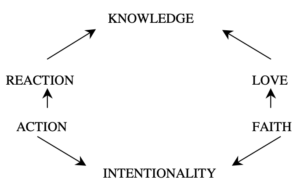
As is the case with any new discipline, so it is with learning spiritual growth. Our first steps forward are painfully self-conscious and hesitant. We are acutely aware of each detail, so much so that we wonder whether we will ever be able to make it work. We are elated at our first successes, but we tend to linger on the plateaus, becoming sufficiently motivated to take another step only when negative pressures begin to build up intolerably, forcing us to act.
Yet, as we pursue the process, we become more adept at it. Gradually, certain aspects become spontaneous and natural (not unconscious). They become part of us to the point of being reflex actions. The feedback loop resulting from our actions becomes more and more automatic. The rate of progress begins to pick up. The steps merge imperceptibly. Finally, the process becomes almost continuous. In other words, the rate of progress increases as we go along because we are not only making progress but also perfecting our skill at making progress.
‘Abdu’l-Bahá has said:
It is possible to so adjust one’s self to the practice of nobility that its atmosphere surrounds and colours every act. When actions are habitually and conscientiously adjusted to noble standards, with no thought of the words that might herald them, then nobility becomes the accent of life. At such a degree of evolution one scarcely needs try any longer to be good—all acts are become the distinctive expression of nobility.59‘Abdu’l-Bahá, Star of the West, Vol. 17, p. 286.
A process in which the rate of progress is proportional to the amount of progress made is exponential (see note 52). Thus, an analysis of the mechanism of the spiritual growth process allows us to understand why this process, though remaining a gradual one, is exponential: It is because we perfect the process of growing spiritually as we grow, thereby increasing the rate at which growth occurs.
The above diagram, and the detailed analysis of each stage of the mechanism involved in the hierarchical relationship between knowledge, love, and will, should not lead us to forget the other fundamental point, namely that all of our spiritual faculties must function together at each stage of the mechanism. In order to gain self-insight, we must will to know the truth about ourselves, and we must be attracted towards the truth. When we act, we must temper our actions with the knowledge and wisdom we have already accumulated at that given point in our development.
Moreover, when we begin the process of conscious, self-directed spiritual growth we do not start from absolute emptiness but rather from the basis of whatever knowledge, love, faith, and will we have developed at that point in our lives. Thus, the spiritual growth process is lived and dramatized by each individual in a way which is unique to him even though the basic mechanism of progress and the rules which govern it are universal.
5. Tools for Spiritual Growth
Our understanding of the process of spiritual growth and its dynamics does not guarantee that we will be successful in our pursuit of spirituality. We stand in need of practical tools to help us at every turn. The Bahá’í Writings give a clear indication of a number of such tools. In particular, prayer, meditation and study of the Writings of the Manifestations, and active service to mankind are repeatedly mentioned. For example, in a letter written on behalf of Shoghi Effendi it is stated:
When a person becomes a Bahá’í, actually what takes place is that the seed of the spirit starts to grow in the human soul. This seed must be watered by the outpourings of the Holy Spirit. These gifts of the spirit are received through prayer, meditation, study of the Holy Utterances and service to the Cause of God …service in the Cause is like the plough which ploughs the physical soil when seeds are sown.60Excerpt from a letter written on behalf of Shoghi Effendi in The Bahá’í Life, p. 20.
Some of the points mentioned briefly in the above passage are amplified in the following statement from the same source:
How to attain spirituality is indeed a question to which every young man and woman must sooner or later try to find a satisfactory answer.…
Indeed the chief reason for the evils now rampant in society is the lack of spirituality. The materialistic civilization of our age has so much absorbed the energy and interest of mankind that people in general do no longer feel the necessity of raising themselves above the forces and conditions of their daily material existence. There is not sufficient demand for things that we call spiritual to differentiate them from the needs and requirements of our physical existence.…
The universal crisis affecting mankind is, therefore, essentially spiritual in its causes … the core of religious faith is that mystic feeling which unites Man with God. This state of spiritual communion can be brought about and maintained by means of meditation and prayer. And this is the reason why Bahá’u’lláh has so much stressed the importance of worship. … The Bahá’í Faith, like all other Divine Religions, is thus fundamentally mystic in character. Its chief goal is the development of the individual and society, through the acquisition of spiritual virtues and powers. It is the soul of man which has first to be fed. And this spiritual nourishment prayer can best provide.61Excerpt from a letter written on behalf of Shoghi Effendi in Directives from the Guardian (New Delhi: Bahá’í Publishing Trust), pp. 86-87.
With regard to meditation, the Bahá’í Writings explain that it has no set form and each individual is free to meditate in the manner he finds most helpful. Statements by ‘Abdu’l-Bahá describe meditation as a silent contemplation, a sustained mental concentration or focusing of thought:
Bahá’u’lláh says there is a sign (from God) in every phenomenon: the sign of the intellect is contemplation and the sign of contemplation is silence, because it is impossible for a man to do two things at one time—he cannot both speak and meditate. …
Meditation is the key for opening the doors of mysteries. In that state man abstracts himself: in that state man withdraws himself from all outside objects; in that subjective mood he is immersed in the ocean of spiritual life and can unfold the secrets of things-in-themselves.62‘Abdu’l-Bahá, Paris Talks (London: Bahá’í Publishing Trust, 1979), pp. 174-175.
‘Abdu’l-Bahá leaves no doubt concerning the importance of meditation as a tool for spiritual growth:
You cannot apply the name “man” to any being void of this faculty of meditation; without it he would be a mere animal, lower than the beasts. Through the faculty of meditation man attains to eternal life; through it he receives the breath of the Holy Spirit—the bestowal of the Spirit is given in reflection and meditation.63‘Abdu’l-Bahá, Paris Talks (London: Bahá’í Publishing Trust, 1979), p. 175.
And Bahá’u’lláh has said that “One hour’s reflection is preferable to seventy years of pious worship.”64Bahá’u’lláh, The Kitáb-Íqán (Wilmette: Bahá’í Publishing Committee, 1954),p. 238. These strong statements of Bahá’u’lláh and ‘Abdu’l-Bahá concerning meditation should not, however, be taken as implying an absolute faith in man’s intuitive powers. See note 39.
The Bahá’í Writings suggest that the words and teachings of the Manifestations provide a helpful focus for meditation. Also, while giving considerable freedom to the individual concerning prayer, they likewise suggest that the prayers of the Manifestations are especially useful in establishing a spiritual connection between the soul of man and the Divine Spirit. Prayer is defined as conversation or communion with God:
The wisdom of prayer is this, that it causes a connection between the servant and the True One, because in that state of prayer man with all his heart and soul turns his face towards His Highness the Almighty, seeking His association and desiring His love and compassion. The greatest happiness for a lover is to converse with his beloved, and the greatest gift for a seeker is to become familiar with the object of his longing. That is why the greatest hope of every soul who is attracted to the kingdom of God is to find an opportunity to entreat and supplicate at the ocean of His utterance, goodness and generosity.65‘Abdu’l-Bahá in Divine Art of Living, p. 27.
‘Abdu’l-Bahá has elsewhere explained that the spirit in which one prays is the most important dimension of prayer. A ritualistic mumbling of words or a mindless repetition of syllables is not prayer. Moreover, the Bahá’í Writings enjoin the spiritual seeker to make of his whole life, including his professional activities, an act of worship:
In the Bahá’í Cause arts, sciences and all crafts are counted as worship. The man who makes a piece of notepaper to the best of his ability, conscientiously, concentrating all his forces on perfecting it, is giving praise to God. Briefly, all effort put forth by man from the fullness of his heart is worship, if it is prompted by the highest motives and the will to do service to humanity. Thus is worship: to serve mankind and to minister to the needs of the people. Service is prayer. …66 ‘Abdu’l-Bahá in Divine Art of Living, p. 65.
Thus, it is the spirit and motive of service to others which makes external activity a tool for spiritual progress. In order to pursue the goal of spirituality, one must therefore maintain a persistently high level of motivation. Prayer, meditation, and study of the Words of the Manifestations are essential in this regard:
The first thing to do is to acquire a thirst for spirituality, then Live the Life! Live the Life! Live the Life! The way to acquire this thirst is to meditate upon the future life. Study the Holy Words, read your Bible, read the Holy Books, especially study the Holy Utterances of Bahá’u’lláh. Prayer and Meditation, take much time for these two. Then will you know the Great Thirst, and then only can you begin to Live the Life!67Abdu’l-Bahá in Bahá’í Magazine, vol. 19, no. 3, 1928.
Thus, while the quality and maturity of one’s relationship to others remain the best measure of spiritual progress and growth, acquiring the capacity for such mature relationships depends essentially on an intense inner life and self-development. Moreover, the individual’s actions are experienced both by himself and by others, whereas inner life is experienced only by the individual and is thereby more properly “his.” The sense of “that mystic feeling which unites Man with God” becomes to the spiritual seeker the most precious of experiences. It is that part of spirituality which lies at the center of his heart and soul.
In this inner dimension, spirituality becomes a sort of dialogue between the human soul and the Divine Spirit as channeled through the Manifestation. It is within this subjective but nevertheless real dimension of inner spirituality that one finds all the passion, the exaltation of spirit, as well as the terrible but somehow precious moments of despair, of utter helplessness and defeat, of shame and repentance. It is here that one learns with the deeply certain knowledge only personal experience can bestow, that the ultimate category of existence, the absolute and transcendent God who guides and oversees our destiny, is an infinitely loving and merciful Being.
Human history has witnessed the birth, proliferation, and death of countless religions, belief systems, and philosophies. Though the generating impulse for each of these systems is undoubtedly related to numerous particular cultural and psychological factors, there runs through virtually all of them the common idea that man is not, in his naturally given human state, whole or complete. The concomitant to this belief is the idea that man must undergo some process of completion, some discipline of self-definition. Such a process is usually regarded by its exponents as the basic purpose of man’s existence, for through it man is seen to acquire or develop what is essential and universal, and not merely accidental and local, within the range of human potentiality. By this process, he defines what he truly is by becoming what he most truly can be. The process is often described as one of “salvation”, of being lifted above the condition of unregeneration (or spiritual death) to the plane of a superior reality.
The revealed religions have been major sources of such salvation concepts, spiritual philosophies, and spiritual disciplines. Historically, the revealed religions would seem to be united in affirming, each in its own particular way, that there is an objectively real spiritual dimension to the universe, and that this spiritual dimension of existence is for man the most fundamental and the most important aspect of reality. However, the revealed religions also appear, at least at first glance, to exhibit a disturbing degree of difference in their respective views of the exact nature of this spiritual reality and of how man should relate properly to it. Moreover, most of the traditional systems of religious belief appear now to have crystallized into rigid social patterns and dogmatic attitudes of thought and belief with which the modern ethos of rapid social and intellectual change seems incompatible.
The changes in modern-day society are being wrought primarily by a highly efficient, powerful, and established science which owes little or nothing to established religion. Whereas the religions, for the most part, continue to press harder and harder their mutually contradictory claims each to possess an absolute and unchanging truth which admits no compromise, science is based squarely on the idea that truth is relative and progressive, that what is useful and productive in the realm of ideas and techniques today may be obsolete and unproductive tomorrow. Thus, traditional religion has come to abhor and fear change while science thrives upon it.
Yet, science and technology have not given man the sense of wholeness he has so long been seeking, even though they have given him a vastly increased power to control and manipulate his physical environment. The sense of incompleteness and the conscious need for transcendence, for contact with some deep spiritual reality, are widespread in our society. Indeed, hardly at any other time of history or in any other culture has the sense of spiritual inadequacy been so acute as is currently the case in industrialized, high-technology, Western culture. But if contemporary man turns to religion for enlightenment, he too often finds dogmatism, which his mind cannot accept, or mindless emotionalism, which is not worthy of acceptance.
From the modern perspective, each of the great religions appears as a system which was largely successful in satisfying the spiritual and social needs of a certain people or culture during a previous era of history, but which is no longer adequate to meet the needs of humanity in the present critical period of history. Thus, modern man is caught in a serious dilemma with regard to fundamental spiritual questions. On the one hand, the highly efficient science he has so successfully developed serves in part to deepen his moral and spiritual needs—needs that science alone cannot satisfy.1For example, powerful new techniques for manipulating such things as the human genetic endowment raise novel and acute ethical questions concerning their proper and responsible use. On the other hand, most of the traditional religious forms, attitudes and concepts now appear obsolete and irrelevant.
This modern dilemma is addressed by several of the fundamental principles of the historically recent Bahá’í Faith. The Bahá’í principle of the unity of science and religion holds that religious truth, like scientific truth (or truth in general), is relative and progressive. It accepts unreservedly that “If religious beliefs and opinions are found contrary to the standards of science they are mere superstitions and imaginations….”2‘Abdu’l-Bahá in Bahá’í World Faith (Wilmette: Bahá’í Publishing Trust, 1956), p. 240. In particular, with regard to spiritual questions the Bahá’í Faith rejects a dogmatic approach: It affirms that there are spiritual realities governed by lawful relationships, and it invites each individual to assume a scientific attitude and to seek out and test for himself these spiritual truths.3The present monograph consists in a rather detailed discussion of certain aspects of the Bahá’í conception of these spiritual truths and realities, but with little or no attempt to explain the basis upon which such a conception rests. This latter task was the objective of a previous effort of the present writer, published as “The Science of Religion,” Bahá’í Studies, vol. 2, rev. ed., 1980.
Concerning the great world religions, the Bahá’í Faith teaches that they all derive from one common source, namely, that one, ultimate, creative force responsible for the phenomena of the universe, that force we call God. Bahá’ís hold that the founding figures of those great religious systems (e.g., Moses, Buddha, Jesus, Zoroaster, Muhammad) were all chosen channels or true spokesmen for this unique God, and that differences in Their teachings are due primarily to the varying requirements of the cultures and ages in which these systems were originally promulgated. Other significant doctrinal differences among these systems, as they are currently elaborated, are attributed to inaccuracies and distortions gradually introduced by their followers in the course of their evolution as social systems after the death of their founders.4Also, one should not forget that, except for the more historically recent of these systems (such as Islám), we have no direct access to the exact words or the pure form of the original teachings as given by the Founder. Moreover, the various interpretations which the theologians and thinkers have subsequently attached to those written records which do exist are conditioned and limited by various cultural factors and cannot, therefore, be regarded as surely authentic representations of the thought of the Founder. However, the essential spiritual message of these systems is affirmed to be universal and common to all.
The Bahá’í Faith views itself as deriving from the most recent of these revelation events, as the latest chapter in the (unending) book of religion, so to speak. Bahá’u’lláh (1817-1892), Founder of the Bahá’í Faith, put forth these and other teachings in a series of over 100 books and manuscripts written primarily between 1853 and His death in 1892. Thus, Bahá’ís feel that traditional religions are perceived by modern man as so unsatisfactory partly because some of their teachings are laden with culture-bound patterns and concepts (e.g., the dietary and penal laws of Judaism and Islám) and partly because of man-made distortions and corruptions which have crept in over the years. Religious dogmatism represents the arrogant attempt to transform a relative and partial conception of truth into an absolute and unchanging system, binding the whole of mankind for all human history. According to the Bahá’í understanding of the dynamics of God-created human nature, no such fixed system could ever be adequate for mankind. The Bahá’í system itself is viewed as responding to the needs of mankind in the present hour, but not for all future history.
Bahá’ís hold that the basic spiritual message common to the revealed religions is progressively elaborated and more fully articulated in each successive revelation. One would therefore expect that the Bahá’í Faith, if it is indeed the most recent divinely inspired articulation of spiritual truth to mankind, would contain a fuller elaboration and deeper expression of this truth.
I believe that such is the case, and in the following pages I have quoted liberally, and sometimes at length, from the Bahá’í Writings in an effort to convey to the reader some of the incredible spiritual riches they contain. Yet, all the ideas and opinions expressed herein should be strictly regarded as nothing beyond the attempt of one mind to grasp some of the deeper meanings latent in the profound Writings of Bahá’u’lláh, ‘Abdu’l-Bahá, and Shoghi Effendi. In an effort to limit the scope of this monograph to reasonable proportions and to achieve an orderly exposition, I have consistently focused on the concept of spirituality, that is, on an intellectual and logical understanding of spirituality. This work does not attempt in any way to be a manual for attaining spirituality but seeks only to gain, insofar as is possible, a clearer conception of what is implied in attaining it.
Of course, attaining any goal is easier when we have a clear conception of what its attainment involves. I have offered the present text for publication only in the hope that it may contribute in some measure to the common task we all have of trying to express our spiritual understanding to each other, especially as I have already richly benefited from the insights and reflections of so many in this regard.
I. THE NATURE OF MAN
1. The Basic Components of Man’s Character
The Bahá’í writings articulate a model of human nature and functioning which sees man as the product of two basic conditions, the physical (material) and the spiritual (non-material). The physical dimension of man’s existence derives from his genetic endowment, determined at conception, plus the interaction of this configuration with the environment. This interaction produces an internal, physical milieu which is unique to each individual, though sharing common features with all members of the human species. The spiritual dimension of man’s nature derives from the existence of a non-material entity, the soul, which is individualized, it is explained, at the moment of conception. Just as the physical body of man has various physical capacities, so the soul has its capacities, called spiritual capacities of man. Among the most important spiritual capacities mentioned in the Bahá’í Writings as characteristic of man are those of the intellect or understanding, the heart or feeling capacity, and the will (the capacity to initiate and sustain action).
The interactions of the individual with his environment affect not only his body but his soul as well. They develop both the genetically given physical capacities and the initially given spiritual capacities. These interactions may be called learning or education, and they give rise to a third aspect of man’s total character, an aspect that is both physical and spiritual.
In sum, there are three essential aspects of the character of man: his genetic endowment, which is surely physical; his soul and its capacities, which are purely spiritual; and education, which is both physical and spiritual.5According to the Bahá’í conception, the soul of each individual is eternal while the body, composed as it is of elements, is subject to physical decomposition, i.e., death. Thus, the soul is the true source of the individual’s consciousness, personality, and self. The soul does not depend on the body but rather the body is the instrument of the soul during the period of earthly existence when the soul and the body are linked together. The Bahá’í Writings also make unequivocally clear the Bahá’í belief that each human soul is not preexistent but is “individualized” at the moment of conception. Bahá’ís do not, therefore, believe in reincarnation—the doctrine that the same individual soul returns in different bodies to live different or successive earthly lives. It is explained rather that the soul’s progress after the death of the physical body is towards God and that this progression takes place in other, purely spiritual (i.e. nonmaterial) realms of existence.
Of course, we cannot see the soul since it is not physical, but we can deduce its existence from the observable effects it produces. Roughly speaking, we can observe that the physical endowments of the higher apes, and, in particular, their central nervous systems, do not differ substantially from man’s. Yet such beings seem incapable of the conscious, self-aware, deliberate intellection which characterizes man. At best, they seem capable only of “reactive” conditioned response rather than the imaginative, self-initiated thought of man, involving as it does long chains of deduction, and anticipation of and adaptation to imagined future events (i.e., hypotheses).
In Some Answered Questions, ‘Abdu’l-Bahá speaks of these three basic aspects of man’s character:
He [man] has the innate character, the inherited character, and the acquired character which is gained by education.
With regard to the innate character, although the divine creation is purely good, yet the variety of natural qualities in man come from the difference of degree; all are excellent, but they are more or less so, according to the degree. So all mankind possesses intelligence and capacities, but the intelligence, the capacity and the worthiness of men differ. …
The variety of inherited qualities comes from strength and weakness of constitution—that is to say, when the two parents are weak, the children will be weak; if they are strong, the children will be robust. …
But the difference of the qualities with regard to culture is very great, for education has great influence …Education must be considered as most important, for as diseases in the world of bodies are extremely contagious, so, in the same way, qualities of spirit and heart are extremely contagious. Education has a universal influence, and the differences caused by it are very great.6‘Abdu’l-Bahá, Some Answered Questions (Wilmette: Bahá’í Publishing Trust, 1981), pp. 212-214.
From this, and other similar passages in the Bahá’í Writings, it is clear that the innate character derives from the capacities of the soul while the inherited character derives from the individual’s genetic endowment. Once fixed, these two elements of man’s character remain unchanged, but the process of education enables man to develop these capacities either to a relatively high degree or to a relatively low degree, thus producing significant differences in character not attributable solely either to heredity or to innate spiritual capacity.
2. Spirituality Defined
We have used the word “capacity” in referring both to the spiritual and to the physical endowments of the individual. The word connotes a potential, something to be fulfilled or accomplished (and something that is capable of fulfillment and accomplishment). Indeed, it is clear that the individual, at his birth into this world, is capable of manifesting very few of the qualities possessed by the mature adult human being. We know, moreover, that unless the infant is properly cared for and provided with a host of support systems and a growth-inducing milieu, he will never exhibit such qualities. Life, then, is a growth process. Man begins the process as a little bundle of potential and proceeds, for better or worse, to develop his potential through the process of education (considered broadly as the sum of all environmental influences on the individual plus the individual’s reaction to these influences).
According to Bahá’í teachings, the very purpose of man’s life is the proper, harmonious, and full development of spiritual capacities. This is the most worthwhile possible goal since spiritual capacities, being part of the immortal soul (see note 1), will eternally endure while the body and its capacities will not. However, the body is the instrument of the soul’s development in this earthly life, and so physical health and development cannot be safely neglected but rather must be made to serve the primary goal of fostering the soul’s progress.
Bahá’u’lláh expresses this truth succinctly and powerfully:
Through the Teachings of this Day Star of Truth [The Manifestation or Prophet of God] every man will advance and develop until he attaineth the station at which he can manifest all the potential forces with which his inmost true self hath been endowed. It is for this very purpose that in every age and dispensation the Prophets of God and His chosen Ones have appeared amongst men, and have evinced such power as is born of God and such might as only the Eternal can reveal.7Bahá’u’lláh, Gleanings from the Writings of Bahá’u’lláh (Wilmette: Bahá’í Publishing Trust, 1971), p. 68.
The process of developing one’s spiritual capacities is called spiritual growth or simply spirituality. We can thus formulate a working (operational) definition of the concept of spirituality as follows: Spirituality is the process of the full, adequate, proper, and harmonious development of one’s spiritual capacities. Unspirituality, by contrast, is either the lack of development of these capacities, their imbalanced or inharmonious development (e.g., the development of one to the exclusion of others), or else the false (improper) development and/or use of these capacities.
With this definition of spirituality in mind, we can also formulate a working definition of Bahá’í morality: That which fosters and advances the process of spiritual development is good, and that which tends to inhibit it is bad. Every law, counsel or behavioral norm contained in the Writings of the Bahá’í Faith can be understood in large measure from this perspective.
3. The Duality of Human Nature
The only component of man’s character capable of change is that which is acquired through education, where the latter term is understood broadly to mean the sum of all influences on the individual resulting from his encounters with and reactions to his environment. However, the human situation is such that not every influence, and most certainly not every one of our reactions to these influences, is conducive to spiritual progress. Thus, the process of spiritual growth involves learning how to make appropriate responses to various circumstances and how to initiate certain kinds of actions: spiritual growth is an educational process of a particular sort.
The experience of our life during the period when the body and the soul are linked is one of a tension between contradicting and opposing forces. ‘Abdu’l-Bahá explains that this tension results from the duality of the physical and the spiritual in man’s nature. On the one hand, man’s body has legitimate physical needs which cry for satisfaction: food, shelter, companionship, and protection from threatening forces. However, in seeking to satisfy these needs, man is easily led to be possessive, aggressive, and insensitive to the needs of others. On the other hand, man’s soul also has intrinsic needs that demand satisfaction. These needs are metaphysical and intangible. They incite the individual to seek meaning and purpose in life and to establish the proper relationship with God, with himself, and with his fellow humans. Though this proper relationship may, and indeed must, be expressed through physical means, it also is essentially intangible. It involves submission to the will of God, the acceptance of our dependence on a power higher than themselves. It implies self-knowledge, the discovery both of our limitations and of our particular talents and capacities. And it requires recognition of and respect for the rights of others. This means that we realize and understand that all other men have needs similar to our own and that we accept all the implications of this fact in our relations with and actions towards others.
Of course, the Bahá’í Faith is certainly not the first belief system to recognize this duality in man’s nature. But the Bahá’í view of this duality is significantly different from certain views frequently attributed to other belief systems, for the Bahá’í Faith does not superimpose an absolute (good-evil) value judgement upon the duality, viewing all things spiritual as good and all things material as bad. The Bahá’í Writings make clear that man can misuse his spiritual faculties just as easily as he can misuse his material ones. At the same time, the material faculties of man (indeed all of man’s natural capacities) are viewed as God-given and therefore intrinsically (metaphysically) good. As moral categories, good and evil are relative terms: A given action on the part of an individual is relatively less good than another action if that other action would have been more favorable to the process of spiritual growth. Moreover, the Bahá’í Writings lead us to understand that God judges human actions only with regard to those actions which are truly logically possible for the individual in the given circumstances. To judge otherwise would be tantamount to requiring of man that which is beyond his capabilities or, paraphrasing words of Bahá’u’lláh, to tasking a soul beyond its power.8See Bahá’u’lláh, Gleanings from the Writings of Bahá’u’lláh (Wilmette: Bahá’í Publishing Trust, 1971), p. 106.
In other words, only the direction of the spiritual growth process is given absolutely: it is towards the (unattainable) ideal of God-like perfection. But the process itself is lived relatively by each individual according to his spiritual and material endowments plus the free will choices he makes in dealing with the particular circumstances of his life. Since only God knows truly what these endowments and circumstances are for any individual, only God can judge the degree of moral responsibility of the individual in any situation.9This observation explains the time-honored injunction expressed by virtually all religious prophets and thinkers that no man is capable of judging the spiritual or moral worth of any other individual. This has nothing to do with society’s right to protect itself against antisocial behavior whether perpetrated deliberately by morally insensitive individuals, or involuntarily by sick or misguided individuals.
Here is the way that ‘Abdu’l-Bahá explains the essential and intrinsic goodness of all of man’s capacities, material or spiritual:
In creation there is no evil; all is good. Certain qualities and natures innate in some men and apparently blameworthy are not so in reality. For example, from the beginning of his life you can see in a nursing child the signs of greed, of anger and of temper. Then, it may be said, good and evil are innate in the reality of man, and this is contrary to the pure goodness of nature and creation. The answer to this is that greed, which is to ask for something more, is a praiseworthy quality provided that it is used suitably. So if a man is greedy to acquire science and knowledge, or to become compassionate, generous and just, it is most praiseworthy. If he exercises his anger and wrath against the bloodthirsty tyrants who are like ferocious beasts, it is very praiseworthy; but if he does not use these qualities in a right way, they are blameworthy.
Then it is evident that in creation and nature evil does not exist at all; but when the natural qualities of man are used in an unlawful way, they are blameworthy. 10‘Abdu’l-Bahá, Some Answered Questions (Wilmette: Bahá’í Publishing Trust, 1981), p. 215.
Thus, the main function of the body is to serve as an instrument of the soul during the time the immortal soul is linked to the mortal body. This period constitutes the first stage of an eternal growth process. The body’s capacities, when properly used, contribute to the process of spiritual growth. These material capacities are no more intrinsically bad than the capacities of the soul itself. Both material and spiritual capacities become harmful if they are misused through false or improper development.
However, Bahá’u’lláh and ‘Abdu’l-Bahá do stress the fact that the material capacities must be rigorously disciplined (not suppressed) if they are to serve their intended purpose as vehicles for spiritual growth. Since satisfying our physical needs can easily incite us to become aggressive towards others and insensitive to their needs, the individual must engage in a daily struggle with himself to maintain the proper perspective on life and its spiritual meaning.11Also, the Bahá’í Writings make totally clear the Bahá’í disbelief in the objective existence of Satan or of any such evil power or force (cf. Some Answered Questions, ‘The Nonexistence of Evil,’ pp. 263-264). It is explained that what man perceives as evil within himself is simply the absence of some positive quality (which lack is perhaps perceived in a particularly acute way if the individual suddenly finds himself in a situation where the missing quality would have been very useful). Similarly, strong or irrational urges are not, it is affirmed, the result of the action on us of some extrinsic evil force, but rather of subjectives desires arising from within ourselves, possibly due either to a prior lack of proper discipline or to the existence of some deep need which we may have neglected to fulfil in a healthy way (or which has not, in any case, been properly fulfilled). ‘Abdu’l-Bahá explains that improper development can pervert our intrinsically good, natural (God-given) capacities into negative and destructive acquired capacities: “… capacity is of two kinds: natural capacity and acquired capacity. The first, which is the creation of God, is purely good … but the acquired capacity has become the cause of the appearance of evil. For example, God has created all men that they are benefited by sugar and honey and harmed and destroyed by poison. This nature and constitution is innate, and God has given it equally to all mankind. But man begins little by little to accustom himself to poison by taking a small quantity each day, and gradually increasing it, until he reaches such a point that he cannot live without a gram of opium each day. The natural capacities are thus completely perverted. Observe how much the natural capacity and constitution can be changed until by different habits and training they become entirely perverted. One does not criticize vicious people because of their innate capacities and nature, but rather for their acquired capacities and natures.’ Some Answered Questions, pp. 214-215.
More will be said later about the nature of this daily spiritual discipline. The main point here is that the tension between the material and spiritual in man is a creative tension purposely given by God, a tension whose function it is constantly to remind the individual of the necessity of making an effort in the path of spiritual growth. Moreover, the existence of the physical body with its needs provides daily opportunities for the individual to dramatize through action the degree of spirituality he has attained and to assess realistically his progress.12For example, since everyone knows what the physical sensation of hunger is like, anyone who willingly sacrifices his own physical well-being to help feed others commands a certain respect and communicates a spiritual reality to others in a way that far transcends preaching or philosophical discourse.
If man did not have the spiritual-material duality in his nature, he would be spared the unpleasant tension that often accompanies the struggle to take a step along the path of spiritual growth, but he would also be denied the opportunities for growth provided by this very duality.
4. Metaphysical Considerations
We have seen how the Bahá’í concept of spirituality flows naturally and logically from a coherent concept of the nature of man and of God’s purpose for man. It must be admitted, however, that a paradox seems to be at the heart of this process, or at least of our experience of the process during this earthly life. The paradox is that God has given man immediate and easy access to material reality while denying him such immediate access to spiritual realities. This seems a curious thing for God to have done if, in fact, the most important aspect of reality is the spiritual one and if our basic purpose in life is spiritual. If the spiritual dimension of man’s existence is ultimately the most real, then why are we given immediate perception only of the less substantial portion of total reality? Why, in short, are we called upon by God to pursue a spiritual purpose while being immersed in a sea of materiality?
To many people, this basic perception of our human condition is not just a paradox but an outright contradiction. It is impossible, they say, that there could be a world of unseen and unobservable spiritual realities so much less accessible than the world of material reality: the most obvious explanation for the inaccessibility of spiritual reality is that it does not exist. Whether or not the paradox is stated this strongly, it remains the basic stumbling block to atheists, agnostics, materialists, and positivists of whatever philosophical stripe in their approach to spiritual questions. For, even if one becomes convinced that there is a significant, nonmaterial dimension to objective reality, the rationale for its having been deliberately hidden from immediate access by a God who nevertheless holds us responsible for relating properly to it remains obscure.
Fortunately for our attempts to grasp the deeper significance of the Bahá’í concept of spirituality, Bahá’u’lláh has explained in clear terms the divine purpose underlying this fundamental feature of the human situation. The explanation lies in the principle of ‘separation and distinction’ by which God wishes individual moral and spiritual attainment to be the result of the individual’s self-responsible and self-directed efforts. Bahá’u’lláh affirms unequivocally that God could certainly have rendered spiritual truth and spiritual reality as irrefutably evident and as immediately accessible to our spiritual senses as is material reality to our physical senses. But, had He done so, all men would have been forever bereft of one important experience: the experience of the state of spiritual deprivation. As the universe is now ordered, everyone can have the experience of moving from a position of relative doubt, insecurity, uncertainty, and fear towards a position of relative certitude, security, knowledge and faith.
On this journey, we learn important lessons which would otherwise be denied us. We value true spirituality the more for having experienced, to whatever degree, its lack, and we are grateful for the privilege of having participated in and contributed to the process of its attainment. All of this would not be possible if spiritual knowledge and perfection were simply our natural state of being from the moment of our creation.
Here is one passage in which Bahá’u’lláh explains the principle of separation and distinction:
The purpose of God in creating man hath been, and will ever be, to enable him to know his Creator and to attain His Presence. … Whoso hath recognized the Day Spring of Divine guidance and entered His holy court hath drawn nigh unto God and attained His Presence. … Whoso hath failed to recognize Him will have condemned himself to the misery of remoteness, a remoteness which is naught but utter nothingness and the essence of the nethermost fire. Such will be his fate, though to outward seeming he may occupy the earth’s loftiest seats and be established upon its most exalted throne.
He Who is the Day Spring of Truth is, no doubt, fully capable of rescuing from such remoteness wayward souls and of causing them to draw nigh unto His court and attain His Presence. “If God had pleased He had surely made all men one people.” His purpose, however, is to enable the pure in spirit and the detached in heart to ascend, by virtue of their own innate powers, unto the shores of the Most Great Ocean, that thereby they who seek the Beauty of the All-Glorious may be distinguished and separated from the wayward and perverse. Thus hath it been ordained by the all-glorious and resplendent Pen. …
That the Manifestations of Divine justice, the Day Springs of heavenly grace, have when they appeared amongst men always been destitute of all earthly dominion and shorn of the means of worldly ascendancy, should be attributed to this same principle of separation and distinction which animateth the Divine Purpose. Were the Eternal Essence to manifest all that is latent within Him … none would be found to question His power or repudiate His truth. Nay, all created things would be so dazzled and thunderstruck by the evidences of His light as to be reduced to utter nothingness.13Bahá’u’lláh, Gleanings from the Writings of Bahá’u’lláh (Wilmette: Bahá’í Publishing Trust, 1971), pp. 70-72.
From this passage, we can understand that the intangibility of spiritual realities is not an accident but rather a deliberate and fundamental aspect of God’s purpose for man. Of course, if God had created us with no spiritual inclinations or perceptions whatever, if He had denied us immediate access to any part of reality, material or spiritual, or if He had created us with spiritual and metaphysical longings impossible of genuine fulfillment, we would be unable to succeed in our basic task. By starting the eternal spiritual growth process as spiritual-material hybrids, having immediate access to material reality and being endowed with significant physical and intellectual powers, we are able to learn the subtleties of spiritual development gradually. By experiencing first-hand the order and the lawfulness of the physical creation, we come to understand that the unseen spiritual realm is similarly ordered and governed by lawful, cause-and-effect relationships. At first intuitively, then explicitly and intellectually, and finally through genuine spiritual experience and inner development, we learn to participate consciously in this spiritual order of things. It becomes a day-to-day reality having an immediacy equal to and even greater than the immediacy of physical experience. Indeed, as Bahá’u’lláh explains, if we fulfill our responsibilities and learn our lessons well, we will be ready at the time of our physical death to pass easily into the purely spiritual realm. We will already have become familiar with its basic laws and modes of functioning and will therefore be prepared to take up our lives in that new realm and proceed with our growth process in a harmonious and satisfying manner:
The Prophets and Messengers of God have been sent down for the sole purpose of guiding mankind to the straight Path of Truth. The purpose underlying Their revelation hath been to educate all men, that they may, at the hour of death, ascend, in the utmost purity and sanctity and with absolute detachment, to the throne of the Most High.14Bahá’u’lláh, Gleanings from the Writings of Bahá’u’lláh (Wilmette: Bahá’í Publishing Trust, 1971), pp. 156-157. For a parallel discussion of some of these points see ‘The Metaphorical Nature of Physical Reality’, by John S. Hatcher, Bahá’í Studies, vol. 3, 1977.
Parts 2 and 3 of this article are re-published separately on this website and can be found in the Library.