“If you had your life to live all over again, what would you change?”
This question was put to Bernard Leach during the last year of his life. His instantaneous reply: “Nothing, except myself, I hope.”
“A change for the better?”
“Of course. Deeper, wider, truer, more loving. When I went into hospital nine years ago and very nearly died, what did I learn? That I had never been as kind as those who were kind to me. And I felt shame at myself for not having been more thoughtful, more kind, more generous. It did make a difference.”
The interview was for a “Profile” of Bernard Leach C.H., C.B.E. for the overseas service of the British Broadcasting Corporation which was broadcast to over forty countries.
Many times I have been asked what I remember most about Bernard Leach: it was his humility. He used to say, pointing his long finger upwards, “It’s the ‘I’, not the I.”
I remember vividly his miraculous recovery from that serious illness in 1969. The doctors and the specialist did not expect him to live. He was eighty-three. But those Bahá’ís who were close to him at the time had no doubts. This was a spiritual progression. There was even a Bahá’í nurse who had just arrived at the hospital to take part of her training. I was committed to a demanding job that weekend in August. I knew he was gasping for breath with the help of oxygen. My prayers took me to the typewriter. “You are suffering like the Báb and Bahá’u’lláh for the love of God because He has great things for you to do. Be content with the love of God. Everyone, everywhere is praying for you and willing you to get better.” This message I sent in large type, to be read to him by a very dear friend. I was told that he changed colour afterwards. In the evening I received the wording of a cable from the Universal House of Justice assuring Bernard of loving prayers. Early the next morning I was allowed into his hospital room for the few minutes I needed.
“I’ve been very ill,” he said between gasps for breath.
“I know,” I said. “Don’t talk, listen.” I placed my hand on his shoulder. “Everyone is praying for you on Mount Carmel. They are praying at the Holy Shrines for your recovery.” Then I left him, knowing that he would draw comfort from the thought of those prayers. About a week or so later when I visited him he showed me the following lines that he had written:
Oh, let me out
Into the garden there
I want to put down
My shrunken hand
To the green grass
Yet once again
Before I lie quiet
Under the sod.
Many voices rose gently
To Him, the Lord God,
Who looked down in mercy
And said, `Spare the rod.’
In this room
Where I have known
Such pain and joy
I felt the tremor
Of those prayers
All the way from
Here to Carmel.
O God, wilt Thou
Accept my thanks
From here to Heaven?
When Bernard Leach was born in Hong Kong in 1887 his mother died, and he was taken by his grandparents to live with them in Kyoto where his grandfather was a professor of English at the university. Bernard was educated in England, and at the Slade School of Art in London he met his life-long friend, Reginald Turvey whom the Guardian later referred to as “the spiritual father of the Bahá’ís of South Africa”. When Bernard returned to Japan in 1909 with the first etching press ever to reach that country (he planned to make a living teaching etching) he wanted to find out more about Eastern art and life. He speaks of his experience in 1911 when he met a group of artists and poets and first saw pots being made. ‘One was taken out from the kiln, red hot, with long-handled tongs, dipped into a bucket of cold water, and it did not break. I thought, “Isn’t it exciting! I want to do that; I believe I could learn to do that. I wonder if I could get a teacher? I did…”
Before he left Japan in 1920 some of his friends presented him with a book entitled An English Artist in Japan. The prophetic tribute written by Soetsu Yanagi, the founder of the Japanese Craft Movement, concludes with these words:
When he leaves us we shall have lost the one man who knows Japan on its spiritual side. I feel very sad that he is going, but I hope when he returns to his own land he will be able to represent the East in a more just way than has yet been done, and that not only in words will he be able to show his affection, but in his works. I consider his position in Japan, and also his mission in his own country, to be pregnant with the deepest meaning. He is trying to knit the East and West together by art, and it seems likely that he will be remembered as the first to accomplish as an artist what for so long mankind has been dreaming of bringing about…
“I desire distinction for you…” were the words of ‘Abdu’l-Bahá addressed to the Bahá’ís.
Fifty years after Bernard Leach left Japan he was honoured by the World Crafts Council at a gathering in Dublin. In 1974 he received the Japan Foundation Cultural Award; he had already been given, in 1966, the Order of the Sacred Treasure, Second Class, the highest honour the Japanese government bestows upon a foreigner. He was made a Commander of the Order of the British Empire in 1962 and, in 1973, in an audience with Her Majesty Queen Elizabeth at Buckingham Palace, he was made a Companion of Honour.
During these later years retrospective exhibitions of his work were held both in Japan (1966) and in England (1977). During the opening week of his exhibition in London’s Victoria and Albert Museum printed invitations were made available to visitors for a Bahá’í talk given by him at the Commonwealth Institute on `My life, my work and my belief’. Many people attended that meeting and mention of the Bahá’í Faith was made in some of the press reports.
These years also saw the publication of several books written by Bernard Leach including Drawings, Verse and Belief in 1973 and, in 1978, Beyond East and West, which he considered to be his most important literary work. This book, the last two chapters of which are devoted to the Faith–“The Mountain of God” and “Stepping Stones of Belief”–was also published in America and has been translated into Japanese. Many seeds must have been and still are being sown through this testament of faith. Reviews of Beyond East and West in many countries mentioned his Bahá’í belief and paid tribute to him. The reviewer of the Birmingham Post wrote:
I have never met Bernard Leach… I feel that, having seen this last exhibition and having enjoyed every page of this enlightening and loving book, and having as it were travelled with him through time, sharing his feelings and experiences and friendships, I now already do know, and intimately, this great man, respected and indeed honoured all the world over… It is a book to be delighted in, not just by potters such as Leach himself, or even by artists and craftsmen in general, but by anyone who cares about the joy of the one life we all share–all roads meeting, as we are reminded, on the mountain of God…
It was not possible for Bernard in his book of memoirs to include all his Bahá’í activities over the years. Wherever he travelled he tried to keep some time for talks on the Faith. While exhibiting in South America–in Caracas and Bogota–he was tendered a special reception in Colombia to which several Bahá’ís were invited. His pamphlet, My Religious Faith, written in Japan in 1953, has been translated into Japanese and is still being used. A copy was presented to Princess Chichibu by Amatu’l-Bahá Rúhíyyih Khánum when she visited her while touring Japan in 1978. The blindness which came to Bernard in 1974 opened another door. On 30 December 1973 he scrawled with a thick pen:
Come blindness
With the dawn this day.
Not to see a human face again.
Not to see a line on paper drawn.
Warning, yes, but both this day.
Groping along walls,
Premonitory steps.
Awake, awake, the inner eyes,
Love more, not less,
The memories of human sight,
See with, not through.
The spiritual awareness which grew with his blindness was an inspiration to visitors who came from far and wide to see him. He talked much about the Faith. One potter declared her belief in Bahá’u’lláh upon returning to America after spending a few days with him in St. Ives, Cornwall.
It was important to him to leave this world with all work done. “Death as a friend, death as a doorway”, he wrote to a Bahá’í friend after completing his manuscript of Beyond East and West. It was a long time since 1914 when he had first heard of the Bahá’í Faith from Agnes Alexander in Japan and, in that same year, had written:
I have seen a vision of the marriage of East and West, and far off down the Halls of Time I heard the echo of a child-like Voice: “How long? How long?”
In 1856, or thereabouts, even as the little city of Yazd, in the very heart of Persia, was carrying on its lackluster existence, something was astir. The town’s population for the most part lived in poverty and ignorance, unaware of what was happening in the rest of the world. But there was something stirring. There was hushed talk of the Báb, the new Prophet Who had been martyred, and of the Message He had brought. There were people secretly spreading the news at the risk of their lives.
A youth, only fourteen, came into contact with these people, heard the Message and wholeheartedly accepted it. Only fourteen years of age! His name was Shaykh ’Alí. He was the eldest son of the well-to-do and highly respected Hájí ‘Abdu’r-Rahím Yazdí. The family was alarmed. The boy was in grave danger. His allegiance could bring ruin to the whole family. But Shaykh ’Alí was ablaze. To distract him from the Bábí Faith, his family sent him to Kirmán with enough goods to start a business. The shop was successful but soon rumors floated back that he was meeting with the Bábís. ‘Abdu’r-Rahmín went to Kirmán and brought him home.
In Yazd the boy again attended the secret meetings and took aid to the beleaguered Bábís who were imprisoned there. One night he was so late returning home that his mother, terribly worried, waited for him at the door and when he came in, slapped him, without saying a word. In silence he took her hand, kissed it tenderly, and gazed at her with deep love.
Throughout this difficult time, in the face of the calumnies and persecutions heaped upon the Bábís by their enemies, Shaykh ’Alí displayed a kindness and fearlessness remarkable in one so young. As time passed, his character, his behavior, his attitude and his actions gradually won over the whole family. One by one they joined the Faith. Now meetings were held in the Yazdí home though the need for secrecy remained paramount. Teachers came from other cities, each with new tales. Some who came from Baghdád spoke of Bahá’u’lláh. Later they came from Adrianople, and then from ‘Akká.
My father, Hájí Muhammad, who like his brother had joined the Faith when he was fourteen, left for the Holy Land with a friend, a donkey, lots of faith and very little money. He and his companion set out to see Bahá’u’lláh and traveled over steep, rugged mountains and across hot, arid plains until they arrived in ‘Akká, around 1870. Other members of the family followed later. Hájí ‘Abdu’r-Rahím, my grandfather, left Yazd after he had been tortured, beaten and bastinadoed. The story of this ‘precious soul’, as the Master called him, his arrival in ‘Akká, and his life there, is told with tender compassion by ‘Abdu’l-Bahá in Memorials of the Faithful. Each member of the Yazdí family was given an assignment by Bahá’u’lláh and sent out to accomplish it. Hájí Muhammad, my father, and two other youthful believers were sent to Egypt where they worked hard for many years and eventually built up a prosperous business.
Through these believers – all young people – the Faith was first established in Alexandria, Cairo and Port Said. Although they were not free to openly teach the Faith they were on good terms with the population and were generally well-liked and respected.
My family and I lived in a suburb of Alexandria called Ramleh, a beautiful and peaceful residential district on the edge of the Mediterranean. The house in which I was born and where I lived until I was about four or five, had a separate guest house and a large garden surrounded by a wall of rough-hewn stone. Within the garden there were many lime, sweet lemon, orange and pomegranate trees as well as rose bushes. In the summer a tropical scent hung in the air. The house to which we then moved also had a large garden. Jasmine grew over the veranda, a large porch adjoining the garden. Here our family often had breakfast, with father presiding at the samovar and dispensing glasses of hot tea to the adults and, to the children, hot water with a drop of tea floating on top. Before breakfast, however, we chanted our morning prayers and heard father tell wonderful stories about his experiences with Bahá’u’lláh and the Master, or read the latest communications from the Holy Land.
It was in this setting, when I was a child of eleven, that I heard the news of the coming of ‘Abdu’l-Bahá to Ramleh. The news came suddenly, without warning. The Master had left Haifa without notice on a steamer bound for Europe. Because of ill health and fatigue, He had stopped in Port Said and was coming on to Alexandria. Then the news came that He was coming to Ramleh! To Ramleh where we lived! What a miracle! There was intense joy within the Bahá’í community, within my family, within me. Of all the places in the world, He happened to choose Ramleh as His headquarters for His trips to Europe and America during the period 1910-1913. Excitement, curiosity, anticipation swirled through my mind. All I knew about ‘Abdu’l-Bahá was what my father had told us. No one in the immediate family except father and grandfather had seen Him. The only photograph was an early one taken when He was a young man in Adrianople. He was a prisoner beyond our reach, a legendary figure. Now He was free and coming to Ramleh! The Bahá’í Faith was an integral part of me, not something superimposed. In Ramleh I was surrounded by it, lived it, believed it, cherished its spiritual concepts and goals and principles. I realized its fundamental importance, its necessity for the world today. Yet my studies at the French school which I attended had opened other areas to my mind. The discoveries of science fascinated me and I believed they provided us with effective tools for the implementation of the teachings of the Faith. I prayed that I might be guided to play some role in this endeavour. I sensed that my contact with ‘Abdu’l-Bahá would provide the inspiration and the impetus to move in this direction. So I waited eagerly for the day of His arrival.
There was a crowd gathered in front of the Hotel Victoria. Suddenly there was a hush, a stillness, and I knew that He had come. I looked. There He was! He walked through the crowd – slowly, majestically, smiling radiantly as He greeted the bowed heads on either side. I could only get a vague impression as I could not get near Him. The sound of the wind and surf from the nearby shore drowned out His voice so I could hardly hear Him. Nevertheless, I went away happy.
A few days later, a villa was rented for the Master and His family, not far from the Hotel Victoria, in a lovely residential section that lay right next to the beautiful Mediterranean and the beaches. Like all the villas in that area, it had a garden with blossoms and flowering shrubs. It was there that ‘Abdu’l-Bahá chose to receive His guests – a great variety of notables, public figures, clerics, aristocrats, writers as well as poor and despairing people. I went there often, sometimes on the way home from school, sometimes on weekends. When I was not in school I spent most of my time in His time in His garden. I would wait to catch a glimpse of Him as He came out for His customary walk, or conversed with pilgrims from faraway places. To hear His vibrant and melodious voice ringing in the open air, to see Him, somehow exhilarated me and gave me hope. Quite often, He came to me and smiled and talked. There was a radiance about Him, an almost unlimited kindness and love that shone from Him. Seeing Him, I was infused with a feeling of goodness. I felt humble and, at the same time, exceedingly happy.
I had many opportunities to see the Master – as we always called Him – at meetings and on festive occasions. I especially remember the first time He came to our house to address a large gathering of believers. The friends were all gathered, talking happily, waiting. Suddenly all grew quiet. From outside, before He entered the room, I could hear the voice of ‘Abdu’l-Bahá, very resonant, very beautiful. Then He swept in, with His robe flowing! He was straight as an arrow. His head was thrown back. His silver-gray hair fell in waves to His shoulders. His beard was white; His eyes were keen; His forehead, broad. He wore a white turban around an ivory-colored felt cap.
He looked at everyone, smiled and welcomed all with Khushámadíd!Khushámadíd! (Welcome! Welcome!) I had been taught that in the presence of ‘Abdu’l-Bahá, I should sit or stand with my hands crossed in front of me, and look down. I was so anxious to see Him that I found myself looking up furtively now and then. He often spoke – I was privileged to hear Him speak on many subjects. For nine months it seemed like paradise. Then He left us and sailed for Europe. How dismal everything became. But there was school and there were duties. Exciting news came from Europe, and there were memories! ‘Abdu’l-Bahá came back four months later. Paradise returned. He spoke to me on several occasions, calling me Shaykh ’Alí, the name He Himself had given me, after my uncle who was the first member of the family to join the Faith. When ‘Abdu’l-Bahá spoke to me, I would look into His eyes – blue, smiling and full of love.
Again He left us, this time for America. I will never forget the scene of His departure as He came out of the house and turned to wave gazing down from the veranda above. They were greatly concerned about His safety and well-being. He was sixty-eight years old. He had suffered many hardships and endured severe trials. He had been in prison for forty years of His life and now He was undertaking this journey to a far-off country utterly different from any to which He was accustomed. But ‘Abdu’l-Bahá had made up His mind and nothing could turn Him back. He walked out of the garden gate and never looked back again. He walked for several blocks near the shore to take the electric train to Alexandria where He would board the ship that was to take Him to New York. He was followed by about thirty believers who walked silently behind Him. I was one of them. What ‘Abdu’l-Bahá accomplished in America is now history. He went to Europe and came back to Ramleh on 3 July 1913, to remain until the following December. Then He left for Haifa, never to return.
That was the first chapter of my experience with ‘Abdu’l-Bahá when I was a child between the ages of eleven and fourteen. In 1914 my family moved to Beirut, Lebanon, only a short distance north of Haifa. This opened the second chapter when I was privileged to be in the presence of the Master again, but only on special occasions. I was at that time a student at the American University of Beirut, then known as the Syrian Protestant College. In the summer of 1917 I spent my summer vacation with my uncle, Mírzá Husayn Yazdí, in his house on Mt. Carmel, a memorable two months for me. Every evening before sunset I had the bounty of being in the presence of ‘Abdu’l-Bahá. I would join the other believers gathered in front of the Master’s house. The entrance had an iron gate and then a garden. He would come out with a cheerful and warm greeting, welcome all, and take His seat on the platform at the head of the wide stairs. The sun was going down, and it was very quiet. Sometimes He sat in a relaxed attitude and didn’t speak at all. Usually, however, He spoke. He talked in His commanding voice, looking straight ahead, as if He were addressing posterity. He talked about Bahá’u’lláh, about His Teachings, and about significant world events in the history of the Faith. He told stories sprinkled with humour. Often, however, He talked of the believers around the world and of their progress in spreading the Faith. Then He would become wistful. For three years, while World War I raged, He had little news from abroad. The isolation and constraint weighed heavily upon Him. Now and then He would address individuals in the audience, ask them about their families, their work, their problems; He would offer advice and help. Toward the end, He would ask one of the believers to chant verses from the poems of Bahá’u’lláh. When the chanting ended, the meeting was over. ‘Abdu’l-Bahá would arise and enter the house. Dusk would have descended over Haifa.
There were frequent visits to the Shrine of the Báb. ‘Abdu’l-Bahá would ride the old horse-drawn, bus-like vehicle up the mountain. The rest of us would walk along the rocky road, past the Pilgrim House, to the terrace overlooking the city of Haifa, the blue bay beyond and, in the distance, the hazy outline of ‘Akká. We would gather there until ‘Abdu’l-Bahá appeared and entered the Shrine. He would chant the Tablet of Visitation. Sometimes He asked Shoghi Effendi to chant this prayer. And when it was all over and the believers began to leave the Shrine, He would stand at the door with a bottle of rose water and put a little in each one’s hand. There were also trips – less frequent – to ‘Akká and Bahjí, and visits to the Shrine of Bahá’u’lláh. There were also times that summer when ‘Abdu’l-Bahá went in the horse-drawn carriage to Tiberias, Lake Tiberias and the Sea of Galilee, of Biblical renown. His purpose on these trips was to oversee the grain crops which the believers, under His supervision, had planted in the Jordan Valley. The grain the Master had stored in ancient Roman pits was to be distributed to everyone who needed it, Bahá’í and non-Bahá’í alike. On 27 April 1920, in the garden of the Military Governor of Haifa, ‘Abdu’l-Bahá was invested with the insignia of the Knighthood of the British Empire in recognition of His humanitarian work during the war for the relief of distress and famine.
I would sometimes go into ‘Abdu’l-Bahá’s garden and talk with Ismá’íl Áqá, the gardener, an old man beloved by the Master. On one of’ my visits to the Master’s garden I noticed that everyone was quiet. When I asked why, I was told that a commission of inquiry was interrogating ‘Abdu’l-Bahá in His room. I could hear ‘Abdu’l-Bahá’s clear, commanding voice through the open window above our heads. He spoke to the members of the commission with dignity and authority as if He were the investigator and they the suspected culprits.
Although He was humble in many ways, ‘Abdu’l-Bahá never really bowed to anyone; at the right time, and in the right way, He was proud. He would not compromise the Cause of God. Somehow, the confidence with which the Master spoke gave me confidence and faith that He would be spared. Those were dangerous and difficult days. The violators were active and Jamál Páshá had vowed that he would crucify ‘Abdu’l-Bahá when he returned victorious from his campaigns. When he did return, however, he was fleeing in defeat and humiliation. Despite the turbulence of this period the Master conferred upon the Bahá’ís of the west their world mission by revealing the Tablets of the Divine Plan, eight in 1916 and six in 1917.
I remember other little details from the summer of 1917, such as eating at ‘Abdu’l-Bahá’s table. He ate very simply, but He insisted on others having the proper amount of food. Quite often He would come behind the guests and speak to them. I remember His standing behind my chair saying, ‘Why aren’t you eating?’ I was hungry, but my shyness prevented my eating. ‘Why aren’t you eating, Shaykh ’Alí?’ And He placed a generous portion of rice on my plate. I had to eat it! One day, when I was walking along a curved street up the hill toward the House of ‘Abdu’l-Bahá, I turned the corner and there He was!
I saw the Master walking down the hill, followed by two of the believers. As was the custom, I stepped to one side and bowed. The Master stopped and walked over to me, stopped right in front of me, and looked me straight in the eyes. I shall never forget having seen ‘Abdu’l-Bahá face to face.
What was He like? His bearing was majestic, and yet He was genial. He was full of contrasts: dominant, yet humble; strong, yet tender; loving and affectionate, yet He could be very stern. He was intensely human, most keenly alive to the joys and sorrows of this life. There was no one who felt more acutely than He did the sufferings of humanity.
At the end of the summer I went to see my family in Damascus before going back to college to graduate. Then I returned home. The war seemed to drag on and on, but finally the end came. Our great concern was Haifa: what had happened there? But soon the news arrived: General Allenby and the British had occupied Haifa and the Master was safe. As the doors to the outside world opened again we began to make plans. There was much thinking and counting of pennies. I had studied civil engineering and had been hired as a draftsman by the government. From my earnings I had saved a little, but it wasn’t enough to enable me to go on with my graduate studies. News of this reached ‘Abdu’l-Bahá through my uncle, Mirza Husayn, and the Master offered me one hundred pounds which, in those days, was the equivalent of about $500.00. That made it possible for me to go. I wasted no time. In the autumn of 1919 I went to Haifa in order to say farewell to ‘Abdu’l-Bahá. I was on my way to Europe – Switzerland and then Germany – for my graduate studies. I was twenty years old. This was to be my last experience with ‘Abdu’l-Bahá.
I was in Haifa for two or three days. Just before I left ‘Abdu’l-Bahá called me to His room. I was there alone with Him; the only other person was Shoghi Effendi, who was in and out. The Master invited me to be seated and He asked Shoghi Effendi to bring me some tea. He spoke to me, gave me instructions on how to live, mentioned that He had hopes for me. He said, ‘You are a good boy, Shaykh ’Alí. The tea that Shoghi Effendi brought in a glass was boiling hot. I tried to drink it, but couldn’t. ‘Abdu’l-Bahá said, ‘Drink! Drink your tea!’ So I had to drink it! It didn’t matter! At the very end He gave me His blessing. Then He stood up and beckoned me to Him. I went to ‘Abdu’l-Bahá and He put His arms around me and kissed me on both cheeks. I never saw Him again.
Two years later, when I was at the University of California studying civil engineering, I learned of‘Abdu’l-Bahá’s ascension. Looking back, I can see that the passing of ‘Abdu’l-Bahá marked the end of an era. He was passionately devoted to the single goal of spreading the Teachings of Bahá’u’lláh. It was His mission to establish the brotherhood of man on earth in fact, as well as in principle. Nothing stopped Him; nothing deflected Him from His purpose. And yet it was not easy, for despite His high station, He was also intensely human, and He suffered a great deal. He was often very happy, and He always asked the Bahá’ís to be happy. Be happy! Be happy! That was His counsel to the believers, and He set the example. But there were times when I would see Him with the burdens of the whole world upon His shoulders.
There is something I learned from ‘Abdu’l-Bahá which I feel should not be forgotten. His life was not really His life alone; it was the life of every one of us. It was an example for every one of us. A new generation of Bahá’ís is being attracted to the Faith, and a new generation is growing up within the Bahá’í community. They will acquire knowledge of the Faith from books. But this is a living Faith. The Manifestation of God has appeared and initiated a new era. Bahá’ís have lived and worked and died for this Cause. The Faith is not something extraneous; it is not merely something beautiful, logical, just and fair – it is the very blood and fibre of our being, our very life. If men and women all over the world were to arise in ever-increasing numbers and make ‘Abdu’l-Bahá’s way of life their own, each pursuing His path with zest and confidence, what would the world be like? Would not these individuals be a new race of men?
The Prayers and Meditations by Bahá’u’lláh which the beloved Guardian has given us is in large measure an intimate remembrance of the Redeemer’s sufferings. And Bahá’u’lláh wished us to meditate on these sufferings. In the Tablet of Aḥmad He says: ‘Remember My days during thy days, and My distress and banishment in this remote prison.’
In a great poem known as the Fire Tablet He records at length the tale of His calamities and writes at the close:
‘Thank the Lord for this Tablet whence thou canst breathe the fragrance of My meekness and know what hath beset Us in the path of God.’ He adds: ‘Should all the servants read and ponder this, there shall be kindled in their veins a fire that shall set aflame the world.’
True religion in all ages has called on the faithful to suffer. On the one hand it brings to mankind a happiness in the absolute and the everlasting which is found nowhere but in religion. No unbeliever knows any joy which in its preciousness can be compared to the joys of religion. ‘The true monk,’ it has been said, ‘brings nothing with him but his lyre.’
On the other hand Heaven is walled about with fire. This bliss must be bought at a great price. So it has ever been in all religions of mankind.
An ancient hymn of lndia proclaims a truth as real now as it was in distant times:
The way of the Lord is for heroes. It is not meant for cowards.
Offer first your life and your all. Then take the name of the Lord.
He only tastes of the Divine Cup who gives his son, his wife, his wealth and his own life.
He verily who seeks for pearls must dive to the bottom of the sea, endangering his very existence.
Death he regards as naught; he forgets all the miseries of mind and body.
He who stands on the shore, fearing to take the plunge, attains naught.
The path of love is the ordeal of fire. The shrinkers learn from it.
Those who take the plunge into the fire attain eternal bliss.
Those who stand afar off, looking on, are scorched by the flames.
Love is a priceless thing only to be won at the cost of death.
Those who live to die, those attain; for they have shed all thoughts of self.
Those heroic souls who are rapt in the love of the Lord, they are the true lovers.
All the founders of religions have had to endure rejection and wrong, and as mankind grew more and more mature and the victory of God nearer, these wrongs, these sufferings have grown more and more severe continually.
We read little if anything of martyrdom in the Old Testament. But the New opens with Herod’s slaughter of the innocents, his beheading of John the Baptist; its central figure is a Man of Sorrows acquainted with grief. The Gospels close with the agony in Gethsemane and with the Cross, the Nails, the Spear, and history follows with the martyrdom of all the eleven apostles. The Báb Himself was martyred and His followers gave up their lives for love of Him, not by dozens only but by hundreds and by thousands. In establishing the victory of God Bahá’u’lláh and ‘Abdu’l-Bahá drank the cup of suffering to the dregs.
It is said there are three kinds of martyrdom: one is to stand bravely and meet death unflinchingly in the path of God without wavering or under torture denying for an instant one’s faith. The second is little by little to detach one’s heart entirely from the world, laying aside deliberately and voluntarily all vanities and worldly seductions, letting every act and word become a speaking monument and a fitting praise for the Holy Name of Bahá’u’lláh. The third is to do the most difficult things with such self-sacrifice that all behold it as your pleasure. To seek and to accept poverty with the same smile as you accept fortune. To make the sad, the sorrowful your associates instead of frequenting the society of the careless and gay. To yield to the decrees of God and to rejoice in the most violent calamities even when the suffering is beyond endurance. He who can fulfill these last conditions becomes a martyr indeed.
None can attempt to delineate the variety or to analyze the nature of the afflictions which were poured upon Bahá’u’lláh. Repeatedly He has Himself summarized them in a few brief powerful sentences. In one place He calls our particular attention to the fact that it was not the Black Dungeon of Ṭihrán, for all its horrors and chains, which He named the Most Great Prison. He gave that name to ‘Akká. We are left to surmise why, and we reflect that in the Black Pit His sufferings were chiefly personal and physical; His enemies were external foes, the hope of redeeming the Cause was still with Him. But when He went down to ‘Akká in 1868, the traitor Mírzá Yaḥyá had done his deadly work; the kings and leaders had definitely rejected the Message, He was definitely cast out and silenced. Not He Himself alone but the Cause of God was in prison.
We can never imagine what numberless possibilities of immediate redemption the mad, sad, bad world had wantonly flung away; nor can our less sensitive natures know what the anguish of this frustration must have been to the eager longing of a heart as divinely centered, divinely loving as His.
But this much is abundantly plain; that the pains, the griefs, the sorrows, the sufferings, the rejections, the betrayals, the frustrations which were the common lot of all the High Prophets reached their culmination in Him.
Yet through all He remained calm, confident, His courage unshaken, His acquiescence forever radiant.
No one is to imagine that the excess of His tribulations means that at any time the power of evil had prevailed against Him. Pondering as He would have us to do, over the significance of these afflictions, we are shown that the truth is quite otherwise. He reveals:
‘Had not every tribulation been made the bearer of Thy wisdom, and every ordeal the vehicle of Thy providence, no one would have dared oppose Us, though the powers of heaven and earth were to be leagued against Us.’ He writes that God had sacrificed Him that men might be born anew and released from their bondage to sin. He praises God for His sufferings, He welcomes them, and even prays that for God’s sake the earth should be dyed with His blood and His head raised on a spearpoint. He continually protests that with every fresh tribulation heaped upon Him He manifests a fuller measure of God’s Cause and exalts more highly still God’s Word.
How bitterly felt were His tribulations, how acute His anguish, how real His grief and pain is shown a hundred times in His laments. His high divinity did not protect Him from human sensibility, but never did He quail nor blanch, never did He show resentment.
Many of His laments are not over His woes themselves but over the effect they produce on the faithful whose hearts they sorely shook or on the enemies of the Cause whom they fill with joy.
Nothing could exhaust His patience nor dampen His spirit. ‘Though My body be pained by the trials that befall Me, though it be afflicted by the revelation of Thy decree, yet My soul rejoiceth.’ He affirms that the tribulations that He and the faithful are made to endure are such as no pen in the entire creation can record, nor anyone describe. Yet ‘We swear by Thy Might, every trouble that toucheth us in our love for Thee is an evidence of Thy tender mercy, every fiery ordeal a sign of the brightness of Thy light, every woeful tribulation a cooling draught, every toil a blissful repose, every anguish a fountain of gladness.’
How then is it that ‘by Thy stripes we are healed?’
It is because the intensity, the magnitude, the volume of the sufferings of Bahá’u’lláh called forth the fullest possible expression and outpouring of the infinite mercy and love of God.
Wrongs done to the founder of a religion have two inevitable effects: one is that of retribution against the wrong done—the severity of which we may judge from the two thousand year exile of the Jewish people. The other is that of reward to the High Prophet whom they enable to release fresh powers of life that would have otherwise lain latent, to pour forth Divine energies which in their boundlessness will utterly overwhelm the forces of evil and empower Him to say: ‘Be of good cheer. I have overcome the world.’
The sufferings of Bahá’u’lláh enable us in some degree to measure the immensity of His love for mankind, to appreciate the sacrifice He made for love of us. The story of them enables us to keep in remembrance the heinous blackness and cruelty of the world of man from which He saved us; it enables us to realize the meaning and the need of Divine redemption, it proves to us the invincibility of God and the lone majesty of God’s victory over evil.
It is for the sake of learning more fully the love and the glory and the might of God that we contemplate this story of Bahá’u’lláh’s tribulations.
In that spirit we are to read it, and as a proof of His triumphant inviolable love He keeps the picture before us in many forms that we may be fortified and uplifted in our poor human struggle with the tests and afflictions of life.
The Fire Tablet adds all the poignancy and impassioned power of divine poetry to the story of the boundless suffering He and His beloved followers had to endure. In language of torrential eloquence He tells of the longing of the faithful for reunion with God being ungratified, He tells of the casting out of those most near to His heart, of dying bodies, of frustrated lovers left afar to perish in loneliness, of Satan’s whisperings in every human ear, of infernal delusions spreading everywhere, of the triumph of calamity, darkness, and coldness of heart. He tells of the sovereignty in every land of hate and unbelief while He Himself is forbidden to speak, left in the loneliness of His anguish, drowning in a sea of pain with no rescue ship to come and save Him. The lights of honour and loyalty and truth are put out; slander prevails and no avenging wrath of an outraged God descends to destroy the wicked and vindicate God’s messenger.
He calls to God for an answer. And the answer comes, showing the inner significance of God’s seeming to forsake His righteous ones.
Man’s evil sets off God’s goodness. Man’s coldness of heart sets off the warmth of God’s love.
Were it not for the night, how would the sun of the Prophet’s valour show forth the splendour of its radiance? Through His loneliness, the unity of God was revealed; through His banishment, the world of divine singleness grew fair.
‘We have made misery,’ said God to Him, ‘the garment of Thy glory, and sorrow the beauty of Thy temple. O Thou treasure of the worlds! Thou seest the hearts are filled with hate, and shalt absolve them, Thou Who dost hide the sins of all the worlds! Where the swords flash, go forward; Where the shafts fly, press onward, O Thou victim of the worlds.’
In that battle which we—all of us—wage with pain and suffering and sorrow, those are God’s last words to us:
‘Where the swords flash, go forward; Where the shafts fly, press onward.’
For love is a priceless thing, only to be won at the cost of death. Those who live to die, those attain; for they have lost all thoughts of self. Those heroic souls who are rapt in the love of the Lord, they are the true lovers.
Strive, O people, to gain admittance into this vast Immensity for which God ordained neither beginning nor end, in which His voice hath been raised, and over which have been wafted the sweet savors of holiness and glory.1Gleanings from the Writings of Bahá’u’lláh, LII. Available at www.Bahái.org/r/348389522
It is impossible for the reader of such words to remain detached, for he is a seeker as soon as he begins to read. Faced with the vast immensity of the written Revelation of Bahá’u’llah, he responds like a lover to its imagery, like a servant to its exhortations, and like a passionate believer to its message of Divine Unity. Indeed, the Writings of Bahá’u’llah are some of the mightiest gates through which the seeker can strive to gain admittance into the courts of God, for here one can clearly catch the accents of that voice and can sense the sweet savours of understanding from its melodies; here one can discover, through the mysterious affinity shared by Books and Gates in this Dispensation, the symbolic archetype of the many metaphorical and literal gates that stand wide open in this Day, summoning mankind unto them.
From its inception this Cause has taught man the ways of worship through the medium of language which is alike the channel of his praise and the expression of his service: the Báb, through His Name “The Primal Point,” is both the Gate and the Initiator of language, in its most profound sense of divine revelation, and from the Bayán, “the Mother Book,” proceeds the inspiration that forms the Letters of the Living, those motions of spirit and sacrifice in the world of creation. The mystical harmony between the language of pen and spirit found in the Writings reflects the link between word and deed in the lives of men:
I render Thee thanks … that Thou hast taught Thy servants how to make mention of Thee and revealed unto them the ways whereby they can supplicate Thee through Thy most holy and exalted tongue and Thy most august and precious speech.2Prayers and Meditations by Bahá’u’lláh, CLXXVI. Available at www.bahai.org/r/721015589
The reconciliation of word and deed is likewise reflected in the mingling of justice and mercy in relation to the Writings, for while a single letter from the mouth of God is the “mother of all utterances”3Prayers and Meditations by Bahá’u’lláh, CLIII. Available at www.bahai.org/r/360017873 and the “begetter of all creation,”4Prayers and Meditations by Bahá’u’lláh, CLIII. Available at www.bahai.org/r/360017873 it can also decide “between all created things, causing them who are devoted to Thee to ascend unto the summit of glory and the infidels to fall into the lowest abyss.”5Prayers and Meditations by Bahá’u’lláh, CLXXX. Available at www.bahai.org/r/169155682 At the same time words are the repositories of God’s infinite grace; the sheer abundance and poetry of Bahá’u’lláh’s language is an affirmation of the statement that “from eternity the door of Thy grace hath remained wide open.”6Prayers and Meditations by Bahá’u’lláh, CLIII. Available at www.bahai.org/r/573843764 Such words are tokens of His immeasurable bounty:
Through the power released by these exalted words He hath lent afresh impulse and set a new direction to the birds of men ‘s hearts and hath obliterated every trace of restriction and limitation from God’s Holy Book.7Tablets of Bahá’u’lláh. Available at www.bahai.org/r/354019569
“O Comrades,” He cries to those who whether reading or seeking stand before the vast immensity of His Cause, “the gates that open on the Placeless stand wide”8Bahá’u’lláh, The Hidden Words. Available at www.bahai.org/r/304654598 … “This,” He attests, “is verily an evidence of His tender mercy unto men.”9Gleanings from the Writings of Bahá’u’lláh, LII. Available at www.bahai.org/r/043258227
To enter such gates requires both strength and submission: the strength of dichotomies and the submission to the widening wonder of paradox. The angels are of fire and snow; the food of them who haste to meet Him is the fragments of their broken hearts; the true believer is both a river of life eternal and a flame of fire. He must at one moment be consumed and also rise phoenix-like from the flame to become the source of another’s attraction. The reader struggles against the limitations of antithesis in his mind in order to resolve them through action, and yearns like the angels, the lovers, and the believers, to translate these words into acts of praise and dedication, to sing aloud of His glory, to circle with deeds of love around Him and stand in servitude before His throne. The traditional dichotomy between words and deeds is strangely transformed so that words become deeds, for the reader cannot remain static in this vast immensity but must be characterized by the forward striving of a life as well as a mind. The understanding and insight he receives from the language of Bahá’u’lláh demands expression in his acts. Anything less would belittle the nature of the initial invitation to strive; anything else would indeed be blasphemy
O miserable me! Were I to attempt merely to describe Thee, such an attempt would itself be an evidence of my impiety, and would attest my heedlessness in the face of the clear and resplendent tokens of Thy oneness.10Prayers and Meditations by Bahá’u’lláh, CXIV. Available at www.bahai.org/r/954407631
Since limitation is the hallmark of any human endeavor, it might be in keeping with the nature of this article to begin with a necessarily limited consideration of dust as a symbol of that state in the Writings. Again and again the circumference of the human heart, like the surface of earth, is stressed as a fixed condition, one that may not be transcended. Bahá’u’lláh writes unequivocally that men “can never hope to pass beyond the bounds which by Thy behest and decree have been fixed within their own hearts.”11Prayers and Meditations by Bahá’u’lláh, CXL. Available at www.bahai.org/r/383694989 We are children of dust, weeds that spring out of that dust, moving forms of dust, and sons of earth. Easily overwhelmed by “shades of utter loss,”12Bahá’u’lláh, The Hidden Words. Available at www.bahai.org/r/944463388 man keeps turning and returning to “water and clay.”13Bahá’u’lláh, The Hidden Words. Available at www.bahai.org/r/944463388 Content “with transient dust”14Bahá’u’lláh, The Hidden Words. Available atwww.bahai.org/r/775010913 he sinks into “the slough of heedlessness”15Bahá’u’lláh, The Hidden Words. Available at www.bahai.org/r/775010913; the meadows of his heart too readily become a “pastures of desire and passion.”16 His hands are too easily soiled by the dust of “self and hypocrisy.”16Bahá’u’lláh, The Hidden Words. Available at www.bahai.org/r/810818726 Within him and about him threatens the abyss of his limitations as he moves with stumbling slowness across the “dust-heap of a mortal world.”17Bahá’u’lláh, The Hidden Words. Available at www.bahai.org/r/921804077
The possibilities within these limits, however, are boundless. Once the reader recognizes his kinship with it, the metaphor invites him further. He realizes that both in the language itself and in the reality of his own being there lies a path across his earth-nature that beckons him beyond those gates he has already seen shimmering before him, a path upon which the particles of dust appear to gleam like gems. His dusty limitations become the expression of his most perfected virtues along these paths of service and ways of sanctity; his humility is his diadem on this highway of love and this pathway of “Thy loved ones.” The essence of his being is molded and sustained by the clay of love and grace, and words—the written expression of man both as mystery and limitation—like atoms of dust hold within them “a door that leadeth … to the station[s] of absolute certitude.”18Bahá’u’lláh, The Kitáb-i-Íqán. Available at www.bahai.org/r/729558295 Through such words “the rivers of Divine utterance”19Gleanings from the Writings of Bahá’u’lláh, XVIII. Available at www.bahai.org/r/425325847 have flowed and caused the “tender herbs of wisdom and understanding”20Gleanings from the Writings of Bahá’u’lláh, XVIII. Available at www.bahai.org/r/425325847 to spring from the soil of his heart, and from such soil the hyacinths of a greater knowledge may also grow. Indeed, such a heart is not merely “a garden of eternal delight”21Bahá’u’lláh, The Hidden Words. Available at www.bahai.org/r/921804077 but a throne sanctified for His descent, a Sinai upon which His mysteries are vouchsafed, a place whose loftiness and dignity should never be defiled.
At the heart of this lofty station, however, lies the paradox of humility, for the earth can only be of such a transcendent nature when “ennobled by the footsteps of Thy chosen ones in Thy Path.” To be “a martyr in My path and shed thy life-blood on the dust” are fragments of the ideal evinced by the earth itself: “witness with what absolute submissiveness I allow myself to be trodden beneath the feet of men.” The actions of men must be of such humility that “every atom dust beneath their feet attest the depth of their devotion” and their words be of such quality “that these same atoms of dust will be thrilled by its influence.” Humility, therefore, is the station towards which one strives in approaching the immensity of service.
Having stepped forward onto this path and recognized the paradox inherent within the very dust upon which one treads, the motion forward both for the reader and the seeker is most simply conveyed by the imagery of courts and thresholds, steps and portals, canopies and shelters. The progress (if one can convey so multitudinous an approach by so flat a word) guides the reader through courts of ever increasing beauty and gardens of intoxicating nearness, like the worshipper in his approach towards the Shrines. Shoghi Effendi, in his creation of these literal gardens was not only providing a protection and establishing a respect around the holy places, but was also interpreting exquisitely the Words of Bahá’u’lláh; for these gardens reflect with haunting accuracy the shimmering presence of inner and outer courts, of marble steps that ever rise, and gates that ever open to the seeking spirit of the reader in his parallel progress through the language of Bahá’u’lláh. It is a language that is replete with the concept of kingship. This is the underlying theme that reverberates within the splendid architecture of courts and finds its nearest resolution in its references to the awe, the beauty and the fragrance of the King Who occupies them. Both His Person and His courtly surroundings are metaphors of approach, degree and perspective by which the reader can comprehend the nature of attainment in this Cause.
To begin with he finds himself among those who “stand(s) at the gate of the city of Thy nearness”22Prayers and Meditations by Bahá’u’lláh. LXXXIII. Available at www.bahai.org/r/906443921 and is granted the inestimable bounty of approaching the courts of His presence, the canopy of His majesty and the precincts of His mercy. By the light of God “concealed in the well-hidden pavilions” he is able to see the path clearly enough before him and watch as it ascends “into the loftiest chambers of paradise.” With his whole being poised to follow in the direction of this insight, he sets himself towards “the adored sanctuary of Thy Revelation and of Thy Beauty”23Prayers and Meditations by Bahá’u’lláh. CL. Available at www.bahai.org/r/424129344 and is able to draw nearer “the habitation of Thy throne.”24Prayers and Meditations by Bahá’u’lláh. LXXI. Available at www.bahai.org/r/877249228 Finally, in his blessedness, he finds that he has “entered Thy presence and caught the accents of Thy voice.”25Prayers and Meditations by Bahá’u’lláh. LXXI. Available at www.bahai.org/r/877249228
It is here, in this dazzling proximity where he can cling to the hem of His Robe, smell the musk-scented perfume of His hair and hear the Words that flow from His “sugar-shedding lips,”26Bahá’u’lláh, The Hidden Words. Available at www.bahai.org/r/725404749 that the reader confronts another paradox. He realizes that his considered proximity is nothing but remoteness in relation to the magnitude beyond the metaphor:
Now that Thou hast made them to abide under the shade of the canopy of Thy mercy, do Thou assist them to attain what must befit so august a station. Suffer them not, O my Lord, to be numbered with them who, though enjoying near access to Thee, have been kept back from recognizing Thy face, and who, though meeting with Thee, are deprived of Thy presence …27Prayers and Meditations by Bahá’u’lláh. LXXXV. Available at www.bahai.org/r/337730441
It is by now a familiar paradox and has been met before, but the relative simplicity of its presence in a single word such as “dust” is further enhanced and its orbit of association and implication widened as the complexity of the language forces the reader to reconsider his original discovery through the application of a whole metaphor. Then again, within the image itself, are a number of layers of comprehension which the reader might approach. The topical allusions alone, with their disturbing reference to the treachery and egoism which constantly surrounded the Blessed Beauty both from within and without His household, are a disconcerting enough interpretation of this paradox. But there is also an uneasy immediacy in these words which applies to the present instant in which they are being read, and implicates the reader as he stands preoccupied by his reading and is equally threatened by his preoccupation “from having near access to Thee and from attaining the court of Thy glory.”28Prayers and Meditations by Bahá’u’lláh. LXXXV. Available at www.bahai.org/r/832218644
An abrupt return to a reconsideration of one’s abject limitations seems a necessary prerequisite to the motion of “circling” that must accompany any step towards proximity along this path. The gulf of separation that yawns between the servant and his King, the lover and his Beloved, the reader and the Goal of his desire, is a measure of this process:
Others were able to approach Thee but were kept back from beholding Thy face. Still others were permitted in their eagerness to look upon Thee, to enter the precincts of Thy court, but they allowed the veils of the imaginations of Thy creatures and the wrongs inflicted by the oppressors among Thy people to come in between them and Thee.29Prayers and Meditations by Bahá’u’lláh. LXXXV. Available at www.bahai.org/r/832218644
Separation also has its own perverse architecture, for below the ascending tiers of court and pavilion that provide the pedestrian mind of the reader with a measure of the proximity of his Goal, there is a converse motion possible, down into “this darksome well which the vain imaginations of Thine adversaries have built, down farther into this blind pit which the idle fancies of the wicked among Thy creatures have digged.”30Prayers and Meditations by Bahá’u’lláh. CLXXVI. Available at www.bahai.org/r/909084691 Suffocated by remoteness in the stale and cavernous dungeons of his separation from God the reader might also be dwelling “in a place within whose walls no voice can be heard except the sound of the echo, a place of thick darkness”31Prayers and Meditations by Bahá’u’lláh. LXV. Available at www.bahai.org/r/283879331 in which “the croaking of the raven”32Gleanings from the Writings of Bahá’u’lláh, CLXI. Available at www.bahai.org/r/851820312 obliterates the melodies of the very Words he reads. The Most Great Prison and the Síyáh-Chál become symbols of the contingent world bearing down upon the soul aspiring towards God. Just as gates were the means of literal and metaphorical approach and were always open, always beckoning, so prisons and the constraint of chains and veils are also always present, threatening and denying the seeker access to his Beloved. This separation, whether imposed from within or from without, is significantly felt at the instant when proximity seems imminent. “This is the Day,” Bahá’u’llah states, “whereon every atom of the earth hath been made to vibrate and cry out: ‘O Thou Who art the Revealer of signs and the King of creation! I, verily, perceive the fragrance of Thy presence. …’”33Prayers and Meditations by Bahá’u’lláh. CLXXVI. Available at www.bahai.org/r/740818506 But within the same passage this very atom declares:
I know not, however, O Thou the Beloved of the world and the Desire of the nations, the place wherein the throne of Thy majesty hath been established, nor the seat which hath been made Thy footstool, and been illumined with the splendors of the light of Thy face.34Prayers and Meditations by Bahá’u’lláh. CLXXVI. Available at www.bahai.org/r/740818506
The “unknowing” that must always impose itself between the reader and the Writings of Bahá’u’lláh is an ancient formless tradition in mystical poetry and finds its most tangible expression in the imagery of this Revelation. What was a cloud in an earlier dispensation is transformed by Bahá’u’lláh’s pen, and through the metaphors of separation, becomes an intensely felt, almost physical anguish. At the instant that the reader grasps the significance of the Words he reads, he becomes overwhelmed by his devastating unworthiness to approach such meaning. He realizes, moreover, that the meaning he has grasped is necessarily puny and pathetic, a play of shadows, a feeble echo of “the Kingdom of Thy Names” which is far above his comprehension and is itself “created through the movement of Thy fingers and trembleth for fear of Thee.”35Prayers and Meditations by Bahá’u’lláh. CLXXVI. Available at www.bahai.org/r/684005534 The burst of praise that rises to his lips is a mere reflection of those same limitations against which he has striven with such zeal:
Whatsoever hath been adorned with the robe of words is but Thy creation which hath been generated in Thy realm and begotten through the operation of Thy will and is wholly unworthy of Thy highness and falleth short of Thine excellence.36Prayers and Meditations by Bahá’u’lláh. CLXXVI. Available at www.bahai.org/r/062387424
And finally this anguish is stretched to its limits through the added dimension afforded to the reader of the presence, within the Words, of the Author Himself. He is not only, through His bounty and grace, speaking on behalf of man as his advocate with words of tender compassion that can be echoed; He is also speaking in His Own capacity, with His Own personal anguish, so that the separation experienced is that of the Manifestation from the source of His light:
And at whatever time my pen ascribeth glory to any one of Thy names, methinks I can hear the voice of its lamentation in its remoteness from Thee, and can recognize its cry because of its separation from Thy Self.37Prayers and Meditations by Bahá’u’lláh. LXXVI. Available at www.bahai.org/r/344214198
To the frail reader standing on the furthest shores of this vast immensity, dazzled by orb within orb of light, it might seem that his initial presumption to strive can only set him adrift without direction on this luminous ocean, for failures are his sole means of measuring any attempt to progress. Even when he thinks he has finally grasped, on the most superficial level, the rise and fall of the metaphors and can at least stay afloat upon the waves of language, he discovers that:
It should be remembered in this connection that the one true God is in Himself exalted above proximity and remoteness. His reality transcends such limitations. His relationship to His creatures knoweth no degrees. That some are near and others are far is to be ascribed to the manifestations themselves.38Gleanings from the Writings of Bahá’u’lláh, XCIII. Available at www.bahai.org/r/235886968
And with this new paradox, this new return to a contemplation of limitation as a means of reaching towards his Goal, the reader draws nearer than he ever has before to an understanding of the nature of Bahá’u’lláh’s language.
Since God must remain unknowable and above all degree, and since the language of limitation is the only means whereby man can either know or express his unknowing, it becomes clear that the Manifestation becomes the spiritual reality of words, of metaphors and of language. He is the Word, the Primal Point, the song of the Nightingale; He holds within Him both extremes of proximity and remoteness in their most perfect balance; He is the vivid and acute stillness at the heart of all the polarities experienced by the reader, the seeker, the lover and believer. The palpable remoteness that lay couched in the imagery of dust all the way from the path through the gates to the Placeless, the play of attraction that resonated in the language of the lover, the tangible space that existed throughout the vast architecture of courts and kingship, all compel the reader to recognize his reliance on language as his only means of understanding, and recognize at the same time that any language other than that of the Manifestation, any word other than that most mighty Word, and any name that is not the King of Names, cannot hope to transcend the limitations of dust. This recognition or confession of the reader’s powerlessness to strive beyond the limits of his understanding, or travel further than the Words themselves will go, constitutes “the utmost limit to which they who lift their hearts to Thee can rise”39Prayers and Meditations by Bahá’u’lláh. LVIII. Available at www.bahai.org/r/556699770; it is the highest station afforded both reader and seeker, for in this condition they come closest to discovering the “hidden gift” in the written storehouse of the Manifestation of God, and admit to “their impotence to attain the retreats of Thy Sublime Knowledge.”
It is so intrinsic to the original desire of the reader to strive towards the unknown that he finds the intimate voice of the Manifestation uttering his most poignant thoughts:
Where can separation from Thee be found, O my God, so that reunion with Thee may be clearly recognized at the appearance of the light of Thy unity and the revelation of the splendors of the Sun of Thy oneness?40Prayers and Meditations by Bahá’u’lláh. CLXXVI. Available at www.bahai.org/r/581711640
Now at this stage, something wholly mysterious transpires. Even as the reader glimpses his longed-for reunion shimmering before him in the Words of the Manifestation, even as he recognizes, simultaneously, how far he is, how remote he is from grasping the full beauty of those Words, he experiences a miracle. Depending on his sincerity, of course, about which an entire other chapter could be written, he is transfigured by the very pull and push of the hyperbole into something comparable to an angel. He may, by the grace of God, approach the condition of one of those embodiments of integration and disintegration, of harmony and conflict, of snow and of fire that hang suspended above their own extremes of sorrow and joy. In this condition of helplessness and dependency upon the Words, the reader finds himself, like those same angels, protected again from both extremities of reunion and separation by the merciful structure of Bahá’u’lláh ‘s language. Instead of extinguishing his precarious being by the expression of a climax, by an arrival as it were at the furthermost reaches of his understanding, Bahá’u’lláh controls the reader’s inward state by presenting this climactic discovery not as an end in itself but rather as a means towards an end which, for his own protection, must still remain out of sight. In other words, instead of the powerlessness of man, his limitation, his weakness, his dependence upon grace being the focal point of the prayer, it becomes the grounds for his beseeching:
I, therefore, beseech Thee, by this very powerlessness which is beloved of Thee, and which Thou hast decreed as the goal of them that have reached and attained Thy court … not to deprive them that have set their hopes on Thee of the wonders of Thy mercy, nor to withhold from such as have sought Thee the treasures of Thy grace.41Prayers and Meditations by Bahá’u’lláh. LVIII. Available at www.bahai.org/r/556699770
Part of the mysterious subtlety and power of Bahá’u’lláh’s language lies in the contrapuntal relationship between the grounds of His beseeching and its appeal. Often, as in the beautiful Dawn Prayer for the Fast, one cannot comprehend the object for which one is beseeching without listening more closely to the grounds on which one’s appeal is raised. In this case the reader calls for grace to support and protect his limitations “by this very powerlessness which is beloved of Thee.”42Prayers and Meditations by Bahá’u’lláh. LVIII. Available at www.bahai.org/r/556699770
He seems to have come full circle. The limitations against which he struggled earlier now become the means of his attainment. Here in the vulnerability of his essence is couched the ageless Covenant of God; here in the midmost heart of his humility reposes the eternal promise of the Beloved, assuring him that he will be graced, he will be visited again and again, in spite of his weakness and because of his unworthiness. Here as he stands, small and insignificant on the edge of the vast immensity of his relationship with the Writings of Bahá’u’lláh, the reader finds himself protected from utter loss by the promise that within this immensity may be found His footsteps also, and may be seen the lineaments of His blessed Face. And here again the cherished sweetness of this Covenant becomes the grounds of his beseeching and resolves the original exhortation that had challenged the reader to set out on this endless discovery:
I entreat Thee, by Thy footsteps in this wilderness, and by the words “Here am I. Here am I.” which Thy chosen Ones have uttered in this immensity, and by the breaths of Thy Revelation and the gentle winds of the Dawn of Thy Manifestation, to ordain that I may gaze on Thy Beauty and observe whatsoever is in Thy Book.43Prayers and Meditations by Bahá’u’lláh. CLXXXIII. Available at www.Bahái.org/r/382716458
INTRODUCTION
Part of the difficulty involved in attempts to understand and clarify the relationship between religion and science is that the nature of religion seems much less clearly defined than that of science. Is religion primarily a cognitive activity like science, or is it more akin to an aesthetic or emotional experience? If religion is seen as primarily cognitive, then the main problem seems to be that of reconciling the application of scientific method to religion. In particular, it is often felt that this is difficult to do without falsifying either the nature of scientific method or else the global, subjective, mystic character of religion. On the other hand, viewing religion as primarily non-cognitive appears ultimately to relegate religion to an unacceptably secondary and inferior status in the range of human activities.
The Bahá’í Faith, founded in 1844 in Persia under extraordinary circumstances, is significant among the religions of the contemporary world in its clear statement both of the nature of religion itself and of the applicability of scientific method to religion. In a summary description of basic Bahá’í beliefs, Shoghi Effendi (1897–1957) affirms:
The Revelation proclaimed by Bahá’u’lláh, His followers believe is divine in origin, all-embracing in scope, broad in its outlook, scientific in its method, humanitarian in its principles and dynamic in the influence it exerts on the hearts and minds of men. The mission of the founder of their Faith, they conceive it to be to proclaim that religious truth is not absolute but relative, that Divine Revelation is continuous and progressive, that the Founders of all past religions, though different in the nonessential aspects of their teachings, “abide in the same Tabernacle, soar in the same heaven, are seated upon the same throne, utter the same speech and proclaim the same Faith.” His Cause, they have already demonstrated, stands identified with and revolves around, the principle of the organic unity of mankind as representing the consummation of the whole process of human evolution. This final stage in this stupendous evolution, they assert, is not only necessary but inevitable, that it is gradually approaching, and that nothing short of the celestial potency with which a divinely ordained Message can claim to be endowed can succeed in establishing it.
The Bahá’í Faith recognizes the unity of God and of His Prophets, upholds the principle of an unfettered search after truth, condemns all forms of superstition and prejudice, teaches that the fundamental purpose of religion is to promote concord and harmony, that it must go hand-in-hand with science, that it constitutes the sole and ultimate basis of a peaceful, an ordered and progressive society…1Shoghi Effendi, World Order of Bahá’u’lláh, Bahá’í Publishing Trust, Wilmette, Ill., 1955, p. xi. Italics mine.
Further, the essentially cognitive nature of religion is affirmed by the founder, Bahá’u’lláh (1817–1892) in language such as that of the following passage:
First and foremost among those favors, which the Almighty hath conferred upon man, is the gift of understanding. His purpose in conferring such a gift is none other except to enable His creature to know and recognize the one true God—exalted be His glory. This gift giveth man the power to discern the truth in all things, leadeth him to that which is right, and helpeth him to discover the secrets of creation. Next in rank, is the power of vision, the chief instrument whereby his understanding can function. The senses of hearing, of the heart, and the like, are similarly to be reckoned among the gifts with which the human body is endowed… These gifts are inherent in man himself. That which is preeminent above all other gifts, is incorruptible in nature and pertaineth to God Himself, is the gift of Divine Revelation. Every bounty conferred by the Creator upon man, be it material or spiritual, is subservient unto this…2Bahá’u’lláh, Gleanings from the Writings of Bahá’u’lláh, Bahá’í Publishing Trust, Wilmette, Ill., 1971, p. 194–195.
In other words from the Bahá’í viewpoint religion is importantly and basically a form of knowing, the object of knowledge (or basic datum) of which is the phenomenon of revelation. The other mystic and emotional aspects of religion are also affirmed in the Bahá’í Faith, but still the Faith is proclaimed to be “scientific in its method.” Another essential aspect of religion is that of action or “good works.” Still, ‘Abdu’l-Bahá (1844–1921), son of Bahá’u’lláh and designated interpreter of his father’s revelation, affirms the primacy of knowledge with respect to action in the following terms: “Although a person of good deeds is acceptable at the Threshold of the Almighty, yet it is first ‘to know,’ and then ‘to do.’ Although a blind man produceth a most wonderful and exquisite art, yet he is deprived of seeing it… By faith is meant, first conscious knowledge, and second the practice of good deeds.”3‘Abdu’l-Bahá, Bahá’í World Faith, Bahá’í Publishing Trust, Wilmette, Illinois, pages 382–383.
The problem with all of this is that to affirm something as true does not necessarily give us an understanding as to how or why it is true. My purpose in this paper, then, is to discuss the religion–science conflict from a Bahá’í viewpoint with the specific goal of explicating the above affirmations. It is my hope that such an effort may prove of interest and profit to those of any religious background or viewpoint.
THE NATURE OF THE RELIGION-SCIENCE CONFLICT
At the heart of the conflict between science and religion is the fact that two essentially different views of man are associated respectively with each, at least in the popular view. In the one instance, man is seen as a superevolved animal, a chance product of a material thermodynamic system. In the other case, he is seen as a spiritual being, created by God with a spiritual purpose given by God. Of course, conflicting views of the nature of man are as old as thought itself and certainly predate the period of modern science. However, it is only in the modern period that these materialistic views have become linked to a prestigious and highly efficient natural science. This prestige of science forces people to take seriously any pronouncement that is put forth in its name. All of this contrasts sharply with the pre-modern period in which the materialistic view was just one among many competing views and had no particular natural or obvious superiority over other views. People could simply discredit or disregard the materialistic viewpoint without feeling any pangs of conscience or without feeling threatened.
In sum, then, I am suggesting that the conflict between religion and science is due essentially to the two qualitatively different views of man which are associated respectively with them, that the force of the materialistic view associated with modern science is due not to any inherent philosophical superiority of that view but rather to the immense prestige of the science in the name of which the materialistic view is put forth, and that this prestige of science is due essentially to its evident technological productivity and efficiency.
One may, in turn, ask to what the efficiency and productiveness of modern science is due, and I believe that here there is one basic answer: scientific method. It is the method of science which has led to such remarkable results and thus to the present situation. Although some thinkers have tried to attribute the success of scientific method to one aspect or another of Western culture or religion, it is now abundantly clear that modern scientific method can be practised with success independently of any particular and religious or cultural orientation. Indeed, we can say that science as an activity is characterized by its method, for the immense diversity of domains which are now the object of scientific study defies any intrinsic characterization in terms of unity of content. The unity of science is its method.
The importance of religion, on the other hand, derives precisely from its goal and its contents rather than its method. Religion treats of questions which are so fundamental for us that every human being is obligated to realize the importance of answering them. Some of these questions are: the purpose of man’s existence, the possibility of life after death, the possibility of self-transcendence, the possibility of contacting and living in harmony with a higher spiritual consciousness, the meaning of suffering, the existence of good and evil. Once we realize that the basis of science is its method and that the basis of religion is its object of study, the essential move towards resolving the religion–science controversy seems obvious and logical: apply scientific method within religion. But, as we have already noted in the preceding, there is widespread feeling that this is not truly possible. Thus, each side remains with its view of the nature of man and feeling basically that a reconciliation is not possible.
It seems to me, however, that the conviction of the impossibility of applying scientific method to religion rests on several misconceptions both of the nature of scientific method and of the nature of religion. The ensuing discussion, though clearly incomplete, attempts to identify the sorts of misunderstandings involved.
THE NATURE OF SCIENTIFIC METHOD
Science is, first of all, knowledge. Moreover, it is human knowledge because it is humans who do the knowing, and the nature of human knowledge will be determined by the nature of human mental faculties. Of course, every human being on earth knows things and uses his mental faculties in order to attain this knowledge. What distinguishes the scientific method of knowing, it seems to me, is the systematic, organized, directed, and conscious nature of the process. However much we may refine and elaborate our description of the application of scientific method in some particular domain such as mathematics, logic or physics, this description remains essentially an attempt on our part to bring to ourselves a fuller consciousness of exactly how we apply our mental faculties in the course of the epistemological act within the given domain. I offer, therefore, the following heuristic definition of scientific method:
Scientific method is the systematic, organized, directed and conscious use of our various mental faculties in an effort to arrive at a coherent model of whatever phenomenon is being investigated.
In a word, science is self-conscious common sense.4This is a conscious paraphrase of a description due to W. V. Quine, Word and Object, Technology Press of M.I.T., Cambridge, Mass., 1960, page 3. Instead of relying on chance happenings or occasional experiences, one systematically invokes certain types of experiences. This is experimentation (the conscious use of experience). Instead of relying on naive reasoning, one formalizes hypotheses explicitly and formalizes the reasoning leading from hypothesis to conclusion. This is mathematics and logic (the conscious use of reason). Instead of relying on occasional flashes of insight, one systematically meditates on problems. This is reflection (the conscious use of intuition).5For a much more detailed and exhaustive analysis of this conception of scientific method, see William S. Hatcher, “Science and Religion” World Order, 3, No. 3 (Spring 1969), p. 7–19.
The practice of this method is not linked to the study of any particular phenomenon. It can be applied to the study of unseen forces and mysterious phenomena as well as to everyday, common occurrences. Failure to appreciate the universality of scientific method has led some to feel that science is really only the study of matter and purely material phenomena. This narrow philosophical outlook, plus the historical fact that physics was the first science to develop a high degree of mathematical objectivity, has led to a common misconception that scientific knowledge is inherently limited only to physical reality and material phenomena.
It should also be stressed that the scientific study even of material and concretely accessible phenomena involves a heavily theoretical and subjective component. Far from just “reading the facts from the book of nature,” the scientist must bring an essential aspect of creative hypothesis and imagination to his work. Science as a whole is underdetermined by experience, and there are often many different possible models to explain a given phenomenon. The scientist must, therefore, not only seek to find out how things are but he must also imagine how things might be. Developments in all branches of science during the twentieth century have led to an increasing awareness among scientists and philosophers of the vastness of this subjective input into science.
Another feature of scientific knowledge is its relativity. Because science is the self-conscious use of our faculties, we become aware that man has no absolute measure of the truth. The conclusions of scientific investigations are always more or less probable. They are never absolute proof.6 Some might feel that deductive logical proofs are absolute, but such proofs proceed from premises which are ultimately based on empirical, and thus inductive or probable, inference. See the reference of note 5 above for a more detailed analysis and discussion of these points.
Of course, if a conclusion is highly probable and its negation highly improbable we may feel very confident in the results, especially if we have been very thorough in our investigation. But realization and acceptance of this essential incertitude and relativity of our knowledge is important, for the exigencies of the human situation are often such that we are forced to act in some instances before we have had time to make such a thorough investigation. It therefore behooves us to remain constantly alert to the possibility that we may, in fact, be wrong.7The appeal to probable inference here is in the sense of “approximate” and not in the technical sense of the strict construction of a probabilistic model for the phenomenon being investigated. Probability in our sense is thus a measure of the relative ignorance of the knowing subject rather than the hypothesis that the phenomenon under investigation is indeterminate in some way. This leaves unanswered the question as to whether every use of probability can be so regarded. However, if one espouses an essentially pragmatic epistemology, as I do, it may not even be necessary to determine, in any given instance, which part of our world view comes from the viewer and which part derives from the thing viewed. We have only to evaluate the explanatory and predictive value of our model according to pragmatic criteria. (See Hatcher, “Foundations as a Branch of Mathematics”, Journal of Philosophical Logic, Vol. 1 (1972), p. 349–358, for a further discussion of these points.)
Let us note, in passing, that a similar view of scientific method is expressed in several places in the Bahá’í Writings. In a talk delivered at the Green Acre Institute in Eliot, Maine in 1912 ‘Abdu’l-Bahá discusses the methods of knowledge or criteria of judgment available to man:
Proofs are of four kinds; first through sense-perception; second through the reasoning faculty; third, from traditional or scriptural authority; fourth, through the medium of inspiration. That is to say, there are four criteria or standards of judgment by which the human mind reaches its conclusions.8This and the following passage are quoted in Balyuzi, ‘Abdu’l-Bahá, George Ronald, London, 1971, p. 242.
‘Abdu’l-Bahá then discusses each of these criteria and shows why it is fallible and relative.9It is interesting to note the discussion given of the use of scriptural authority. In Some Answered Questions (Bahá’í Publishing Trust, Wilmette, Ill., 1930), ‘Abdu’l-Bahá points out that man’s understanding of scripture is limited by his own powers of reasoning and interpretation. Since these powers are relative, so is his understanding of scripture. Thus, regardless of the authority one attributes to the text itself, arguments based on such authority are in reality based on man’s understanding of the text and hence are not absolute. (see pages 342–343). He then continues:
Consequently it has become evident that the four criteria or standards of judgment by which the human mind reaches its conclusions are faulty and inaccurate. All of them are liable to mistake and error in conclusions. But a statement presented to the mind accompanied by proofs which the senses can perceive to be correct, which the faculty of reason can accept, which is in accord with traditional authority and sanctioned by the promptings of the heart, can be adjudged and relied upon as perfectly correct, for it has been proved and tested by all the standards of judgment and found to be complete. When we apply but one test there are possibilities of mistake…10See reference of note 8 above.
In still another passage, ‘Abdu’l-Bahá explains the relativity of man’s knowledge in the following terms:
Knowledge is of two kinds: one is subjective, and the other objective knowledge; that is to say, an intuitive knowledge and a knowledge derived from perception.
The knowledge of things which men universally have, is gained by reflection or by evidence; that is to say, either by the power of the mind the conception of an object is formed, or from beholding an object the form is produced in the mirror of the heart. The circle of this knowledge is very limited, because it depends upon effort and attainment.
But the second sort of knowledge, which is the knowledge of being, is intuitive, it is like the cognizance and consciousness that man has of himself.
For example, the mind and the spirit of man are cognizant of the conditions and states of the members and component parts of the body, and are aware of all the physical sensations… This is the knowledge of being which man realises and perceives for the spirit surrounds the body, and is aware of its sensations and powers. This knowledge is not the outcome of effort and study; it is an existing thing, it is an absolute gift.11Some Answered Questions, page 180.
‘Abdu’l-Bahá then explains that the Manifestations, or Revelators, are distinguished from ordinary men in that they have the subjective (intuitive) knowledge of all things:
Since the Sanctified Realities, the universal Manifestations of God, surround the essence and qualities of the creatures, transcend and contain existing realities and understand all things, therefore their knowledge is divine knowledge, and not acquired: that is to say, it is a holy bounty, it is a divine revelation.12Some Answered Questions, page 180.
In yet another passage, ‘Abdu’l-Bahá puts the matter in the following way:
Know that there are two kinds of knowledge; the knowledge of the essence of a thing, and the knowledge of its qualities. The essence of a thing is known through its qualities, otherwise it is unknown and hidden.
As our knowledge of things, even of created and limited things, is knowledge of their qualities and not of their essence, how is it possible to comprehend in its essence the divine Reality, which is unlimited?13Some Answered Questions, page 255
We might try to sum up, however inadequately, the epistemological implications of these passages in somewhat the following way: human knowledge is the truth which is accessible to man, and this truth is relative because man, the knower, is relative, finite, and limited. There is an absolute reality underlying the multifaceted qualities and experiences accessible to man, but direct access to this reality, direct contact with it, or direct perception of it are forever beyond man’s capabilities. His knowledge is therefore relative and limited only to the knowledge of the various effects produced by this absolute reality. However, if man uses systematically all of the various modes of knowledge available to him, he is assured that his knowledge and understanding, such as it is on its level, will increase.14We have, in effect, a Platonic metaphysics combined with a pragmatic epistemology, the essential connection between the two being the Manifestation. See also note 26.
POSITIVISM AND EXISTENTIALISM
The main purpose of this brief discussion of scientific method is to suggest that a misconception of the nature of scientific method—namely that it is applicable only to more or less concretely accessible material phenomena15Of course it is clear that such things as remote stars and subatomic particles are not immediately accessible, but the refined techniques used to study these are often appealed to as concrete extensions of the immediately accessible, even to the extent of identifying the object of study as being the techniques themselves (operationalism) On the other hand, such examples (and especially the sub-atomic case) can be seen already as a partial refutation to the narrow view of scientific method. Witness the difficulty encountered by positivistic philosophers of science in assimilating the study of these phenomena to the narrow view. and only in a relatively narrow way—has led to the general conclusion on the part of many religionists and scientists that scientific method is not applicable to religion. Depending on what further assumptions are made, one is led to two basic positions which I have labeled positivism and existentialism. There are many variants to each one of these two positions, and so these labels must be understood in a very general, heuristic way.
On the other hand, we may add to the narrow view of scientific method the assumption that scientific method (so construed) is the only valid method of knowledge. One then concludes that religion is not a form of knowledge at all but rather an institutionalized form of superstition, emotionalism, fanaticism, togetherness, or what have you. On the other hand, we may conclude rather that there are methods of knowledge other than the scientific one and appropriate to religion. Religion, in this view, is seen as so deeply private, mystical, and subjective as to be “beyond” scientific method. It is, of course, the first of these views that I have labelled “positivism” and the second “existentialism”. I would like now to discuss briefly each of these positions in an attempt to show exactly why I hold them to be mistaken.
Basically, the positivistic position regards religion as too hopelessly lacking in objectivity to be accessible to scientific treatment. It is true, of course, that the subject matter of religion is more complex than that of, say, physics because it includes more parameters. In the same way, biology is more complex than physics, psychology more complex than either and religion the most complex of all. In this sense, religion is indeed more “subjective” for the presence of many more parameters makes objectivity harder to obtain since the effort to make all parameters explicit is correspondingly much greater. Indeed, this is quite clearly reflected in the historical development of science in which first physics was developed to a fairly high level of objectivity, followed by chemistry, then biology, and now increasingly psychology and sociology.
But it is important to realize, as we have already mentioned in the foregoing, that there is an essential part of subjectivity involved in the application of scientific method in any context. Suppose, for example, that we try to eliminate the subjective element of the notion “red” by agreeing that the term shall be applied only to those objects which give a reading of thus-and-so on a spectroscope. Once this agreement is made, we may still argue sometimes about whether or not the needle really is quite on thus-and-so, and the unbeliever will go away saying that the definition was all wrong in the first place. Though parts of the total context of science may involve highly articulated objectifications, the ultimate roots of understanding lie always in collective human subjectivity and so there is always “room for argument”.
Besides appealing to explicit conventions, formal logic, and the like, positivists have tried to discredit the application of scientific method in religion by insisting on public verifiability as an essential aspect of scientific method. However, a little reflection will easily show that this restriction is arbitrary and in no wise a criterion of scientific method. I offer the following paradigm as an illustration of this point.
A biologist looks through a microscope in his laboratory, sees a certain configuration, and exclaims: “Aha, at last I have the evidence that my theory is correct!” Question: How many people in the world are capable of looking at the configuration and verifying the findings of the biologist? Answer: Very few, almost none, probably only a few specialists in his field. The fact is that the biologist will publish his findings, and a few other qualified individuals will test his results, and if they seem confirmed, the scientific world at large will accept the theory as verified. The positivist might concede this but say: “But if an individual did go through the years of training necessary to understand everything the biologist knows, then the individual could verify the statement. Thus, I admit the statement is not practically verifiable by the public, but it is theoretically verifiable.” But even this is not enough. That fact is that the positivist will be constrained to admit that a great many people may be unable, through lack of intelligence or mental proclivity, ever, in theory, to validate the result. The fact is that the findings are not verifiable by the public at all. The findings can be verified only by individuals capable of assuming and willing to assume the point of view of the researcher. In most instances, this group is a very select one indeed, drawn from those who are members of a community of understanding and who participate in a certain framework of interpretation which is applied to all those subjective experiences which fall within a certain category. More will be said of this further on.
At bottom, the criterion for truth in science is pragmatic. “Does it work the way it says it will?” is the question to be answered. If the theory says that such and such a thing must happen, then does it happen? It is by repeated application of this pragmatic criterion, interlaced with intervening theory, that we gradually build up a model of reality, a collection of true statements. We might try to formulate a general criterion of scientific truth somewhat as follows: We have a right to accept a statement as true when we have tendered it considerably more acceptable than its negation. Proof, in scientific terms, means nothing more than the total process by which we render a statement acceptable by this criterion. Such a proof remains always relative, for it depends on the total context of the statements involved, the implicit and explicit conventions concerning the meaning and operational use of symbols, the experiential component of these statements, and so on. All of these things have their ultimate roots in human subjectivity and are therefore liable to possible revision in the future.
In practice, of course, it often happens that revision comes either from strikingly new and different experiences which demand that we revise our conceptual framework in order to account for them, or else from some unexpected conclusions deduced within the framework itself and which contradict known experiences (the most radical case being that of logical contradictions). But nothing excludes the possibility that revision might come from some subtle interaction of all of these factors in a way which is totally inconceivable to us at present.
In short, I maintain that any sort of formulaic, pseudo-objective characterization of scientific method such as that attempted by various positivistic-minded philosophers cannot truly capture scientific method.16The most well-known attempts are those of the Vienna–Oxford schol typified in Ayer’s Language, Truth, and Logic, Dover, New York, 1952. Our description of scientific method must remain scientific, i.e. pragmatic, relative, open, etc.
Lacking any such closed, exclusive formula characterization of scientific method, there is no basis on which to limit scientific method in such a way as to exclude its application to religion. Of course, this does not mean that everything that passes for religion is scientific nor does it allow us to say what we will find if we do apply scientific method to religion. My essential contention is simply the following: no known positivistic formulations of or restrictions on the nature of scientific method and which exclude a priori the applicability of scientific method to religion, seem to be justified by the nature of scientific method itself. Furthermore, the nature of scientific method does not appear to lend itself to such formulations or restrictions.
The existentialist position derives its character more from its view of religion than from its view of scientific method. The existentialist might well accept, even readily, that scientific method cannot be applied to religion. But such a contention would not bother him (as it does me) because it only serves to heighten the difference and cleavage between science and religion. For him the very importance of religion derives from its being unsystematic, even chaotic, subjective, private, incommunicable, emotional, etc. For him, the knowledge that religion brings is a mystic or occult knowledge, communicable only to a limited extent and primary through myth, symbol, art and other forms of non-verbal activity.
One extreme form of this position would be to accept completely the positivistic contention that religion is not a form of knowledge, and to view religion primarily as an aesthetic experience of some sort. Otherwise, if religion is viewed as a form of knowledge, it is a form totally different from science, with its own methodology (or lack of methodology), symbols, experiences, etc.
Perhaps, in the last analysis, the difference between the existentialist and the positivist lies not so much in their respective views as to the nature of religion and of science but rather in their difference in attitude towards these perceptions. The positivist values science above religion and sees his narrow interpretation of scientific method, with the consequent exclusion of religion, as purifying science from the unwanted trash of emotionalism and irrationality. The existentialist values religion above science and is just as glad to see religion separated from what he feels to be the soul-stultifying dryness, uniformity, formalism, and mechanization of science. While the positivist is impressed primarily by the efficiency and achievements of science, the existentialist is impressed by the potentialities of the richness of subjective experience. This richness he sees as constituting that which is most truly human and which deserves to be most thoroughly and strenuously developed in man. Since, as he supposed, scientific methods cannot be used to develop this richness, religion must develop methods of its own different from those of science. It is to the development of such methods that the existentialist bends his efforts, and it would never occur to him to try to reconcile religion and science, something which he would regard as impossible in any case.
My sketch here of what I have labeled as the existentialist position is consciously exaggerated at some points, but the logical thrust is clear: the existentialist grants that science cannot be applied to religion, that religion is peculiarly subjective and mystical in a way that makes it necessarily unsystematic and thus inaccessible to science, and he values this subjective aspect of religion above science and its method. He is, therefore, not upset by the cleavage between religion and science (except that he may have existential difficulties living in a world which is currently so dominated by science and its fruits!).
Now, I am as impressed as anyone by the richness of subjective experience, and I certainly feel that if the practice of science, or anything else, is going to lead ultimately to a progressive impoverishment of it, then such practice is dehumanizing and should be abandoned. But I feel that the existentialist position and its variants fall into their particular view of internal experience only by neglecting seriously the collective and social dimension of religion, in short, by considering religion as something which is purely internal to the individual. It is only within such a framework that the subjective aspect of religion can be so isolated from the rest and made to seem as inherently separate from other types of subjective experience, and in particular from that involved in the practice of science itself.
We have already had occasion in the foregoing to appreciate the fact that subjective experience is intimately and irrevocably involved in the practice of science at all levels. Clearly it is more reasonable, then, to view subjective experiences as being ranged on some sort of continuum from less intense to more intense, or from less profound to more profound, or yet some other characterization. As different as may be the experience of seeing a red object on the one hand, and that of mystical ecstasy on the other, they are generically instances of subjective experience before they are specifically anything else. Moreover, the practicing scientist and the mystic, when confronted with the problem of building and communicating conceptual models of their experience, both face essentially the same logical difficulty on their level of experience. For everyone, including the scientist, knows that no amount of explication, verbal or otherwise, can ever exhaust all of the subjective richness of the experience of “red”. Our previous example of the spectroscope shows the nature of the problem involved, and we must further remember that during the long years of science’s evolution, such sophisticated conventional devices were not at hand.
Science has overcome this barrier by creating a community of understanding. Each individual scientist must undergo training of a sort which enables him to participate in the validation of the subjective experience of other members of the scientific community, when this experience falls within a certain range determined by the nature of the particular scientific discipline in question. As we have already seen in the example of the biologist and his microscope, subjective experience is never publicly verifiable. It is verifiable only by those capable of assuming and willing to assume the point of view of the one who has the experience. By maintaining a growing discipline of education and training in science, a community of qualified individuals capable of assuming and willing to assume a certain point of view is gradually evolved. This community gives a framework of interpretation to the individual practicing scientist, and it is the framework of interpretation which alone enables his own work, however brilliant or insightful, to become truly illuminating. No matter how far above the common lot of scientists an Einstein or a Newton may be, he can function significantly only in the context of such a community of understanding. If these same individuals had been born in a desert or in a tropical rainforest, their subjective experience would have fallen within another framework of interpretation and would certainly not have had the same result (though it may have been just as illuminating in its own context).
This model of the objectification of internal experience through creating a community of understanding and a consequent framework of interpretation is borne out by observation and experience, not only of the history and development of science but also of individuals. For example, case histories of individuals blind from birth who were given sight after reaching maturity indicate, as one would expect, that perception is not immediate but has to be painfully and slowly learned. Their first experience is a chaos of sensations with no discernible objects, forms, etc. Gradually, through participation in the framework of interpretation given by the community, perception is born, and order is brought out of chaos.17Comparison might well be made here between such an experience and that of mystics. Perhaps the mystic is initially overwhelmed by the newness and intensity of his first experience and is thus led to feel that it is essentially an irredeemably, chaotic and unsystematic. This would naturally lead to the glorification of the subjective which is characteristic of the existentialist view, as well as to the conviction that mystic experience is essentially non-objectifiable. But it is precisely my suggestion that the building of a religious community of understanding in a scientific way can lead to a relative objectification of mystic experience similar to that effected by the application of scientific method on other levels of experience. The resulting framework of interpretation would allow the individual to proceed from the initial mystic experience to a new stage of spiritual perception or knowledge, again bringing order out of chaos. This model also serves to illumine the relationship between the individual practicant and the community. The individual’s mystic experience is his own and no one else’s, but he has to relate properly to the community if his internal experience is to be of genuine profit to him. At the same time, there is the further benefit to the community itself which profits from harnessing the individual’s spirituality in the form of service.
The neglect of the social dimension of religion is only one aspect of the weakness of the existentialist position. Another aspect comes into focus when we further examine the comparison between the scientific view of subjective experience and the existentialist view. While our discussion of scientific method has led us to acknowledge a certain irreducibility of the subjective input into the epistemological act, it is nevertheless equally clear that our experience, however subjective, of anything, say a red object, is still an experience of something. Even the chaos of sensation that the previously sightless person experiences is a reaction of his subjectivity to something “out there”. It is not simply the mind’s experience of itself (which might be like the sensations of images one has during sleep or when one’s eyes are closed). But the existentialist glorification of the subjective amounts to treating the internal experience of the individual as the datum of religion. Religious experience is thus not viewed as an experience of anything, at least not anything other than the internal self of the individual. Insofar as religion is scientific, it would thus be indistinguishable from psychology, and this again explains the tendency to emphasize the unsystematic, unpredictable, irrational, mythic, and aesthetic aspects of religious experience, for these are the only aspects which, from such a standpoint, can be viewed as properly and specifically religious.
If such a view of religion and religious experience is to be refuted, one must face and answer the basic question “of what is religious experience an experience?” What is religion about? If scientific method can be applied to religion, then what is the datum of religion?
THE BAHÁ’Í FAITH
The answer which the Bahá’í Faith offers to this central question is, or so it seems to me, particularly cogent, clear and direct. For Bahá’ís, religion is the study of the phenomenon of revelation and religious experience a response to the spirit and teachings of the Revelator or Manifestation. The Bahá’í Faith offers the scientific hypothesis that revelation is a periodic phenomenon of a period of roughly one thousand years. The large number of generations intervening between two occurrences of revelation poses obvious problems for the study of this phenomenon.
However, we cannot refuse to study something simply because the study is hard or because the data associated with it are, in some instances, accessible only with difficulty. Other natural sciences, such as astrophysics, also study periodic phenomena whose periods are much greater than a thousand years and for which the accessibility of data is likewise a problem. Simply, allowances have to be made for the fact that, because of the periods involved, careful records must be kept since the observations which a given individual scientist can make in his lifetime are too limited to form in themselves a basis for the furtherance of the science.
Let us take a brief look at the phenomenon of revelation as it presents itself to us in history, which is man’s collective experience. If we consider the great religious systems of which there still exists some extant manifestation or some historical record, we will see that each has been founded by an historical figure, a unique personage. Islam was founded by Muhammad, Buddhism by Buddha, Christianity by Jesus, Judaism (in its definitive form) by Moses, Zoroastrianism by Zoroaster, and so on. These religious systems have all followed quite similar patterns of development. There is a nucleus of followers gathered around the founder during his lifetime. The founder lays down certain teachings which constitute the principles of his religion. Moreover, each of these founders has made the same claim, namely that the inspiration for his teachings and his influence was due to God and not to human learning or human devices. Each of these founders claimed to be the exponent on earth of an invisible, superhuman, personal God of unlimited power, the creative force (creator) of the universe. After the death of the founder, an early community is formed and the teachings of the founder are incorporated into a book (if no book was written by the founder). And finally a great civilization grows up based on the religious system, a civilization which lasts for many centuries.
All of the statements of the above paragraph are statements with high empirical content and low theoretical content. These are a few facts of religious history. Of course these facts are based on records and observations of past generations. One can try to dispute these records if one chooses, but we must be scientific in any approach we make. In particular, the records of the older religions are of validity equal to any other record of comparable date. If, for example, we refuse to believe that Jesus lived, we must also deny that Socrates lived for we have evidence of precisely the same validity for the existence of both men. The records of Muhammad’s life are much more valid than these and are probably beyond serious dispute. Moreover, if we choose to posit the unreality of the figures whose names are recorded and to whom various teachings and influence are attributed, we must, at the same time, give an alternative explanation for the tremendous influence which these religious systems, elaborated in the name of these founders, have had. This is more difficult than one may be inclined at first to believe.
The major civilizations of history have been associated with the major prophetic religious systems. Zoroastrianism was the religion of the “glory of ancient Persia” the Persia that conquered Babylon, Palestine, Egypt, and the Greek city-states. Judaism was the basis of the great Hebrew culture which some philosophers such as Jaspers regard as the greatest in history. Moreover, Jewish law has formed the basis of common law and jurisprudence in countries all over the world. Western culture, until the rise of modern science, was dominated by Christianity. The great Muslim culture invented algebra and preserved and developed the Hellenistic heritage. It was probably the greatest civilization the world had seen until the rise of the industrial revolution began to transform Western culture.
We are, however, very much in the same position with respect to past revelations as we are with regard to any phenomenon of long period. We were not there to observe Jesus or Muhammad in action. The contemporaries of these people were certainly impressed by them, but these observations were made years ago and are liable, we feel, to embellishments. Even though it may be unscientific to try to explain away the influence of these religious figures, there is still a certain desire to do so. We are put off by certain obvious interpolations, and we are not sure just what to accept and what to reject.
Bahá’ís believe that man’s social evolution is due to the periodic intervention into human affairs of the creative force of the universe by means of the religious founders or “Manifestations”. What is most significant is that the Bahá’í Faith offers fresh empirical evidence, in the person of its own founder, that such a phenomenon has occurred. Bahá’u’lláh (1817–1892) claimed to be one of these Manifestations and he reaffirmed the validity of the past revelations (though not necessarily the accuracy of all the details recorded in the ancient books). Here is a figure who walked the earth in recent times and whose history is documented by thousands of records and witnesses. Moreover, the teachings of Bahá’u’lláh are preserved in his manuscripts and so we are faced with a record of recent date and one of which there can be no serious doubt.
The only way we can judge Bahá’u’lláh’s fascinating hypothesis that social evolution is due to the influence of the Manifestations is the way we judge any proposition: scientific method. This is the only way we can judge Bahá’u’lláh’s claim to be one of these Manifestations. We must see if these assumptions are consistent with our knowledge of life as a whole. We must see if we can render these assertions considerably more acceptable than their negations. In the case of Bahá’u’lláh, we have many things which we can test empirically. Bahá’u’lláh made predictions. Did they come true? Bahá’u’lláh claimed Divine inspiration. Did he receive formal schooling, and did he exhibit power and knowledge not easily attributable to human sources? He insisted on moral purity. Did he lead a life of moral purity? In his teachings are found statements concerning the nature of the physical world. Has science validated these? He engaged in extensive analysis of the nature of man’s organized social life. Does his analysis accord with our own scientific observations of the same phenomena? He also makes assertions concerning human psychology and subjectivity and invites individuals to test these. Do they work? The possibilities are unlimited.
Of course, the same criteria can be applied to other Manifestations, but the known facts are so much less authenticated and so restricted in number that much direct testing is not possible. This does not disturb Bahá’ís because they believe that, essentially, there is only one religion and that each of the successive revelations is a stage in the development of this one religion. The Bahá’í Faith is thus the contemporary form of religion and we should not be surprised that it is so accessible to the method of contemporary science. Christianity and Islam were probably just as accessible to the scientific methods of their day as is the Bahá’í Faith to modern scientific method.
This relative inaccessibility of data concerning the older religions should not be taken as in any way lessening their importance or value relative to the Bahá’í Faith. The Bahá’í view is that of the absolute unity of religion, not the superiority of one religion over another for whatever reason.18In this regard, Bahá’u’lláh has given the following clear statement: “Beware, O believers in the Unity of God, lest ye be tempted to make any distinction between any of the Manifestations of His Cause, or to discriminate against the signs that have accompanied and proclaimed their Revelation. This indeed is the true meaning of Divine Unity, if ye be of them that apprehend and believe this truth. Be ye assured, moreover, that the works and acts of each and every one of these Manifestations of God, nay whatever pertaineth unto them, and whatsoever they may manifest in the future, are all ordained by God, and are a reflection of His Will and Purpose. Whoso maketh the slightest possible difference between their persons, their words, their messages, their acts and manners, hath indeed disbelieved in God, hath repudiated His signs1 and betrayed the Cause of His Messengers”. (Bahá’í World Faith, op. cit., pages 27–28). Nevertheless, if one is talking about applying scientific method to religion, problems such as that of the authenticity of ancient records must be frankly faced and seen in their true light. They must be neither exaggerated out of proportion nor swept under the rug as if they did not matter. Indeed, the best of modern Biblical scholarship, both Christian and Jewish, has been undertaken in this scientific spirit. If it has resulted, in some instances, in the undermining of certain traditional beliefs, it has more fundamentally served to clarify and enlighten the faith of truly informed students of religion. If the doubtfulness of a few passages of the Bible has been exposed, the validity of the basic text has been vindicated (as for example by the corroborative version of Isaiah in the Dead Sea manuscripts).
Each religious system has been founded on the faith in the reality of the phenomenon of revelation, and those people associated with the phenomenon felt fully justified in their faith. But as the influence of religion declined and the facts of revelation receded into history, the sense of conviction of the reality of the phenomenon subsided, and this was only natural as we have seen. It is therefore important to realize that the Bahá’í Faith offers much more than new arguments about the old evidence for the phenomenon of revelation. It offers empirical evidence for the phenomenon and it is frank to base itself on this evidence and to apply the scientific method in understanding the evidence. So much is this so, that I would unhesitatingly say that the residue of subjectivity in the faith of a Bahá’í is no greater than the residue of subjectivity in the faith one has in any well-validated scientific theory. Just as in the example of the biologist and the microscope, the findings of a Bahá’í can be verified by anyone willing to assume and capable of assuming the point of view of a Bahá’í.
According to Bahá’u’lláh, the social purpose of religion is to create an adequate spiritual basis for the progressive unfolding of an ordered social life for mankind. Indeed, as one examines the history of mankind, one can perceive the gradual ordering and re-ordering of man’s collective life on ever higher levels of unity, each new level maintaining the integrity of the previous ones and, at the same time, calling forth from the individual a correspondingly greater degree of altruism and other-centeredness. The family, the tribe, the city-state, and the nation can be seen as significant steps in this social evolution. The first two of these successive stages can be identified in a large measure with the respective revelations of Abraham and Moses, while the latter is due essentially to Muhammad, the founder of the Nation of Islam.19The Revelation of Jesus was primarily focused on the individual, and can be viewed, at least in part, as a counterbalance to the overemphasis on the totalitarian state and to the miserable social conditions and status to which the majority of the recipients of his message were subject.
Bahá’u’lláh explains that, besides the general mission of renewing the spiritual life of men and society, each religion has a specific mission which accomplishes a definite step forward in the total evolution of mankind. He views his own revelation as being the most recent in this succession and as having the unification of mankind as a whole for its specific mission.20Bahá’u’lláh does not claim to be the last of these Messengers, for according to his teachings, the succession will never stop, nor will human and social evolution ever come to a dead end (though the ultimate physical death of the solar system itself seems inevitable according to the best current scientific knowledge) . However, he does state clearly that the next Manifestation will not come before the lapse of a thousand years time.
As one thinks about this progressive unfoldment of human society, one comes to see certain aspects of its mechanism. To begin with, it is clear that unity on one level can eventually become disunity on another; the unity of the family can coexist with disunity between families, for example. When the new level of unity is first attained, it represents a positive step, but the very accretion of power and the increased mastery resulting from the reorganization of society on this higher level can ultimately lead to tensions among these higher order units themselves. This may happen years or centuries, or millenia later, but when it does happen, the suffering caused by these tensions becomes increasingly unbearable and serves as one of the factors generating the motivation to accomplish the next stage of unity. That is, the individuals participating in the social system in question develop a strong sense of, and a need for, the higher unity.21This reflects a fundamental principle of evolutionary phenomena: That which is functional and productive at one stage of the process can become dysfunctional and unproductive at another stage. The same principle can also be applied in attempting to understand the various changes in religious practice wrought by each successive Revelation.
This higher unity is effected not by the suppression of the existing units, but rather by their being harmoniously organized into a higher unit—the unity to the tribe is the unity of families, the unity of a race that of tribes, the unity of a nation that of races, etc. Indeed, the attainment of unity on the lower level has been a necessary prerequisite to its establishment on the higher one. In the same way, Bahá’u’lláh envisages world unity as being a unity among nations, with a world government, a world tribunal, a single auxiliary universal language, and a world economic system.
Just as a tree must push its roots deeper as it grows higher, so must each external step forward have an internal concomitant. The individual must, at each stage, become less self-centered. He must give his loyalty to and identify with an ever-widening circle of his fellow humans. Whereas “brother” first meant physical brother, it gradually came to mean fellow Jew, fellow brother in Christ, fellow countryman, and must ultimately mean fellow world citizen. There is, in short, a gradual increase in the consciousness of the individual, and it is this new consciousness which alone allows the new unity, the new external step forward, to take place on a spiritual basis. This new depth of individual spiritual awareness also serves to increase the quality of unity at all levels. In this way, the creation of the new unity is not a superficial juxtaposition of parts or a purely formal restructuring, but rather a renewal of the whole of the society, and indeed the only way the society can be so renewed at that given stage in its development. Thus Bahá’u’lláh teaches that the establishment of world unity will lead to the perfecting and deepening of the quality of life at all levels of society.
This model also explains why we cannot wait for the lower levels of society to become perfect before working on the establishment of world unity (such an objection of the Bahá’í goal of establishing world unity is frequently heard). The interdependence of the part and the whole is too great for such a piecemeal approach to succeed. Bahá’u’lláh explains that mankind is like a body whose cells and organs are the individual human beings and the smaller social units. If the whole body is ill, every single cell will be affected in some way. At the same time, the whole body suffers to some extent from even a few unhealthy cells. Thus, in the teachings of Bahá’u’lláh, there are provisions for the organization and restructuring of society on a world level, and there also provisions for the perfecting of social organization on the local and intermediate levels, as well as manifold spiritual aids for the individual in his own effort to spiritualize his life and attain to a new, more universal, consciousness.
Indeed, the individual aspect of religion is just as important and essential as the global, social aspect. This individual component was the point of departure for our whole discussion and so I would like to return to it in closing this essay.
For Bahá’ís, the individual, internal aspect of religion is a direct response to the datum of the Manifestation, his spirit and teachings. It is not simply the mind’s experience of itself or some form of autosuggestion. This is why scientific method can be applied even in this aspect of religion. In the Bahá’í Faith, the individual component of religion takes the form of daily prayer, communion with God, meditation on the words of Bahá’u’lláh, and a constant effort to express one’s developing spirituality through service to mankind. Among the many individual attributes which Bahá’u’lláh mentions as characteristic of the spiritually-minded individual are humility, obedience to the will of God, justice, love, abstention from backbiting and criticism of others, regarding others with a sin-covering eye, and preferring others to oneself in all things.
Bahá’u’lláh stresses that personal spiritual development, the experience of self-transcendence, and the mystic, sense of union with God—all of which have been described and discussed in the world’s mystic literature—these are the fruits only of conscious and deliberate search and struggle. They are not haphazard experiences which we can casually cajole from the universe. They must be consciously sought and practiced as diligently as any scientific or academic discipline. Scientific method, the conscious, systematic, organized, and directed use of our mental faculties, must be employed if we are to be successful in developing spirituality.
Of course, to say that spirituality must be consciously and systematically sought does not imply that it can be reduced to any formula practice, any more than science itself can be so reduced. ‘Abdu’l-Bahá has expressed it simply:
Everything of importance in this world demands the close attention of its seeker. The one in pursuit of anything must undergo difficulties and hardships until the object in view is attained and the great success is obtained. This is the case of things pertaining to the world. How much higher is that which concerns the Supreme Concourse!2222. The Divine Art of Living, Bahá’í Publishing Trust, Wilmette, Ill., revised edition, their printing 1970, page, 92
In contemplating the application of scientific method to individual spiritual practice, let us again recall that science never leads to total or absolute objectification of internal experience, for such a thing is simply unobtainable. Moreover, the quality of internal experience involved in the pursuit of spirituality will clearly be infinitely richer than that connected with most other types of activity. In this perspective, emphasis on the aesthetic and the mythic is legitimate, important, and useful, for the gap between any descriptive models of such experience and the experience itself will be correspondingly greater than in other areas, though the basic method remains unchanged.2323. Nothing that I have said in the foregoing should be taken as implying that the aesthetic and emotional aspects of religion should be in any way de-emphasized, neglected, or excised from religion. My contention has been rather that, when religion is excluded from the application of scientific method, the aesthetic and emotional tend to become drastically over-emphasized, as they are then seen as constituting the only datum of religion. But it is my feeling that when one attains a more balanced picture of religion and recognizes its basically cognitive nature, then these other aspects naturally fall into place in a healthy way, neither being indulged or sought for their own sakes on the one hand, nor rejected on the other. I think it is fair to say that many of the excesses witnessed throughout religious history, such as fanaticism, asceticism, mystic thrillseeking, and withdrawal from society, can be largely attributed to the lack of the sort of balanced viewpoint I am seeking to describe. It is interesting to note that Bahá’u’lláh pointedly condemns these specific excesses, as well as others.
Religion is primarily a form of knowing, but the relativity and limitations of our knowledge will be felt even more keenly here than elsewhere. Indeed, it is this self-knowledge, the acute consciousness of these very limitations, which constitutes an important part of our knowledge of God. One of the profoundest truths that the mystic discovers is that the ultimate goal is, not to comprehend, but to be comprehended. The deepest knowledge is attained by the profoundest awareness of our own relative ignorance. Bahá’u’lláh expresses this important truth in the following terms:
Consider the rational faculty with which God hath endowed the essence of man. Examine thine own self, and behold how thy motion and stillness, they will and purpose, thy sight and hearing, thy sense of smell and power of speech, and whatever else is related to, or transcendeth, thy physical sense or spiritual perceptions, all proceed from, and owe their existence to, this same faculty… Wert thou to ponder in thine heart, from now until the end that hath no end, and with all the concentrated intelligence and understanding which the greatest minds have attained in the past or will attain in the future, this divinely ordained and subtle Reality, this sign of the revelation of the All-Abiding, All-Glorious God, thou wilt fail to comprehend its mystery to appraise its virtue. Having recognized thy powerlessness to attain to an adequate understanding of that Reality which abideth within thee, thou wilt readily admit the futility of such efforts as may be attempted by thee, or by any of the created things, to fathom the mystery of the Living God, the day Star of unfading glory, the Ancient of everlasting days. This confession of helplessness which mature contemplation must eventually impel every mind to make is in itself the acme of human understanding, and marketh the culmination of man’s development.2424. Bahá’u’lláh, Gleanings, op. cit., pages 164, 165 and 166.
Since, in the Bahá’í view, internal religious experience is not simply the self’s experience of itself, but is a direct response to the datum of the Manifestation, there is consequently a need for a constantly accessible focal point towards which the individual can turn in his pursuit of these individual spiritual goals. This indeed is one of the reasons for the periodic nature of the phenomenon of revelation. Although something of God’s nature can be said to be revealed in every aspect of creation, clearly the force and importance of such a revelation are conditioned by two things, namely, the inherent limitations of the instrument used as a vehicle of revelation, and the accessibility to us of the occurrence of revelation.
Man himself is the most highly-ordered and subtle phenomenon in all the universe known to man. It would thus seem logical that man would be the most perfect available (i.e. least limited) instrument as a vehicle for God’s self-revelation. Hence, the Person of the Manifestation.2525. In this connection, Bahá’u’lláh has said: “…all things, in their inmost reality, testify to the revelation of the names and attributes of God within them… Man, the noblest and most perfect of all created things, excelleth them all in the intensity of this revelation, and is a fuller expression of its glory. And of all men, the most accomplished, the most distinguished, and the most excellent are the Manifestations of the Sun of Truth. May, all else besides these Manifestations, leve by the operation of their Will, and move and have their being through the outpourings of their grace.” (Gleanings, op cit., p. 178–179). The necessity for the repetition of revelation derives from the condition of accessibility. The length of the period between occurrences, on the other hand, derives from the social nature of religion as described in the foregoing. Simply, it takes a certain time for a Manifestation to become known, His system to become established, and for the specific purpose of His revelation to be accomplished.2626. The crucial role of the Manifestation as the link between the transcendent Absolute Reality and the world of man is expressed by ‘Abdu’l-Bahá in these words: The knowledge of the Reality of the Divinity is impossible and unattainable, but the knowledge of the Manifestations of God is the knowledge of God, for the bounties, splendours, and divine attributes are apparent in them. Therefore, if man attains to the knowledge of the Manifestations of God, he will attain to the knowledge of God; and if he be neglectful of the knowledge of the Holy Manifestation, he will be bereft of the knowledge of God. (Some Answered Questions, p. 257–58.)
CONCLUSIONS
I feel that the Bahá’í view of religion is exciting in its fundamental assertion of the universality and accessibility of religion and religious experience to the enquiring mind. The existentialist view of religion, as well as other subjective views, see religious experience rather as something which cannot (and perhaps should not) be cultivated, practised and sought systematically. Rather it must strike like lightning for reasons which are never wholly clear or else as the result of some magical or occult practice. Clearly no experience of such an erratic and unstable nature could ever serve as the basis for a progressive society.
Positivism and its variants limit unduly the application of scientific method and fail to see that the essence of the method can be applied to all phenomena and to all aspects of life, including the spiritual.
The ultimate resolution of the religion-science opposition is thus based on a balance and complementarity between the two, involving a better understanding of the nature and universality of scientific method on the one hand, and of the nature and content of that datum which is the phenomenon of revelation on the other. ‘Abdu’l-Bahá has expressed admirably the nature of this balance in the following words:
Religion and science are the two wings upon which man’s intelligence can soar into the heights, with which the human soul can progress. It is not possible to fly with one wing alone! Should a man try to fly with the wing of religion alone he would quickly fall into the quagmire of superstition, whilst on the other hand, with the wing of science alone he would also make no progress, but fall into the despairing slough of materialism… When religion, shorn of its superstitions, traditions and unintelligent dogmas, shows its conformity with science, then will there be a great unifying, cleansing force in the world which will sweep before it all wars, disagreements, discords and struggles—and then will mankind be united in the power of the Love of God.2727. ‘Abdu’l-Bahá, Paris Talks: Addresses Given by ‘Abdu’l-Bahá in Paris in 1911–1912, 11th ed., London, Bahá’í Publishing Trust, 1969, pages 143–146.
It is well known that the loved ones of ‘Abdu’-Bahá, in every part of the world, are anxiously waiting to receive some details of the closing events of His unique and wonderful life. For this reason the present account is being written.
We have now come to realize that the Master knew the day and hour when, His mission on earth being finished, He would return to the shelter of heaven. He was, however, careful that His family should not have any premonition of the coming sorrow. It seemed as though their eyes were veiled by Him, with His ever-loving consideration for His dear ones, that they should not see the significance of certain dreams and other signs of the culminating event. This they now realize was His thought for them, in order that their strength might be preserved to face the great ordeal when it should arrive, that they should not be devitalized by anguish of mind in its anticipation.
Out of the many signs of the approach of the hour when He could say of His work on earth, “It is finished ,” the following two dreams seem remarkable. Less than eight weeks before His passing the Master related this to His family:
I seemed to be standing within a great temple, in the inmost shrine, facing the east, in the place of the leader himself. I became aware that a large number of people were flocking into the temple; more and yet more crowded in, taking their places in rows behind me, until there was a vast multitude. As I stood, l raised loudly the “Call to Prayer”. Suddenly the thought came to me to go forth from the temple.
When I found myself outside I said within myself, “For what reason came I forth, not having led the prayer? But it matters not; now that I have uttered the call to prayer, the vast multitude will of themselves chant the prayer.”
When the Master had passed away, His family pondered over this dream and interpreted it thus:
He had called that same vast multitude—all peoples, all religions, all races, all nations, and all kingdoms—to unity and peace, to universal love and brotherhood; and, having called them, He returned to God the Beloved, at whose command He had raised the majestic call, had given the divine message. This same multitude—the peoples, religions, races, nations and kingdoms—would continue the work to which ‘Abdu’l-Bahá had called them, and would of themselves press forward to its accomplishment.
A few weeks after the preceding dream the Master came in from the solitary room in the garden, which He had occupied of late, and said:
“I dreamed a dream and behold the Blessed Beauty [Bahá’u’lláh] came and said unto me, ‘Destroy this room!'”
The family, who had been wishing that He would come and sleep in the house, not being happy that He should be alone at night, exclaimed, “Yes, Master, we think Your dream means that You should leave that room and come into the house.” When He heard this from us, He smiled meaningly as though not agreeing with our interpretation. Afterwards we understood that by the ‘room’ was meant the temple of His body. …”
In the same week He revealed a Tablet to America, in which is the following prayer: “Yá Bahá’u’l-Abhá! [O Thou the Glory of Glories] I have renounced the world and the people thereof, and am heartbroken and sorely afflicted because of the unfaithful. In the cage of this world I flutter even as a frightened bird, and yearn every day to take my flight unto Thy kingdom.”
“Yá Bahá’u’l-Abhá! Make me to drink of the cup of sacrifice and set me free. Relieve me from these woes and trials, from these afflictions and troubles. Thou art He that aideth, that succoureth, that protecteth, that stretcheth forth the hand of help.”
After lunch He dictated some Tablets, His last ones, to Rúhí Effendi. When He had rested He walked in the garden. He seemed to be in a deep reverie.
His good and faithful servant Ismá’il Áqá, relates the following:
Some time, about twenty days before my Master passed away, l was near the garden when I heard Him summon an old believer saying:
“Come with me that we may admire together the beauty of the garden. Behold, what the spirit of devotion is able to achieve! This flourishing place was, a few years ago, but a heap of stones, and now it is verdant with foliage and flowers. My desire is that after I am gone the loved ones may all arise to serve the divine cause and, please God, so it shall be. Ere long men will arise who shall bring life to the world.”
Three days before His ascension, whilst seated in the garden, He called me and said, “I am sick with fatigue. Bring two of your oranges for me that l may eat them for your sake.” This I did, and He, having eaten them, turned to me, saying, “Have you any of your sweet lemons?” He bade me fetch a few. … Whilst l was plucking them, He came over to the tree, saying, “Nay, but I must gather them with my own hands.” Having eaten of the fruit, He turned to me and asked “Do you desire anything more?” Then with a pathetic gesture of His hands, He touchingly, emphatically, and deliberately said, “Now it is finished, it is finished!”
These significant words penetrated my very soul. l felt each time He uttered them as if a knife were struck into my heart. I understood His meaning but never dreamed His end was so nigh.
It was Ismá’il Aqá who had been the Master’s gardener for well nigh thirty years and who, in the first week after his bereavement, driven by hopeless grief, quietly disposed of all his belongings, made his will, went to the Master’s sister, and craved her pardon for any misdeeds he had committed. He then delivered the key of the garden to a trusted servant of the household and, taking with him means whereby to end his life at his beloved Master’s tomb, walked up the mountain to that sacred place, three times circled round it, and would have succeeded in taking his life had it not been for the opportune arrival of a friend who reached him in time to prevent the accomplishment of his tragic intention. …
During the evening ‘Abdu’l-Bahá attended the usual meeting of the friends in His own audience chamber.
In the morning of Saturday, November 26, He arose early, came to the tea-room, and had some tea. He asked for the fur-lined coat which had belonged to Bahá’u’lláh. He often put on this coat when He was cold or did not feel well, He so loved it. He then withdrew to His room, lay down on His bed, and said, “Cover me up. I am very cold. Last night I did not sleep well, I felt cold. This is serious, it is the beginning.”
After more blankets had been put on, He asked for the fur coat He had taken off to be placed over Him. That day He was rather feverish. In the evening His temperature rose still higher, but during the night the fever left Him. After midnight He asked for some tea.
On Sunday morning, November 27, He said. “I am quite well and will get up as usual and have tea with you in the tea-room.” After He had dressed, He was persuaded to remain on the sofa in His room.
In the afternoon He sent all the friends to the tomb of the Báb, where on the occasion of the anniversary of the declaration of the Covenant a feast was being held, offered by a Pársí pilgrim who had lately arrived from India.
At four in the afternoon, being on the sofa in His room, He said, “Ask my sister and all the family to come and have tea with me.”
His four sons-in-law and Rúhí Effendi came to Him after returning from the gathering on the mountain. They said to Him, “The giver of the feast was unhappy because You were not there”. He said unto them:
But I was there, though my body was absent, my spirit was there in you r midst. I was present with the friends at the tomb. The friends must not attach any importance to the absence of my body. In spirit I am, and shall always be, with the friends, even though I be far away.
The same evening He asked after the health of every member of the household, of the pilgrims, and of the friends in Haifa. “Very good, very good,” He said when told that none were ill. This was His very last utterance concerning His friends.
At eight in the evening He retired to bed after taking a little nourishment, saying, “I am quite well.”
He told all the family to go to bed and rest. Two of His daughters, however, stayed with Him. That night the Master had gone to sleep very calmly, quite free from fever. He awoke about 1.15 a.m., got up, and walked across to a table where He drank some water. He took off an outer night garment, saying, “I am too warm.” He went back to bed; and, when His daughter Rúhá Khánúm, later on, approached, she found Him lying peacefully; and, as He looked into her face, He asked her to lift up the net curtains saying:
“I have difficulty in breathing, give me more air.” Some rose water was brought of which He drank, sitting up in bed to do so, without any help. He again lay down, and as some food was offered Him, He remarked in a clear and distinct voice:
“You wish me to take some food, and I am going?” He gave them a beautiful look. His face was so calm, His expression so serene, they thought Him asleep.
He had gone from the gaze of His loved ones!
The eyes that had always looked out with loving-kindness upon humanity, whether friends or foes, were now closed. The hands that had ever been stretched forth to give alms to the poor and the needy, the halt and the maimed, the blind, the orphan and the widow, had now finished their labour. The feet that, with untiring zeal, had gone upon the ceaseless errands of the Lord of Compassion were now at rest. The lips that had so eloquently championed the cause of the suffering sons of men, were now hushed in silence. The heart that had so powerfully throbbed with wondrous love for the children of God was now stilled. His glorious spirit had passed from the life of earth, from the persecutions of the enemies of righteousness, from the storm and stress of well nigh eighty years of indefatigable toil for the good of others.
His long martyrdom was ended!
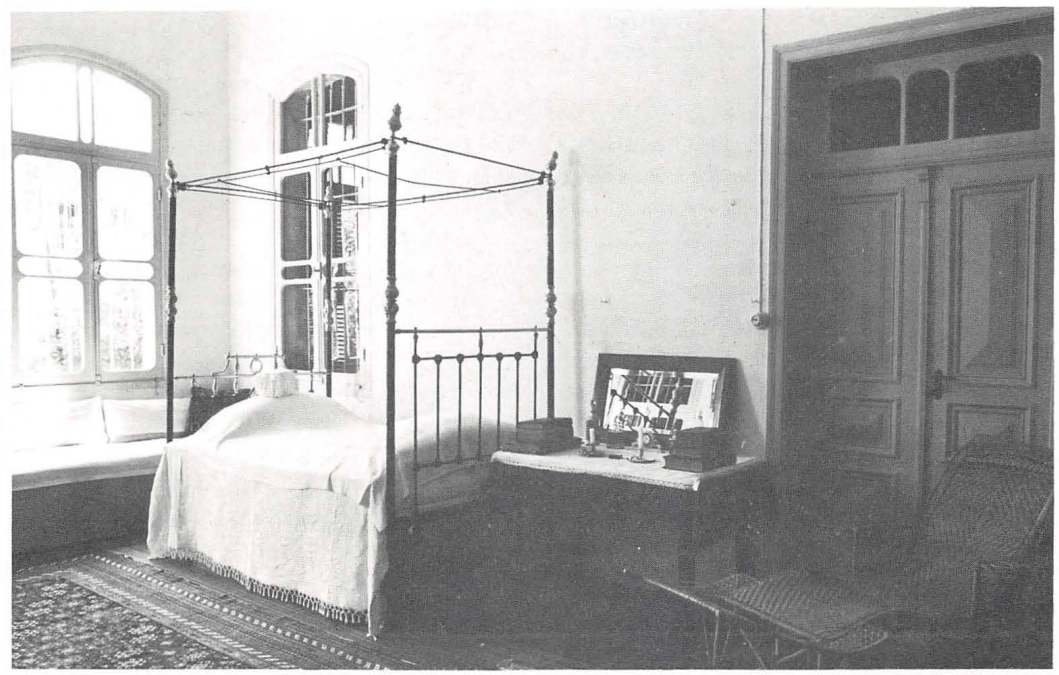
Early on Monday morning, November 28, the news of this sudden calamity had spread over the city, causing an unprecedented stir and tumult, and filling all hearts with unutterable grief.
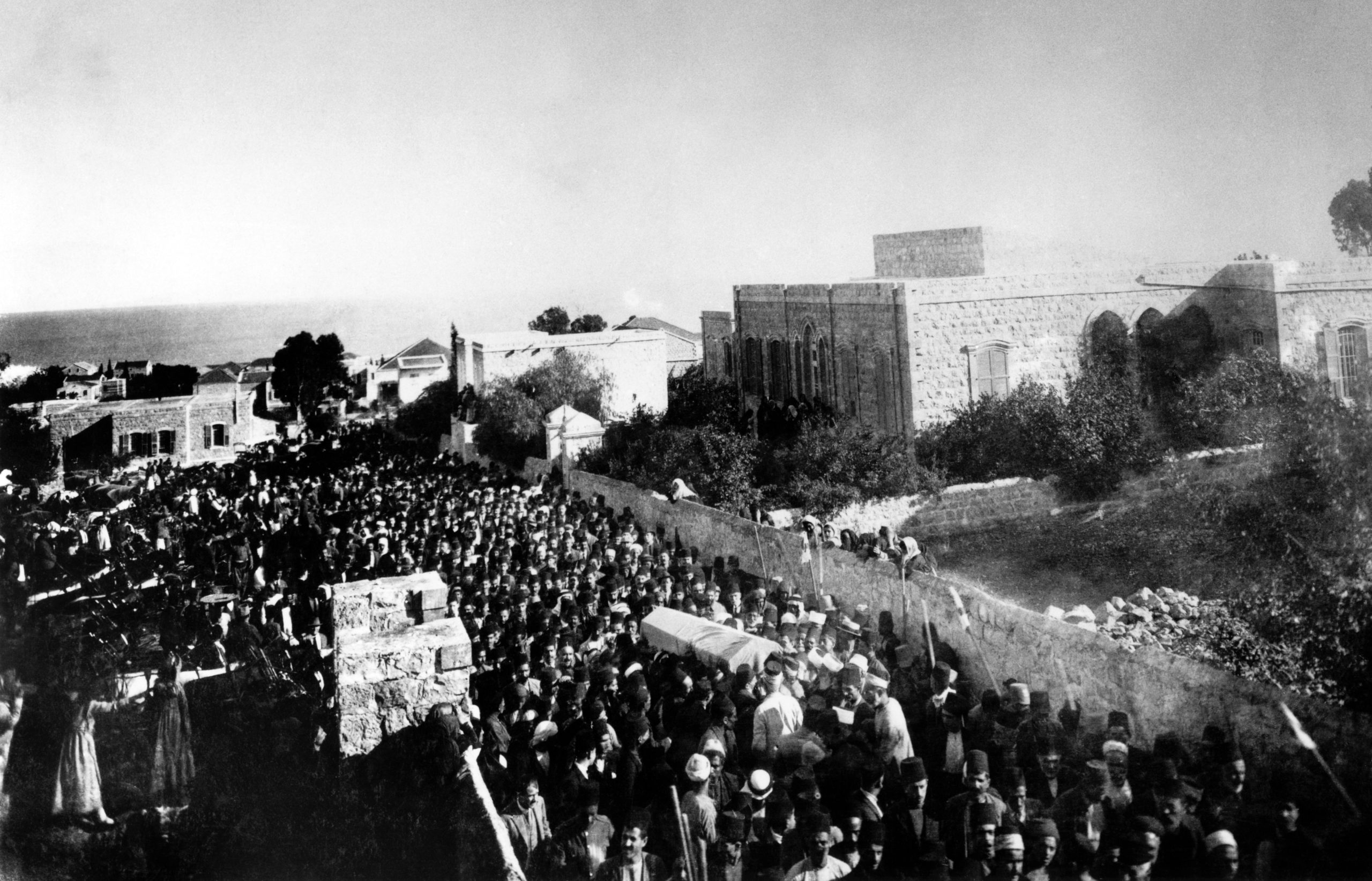
More than 10,000 people attended ‘Abdu’l-Baha’s funeral, held on 29 November 1921, the day after His passing. This photo shows the start of the funeral procession outside of ‘Abdu’l-Bahá’s home in Haifa at the bottom of Mount Carmel. His remains were temporarily laid to rest in a vault inside the Shrine of the Báb. The construction of a permanent Shrine of ‘Abdu’l-Bahá is well under way.
The next morning, Tuesday, November 29, the funeral took place, a funeral the like of which Haifa, nay Palestine itself, had surely never seen, so deep was the feeling that brought so many thousands of mourners together, representative of so many religions, races and tongues.
The High Commissioner of Palestine, Sir Herbert Samuel, the Governor of Jerusalem, the Governor of Phoenicia, the chief officials of the government, the consuls of the various countries, resident in Haifa, the heads of the various religious communities, the notables of Palestine, Jews, Christians, Muslims, Druses, Egyptians, Greeks, Turks, Kurds, and a host of his American, European and native friends, men, women and children, both of high and low degree, all, about ten thousand in number, mourning the loss of their beloved One.
This impressive, triumphal procession was headed by a guard of honour, consisting of the City Constabulary Force, followed by the Boy Scouts of the Muslim and Christian communities holding aloft their banners, a company of Muslim choristers chanting their verses from the Qur’an, the chiefs of the Muslim community headed by the Mufti, a number of Christian priests, Latin, Greek, and Anglican, all preceding the sacred coffin, upraised on the shoulders of His loved ones. Immediately behind it came the members of His family, next to them walked the British High Commissioner, the Governor of Jerusalem, and the Governor of Phoenicia. After them came the consuls and the notables of the land, followed by the vast multitude of those who reverenced and loved Him.
On this day there was no cloud in the sky, nor any sound in all the town and surrounding country through which they went, save only the soft, slow, rhythmic chanting of Islam in the call to prayer, or the convulsed sobbing moan of those helpless ones, bewailing the lo.:s of their one Friend, Who had protected them in all their difficulties and sorrows, Who e generous bounty had saved them and their little ones from starvation through the terrible years of the “Great Woe.”
“O God, my God!” the people wailed with one accord, “Our father has left us, our father has left us!”
O the wonder of that great throng! Peoples of every religion and race and colour, united in heart through the manifestation of servitude in the lifelong work of ‘Abdu’l-Bahá!
As they slowly wended their way up Mount Carmel, the Vineyard of God, the casket appeared in the distance to be borne aloft by invisible hands, so high above the heads of the people was it carried. After two hours walking, they reached the garden of the tomb of the Báb. Tenderly was the sacred coffin placed upon a plain table covered with a fair white linen cloth. As the vast concourse pressed around the tabernacle of His body, waiting to be laid in its resting place, within the vault, next to that of the Báb, representatives of the various denominations, Muslims, Christians, and Jews, all hearts being ablaze with fervent love of ‘Abdu’l-Bahá, some on the impulse of the moment, others prepared, raised their voices in eulogy and regret, paying their last homage of farewell to their loved one. So united were they in their acclamation of Him, as the wise educator and reconciler of the human race in this perplexed and sorrowful age, that there seemed to be nothing left for the Bahá’ís to say.
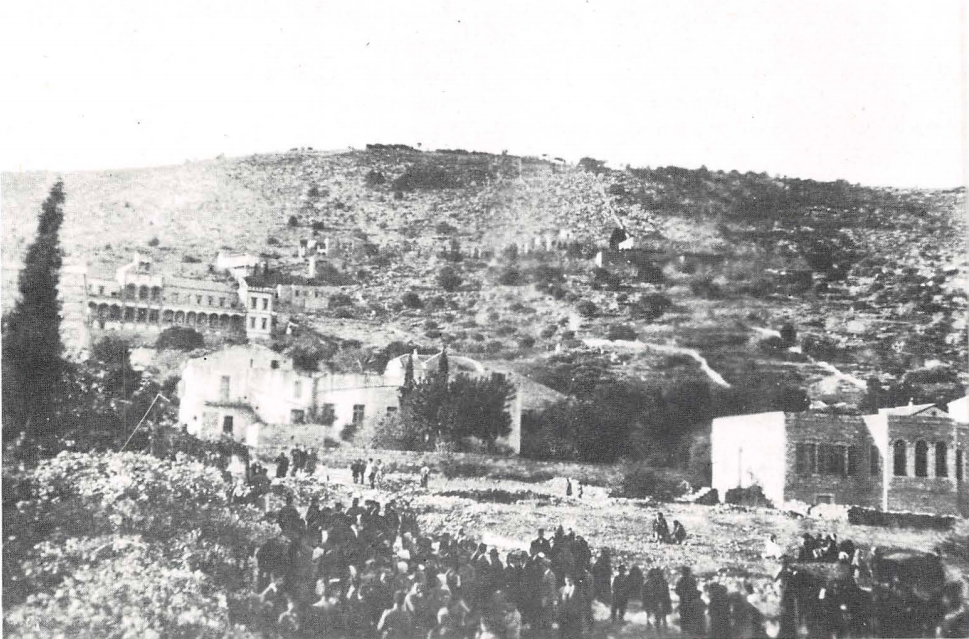
The following are extracts from some of the speeches delivered on that memorable occasion.
The Muslim voicing the sentiments of his coreligionists spoke as follows:
O concourse of Arabians and Persians! Whom are ye bewailing? Is it He who but yesterday was great in this life and is today in His death greater still? Shed no tears for the one that hath departed to the world of eternity, but weep over the passing of virtue and wisdom, of knowledge and generosity. Lament for yourselves, for yours is the loss, whilst He, your lost one, is but a revered wayfarer, stepping from your mortal world into the everlasting home. Weep one hour for the sake of Him who, for well nigh eighty years, hath wept for you! Look to your right, look to your left, look East and look West and behold, what glory and greatness have vanished! What a pillar of peace hath crumbled! What eloquent lips are hushed! Alas! In this tribulation there is no heart but aches with anguish, no eye but is filled with tears. Woe unto the poor, for lo! goodness hath departed from them, woe unto the orphans, for their loving father is no more with them! Could the life of Sir ‘Abdu’l-Bahá ‘Abbás have been redeemed by the sacrifices of many a precious soul, they of a certainty would gladly have offered up their lives for His life. But fate hath otherwise ordained. Every destiny is predetermined and none can change the divine decree. What am I to set forth the achievements of this leader of mankind? They are too glorious to be praised, too many to recount. Suffice it to say, that He hath left in every heart the most profound impression, on every tongue most wondrous praise. And He that leaveth a memory so lovely, so imperishable, He, indeed, is not dead. Be solaced then, 0 ye people of Bahá! Endure and be patient; for no man, be he of the East or of the West, can ever comfort you, nay he himself is even in greater need of consolation.
The Christian then came forward and thus spoke:
I weep for the world, in that my Lord hath died; others there are who, like unto me, weep the death of their Lord . . . O bitter is the anguish caused by this heart-rending calamity! It is not only our country’s loss but a world affliction. . . He hath lived for well-nigh eighty years the life of the messengers and apostles of God. He hath educated the souls of men, hath been benevolent unto them, hath led them to the way of Truth. Thus He raised His people to the pinnacle of glory, and great shall be His reward from God, the reward of the righteous! Hear me 0 people! ‘Abbás is not dead, neither hath the light of Bahá been extinguished! Nay, nay! this light shall shine with everlasting splendour. The Lamp of Bahá, ‘Abbás, hath lived a goodly life, hath manifested in Himself the true life of the Spirit. And now He is gathered to glory, a pure angel, richly robed in benevolent deeds, noble in His precious virtues. Fellow Christians! Truly ye are bearing the mortal remains of this ever lamented One to His last resting place, yet know of a certainty that your ‘Abbás will live forever in spirit amongst you, through His deeds, His words, His virtues, and all the essence of His life. We say farewell to the material body of our ‘Abbás and His material body vanisheth from our gaze, but His reality, our spiritual ‘Abbás, will never leave our minds, our thoughts, our hearts, our tongues.
O great revered Sleeper! Thou hast been good to us, Thou hast guided us, Thou hast taught us, Thou hast lived amongst us greatly, with the full meaning of greatness, Thou hast made us proud of Thy deeds and of Thy words. Thou hast raised the Orient to the summit of glory, hast shown loving kindness to the people, trained them in righteousness, and hast striven to the end, till Thou hast won the crown of glory. Rest Thou happily under the shadow of the mercy of the Lord Thy God, and He, verily, shall well reward Thee.
Yet another Muslim, the Mufti of Haifa, spoke as follows:
I do not wish to exaggerate in my eulogy of this great One, for His ready and helping hand in the service of mankind and the beautiful and wondrous story of His life, spent in doing that which is right and good, none can deny, save him, whose heart is blinded …
O Thou revered voyager! Thou hast lived greatly and hast died greatly! This great funeral procession is but a glorious proof of Thy greatness in Thy life and in Thy death. But 0, Thou whom we have lost! Thou leader of men, generous and benevolent! To whom shall the poor now look? Who shall care for the hungry? And the desolate, the widow and the orphan?
May the Lord inspire all Thy household and Thy kindred with patience in this grievous calamity, and immerse Thee in the ocean of His grace and mercy! He, verily, is the prayer-hearing, prayer-answering God.
The Jew when his turn came, paid his tribute in these words:
[In a century of exaggerated positivism and unbridled materialism, it is astonishing and rare to find a philosopher of great scope, such as the lamented ‘Abdu’l-Bahá ‘Abbás, speak to our heart, to our feelings, and especially seek to educate our soul by inculcating in us the most beautiful principles, which are recognized as being the basis of all religion and of all pure morality. By His Writings, by His spoken Word, by His intimate conversations as well as by His famous dialogues with the most cultivated and the most fervent adepts of sectarian theories, He knew how to persuade; He was always able to win our minds. Living examples have a special power. His private and public life was an example of devotion and of forgetfulness of self for the happiness of others … His philosophy is simple, you will say, but it is great by that very simplicity, since it is in conformity with human character, which loses some of its beauty when it allows itself to be distorted by prejudices and superstitions … ‘Abbás died in Haifa, Palestine, the Holy Land which produced the prophets. Sterile and abandoned for so many centuries, it is coming back to life and is beginning to recover its rank and its original renown. We are not the only ones to grieve for this prophet; we are not the only ones to testify to His glory. In Europe, in America, yea, in every land inhabited by men conscious of their mission in this base world, athirst for social justice, for brotherhood, He will be mourned as well. He is dead after suffering from despotism, fanaticism, and intolerance. ‘Akká, the Turkish Bastille, was His prison for decades. Baghdad, the Abbassid capital, has also been His prison, and that of His Father. Persia, the ancient cradle of gentle and divine philosophy, has driven out her children, who brought forth their ideas within her. May one not see herein a divine will and a marked preference for the Promised Land which was and will be the cradle of all generous and noble ideas? He who leaves after Him so glorious a past is not dead He who has written such beautiful principles has increased His family among all His readers and has passed to posterity, crowned with immortality.]1Translated from French
The nine speakers having delivered their funeral orations, then came the moment when the casket which held the Pearl of loving servitude passed slowly and triumphantly into its simple, hallowed resting place.
O the infinite pathos! that the beloved feet should no longer tread this earth! that the presence which inspired such devotion and reverence should be withdrawn!
Of the many and diverse journals that throughout the East and West have given in their columns accounts of this momentous event, the following stand as foremost among them:
Le Temps, the leading French paper, in its issue of December 19, 1921, under the title ‘Un Conciliateur’ (A Peacemaker), portrays graphically the life of ‘Abdu’l-Bahá. …
The London Morning Post, two days after His passing, among other highly favourable comments, concluded its report of the movement in the following words:
The venerated Bahá’u’lláh died in 1892 and the mantle of his religious insight fell on his son ‘Abdu’l-Bahá, when, after forty years of prison life, Turkish constitutional changes permitted him to visit England, France and America. His persistent messages as to the divine origin and unity of mankind were as impressive as the Messenger himself. He possessed singular courtesy. At his table Buddhist and Mohammedan, Hindu and Zoroastrian, Jew and Christian, sat in amity. “Creatures”, he said, “were created through love; let them live in peace and amity.”
The New York World of December 1, 1921, published the following:
Never before ‘Abdu’l-Bahá did the leader of an Oriental religious movement visit the United States. … As recently as June of this year a special correspondent of the World who visited this seer thus described him: “Having once looked upon ‘Abdu’l-Bahá, his personality is indelibly impressed upon the mind: the majestic venerable figure clad in the flowing ‘abá, his head crowned with a turban white as his head and hair; the piercing deep set eyes whose glances shake the heart; the smile that pours its sweetness over all.” …
Even in the twilight of his life ‘Abdu’l-Bahá took the liveliest interest in world affairs. When General Allenby swept up the coast from Egypt he went for counsel first to ‘Abdu’l-Bahá. When Zionists arrived in their Promised Land they sought ‘Abdu’l-Bahá for advice. For Palestine he had the brightest hopes. ‘Abdu’l-Bahá believed that Bolshevism would prove an admonition to the irreligious world. He taught the equality of man and woman, saying: “The world of humanity has two wings, man and woman. If one wing is weak, then the bird cannot fly.’ …
Nearly all representative American newspapers devoted attention to the passing of ‘Abdu’l-Bahá. The Evening Telegram, New York, December 4, 1921, found in the international peace movement a complete vindication for the Bahá’í ideals. “In all countries of the world today can be found mourners of the prophet ‘Abdu’l-Bahá. … Churches of all denominations in New York City and Chicago were thrown open to him for, unlike the leaders of many cults, he preached not the errors of present religions but their sameness.” The New York Tribune on December 2 carried an editorial entitled ‘Abdu’l-Bahá. “A prophet, as his followers believe, and the son of a prophet, was ‘Abdu’l-Bahá, who is now at rest with all prophetic souls bygone. He lived to see a remarkable expansion of the quietist cult of which he was the head … Bahá’u’lláh over sixty years ago set forth a peace plan not dissimilar to the aspirations of today.”
The magazine Unity, published in Chicago, included an article on the Master in its issue of December 22. “’Abdu’l-Bahá voiced and made eloquent the sacred aspiration that yearns dumbly in the hearts of men. He embodied in glorious, triumphant maturity that ideal which in others lies imprisoned behind the veil. Men and women of every race, creed, class, and colour are united in devotion to ‘Abdu’l-Bahá because ‘Abdu’l-Bahá has been a pure, selfless mirror reflecting only the noblest qualities of each.”
The Sphinx, of Cairo, Egypt, on December 17 described ‘Abdu’l-Bahá as a great leader of men. “In his personality and influence ‘Abdu’l-Bahá embodied all that is highest and most striking in both the Christian and Moslem faiths: living a life of pure altruism, he preached and worked for inter-racial and inter-religious unity. … When in the presence of ‘Abdu’l-Bahá thoughtful inquirers soon realized that they were speaking to a man of unique personality, one endowed with a love and wisdom that had in it the divine quality.”
The Times of India, in its issue of January 1922, opens one of its editorial articles as follows:
In more normal times than the present the death of ‘Abdu’l-Bahá, which was sorrowfully referred to at the Bahá’í Conference in Bombay would have stirred the feelings of many who, without belonging to the Bahá’í brotherhood, sympathize with its tenets and admire the life-work of those who founded it. As it is we have learned almost by chance of this great religious leader’s death, but that fact need not prevent our turning aside from politics and the turmoil of current events to consider what this man did and what he aimed at.
Sketching then in brief an account of the history of the movement it [the Times of India] concludes as follows:
It is not for us now to judge whether the purity, the mysticism and the exalted ideas of Baha’ism will continue unchanged after the loss of the great leader, or to speculate on whether Baha’ism will some day become a force in the world as great or greater than Christianity or Islam; but we would pay a tribute to the memory of a man who wielded a vast influence for good, and who, if he was destined to see many of his ideas seemingly shattered in the world war, remained true to his convictions and to his belief in the possibility of a reign of peace and love, and who, far more effectively than Tolstoy, showed the West that religion is a vital force that can never be disregarded.
Out of the vast number of telegrams and cables of condolence that have poured in, these may be mentioned:
His Britannic Majesty’s Secretary of State for the Colonies, Mr. Winston Churchill, telegraphing to His Excellency the High Commissioner for Palestine, desires him “to convey to the Bahá’í community, on behalf of His Majesty’s Government, their sympathy and condolence on the death of Sir ‘Abdu’l-Bahá ‘Abbás, K.B.E.”
On behalf of the Executive Board of the Bahá’í American Convention, this message of condolence has been received:
He doeth whatsoever He willeth. Hearts weep at most great tribulation. American friends send through Unity Board radiant love, boundless sympathy, devotion. Standing steadfast, conscious of His unceasing presence and nearness.
Viscount Allenby, the High Commissioner for Egypt, has wired the following message, through the intermediary of His Excellency the High Commissioner for Palestine, dated November 29, 1921:
Please convey to the relatives of the late Sir ‘Abdu’l-Bahá ‘Abbás Effendi and to the Bahá’í community my sincere sympathy in the loss of their revered leader.
The loved ones in Germany assure the Greatest Holy Leaf of their fidelity in these terms:
All believers deeply moved by irrevocable loss of our Master’s precious life. We pray for heavenly protection of Holy Cause and promise faithfulness and obedience to Centre of Covenant.
An official message forwarded by the Council of Ministers in Baghdád, and dated December 8, 1921, reads as follows:
His Highness Sayed Abdurrahman, the Prime Minister, desires to extend his sympathy to the family of His Holiness ‘Abdu’l-Bahá in their bereavement.
The Commander in Chief of the Egyptian Expeditionary Force sent through His Excellency the High Commissioner for Palestine these words of sympathy:
General Congreve begs that you will convey his deepest sympathy to the family of the late Sir ‘Abbás al-Bahá’í.
The Theosophical Society in London communicated as follows with one of the followers of the Faith in Haifa: “For the Holy Family Theosophical Society send affectionate thoughts.”
The thousands of Bahá’ís in Ṭihrán, the capital of Persia, remembering their Western brethren and sisters in London and New York assure them of their steadfast faith in these words: “Light of Covenant transferred from eye to heart. Day of teaching, of union, of self sacrifice.”
And lastly, one of the distinguished figures in the academic life of the University of Oxford, a renowned professor and an accomplished scholar, whose knowledge of the Cause stands foremost among that of his colleagues, in the message of condolence written on behalf of himself and wife, expresses himself as follows:
The passing beyond the veil into fuller life must be specially wonderful and blessed for One Who has always fixed His thoughts on high and striven to lead an exalted life here below.
On the seventh day after the passing of the Master, corn was distributed in His name to about a thousand poor of Haifa, irrespective of race or religion, to whom He had always been a friend and a protector. Their grief at losing the “Father of the Poor” was extremely pathetic. In the first seven days also from fifty to a hundred poor were daily fed at the Master’s house, in the very place where it had been His custom to give alms to them.
On the fortieth day there was a memorial feast, given to over six hundred of the people of Haifa, ‘Akká and the surrounding parts of Palestine and Syria, people of various religions, races and colours. More than a hundred of the poor were also fed on this day. The Governor of Phoenicia, many other officials and some Europeans were present.
The feast was entirely arranged by the members of the Master’s household. The long tables were decorated with trailing branches of bougainvillea. Its lovely purple blooms mingled with the white narcissus, and with the large dishes of golden oranges out of the beloved Master’s garden, made a picture of loveliness in those spacious lofty rooms, whose only other decoration was the gorgeous yet subdued colouring of rare Persian rugs. No useless trivial ornaments marred the extreme dignity of simplicity.
The guests received, each and all, the same welcome. There were no “chief places”. Here, as always in the Master’s home, there was no respecting of persons.
After the luncheon the guests came into the large central hall, this also bare of ornament, save only for the portrait of Him they had assembled to honour and some antique Persian tapestries hung upon one wall. Before this was placed a platform from which the speeches were made to the rapt and silent throng, whose very hearts were listening.
The Governor of Phoenicia, in the course of his address, spoke the following:
Most of us here have, I think, a clear picture of Sir ‘Abdu’l-Bahá ‘Abbás, of His dignified figure walking thoughtfully in our streets, of His courteous and gracious manner, of His kindness, of His love for little children and flowers, of His generosity and care for the poor and suffering. So gentle was He, and so simple that, in His presence, one almost forgot that He was also a great teacher and that His writings and His conversations have been a solace and an inspiration to hundreds and thousands of people in the East and in the West.
His [‘Abdu’l-Bahá’s] detailed and powerfully written Will and Testament reveals the following words of general counsel to all His friends:
O ye beloved of the Lord! In this sacred Dispensation, conflict and contention are in no wise permitted. Every aggressor deprives himself of God’s grace. It is incumbent upon everyone to show the utmost love, rectitude of conduct, straightforwardness and sincere kindliness unto alt the peoples and kindreds of the world, be they friends or strangers. So intense must be the spirit of love and loving-kindness, that the stranger may find himself a friend, the enemy a true brother, no difference whatsoever existing between them. For universality is of God and all limitations are earthly. Thus man must strive that his reality may manifest virtues and perfections. the fight whereof may shine upon every one. The light of the sun shineth upon all the world and the merciful showers of Divine Providence fall upon all peoples. The vivifying breeze reviveth every living creature and alt beings endued with life obtain their share and portion at His heavenly board. In like manner, the affections and loving-kindness of the servants of the One True God must be bountifully and universally extended to all mankind. Regarding this, restrictions and limitations are in no wise permitted.
Wherefore, O my loving Fiends! Consort with all the peoples, kindreds and religions of the world with the utmost truthfulness, uprightness, faithfulness, kindliness, goodwill and friendliness, that all the world of being may be filled with the holy ecstasy of the grace of Bahá, that ignorance, enmity, hate and rancour may vanish from the world and the darkness of estrangement amidst !he peoples and kindreds of the world may give way to the Light of Unity. Should other peoples and nations be unfaithful to you show your fidelity unto them, should they be unjust toward you show justice towards them, should they keep aloof from you attract them to yourselves, should they show their enmity be friendly towards them, should they poison your lives, sweeten their souls, should they inflict a wound upon you, be a salve to their sores. Such are the attributes of the sincere! Such are the attributes of the truthful!
O ye beloved of the Lord! Strive with all your heart to shield the Cause of God from the onslaught of the insincere, for souls such as these cause the straight to become crooked and all benevolent efforts to produce contrary results.
He prays for the protection of His friends:
O Lord, my God! Assist Thy loved ones to be firm in Thy Faith, to walk in Thy ways, to be steadfast in Thy Cause. Give them Thy grace to withstand the onslaught of self and passion, to follow the light of Divine Guidance. Thou art the Powerful the Gracious, the Self-Subsisting, the Bestower, the Compassionate, the Almighty, the All-Bountiful!
For His enemies this is His prayer:
I call upon Thee , O Lord, my God! with my tongue and with all my heart, not to requite them for their cruelty and their wrong-doings, their craft and their mischief, for they are foolish and ignoble and know not what they do. They discern not good from evil, neither do they distinguish right from wrong, nor justice from injustice. They follow their own desires and walk in the footsteps of the most imperfect and foolish amongst them. O my Lord! Have mercy upon them, shield them from all afflictions in these troubled times and grant that all trials and hardships may be the lot of this Thy servant, that hath fallen into this darksome pit. Single me out for every woe and make me a sacrifice for all Thy loved ones! O Lord, Most High! May my soul, my life, my being, my spirit, my all be offered up for them! O God, my God! Lowly, suppliant and fallen upon my face, I beseech Thee with all the ardour of my invocation to pardon whosoever hath hurt me, to forgive him that hath conspired against me and offended me, and to wash away the misdeeds of them that have wrought injustice upon me. Vouchsafe unto them Thy goodly gifts, give them joy, relieve them from sorrow, grant them peace and prosperity, give them Thy bliss and pour upon them Thy bounty.
Thou art the Powerful, the Gracious, the Help in Peril, the Self-Subsisting.
And now, what appeal more direct, more moving, with which to close this sad yet stirring account of His last days, than these His most touching, most inspiring words?
Friends! The time is coming when l shall be no longer with you. I have done all that could be done. I have served the Cause of Bahá’u’lláh to the utmost of my ability. I have laboured night and day, all the years of my life. O how I long to see the loved ones taking upon themselves the responsibilities of the Cause! Now is the time to proclaim the Kingdom of Bahá! Now is the hour of love and union! This is the day of the spiritual harmony of the loved ones of God! All the resources of my physical strength I have exhausted, and the spirit of my life is the welcome tidings of the unity of the people of Bahá. I am straining my ears toward the East and toward the West, toward the North and toward the South that haply I may hear the songs of love and fellowship chanted in the meetings of the faithful. My days are numbered, and, but f or this, there is no joy left unto me. O how I yearn to see the friends united even as a string of gleaming pearls, as the brilliant Pleiades, as the rays of the sun, as the gazelles of one meadow!
The mystic nightingale is warbling for them all; will they not listen? The bird of paradise is singing; will they not heed? The angel of Abhá is calling to them; will they not hearken? The herald of the Covenant is pleading; will they not obey?
Ah me, I am waiting, waiting, to hear the joyful tidings that the believers are the very embodiment of sincerity and truthfulness, the incarnation of love and amity, the living symbols of unity and concord. Will they not gladden my heart? Will they not satisfy my yearning? Will they not manifest my wish? Will they not fulfil my heart’s desire? Will they not give ear to my call?
I am waiting, I am patiently waiting.
My name is ‘Abdu’l-Bahá. My qualification is ‘Abdu’l-Bahá. My reality is ‘Abdu’l-Bahá. My praise is ‘Abdu’l-Bahá. Thraldom to the Blessed Perfection is my glorious and refulgent diadem, and servitude to all the human race my perpetual religion . .. No name, no title, no mention, no commendation have I, nor will ever have, except ‘Abdu’l-Bahá. This is my longing. This is my greatest yearning. This is my eternal life. This is my everlasting glory. 1‘Abdu’l-Bahá, Bahá’í Sacred Writings
An attempt I strongly feel should now be made to clarify our minds regarding the station occupied by ‘Abdu’l‑Bahá and the significance of His position in this holy Dispensation. It would be indeed difficult for us, who stand so close to such a tremendous figure and are drawn by the mysterious power of so magnetic a personality, to obtain a clear and exact understanding of the rôle and character of One Who, not only in the Dispensation of Bahá’u’lláh but in the entire field of religious history, fulfills a unique function. Though moving in a sphere of His own and holding a rank radically different from that of the Author and the Forerunner of the Bahá’í Revelation, He, by virtue of the station ordained for Him through the Covenant of Bahá’u’lláh, forms together with them what may be termed the Three Central Figures of a Faith that stands unapproached in the world’s spiritual history. He towers, in conjunction with them, above the destinies of this infant Faith of God from a level to which no individual or body ministering to its needs after Him, and for no less a period than a full thousand years, can ever hope to rise. To degrade His lofty rank by identifying His station with or by regarding it as roughly equivalent to, the position of those on whom the mantle of His authority has fallen would be an act of impiety as grave as the no less heretical belief that inclines to exalt Him to a state of absolute equality with either the central Figure or Forerunner of our Faith. For wide as is the gulf that separates ‘Abdu’l‑Bahá from Him Who is the Source of an independent Revelation, it can never be regarded as commensurate with the greater distance that stands between Him Who is the Center of the Covenant and His ministers who are to carry on His work, whatever be their name, their rank, their functions or their future achievements. Let those who have known ‘Abdu’l‑Bahá, who through their contact with His magnetic personality have come to cherish for Him so fervent an admiration, reflect, in the light of this statement, on the greatness of One Who is so far above Him in station.
That ‘Abdu’l‑Bahá is not a Manifestation of God, that, though the successor of His Father, He does not occupy a cognate station, that no one else except the Báb and Bahá’u’lláh can ever lay claim to such a station before the expiration of a full thousand years—are verities which lie embedded in the specific utterances of both the Founder of our Faith and the Interpreter of His teachings. …
‘Abdu’l‑Bahá’s own statements, in confirmation of this warning, are no less emphatic and binding: “… My station is the station of servitude—a servitude which is complete, pure and real, firmly established, enduring, obvious, explicitly revealed and subject to no interpretation whatever… I am the Interpreter of the Word of God; such is my interpretation.”
. . . From such clear and formally laid down statements, incompatible as they are with any assertion of a claim to Prophethood, we should not by any means infer that ‘Abdu’l‑Bahá is merely one of the servants of the Blessed Beauty, or at best one whose function is to be confined to that of an authorized interpreter of His Father’s teachings. Far be it from me to entertain such a notion or to wish to instill such sentiments. To regard Him in such a light is a manifest betrayal of the priceless heritage bequeathed by Bahá’u’lláh to mankind. Immeasurably exalted is the station conferred upon Him by the Supreme Pen above and beyond the implications of these, His own written statements. Whether in the Kitáb-i-Aqdas, the most weighty and sacred of all the works of Bahá’u’lláh, or in the Kitáb-i-‘Ahd, the Book of His Covenant, or in the Súriy-i-Ghusn (Tablet of the Branch), such references as have been recorded by the pen of Bahá’u’lláh—references which the Tablets of His Father addressed to Him mightily reinforce—invest ‘Abdu’l‑Bahá with a power, and surround Him with a halo, which the present generation can never adequately appreciate.
He is, and should for all time be regarded, first and foremost, as the Center and Pivot of Bahá’u’lláh’s peerless and all-enfolding Covenant, His most exalted handiwork, the stainless Mirror of His light, the perfect Exemplar of His teachings, the unerring Interpreter of His Word, the embodiment of every Bahá’í ideal, the incarnation of every Bahá’í virtue, the Most Mighty Branch sprung from the Ancient Root, the Limb of the Law of God, the Being “round Whom all names revolve,” the Mainspring of the Oneness of Humanity, the Ensign of the Most Great Peace, the Moon of the Central Orb of this most holy Dispensation—styles and titles that are implicit and find their truest, their highest and fairest expression in the magic name ‘Abdu’l‑Bahá. He is, above and beyond these appellations, the “Mystery of God”—an expression by which Bahá’u’lláh Himself has chosen to designate Him, and which, while it does not by any means justify us to assign to Him the station of Prophethood, indicates how in the person of ‘Abdu’l‑Bahá the incompatible characteristics of a human nature and superhuman knowledge and perfection have been blended and are completely harmonized. …
“O Thou Who art the apple of Mine eye!” Bahá’u’lláh, in His own handwriting, thus addresses ‘Abdu’l‑Bahá, “My glory, the ocean of My loving-kindness, the sun of My bounty, the heaven of My mercy rest upon Thee. We pray God to illumine the world through Thy knowledge and wisdom, to ordain for Thee that which will gladden Thine heart and impart consolation to Thine eyes.” “The glory of God rest upon Thee,” He writes in another Tablet, “and upon whosoever serveth Thee and circleth around Thee. Woe, great woe, betide him that opposeth and injureth Thee. Well is it with him that sweareth fealty to Thee; the fire of hell torment him who is Thine enemy.” “We have made Thee a shelter for all mankind,” He, in yet another Tablet, affirms, “a shield unto all who are in heaven and on earth, a stronghold for whosoever hath believed in God, the Incomparable, the All-Knowing. God grant that through Thee He may protect them, may enrich and sustain them, that He may inspire Thee with that which shall be a wellspring of wealth unto all created things, an ocean of bounty unto all men, and the dayspring of mercy unto all peoples.”
“Thou knowest, O my God,” Bahá’u’lláh, in a prayer revealed in ‘Abdu’l‑Bahá’s honor, supplicates, “that I desire for Him naught except that which Thou didst desire, and have chosen Him for no purpose save that which Thou hadst intended for Him. Render Him victorious, therefore, through Thy hosts of earth and heaven… Ordain, I beseech Thee, by the ardor of My love for Thee and My yearning to manifest Thy Cause, for Him, as well as for them that love Him, that which Thou hast destined for Thy Messengers and the Trustees of Thy Revelation. Verily, Thou art the Almighty, the All-Powerful.”2Shoghi Effendi, The World Order of Bahá’u’lláh. Available at www.bahai.org/r/553653426
He alone had been accorded the privilege of being called “the Master,” an honor from which His Father had strictly excluded all His other sons. Upon Him that loving and unerring Father had chosen to confer the unique title of “Sirru’lláh” (the Mystery of God), a designation so appropriate to One Who, though essentially human and holding a station radically and fundamentally different from that occupied by Bahá’u’lláh and His Forerunner, could still claim to be the perfect Exemplar of His Faith, to be endowed with super-human knowledge, and to be regarded as the stainless mirror reflecting His light. To Him, whilst in Adrianople, that same Father had, in the Súriy-i-Ghusn (Tablet of the Branch), referred as “this sacred and glorious Being, this Branch of Holiness,” as “the Limb of the Law of God,” as His “most great favor” unto men, as His “most perfect bounty” conferred upon them, as One through Whom “every mouldering bone is quickened,” declaring that “whoso turneth towards Him hath turned towards God,” and that “they who deprive themselves of the shadow of the Branch are lost in the wilderness of error.” To Him He, whilst still in that city, had alluded (in a Tablet addressed to Ḥájí Muḥammad Ibráhím-i-Khalíl) as the one amongst His sons “from Whose tongue God will cause the signs of His power to stream forth,” and as the one Whom “God hath specially chosen for His Cause.” On Him, at a later period, the Author of the Kitáb-i-Aqdas, in a celebrated passage, subsequently elucidated in the “Book of My Covenant,” had bestowed the function of interpreting His Holy Writ, proclaiming Him, at the same time, to be the One “Whom God hath purposed, Who hath branched from this Ancient Root.” To Him in a Tablet, revealed during that same period and addressed to Mírzá Muḥammad Qulíy-i-Sabzivárí, He had referred as “the Gulf that hath branched out of this Ocean that hath encompassed all created things,” and bidden His followers to turn their faces towards it. To Him, on the occasion of His visit to Beirut, His Father had, furthermore, in a communication which He dictated to His amanuensis, paid a glowing tribute, glorifying Him as the One “round Whom all names revolve,” as “the Most Mighty Branch of God,” and as “His ancient and immutable Mystery.” He it was Who, in several Tablets which Bahá’u’lláh Himself had penned, had been personally addressed as “the Apple of Mine eye,” and been referred to as “a shield unto all who are in heaven and on earth,” as “a shelter for all mankind” and “a stronghold for whosoever hath believed in God.” It was on His behalf that His Father, in a prayer revealed in His honor, had supplicated God to “render Him victorious,” and to “ordain … for Him, as well as for them that love Him,” the things destined by the Almighty for His “Messengers” and the “Trustees” of His Revelation. And finally in yet another Tablet these weighty words had been recorded: “The glory of God rest upon Thee, and upon whosoever serveth Thee and circleth around Thee. Woe, great woe, betide him that opposeth and injureth Thee. Well is it with him that sweareth fealty to Thee; the fire of hell torment him who is Thy enemy.”
And now to crown the inestimable honors, privileges and benefits showered upon Him, in ever increasing abundance, throughout the forty years of His Father’s ministry in Baghdád, in Adrianople and in ‘Akká, He had been elevated to the high office of Center of Bahá’u’lláh’s Covenant, and been made the successor of the Manifestation of God Himself—a position that was to empower Him to impart an extraordinary impetus to the international expansion of His Father’s Faith, to amplify its doctrine, to beat down every barrier that would obstruct its march, and to call into being, and delineate the features of, its Administrative Order, the Child of the Covenant, and the Harbinger of that World Order whose establishment must needs signalize the advent of the Golden Age of the Bahá’í Dispensation.
The immediate effect of the ascension of Bahá’u’lláh had been… to spread grief and bewilderment among His followers and companions, and to inspire its vigilant and redoubtable adversaries with fresh hope and renewed determination. …
Yet, as the appointed Center of Bahá’u’lláh’s Covenant and the authorized Interpreter of His teaching had Himself later explained, the dissolution of the tabernacle wherein the soul of the Manifestation of God had chosen temporarily to abide signalized its release from the restrictions which an earthly life had, of necessity, imposed upon it. Its influence no longer circumscribed by any physical limitations, its radiance no longer beclouded by its human temple, that soul could henceforth energize the whole world to a degree unapproached at any stage in the course of its existence on this planet.
Bahá’u’lláh’s stupendous task on this earthly plane had, moreover, at the time of His passing, been brought to its final consummation. His mission, far from being in any way inconclusive, had, in every respect, been carried through to a full end. The Message with which He had been entrusted had been disclosed to the gaze of all mankind. The summons He had been commissioned to issue to its leaders and rulers had been fearlessly voiced. The fundamentals of the doctrine destined to recreate its life, heal its sicknesses and redeem it from bondage and degradation had been impregnably established. The tide of calamity that was to purge and fortify the sinews of His Faith had swept on with unstemmed fury. The blood which was to fertilize the soil out of which the institutions of His World Order were destined to spring had been profusely shed. Above all the Covenant that was to perpetuate the influence of that Faith, insure its integrity, safeguard it from schism, and stimulate its world-wide expansion, had been fixed on an inviolable basis.
His Cause, precious beyond the dreams and hopes of men; enshrining within its shell that pearl of great price to which the world, since its foundation, had been looking forward; confronted with colossal tasks of unimaginable complexity and urgency, was beyond a peradventure in safe keeping. His own beloved Son, the apple of His eye, His vicegerent on earth, the Executive of His authority, the Pivot of His Covenant, the Shepherd of His flock, the Exemplar of His faith, the Image of His perfections, the Mystery of His Revelation, the Interpreter of His mind, the Architect of His World Order, the Ensign of His Most Great Peace, the Focal Point of His unerring guidance—in a word, the occupant of an office without peer or equal in the entire field of religious history—stood guard over it, alert, fearless and determined to enlarge its limits, blazon abroad its fame, champion its interests and consummate its purpose. …
The cloud of despondency that had momentarily settled on the disconsolate lovers of the Cause of Bahá’u’lláh was lifted. The continuity of that unerring guidance vouchsafed to it since its birth was now assured. The significance of the solemn affirmation that this is “the Day which shall not be followed by night” was now clearly apprehended. An orphan community had recognized in ‘Abdu’l‑Bahá, in its hour of desperate need, its Solace, its Guide, its Mainstay and Champion. The Light that had glowed with such dazzling brightness in the heart of Asia, and had, in the lifetime of Bahá’u’lláh, spread to the Near East, and illuminated the fringes of both the European and African continents, was to travel, through the impelling influence of the newly proclaimed Covenant, and almost immediately after the death of its Author, as far West as the North American continent, and from thence diffuse itself to the countries of Europe, and subsequently shed its radiance over both the Far East and Australasia.3Shoghi Effendi, God Passes By. Available at www.bahai.org/r/565667412
We drove through the newer part of ‘Akká down to the great sweep of sandy beach where a stormy wind lashed the great breakers and drove them as far into the old city as possible. We turned left and wound our way over the hill down into the old city again. The wind blew everyone’s coat collar up around the neck. The day was still gray, misty and chill. The cold crashing of the surf punctuated the silent spots in our conversation as we stood, our backs to the sea wall, gazing across the way at the House of ‘Abbúd.
The sea, the wind, the swirling mist, none could cool down the ardor that stirred inside the pilgrim as he looked upon this gray shell of a house that once sheltered the Supreme Prophet of God. This was once the sanctuary of the Supreme Pen. Its walls had resounded to the words of the Most Great Book, the Mighty Aqdas. Here were formed the laws which would stand inviolate and unaltered for a thousand years. Here were fashioned the provisions which would lay the foundation for the greatest structure in the social history of mankind. Here, those ancient prophetic words had come true, “The Government shall be upon His shoulders.” Here, the Author of the Bahá’í Faith, protected by these blessed walls from the stinging winds of the sea, had poured out the fairest fruit of all His Revelation, the Aqdas—pre-eminent among all the writings which had streamed forth in a never-ending river from His holy pen.
What a plain, unimposing structure. Two stories in height with a small balcony around the second floor front, drab gray in color, bleak in appearance, beautiful to the believer.
We were all staring silently up at the balcony which surrounds the bedroom of Bahá’u’lláh. Many long hours He had paced this balcony, looking out over the sea and down upon the very earth where we were standing. This small balcony, which can be crossed in less than ten paces, furnished almost the only outside exercise for Bahá’u’lláh in seven long years of imprisonment within the walls of this house.

Before entering the House, we walked to the small public square in the rear. Our gracious host, Leroy Ioas, holding his hat and coat-collar against a wind that whirled tiny cyclones of ‘Akká dust across the courtyard, showed us the exact spot where the Master had stood and distributed alms and food to the poor.
Salah led us back between the houses and into the side door of the House of ‘Abbúd. We crossed an inner court and started up a flight of stairs, turning to the right twice and continuing to climb until we reached the living quarters of the Holy Family. We saw the small room that held thirteen believers the first night spent in this house. We saw the upper shelf which one of the friends had slept upon that first night and, rolling over too far to one side, had toppled down upon the Master.

We removed our shoes and walked across another room of soft carpets, through a small hallway and then turned left into Bahá’u’lláh’s bedroom. Against the wall on the sea-side of the room was a long cushioned bench. Upon the south end, toward Haifa, rested the táj of Baha’u’llah, marking the place where He often would sit. A few feet away, along the south wall, was a rocking chair which He used. Upon the floor, a carpet brought with them all the way from Adrianople.
As I write this now in Johannesburg, I am back there again. I can feel my pulse accelerate and my heart beat stronger. The atmosphere of these holy places never leaves you. It comes rushing back whenever you turn to ‘Akká and Haifa. Hour after hour, month after month, year upon year, Bahá’u’lláh had moved back and forth in this room. At times He would turn left in the doorway and go out on the balcony which runs across the front of the house. After Salah chanted a prayer, we followed Bahá’u’lláh’s path to the balcony and looked out upon the turbulent sea. The wind, it seemed to us, was still whipping up the indifferent Mediterranean and driving it toward the shore, where in mighty rollers it bowed and prostrated itself before the throne of Majesty.
The room of revelation (where Baha’u’llah revealed the Aqdas) is quite different from the others. This was also ‘Abdu’l-Bahá’s bedroom. It is paneled in wood which is to be found in other places associated with Him. This bedroom is in the back corner of the House. We could look down into the back courtyard. … We saw many of the books of ‘Abdu’l-Bahá, His writing equipment, papers, the simple iron bed—many things that were much loved by Him and are revered by all who look upon them.
Above all else, the mind tries to take in the truth that here in this room, a room that is simplicity itself, was revealed the Book of Laws, the Most Great Book, the mightiest written testimony since the beginning of our recorded times. Its Author would cast His Shadow of guidance for five hundred thousand years!
It is too much to understand. The mind willingly surrenders and turns to examine the surroundings, the little things it can comprehend. ‘Abdu’l-Bahá sat here, He walked here, He knelt here, He looked out this window. But irresistibly your thoughts keep coming back to that one inescapable fact—it was here that Bahá’u’lláh revealed the Aqdas.
Emptying yourself of every single thing to which the mind can cling, you ask Almighty God to pour into your heart a true appreciation of this experience you are undergoing. … The presence and significance of these holy places are like hammer-blows to those of us who have lived in a world so remote from the spirit.
Those veritably spiritual thunderbolts the Shrine of Bahá’u’lláh, of the Báb, and of ‘Abdu’l-Bahá, the room at Bahjí where Bahá’u’lláh passed away, the mansion of Mazra‘ih, the Garden of Riḍván—all had numbed the senses until the cup could not contain the flood.
Each of us said a prayer before departing from this cradle of future civilization. When we made our way downstairs, there was additional conversation, but none of it registers. The hearing was working, but the comprehension and recording instruments were unable to function. This was a mercy of God. The body must be much like an electrical system. It can successfully carry its normal “load” of power, but when subjected suddenly to an incredibly strong current, it “blows out” the fuse at its point of protection. A similar phenomenon happens to the pilgrim, several times, in fact. Something breaks the connection and permits no more impulses to register. The system cannot bear them. (Bahá’u’lláh has written of this spirit, saying of the wine of revelation that it is so inebriating to the Prophet, Himself, that the pen is stilled and can move no more.)
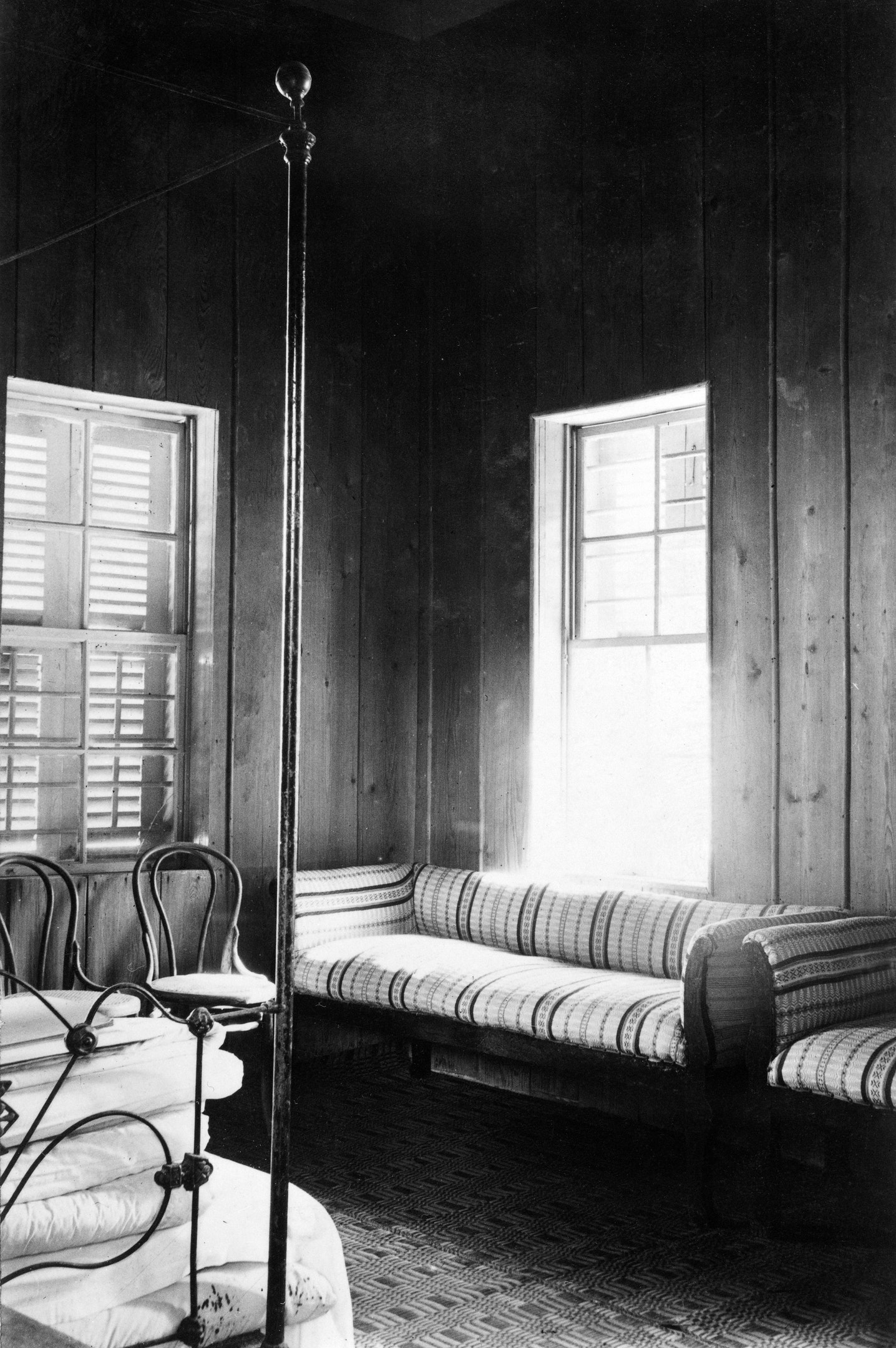
The sun came out gaily for a brief moment, for the first time, as we strolled through the picturesque streets of “Old ‘Akká.” It splashed against the drab earth-colored walls and transformed them into a happy tan. We traced our way along many of the favorite walks of the Master.
We paused and took photographs in the doorway of the house of the former Mufti of ‘Akká. He had been a bitter enemy of Bahá’u’lláh. Salah, caretaker at Bahjí, told us the story of the two attempts on the life of Bahá’u’lláh made by this Mufti while Bahá’u’lláh was still in prison. Once with a hidden dagger, but Baha’u’llah before admitting him to His presence said, “Let him first cleanse his hands.” A second time, the Mufti planned to strangle the Blessed Beauty, and Bahá’u’lláh said before admitting him, “First let him cleanse his heart.” The Mufti became an ardent believer and collected all the “traditions” to be found in the Faith about ‘Akká.
What a delightful city “Old ‘Akká” is to visit. Salah, who was born within its walls, greeted almost everyone. He told us many intriguing stories about its non-Bahá’í history as well. We entered a small door built in one of the lower walls of the prison, walked to the center of a cellar-like cavern. Below us excavation had been started. How strange to know that beneath the prison lies this famous church built by Richard, the Lion-hearted. The packed earth on which we stood was high up toward the top of the Gothic arches. The pillars were buried many, many feet in the solid earth below us.
Salah pointed out the house to which Bahá’u’lláh had been taken in custody when some of His followers had disobeyed His commands, quarreled with three enemies of the Faith and slew them. Bahá’u’lláh was dictating Tablets to His secretary when troops surrounded His house. Crowds gathered quickly. They shouted at Bahá’u’lláh as the Governor, sword in hand, led Him away for questioning. His innocence was established and Bahá’u’lláh was freed; the Governor apologized for his own bad behavior.
We began our approach to the prison itself. The steps up which Bahá’u’lláh had walked to enter the fortress that first time have been taken down. They have left their scar across the body of the prison wall. We all stopped and gazed up at the marks of that old stairway. This was as far as we could retrace the steps of banishment. In order to enter the prison, we had to drive around the city to the front by the sea wall.
We parked by the gate, passed the guards, and walked about three hundred yards up to the prison entrance. As you cross the small bridge over the moat, you can see the cannon balls of Napoleon embedded in the walls. They are splashed with red paint to make them easily visible. Passing through a small arched entrance, we approached the courtyard.
The prison is now a hospital for the insane and feeble-minded. You can see them exercising in the very courtyard where the believers were herded together that first day. There was a sound of heavy keys rattling in a metal door, the door swung open, and you entered the prison barracks. Passing through an ante-room of poor, unfortunate sick ones, you enter the cell-block. In the far left-hand corner is a plaque which reads: Bahá’í Holy Place. . . . This is the cell of Baha’u’llah. The plaque is written in both English and Hebrew.
We removed our shoes outside the great door, and then entered the prison cell where for over two years Bahá’u’lláh had been shut away from the world. This was the heart of the “Most Great Prison.” Even that Black Pit in Ṭihrán, the Siyáh-Chál, a place foul beyond comparison, a dungeon wrapped in thick darkness, so dreadful that no tongue could describe its loathsome smell, had not been called by such a name.
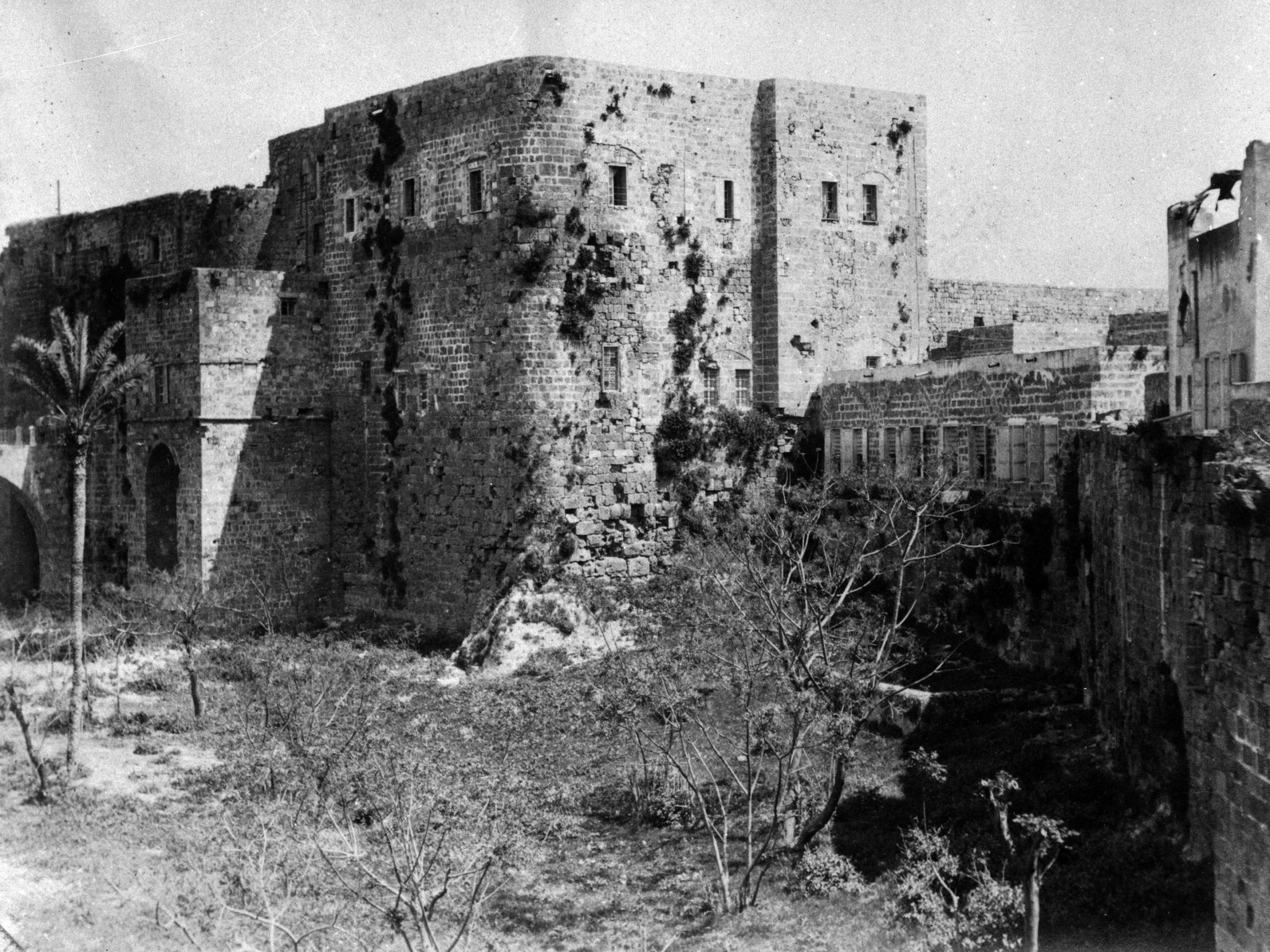
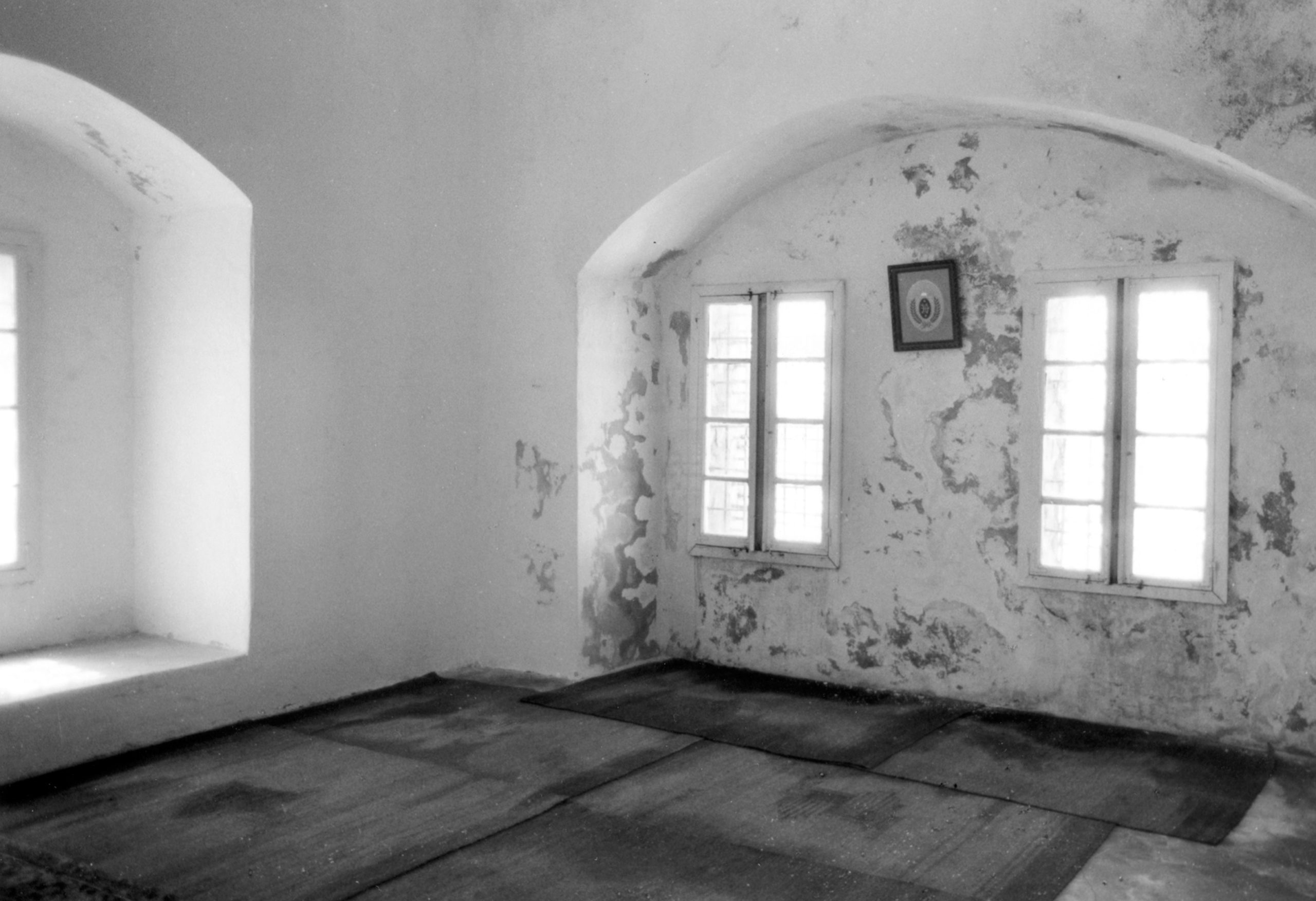
The cell was barren and desolate in Bahá’u’lláh’s day. Now there is a Persian carpet in the corner where He used to sit. There are five straight-backed chairs upon which the pilgrims sit. One window looks out upon the old ‘Akká. The other two windows look out upon the sea. These are the windows shown in most of the photographs.
From here Bahá’u’lláh would look out toward that spot beyond the moat where His followers would stand hoping for a glimpse of His hand waving from the window. We all stood and peered out at that same spot and to the white-capped sea beyond it. Later we walked out to that place of bliss and sorrow and looked up at these two forlorn windows. The face of the prison is bruised and scarred from shell-fire.

Inside the prison-cell itself, the heart is touched and saddened by the sight of that bleak, unfragrant room. True, it has been cleaned and restored, but here and there upon the floor were small fragments of paint and plaster which had fallen from the ceiling and walls. These are a grim reminder of the chilling dampness of this dismal place.
Here in this cell, where but a few paces carry you from end to end, Bahá’u’lláh spent over two years of His precious life. Here it was that Baha’u’llah, Himself, said that His sufferings had reached their culmination.
Our eyes bestowed loving prayers upon each of these places of anguish. After all these years, and even with the reformations, it is still unsanitary and foul in these barracks. The mind refuses to try to picture the misery and abomination that must have surrounded Bahá’u’lláh upon His arrival here. We know that they were herded together, deprived of food and drink, that malaria, dysentery, and the sickening heat added to their sorrows. All were ill but two.
It was here that the two brothers died the same night locked in each other’s arms. Bahá’u’lláh sold His carpet to provide for their winding sheets and burial, but the guards had kept the money and cast them into a pit unwashed and unshrouded.
This is where Bahá’u’lláh’s young son, Mírzá Mihdí, the Purest Branch, was killed. He was pacing the roof at twilight reciting his prayers. He fell through an unguarded skylight on a wooden crate below which pierced his ribs and took his life in less than a day. It was here that this sweet son pleaded with his Father, Bahá’u’lláh, that his life be not saved, but that it be offered as a ransom so that the pilgrims, who so longed for His healing Presence, might be permitted to attain their hearts’ desire. At his tomb in the Monument gardens, we repeated the words of Baha’u’llah written about him:
“Thou art the trust of God and His treasure in this land. Erelong will God reveal through thee that which He hath desired.”
From here Bahá’u’lláh wrote many of His tablets to the kings of the earth, proclaiming that the only remedy for the ills of the world was the union of all its peoples in one common faith, and that only a divine, inspired Physician could bring this to pass.
Many were the wholesome truths that flowed from that Supreme Pen within this prison cell. Each of these tablets and writings took on a new force since we had come to the scene of their origin.
The doors that did not open for Bahá’u’lláh for two years, swing wide for you, then grind closed upon their hinges. We put on our shoes, everyone silent, lost in the weight of thoughts which held words down, unformed.
This was the last stop in ‘Akká. We were grateful. We wanted no conversation; no invasion of that place the mind had set aside for reflecting upon this unequaled experience.
There was no receptiveness left to truly appreciate the stories told as we descended the stairs; the room below where the rest of the pilgrims had been quartered, the place where the Master had made broth for all—made broth with little more than air for ingredients. His words spoken in London sent another sliver of pain into the body. He had made so much broth in those days, He said, that He could make a very good broth with a very little. How the Master loved His wonderful Father. He told of this loathsome prison. How Bahá’u’lláh would call the pilgrims together, would make them laugh at their troubles, until they forgot their stone beds, the lack of food and water. He banished the pain of their illness and the ravages of their fever. He would tell them stories and lift their hearts. He would start them to laughing so loudly that they must be cautioned for fear the sentinels would believe they were mad if they could laugh and enjoy themselves in these conditions of utter dreadfulness.
What tenderness must have been in the Master’s eyes as He placed His graceful hand upon the luxurious furniture of the Western world and said, “We had no chairs such as this in the prison of ‘Akká; no soft beds to lie upon; no delicious food to nourish us. But I would not exchange all of these days for one moment of the sweetness of those hours in the presence of the Blessed Beauty.”

Seeing these poor, unfortunate inmates of the asylum for the last time, one thinks: How like the entire world is this prison barracks. These pitiful wretches, unbalanced, living in another dead world (like all humanity) are within but a few paces of the Holy Place of Bahá’u’lláh‘ Healer of all ills.
We crossed the moat and walked out into the open air. The clouds were gone. The sun was out ruling the blue sky all by itself. The sea, a deeper blue, was still charging up to the old sea wall and plunging against its rocks. There was a queer, mingled feeling in possession of me. It was half of joy and half of sadness, gladness and heavy-heartedness, happiness and sorrow. Perhaps it was the accumulation of the day’s emotions, unsettled and unabsorbed within me. Each experience taking charge of my being at alternate intervals, just as the sea sent alternate breakers against the wall.
I did not look back. It was all locked forever in my heart.
And they shall see the Son of man coming… 1Matthew 24:30
Daytimes the trout stream was a big trout, slippery, dappled, now and then flashing white, easing under the watery aspens. At night it was pale in the blackness. Sitting by the campfire one could only hear it and see a vagueness down there under the bank where it ran. One could not distinguish between the moths brought into the flame, and the sparks flying out, and higher insects catching the light as they passed, and shooting stars, and stars. One could not keep track of these things.
Except that the stars were campfires again. This used to be Indian country, here under the incongruously Swiss-looking snow crags, along the trout stream; here you can still pick up Indian arrowheads of dark bottle-green obsidian, with the hairy chisel marks. When the white man drove the Indians away, they went up there in the sky, over our heads, and lit those campfires. So we have peace between the two again, with the red man up there the winner. His spirit is always seeping back into America, like the blood of the heart seeping back, and it never wipes away. (That time we saw Boulder Dam, the least Indian of all things, we found that Indian patterns had been worked into the massive floors; soft, moccasined, his spirit had come back.)
You would look into the redness of the campfire, and there, standing on its tail and watching you with white, piteously smoking eyes, was the ghost of the trout you had caught in the morning and fried at noon; fried it so fresh that it leapt in the pan.
That particular night something was going to happen, up there in the mountains. Everything was waiting for it. The wind had lowered, the hot ashes fell softly, the stream quieted and the aspens stilled. Now it was happening. We looked up out of our well of blackness to the ridge: the trees along the ridge were catching fire, they were burning, like hair in a nimbus on some old saint’s picture. Flaming hair of trees along the ridge. We waited not moving, and we saw the white fire growing, and then we saw it was the white moon burning and rising up there over the fall of the ridge. Then the night went on as before. It resumed.
Later in the night we went over to the little store on the lake for a couple of bottles of milk. This place is listed on the map as “primitive area,” and it is safely far away from any towns, but even so we were only around the corner to milk “from non-reactive tuberculin tested cows.” That is America.
No moon during the mile’s walk, only the black wind to lean against. The lake was rimmed with a beach piled with tree limbs twisted satiny-white wood that made good burning. We could have sworn the lake was an ocean with China just beyond it, its further shores were so lost and unattainable.
On our way back we punched the dark now and then with our flashlight. Everything was black and quiet. Something was going to happen. We looked up to the hilltop, above the road, and there suddenly was the moon, dawning again, with all the freshness and drama, the ceremony and pause, of its dawning an hour ago, over our campfire.
I had never known before that the moon has many dawnings in a single night. It comes up as many times as there are hills and valleys and eyes watching.
An idea in the world is the same—it has many risings, each authentic and new and especially for the people it shines on. When you describe it, the people do not only hear what you tell them, they get the idea at first hand. It rises for them as it did for you.
The great world ideas are like that. For instance, about the time Jesus rose over England—597—Buddha rose over Japan, 552. A new world idea comes, this time from Shiraz and Baghdad, and it is only beginning to rise, say over the western seas.
“I do not see the new world idea coming out of the East as you describe it,” people comment. It is perfectly all right for them to say this; they are telling you the truth. But then other people, apparently no more brilliant or stupid than the first, do see it. It rises for them, a special dawning for them, and their faces begin to glow with it. It is not only your moon any more, it is theirs too. You don’t have to repeat any more, “See the moon coming up—” or “Wait a minute and you’ll see the moon coming—” They would only look at you and say, “Are you crazy? Of course I see it.”
Back at the campfire, the tamaracks had turned to cypresses in the moonlight. You had to force yourself not to imagine an Eastern palace there, piling lightly into the sky, poised above seven cloudy pools, tiled and terraced, one below the other, one spilling into the other. You had to hang on to yourself not to feel a nostalgia for something long ago that you never knew about; this is much worse than missing something that was once yours. Probably, through a twisting of time, it is a homesickness for what will come later on, perhaps in the world beyond this. Anyhow it takes hold of you if you sit by a trout stream in the summer moonlight.