O my Lord, how many and how diverse are those holy melodies which Thou hast chanted to the wayward heart of man, summoning him to Thy dear presence, singing of the joys of eternal reunion, drawing him to the shrine of perfect Beauty.
Sometimes in tones more sweet, more thrilling than any mortal utterance Thou speakest as a father or a lover, wooing the heart of man which Thou hast created for Thyself to leave its forlorn plight of isolation.
Now Thou comest to man, openest to him the Hidden Way, tracest out its progress, stage by stage and step by step, and makest Thyself his companion, animating him, urging him onward, cheering his heart with words of love and courage.
This is for every man the one and only way that leads onward and ever onward to the fulfillment of destiny and of every desire. All other soul-paths soon or late close in and end, and leave the traveler in utter loss, unable to proceed or to return.
There is no goal anywhere but Thee, O my Lord; and no rest save in journeying to Thee!
In comparison with this spiritual journey to Thee, that path of life on which all men set forth at birth is but a mockery and a cheat. Disappointment and decay and loss reign over it. They who have trusted to it fill the air with mourning and woe. “Vanity of vanities,” they cry, “all is vanity”: “a short blossoming, a long withering”; and at the last they are left to “mere oblivion, sans teeth, sans eyes, sans taste, sans everything.” Every step means the shortening of a measured life. For every man the journey ends not in meeting but in parting. And the deepening shadow of an assured and complete futility falls along the entire length of the path to its beginning.
Thou, my Lord, openest another way, a way hidden from unspiritual eyes, a way which travels far from the land of shadow and of age and leads through ever-growing light to realms of eternal peace and wisdom and undying love.
On this journey to Thee every movement is an everlasting gain, every effort is an immortal victory and that dear Paradise which is to be the traveler’s goal is never wholly hidden but pours its fragrance far down all Thy Seven Valleys to sweeten the toils of the seeker’s way.
Thou warnest us it is no easy enterprise. We all travel towards Thee through the same country towards the same Heaven and have the same Guide. But each of us must trace out his particular path little by little with his own eyes and tread it to the end mile after mile, inch by inch, upon his own feet. He cannot accomplish the journey nor travel forth upon it without pain; nor can he so much as find the beginning of the path without patience.
Thou art veiled from Thy servant, O my companion, and the entrance to the true path is hidden likewise. Though he knows it not, Thy servant’s own self-love has woven his veil; and much is to be done, much to be suffered, ere he can see the door Thou hast opened before him.
Urged by an inborn need, Thy servant seeks blindly self-satisfaction in this activity and that. He follows in the train of the world, grasping at what he sees others grasp at. He becomes lost among wayward inclinations, among diverse examples and a multitude of counselors. There is no realization of desire in this; only disappointment and disillusion. The vision—the truth—of Something out of the plane of this activity abides with him—holds him. Its influence grows more distinct. This is of Thy Mercy, O Lord, which reaches through every veil! Thy servant knows of a surety there exists a Hidden Reality, and that with which he busies himself is a shadow-life. The stars, the seas, the lonely mountains, the quiet of the countryside, with one voice of ecstasy tell him of that Beauty which eludes him in human life. For lack of knowledge of Thee, my Lord, in ignorant love he makes the wilderness his home. But lo! he is rebuked by the sense of a greater beauty—the beauty of holiness. In the Sacred Writ of ancient days he reads of Beings who walked this earth of ours, full of love for all mankind, and spread about them a glory that outlasts the centuries and even at this distance of time makes all the splendor of dawn and day and night seem temporal and poor. These are the Prophets of Beauty, the Guardians of Perfect Truth, the Messengers to man of deathless Reality.
What, O Mighty Ones, is this earth whereon you walked, this mortality you shared? What is the wisdom of sorrow and wrong and mutability? Where is our deliverance—and why is there a Prison-house from which to be delivered? What is this “Knowledge of God” of which you speak as the great attainment of spiritual man, as the opening of mysteries, the end of illusion and ignorance?
Thy servant seeks for one who has this knowledge and would, if heaven permit, impart it to him.
Years pass; and he finds none.
Thy servant seeks for one who desires this knowledge and who will not rest till he find it. How precious would be a mortal companion in this search!
He tries many openings. Disappointment follows disappointment. He is baffled; and again baffled. He sems to be more completely at a loss, more near to desolation than ever, when lo! in a moment, almost unawares he finds Thee.
A moment of all moments!
At first it was but an echo that came from far away. There is no voice like the voice of the True One; nor is there any intonation of any voice like that of His!
In rapture, transported with delight, Thy servant answered that remote call.
Child of the darkness that wandered in gloom but dreamed of the light
Lo, I have seen thy splendor ablaze in the heavens afar
Showering gladness and glory and shattering the shadows of night.
And seen no other star.
Thy words are to me as fragrances borne from the gardens of heaven,
Beams of a lamp that is hid in the height of a holier world,
Arrows of fire that pierce and destroy with the might of the levin
Into our midnight hurled.
Weak and unworthy my praise. Yet as from its throbbing throat
Some lone bird pours its song to the flaming infinite sky
So unto Thee in the zenith I lift from a depth remote
This broken human cry.
Happiness wrapped Thy servant about, and his mind passed through opening doors of truth from wonder to wonder.
It is as though the few stray filaments of light which had pierced the gloom and saved it from utter darkness now strengthened one by one and slowly spread seeking perchance to join the edges of their rays and to combine at last to make one ocean of all-encompassing light.
By slow degrees there were revealed the outline and the perspective of the land wherein Thy servant dwelled and wandered. He watched and thought and measured and marveled. Change after change came upon him. The old loveliness and sanctitude that had seemed the utmost and the highest lost its supremacy; lost its sufficiency. A great Beauty dawned. A sovereign Glory outshone lesser Thrones. Thy servant’s restless heart no longer wandered in uncertainty; it turned from reflected lights to the one source of light.
How little had he within that hall of blackness known of the realities that lay about him all his life! How unimaginably rich and vast this earth and heaven which the Dawn brings out of the Unseen! And this Thy servant, what is he in the midst of it, O Lord!
How little (as he bathed his thoughts in that increasing glory) how little did he grasp the meanings that were unfolded before him! How blind was he to the opportunities Thou offeredst him! How deaf to Thy answer to his prayers!
Is he wiser now? What ancient darkness reigns yet in Thy servant’s heart steeping his thoughts in error? What illusions still dim and distort his vision? What false affections numb his soul?
Far off the scene grows clear, but not the path at hand. He presses forward and misses the way and stumbles; and recovering presses on. Well has it been said, O Lord, that the path to Thee is narrow as a hair and sharp as a sword … Has light, too, its rhythms and its waves?
Now again it seems to brighten. Ah, it is one thing to greet a dawn that rises on the distant horizon; it is another to welcome it when it stands in fire on your own threshold. It is one thing to dream and to admire; it is one thing to applaud those who challenged terror and with unblenched cheek walked through the horrors of the Pit; it is another to recognize that Truth’s sanctuary is guarded eternally by walls of flame through which no doubt or fear can ever pass alive.
Thy servant must go on. He cannot do otherwise. Sooner or later everyone who worships Truth and Thee must face the searching fire. But from him whose heart loves only Thee, the flames will bend back.
And when the Seven Valleys are traversed to the end; and the Goal is won and Thy Paradise attained, what will remain for any servant of Thine, but to begin his journey again and travel on and on for ever through infinitudes of wisdom and love, passing from light to fuller light, from Truth to further Truth, from Beauty to a more perfect Beauty?
From the beginning of time man has ever been conscious of the existence of God. The most primitive of men worshipped the Deity, in a primitive manner, perhaps, but nevertheless in conformity with their intelligence and such understanding as they believed they had of their Creator. It is not at all surprising that primitive man should have entertained such strange, and to us, such ridiculous ideas of Divinity because to them God was a mystery, even as today in this enlightened 20th century, God to us is still a mystery. But science with her many instruments has greatly enlarged modern man’s vision. With astronomy and the telescope, physics and the microscope, chemistry and its analyses, science has brought to man a better understanding of the vastness of the universe, but in regard to our Creator, it has caused Him to become only more incomprehensible to us than ever (if such a thing is possible).
Primitive man in attempting to describe his Creator naturally limited God to his own comprehension, and man today, in attempting to understand God, in like manner, can limit God only to that which his finite mind can conceive. The created thing can never hope to comprehend its Creator, any more than a table can hope to understand the carpenter who built it. For as we attempt to conceive this universe with infinite space extending out from us in every direction beyond limit; infinite time without beginning or end; infinite worlds and infinite suns, the mysteries of which man can never hope to fathom; and then right on this earth, in the very air we breathe and the water we drink, the mystery of infinite living creatures, invisible to our eye, and of unbelievable minuteness; these serve to indicate to us that a Creator which surrounds all of creation certainly is incomprehensible to man who represents such a small part of His Creation.
Bahá’u’lláh tells us that “God, singly and alone, abideth in His own Place, which is holy above space and time, mention and utterance, sign, description, and definition, height and depth,”1Bahá’í Scriptures, page 158 and in the Gospel of St. John we are told, “No man hath seen God at any time; the only begotten Son, which is in the bosom of the Father, he hath declared Him.”2John 1:18
Now as for man—in Genesis we read that man is the creation of God. Bahá’u’lláh writes that “The purpose of God in creating man hath been, and will ever be, to enable him to know his Creator and to attain His Presence. To this most excellent aim, this supreme objective, all the heavenly Books and the divinely revealed and weighty Scriptures unequivocally bear witness.”3Gleanings from the Writings of Bahá’u’lláh, page 70 And again He says, “From among all created things He hath singled out for His special favor the pure, the gem-like reality of man, and invested it with a unique capacity of knowing Him and reflecting the greatness of His glory.”4Gleanings from the Writings of Bahá’u’lláh, page 77
To know God, and to reflect His glory, should therefore be the aim of Man, and that this task is not beyond our possibilities is evident because God has created us for this very purpose. Because there is a way of knowing Him, we are not to consider that man can directly contact the Incomprehensible, or that the created thing can know its Creator. The finite can never comprehend the infinite, nor can a lower plane comprehend a higher one—for instance a stone representing the mineral kingdom, or a tree representing the vegetable kingdom, can never understand man representing the human kingdom.
The manner in which man acquires knowledge of God, the Unknowable Essence, is through an Intermediary, or Mediator, for God from the beginning of time has provided mankind with His Manifestations to serve as “vehicles for the transmission of the Grace of Divinity itself”—in other words to serve as a channel through which man may be enabled to know Him. The theory of an intermediary between man and his Creator exists in all great religions today. Each points to a mediator as receiving from God the “light of divine splendor” and thence distributing it over the human world. The Jews look to Moses and the Christians to Christ. For others it is Buddha, or Muhammad, or Zoroaster. In this day the Bahá’ís recognize in Bahá’u’lláh this same station as Intermediary between God and man.
Now the very nature of an intermediary immediately suggests to us a dual relationship, because it brings to us two extremes in relation to each other. Anything that might have but a single relationship could not be an intermediary, and so a Manifestation of God, serving as mediator between God, the Unknowable Essence, and Man, His Creation, must needs have a relationship with both the finite and the infinite. In other words he must have a divine relationship, and also a human relationship.
Considering first the divine relationship, or the relation of the Manifestation to God Himself, we have the following words of Bahá’u’lláh, “The door of the knowledge of the Ancient of Days being thus closed in the face of all beings, the Source of infinite grace hath caused those luminous Gems of Holiness to appear out of the realm of the spirit, in the noble form of the human temple, and be made manifest unto all men, that they may impart unto the world the mysteries of the unchangeable Being, and tell of the subtleties of His imperishable Essence. These sanctified Mirrors, these Daysprings of ancient glory are one and all the Exponents on earth of Him Who is the central Orb of the universe, its Essence and ultimate Purpose.”5The Kitáb-i-Íqán, page 99 Bahá’u’lláh further tells us “These Tabernacles of holiness, these primal Mirrors which reflect the light of unfading glory, are but expressions of Him Who is the Invisible of the Invisibles. By the revelation of these gems of divine virtue all the names and attributes of God, such as knowledge and power, sovereignty and dominion, mercy and wisdom, glory, bounty and grace, are made manifest.”6The Kitáb-i-Íqán, page 103
Thus the Intermediary, or the Manifestation, as we shall call Him, in the words of Bahá’u’lláh, “appears out of the realm of the spirit in the noble form of the human temple” and is thus “made manifest unto all men.”7Gleanings from the Writings of Bahá’u’lláh, XIX They impart unto the world the mysteries of God, by expressing to man the attributes of God. That God should reveal His attributes through His Manifestation rather than His Essence can be understood because it is not possible for God to reveal to man that which man cannot understand. Man cannot understand the nature of fire, but he does understand its attributes, such as heat and light, and in this manner he obtains a knowledge of fire. Likewise God’s attributes, expressed by His Manifestations, become our only means of knowing God, the Unknowable. The attributes of God, which Bahá’u’lláh has enumerated as knowledge, power, sovereignty and dominion, mercy, wisdom, glory, bounty and grace, are not realities in themselves and we can in no way consider them as independent existences. Detached from substance these attributes do not exist, because they are not substance, merely adjectives. So knowledge, power, sovereignty, dominion, mercy, etc., are not God, but only His attributes. They are not the Supreme Essence, and in recognizing them we have no cognizance of the Essence itself, only of Its attributes. And so God in His mercy has created for man an Intermediary or Manifestation, reflecting His attributes to man, and so perfectly do they fulfill this mission that Bahá’u’lláh states, “From Him proceed their knowledge and power; from Him is derived their sovereignty. The beauty of their countenance is but a reflection of His image, and their revelation a sign of His deathless glory. They are the Treasuries of divine knowledge, and the Repositories of celestial wisdom. Through them is transmitted a grace that is infinite, and by them is revealed the light that can never fade.”8Gleanings from the Writings of Bahá’u’lláh, XIX
So as we assume the Manifestation perfectly reflects God’s attributes we naturally consider that He is God. We speak of Him as God, in similar manner as we speak of light in reference to either the light or the lamp. The lamp, which is really the vehicle which transmits the light, is often called a light, and the Manifestation which is the “vehicle which transmits the grace of divinity” likewise is considered God. This conclusion is therefore legitimate, and while the followers of Moses, of Jesus, and Muhammad, do not all consider their prophet in this light, it is interesting to note that here in the western world, the largest single division of Christianity does regard Christ as God.
When ‘Abdu’l-Bahá was in London in 1911, He was asked, “Is the Divine Manifestation God?” and His answer was, “Yes, but not in Essence.”9‘Abdu’l-Bahá in London, page 61
In the passages quoted from The Kitáb-i-Íqán,” Bahá’u’lláh speaks of the Manifestations as “Mirrors of Sanctity, expressing the central Orb of the Universe.” ‘Abdu’l-Bahá again and again when speaking of the Manifestations of God described them in similar fashion, as Mirrors reflecting the light of the Divine Sun, and this picture so thoroughly covers the subject that every one should attempt to visualize His illustration.
Let us imagine a mirror placed in a room in such a position as to reflect the light of the sun. The mirror is to represent the Manifestation of God and the sun is to represent God, or the Divine Essence. A person might then say that he saw two suns; one in the sky and one in the mirror, a statement that could not be disproved. And yet we know that the sun in the sky and the sun in the mirror are one, and the appearance of the two suns can in no way refute the singleness of the heavenly sun. The sun of the heavens is considered the Divine Essence, but we cannot say this of the sun in the mirror. So then, we can say, the Divine Manifestation is God, but not in His Essence. The light is the same, but the Mirror is not the Sun.
The Sun we see in the mirror is a perfect reflection of the attributes of the Heavenly Sun. If we had a giant mirror so placed as to reflect the sunlight directly into a room, we could flood it with sunshine so perfectly that those inside would experience every sensation or attribute of the sun, as perfectly as though they might be outside. The light would be just as blinding, and the radiation just as definite. However those in the room would be receiving those sensations through an intermediary, the mirror, and not directly from the Sun.
This illustration might be carried even farther, by giving the mirror a name. Suppose it were named Moses, to demonstrate the relationship between God and the Jews. And then suppose other mirrors were brought forth which might be named Christ, Muhammad, and Bahá’u’lláh. Now each of these four mirrors would reflect the same light, yet none of them would be the sun. In this manner all of the Manifestations of God have the same relationship to God, and in this sense they are one, yet each has His own individual identity.
It would be interesting at this point to study each of the Manifestations of God in order to demonstrate how marvelously each is endowed with God’s attributes. However, this is a large subject which could not be covered properly in a few moments. Nevertheless, regardless of how well we know the life and teachings of Moses, of Jesus, of Muhammad, of the Báb or of Bahá’u’lláh, we are at least familiar enough with them to realize that when we think of God’s attributes, such as knowledge, power, dominion, we can visualize them practically all reflected in Their lives. Should some certain quality not visibly appear in any one of these Divine Beings, it would not necessarily mean that He did not possess that quality; for Bahá’u’lláh states that all of these brilliant Beings are endowed with all the attributes of God though all may not appear outwardly.10The Kitáb-i-Íqán, page 104 We can readily realize how reasonable this statement is, for in our daily lives we continually discover in even our most intimate friends qualities that they possess which outwardly are not apparent. For instance, a man may have amazing strength, but due to his occupation or mode of living, he is never called upon to display it, and the world may not recognize that such a quality existed in him. And so we could not truthfully say that a Prophet of God did not possess a certain attribute of God just because that attribute was not outwardly visible to the world.
The thought might come to us at this point, as to whether or not the teachings of Christ, or of Muhammad, show evidences of the relationship which Bahá’u’lláh states exists between God and His Manifestations, such as we have already discussed.
First turning to the Bible, we find in the Gospel of St. John countless references to the relationship of Jesus to God, some of which we will quote. We have the following words of John, “No man hath seen God at any time; the only begotten Son, which is in the bosom of the Father, he hath declared him.”11John 1:18 This verse was quoted before to show the relation of God to His creatures, but it also indicates that the knowledge of God is possible only through His Manifestations.
Then, where we find the Jews desiring to kill Jesus because He not only had broken the Sabbath but had said that God was His Father, apparently making Himself equal with God, we have the reply of Jesus, as follows, “Verily, verily, I say unto you, The Son can do nothing of himself, but what he seeth the Father do; for what things soever he doeth, these also doeth the Son likewise.” “For as the Father hath life in himself; so hath he given to the Son to have life in himself.” “That all men should honor the Son, even as they honor the Father. He that honoreth not the Son honoreth not the Father which hath sent him.”12John 5:16-23 In the light of the explanations which Bahá’u’lláh and ‘Abdu’l-Bahá have given us, these words of Jesus become easier for us to understand. If the Jews had understood His explanation they would have known that Jesus only claimed equality with God in the sense that He reflected His attributes. He made no mention of His Essence, but did state that He could do nothing of Himself; only that which He saw His Father do.
After Jesus foretold that Judas would betray Him and it became necessary for Him to comfort His disciples, we remember Philip coming to Him, saying, “Lord, shew us the Father and it sufficeth us,” and then we have Jesus’ reply, “Have I been so long with you, and yet hast thou not known me, Philip? He that hath seen me hath seen the Father; and how sayest thou then, Shew us the Father? Believest thou not that I am in the Father, and the Father in me? the words that I speak unto you I speak not of myself; but the Father that dwelleth in me, he doeth the works. Believe me that I am in the Father and the Father in me: or else believe me for the very works’ sake.”13John 14:8-11 The relationship of “the Father in Me” is one which Jesus mentioned many times, and is one that many have attempted to explain. In fact Jesus used it so often that a person could not honestly feel that he understood the true relationship of Christ to God, unless he also understood the relationship signified in “the Father in Me.” We could hardly be expected to understand this from a literal standpoint, because such an interpretation would be contrary to science and reason. We are therefore warranted in understanding this from a symbolic and allegorical standpoint. Christ often spoke in parables and it is an interesting fact that when He told His disciples a parable He never advised them that what He was telling them was a parable, but He always spoke as if it were an actual occurrence. Since we do interpret His parables as allegories it stands that we can also consider the “Father in Me” as allegorical and symbolical, particularly so because a literal interpretation of this statement is beyond reason. And so ‘‘Abdu’l-Bahá in explaining this statement of “the Father in Me” in Paris in 1913, spoke as follows, “The fatherhood and sonship are allegorical and symbolical. The Messianic reality is like unto a mirror through which the sun of divinity has become resplendent. If this mirror expresses, “The light is in me”—it is sincere in its claim; therefore Jesus was truthful when he said, ‘The Father is in Me.’ The sun in the sky and the sun in the mirror are one, are they not,—and yet we see there are apparently two suns.”14Divine Philosophy, page 152
And then as we leave the Bible and take up Muhammad and the Qur’án, we have first—”It is not for man that God should speak with him but by vision or behind a veil or he sendeth a Messenger to reveal by His permission what He will.”15Qur’án, Sura 42, verse 50 This confirms the truth, that the knowledge of God is possible only through His Manifestations, or Messengers, as was stated in this verse. Bahá’u’lláh quotes the following verse from the Qur’án: “There is no distinction whatsoever between Thee and Them; except that they are Thy servants, and are created of Thee.”16The Kitáb-i-Íqán, page 100 Again Bahá’u’lláh quotes from the Qur’án as follows: “Manifold and mysterious is My relationship with God. I am He, Himself, and He is I Myself, except that I am that I am, and He is that He is.”17Gleanings from the Writings of Bahá’u’lláh, page 66 These holy words of Muhammad require no explanation. They merely indicate to us, that the teachings of Muhammad are identical with those of Christ and Bahá’u’lláh, with regard to the relationship of the Manifestation to God.
And now let us consider the second relationship of the Manifestation: that of His relationship to man.
It was pointed out that since man cannot comprehend the Infinite, it must necessarily follow that the Manifestation of God must have human aspects. Were this not so, man could no more comprehend Him than he could the Supreme Essence, and those that have considered the Manifestation exclusively as God, and denied His human aspects, have perhaps unconsciously, but nevertheless in fact, denied the Infinity of God Himself. We have quoted Bahá’u’lláh where He states that God “caused luminous Gems of Holiness to appear from the worlds of spirit in noble human temples, among His creatures.”18The Kitáb-i-Íqán, page 99 From this we understand that God created His Manifestations in human form; that they each took on a physical body and a rational soul, and to each of them was assigned a different Name.
It should not be necessary to attempt to prove this point, for history tells us how the people of the time of a Manifestation have invariably recognized Him merely as one of their own fellowmen, and dealt with Him as such. They certainly could not have mistaken His knowledge, His mercy, His wisdom, His generosity, or His beneficence; as a matter of fact His enemies have even acknowledged that these qualities existed in Him whom they were so mercilessly persecuting. The persecutions the Manifestations endured were due entirely to the materialism of the people among whom They lived, who were thus permitted to see only the Manifestations’ physical condition, and were blinded from recognizing the significance of Their more important Spiritual aspects, which elevated Them to the true station of a Manifestation of God.
Entering this world as an infant, the Manifestation is administered to as any other child. His body develops gradually and is built up of elements just as man’s body has been developed. Composed of elements it is therefore also subject to decomposition. The Manifestation has human limitations similar to man in that He is subject to illness, endures pain, is dependent on food and drink, needs sleep and rest, and has either material means or is without them. And yet while the Manifestations have the same physical conditions as mankind, it is evident that these physical powers are often higher developed. For instance, man has ever been amazed at the suffering these Holy Beings were obliged to endure. Men have marveled at their remarkable endurance, their phenomenal recuperative powers. In the specific case of Bahá’u’lláh an account tells of the extraordinary condition of Bahá’u’lláh during the last three years of His life, a period during whch He ate practically nothing. Once when He was not feeling well a Greek physician examined His pulse and expressed his astonishment, stating that he had never seen a constitution so sensitive as that of Bahá’u’lláh.19Star of the West, Vol. VIII, page 178
The Manifestation also has a rational soul, or individual reality such as man; however, they are not exactly alike; the difference is explained by ‘Abdu’l-Bahá being as follows:—“But the individual reality of the Manifestations of God is a holy reality, and for that reason it is sanctified, and in that which concerns its nature and quality, is distinguished from all other things. It is like the sun, which by its essential nature produces light, and cannot be compared to the moon, just as the particles that compose the globe of the sun cannot be compared with those which compose the moon. The particles and organization of the former produce rays, but the particles of which the moon is composed do not produce rays, but need to borrow light. So other human realities are those souls who, like the moon, take light from the sun; but that holy reality is luminous in himself.”20Some Answered Questions, page 177
So then the Manifestation is similar to man in that He has a similar physical body, but more highly developed, and then like man, He has a rational soul, with the exception that His reality being holy is luminous, whereas man is dependent on his light from the Manifestation.
Where the Manifestation differs essentially from man is in His Divine Identity, which is known as the Divine Bounty. Obviously this is a station which cannot be shared by man, because it is of an environment beyond the realm of man. This station is described as the Word of God, the Holy Spirit, or the Reality of Prophethood.21Some Answered Questions, page 174 Being of the Divine World, it has neither beginning nor end. This station represents the radiance of the light of the Supreme Essence or the radiance of the light of the Sun from a perfect mirror, and is the station which Christ referred to when He spoke of “the Father in Me.” It is through this station that the Manifestation displays His Divine attributes; whereby He becomes a Creator of Spiritual Life. By His innate knowledge, He becomes both a Divine Educator and a Divine Physician; an Establisher of a New Social Order.
This Reality of Prophethood wherein the Manifestation differs so essentially from man, as was stated, is of the Divine World, and has neither beginning nor end, hence it does not come into being with the declaration of prophethood by the Manifestation, nor does it cease with the death of His physical body. We have the words of St. John: “In the beginning was the Word, and the Word was with God. The same was in the beginning with God,” from which we deduce that the station of Messiahship was always with Christ and existed prior to His baptism, or even to His physical birth. Likewise the Divine Identity of Bahá’u’lláh did not suddenly appear in His physical body while he was sleeping upon His couch, as a literal interpretation of His Tablet to the Sháh of Írán would have us believe. This is explained [by ‘‘Abdu’l-Bahá] in the following words: “Briefly, the Holy Manifestations have ever been, and ever will be, Luminous Realities; no change or variation takes place in their essence. Before declaring their manifestation, they are silent and quiet like a sleeper, and after their manifestation, they speak and are illuminated, like one who is awake.”22Some Answered Questions, page 98
As we study the utterance of the Manifestations, we learn that just as they have a dual relationship, They likewise have a dual form of utterance. There are times when They speak as a man, usually in a spirit of humility, such as the words of Jesus: “Nevertheless not my will, but Thine be done” or the words of Muhammad: “Say praise be to my Lord! Am I more than a man an apostle,” or “I am but a man like you.” In this connection there is also Bahá’u’lláh’s epistle to the Sháh or Írán, previously referred to. This Tablet is too lengthy to quote, however it clearly indicates Bahá’u’lláh speaking as man, and in addition indicates that the station of Manifestation He had assumed was not of His own will. In His Tablet of Ishráqát He expressed a similar thought by saying, “Had another exponent or speaker been found we would not have made ourself an object of censure, derision and calumnies on the part of the people.” Jesus spoke in like manner when He said, “Father, if it be possible, let this Cup pass from Me.”23Matthew 26:39
There are other times when the Manifestation speaks directly from the standpoint of the Deity. In this class of utterance His human personality is completely subservient, and we then have the Voice of God speaking direct to man, through Him. Dr. J. E. Esslemont, in Bahá’u’lláh and the New Era, states that through the Manifestation “God addresses His creatures, proclaiming His love for them, teaching them His attributes, making known His will, announcing His laws for their guidance and pleading for their love, their allegiance and service.” And continuing, Dr. Esslemont writes as follows: “In the writings of Bahá’u’lláh, the utterance frequently changes from one of these forms to another. Sometimes it is evidently the Man who is discoursing, then without a break the writing continues as if God were speaking in the first person. Even when speaking as a man, however, Bahá’u’lláh speaks as God’s messenger, as a living example of entire devotion to God’s will. His whole life is actuated by the Holy Spirit. Hence no hard and fast line can be drawn between the human and divine elements in His life or teachings.“ “Say: ‘Naught is seen in my temple but the Temple of God, and in my beauty, but His Beauty, and in my being, but His Being, and in myself but Himself, and in my movement but His Movement, and in my acquiescence but His Acquiescence and in my Pen but His Pen, the Precious, the Extolled’!” “Say: ‘Naught hath not been in my soul but the Truth, and in myself naught could be seen but God’.”24Bahá’u’lláh and the New Era, page 53
How great the blessedness that awaiteth the king who will arise to aid My Cause in My Kingdom, who will detach himself from all else but Me! Such a king is numbered with the companions of the Crimson Ark—the Ark which God hath prepared for the people of Bahá. All must glorify his name, must reverence his station, and aid him to unlock the cities with the keys of My Name, the omnipotent Protector of all that inhabit the visible and invisible kingdoms. Such a king is the very eye of mankind, the luminous ornament on the brow of creation, the fountain-head of blessings unto the whole world. Offer up, O people of Bahá, your substance, nay your very lives, for his assistance.1Gleanings from the Writings of Bahá”u’lláh, www.bahai.org/r/204457703
The first Queen of the world to study and to promote Bahá’u’lláh’s great Teachings has been Her Majesty Queen Marie of Romania, one of the queens of this twentieth century who stands highest in intellect, in vision, in clear understanding of the new universal epoch now opening. Her Majesty received the book “Bahá’u’lláh and the New Era” by Dr. J. E. Esslemont and a note from the writer of this article who first visited Bucharest, Romania, in January, 1926. The Romanian Queen, grand-daughter of the renowned Queen Victoria of the British Empire and of Czar Alexander II of Russia, both of whom received Tablets from Bahá’u’lláh in their day, read this volume until three o’clock in the morning and two days later, on January 30, 1926, received me in audience in Controceni Palace, in Bucharest. Her first words after the greeting were, “I believe these Teachings are the solution for the world’s problems today!” The account of that historic morning appeared in “The Bahá’í Magazine” in Washington, in June, 1926, but very illuminating letters written by Her Majesty that same year show how deep was her confirmation. Here is one written to her loved friend Loie Fuller, an American then residing in Paris, which after these ten years can be published for the first time:
Lately great hope has come to me from one, ‘Abdu’l-Bahá, a personal follower of Christ. Reading, I have found in His and His Father Bahá’u’lláh’s Message of Faith all my yearnings for real religion satisfied. If you ever hear of Bahá’ís or of the Bahá’í Movement which is known in America you will know what that is! What I mean, these books have strengthened me beyond belief and I am now ready to die any day full of hope; but I pray God not to take me away yet, for I still have a lot of work to do.
Other letters record that first of all she was teaching her young daughter Ileana about these beautiful truths. For ten years Her Majesty and her daughter, H.R.H. Princess Ileana (now Archduchess Anton), have read with interest each new book about the Bahá’í Movement as soon as it came from the press.
As we know she wrote three marvelous articles about these Bahá’í peace Teachings in 1926, and as they were syndicated each article appeared in nearly two hundred newspapers in the United States and Canada. Many millions of people were thrilled to read that a Queen had arisen to promote Bahá’u’lláh’s plan for universal peace. Quickly these articles were translated and published in Europe, China, Japan, Australasia and in the Islands of the seas.
Received in audience by Her Majesty in Pelisor Palace, Sinaia, in 1927, after the passing of His Majesty King Ferdinand, her husband, she graciously gave me an interview, speaking of the Bahá’í Teachings about immortality. She had on her table and on the divan a number of Bahá’í books, for she had just been reading in each of them the Teachings about Life after death. She asked the writer to give her greeting to Shoghi Effendi, to the friends in Írán and to the many American Bahá’ís who she said had been so remarkably kind to her during her trip through the United States the year before. Also, she graciously gave the writer an appreciation of these Bahá’í Teachings in her own hand-writing, for Volume IV. of the “Bahá’í World.”
Meeting the Queen again on January 19, 1928, in the Royal Palace in Belgrade, where she and H.R.H. Princess Ileana were guests of the Queen of Jugoslavia—and they had brought some of their Bahá’í books with them—the words I shall remember longest of all that Her dear Majesty said were these: “The ultimate dream which we shall realize is that the Bahá’í channel of thought has such strength, it will serve little by little to become a light to all those searching for the real expression of Truth.”
Another happy audience was in Her Majesty’s lovely summer palace “Tehna-Yuva,” at Balciĉ, on the Black Sea, in October, 1929. Again in the home of Archduchess Anton at Mödling near Vienna she and her mother received me on August 8, 1932, and in February, 1933, and Her Majesty made this great statement which was used as the frontispiece to “Bahá’í World,” Volume IV.:
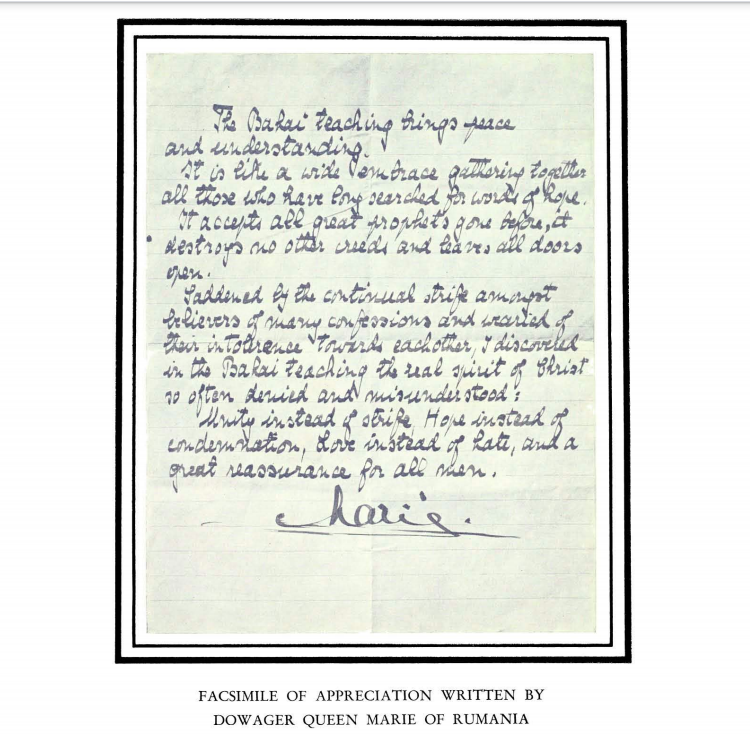
Then in the audience in Controceni Palace on February 16, 1934, when Her Majesty was told that the Romanian translation of “Bahá’u’lláh and the New Era” had just been published in Bucharest, she said she was so happy that her people were to have the blessing of reading this precious Teaching.
How beautiful she looked that afternoon—as always—for her loving eyes mirror her mighty spirit; a most unusual Queen is she, a consummate artist, a lover of beauty and wherever she is there is glory. Perhaps too, a Queen is a symbol, people like to have their Queen beautiful and certainly Queen Marie of Romania is one of the most lovely in this world today. Her clothes, designed by herself, are always a “tout ensemble” creation so harmonious in colors they seem to dress her soul. She received me in her private library where a cheerful fire glowed in the quaint, built-in fireplace; tea was served on a low table, the gold service set being wrought in flowers. There were flowers everywhere, and when she invited me into her bedroom where she went to get the photograph which I like so much, as I saw the noble, majestic proportions of this great chamber with its arched ceiling in Gothic design, I exclaimed in joy, “Your room is truly a temple, a Mashriqu’l-Adhkár!” There were low mounds of hyacinths, flowers which Bahá’u’lláh loved and mentioned often in His Writings; there was a bowl of yellow tulips upon a silken tapestry in yellow gold, a tall deep urn of fragrant white lilacs, and an immense bowl of red roses. Controceni Palace is the most beautiful palace I have seen in any country in the blending of its colors and III its artistic arrangements.
Her Majesty is a writer as well as an artist, and Her Memoirs entitled “The Story of My Life” were just then being published in “The Saturday Evening Post.” She told me she writes two hours every morning unless her time is invaded by queenly duties, charity duties, family duties. She was pleased with the sincere letters that were pouring in from all continents giving appreciations of her story. She told me the American people are so open-hearted and that from the United States children, professors, farmers’ wives and the smart people had written to her, the tone in all their letters revealing Her Majesty’s entire sincerity and the deep humanity of her character. One teacher wrote Her Majesty that in her childhood each one lived through his own childhood: another said, “All who read your story have their own lives stirred!” The Queen remarked, “And this is a very satisfactory criticism for an author.”
A most pleasing letter had just arrived from Japan from a girl there who thanked God Who had allowed her to live in a period in which such a wonderful book had been written! “This,” said the Queen, “is one of the nicest appreciations I have ever heard.”
Then the conversation turned again to the Bahá’í Teachings and she gave a greeting to be sent to Shoghi Effendi in Haifa. Later she mentioned an incident in Hamburg when she was en route to Iceland in the summer of 1933. As she passed through the street, a charming girl tossed a little note to her into the motor car. It was: “I am so happy to see you in Hamburg, because you are a Bahá’í.” Her Majesty remarked that they recognized a Bahá’í and this shows a spirit of unity in the Bahá’í Movement.
Her Majesty said to me, “In my heart I am entirely Bahá’í,” and she sent me this wonderful appreciation: “The Bahá’í Teaching brings peace to the soul and hope to the heart. To those in search of assurance the Words of the Father are as a fountain in the desert after long wandering.”
And now today, February 4, 1936, I have just had another audience with Her Majesty in Controceni Palace, in Bucharest. As I was starting to walk up the wide ivory toned stairs carpeted with blue Iranian rugs to the third floor suites, at that very moment over a radio came the rich strains of the Wedding March from “Lohengrin,” played by an orchestra. It seemed a symbol: the union of spiritual forces of the East and Europe! Again Queen Marie of Romania received me cordially in her softly lighted library, for the hour was six o’clock. She was gowned in black velvet and wore her great strands of marvelous pearls. The fire in the grate beamed a welcome with its yellow-glowing fragrant pine boughs and large bowls of yellow tulips adorned the apartment.
What a memorable visit it was! She told me she has a friend in ‘Akka, Palestine, who knows Shoghi Effendi and this friend recently has sent her pictures of ‘Akka and Haifa; the two were playfellows when they were children and met in Malta. She also told me that when she was in London she had met a Bahá’í, Lady Blomfield, who had shown her the original Message that Bahá ‘u’llah had sent to her Grandmother Queen Victoria in London. She asked the writer about the progress of the Bahá’í Movement especially in the Balkan countries.
“Since we met two years ago,” said Her Majesty, “so many sad events have happened! I look on with a great deal of sorrow at the way the different peoples seem to misunderstand one another; especially now that I have become very lonely in my home, I have all the more time to think over these problems, and I’m sometimes very sad that I can do so little. However, I know that the right spirit and the right thoughts go a long way towards that unity of hearts which I haven’t given up the hope to see before I pass on.”
She spoke, too, of several Bahá’í books, the depths of “Íqán” and especially of “Gleanings from the Writings of Bahá’u’lláh” which she said was a wonderful book! To quote her own words: “Even doubters would find a powerful strength in it, if they would read it alone and would give their souls time to expand.”
Her Majesty kindly promised to write for “Bahá’í World,” Volume VI, a special appreciation and to send it after four days.
I asked her if I could perhaps speak of the broach which historically is precious to Bahá’ís, and she replied, “Yes, you may.” Once, and it was in 1928, Her dear Majesty had given the writer a gift, a lovely and rare brooch which had been a gift to the Queen from Her Royal Relatives in Russia some years ago. It was two little wings of wrought gold and silver, set with tiny diamond chips and joined together with one large pearl. “Always you are giving gifts to others, and I am going to give you a gift from me,” said the Queen smiling, and she herself clasped it onto my dress. The wings and the pearl made it seem “Lightbearing,” Bahá’í! It was sent the same week to Chicago as a gift to the Bahá’í Temple, the Mashriqu’l-Adhkár, and at the National Bahá’í Convention which was in session that spring, a demur was made-should a gift from the Queen be sold? Should it not be kept as a souvenir of the first Queen who arose to promote the Faith of Bahá’u’lláh? -However, it was sold immediately and the money given to the Temple, for all Bahá’ís were giving to the utmost to forward this mighty structure, the first of its kind in the United States. Mr. Willard Hatch, a Bahá’í of Los Angeles, California, who bought the exquisite brooch, took it to Haifa, Palestine, in 1931 and placed it in the archives on Mt. Carmel where down the ages it will rest with the Bahá’í treasures.
Inadequate as is anyone article to portray Her Majesty Queen Marie of Romania’! splendid spiritual attitude, still these few glimpses do show that she stands strong for the highest Truth, and as an historical record they will present a little of what the first Queen did for the Faith of Bahá’u’lláh.
1.
It was only a few generations ago when the people ceased thinking that man, with the animals and plants, inhabited a world composed of “dead” matter. Life was conceived to be that which could think, feel, move or at least which could grow and reproduce.
As the notion of “life” has become extended until it includes all matter, all substance, and every ingredient and constituent of substance, so has the notion of religion developed until it applies to the whole of man. No longer is religion confined, like a small island in a great sea, to that little area of belief and practice specialized under the influence of a formal creed. It is the entire human life, its conscious and unconscious elements, its personal and social relationships, its affirmations and denials, its triumphs and defeats, its hidden as well as its revealed awareness and action, its unrealized possibility along with its recognized, admitted frustration and impotence.
The real aim of the physical sciences is fulfilled in knowledge of man. The physical and chemical principles discovered in the world have meaning only as they are principles of human life. Man himself is the universe in miniature. Physical science thus becomes part of a larger science of biology, and biological science in turn becomes a chapter in the greater volume of the human science, psychology.
A man’s whole life, and not merely his conscious creedal practice, is his religion. His highest love is conditioned by his profoundest hate; his supreme sacrifice is limited by his unconscious selfishness; his ideals and his daily life are a single reality, one and inseparable.
The social sciences likewise are dependent for their validity on human psychology. When a science calling itself “economics” gives official sanction for cruel indifference; when a science calling itself “politics” finds imperatives for armed frontiers, this lack of agreement between these social sciences and the sanctions of the separate department of human life called “religion” does not mean that men live in three separate worlds, obeying three mutually exclusive “laws” – it means simply that a general failure in the realm of motive and understanding has projected itself outward into society, and this failure men try to conceal from themselves and each other by labelling the anti-religious actions one or another “science.”
But just as these evasions and attempts at concealment in personal life sooner or later come to a balance of accounts with every other element of the personality, so the elaborate myth called “civilization” has now become rent to fragments as the social “sciences” and the formal creeds alike eventuate in a society which as a whole does not know how to survive. It matters not which element of the whole result is made the scapegoat – whether formal “religion” or “economics” or “politics” – the truth is that man himself has failed in his social relationships, and this failure in turn rests upon failure in his relationship to himself. The fictitious separation of life into formal departments, each with an exclusive label, has been an unconscious evasion of reality the final result of which was inevitable from the beginning.
On no other basis can we erect a spiritual knowledge preserving the responsibility on which integrity depends.
2.
At some definite point of experience, the conscious person comes to realize the oneness of the universe and the wholeness of human personality. His formal religious beliefs undergo profound adjustment as he perceives their artificial separateness from the rest of his existence. Able no longer to isolate “Sunday” from the remaining days of the week, his new sense of cause and effect compels him to fit his religious values into experience as a whole. This adjustment in some cases enhances the whole of life with new spiritual possibility; in other cases what had been a mere artificial belief or practise is destroyed, and life as a whole becomes secular and without spiritual content. The philosophic projection of this awareness is pantheism or atheism – both are based upon an effort to realize the universe as homogeneous, as one. The only difference between pantheism and atheism is that the former raises everything to the “high” level of God, or Spirit, or Providence while the latter reduces everything to the “low” level of matter and natural law.
The similarity between pantheism and atheism is more vital than the difference. Both philosophies establish one single level; both maintain a view of the universe which interprets experience in terms of cause and effect operating on one plane. There is little real distinction between realizing all substance as “God” and realizing all experience as subject to natural law; for both views deprive one of the necessity of making any truly vital choice.
The realization of oneness, in fact, is but a starting point in the search for religion. Religion is distinctiveness as well as universality.
Historically, religion has a definite point of origin. No religion has come into existence without a Founder, a Prophet or Messiah.
Whether one considers Christianity, Judaism, Muhammadanism or any other organic religion historically, what appears is the phenomenon of religion as an experience suddenly interposed into the current stream of human life. This interposition compels the most vital choice or decision which life can offer. It creates a new standard of reality rising like a mountain from the plain of daily intercourse. Its influence sets the individual against his own past, and historically has always made a definite cleavage in the course of civilization. The prophet becomes identified with a higher possibility in the present, which necessarily divides the future from the past. Life tends to become dynamic and assert new directions, while the past exists in the present as inertia.
3.
Religious history is meaningless when conceived merely as a time sequence without reference to the fundamental law of cycles. We take for granted the existence of this law whenever dealing with natural phenomena: the cycle of life operating for the tree from seed to fruit, for the human being from birth to death, even for the stars of immensest magnitude. But societies and social institutions seldom or never admit that for their own existence there is also an allotted period, the beginning of which is their birth, the end of which is their destruction, during the course of which they rise to a climax of maturity and power, receding thereafter until eventually they are no more. Tracing this development in Judaism we come to the civilization of Solomon, a glory that could not be retained. In Christianity we have the feudal age, when religion could he completely identified with civilization after which the Reformation destroyed the unity not only of the church but of the civilization as well. Here stands the origin of “modern” times, which actually have been the autumn and winter of faith. On one side has existed an alliance between national state, natural science, industry and militarism; on the other side the tradition of feudal aristocracy, the memory of a living unifying faith, the organization of the church.
Both phases in reality proceeded from the same prior condition. One can not be termed “Christian” and the other “pagan” or “non-Christian” with the slightest historical accuracy. For modern militarism, justified as the necessary virtue of the national state, derives immediately from the Crusades, justified as the necessary virtue of the church. The profit motive, justified as the necessary virtue of industry, derives immediately from the practice of the sale of indulgences, justified as the necessary virtue of the church. If modern science is condemned as “pagan,” a vast power delivered over to the secular realm, it must be recalled that the first faint beginnings of natural science were so resisted by the church that the scientists were compelled to develop their knowledge outside the religious community.
The Reformation, then, merely marks the point at which the historical religion has reaped its harvest, produced its richest fruit; and consequently could no longer maintain its internal unity nor its balance between religion and civilization.
The law of cycles operates in the case of religions and nations no less imperatively than in the case of trees, animals, planets and human beings. This law may for a time appear inoperative where the larger social bodies are concerned, but this is merely for the reason that man has yet attained no adequate sense of historical process, and also because even after a great social institution has died spiritually it can still survive physically for a relatively long period. But when a religion ceases to be the motive and inspiration of civilization, its date of death is recorded in the annals of destiny. And once this spiritual death has taken place, the religion can never be artificially revived.
The “modern” world, striving to transform nationalism into world order, overcome the antagonism of economic classes and reconcile peoples and creeds, is nothing else than a larger example of ancient Rome striving to maintain order, justice and law after its original impulse had ebbed and the creative power had passed from the imperial government to the weak, despised and minority body of Christians, reborn by the mystery of superhuman faith. Our social institutions are more powerful to destroy than to create; no matter how conscientiously administered, without transformation they are vessels not built to outride this time of worldwide storm.
4.
When the creative power of spirit is withdrawn from the community as a whole, and the parts of the community engage in mutual struggle for predominance or survival, the life cycle of that social order has run its course.
Such is the nature of the present crisis. The old order was based historically upon Christianity in the West, upon Muhammanadism and other Faiths in the East. Each Faith had, in accordance with the principle underlying human society, developed a characteristic civilization representing a balance between legal, cultural, economic and social factors. All these regional civilizations had arrived at that stage in the cyclic process marked by the weakening of the original religious impulse, which bound the civilization together in one organism, and by the assertion of the superiority of the constituent parts over the whole.
As in Christianity a few centuries ago, so in Muhammadanism today, law, government, education and industry have thrown off the control of the religious tradition and undergone separate development, each seeking a fulfilment in terms of its own independent need and without reference to the general need of the community in its spiritual as well as material integrity. This development is more complete in the West, but the history of Europe since the Reformation has been paralleled in all essentials by the more recent experience of Turkey, Egypt and Iran.
The crucial point in this development is the transfer of social authority from a religious organization, by which it has been fatally abused, to a secular organisation explicitly claiming to be unmoral. At the stage of religious decay where this transfer of authority takes place, the secular government cannot control the entire area previously controlled by the religious influence. The transfer is characterized by the rise of several independent secular governments which divide the body of believers into separate, and potentially competitive nations. Western nationality arose from the spiritual death of Christendom, and the nations of Islam are similarly independent and exclusive.
The next step in the process, which in reality is disintegration and not “progress” except in a local and temporary degree, consists in the reinforcement of the secular (unmoral) authority by such laws and instruments as it deems necessary to protect itself in the rapidly augmenting struggle for national existence. Religion is replaced by patriotism of an exclusive nature, and the social duty of man becomes defense of his national state. Militarism inevitably develops. Compulsory military duty, found necessary as economic rivalry follows the original territorial competition of the states, sets mankind upon the path of death. In the modern world this complete divorce between spiritual and material values, enmeshing human life in a fatal net as economic and social existence come to depend upon struggle and competition rather than upon unity and cooperation, establishes a point of crisis imperilling the race. Authority, power and initiative throughout society are identified with unmoral institutions whose fiat controls a system of destruction well-nigh universal in capacity. On the other hand, the spiritual tradition of each race has become sterile, for ecclesiasticism is the negation of faith.
Such a jungle of competitive nationalism seems to reproduce, in terms of social organizations, the era of the pre-historic monsters marking an early stage in the biological evolution of the world of nature. Forms of life organized almost entirely for offense and defense had little available energy for the kind of response required in a changing world. Evolution left them behind. Their towering strength was their fatal weakness, and in their enormous aggressiveness they had no capacity to survive.
In the same way, the present stage of armed, competitive nationalism is essentially transitory and fugitive. The more aggressive it becomes, the less its capacity to meet social problems the only solution of which is non-aggression – cooperation. The states have waxed powerful upon the poverty of the people; their might is an illusion. They can destroy themselves by one final outburst of general war; or a series of revolutions, each perhaps small and almost unnoted, will evolve from them a type of government intelligent enough to deal with social relationships and moral enough to summon the highest and not the lowest impulses of an evolving race.
The key to future social evolution lies in the capacity for transformation rather than in mere progress and extension along the lines fixed by our prior history. For progress is the law of the cycle, but transformation is the sign that a cycle has run its term and a new age has dawned.
It is evolutionary progress when a form of life becomes larger, or fleeter by adaptation to its environment. This type of progress marks the biological world, where the natural environment is fundamentally constant. Likewise, when the social environment remains fundamentally constant, an institution progresses by growth in ways determined by its original character and aim.
Unlike nature, the social environment is subject to profound alteration. The development of machine production was more than progress from a small tool to a larger tool; it brought about an entirely different kind of society. Action and re-action in an industrialized society are not simply enlargement of the action and re-action of an agricultural, hand-craft society – they respond in quality to a different law. The plane has been raised from physical effort to intelligence.
As long as the simple law of progress applies to human society, the evil will be multiplied along with the good, the destruction will augment by the same ratio as the construction.
The symbol of transformation in the natural world is the organism like the butterfly, which at one stage is an egg, at the next stage is a caterpillar, becomes then a chrysalis in its cocoon, thence emerging as imago, the perfect insect with beautifully coloured wings. Applying the law of simple progress to this organism at any preliminary stage, we would have merely a larger egg, or a greater caterpillar or a larger and stronger cocoon. Metamorphosis is the scientific equivalent of that organic change which takes place in human society at those critical stages marked by the cycles of religion.
It is by no means necessary to contemplate a simple extension into the future of the social agencies dominating this transitional era. The progress of national government into empire is strictly limited by inter-state competition, and the progress of religion into the condition of world empire by any one creed is no less impossible.
5.
The impermanence of the several civilizations now existing becomes clear when we give attention to the non-social character of the religions from which they separately sprang.
In the saying, “Give unto Caesar” we are compelled to note that the Founder of Christianity limited His spiritual teaching to persons, to individuals, and refrained from extending that teaching to establish a principle for society. The character and scope of the Christian teaching, at its source, clearly contemplated an era during which individuals were to cultivate a spiritual life, purifying their inner motives and assuming responsibility for their deeds, in contrast to and complete disregard of their social institutions. They were to seek a Kingdom in the realm of the awakened and conscious soul, but the world was Caesar’s and the successors of Caesar.
Moreover, that doctrine, at its source, does not fail to include a social principle alone: it is in essence a doctrine of the “heart” and makes no provision for the life of the mind. It justifies no particular social form, creates a basis for no particular type of social institution, and in nowise explains those aspects of life and the universe which constitute the ends of psychology and philosophy. It renewed man’s inner life, it revealed more fully than ever before the nature of God and the spiritual capacity of human beings; it released a quality of personal relationships on the high plane required to maintain the new vision of the sanctity of life; but Christianity, at its source and in its reality, supports no political principle, sustains no economic theory, outlines no cosmogony, throws no light upon man’s relation to the physical universe, and sanctions no conception of the function of mind.
These organic limitations, posed not by absence of power at the Source but by lack of capacity in the environment and age, mark a cycle whose term was set at its beginning. It signalizes one necessary stage in the evolution of religion, or rather in the upward march of conscious human life, but finality is entirely absent, because the requisite foundation in revealed truth for the wholeness of life was not spiritually established. Unlike a scientific formula, religious truth does not continue indefinitely and independent of the way it is applied. While a chemical action can be employed for good or evil ends with equal efficiency, a spiritual truth, to possess validity, must include the vital element represented by the believer’s quality of response. When the quality of response has fallen below the level of the aim implied in the truth, the truth becomes void of influence. The living impulse sent forth from its Source has been expended; what remains is a form of words, a lifeless symbol, a ceremony possessing psychic but not spiritual effect.
Civilization is the outworking of spiritual faith. That faith inspires fresh courage, removes the barriers of personality and groups, stimulates the mind to solve necessary problems from the point of view of the society as a whole, establishes a foundation of human reality raised above the bestial struggle for existence, and enables mankind to take one more forward step in its progress upon the eternal path.
There is, however, no historical permanence for any civilization equivalent to the universality of revelation upon the plane of soul. Until mankind is united within one true faith and within one order of justice and knowledge, the need of the renewal and enlargement of spiritual truth is manifest to all.
6.
The external surface of human life, as recorded by sympathetic observers in every country, has become marked by appalling personal misery. Its innumerable details constitute a catalog which oppresses the heart like a Book of Doom. By war, by influenza, by poverty and by revolution a vast number of people have been reduced to a narrow margin of existence we thought had been left behind with the memories of the stone age before history began.
But this external surface does not reflect the entire content of modern life. The observer who concentrates all his attention upon the evidences of misfortune and suffering must be balanced by those who look with equal clarity beneath physical evidence to the inner surface and the foundations upon which human life is established. The world of the mind is rich with infinite possibilities, in tragic contrast to the poverty of the world of the body.
From the world of truth, as from an inexhaustible mine, we have derived truly miraculous reinforcement for the feeble body in its eternal struggle against the environment of nature. No longer need human aspiration and will be limited in fulfillment by the inadequate tool of hand and arm, directed by the inaccurate and incomplete guidance of the five physical senses. Mechanisms as sensitive as thought itself, as powerful as human ambition requires, stand as servants ready to carry out any material command. However far imagination may fly ahead, it can reach no ultimate limit beyond which the creative thought of the race dare not go.
But these two worlds, the world of body and the world of mind, though man lives native in both, appear to co-exist independently, in a relationship which is a separation no less than it is a contact. The scientist’s achievement in the form of truth has no human equivalent in the form of social security. The inventor’s technic has complicated existence but multiplied poverty. The world of truth is the modern Tantalus cup, offering what life cannot receive, even while it is likened to the slave of the lamp, fulfilling every command.
Social systems and programs devised during the last hundred years have one and all been efforts to confirm the contact and overcome the separation between the world of truth and the world of human experience. They have sought to mediate between the possibility of mind and the actuality of social need. What thought has accomplished in efficiency of mechanism it has endeavored to duplicate in efficiency of human relations. But every system and program combining the possibility of scientific truth with the social ingredient of human nature has produced not order but an increase of conflict. What appears perfectly fused in the crucible of abstract speculation reasserts its duality when put to the test of life. Socialism, communism, capitalism fundamentalist or reformed—all these systems alike—are unmistakably incapable of reconciling and blending the worlds of body and mind, the truths of science and society. The more that arbitrary power is applied to compel their acceptance as programs, the more explosive becomes the reaction of the human nature coerced in the name of efficiency and truth. Ours is not the first civilization to be brought to an end by mental capacity devoid of spiritual truth.
The unescapable historic fact is that the mediator between universe and humanity, the link between the world of truth and the world of social experience, has never been the speculative mind but the Prophet. The mind discovers only that which it seeks; its voyages of exploration bring back only that reality which can be confined in the small cage of material reason. The universe is not such captive truth, such mastered knowledge. The universe is the Will above and beyond man’s physical will; that Will by which man must become and not merely possess, by which man must serve and not merely enslave to himself. The life and words of a Moses, a Jesus, a Muhammad, by the spirit inspiring them are truth. Within that truth, since it contains man and is not merely man’s exploitation of what he contains, the life of the race is secure and progressive. Outside that truth, human existence moves ever toward destruction; for the Prophet is truth in that form in which it applies to the life of mankind.
By each Prophet is established a new civilization, because each Prophet establishes a spiritual world for the soul not less real than the nature which is the world of the body. The modern age, in all its social relationships, lies outside the spiritual world. Hence its agony, its frustration physical and mental, the degradation of an unrepentant Prodigal Son.
7.
Never has there been such a time of sincere, whole-hearted searching for a foundation grounded not upon secondary, temporary historical events and developments but upon the nature of the universe itself.
This age, in its spirit, feels nearer to the ancient Prophets than has any generation since the first generation of believers laid down their lives that the divine Cause might prevail. Not in Christendom alone, but in the other existing civilizations, the appeal to the pure manifestation of love and wisdom, the racial Prophet, has become for many the last refuge of hope that human life can endure, can be meaningful and blessed upon this troubled earth.
Between themselves and that radiant Source of hope they feel the long centuries of strife and ignorance fading to the unreality of a frantic dream. Let mankind, they cry from the depths of their souls, let mankind make a new beginning; let life rest upon the sure foundation of the Divine will; let us become transformed, renewed with a new spirit, and in that spirit proceed to transform all things which are in denial of or in conflict with that eternal will. The nations hurry to destruction, they lament, when vision perishes. From this undying flame let our hearts and minds be kindled with the fire of love.
As the crisis persists, this call, feeble at first, becomes louder and more assured. First a personal attitude, then a social movement, gathering force and momentum, the going back to the Prophet now represents a mighty psychological crusade paralleling the physical crusades of medieval times.
To what degree can this movement be fulfilled?
The Prophet himself made a fundamental condition, that those who sought to follow him should abandon their goods, their wealth, and walk in his path. This was said to a rich man’s son, but does it not apply likewise to those who have inherited goods and wealth in the realm of mind? Does it not mean that those who seek to return today must abandon their acquired culture, their traditional philosophy, their ecclesiastical institutions, their rites and ceremonies, their pomp of church and churchly power? Either it means this, or it means nothing at all, for the Prophet was not slain by the materially rich of his day, he was slain by order of the established church.
For Christendom, surely, the sincerity of all effort to establish life upon Divine rather than upon human will must be tested by conformity to the conditions its own Prophet laid down. When the churches voluntarily disband, and people of all denominations and sects seek the Prophet upon absolutely equal terms, then, and then alone, will this psychological crusade reach the Holy Land. As long as certain individual believers alone fulfil this test, the movement will not affect the vital problems of civilization but remain in the limited realm of personal experience. It may produce a beautiful literature; it will not carry civilization outside its captivity to the lords of war.
There is also, it would appear, another essential condition to be met in this poignant appeal from the world to God: the recognition that other races likewise had their Prophets, their revelations of the Divine will. For without such recognition, the crusade goes hostile and armed, a challenge to battle and not a conquest of universal peace. These two conditions—at root one condition seen in two different aspects—may fairly be said to be so difficult of realization as to be highly improbable, if not impossible, at least without one single precedent in human history. Rivers flow downhill; and the water once descended from its spring does not return.
8.
A contemporary historian remarks that the old world has died, but a new world has not yet been born. This view is no doubt the expression of an attitude which has come to prevail among many thoughtful people over a wide social area. It perceives that the foundation of the civilization existing prior to the European War cannot be rebuilt; it realizes to the full the present instability of conditions and the lack of agreement among aims and programs; it frankly admits that the future, both in general trend and in outline, is concealed from the rational mind. Its clarity of analysis of the past is matched by its incapacity for synthesis directed toward the future.
What emerges from consideration of this frank and sincere assertion is awareness of the artificial limitation assumed by the rational intelligence in dealing with the process of human history. By the phrase “old world” and “new world” it means civilization as formal institutions and established habits, and thereby overlooks the significant fact that civilization is an effect and not primarily a cause.
For civilization, long before it emerges in formal institutions, exists as an aspiration of the heart, as an ideal to be pursued and fulfilled by every faculty of mind and soul. It is only when human aspiration and ideal, shared by a considerable group or community, has gathered force and thrust through to the plane of social action, that civilization actually begins. Without this preliminary period of spiritual action, no civilization has ever become manifest. That period is to the later formal institutions and habits and doctrines as the root to the visible tree. Though the entire tree is potentially present in the seed, the great trunk and the widespread branches are contingent upon a period of prior and invisible growth within the soil.
To complete the thoughtful statement uttered by the historian, it is necessary to seek for the future “world” not in different programs and expedients adopted by the institutions of the dead “world” but in evidences of a spiritual life intense enough, universal enough, to establish within humanity that inner power required to raise the trunk and spread forth the branches of a tree whose fruit shall be universal peace.
World order, it is clear, represents a goal which includes the reconciliation of two values or ideals: the spiritual value of human brotherhood, and the social value of a united, an organic civilization. Without a firm and enduring basis in moral unity, the institutions of society, no matter how far extended, cannot alone produce peace but will remain as centers of disunity and strife. On the other hand, those instinctive anarchists who preach a “brotherhood” conceived as absence of governmental institutions are naïve and immature. Society without institutions would be a body without vital organs capable of expressing its various capacities and maintaining its existence.
These two values—humanity and civilization—have never been reconciled and united within the brief historic period known to the present age. We have had races but not mankind, cultures but not spiritual knowledge, nations but not civilization, and religions but not a brotherhood embracing the earth. We therefore approach the vital problem of world peace without experience of what world peace really is. World order—the goal of human evolution—cannot rightly be conceived as a mere truce or treaty between groups or institutions each born of past strife and discord, each cherishing a secret or avowed superiority and each committed to an ideal of sovereignty incompatible with the needs of permanent peace. Nor can world order be effectively upheld on terms of “non-cooperation” with existing agencies responsible for the little public order which now remains. Peace does not consist in abhorrence of war but in maintaining a steadfast conviction that the end of faith is human unity and the fulfilment of intelligence is a new social form, worldwide in scope and superior to the local forms which can no longer protect mankind and serve its highest interests.
In addition to a political world order, the attainment of universal peace involves:
- The harmony and cooperation of races.
- The unity of religions in a world faith.
- An economic world order in which capital and labor are conjoined in a relationship of partners and not competitors.
- Compulsory education throughout the world, and an education grounded in universal ethics and adapted so as to prepare every child for a useful trade, art or profession.
- A universal secondary language.
Compared to these organic aims, the peace efforts aimed at occasional details such as reduction of armaments or the signing of new treaties are insignificant. The character of this age is wholly new. It is charged with a spirit of transformation superficially violent but in reality constructive. The whole problem of world order consists in attaining an attitude of reverence and humility to that creative spirit.
The principles briefly stated here were promulgated more than twenty years ago by ‘Abdu’l-Bahá, in whom the spirit of the age found its most faithful interpreter and its noblest exemplar. He declared that humanity is entering upon its period of maturity, when powers will be given the world to achieve an organic unity never possible in any previous age. But ‘Abdu’l-Bahá made the enjoyment of these powers conditional upon purity of motive and acceptance of the oneness of mankind. Not for the people of prejudice and division, not for the organized selfishness of the rich nor the organized envy of the poor, but for those who have become truly human the day of universal peace has dawned. The way backward has become a door that is forever closed. Revolutions and wars bring no lasting fruit; arbitrary social laws, divorced from human values, bring no true security nor repose. The world needs a central point of inspiration raised above the clamors of history, a divine element, to supply a foundation for the latent unity within all people of good will.
The foundations of all the divine religions are peace and agreement, but misunderstandings and ignorance have developed. If these are caused to disappear you will see that all the religious agencies will work for peace and promulgate the oneness of humankind. For the foundation of all is reality, and reality is not multiple or divisible. His Holiness Moses founded it, His Holiness Jesus raised its tent, and its brilliant light has shone forth in all the regions. His Holiness Bahá’u’lláh proclaimed this one reality and spread the message of the ‘Most Great Peace.’1https://www.bahai.org/library/authoritative-texts/abdul-baha/promulgation-universal-peace/8#380056591
Bahá’u’lláh revealed a sublime vision of human history as an epic written by the finger of God and proceeding along an ordered course to a climax, the nature of which was exactly defined before the story opened and the appearance of which at the date ordained by the Author no human misunderstanding nor opposition could prevent or postpone.
He taught that human history throughout its entire length was an intelligible and connected whole, centring round a single theme and developing a common purpose. From the beginning of the cycle to the present day and beyond the present to the cycle’s distant end, one master-scheme is by set degrees disclosed. The stage upon which the action moves forward is the entire globe, with all its continents and all its seas; and there is no race nor nation nor tribe nor even individual who has not a designated place in the unfolding of the Grand Design of God.
This doctrine of the unity of world-history held in the revelation of Bahá’u’lláh a position of cardinal importance. He was far from being the first among the Messengers of God to reveal it. Those “prophets which have been since the beginning of the world” and lesser seers as well as they have given glimpses of it to mankind, or have referred to it in symbol and in parable. It is indeed involved in all the historic faiths of the human race, and there is no world-religion extant which can be fully understood without a knowledge of its truth. But Bahá’u’lláh was the first to lay on it so great an emphasis and to expound it at large and in plain terms. On it depends the significance of his own advent and the timeliness of his humanitarian reforms; and on it turns his teaching as to the aims and methods of Providence in its dealings with mankind.
This scheme is carried out by the power of God’s will and it has its origin in his desire for the well-being of his creatures. Its aim is the training of the peoples of the world to live and to work together in harmony, and to establish by God’s particular assistance a universal civilisation in which all the human faculties shall find at last adequate and complete expression. The attainment of this goal is in the Divine Author’s eyes the opening of the main movement of human history. All previous and earlier events are in the nature of an introduction. They are steps up a long ascent, causes of a desired result. However important they be, their meaning lies not wholly in themselves, but in the fact that they look and lead forward to a transcendent issue save for which they themselves would never have been called into existence.
Secular schools of thought cannot be said to have applied nor adopted any such broad conception of the integral unity of all human history. In past times, truths so large did not find easy entrance into the minds of men. So long as accurate knowledge of distant peoples was as hard to gain as accurate knowledge of past events, such doctrines would remain for scholars disembodied and unsubstantiated ideas. Today, histories of mankind on a comprehensive scale have become numerous; yet those of them which present the complete story as having an organic plot like a well-constructed epic, are probably few indeed.
In the sphere of religion, however, the case is different. The idea that the course of human events is directed by a stronger will and a clearer eye than man’s to a predetermined end is found in more revelations than one. It is said to have been mentioned by the founders of all the world-religions. Though it has not been in any past age of such critical interest as it is today and has not before been treated so fully as now by Bahá’u’lláh, yet it has never been kept wholly concealed from man. There are references to it in scripture or tradition which are clear enough to show that this truth is part of the common religious knowledge of mankind while slight enough to prove that it did not hold in any High Prophet’s teaching the same importance as in that of Bahá’u’lláh.
The general fact that God ordains human events long ages before they take shape on this earth (somewhat as a dramatist will complete his play before it is embodied in action on the stage), was alluded to by Jesus when He said of the righteous in the Last Day, “Enter into the joy prepared for you by the Father before the beginning of the world”; and again on many occasions by the Apostle Paul, as, “He chose us in him before the foundation of the world” (Eph. i. 4), and by Peter who speaks in a similar connection of “the foreknowledge of God the Father” (I Peter i. 2).
Muhammad bore the same witness when he revealed that the first thing which God created was a pen and that he said to it, “Write.” It said to him, “What shall I write?” and God said, “Write down the quantity of every separate thing to be created.” And it wrote all that was and all that will be to eternity.
More specifically, Zarathustra taught the gradual perfecting of mankind under divine law and the God-guided progress of history towards a distant but certain culmination.
At some unknown date the Hebrew allegory of the creation of the world in seven days made a cryptic allusion to the procession of world-religions and to the final consummation of God’s full purpose in the Seventh Day, the day of maturity, completion and rest. The seers of the Hebrew people, lifted by inspiration into the eternal realm, would descry some sign or feature of the far-off Day of God, the foreordained climacteric of world-history, and in a mood of exaltation would give utterance to their predictive vision without fully comprehending what they saw or measuring the interval which separated them from its fulfilment.
Isaiah cries:
It shall come to pass in the last days that the Mountain of the Lord’s House shall be established in the top of the mountains . . . and all nations shall flow to it. They shall beat their swords into ploughshares and their spears into pruning hooks; nation shall not lift up sword against nation, neither shall they learn war any more.1(i. 2, 4)
Or Zechariah:
The Day of the Lord cometh. . . . And the Lord shall be king over all the earth; in that day shall there be one Lord and His name one.2(Zech. xiv. 1, 9).
Or again Joel:
The Day of the Lord cometh . . . there hath not been ever the like, neither shall there be any more after it even to the years of many generations. . . . Ye shall eat in plenty and be satisfied and praise the name of the Lord that hath dealt wondrously with you . . . ! I will pour out my spirit and your sons and your daughters shall prophesy . . . your old men shall dream dreams . . . your young men shall see visions. And also upon the servants and the handmaids in those days will I pour out my spirit. And I will show wonders in the heaven and on the earth. The sun shall be turned into darkness and the moon into blood before the great and the terrible Day of the Lord come. And whosoever shall call on the name of the Lord shall be saved.3(Joel ch. 2)
Confucius, more than five centuries before Christ, outlined in his book, Spring and Autumn, the ordained Plan of History in brief but plain terms.
He divided history into three stages. In the first, which he called the Stage of Disorder, the social mind was very crude; there was a sharp distinction between one’s own country and other countries, and hence attention was paid more to conditions at home than abroad. In the second stage, the Advancement of Peace, there was a distinction between civilized countries on the one side and those uncivilized on the other; the range of civilization extended and friendship between nations became closer. The smaller people could make their voices heard. In the third and final stage, the Supreme Peace, there was no distinction at all among the nations of the world. All became civilized and met upon the level. Righteousness prevailed and the world was unified.
Jesus spoke much of the Last Day (the Kingdom of God as He usually called it) and of its near approach. “The Kingdom of Heaven is at hand.” He did not stress, as Confucius had done, the historical aspect of the coming climacteric, but taking up the warnings of the Hebrew prophets He spoke of the unexpectedness of its advent and of the terrible jeopardy into which it would bring mankind. Even in an age so late in history as His, a full account of the development and destiny of the race would have been premature. He kept the fullness of this truth among those things which He had to say to His disciples, but which at that stage they could not yet bear.
But now a new occasion has arisen. New opportunities, new problems, new perils, confront mankind; and with these new conditions has come the need of a new knowledge. He who, before the human race began, fixed the date at which that yet untreated race would reach the apex of its course and attain the maturity of its powers, has now declared that the Date has come. He who, in dim and distant ages long past, solemnly ratified with His people a Covenant and made to them a faithful promise that He would bring them all to His Kingdom in His own good time, has now in this epoch kept His ancient promise and fulfilled the Covenant in its completeness.
This present time is God’s Good time. This present time is the Era of which since the beginning of the world prophets have chanted and seers have sung. Suddenly—unexpectedly—unawares—without observation (exactly as Jesus said) the fullness of the Glory of God has irradiated the globe from the east to the farthest west. The Day of the Lord has dawned. Keeping his pledge, God has thrown open to men a new domain of life and activity, has conferred on them new powers, laid on them new responsibilities; and he demands that they enter as quickly as may he into this new order of existence and fit themselves to these higher conditions.
The nature of those charges which in the Day of God are to be laid upon mankind can be gathered from a sympathetic reading of the prophets of Israel. Those seers wrote—as a great poet might write—with their minds turned towards God and their hearts lighted and warmed by ardent faith. They could not control the vision that was vouchsafed them: they could not complete it nor set it in its own environment and perspective, nor plumb its meanings nor yet count the years which should elapse before it descended from the realm in which they saw it to the realm of actuality. When the prophets are read in this spirit as Jesus and the evangelists read them, there rises into view a clear and boldly sketched outline of those world-developments which from the creation have been laid up to await the present hour.
The picture is one which has puzzled, fascinated and awed the Christian mind. The impression made by the vision upon the seer-prophets was profound. They write or chant in a strain of exaltation which finds its answer across the years in the rapturous faith of the Apocalypse and the controlled but not less deep emotion of the Christ telling of his second Advent. The strange scenes and deeds and wonders that appear in the picture are hardly more startling than the violent contrast of the colors in which they are painted. Here Hell seems to reach out to the gates of Paradise; delusion and enlightenment, despair and victory, the unlighted Pit and the sunshine of God’s own presence seem all to have a place here, and through some purgation of Phlegethonian misery man hardly comes alive to inherit the promise of all ages.
The Event which the Hebrew prophets foresaw was not to be an isolated occurrence; it was one of a series of events; it was the Last Day of many days. But it so transcended all before it as to be outstanding and paramount. Its splendour outshone all previous splendours, and its blessings were so far above all previous experience and precedent that men would live in a new world and would not even remember the former things that had passed so utterly away. So full will be the Revelation vouchsafed by God in the Last Day, so glorious the effulgence of this supreme Theophany that darkness and error will not be able to withstand the impact of its might. They will flee and perish. The radiance will sweep across the entire globe from the east to the west. It will settle and abide in every land. Mankind will become one, and will be organised round a single central authority which it will recognise as divinely appointed. One law will run throughout the whole earth. National distinctions will not be obliterated; the various nations will meet upon a common level but will retain their separate identity. All peoples and races will share a common relation to one another. A Universal religion will unite the hearts of all. Mankind will form a single congregation, their God being recognised everywhere as one and the same God endowed with the same attributes and known by the same Name. The Glory of the Most High in its depth and in its height will be poured forth over the earth; and spiritual gifts, once the privilege of a gifted few, will be possessed by the many. War will be abandoned. The skill of those who made weapons of destruction will be turned to beneficent uses. All the world over, men will be able to enjoy their homes and their prosperity in security and peace.4See, for instance, Isaiah ii. 2-4; xv. 17- 25; Zech. ix. 10; xiv. 9; viii, 20 ff.; Zeph. iii. 9; Micah iv. 1-5, etc.
Such is the prophets’ picture of the world conditions of the Last Day; such—believe the Bahá’ís—are the changes which man in this hour is called upon to make.
Prescient of the crisis and the difficulties that lay ahead, Bahá’u’lláh, half a century ago, with timely forethought, offered to mankind the knowledge that would enable them to shoulder the new responsibility about to be imposed upon them. He not only outlined a large plan of reform, but he explained, with an emphasis, a fullness, and a precision not used before, the brotherhood of mankind and the unity of their development from the infancy of the race to the present time.
History, he taught, is in its length and breadth one and single. It is one in its structure. It is one in its movement. From the beginning of time the whole human race has been subject to one law of development; and it has advanced age after age in accordance with one and the same principle and by the application of one and the same method. Its whole movement has one source and one cause, and is directed towards one goal. The unification of the world, instead of being an afterthought, or of needing an improvised miracle for its completion, is the normal conclusion of a process that has been going on since the race began. Each of the world-religions has its own set place within this vast economy. Each is mediated through a Master Prophet from God by one and the same principle and bears witness to some phase of one indivisible Truth. No religion has been exhaustive or final. Every one admits of development and invites it. If all were under God thus developed, each along the line of its own implicit truth, they would not move farther and farther apart, but on the contrary would approach one another till at last they merged and became one. The ultimate ideal of them all, while not the same as any one of those from which it grew, will yet be consistent with the essence of each of them. It is the universal religion: the fruit and the perfection of all that preceded it. He who accepts it on its appearance will not deny the ancient Faith of his forefathers; he will reassert it, and at the same time will accept all the other revealed faiths of mankind.
When all men know the certainty of their common history and their organic unity, then, said Bahá’u’lláh, on that knowledge will be built the temple of peace and the fabric of future civilisation.
Here the world’s religions meet and are fused into one by the fire of a great love. “This is that which hath descended from the realm of glory, uttered by the tongue of power and might, and revealed unto the prophets of old. We have taken the inner essence thereof and clothed it in the garment of brevity.”
In an age of compendiums there is no other compendium such as this. No other pen has attempted to make a summary which shall be so concise and so complete as to contain in less than eight score brief Words of Counsel the vital substance of the world-religions. In the newly printed version of Shoghi Effendi, the “Hidden Words” makes a small pocket volume of fifty-five pages.
Yet for all its terseness it bears none of the marks of a digest or an abstract. It has the sweep, the force, the freshness of an original work. It is rich with imagery, laden with thought, throbbing with emotion. Even at the remove of a translation one feels the strength and majesty of the style and marvels at the character of a writing which combines so warm and tender a loving kindness with such dignity and elevation.
The teaching of the book throughout is borne up as if on wings by the most intense and steadfast spirituality. With the first utterance the reader is caught away to the heavenly places, and the vision is not obscured when the precepts given deal with the details of workaday life, with the duty of following a craft or a profession and of earning a livelihood to spend on one’s kindred for the love of God. The picture given of man and of human nature is noble and exalted. If he be in appearance a “pillar of dust,” a “fleeting shadow” yet he is in his true being a “child of the divine, and invisible essence,” a “companion of God’s Throne.” The created worlds are designed for his training. The purpose of all religious teaching is to make him worthy of the love of God and able to receive his bounties.
The “Hidden Words” is a love-song. It has for its background the romance of all the ages—the Love of God and Man, of the Creator and His creature. Its theme is God’s faithfulness and the unfaithfulness of Man. It tells of the Great Beloved Who separates from Himself His creatures that through the power of the Spirit breathed in them they may of their own will find their way to that reunion with Him which is their paradise and their eternal home. It tells how they turned away to phantoms of their own devising, how He ever with unwearying love sought them and would not leave them to the ruin they invoked but called them back that they might enter yet the unshut gates of heaven. Only the final event of the love-story is lacking. God calls, and when His utterance is complete He pauses that man may answer, and waits—listening.
Love is the cause of creation: it is the Beginning, the End and the Way. God, as yet a Hidden Treasure, knew His love for man, drew him out of the wastes of nothingness, printed on him His Own image and revealed to him His beauty. Apart from God man has nothing and is nothing; but in union with God he possesses all things. God ordained for his training every atom in the universe and the essence of all created things. He is the dominion of God and will not perish: the light of God which will never be put out; the glory of God which fades not, the robe of God which wears not out. Wrought out of the clay of love and of the essence of knowledge he is created rich and noble. He is indeed the lamp of God, and the Light of Lights is in him. He is God’s stronghold and God’s love is in him. His heart is God’s home; his spirit the place of God’s revelation. Would he sanctify his soul, he could look back beyond the gates of birth and recall the eternal command and antenatal covenant of God. Would he but look within himself, he would see there God standing powerful, mighty and supreme.
Alas! in the proud illusion of his separateness, man has forgotten whence he came, and what he is, and whither he moves. He has turned away from his True Beloved and given his heart to a stranger and an enemy. Bound fast in the prison of self, dreading that death which might be to him the messenger of joy he has rejected the immortal wine of wisdom for the poor dregs of an earthly cup and has given up eternal dominion that he might revel for an hour in the lordship of a passing world.
So blinded by arrogance and rebellion have mankind become that they live well content amid these sterile imaginings. They are no longer able to tell Truth from error nor to recognize it when it stands before them in naked purity. Thought they enter the presence of the All-Glorious; thought the Manifestation of Him Whom they affect to seek is before them and the Face of the Mighty One in all its beauty looks into their face, yet are they blind and see not. Their eyes behold not their Beloved; their hands touch not the hem of His robe. Though every utterance of His contains a thousand and a thousand mysteries, none understands, none heeds. He made the human heart to be His dwelling place; but it is given to another. Among His own on earth He is homeless. Nay more, His own heap on him persecutions. The dove of holiness is imprisoned in the claws of owls. The everlasting candle is beset by the blasts of earth. The world’s darkness gathers about the Celestial Youth. The people of tyranny wrong Love’s King of Kings. The angels weep at the spectacle; lamentation fills the heaven of heavens; but men glory in their shame and esteem their impiety a sign of their loyalty to God’s cause.
In His mercy and compassion, God leaves them not to self-destruction. Sternly but lovingly He upbraids them, He warns them. He summons them from the couch of heedlessness to the field of endeavor and heroic adventure. He demands of them a faith and courage that will dare the utmost in His service, a fortitude that will endure serenely every calamity, a devotion that will rejoice in tribulation and in death itself for the Beloved’s sake.
He gives them counsel upon counsel. With definiteness and force He shows what God expects of His lovers. The toils and perils of the Homeward Way are many and grievous; but true love will overcome them all and be grateful for afflictions through which it can prove its strength. None can set out upon this journey unless his heart is single and his affections are centered without reserve on God. If he would see God’s beauty he must be blind to all other beauty. If he would hear God’s word, he must stop his ear to all else. If he would attain to the knowledge of God he must put aside all other learning. If he would love God he will turn away from himself; if he would seek God’s pleasure he will forget his own. So complete will be his devotion that he will yield up all for the dear sake of God and welcome with longing the martyr’s death.
Earth has a thousand ties to bind men from their God: envy, pride, indolence, ambition, covetousness, the habit of detraction, the ascription to others of what one would not like to have ascribed to oneself. Against such things as these He warns all who wish to reach the bourne of Love, bids them keep ever before them the rule of Justice (“the best beloved of all things God’s sight”), and every day to bring themselves to account ere the opportunities given here on earth are snatched from them for ever by the hand of death.
He reminds them of the treasures He has laid up for those who are faithful to the end. Upon the sacred tree of glory He has hung the fairest fruits and has prepared everlasting rest in the garden of eternal delight. Sweet is that holy ecstasy, glorious that domain. Imperishable sovereignty awaits them there, and in the joy of reunion they will mirror forth the beauty of God Himself and become the revelation of His immortal splendor.
Now in this age, He declares, yet greater rewards and ampler powers are vouchsafed to mankind than in time gone by. God’s favor is complete, His proof manifest, His evidence established. He has opened in the heavenly heights a new garden, a new degree of nearness to God. Whoso attains thereto, for him the flowers of that garden will breathe the sweet mysteries of love, for him its fruits will yield the secrets of divine and consummate wisdom.
Yet even in this great day of revelation the fulness of God’s ultimate being has not been uttered. So much has been said as the will of the Most High permits: and no more. What has been set forth is measured by man’s capacity to understand it. God’s true estate and the sweetness of His voice remain undivulged.
How strange and pitiful that in the East the warmth of heart and breadth of mind of him who wrote this little book should have brought on him the relentless hate of the priests of his land. Born the heir of an ancient and noble family of Persia and endowed with vast wealth, he was through priestly envy deprived of all his possessions, driven into exile, chained, tortured and at last consigned to a life-imprisonment in the city of ‘Akká, a gaol reserved for the lowest criminals of the Ottoman Empire and reputed so pestilential that the birds of the air fell dead as they flew over it.
Strange, too, that this devotional volume, so beautiful in its thought and also (it is said) in the classic purity of its style, should never have drawn to itself the attention of an English scholar and should remain after seventy years unknown to the religion and the culture of the West.
Whether Bahá’í or non-Bahá’í, Haifa makes pilgrims of all who visit her. The place itself makes mystics of us all—for it shuts out the world of materiality with its own characteristic atmosphere and one instantly feels one’s self in a simple and restful cloistral calm. But it is not the characteristic calm of the monastic cloister—it is not so much a shutting out of the world as an opening up of new vistas—I cannot describe it except to say that its influence lacks the mustiness of ascetism, and blends the joy and naturalness of a nature-cult with the ethical seriousness and purpose of a spiritual religion.
Every thing seems to share the custody of the message—the place itself is a physical revelation. I shall never forget my first view of it from the terraces of the shrine. Mount Carmel, already casting shadows, was like a dark green curtain behind us and opposite was a gorgeous crescent of hills so glowing with color—gold, sapphire, amethyst as the sunset colors changed—and in between the mottled emerald of the sea, and the gray-toned house-roofs of Haifa. Almost immediately opposite and picking up the sun’s reflection like polished metal were the ramparts, of Akká, transformed for a few moments from its shabby decay into a citadel of light and beauty. Most shrines concentrate the view upon themselves—this one turns itself into a panorama of inspiring loveliness. It is a fine symbol for a faith that wishes to reconcile the supernatural with the natural, beauty and joy with morality. It is an ideal place for the reconciliation of things that have been artificially and wrongfully put asunder.
The shrine chambers of the Báb and ‘Abdu’l-Bahá are both impressive, but in a unique and almost modern way: richly carpeted, but with austerely undecorated walls and ceilings, and flooded with light, the ante-chambers are simply the means of taking away the melancholy and gruesomeness of death and substituting for them the thought of memory, responsibility and reverence . Through the curtained doorways, the tomb chambers brilliantly lighted create an illusion which defeats even the realization that one is in the presence of a sepulchre. Here without mysticism and supernaturalness, there is dramatically evoked that lesson of the Easter visitation of the tomb, the fine meaning of which Christianity has in such large measure forgotten—”He is not here, He is risen.” That is to say, one is strangely convinced that the death of the greatest teachers is the release of their spirit in the world, and the responsible legacy of their example bequeathed to posterity. Moral ideas find their immortality through the death of their founders.
It was a privilege to see and experience these things. But it was still more of a privilege to stand there with the Guardian of the Cause, and to feel that, accessible and inspiring as it was to all who can come and will come, there was available there for him a constant source of inspiration and vision from which to draw in the accomplishment of his heavy burdens and responsibilities. That thought of communion with ideas and ideals without the mediation of symbols seemed to me the most reassuring and novel feature. For after all the only enlightened symbol of a religious or moral principle is the figure of a personality endowed to perfection with its qualities and necessary attributes. Earnestly renewing this inheritance seemed the constant concern of this gifted personality, and the quiet but insistent lesson of his temperament.
Refreshingly human after this intense experience, was the relaxation of our walk and talk in the gardens. Here the evidences of love, devotion and service were as concrete and as practical and as human as inside the shrines they had been mystical and abstract and super-human. Shogi Effendi is a master of detail as well as of principle, of executive foresight as well as of projective vision. But I have never heard details so redeemed of their natural triviality as when talking to him of the plans for the beautifying and laying out of the terraces and gardens. They were important because they all were meant to dramatize the emotion of the place and quicken the soul even through the senses. It was night in the quick twilight of the east before we had finished the details of inspecting the gardens, and then by the lantern light, the faithful gardener showed us to the austere retreat of the great Expounder of the teaching. It taught me with what purely simple and meager elements a master workman works. It is after all in himself that he finds his message and it is himself that he gives with it to the world.
The household is an industrious beehive of the great work: splendid division of labor but with all-pervading unity of heart. Never have I seen the necessary subordinations of organized service so full of a sense of dignity and essential equality as here. I thought that in the spirit of such devoted co-operation and cheerful self-subordination there was the potential solution of those great problems of class and caste which today so affect society. Labor is dignified through the consciousness of its place and worth to the social scheme, and no Bahá’í worker, however humble, seems unconscious of the dignity and meaning of the whole plan.
Then there was the visit to the Bahjí, the garden spot of the Faith itself and to Akká, now a triumphant prison-shell that to me gave quite the impression one gets from the burst cocoon of the butterfly. Vivid as the realization of cruelty and hardships might be, there was always the triumphant realization here that opposite on the heights of Carmel was enshrined the victory that had survived and conquered and now was irrepressible. The Bahjí was truly oriental, as characteristically so as Mt. Carmel had been cosmopolitan. Here was the eastern vision, full of its mysticism, its poetry, its spirituality. Not only was sombreness lacking, but even seriousness seemed converted into poetry. Surely the cure for the ills of western materialism is here, waiting some more psychological moment for its spread—for its destined mission of uniting in a common mood western and oriental minds.
There is a new light in the world: there must needs come a new day.