The transformative processes that were advancing in the Bahá’í world also found expression in the further development of the Bahá’í administrative order. The responsiveness of Bahá’í administration to the rapid developments in the Faith reflect one of its vital characteristics: “Even as a living organism, it has coded within it the capacity to accommodate higher and higher degrees of complexity, in terms of structures and processes, relationships and activities, as it evolves under the guidance of the Universal House of Justice.”1Universal House of Justice to the Bahá’ís of the world, Riḍván 2010, https://www.bahai.org/r/878839251
HISTORICAL CONTEXT
In describing the profound implications of the principle of the oneness of humanity, Shoghi Effendi wrote: “It does not constitute merely the enunciation of an ideal, but stands inseparably associated with an institution adequate to embody its truth, demonstrate its validity, and perpetuate its influence.”2The World Order of Bahá’u’lláh, https://www.bahai.org/r/264008982 For much of the twentieth century, Bahá’ís endeavored to bring into being the foundational elements of this institution—a new administrative system—with the conviction that it represents the nucleus and pattern of an emerging global order. The fundamental principles of the Bahá’í administrative order were revealed by Bahá’u’lláh and have been progressively elaborated by ‘Abdu’l-Bahá, Shoghi Effendi, and the Universal House of Justice.
The elected structures of the administrative order initially consisted only of Local Spiritual Assemblies, and, soon after, National Spiritual Assemblies. By 1963, the Bahá’í Faith had become sufficiently large and widespread, with 56 National Spiritual Assemblies, to hold the first election of the Universal House of Justice. By the twelfth election in 2018, there were 173 National Assemblies, reflecting the dramatic growth and geographic spread of the Faith in the preceding century.
In addition to elected councils, the appointed institutions of the Faith were mandated with stimulating and supporting the efforts of the community, facilitating its healthy development, and ensuring the flow of insights and experience from the international level to the grassroots. Bahá’u’lláh appointed four distinguished believers as Hands of the Cause of God. The appointment of individuals as Hands of the Cause continued through the lifetime of Shoghi Effendi and came to a close with his passing. Today, the appointed arm of the Bahá’í administrative order comprises the International Teaching Centre, the Continental Boards of Counsellors, and Auxiliary Board members and their assistants.
THE SERIES OF GLOBAL PLANS
The Bahá’í administrative system as a whole evolved to enable institutions to support and cultivate learning and to allow for new insights and experience at the grassroots to appropriately be shared for the benefit of other communities. As the institute process gained in strength in various parts of the world, it began to give rise to “a culture which promotes a way of thinking, studying, and acting, in which all consider themselves as treading a common path of service—supporting one another and advancing together, respectful of the knowledge that each one possesses at any given moment,” wrote the House of Justice. Speaking of this emerging culture, the House of Justice continued, “And therein lie the dynamics of an irrepressible movement.”3Universal House of Justice to the Bahá’ís of the world, Riḍván 2010, https://www.bahai.org/r/432258610 Where such dynamics were present, Bahá’í institutions had the opportunity to learn how to more effectively nurture human potential. Terms such as “facilitate,” “accompany,” “support,” “encourage,” “empower,” and “channel” came to define the work of the administration of the Faith at the grassroots.
The “dynamics of an irrepressible movement” became more pronounced in small settings, such as villages, neighborhoods, and small pockets within them. A concentration of activities in a relatively small geographic area could have a pronounced impact on the attitudes, orientation, and daily activities of a village or neighborhood. This, combined with the participation of inhabitants in the institute process, fueled a process of individual and collective transformation, manifesting in various ways—for example, greater unity, trust, and consideration in a community; a decrease in crime rates and drug abuse; a far greater weight being given to the education of girls as well as their participation in collective decision-making; and the amelioration of tensions between previously opposing groups.
What occurred in all such settings was the shifting of decision-making processes closer to the ground, where activities were occurring among groups of families and small nuclei of friends. A remarkable pattern of spiritual empowerment and social change began to emerge. Such developments, most notably the progressive decentralization of decision-making to enable the participation of people in greater numbers in the spiritual development of their communities, point to the ability of the administrative order to adapt to changing circumstances and to evolve in response to the exigencies of growth. To further stimulate and coordinate grassroots activity, the Universal House of Justice formalized a new institution in 1997 at the regional level: Regional Bahá’í Councils. By 2021, the number of Regional Councils had grown to 228 in no fewer than 60 national communities. Regional Councils followed the advancement of clusters within their jurisdiction, and supported their further development.
In growing, vibrant local communities, the institution of the Local Spiritual Assembly was able to mature further and evolve. In towns and villages where the number of those participating constituted a substantial percentage of a population, Local Assemblies assumed a more prominent role, not only within the Bahá’í community, but also in the wider society. They began to deliberate on the well-being of the entire local population and came to be seen as a source of moral insight.
The influence of the transformation occurring worldwide at all levels of the community and the development of its administrative affairs had implications for the Faith’s international institutions. At the Bahá’í World Centre, the historic formation in 2005 of the International Board of Trustees of Ḥuqúqu’lláh, with branches spread throughout the globe, marked the further development of an institution that was created by Bahá’u’lláh to foster the prosperity of humankind. Several other entities were created to support various major aspects of the work of the Faith, including the Office of Temples and Sites in 2011, the Office of Public Discourse in 2012, and the Office for the Development of Administrative Systems in 2014. Additionally, after several decades of experience following efforts in social and economic development, the House of Justice established in 2018 a new world-embracing institution: the Bahá’í International Development Organization.
Internationally, the number of Continental Counsellors and Auxiliary Board members increased from 81 in 1995 to 90 in 2020 and from 990 in 1995 to 1,134 in 2016, respectively.
REFLECTIONS ON THE PATH TRAVERSED
The Bahá’í administrative order is shaped by a consciousness of the inherent oneness of humankind. This nascent system provides humanity with a new model of governance characterized primarily by reciprocity and cooperation, unity and concord, and trustworthiness and forbearance. It recasts the nature of the relationships among individuals, institutions, and the community.
The experience of recent years offers the first glimmerings of a new dynamic among these three protagonists—for example, of the kind of individual who exercises self-expression responsibly through thoughtful participation in consultation devoted to the common good; of institutions which, appreciating the need for coordinated action channeled toward fruitful ends, aim not to control, but to nurture and guide; and of communities that work to sustain an environment of unity and mutual support, where the powers of the individual under the guidance of institutions are harmonized into a powerful collective movement. A new warmth and a new life have come to characterize the relationships among the individual, the institutions, and the community, and a profound, transformative power existing in the teachings of Bahá’u’lláh is expressed in fuller measure.
From the grassroots to the international level, then, relationships among these three protagonists in the life of the Bahá’í community are being recast, in stark contrast to those that predominate in many societies, where, too often, the citizen clamors for freedom, the body politic claims precedence, and institutions demand submission, locking all three actors in an ultimately futile struggle for power.
————
Almost a century and a half ago—against a backdrop of feuding monarchs, far-reaching empires, and gathering storms of political and social change—Bahá’u’lláh declared that humanity was approaching its collective maturity, which would usher in an era of lasting peace. However, the patterns of governance and ingrained relationships among the peoples and nations of His time were not capable of achieving such a vision. “The winds of despair,” He wrote, “are, alas, blowing from every direction, and the strife that divides and afflicts the human race is daily increasing. The signs of impending convulsions and chaos can now be discerned, inasmuch as the prevailing order appears to be lamentably defective.”4Tablets of Bahá’u’lláh, https://www.bahai.org/r/041830557
The Bahá’í administrative order—an expression of the “wondrous System” designed by Bahá’u’lláh—though relatively nascent, is demonstrating its capacity to channel the energies of millions of individuals into the weaving of a new social fabric.
Every society wishes for the well-being of its younger generations and is challenged to provide the knowledge, wisdom, and support necessary for youth to navigate the world they inherit, and to live meaningful lives of accomplishment.
Despite the extraordinary advancements made over the last decades, youth everywhere face an unprecedented constellation of social forces. The convergence of these forces has resulted in a bewildering landscape: the accelerating threat of climate change and its catastrophic consequences; the enervating effects of extreme materialism; the rise in youth radicalization; mass migrations of young people fleeing insecurity and war or seeking economic opportunity, often under harrowing and heartbreaking conditions; the depletion of the youth population in certain societies; the high rates of unemployment and poverty; the normalization and legalization of drug use and the rise in substance abuse and addiction; the proliferation and easy accessibility of pornography online and the impact on sexual violence and the degradation of the human being, especially women and girls; a mental health crisis affecting the young in many countries; the sophisticated networks of underground slavery that exploit vulnerable populations for economic gain; the numbness engendered by violence in the media; and the nascent and poorly understood effects of social media, virtual worlds, and artificial intelligence—these are but a sample of the phenomena that those growing up today must, in one form or another, navigate.
Under no illusion about the state of the world, the Bahá’í community has sought to create environments that can nurture and support youth from every background, through the various stages of their lives, and can aid them to contribute to the betterment of society. Its experience has confirmed that in youth lie the seeds of profound social transformation. In vast numbers of young people, the Bahá’í community has encountered a limitless well of optimism and hope and of aspirations for a just and unified world. By 2021, a dynamic, growing movement of youth was emerging to take its place at the forefront of social change—youth who “have no ambition except to revive the world, to ennoble its life, and regenerate its peoples.”1Bahá’u’lláh, Gleanings from the Writings of Bahá’u’lláh, https://www.bahai.org/r/529444114
The following is a brief review of some current programs aimed at the spiritual and intellectual empowerment of young people—Bahá’ís and those who are increasingly drawn to the vision in the Bahá’í teachings of a more just and unified world. While such efforts are modest and nascent, they offer a glimmer of real hope for the future and are explored here in that spirit.
COURSES OF THE TRAINING INSTITUTE
With the establishment of the institute process, and its refinement over many years of experience, the Bahá’í community has developed a powerful means by which to imbue young people with a strong sense of purpose to take ownership of their own spiritual and intellectual growth and to direct their energies towards constructive social transformation. In its approach, the institute process helps young people apply the knowledge they glean through study of sacred writings to their local circumstances, enabling them to take practical steps in applying spiritual principles to the betterment of their communities. Often, youth go through the sequence of courses offered by the training institute together, at times in intensive settings that enable them to progress rapidly and apply what they are learning in acts of service.
Growing numbers of youth have been at the forefront of coordinating community-building efforts in virtually every type of setting. Especially powerful has been the youth’s part in nurturing those younger than themselves. With the training provided through the institute process and a system of support and accompaniment, youth have become, in large numbers, the teachers of children’s classes and the animators, or facilitators, of junior youth groups. The Bahá’í community has begun to witness the potential of youth to create a movement of positive change, albeit still at an early stage, characterized by love and service, and to bring along with them the next generation. Where such an advance at the level of culture has been experienced, the ripple effects on the wider community have been palpable, impacting families and the community in various important ways, including the reduction of destructive behaviors, the empowerment of whole families to contribute to the progress of their community, and the increased value placed in a whole community on knowledge and education.
THE JUNIOR YOUTH SPIRITUAL EMPOWERMENT PROGRAM
In the early stages of the 25-year-long series of plans, as a result of witnessing the idealism and energy of so many young people, the Bahá’í community began to give focused attention to the moral and spiritual development of adolescents through the establishment of a program for the spiritual empowerment of 12-to-15-year-olds, referred to as “junior youth.” Targeted by propaganda of all kinds, junior youth can be especially vulnerable to negative influences and destructive peer pressures. Society may view this population as problematic or self-absorbed. However, the experience of the Bahá’í community has demonstrated in junior youth a host of positive characteristics that, through education and an empowering environment, can be cultivated, including altruism, an acute sense of justice, an eagerness to care for the planet, and a desire to understand life’s purpose and contribute to creating a better world.
The junior youth spiritual empowerment program emerged out of a learning process of Bahá’í and Bahá’í-inspired agencies aimed at providing youth with the opportunity to explore themes and concepts and to engage in activities that enable them to have greater agency in shaping their destiny and contributing meaningfully to social change. The content of the courses explores themes from a Bahá’í perspective, but not in a mode of religious instruction. As the program spread worldwide, it demonstrated an ability to help its participants analyze the constructive and destructive forces operating in society and recognize the influence these forces exert on their thoughts and actions. The program aims to enhance certain important capacities such as spiritual perception, powers of expression, and moral sensibilities. The emerging strong sense of purpose, intertwined with acts of service, unites the fulfillment of individual potential with the advancement of society.
At the time of this writing, the program is being carried out in more than 170 countries. The training course “Releasing the Powers of Junior Youth,” which raises up animators of junior youth groups, has been completed by over 154,000 individuals around the world, and over 255,000 junior youth are participating in the program. It is estimated that the number of junior youth who have completed at least one text is some one million.
The considerable demand for the program experienced worldwide has prompted the establishment of a network of sites for the dissemination of learning in all continents, some 60 of which are currently in operation to provide training to coordinators of the program and help systematize and diffuse knowledge accruing in diverse contexts.
The response from society has been noteworthy. “Only the capacity of the Bahá’í community,” the Universal House of Justice wrote in 2010, “limits the extent of its response to the demand for the program by schools and civic groups.”2Universal House of Justice to the Bahá’ís of the world, Riḍván 2010, https://www.bahai.org/r/178319844.
PREPARATION FOR SOCIAL ACTION
Preparation for Social Action (PSA) is one of the educational programs developed in the context of social and economic development efforts inspired by the Bahá’í teachings. The program seeks to raise up individuals of progressively higher proficiency within a region, capable of applying scientific knowledge together with spiritual principles to advance particular processes of community life related, for example, to health, food production and security, education, and the environment.
The program builds the capabilities of participants to become promoters of community well-being. Groups of youth around the world study the PSA curriculum in informal settings over a period of two to three years. As participants advance through the program, they are able to undertake a wide range of initiatives to address the needs of their villages and towns—initiatives that arise out of participants’ growing understanding of their social reality.
PSA emerged out of a long-term learning process that began in the late 1970s, when Fundación para la Aplicación y Enseñanza de la Ciencia (FUNDAEC) undertook an action-research initiative in partnership with the population of the Norte del Cauca region in Colombia. The aim was to generate knowledge that would assist the region’s rural population, especially its youth, to withstand accelerating forces of social disintegration and the overwhelming drivers of rural-to-urban migration. The aims of the learning process were not only to help young people to find viable ways to stay in their villages and towns, but also to raise their capacity to contribute to the progress and prosperity of their communities.
From the outset, the foundational principles of FUNDAEC’s efforts—the principles of the oneness of humanity and of justice—were explicit. It was the conviction of FUNDAEC that participation of rural populations could only meaningfully be achieved if the people themselves were able to choose and walk their own path of development. Such an approach was, at that time, in contrast to many of the prevalent approaches in the development field—approaches that generally involved local populations participating in plans designed by organizations from the outside.
FUNDAEC’s educational materials were gradually developed in the context of growing experience on the ground. Given the high academic level of the curriculum, it was eventually accredited as a formal secondary program known as Sistema de Aprendizaje Tutorial (SAT). One of the remarkable achievements of SAT was that the educational outcomes of those in rural areas were on par with those from urban centers. In fact, SAT participants scored some of the highest marks in their region on state exams. Perhaps more significantly, though, the program enabled its participants to dedicate their new knowledge and skills, and their time and effort, to the development of their own communities. “SAT students learn for life; others learn for exams” became a sentiment associated with the program.
In the early 2000s, in response to a growing interest in the SAT materials by a number of organizations around the world, FUNDAEC revised a portion of the SAT curriculum to create the PSA program. The 25 units that make up the program help participants cultivate capabilities in three categories: moral capabilities, capabilities related to forms of knowledge (the sciences, mathematics, history, and language), and capabilities connected with service to the community. Participants begin learning about and engaging in different processes of community life such as those related to health, food, education, and the environment.
Since its emergence in 2006, PSA has been implemented in some 20 countries in Africa, Asia, Latin America, and the Pacific, reaching more than 17,000 participants. A number of other countries are taking initial steps to introduce the program.
YOUTH CONFERENCES
With a growing movement of youth on every continent, the Universal House of Justice announced in 2013 plans for 95 youth conferences around the world, with an additional 19 conferences added shortly after to accommodate the large number of young people wishing to participate.
Open to all people between the ages of 15 and 30, the series of conferences catalyzed a global youth movement arising from the impact of the programs of training institutes and other educational initiatives aimed at their spiritual and intellectual development. Over a four-month period, more than 80,000 participants attended. An additional cohort of some 100,000 participated in follow-up gatherings.
The conference program enabled participants to explore such themes as the characteristics inherent to the period of youth, the historical contributions of young people to the transformation of society, the responsibilities of the present generation of youth, the society-building power of the Bahá’í teachings, and the importance of faith and tenacity to a life of service.
The conferences led “to an inclusive and ever-expanding conversation” and a “pattern of action of far-reaching consequence regarding how to live a coherent life and be an agent of spiritual and social transformation.”3Universal House of Justice to the participants in the forthcoming 114 youth conferences throughout the world, 1 July 2013, https://www.bahai.org/r/414514878; Universal House of Justice to the Bahá’ís of the world, 5 December 2013, https://www.bahai.org/r/ 189998829
THE INSTITUTE FOR STUDIES IN GLOBAL PROSPERITY
Another important development in the period under review has been the efforts made by the Institute for Studies in Global Prosperity (ISGP), an educational and research organization established in 1999. ISGP provides a forum for the exploration of concepts and the analysis of processes that give shape to humanity’s search for global peace and prosperity.
Alongside its research initiatives, ISGP offers annual seminars for university students. The seminars seek to “raise the consciousness of youth about the importance of engaging in action and discourse directed towards social change” and to help them “understand and analyze the culture in which they are immersed as well as the content of the university courses they are studying.” Ultimately, ISGP has created a program that aids university students to “assume ownership of their education” and “assist them in their efforts to acquire the kind of knowledge that will enable them to live fruitful, productive and meaningful lives.”4Institute for Studies in Global Prosperity, https://www.globalprosperity.org/lines-of -action/educational-efforts-for-young-adults/
Encouraged to see in education a more expansive purpose than what is commonly promoted, the students are challenged to think beyond superficial or simplistic conceptions of social change, of science, of religion, and of the purpose of education itself. In addition, students explore how the spiritual and material dimensions of life reinforce each other, especially at such an important juncture of their lives as they choose their professions and determine a path for their future. Throughout the four years of study, youth also review different aspects of the efforts undertaken by the Bahá’í community, explore some of the fundamental concepts and principles that sustain its work, and reflect on ways to raise their own capacity to contribute at higher and higher levels of sophistication and effectiveness to the betterment of humanity.
In 2006, 30 participants attended the very first ISGP seminar for undergraduate students, which was held in Kuala Lumpur, Malaysia. The seminars have since been extended to more than 50 units, serving over 100 countries in Africa, the Arab region, Australasia, Europe, Latin America, North America, and South and Southeast Asia. To date some 8,000 youth have participated in at least the first year of the program and around 1,700 have completed all four years. In 2008, ISGP also began to offer a seminar for graduates and young professionals, which has now extended to five regions: Australasia, Europe, North America, Latin America, and South and Southeast Asia—and over 1,500 individuals have attended.
YOUTH IN THE VANGUARD
When viewed together, the educational programs highlighted here—the training institute, the junior youth spiritual empowerment program, Preparation for Social Action, and the seminars offered by the Institute for Studies in Global Prosperity—all seek to foster the spiritual and intellectual capacities of young people. These include, for instance, the capacities to independently investigate reality, to consult with others in seeking a more well-rounded and precise understanding of the world around them, to think clearly and in a nuanced manner, to develop their powers of expression, and to work together in efforts aimed at the progress of their communities. These capacities, and many others developed through participation in the programs described, underpin a host of other initiatives to support the academic success of young people and to fix their footsteps firmly on a path of productive work and of service to humanity.
In the years ahead it is anticipated that, against a backdrop of turbulence and social unrest in societies throughout the world, these educational programs will assist youth to navigate the critical years of their lives and to channel their aspirations for a better world into meaningful action. The Universal House of Justice, ever confident in the potentialities of youth to build the world anew, looks to them “to expand the horizons of what the Bahá’í community can accomplish.5Universal House of Justice to the Bahá’ís of the world, 1 May 2013, https://www.bahai.org/r/947260557.
Few would dispute that the pursuit of knowledge is central to human progress. Access to knowledge is not simply the right of every human being; all should be able to participate, each according to his or her talents and abilities, in its generation, application, and diffusion. For this to occur, far-reaching changes in current conceptions of the individual and in the structures and processes of society are called for. This demands, in turn, among other things, a conversation at the grassroots that involves more and more people committed to bringing these changes about. Such a conversation must necessarily be grounded in action. It must be organized in a way that enables individuals from all walks of life and from every background to enter it at an accessible level and build capacity for increasingly complex expressions of thought and action. It must have mechanisms for recording lessons learned and for disseminating them widely. In small groups in every spot on the globe, this conversation—unfolding in the context of action—is being fostered by the Bahá’í training institute. All are welcome to join the conversation, which, at its core, revolves around the application of the teachings of the Bahá’í Faith to individual and collective life. The institute process connects participants to these teachings and to the accumulating experience of the Bahá’í community in applying them. It involves them in the creation of this body of knowledge and in its further diffusion.
CONCEPTUAL FOUNDATIONS
The conceptual foundations of the institute process can be found in the Bahá’í teachings, particularly those related to the course and direction of history and the nature of social change. According to these teachings, humanity has entered a stage of unprecedented challenge and promise as it moves towards its maturity. While its physical evolution has followed the dictates of the laws of nature, there has also been a spiritual dimension to its long evolution, and the hallmark of the age of maturity will be the unification of the human race in a world civilization that pays due regard to both the material and spiritual dimensions of life. Thus, the processes and structures of this civilization must necessarily embody a host of spiritual and moral ideals. Among these are, for example, the elimination of all forms of prejudice, the promotion of the equality of men and women, the abolition of extremes of wealth and poverty—ideals in consonance with the principle of the oneness of humankind, the central teaching of the Bahá’í Faith.
The emergence of such a civilization, the Bahá’í writings further suggest, will not come about through attempts at bettering society alone, to the exclusion of the individual. Rather, its rise is understood in terms of a dual transformation—a complex set of interactions involving profound changes at the level of the individual and in the structure of society.
To be clear: In no way does the Bahá’í community expect the civilization envisaged in its writings to unfold as the exclusive result of its own actions. The convergence of human endeavor will occur as an inevitable outcome of the forces of history and as the result of the efforts of various groups. For its part, while confident in the direction of history, the Bahá’í community remains ever conscious of the imperative need for humanity to tread the path of change with highly sharpened spiritual perception. Failing this, the civilization emerging, no matter how well advanced materially, will not bring true happiness to the people of the world and will continue to perpetuate oppression. Indeed, it is difficult to escape the conclusion, given mounting evidence worldwide, that economic and political oppression is inherent in a purely materialistic view of existence.
With the above convictions in mind, Bahá’ís are trying to raise up communities built on strong spiritual foundations in localities throughout the globe, communities that reflect the ideals associated with the inherent oneness of humanity. They have no illusions about the magnitude of the challenge before them; there is no blueprint to follow, and they approach this task in a posture of learning. These few lines cannot describe in detail the various elements of the methodology being used to facilitate the requisite process of learning. Let it suffice to mention that they are broadly referred to as action, reflection on action, consultation, and study, all necessarily carried out—to maintain coherence and continuity of action—within an evolving conceptual framework. What is important to note here is that the insights gained from the kind of learning under discussion need to be both diffused and promoted through appropriate education and training.
HISTORICAL CONTEXT
The institute process has been unfolding in the Bahá’í community worldwide since the mid-1990s. It is overseen in every country, or region within a country, by an agency called the training institute. It is a process fundamentally concerned with capacity building. It seeks to open to great multitudes of people a path of service to humanity along which, through study and action, they gradually acquire insights and habits, skills and abilities, qualities and attitudes that enable them to become protagonists of their own spiritual and intellectual development.
The need for such a process of capacity building grew out of decades of earlier experience, particularly in the 1970s and 1980s, following the rapid spread of the Bahá’í Faith across the globe. This experience had made clear that large numbers of people everywhere were attracted to the vision of individual and collective life found in the Bahá’í teachings. But translating that vision into reality did not prove to be simple. Profound questions arose, not only about how to set in motion the process of transformation envisioned, but also about how to sustain it and widen its scope. One question soon stood out as most crucial: How could the great numbers drawn to the teachings be assisted in meeting the challenge of building communities befitting humanity’s budding maturity?
At first, the answer seemed obvious. If opportunities were created for individuals to increase their knowledge of the basic tenets of the Faith, surely that knowledge would spur them to action. And so, different kinds of courses, usually of short duration, were established to help individuals deepen their understanding of Bahá’í fundamentals. These courses, however, while enriching the spiritual life of the individual, did not bring about the level of participation in the field of service that had been expected. It is true that there were some who arose to serve, but not in numbers sufficient to meet the needs of the fledgling communities emerging everywhere. What eventually became evident is that another kind of educational process was called for, one that was not merely concerned with exposing participants to a body of knowledge, however important. The path of service opened by the institute process was laid out with this in mind. It was conceived with the conviction that understanding the implications of the teachings
both in terms of individual growth and social progress, increases manifold when study and service are joined and carried out concurrently. There, in the field of service, knowledge is tested, questions arise out of practice, and new levels of understanding are achieved. In the system of distance education that has now been established in country after country—the principal elements of which include the study circle, the tutor and the curriculum of the Ruhi Institute—the worldwide Bahá’í community has acquired the capacity to enable thousands, nay millions, to study the writings in small groups with the explicit purpose of translating the Bahá’í teachings into reality.…1Universal House of Justice to the Bahá’ís of the world, Riḍván 2010, https://www.bahai.org/r/178319844
The system of distance education now in operation in nearly every country is administered by a network of national and regional training institutes. Before describing the system in further detail, a few words should be said about the educational process that it seeks to foster.
THE EDUCATIONAL PROCESS
Like any educational process, the one fostered by the curriculum of the Ruhi Institute, currently used by Bahá’í training institutes worldwide, has a particular vision of the individual that it hopes to raise up. This vision draws inspiration from the Bahá’í writings, which suggest that, in order to act effectively at this moment in history, individuals must be imbued with a strong sense of purpose that impels them to take charge of their own spiritual and intellectual growth and contribute to the progress of society. This can be seen as a twofold moral purpose.
Briefly, intellectual and spiritual growth is understood in terms of the development of those vast potentialities that distinguish humanity from the rest of creation. Some of these are related to the powers of the human mind, which enable it to discover the mysteries of nature, produce beautiful works of art, and express noble sentiments and thoughts. Others are what may be called spiritual qualities—attributes deeply rooted in the individual that have to do with his or her inner essence, such as trustworthiness, honesty, generosity, and loving-kindness. The image of the individual that begins to emerge in the Bahá’í writings, then, is not of a receptacle waiting to be filled with information, much less a machine in need of programming to perform certain skills.
On a social level, the twofold purpose finds expression through dedication to promoting the welfare of the entire human race. This requires that individuals lend their strength to processes that counteract the destructive forces that are undermining the foundations of human existence and align themselves with the forces of integration that are leading humanity towards a new social order.
In the Bahá’í writings, these two aspects of moral purpose are viewed as complementary and fundamentally inseparable. Further, it is in the field of service that such a purpose can best be realized, for service unites the fulfillment of individual potential with the advancement of society.
Not surprisingly, then, the organizing principle of the Ruhi Institute’s curriculum is related to service. Specifically, the content and order of the courses are not based on a list of subject matter, but on a series of interconnected acts of service; they build capacity in participants to serve in increasingly complex ways and strengthen those habits of the mind required to work with full and complex thoughts.
The term act of service does not, in itself, require much explanation. In this context, however, it has a specific meaning. It refers to those activities that every individual can undertake which, experience has borne out, respond to the spiritual needs of a population. The acts of service are not random, then, but are determined by the exigencies of community building.
This short presentation cannot provide a survey of the acts of service treated in the courses, which begin with the simple act of hosting a gathering for prayer and meditation and grow in complexity to include, for example, conducting educational activities for the younger generations of a community: classes for the spiritual education of children and a program for the spiritual empowerment of those aged 12 to 15. What should be mentioned, however, is that progress along the path traced out by the courses makes it possible for individuals to develop a number of capabilities. Here, the word is not used to refer to skills and abilities that one develops once and for all. To be capable of engaging in meaningful and uplifting conversation, for example, is far more than a simple skill. In the context of the educational process under discussion, capabilities are developed progressively as one sharpens a set of interrelated skills and abilities, acquires relevant information, advances in the understanding of essential concepts and profound truths, and strengthens certain attitudes, habits, and spiritual qualities. As participants study the courses and engage in the action to which they give rise, their capabilities for service are thus enhanced, opening the way for them to undertake more demanding activities.
Invariably, in walking this path of service, individuals find themselves able to draw increasingly on those powers needed to withstand the destructive forces assailing society: the power of prayer and meditation, the power of faith and certitude, the power of thought and expression, the power of unity and mutual support, the power of humble and sacrificial deeds, and, above all, the power of divine confirmations.
The approach described above does not expect participants to progress at the same pace or achieve a specific set of goals in order to move forward in the educational process; it is for participants themselves to consider to what extent they have advanced at any given moment. From the start, then, everyone is an engaged protagonist in a process of personal and social transformation, responsible for his or her own learning.
Ultimately, however, as more and more people proceed through the sequence of courses and carry out the acts of service suggested, it should be possible to witness a corresponding advance at the level of culture. What starts out as a few discrete activities in a locality develops into a pattern of action that affects the rhythm of community life, and a number of questions can gradually come to guide collective learning. To what extent, for example, has a sense of community emerged—this, whether in an urban neighborhood where the forces of alienation and estrangement can be strong or in a village where traditional ties have been weakened by the forces of moral decay? Has unity of thought and purpose, so essential for collective progress, been strengthened? Has an environment been created that is characterized by patience and forbearance toward mistakes—one free of excessive criticism, of backbiting, of conflict and contention? Are meaningful patterns of communication among people of various backgrounds beginning to evolve? Do people of all walks of life feel welcome to join the conversation in action unfolding in the locality about building a better world?
Earlier, the concept of a dual transformation, at the level of the individual and in the structure of society, was discussed in the context of the rise of a new civilization, one materially and spiritually prosperous. The educational process fostered by the institute courses can be seen as an attempt to generate the kind of dynamics needed to advance this dual transformation.
A SYSTEM OF DISTANCE EDUCATION
The rise in the number of programs and systems for remote learning, which aim to replicate the traditional classroom experience, is evidence of an increasing awareness worldwide that access to education must be extended more broadly. While such forms of remote learning have their merits, the system of distance education administered by a Bahá’í training institute—which seeks to build capacity through study and action, in a process likened to walking a path of service—takes a wholly different shape.
Foremost among the features of this system are mutual support and assistance. Wherever individuals find themselves on the path of service, they also accompany others earlier on the path in their efforts to carry out acts of service, helping them to progress. This is a requirement of capacity building. Someone with more experience accompanies those with less as they strive to walk the path on their own and learn, in time, to assist others. Along the way, one very particular act of service, crucial to the perpetuation and expansion of the system itself, opens up to participants. Having completed a sufficient number of courses in the sequence and undertaken the acts of service they encourage, individuals are able to act as tutors.
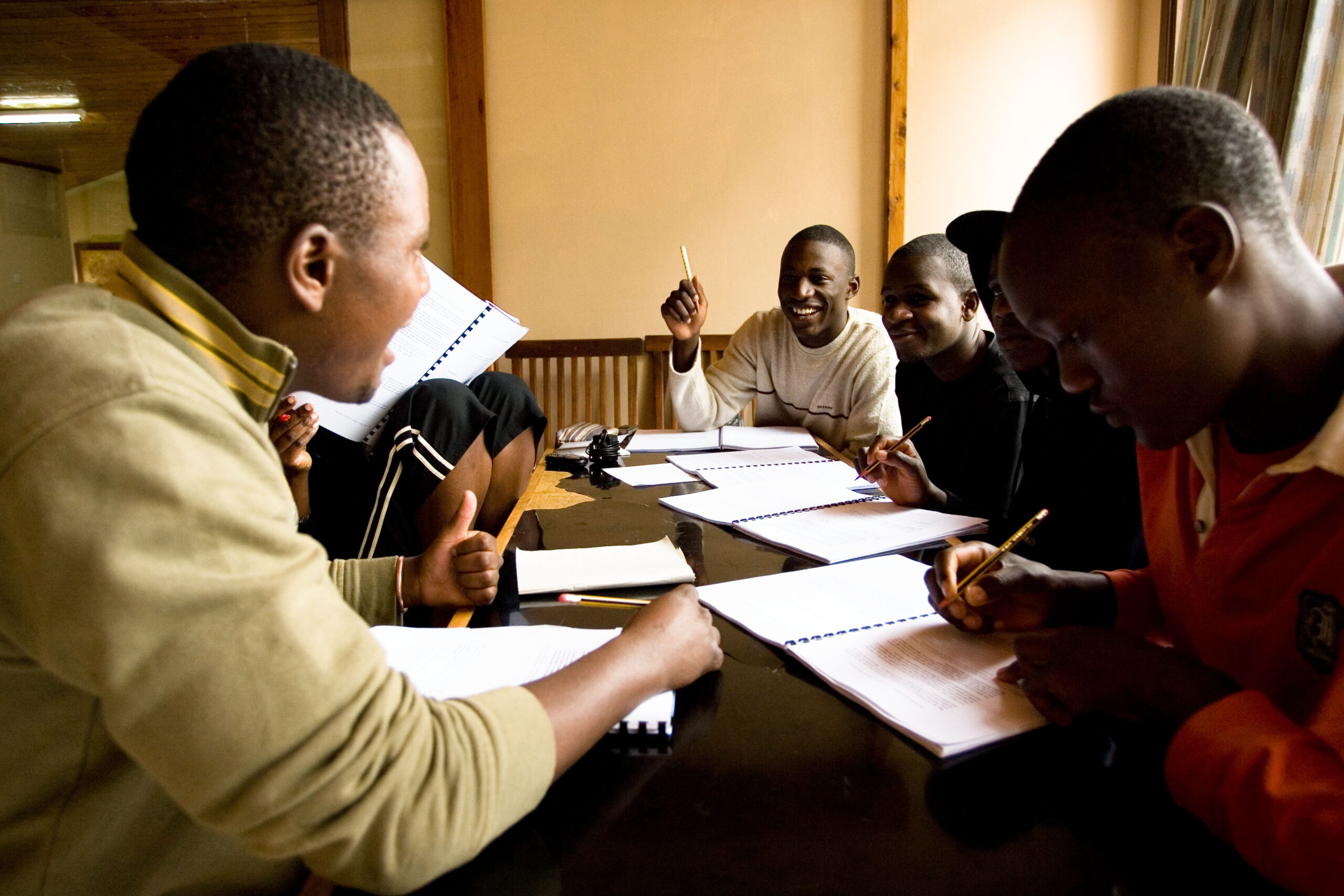
Institute courses are generally studied in small groups with the assistance of such a tutor in the setting of a study circle—ten or so friends who meet regularly for a few hours in a home or other convenient space over an extended period. The relationship of the tutor to the group is not one of a teacher to his or her students. As a member of the group, the tutor is as engaged in the process of learning as the others, but, having gained more experience, helps to ensure that understanding is enhanced among the participants and that the purpose of the course is achieved. To this end, the tutor hopes to reinforce an environment in which all see themselves as active, responsible “owners” of their own learning, striving to fulfill the twofold moral purpose mentioned earlier, as they seek to apply the knowledge they are gaining to their own lives and the life of their community.
What is at stake, then, is a culture that promotes a way of thinking, studying, and acting in which all consider themselves as treading a common path of service—supporting one another and advancing together, respectful of the knowledge each possesses at any given moment and eschewing the inclination to divide people into categories such as “knowledgeable” and “uninformed.” These are the dynamics of a grassroots spiritual movement.
The learning process in which the Bahá’í community is engaged worldwide is still in its earliest stages. The training institute was created as an instrument for systematizing and propagating the learning that accumulates about how the Bahá’í teachings can be translated into reality and a new civilization brought into being, founded on the principle of the oneness of humanity. It represents a new kind of social institution, one concerned with the capacity of a population to become the protagonists of their own material and spiritual development.