In the previous article, “Bahá’í Contributions to the Development of Iran,” the interactions between the Bahá’í community and the modernist reformers in Iran in the late nineteenth and early twentieth centuries were examined over issues such as government, educational reform, and the social role of women. These were issues that had an immediate and evident impact on society. There are a number of Bahá’í teachings, however, that operate at a deeper level and are therefore much more radical, since they were implemented gradually, the changes and their implications were not always discerned by the Iranian population or even, in some cases, by the Bahá’ís themselves. Thus, in the course of the last part of the nineteenth and the whole of the twentieth century, the Bahá’í community in Iran underwent a profound change in its culture and functioning that has resulted in a community that operates in a radically different way from the rest of Iranian society. It presents Iranians with a different model of society.
In the early 1880s, Bahá’u’lláh surveyed the state of the world and wrote that He found it “lamentably defective.” He wrote that He looked for moderation and justice among the leaders of society and discerned instead injustice, strife, chaos, and confusion and that the situation was now irredeemable.1Gleanings from the Writings of Bah’u’lláh, CX, bahai.org/r/529444114. Shoghi Effendi wrote of the “progressive deterioration in human affairs,” in Messages to the Bahá’í World: 1950–1957 (US Bahá’í Publishing Trust, 1971 edition), 103. In other words, there were no suggestions that He could make to fix matters. The situation of the world would inevitably get worse until, “Such shall be its plight, that to disclose it now would not be meet and seemly.”2Bahá’u’lláh, Gleanings, LXI In a letter written a decade earlier to Queen Victoria, Bahá’u’lláh likened the statesmen and political theorists of His time to ignorant physicians who have been summoned to heal the body politic of its illness but only make matters worse.3Bahá’u’lláh, Gleanings, CXX. Whereas He, “the true Physician,” was “debarred from administering the remedy.”4 Bahá’u’lláh, Gleanings, XVI.
Given that the world’s system of governance, its economic order, its social structures, and its values were irredeemably defective, and the whole of the world order was in danger of collapse, the only remedy was to roll up the old “World Order” and “spread out a new Order in its stead.”5 Bahá’u’lláh, quoted in Shoghi Effendi, The World Order of Bahá’u’lláh, bahai.org/r/687286793. Thus, Bahá’u’lláh was calling for a complete and radical change. There have been many revolutions in human history that have sought to bring about change at the level of governance, economics, and society: the French Revolution, the American Revolution, the various communist revolutions, and the Constitutional Revolution and Islamic Revolution of Iran. But what Bahá’u’lláh proposed was a far more radical change than what any of these revolutions proposed. He called for a change at the very deepest levels of the vision, assumptions, and values of society and a transformation of the social order.
There is, of course, much that could be said about such far-reaching changes, but this article will be confined to the consideration of one thread. One of Bahá’u’lláh’s most radical proposals was the dismantling of the power relationships that keep a small group of the elite at the top of society. This elite then organizes the thinking and working of society—its law, governance, education, and the media—in such a way as to maintain the hegemony of wealth and power. In about 1868, Bahá’u’lláh declared that that power had been seized from both secular and religious leaders (umará va ‘ulamá): “From two ranks amongst men power hath been seized: kings and ecclesiastics.”6Bahá’u’lláh quoted in Shoghi Effendi, The Promised Day is Come, bahai.org/r/738996878. This radical statement was not, however, a precursor to what happened in the other revolutions mentioned above, taking power from one group in order to hand it to another. What Bahá’u’lláh was aiming for was a radical overhaul of the structure of society so as to no longer have a pyramid of power. As became clear over time, the Bahá’í administrative system aims to remove power from the grasp of individuals completely. Authority is to be vested in elected institutions acting as a body. As Shoghi Effendi wrote:
But praise be to God that the Pen of Glory has … dismissed the assertions of individuals as an authoritative criterion, even though they were recognized as the most accomplished and learned among men, and ordained that all matters be referred to authorized centers and specified assemblies.7Letter written on behalf of Shoghi Effendi in 1927, translated in Messages from the Universal House of Justice, 1963–1986, comp. Geoffry W. Marks (Bahá’í Publishing Trust, 1986), 216–7.
This was the vision that Bahá’u’lláh presented to the Bahá’í community and to the world. It required a major reorientation of values, assumptions, and practices. Such changes could not be achieved simply through sending instructions; they could not be forced on people; they required a process of counseling and education. The Bahá’í leaders carried this out both through their writings with the inculcation of new values and attitudes and in the specific instructions they sent about the structure and functioning of the community. The process necessarily proceeded slowly and in stages. Because of the continuing hostility and persecution from the general population in Iran, the process also proceeded unobtrusively behind closed doors. It is not surprising, therefore, that the radical nature of what was going on was, for the most part, missed.
One major change that was initiated in the early years of the twentieth century was the transfer of authority from individuals to leadership councils that eventually became elected institutions, which at the local level were called Local Spiritual Assemblies.8A handful of individuals such as ‘Abdul-Ḥusayn Ávárih (Áyatí), Ḥasan Níkú, and Ahmad Sohrab, who had held prominent positions in the Bahá’í community, resisted these changes and this eventually led them to leave the Bahá’í community and attack it. Moojan Momen, The Baha’i Communities of Iran 2 (George Ronald, 2021), 8, 242–3, 405–7. Of course, the mere fact of having elected councils is not sufficient to achieve the goal of removing power from individuals and eliminating hierarchy. It requires a radical change in the way that elected institutions operate. There are many elements to this, but it includes a prohibition on the formation of parties and factions, on nominations of candidates for election or office, and on all manner of election campaigning. The guidance coming from the Bahá’í leaders regarding the consultation process that leads to decisions within the Assemblies includes such elements as maintaining a calm, prayerful, and reflective atmosphere, being detached from one’s own opinions and open to considering all suggestions made, and the willingness to accept and work for the final decision even if one voted against it. The absence of factions and parties (and the divisiveness that goes with them) and the elimination of the chairman’s ability to cast the deciding vote or to set the agenda and other similar measures are all designed to reduce the aggrandizement of individuals and limit the ability of both individuals and vested interests to dominate and determine the decisions made in the consultation process. No individual has power or authority simply by virtue of being elected to these institutions. Only the institution acting as a body has authority.
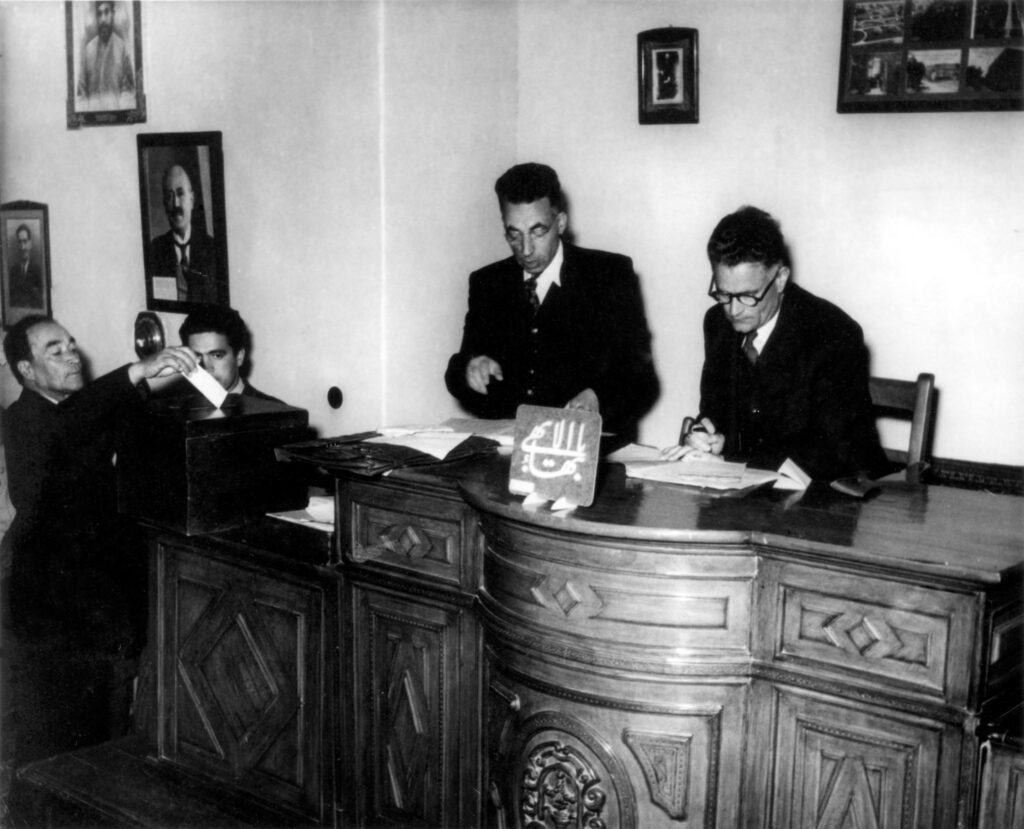
Thus, a novel form of representative democracy was introduced into the Bahá’í community. Since the beginning of this century, an element of participatory democracy has also been added, with most day-to-day decisions being made at the grassroots level through consultation and planning among those who engaged in social action, thus giving them agency. Part of the process is an educational element that encourages participants to think for themselves and gives them the confidence to verbalize their thoughts within a group setting, thus training them to consult effectively in a non-combative manner. It also gives them an ethos of collaborative service and the capacity to undertake simple but fundamental acts of service, such as running children’s classes and junior youth empowerment activities. Meetings are held at a local level, where participants identify the needs of their society and consult about what they can do to address those needs, given the capacities of the group; plans are made which are then carried out in a spirit of collaboration. A few months later, the group meets again to review the results of this effort and what has been learned from it. Moreover, these participants are not just the members of the Bahá’í community. All members of society are welcome to participate in these society-building activities and in the associated consultative and decision-making process. Thus, the Bahá’ís aim to create an ever-widening group of like-minded members of society united in working for the betterment of their community. This pattern of activity is not fixed but is envisioned as continuing to evolve, and there may be major changes to it in the future, depending on the experience gained.
This participation of members of the wider society in the Bahá’í grassroots activities has the potential to influence the general Iranian society. And so, although these changes are occurring within the structures of the Bahá’í community, they can act as a model for Iranians to see that a community can function in ways that are radically different—that replace the competition, conflict, and coercion inherent within the present hierarchical social order with an order that functions through consultation, collaboration, and cooperation and where institutions become instruments for the facilitation of grassroots action rather than for individuals to wield power.
It should be acknowledged, however, that the ongoing hostility towards and persecutions of the Bahá’í community of Iran has limited and continues to limit the range of social actions that it could undertake and has resulted in many who are not Bahá’ís but who appreciate the discourse and lines of action of the Bahá’í community being inhibited from participating in this process. However, the Bahá’ís have continued to be resilient to the pressures that are exerted against them and constructive in their efforts to bring like-minded individuals in Iranian society together to find ways of improving the social environment. Thus, for example, after the Bam earthquake in 2003, Bahá’í educators volunteered to teach young children in that area whose education had been disrupted, and for this they were arrested and imprisoned.9“Bahá’ís who offered education to earthquake-hit Iranian region arrested,” Bahá’í World News Service, 15 March 2011, news.bahai.org/story/812; Kian Sabeti, “Saman’s School: Iranian Authorities Jail Education Pioneer for Being a Bahá’í,” Iranwire, 5 September 2023, iranwire.com/en/bahais-of-iran/120153; Kian Sabeti, “Baha’i Jailed After Educational and Humanitarian Service Projects,” Iranwire, 27 September 2023, iranwire.com/en/bahais-of-iran/120949. Similarly, some 54 young Bahá’ís were working alongside like-minded fellow Iranians in a literacy project among the poor in Shiraz when they were arrested in 2006, and several of them imprisoned.10“Iran: Scores Arrested in Anti-Baha’i Campaign,” Human Rights Watch, 4 June 2006, hrw.org/news/2006/06/04/iran-scores-arrested-anti-bahai-campaign; “54 Bahá’ís arrested in Iran,” UPI, 24 May 2006, upi.com/Top_News/2006/05/24/Report-54-Bahais-arrested-in-Iran/54361148504612; “Iranian report confirms innocence of Shiraz Baha’is,” Bahá’í World News Service, 24 October 2008, news.bahai.org/story/661. More recently there have been a number of arrests in places such as Isfahan, Tehran, and Semnan of Bahá’ís after they had been educating Afghan children who are denied education by the state.11 See “Appeals Court Upholds 90-Year Combined Prison Sentence for 10 Baha’i Women in Isfahan,” Human Rights Activists News Agency, en-hrana.org/appeals-court-upholds-90-year-combined-prison-sentence-for-10-bahai-women-in-isfahan; “Samin Ehsani, Children’s Rights Activist and Baha’i, Summoned to Prison,” Iranwire, 17 June 2022, iranwire.com/en/bahais-of-iran/104924; “Anisa Fanaian, a Bahá’í Citizen in Semnan Province, Sentenced to 8 Years in Prison,” Iran Press Watch, 8 December 2024, iranpresswatch.org/post/25225.
The most important consequence of this change of ethos was to take social agency down to the level of the individual. Thus, this process is bringing together groups of individuals, who are often on the lowest rungs of the social hierarchy, and encouraging them not to wait for government or for charities to help them, but rather to take agency themselves, assess the realities of their communities, identify its needs, and consult about plans to improve their society that are within the capacities of the group, while at the same time expanding these capacities through an educational process.
Apart from the elimination of the power hierarchy, there was a second element in the development of the Bahá’í community of Iran that stood in contrast to the agenda of the modernist reformers. After the Constitution was signed in 1906, the new king, Muḥammad `Alí Sháh, tried to overturn it and the nation became divided. The Constitutionalist reformers, many of whom were familiar with the Bahá’í teachings and had close relations with the community, naturally expected the Bahá’ís to support the Constitutionalist side, given the commonality between the Bahá’í social teachings and the reforms advocated by the Constitutionalists. Although He had previously advised the Bahá’ís against seditious activity in direct opposition to the government, ‘Abdu’l-Bahá appears to have allowed the Bahá’ís to act in conjunction with the reformers in trying to persuade the government of Iran to carry out social reforms. There is evidence of this from various parts of Iran, such as Sari, Isfahan, Shiraz, and Tehran. Then in the period immediately after the signing of the Constitution in 1906, two factors changed. First, the previous national unity in calling for reforms shattered with the emergence of political parties, each with its own agenda and vision for the future of Iran, some supported the shah and others the Constitution. Second, as a consequence of the first, the peaceful nature of the reform movement that had succeeded in obtaining the Constitution disintegrated with the emergence of conflict and violence between the two sides, each trying to subvert and destroy the other. ‘Abdu’l-Bahá wrote of the need for unity and warned of the danger of foreign interference in Iran. He now strictly forbade the Bahá’ís from any engagement with the polarized and often violent politics of the era:
We have no connection with any party: we are neither partisans of the Victorious Government nor do we share the opinions of the Glorious People. We stand aside from all strifes, wish well to all, and offer our prayers and supplications at the Throne of God that He will reconcile these two honourable elements with one another.12Edward Granville Browne, The Persian Revolution, 1905–1911 (University Press, 1910), 425–9, quotation translated by Browne, 427. ‘Abdu’l-Bahá’s approach to the Constitutional Revolution was more complex and nuanced than can be detailed here. For more, see Mina Yazdani, “‘Abdu’l-Bahá and the Iranian Constitutional Revolution: Embracing Principles While Disapproving Methodologies,” Journal of Bahá’í Studies 24, no. 1–2, (June 2014): 47–82, doi:10.31581/jbs-24.1-2.4.
‘Abdu’l-Bahá also gave as His reasons for taking this stance the fact that the Bahá’ís weakened the Constitutionalist cause by supporting it, since it gave the reactionary clerics an opportunity to claim that the Constitution was the work of the Bahá’ís and anti-Islamic, and that the Bahá’ís were in danger because each side was accusing them of supporting the other.13 ‘Abdu’l-Bahá quoted in Browne, Persian Revolution, 426–9. There is evidence that news of this new stance by ‘Abdu’l-Bahá reached Iran in February–March 1907.14Marzieh Gail, Arches of the Years (George Ronald, 1991), 31; Mírzá Ḥábíbu’lláh Afnán, “Táríkh-i Amrí-yi Shíráz,” 556, afnanlibrary.org/tarikh-amri-shiraz/ seems to indicate a similar date.
Parallel to this was the situation in the 1970s when Mohammad Reza Shah was attempting to force everyone in Iran to join a single political party he had created. Bahá’ís refused, even though for many it meant the loss of their jobs and social position. More recently, the Bahá’ís have not backed groups that seek to overthrow the Islamic government of Iran, although they have, alongside many other groups, appealed peacefully for justice and for the rights of oppressed groups.
The position of the Bahá’í leadership regarding political activity has varied over the years, depending on local factors, usually related to whether certain actions would lead to Bahá’í social objectives, achieve greater degrees of unity and not occasion conflict and violence. There was, for example, a brief period of national unity after the restoration of the Constitution in 1909 when ‘Abdu’l-Bahá appears to have contemplated encouraging certain Bahá’ís to seek election to the national parliament,15 Yazdani, “‘Abdu’l-Bahá,” 66. but this soon ended with the re-emergence of political wrangling and conflict. During the ministry of Shoghi Effendi (from 1921 to 1957), the policy of avoiding political involvement was strengthened such that all such activity, including holding political positions in government, was prohibited and even penalized. However, even with this, certain lines of social action, such as seeking racial justice and integration in the United States, which within the context of that country is highly political, have been pursued by the United States Bahá’í community over many decades where these have not involved confrontation with the state or violence.16Richard Thomas, “The Bahá’í Response to Racial Injustice and Pursuit of Racial Unity (Part 1): 1912–1996,” The Bahá’í World, 16 January 2021, bahaiworld.bahai.org/library/the-bahai-response-to-racial-injustice-and-pursuit-of-racial-unity/. More recently certain limited moves have been permitted by the Universal House of Justice, such as when the British Bahá’í community joined with another organization in the “Action for Children” campaign and campaigned successfully for national legislation to allow sexual offences against minors committed by British residents outside the United Kingdom to be prosecuted in Britain.17 United Kingdom House of Commons, “Child Protection,” debated on 12 March 1997, Hansard, hansard.parliament.uk/commons/1997-03-12/debates/cf2d06e1-f08e-48e8-b387-f8b40ccac6cd/ChildProtection. The campaign resulted in the passing of the Sex Offenders Act 1997. Another example was when the worldwide Bahá’í community launched a campaign “Our Story is One,” in parallel to the “Woman, Freedom, Life” movement in Iran.18 “Our Story is One,” Bahá’í International Community, ourstoryisone.bic.org; “Launch of the Our Story Is One Campaign,” United Kingdom Parliament, 11 July 2023, edm.parliament.uk/early-day-motion/61199.
For the Bahá’í community, the present world political order, based as it is on competition and conflict, is part of the problem, and so it cannot be part of the solution. To participate would inevitably pull the Bahá’ís ever deeper into a system that is inherently competitive, conflictual, hierarchical, and corrupt—the very opposite of what the Bahá’ís are aiming for. For this reason, the Bahá’í leadership has, on most occasions, steered the Bahá’í community away from political involvement.
And so, the Bahá’í model for society does not set itself up as a competitor within the present political system. It is working to set up an alternative space outside the conventional political sphere: where a different style of social and political activity can take place, where the present social dynamics of competition is decentered, where the dominant motifs of power and wealth as the central values of society are changed, where the socialization that perpetuates the present dominant culture is disrupted through an educational process that creates a new ethos, and where the culture of monologue (where ordinary people are lectured and told what to think and do) is transformed into a culture in which the capacity of all to engage in dialogue is fostered and becomes the foundation of community life.19For more on this aspect of the Bahá’í teachings, see Michael Karlberg, Beyond the Culture of Contest (George Ronald, 2004). This alternative space is built on the basis described above of participatory democracy, elected institutions, consultative decision-making, and collaborative grassroots social action.
In addition, in Iran there was tension between the intense nationalism of most of the modernist reformers and Bahá’u’lláh’s aim of orienting His followers towards internationalism—here meaning peace and cooperation among nations as indicated by such statements as “The earth is but one country and mankind its citizens”;20Bahá’u’lláh, Gleanings, CXVII. E. G. Browne heard Bahá’u’lláh say: “Let not a man glory in this, that he loves his country; let him rather glory in this, that he loves his kind,” [‘Abdu’l-Bahá], Traveller’s Narrative, xl. and beyond that, towards globalism—here meaning an organic vision of humanity as one interconnected global whole, as implied by such statements as “Regard ye the world as a man’s body, which is afflicted with divers ailments, and the recovery of which dependeth upon the harmonizing of all of its component elements.”21Bahá’u’lláh, The Summons of the Lord of Hosts, bahai.org/r/516098430. And so, while the reformers were advocating for “what is good for Iran”, the Bahá’ís considered that “what is good for humanity as a whole” is actually what is good for Iran in the long run.
This globalism and the position taken by the Bahá’í community for over a century of not participating in partisan and polarizing politics has led to some misunderstandings and distortions of the Bahá’í position. Since most journalists, commentators, and scholars are focused on the political sphere, they have missed what is happening within the Bahá’í community, because it is not operating in that sphere. In addition, the Bahá’í stance frustrated and angered some Iranian reformers and progressive thinkers because it seemed to them that the Bahá’ís were indifferent to the problems of Iran, and therefore they questioned the patriotism of the Bahá’ís.22E. G. Browne voiced similar sentiments, Persian Revolution, 429. Shoghi Effendi refuted this contention by pointing out that the Bahá’í position was not a “repudiation” of “a sane and intelligent patriotism” but rather a realization that it must operate within a “wider loyalty” to the human race.23Promised Day, bahai.org/r/784142005. And indeed, through the global spread of the Bahá’í Faith, the Iranian festival of Naw-Rúz is celebrated, the land of Iran is revered, and there are even individuals learning the Persian language in order to read the Bahá’í scriptures in their original language in almost every country in the world.
Apart from these tensions with the modernist reformers, Bahá’u’lláh’s vision also challenged aspects of traditional Iranian culture. The Shi’íh culture of nineteenth-century Iran envisioned humanity as divided into believers and unbelievers (the concept of kufr), and this division was accentuated by the belief that the unbelievers were unclean (the concept of nijásat). This meant that all contact with unbelievers was to be avoided, and the traditionalists extended this to adopting the ideas and innovations of the unbelieving Europeans. The Bahá’í leaders expressly abolished both these concepts among their followers.24‘Abdu’l-Bahá, The Promulgation of Universal Peace, 454; Bahá’u’lláh, The Kitáb-i-Aqdas, bahai.org/r/301255873. See also Houchang E. Chehabi, “Anatomy of Prejudice: Reflections on Secular Anti-Baha’ism in Iran,” in The Bahá’ís of Iran: Socio-historical studies, ed. Dominic Parviz Brookshaw and Seena B. Fazel (Routledge, 2008), 192. This attitude goes back to the Báb and His openness to trade, ideas, and innovations from Europe that would benefit Iran, see The Báb, The Persian Bayán, vahid 4:16; 7:16, afnanlibrary.org/inba-volume-62/; Stephen Lambden, “QA XLVI [46] Sūrat al-Huwa,” hurqalya.ucmerced.edu/node/438/. ‘Abdu’l-Bahá expressly argues in His 1875 treatise against the close-mindedness that blocked everything from the rest of the world, The Secret of Divine Civilization, pp. 25–7. Western observers, such as Professor Edward G. Browne and the European missionaries in Iran, noted this change among the Bahá’ís as compared to other Iranians.25Edward Granville Browne, A Year among the Persians (Adam and Charles Black, 1893), 223–31; Moojan Momen, “Early Relations between Christian Missionaries and the Bábí and Bahá’í Communities,” In Studies in Bábí and Bahá’í History 1, ed. Moojan Momen (Kalimat Press, 1982), 49–82, esp. 64–6, 70–72. But perhaps the most compelling evidence for this change of ethos in the Bahá’í community was the reports by some members of Iran’s Jewish and Zoroastrian communities of how they were attracted to the Bahá’í Faith by observing that Bahá’ís of Muslim background (some of them formerly Muslim clerics) treated them with kindness and as equals, deliberately rejecting the concept of impurity by eating and drinking from the same vessels as them. The abandoning of such long-held traditions was, however, shocking to the conservative elements in the population.26Moojan Momen, The Baha’i Communities of Iran 1 (George Ronald, 2015), 337.
There was a third area in which the Bahá’í community and its leadership differed from what was going on in Iranian society and among the Iranian reformers. This arose because some of the reformers, seeing the strong hold that the senior religious leaders had on the people and impressed by the way that these clerics had been able to successfully mobilize the masses against a disadvantageous agreement that the Shah had signed with a European entrepreneur in 1890, sought over the next few years to co-opt the senior religious leaders into the reform movement. At exactly this time, ‘Abdu’l-Bahá wrote a treatise, the Treatise on Politics, warning against involving the clerics in politics. He pointed out that every time religious leaders had entered the political arena, the result had been disastrous, leading to defeat, death, and destruction, and He gave several examples of this from the recent history of Iran and the Ottoman Empire. Unfortunately, the reformers failed to heed this advice, and the result was that many of the reforms envisaged by those who instigated the Constitutional Revolution in the 1900s were annulled at the insistence of the clerics and much of the vision of the reformers failed to materialize. ‘Abdu’l-Bahá’s advice was again ignored by those who pressed for change in Iran in the 1970s, and the Islamic religious leadership was again allowed into the political process.
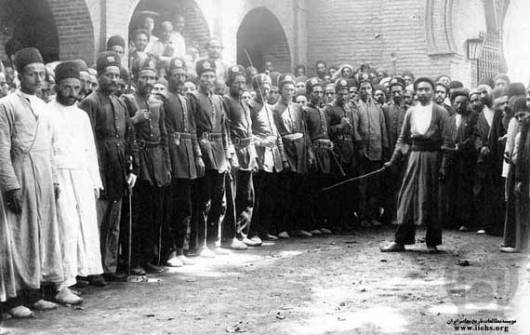
In the first part of this article, certain lines of social action such as the establishment of modern schools and the advancement of the social role of women were described. It should now be clear that, although what the Bahá’ís were advocating and doing appeared superficially to be similar to the program of the modernist reformers, the Bahá’í activity was cultivating a culture that was radically different from that of traditional Iranian society. The children in the Bahá’í schools, for example, were becoming patriotic Iranians but within a context of also envisioning themselves as world citizens.
It should also be appreciated that Bahá’u’lláh did not present a plan for human development that was to be implemented uniformly across the world. He and His successors as leaders of the Bahá’í community presented certain social principles (such as the equality of women and men) that humanity should aim for and certain means of social functioning (such as consultative decision-making) that would assist in achieving these aims. But the exact details of how all this would evolve has been left to the Bahá’ís to work out in a reciprocal relationship of dynamic interdependence between the individual, the institutions, and the community. And of course, it may be that these details will work out differently in each part of the world according to local culture.
THE WORLD OF RELIGION
One aspect of society in which Bahá’u’lláh made the greatest change was in the field of religion. The religious leadership in Iran in the late nineteenth century, as in many parts of the world, wielded great power and influence, and thereby accumulated great wealth. The people were expected to live their lives and pay certain religious taxes according to a Holy Law (the Sharí`ah) as interpreted by the religious leadership. Even the shah and the local governors had to be wary of offending religious leaders who could stir up the population against them.
The teachings of Bahá’u’lláh were a great challenge to the religious leaders. Bahá’u’lláh, and the Báb before Him, were respectful towards the Qur’án and the Prophet Muḥammad.27For the Báb, see B. Todd Lawson, Tafsir as Mystical Experience: Intimacy and Ecstasy in Quran Commentary (Brill, 2018), esp. 9–47. For Bahá’u’lláh, see The Kitáb-i-Íqán, bahai.org/r/540143739. ‘Abdu’l-Bahá, the successor of Bahá’u’lláh, defended Islam and the Prophet Muḥammad in churches and synagogues during His travels in Europe and North America.28See for example, ‘Abdu’l-Bahá, Promulgation, 200–1, 346–7, 409–10. ‘Abdu’l-Bahá’s successor, Shoghi Effendi, called on the Bahá’ís of the West to learn about Islam and defend its fundamentals against attacks in the West.29Shoghi Effendi in Hornby, Lights, 495–6.
However, Bahá’u’lláh and the Báb decried the learning that was taught in the Islamic religious colleges in much the same way that Jesus Christ decried the learning of the Pharisees.30The Báb, Bayán, 4:10; Bahá’u’lláh, Íqán, 186–7; cf Matthew 23:1–34. To emphasize His dismissal of abstruse clerical learning, Bahá’u’lláh declares that understanding holy scriptures depends “solely upon purity of heart, chastity of soul, and freedom of spirit,” Íqán, bahai.org/r/643779013. And since the prestige of the Iranian religious leaders was based on their learning, this was effectively undermining their position. The Bahá’í leaders also condemned the hypocrisy, fanaticism, and corruption of some Muslim religious leaders.31 ‘Abdu’l-Bahá, Secret, 37–8, 56–7. Shoghi Effendi, Bahá’í Administration (Bahá’í Publishing Trust, 1995), 132, 172; Shoghi Effendi, The Advent of Divine Justice, 4; Shoghi Effendi, The Unfolding Destiny of the British Bahá’í Community: The Messages of the Guardian of the Bahá’í Faith to the Bahá’ís of the British Isles (Bahá’í Publishing Trust, 1981), 68. But their criticism was not exclusively reserved for the Muslim clerics. They pointed out that each of the founders of the main religions of the world had experienced opposition and persecution from the religious leaders of their time.32Báhá’u’lláh, Íqán, 15–16; see also 29–31, 182–4. And it was no different this time with the hostility of the Iranian clerics towards the new religion. In view of these criticisms, it is not surprising that Bahá’u’lláh introduced an innovation that would have a profound effect on the ethos of the Bahá’í community: the prohibition of religious professionals.33See for example the Lawḥ-i-Ittiḥád in Ad‘iyyih-yi Ḥaḍrat-i Maḥbūb (Bahá’í-Verlag, 1980), 388–406, esp. 396–9. See also Shoghi Effendi’s authoritative interpretation of the Kitáb-i-Aqdas, God Passes By, p. 241.
The change that the Bahá’í leaders sought to bring about was, however, much more radical and wide-ranging than just the abolition of religious professionals. Bahá’u’lláh sought to bring about a profound change in the way that religion is imagined and thus in the religious ethos of the Iranian nation. True religion is not, according to the Bahá’í teachings, about believing in the correct doctrine, carrying out correct rituals, or the correct following of a Holy Law. Just the act of calling on a holy figure will not bring salvation, nor will special chants or entering states of ecstasy or trance, nor, in particular relation to the Iranian religious scene, will following the directives of a senior Shi’íh cleric (mujtahid) or Sufi shaykh, or participating in the ritual commemorations of the sufferings of the Imáms. These are the trappings that religious professionals have overlaid onto the true core of religion in order to enhance their role and insert themselves into the relationship between the believer and God. True religion has, according to the Bahá’í leadership, two fundamental purposes: the improvement of the character of the individual through developing moral and spiritual qualities (such as love, justice, trustworthiness, etc.); and the betterment of society (leading to more peaceful, united, and coherent communities). And so, religion functions as it ought to function when such transformed individuals come together and consult in order to create ways of improving society, the overall purpose being “to effect a transformation in the whole character of mankind, a transformation that shall manifest itself both outwardly and inwardly, that shall affect both its inner life and external conditions.”34Bahá’u’lláh, Íqán, bahai.org/r/501261243. Indeed, the Bahá’í leaders assert that this has always been the main purpose of the founders of all the world’s religions and, on this level, the religions are all one.
In place of the passivity of listening to the sermons of clerics, obeying their rulings and putting off working for improvements in society in anticipation that all would be put right with the promised return of the Hidden Twelfth Imám, who according to Shi’íh Islamic belief would return at the end of time to fill the world with justice, Bahá’u’lláh declared that the time had come, the Promised Imám had appeared (in the person of the Báb), and that the time for passive religiosity was ended. What was needed now was for all people to take an active role in working towards the implementation of the laws and teachings (as laid down in His Writings) that would bring about the promised world filled with justice.35Bahá’u’lláh, Gleanings, X.
Thus, for Bahá’ís, religious activity is being of service to others, not just the Bahá’í community but the whole of society. And examples of Iranian Bahá’ís doing this have been given above. Furthermore, the society-building activities of the Bahá’í community are open to all. People do not have to become Bahá’ís in order to participate in these; all like-minded people are welcome to join in both the meetings at which such activities are planned and the carrying out of them.
CONCLUSION
In summary then, the Bahá’í community in Iran over the last 150 years or so has been building up gradually, almost imperceptibly, a radically new type of community life: one in which women can contribute more effectively, one in which the education of children is a central focus, one based on moral values, consultation, and collaboration. Its advocacy and efforts for modern education, the advancement of the social role of women and the broad global vision that it cultivates are only the superficial signs of a deeper revolutionary change in the structure and functioning of the community. Over this period, Bahá’ís have been building up a community that is not run by individuals who hold power but rather which functions through consultative decision-making. It could be called a counterculture in the sense that it runs counter to many of the norms and values that have been holding Iran back over the last century or more. It seeks to break down the hierarchical, patriarchal, and polarized nature of society and create a more cohesive and collaborative functioning of society. And in creating such a community, it is in effect acting as a model, demonstrating to Iranians that it is possible to have a different sort of society based on different values, social structures, and ways of functioning. And all are welcome to join in this society-building project. It is not that Bahá’ís are holding up a final blueprint and saying: “This is the new society.” They are offering a vision of what could be and certain principles and ways of getting there, and they are saying to others: “Let us together explore this path and jointly build a new society.”
The process of change has, however, been slow because changing the way people see the world, changing the values of society, changing culture is difficult. The Bahá’í community has proceeded in the last quarter century through an educational process that seeks to start with fundamentals and build in such a way as to carry everyone with it. It focuses on developing consultation skills, reading social reality, changing values, and building capacity. And the process is far from over. As it develops, it engages with ever greater numbers in lines of social action of ever greater complexity identified through the consultation process, all evolving towards what Bahá’u’lláh envisaged when He declared the present order to be “lamentably defective” and set out the framework for a “new World Order”:
The world’s equilibrium hath been upset through the vibrating influence of this most great, this new World Order. Mankind’s ordered life hath been revolutionized through the agency of this unique, this wondrous System—the like of which mortal eyes have never witnessed.36Bahá’u’lláh, Gleanings, LXXIX.
Iran is the birthplace of both the Bahá’í Faith and its predecessor, the Bábí movement. Although the Bahá’í Faith has now spread worldwide, establishing itself in almost every country, the role it has played in the development of its homeland is insufficiently recognized by both the people of Iran and by scholars.
At no time during the history of the Bahá’í community in Iran have there been articles in newspapers, journals, books, or academic publications in Iran that have presented the Bahá’í viewpoint, nor have Bahá’ís been able to publish refutations in Iran in response to numerous attacks and false information. The result is that the general population in Iran is ignorant of even the most basic facts about the Bahá’í Faith, and what it thinks it knows is actually the misinformation that has been fed to it. A number of well-known scholars in Iran have participated in these attacks on the Bahá’í community, even to the extent of fabricating evidence.1For example, the prominent historian Fereydun Adamiyat fabricated a relationship between the Báb’s first disciple, Mullá Ḥusayn Bushrú’í, and the British military intelligence officer Arthur Connolly (a relationship that could not have occurred), giving as his reference Connolly’s book (in which there is no mention of the matter); see Fereydun Vahman, 175 Years of Persecution: A History of the Babis and Baha’is of Iran (Oneworld Publications, 2019), 82–5. Houchang Chehabi, a well-known Iranian scholar, has described the resulting situation in Iran:
It is only a slight exaggeration to say that until very recently any discussion of the Baha’is and their religion that did not use abusive, disparaging, or at least sarcastic language was suspected of being an apologia, and that any writer or speaker who talked about Baha’is in respectful or even in a merely matter-of-fact way was suspected of being a Baha’i.2Houchang E. Chehabi, “Anatomy of Prejudice: Reflections on Secular Anti-Baha’ism in Iran,” in The Baha’is of Iran: Socio-historical studies, ed. Dominic Parviz Brookshaw and Seena B. Fazel (Routledge, 2008), 185. The late Heshmat Moayyad and the late Shapour Rassekh reported to the present writer that in the academic, intellectual, and government circles which they frequented in the 1960s and 1970s, their close Iranian friends and colleagues would even refrain from uttering the word “Bahá’í.” They would refer obliquely to “your group” or “your friends.”
With little information available to them, scholars outside Iran have often ignored the Bahá’í Faith in their analyses or reproduced the misinformation about the religion that abounds within Iran. Commonly, the Bábí movement is regarded as a failed rebellion, while the Bahá’í community is treated as though it played no significant role in the country’s development. There has been an improvement in this situation in recent decades, but there is still an insufficient appreciation of the extent of the influence of the Bahá’í community.
In this first of a series of two articles, the specific contributions that the Bahá’í community has made to the development of Iran will be described. The second article will attempt to portray just how revolutionary the concepts and changes in social structure within the Bahá’í community have been, the potential implications of these for the wider Iranian society, and the way that the ideas of the religion address many of the problems and issues that face Iran (and indeed other countries).3This and the following article are based on the academic paper: Moojan Momen, “The Bābī-Bahā’ī Revolution in Iran,” Iranian Studies 58, no. 2 (2025), 235–58.
In the mid-nineteenth century, following a series of damaging and humiliating military defeats at the hands of European powers, Iran was just becoming aware of the extent to which it had fallen back from being one of the most advanced countries in the world two hundred years earlier. The initial response of the government was to attempt to copy European military training and tactics by bringing European army instructors to Iran.
In the second half of the nineteenth century, however, the thoughts of progressive Iranians moved beyond just the military. Reports from Iranians who traveled abroad, reforms that were instituted in the Ottoman Empire, and the works written by Iranians living outside Iran began to focus the attention of some Iranians towards bringing social, educational, and governmental reforms to Iran. Thus, a cohort of reformers gradually emerged in Iran (and among Iranians living outside Iran), who wrote works suggesting what changes would benefit Iran and help to bring it up to the level of progress and prosperity that Europe had achieved.
The Iranian modernist reformers were making proposals across various areas of social life, and, in particular, they were looking at law, the governance of society, modern education, and, to a lesser extent, the position of women in society. The Bahá’í leaders were making proposals about the same areas of social life, and so, there was a common area of discourse between these two groups. What this article sets out to demonstrate is that the ideas in the writings of the Bahá’í leaders were put forward earlier and were more progressive than what was being advanced by the modernist reformers, that these reformers were in close contact with the Bahá’í leaders and the community, and therefore, that it is not unreasonable to suggest that the reformers may have been influenced by the Bahá’ís in what they wrote and did, although of course, they would have carefully concealed any such borrowing of ideas from what was regarded in Iran as a heretical and misguided sect.
THE GOVERNANCE OF SOCIETY
A good example of the way that the Bahá’í leaders were earlier and more progressive in their proposals about reform is in the area of the governance of society. In the late 1860s and early 1870s, Iranian reformers, such as Mírzá Ḥusayn Khán Mushíru’d-Dawlih and Mírzá Malkam Khán, were advocating that the autocratic Shah should move away from being the sole decision-maker in the governance of Iran and that he should appoint a cabinet and give them responsibility.4Hamid Algar, Mīrzā Malkam Khān: A Biographical Study in Iranian Modernism (University of California Press, 1973), 30–31, 34–5, 105–6; Guity Nashat, The Origins of Modern Reform in Iran (University of Chicago Press, 1982), 79–82, 105–7. At this same time, Bahá’u’lláh went much further, commending democracy and constitutional monarchy in His writings, and His son who was later to succeed Him, ‘Abdu’l-Bahá, specifically wrote in an 1875 treatise about the need for Iran to adopt a representative democracy.5In about 1870, Bahá’u’lláh wrote to Queen Victoria commending the British system of democracy, see The Summons of the Lord of Hosts (Bahá’í World Centre, 2002), 90; He predicted in about 1873 that democracy would soon come to Iran, see The Kitáb-i-Aqdas, par. 91–3. ‘Abdu’l-Bahá recommended representative democracy in His 1875 treatise, see The Secret of Divine Civilization, trans. Marzieh Gail (Bahá’í Publishing Trust, 1990), 23–4. This is all the more remarkable given that the majority of European nations were ruled by autocratic regimes at the time, so such ideas were progressive even for Europe, let alone the Middle East.
And the Bahá’í community in Iran gradually, as circumstances allowed, put these teachings into effect. Thus, Bahá’u’lláh and ‘Abdu’l-Bahá directed the community to have leadership councils, which became called Spiritual Assemblies, and encouraged the Bahá’ís to turn to these councils and abide by the consultative decision-making process that was instituted in them. Eventually these Spiritual Assemblies became elected bodies that guided the community in the area under their jurisdiction. In this way, the ideas about representative democracy from the Bahá’í scriptures became realized in the Bahá’í community.
In addition, Bahá’u’lláh called for world peace at a time when almost no one was talking about this, neither in Iran nor in the West. And He made practical suggestions as to how this may be achieved. In about 1888, He called for a world congress at which all territorial and similar disputes would be settled (by arbitration if necessary) and a treaty signed whereby all the nations would agree to arise collectively against any nation that attacked another nation. This collective guarantee of security would allow all nations to reduce their expenditure on arms and spend the savings on measures that would benefit their citizens. Furthermore, the Bahá’í teachings foresee that a world government and a world security force would be needed to regulate this so that weaker nations would not be disadvantaged.6Tablets of Bahá’u’lláh revealed after the Kitáb-i-Aqdas (Bahá’í World Centre, 1978), 165; see also Gleanings from the Writings of Bahá’u’lláh, trans. Shoghi Effendi (Bahá’í Publishing Trust, 1983), 160–1; ‘Abdu’l-Bahá, Secret, 64–5; Selections from the Writings of ‘Abdu’l-Bahá (Bahá’í World Centre, 1978), 306–7; Shoghi Effendi, The World Order of Bahá’u’lláh (Bahá’í Publishing Trust, 1991), 203–4. Thus, the Bahá’í leaders were envisioning world peace, multilateral disarmament, collective security, a global peace treaty, and global institutions many decades before it was within the conceptual world of anyone in Iran or most of the rest of the world.
There was also an important difference between the Iranian modernist reformers and the Bahá’í leaders in the means by which these aims were to be achieved. The Iranian reformers of the nineteenth and early twentieth centuries looked to political reform as the best way to introduce modernization into Iran and were therefore focused on achieving political power. The Bahá’í leaders, however, specifically advocated against political involvement and confrontation (the reasons for this will be discussed in the next article), and so theirs was a nonviolent, grassroots movement, aiming to transform the social order and the value system upon which it was based, initially within the Bahá’í community but eventually across society as a whole. Since it did not operate at the political level and, apart from a turbulent Bábí period (1848–52), proceeded quietly and slowly, its revolutionary nature remained largely hidden from the populace, from observers and scholars, and perhaps even from many Bahá’ís.
Among the Iranian modernizers, there were some who advocated a wholesale adoption of Western ideas and practices. The Báb, Bahá’u’lláh, and ‘Abdu’l-Bahá rejected this attitude that set the West up as the reference point and standard for progress and modernization. They called for the adoption of those aspects of Western development that would be beneficial to Iran: democracy, modern education, some of the West’s technology, as well as advances in communication such as newspapers and a postal service, as long as the benefits of these were available to all. However, they rejected certain aspects of Western culture. Bahá’u’lláh was critical of the colonialism, militarism, and hypocrisy shown by some of the European powers. Thus, when the British professor Edward G. Browne visited Bahá’u’lláh in 1890, he heard Him criticize the expenditure on the arms race among the European powers. In some of His writings, Bahá’u’lláh expressed His disapproval of Britain’s colonialist campaign in Egypt leading to the bombardment that destroyed much of the city of Alexandria in 1882. He also criticized the hypocrisy of European governments that proclaimed liberal values but allowed pogroms against the Jews.7Edward G. Browne in [‘Abdu’l-Bahá], A Traveller’s Narrative, written to illustrate the Episode of the Báb 2 (Cambridge University Press, 1891), xl; Bahá’u’lláh, in Iranian National Bahá’í Archives 27, 317–8; 22, 323–5, afnanlibrary.org/inba/; Bahá’u’lláh, Tablets, 170. ‘Abdu’l-Bahá praised the scientific and technological advances He witnessed in Europe, while at the same time decrying the materialism of the West8‘Abdu’l-Bahá, The Promulgation of Universal Peace (Bahá’í Publishing Trust, 1982), 16, 261. and warning against the use of science and technology to build ever more destructive weapons: “the malignant fruits of material civilization” as He called them.9‘Abdu’l-Bahá, Selections, 303. He also criticized the Eurocentric arrogance that led to the lives of other people being regarded as without value and unworthy of ethical concern.10See His comments regarding a rail disaster in France, “Let There be Peace,” Star of the West 7, no. 11 (27 Sept 1916): 106–7. In His 1875 treatise, He presented His reasons for regarding the West as “morally uncivilized.”11‘Abdu’l-Bahá, Secret, 62.
The next Bahá’í leader, Shoghi Effendi, who succeeded ‘Abdu’l-Bahá in 1921, took much the same attitude as his predecessors. Shoghi Effendi has been criticized by some Western scholars for being “orientalist.”12One who pigeon-holes the East in a one-dimensional and patronizing manner that pictures it as exotic, backward, and inferior. In fact, Shoghi Effendi’s criticism of the East was mainly directed towards its religious and secular leaders whom he regarded as the main obstacles to progress there. But this is no different from his view of the leadership of most of the rest of the world. While praising certain aspects of the West and appreciative of such advances as the Western educational system, he criticized the hypocrisy, war-mongering, corruption, racism, and colonialism of the leadership of the West that led eventually to the Second World War.13Effendi, World Order, 182; Shoghi Effendi, The Promised Day is Come, rev. ed. (Bahá’í Publishing Trust, 1980), 113. In the opening years of that war, Shoghi Effendi wrote of the three “false gods” of “Nationalism, Racialism and Communism” that were corroding and destroying governments and peoples.14Effendi, Promised Day, 113. In his last general letter to the Bahá’ís of the United States of America in 1957, he wrote of the “all-pervasive materialism” and “the cancerous growth of militant racialism, political corruption, unbridled capitalism, wide-spread lawlessness, and gross immorality” affecting that country.15Shoghi Effendi, Citadel of Faith: Messages to America 1947–1957, 154, see also 124, 155; Effendi, Promised Day, 66–9, 113; Effendi, World Order, 182; Shoghi Effendi, The Unfolding Destiny of the British Bahá’í Community: The Messages of the Guardian of the Bahá’í Faith to the Bahá’ís of the British Isles (Bahá’í Publishing Trust, 1981), 460.
MODERN EDUCATION
One of the major factors that impeded the development and progress of Iran was the fact that the only education available to almost the whole population was in small schools run by a single religious leader, usually in his own home with a religiously-oriented curriculum that did not prepare children for any useful occupation and was of little relevance to the needs of the country—and this only for the small number of families who were able to pay the fees.16David Menashri, Education and the Making of Modern Iran (Cornell University Press, 1992), 39–43. The military defeats at the beginning of the nineteenth century had led to the inauguration in 1851 of a single educational establishment in Tehran, the Dar al-Funun, but this was primarily focused on the ancillary needs of the army. The modernist reformers did write about the need for modern education and opened some schools,17In particular, Mírzá Fatḥ-‘Alí Ákhúndzádih appears to have had an interest in modern education. but they generally considered that the most important objective was achieving political power and then such goals as modern education could be achieved, but these were of secondary importance; they could be implemented once political power was gained. There were some schools opened by European missionaries teaching modern subjects, but these catered almost exclusively to children from Christian families. Many of the Muslim clerics were, moreover, opposed to modern schools, considering them an importation of ideas from the infidel West.18Menashri, Education, 19–22, 38–9.
Bahá’u’lláh gave great importance to education, stating: “Regard man as a mine rich in gems of inestimable value. Education can, alone, cause it to reveal its treasures, and enable mankind to benefit therefrom.”19Bahá’u’lláh, Tablets, 161–2, see also 90, 128. In His 1875 treatise, ‘Abdu’l-Bahá called for universal education and the establishment of modern schools throughout Iran, calling this the “primary” and “most urgent requirement.”20‘Abdu’l-Bahá, Secret, 109, see also 14, 91, 97–8, 105–7, 109–12, 115. The Bahá’ís responded, as soon as it was possible to do so, given the intense persecution and pressure to which they were subjected, by establishing modern schools. One difference between the schools that the Bahá’ís were establishing and the schools that the Iranian reformers were establishing was that these latter were only in the major cities of Iran, while Bahá’í schools could also be found in small towns and even villages where there was a sufficient number of Bahá’ís. ‘Abdu’l-Bahá encouraged a number of American Bahá’ís who were experienced educators to go to Iran in order to assist with the running and curriculum of Bahá’í schools.21Soli Shahvar, The Forgotten Schools: The Baha’is and Modern Education in Iran (Tauris Academic Studies, 2009); Moojan Momen, “Baha’i Schools in Iran,” in The Baha’is of Iran, 94–121. For more on the American Bahá’ís who came to Iran, see R. Jackson Armstrong-Ingram, “American Bahá’í Women and the Education of Girls in Tehran, 1909–1934” in In Iran: Studies in Bábí and Bahá’í History 3, ed. Peter Smith (Kalimat Press, 1986), 181–210.
The following passage records what the district governor said to Shaháb Shahmírzádí, a Bahá’í educator, who was trying to set up a school in the village of Ivel in Mazandaran in 1922. It gives an indication of how difficult this task was and how revolutionary the idea of a village school was for the people of Iran:
How do you hope, here in the middle of the jungle, to convince these wild and ill-behaved people, who are a hundred centuries removed from education and civilisation and spend their days from dawn to dusk in the paddy-fields up to their waists in mud and water accompanied by cows, of the benefits of education and knowledge or that Moses or Jesus or Muhammad or Bahā’u’llāh has commanded this or forbidden that? They are not able to understand such matters . . . What an optimist you are! I have been to Īvil. There is no possibility of a school there. Governors have come to the Chahārdānga district and tried to set up a school here in Kiyāsar which is the centre of the district and has almost 500 families, most of them having wealth and land, and they have failed. Two years ago, A‘ẓam al-Vuzarā was the governor here. He really tried hard in this regard and spent fifty tūmāns of his own money for the furniture of the school. They constructed tables and benches. But he was not able to get the children to come to school for even a day. After he left, they used the furniture of the school for firewood . . . What do these people know of education and training?’22Momen, “Baha’i Schools in Iran,” 100–1; see also 104 for a similar story regarding the Bahá’í girls’ school in Abadeh.
The Bahá’í schools were also different from the other schools in Iran in the extent to which corporal punishment was used. While the beating of children was a routine daily occurrence in Iran (and largely continues to be so to the present day), ‘Abdu’l-Bahá strongly advised against this, and the practice died out in the Bahá’í schools.23 ‘Abdu’l-Bahá, Selections, 125; see for example Shaqáyiq Íqání, “Taríkhchih-yi madáris-i Bahá’í dar Mázandarán” (Graduation thesis, Institute for Advanced Bahá’í Studies, Iran, 2001), 83; Moojan Momen, The Baha’i Communities of Iran 2 (George Ronald, 2021), 301–2.
The Bahá’í schools were closed on government orders in 1934. The impact of the Bahá’í schools on Iran was probably quite considerable. Because Bahá’í schools were open to everyone, they must have had an impact in reducing the hostility towards modern education that had been instilled in the population by many of the Muslim clerics. People could begin to see the benefits of it for themselves. In many smaller localities, the Bahá’í school was the only modern school available; therefore, many children from Muslim or other backgrounds attended. Even in the larger towns and cities where other schools were available, many families who were not Bahá’í preferred to send their children to the Bahá’í schools because of their good reputation. In this way, many who became prominent ministers, politicians, scholars, and writers in the second half of the twentieth century had attended Bahá’í schools as children.24For a partial list, see Shahvar, Forgotten Schools, 179–182.
THE WORLD OF WOMEN
Women in Iran were confined and constrained by a heavy burden of religious and traditional laws and customs, leading to a lack of education and limited social options. While the reform movement and the Constitutional Revolution resulted in some discussion of women’s issues, this did not lead to much in the way of social change. It did not result, for example, in giving women the right to vote, and only a handful of girls’ schools were set up by private individuals in some large cities. The reign of Reza Shah Pahlavi (1925–41) appeared to bring some improvement for women, but the prohibition of the veil was forced on all women and, as one Iranian historian has commented, initiatives that appeared to favor women were actually a means for Reza Shah’s efforts to subdue the religious leadership and transfer their patriarchal authority to himself.25Hamideh Sedghi, Women and Politics in Iran: Veiling, Unveiling, and Reveiling (Cambridge University Press, 2009), 62–98, esp. 67. By the mid-1930s, all women’s organizations were closed down and replaced by a single state-sponsored institution.26Haideh Moghissi, Populism and Feminism in Iran: Women’s Struggle in a Male-Defined Revolutionary Movement (MacMillan, 1996), 40–1.
Women in the Bahá’í community in Iran took much of their inspiration from the Bábí heroine, Táhirih Qurrat al-ʿAyn. She disrupted all the norms that constrained the women of her society. She tore up the script that every woman in her society was given at birth, that of an obedient, submissive and silent daughter, wife, and mother, and wrote her own script. Although she came from a traditional clerical family, she challenged the religious orthodoxy of her family by adopting first the heterodox teachings of the Shaykhí school and later the revolutionary new teachings of the Báb. She upended gender norms by refusing to be submissive to her husband and going off to Karbala to pursue her religious quest, even facing the social opprobrium consequent to being divorced by her husband. She defied religious conventions by joyously celebrating the holy day of the Birth of the Báb during the time of year when Shi’íh Muslims traditionally were in mourning. She disrupted social norms by being appointed to the highest echelon among the followers of the Báb and teaching and leading a large cohort among His male disciples, by preceding the other leading Bábís in realizing the full import of the claims of the Báb, and most famously of all, by appearing unveiled and daring to raise her voice and be heard in a gathering of the leading disciples of the Báb, raising the call announcing the end of the Islamic Dispensation. She did all this knowing that it would lead to the loss of her family, children, social standing, liberty, and even of life itself. In thus claiming agency and making her own choices, Táhirih was not just instituting the women’s movement in Iran; she was the dawn of modernity for both women and men, breaking the shackles of traditional society.
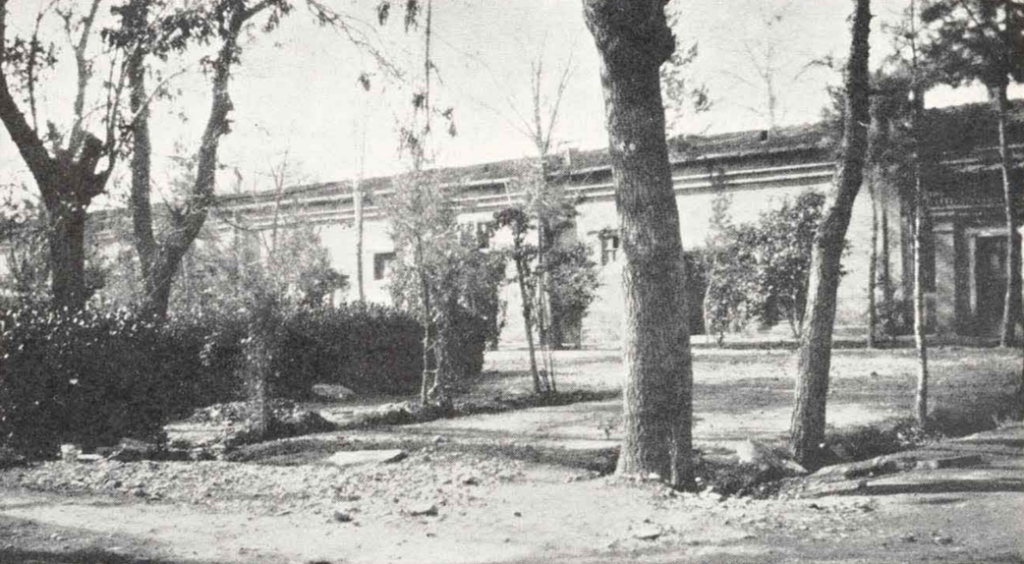
The Bahá’í community continued the work of Táhirih by giving agency to women and advancing their position in the community. Bahá’u’lláh encouraged this, writing that He had “lifted distinctions from between His servants and handmaidens, and… hath conferred upon all a station and rank of the same plane,” and had thus “broken the back of vain imaginings (in other words, disrupted the social constructs that maintain the patriarchy).”27From a Tablet of Bahá’u’lláh, in Compilation of Compilations 2 (Bahá’í Publications Australia, 1991), 357. See also Juan R. I. Cole, Modernity and the Millennium: The Genesis of the Baha’i Faith in the Nineteenth-century Middle East (Columbia University Press, 1998), 171–7.
Of course, the pronouncement of equality by the Founder of the religion did not immediately lead to full equality for women in the Bahá’í community. This was a lived, negotiated, and developing outcome, experienced within the cultural expectations and social constraints of a patriarchal society. But, as early as the 1870s, outside observers were noticing the improving position of women in the Bahá’í community. A Polish journalist visiting Baghdad and an Irish doctor born in Iran both wrote of this in the 1870s.28Jan Jasion, “‘A.J.’ and the Introduction of the Bahá’í Faith into Poland,” Bahá’í Studies 4 (1978), 31–7. Jablowonski calls the individuals he met “Babis” but that was the name by which the Bahá’ís were known throughout the nineteenth century. Edward Granville Browne, Materials for the Study of the Bábí Religion (Cambridge University Press, 1918), 262. The words that Professor Browne of Cambridge University heard in 1888 from a street peddler in Isfahan who was a Bahá’í demonstrated that this ethic of promoting women’s emancipation had penetrated all levels of the Bahá’í community: “We believe that women ought to be allowed to mix more freely with men, and should not be compelled to wear the veil.”29Edward Granville Browne, A Year among the Persians (Adam and Charles Black, 1893), 236. Individual Bahá’í women, such as Táyirih Khánum, contributed to the public discourse on women’s emancipation in the period before and after the Constitutional Revolution, writing articles for newspapers.30Dominic Parviz Brookshaw, “Women Poets,” in Literature of the Early Twentieth Century: From the Constitutional Period to Reza Shah, ed. Asghar Seyed-Gohrab (I.B. Tauris, 2015), 247–58. Afsaneh Najmabadi, “Ṭāyirih,” Nīmeh-ye Dīgar 2, no. 3 (Winter 1997), 146–95.
When the Bahá’ís began to establish a community administration at the beginning of the twentieth century, one of the first committees to be set up was a Committee for the Advancement of Women,31 Moojan Momen, “Role of Women in the Iranian Bahá’í Community during the Qajar Period,” in Religion and Society in Qajar Iran, ed. Robert M. Gleave (RoutledgeCurzon, 2005), 366, photograph, 360. and the advancement of women has remained a goal of the community up to the present. But perhaps the greatest contribution that the changes in the Bahá’í community made to the advancement of women is the progress that it made and continues to make towards the dismantling of the hierarchical social order that buttresses the patriarchy (see Part 2 of this article).
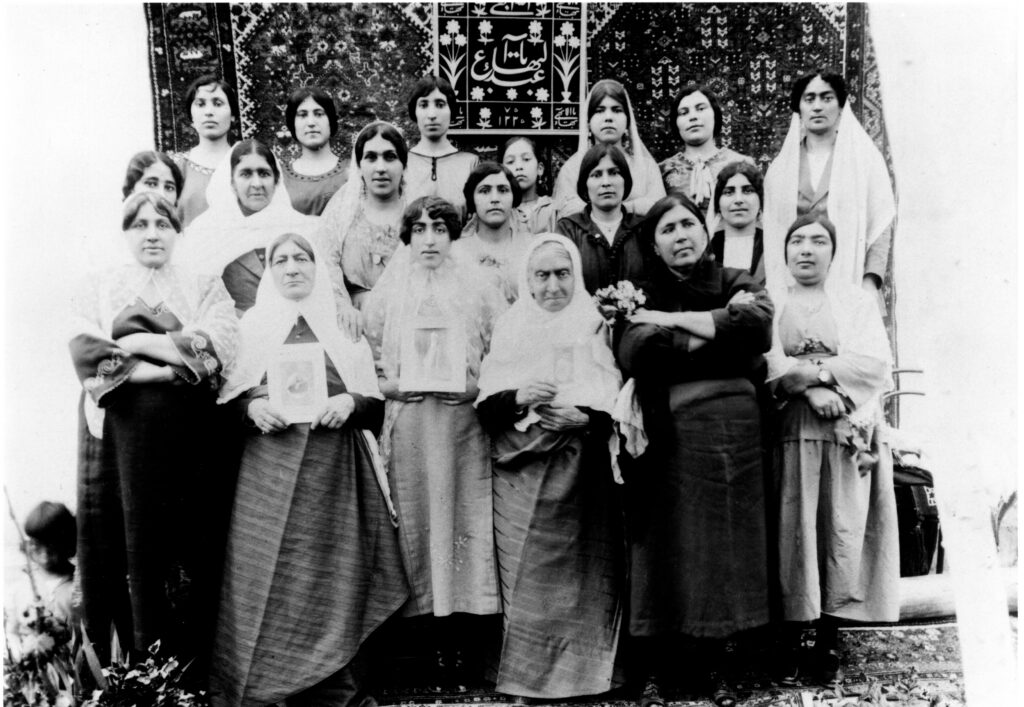
Bahá’u’lláh made it clear that His advocacy for modern education included girls as well as boys.32Bahá’u’lláh, Tablets, 128. Although urged by Western Bahá’í women to promote the unveiling of Eastern Bahá’í women (which was also a feature of the Iranian modernist discourse), ‘Abdu’l-Bahá judged that the more effective and sustainable way to promote the social advancement of women was through education. As the Bahá’í community began to build schools, ‘Abdu’l-Bahá made sure that they built girls’ schools alongside the boys’ schools, even saying that the education of girls took precedence over that of boys since they were the first educators of the next generation.33Compilation 1, 284; Compilation 2, 374. One result of this was that Iranian Bahá’í women were, in general, more educated than other women. By 1973, the Bahá’í community was able to announce a 100% literacy rate among women under 40 years of age at a time when nationally only 40% of Iranian women in this age range were literate.34Momen, “Role of Women,” 366.
It is noticeable that almost all of the Western Bahá’ís whom ‘Abdu’l-Bahá encouraged to settle in Iran to help to develop the Bahá’í community in the fields of education and health were women, who were then able to serve as role models for the Iranian Bahá’í women on how to claim agency and take on social roles.35Armstrong-Ingram, “American Bahá’í Women.”
There were other areas of life where the Bahá’ís were making innovative and radical changes ahead of what was happening in the rest of Iran, especially in agriculture and rural development, and in health and hygiene. But since the Iranian modernist reformers did not concern themselves much with these areas, there is little to compare these Bahá’í activities with and they will not be discussed here.36On agriculture, see Moojan Momen, “Social and Economic Development in an Iranian Village: The Bahá’í Community of Saysan,” Baha’i Studies Review 15 (2009): 67–81; on health and hygiene see, Seena B. Fazel and Minou Foadi, “Baha’i health initiatives in Iran: a preliminary survey,” in The Baha’is of Iran, 122–40.
CONTACTS BETWEEN THE REFORMERS AND BAHÁ’ÍS
As well as the evidence presented above that the Bahá’í leaders were ahead of the Iranian modernist reformers in the reforms they were advocating, there is also strong evidence that these reformers were in close contact with the Bahá’í leaders and the Bahá’í community. In the 1860s, two of the leading Iranian reformers were Mírzá Malkam Khán and Sayyid Jamálu’d-Dín Asadábádí (“Afghání”). The first of these was exiled to Baghdad in 1861 and is known to have met Bahá’u’lláh there. Later in 1866, he represented himself as being knowledgeable about the new religion to French scholar Ernest Renan, who encouraged him to write an article on the subject.37Hasan Balyuzi, Bahá’u’lláh: King of Glory (George Ronald, 1980), 151–3; Ernest Renan, Oeuvres Complètes 10, ed. Henriette Psichari (Calmann-Lévy, 1947–61), 453. See also Moojan Momen, The Bábí and Bahá’í Religions, 1844–1944: Some contemporary Western accounts (George Ronald, 1981), 23. Similarly, Asadábádí is said to have met Bahá’u’lláh in Baghdad, and he also represented himself as knowledgeable about the new religion such that Butrus al-Bustani asked him to contribute an article on the subject for his Arabic encyclopedia.38Nikki Keddie, Sayyid Jamāl ad-Dīn “al-Afghānī.”(University of California Press, 1972), 20–22. He tried to remain in close touch with the Bahá’í leadership, sending them copies of his newspaper al-Urwah al-Wuthqá from Paris in the 1880s.39Bahá’u’lláh, Tablets, 95.
The most consequential reformer from the next decade, the 1870s, was Mírzá Ḥusayn Khán Mushíru’d-Dawlih (Sipahsalár), who succeeded in becoming Prime Minister of Iran and began a reform agenda but was thwarted by the reactionary Iranian elite. He had at first been antagonistic to the Bahá’ís and, as Iranian ambassador to the Ottoman Government, was responsible for Bahá’u’lláh’s successive exiles from Baghdad to Istanbul, to Edirne, and to Acre. But after reading some of the letters addressed to Bahá’u’lláh by His followers after Bahá’u’lláh’s courier had been arrested in Aleppo in 1870, he realized that he had been wrong about Bahá’u’lláh. When he returned to Tehran and later became Prime Minister, he openly praised Bahá’u’lláh and protected the Bahá’ís on more than one occasion.40Ḥájí Mírzá Ḥaydar ‘Alí quoted in Balyuzi, Bahá’u’lláh, 441–4; See also Mina Yazdani, Awḍá‘-yi Ijtimá‘í-yi Írn dar ‘Ahd-i Qájár az khilál-i Áthár-i Baháʾí (Association for Bahā’ī Studies, 2003), 118–121. Information about the Bahá’í Faith probably came to him from his close friend Malkam Khán or one of his relatives who was a Bahá’í.41Moojan Momen, The Baha’i Communities of Iran 1 (George Ronald, 2015), 26, 498. Another close friend of Mushíru’d-Dawlih was Mírzá Yúsif Khán Mustasháru’d-Dawlih, who wrote the first reformist treatise to be published, Yik Kalamih. The Bahá’í scholar Mírzá Abu’l-Faḍl Gulpáygání records that he was passing through Tabriz where Mustasharu’d-Dawlih lived, and that the latter was present at a meeting where Gulpáygání debated with Reverend Robert Bruce, a British missionary, about the Bahá’í Faith.42Abu’l-Faḍá’i Gulpáygání, Rasá’il va Raqá’im (Mu’assih-yi-Milli-yi Maṭbú‘át-i Amrí 134 BE/1977), 210; Rúḥu’lláh Mihrábkhání, Zindigání-yi Mírzá Abu’l-Faḍl Gulpáygání (Bahá’í-Verlag, 1988), 125–31.
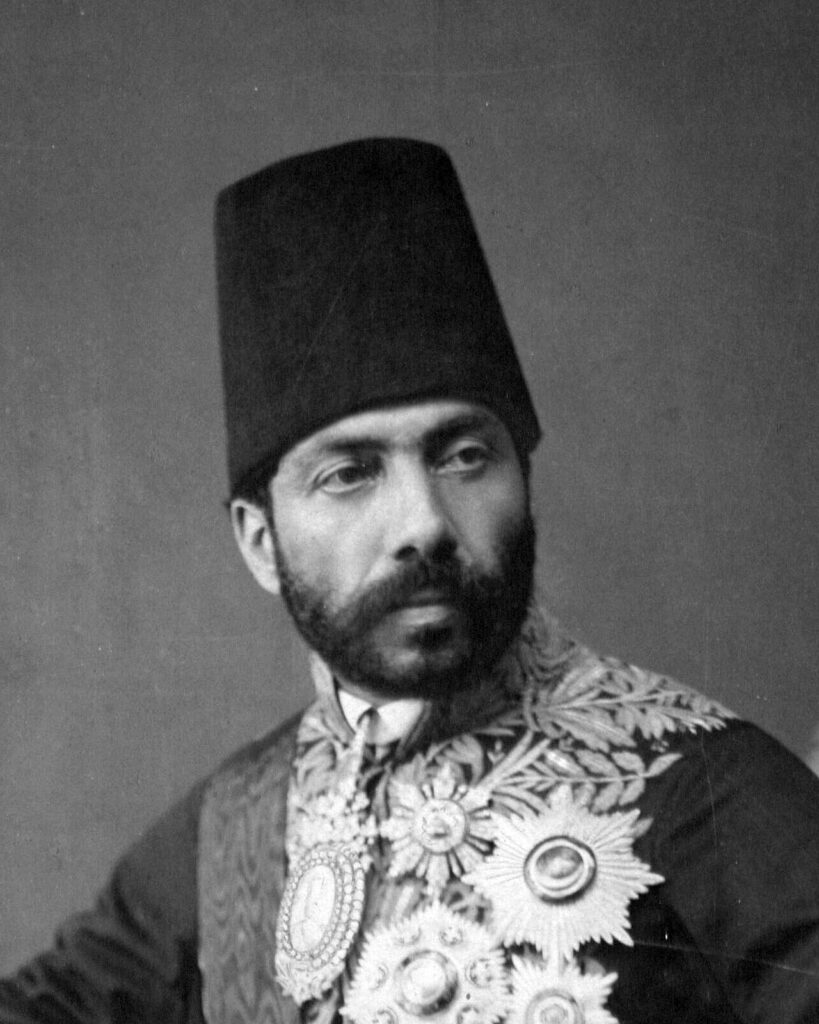
By the 1880s, there was an increasing debate about reform in Iran, fueled by newspapers and books printed outside Iran but circulated within the country. ‘Abdu’l-Bahá wrote an important treatise, the Risálih-yi Madaniyyih (The Secret of Divine Civilization), as a contribution to this debate. It was published in Bombay in 1882 and was probably only the second reform treatise (after Yik Kalamih) to be thus printed and circulated. It was published anonymously and with no overt reference to the Bahá’í Faith in it, so that prejudice against the new religion would not prevent it from being circulated and widely read. In this book, ‘Abdu’l-Bahá enters into the discourse that was going on among Iranian reformers about governmental reform and modern education, but, in contrast to these reformers, He emphasizes the need to develop a sound moral basis in society, upon which these other reforms could be established and develop.
One important focus of reform activity in the 1890s was the city of Isfahan. Here a group of modernist reformers gathered, calling themselves the Progress Society (Anjuman-i Taraqqí). It was one of the earliest such societies in Iran and did not just meet to discuss reform but carried out lines of social action, such as establishing a modern school. Almost all of the leading members of this group, which included such figures as Ḥájí Mírzá Naṣrulláh Maliku’l-Mutakallimín, Sayyid Jamál Vá`iz, Majdu’l-Islám Kirmání, Mírzá Asadu’lláh Vazír, and Mírzá Aḥmad Khán Fátiḥu’l-Mulk were at that time either Bahá’ís or closely associated with the Bahá’í community.43Momen, Baha’i Communities 2, 2:31–6. The first three named individuals moved to Tehran in 1902–3 and then became associated with the Azalí Bábís, but during the time they were in Isfahan there is no evidence that they were in contact with Azalís. Further details including evidence of these individuals being Bahá’ís or closely associated with the Bahá’í community in Isfahan can be found in Moojan Momen, “The Reform Movement in Isfahan, Iran: the role of Bábís and Bahá’ís,” Religions 17(6), (2026), 717; mdpi.com/2077-1444/17/6/717.
In the next decade, the 1900s, similar to the situation in Isfahan in the 1890s, almost all of the leading members of the reform movement in Sari in Mazandaran were either Bahá’ís or closely associated with the Bahá’í community. They set up the Anjuman-i Ḥaqíqat (The Truth Society) and undertook such activities as establishing a modern school.44Moojan Momen, “The Baha’is and the Constitutional Revolution: The Case of Sari, Mazandaran, 1906–1913,” Iranian Studies 41, no. 3 (2008), 343–363. Elsewhere in Iran, leading Constitutionalists such as Ḥájí Abu’l-Ḥasan Mírzá Shaykhu’r-Ra’ís were known to have been Bahá’ís,45Juan R. I. Cole, “Autobiography and Silence: The Early Career of Shaykh al-Ra’īs Qājār,” in Iran im 19. Jahrhundert und die Enstehung der Bahā’ī Religion, ed. Christoph Bürgel and Isabel Schayani (Georg Olms, 1998), 91–126; Juan R. I. Cole, “The Provincial Politics of Heresy and Reform in Qajar Iran: Shaykh al-Rais in Shiraz, 1895–1902,” Comparative Studies of South Asia, Africa and the Middle East 22, nos.1–2 (2002): 119–126; Momen, Baha’i Communities 1, 128–31. while Muḥammad Valí Khán Tunukábuní (Naṣru’s-Salṭanih, Sipahsalár-i A‘ẓam) and ‘Alí Qulí Khán Sardár As‘ad Bakhtiyárí, the two military leaders who led the Constitutionalist forces in their capture of Tehran in 1909, thus ending Muḥammad `Alí Sháh’s attempt to overthrow the Constitution, were both in close touch with the Bahá’í community, and both met ‘Abdu’l-Bahá in Paris.46Moojan Momen, “Who Was a Bahā’ī in the Upper Echelons of Qājār Iran?” Religions, 14, no. 4 (2023): 469, mdpi.com/2077-1444/14/4/469. Published in The Bahā’ī Faith: Doctrinal and Historical Explorations, ed. Moojan Momen and Zachery Heern (MDPI, 2024), 119–31.
Also of great interest and demonstrating the extent to which the modernist reformers looked to and may in some measure have modelled themselves on the Bahá’í community is the report by Náẓimu’l-Islám Kirmání, a historian who was closely involved with the reform movement, of the discussion at a meeting in March 1905 of the leading reformers at which he was present and where it was suggested that the reformers should look to the successful methods and tactics of the Bahá’ís for inspiration.47 Náẓimu’l-Islám Kirmání, Táríkh-i Bídárí-yi Írániyán (Amír Kabír, 1387/2008), 1:189. The text reads “Bábís,” but this is what the Bahá’ís were called at this time and it is unlikely that this refers to the Azalí Bábís, since they dissimulated their beliefs and were not known as an active group by this name.
There were also other factors that made it likely that the Bahá’ís may have been influencing Iranian society much more effectively than is often appreciated. In explaining their ideas, drawn as they were from European writings, the modernist reformers were introducing into their texts European terms and thus using words and concepts that were not immediately understandable to most Iranians and appeared as a rupture with Iranian culture. But the Bahá’í texts used words and ideas that were rooted in Iranian culture and therefore easily understood.48Ghazaleh Faridzadeh and Raed Faridzadeh, “Negotiating Freedom: Mostašār od-Doule’s Yek kalame and the Iranian Constitutional Experience,” Die Welt des Islams 61 (2021): 390–91; Algar, Malkam Khān, 27, 29; Nashat, Origins, 162–3. Indeed, the concept of the progressive revelation of religious truth, introduced by the Báb and developed by Bahá’u’lláh, created a pathway for a gradual organic modernization, in keeping with the culture of the nation and granting agency to all individuals in society.49Abbas Amanat, Iran: A Modern History (Yale University Press, 2017), 239–40.
Moreover, it should be borne in mind that the number of people engaged in the project of the Iranian reformers was very small, the readership for the writings they produced was very limited, and the ability of this small group to carry out any of their suggested changes was very constrained. Mahdí Malikzádih, who was himself part of the reform movement, suggests that the number in the reform circle in the last decades of the nineteenth century was only a few hundred,50Malikzádih, Tarikh, 1:69. and these reformers were operating within secret societies and only in a handful of large cities. By contrast, the Bahá’í community had a much greater membership (estimated to be 100,000 or more),51Peter Smith, “A Note on Babi and Baha’i Numbers in Iran,” Iranian Studies 17, no. 2/3 (Spring-Summer, 1984), 295–301. was distributed across the country, even in small towns and villages, and the Bahá’ís were trying to put these ideas into practice insofar as circumstances allowed.
The above evidence demonstrates that in decade after decade from the 1860s onward, the ideas put forward in the Bahá’í texts were presented earlier, more developed, and more easily understood than what appeared in the discourse and texts of the modernist reformers, and the Bahá’ís were implementing these changes in their communities scattered across the whole of Iran. Given this and the evidence presented above that many of the leading modernist reformers were in close touch with the Bahá’í leaders and the community, it is not unreasonable to suggest that Bahá’í ideas had some influence on the thinking of the reformers. The extent to which this may have occurred requires further research, as it would be hidden by these reformers to forestall opposition and persecution.
ATTACKS AND SETBACKS
Inevitably, the radical changes that the Bahá’í community was trying to make were either misunderstood or deliberately misrepresented to the people of Iran. And so, for example, the Bahá’í endeavor to advance the social role of women led to allegations of sexual immorality. The efforts of the Bahá’í community to introduce modern education led to claims that the Bahá’ís were trying to introduce foreign ideas into Iran. The ethos of modernity and progress cultivated within the Bahá’í community gave rise to accusations that the Bahá’ís were trying to undermine Iran’s culture and even, in later years, to conspiracy theories, which continue to the present day, that the Bahá’ís are agents of foreign powers. The global vision inculcated in the Bahá’í scriptures led to accusations that the Bahá’ís did not care about the welfare and progress of Iran. All of this led to persecution of the Bahá’í community by the religious leaders of Iran, who then recruited the intellectuals and politicians in their campaign against the Bahá’ís.
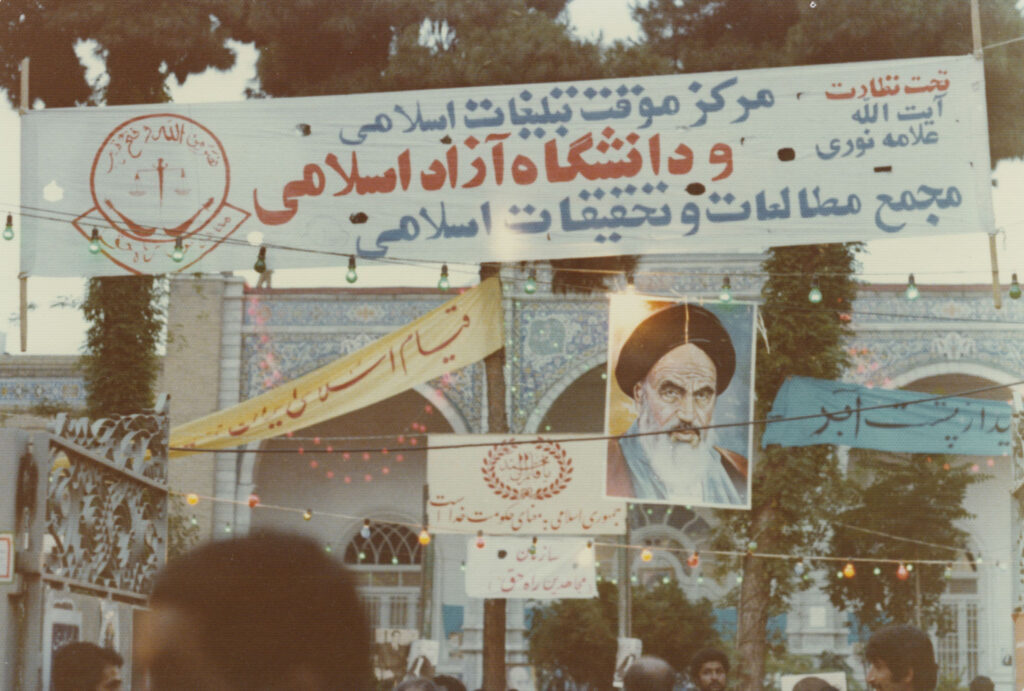
Although the Bahá’í community was striving to advance all of these areas of social progress, the constant persecution and the consequent social constraints that the community suffered did limit their efforts and cause setbacks. The hostile environment created by the opposition of the religious leadership in the country, and often the government, led to a situation in which the only public discourse about the community was hostile attacks. Even many of the secular nationalist reformers, whom one might have thought would have welcomed the Bahá’í social agenda, were contributing to these attacks by the time of Reza Shah’s reign.52 Mohammad Tavakoli-Targhi, “Anti-Baha’ism and Islamism in Iran,” in The Baha’is of Iran, 200–231; Chehabi, “Anatomy.”
The most public face of the Bahá’í community was its schools, and these were vehemently opposed by the Islamic religious leaders, many of whom were opposed both to all modern education and to any Bahá’í initiatives. In several instances, these schools were wrecked or closed down by the authorities, until finally the national government closed all of them permanently in 1934.53Shahvar, Forgotten Schools, 107–30. Another area where the efforts of the Bahá’í community were held back was in the social advancement of women. Thus, although women were able to vote for the Bahá’í leadership councils from 1923, it took until 1954 before conditions were right for them to be elected to these councils.54 Momen, “Role of Women,” 366. In all, there was a constant barrage of black propaganda against the community.
CONCLUSION
At no time since its founding in the latter part of the nineteenth century has the Bahá’í community been free to pursue its agenda for social reform or to enter into Iranian public discourse. The people of Iran have received only falsified facts and fanciful conspiracy theories about the Bahá’ís.55 See the examples provided by Chehabi in “Anatomy,” 186–94 of false allegations that Bahá’ís were enemies of the Iranian nation, tools of Russian and British imperialism, and prominent in the Shah’s regime; see also Reza Afshari, “The Discourse and Practice of Human Rights Violations of Iranian Bahaʾis in the Islamic Republic of Iran,” in The Baha’is of Iran (Routledge, 2008); Tavakoli-Targhi, “Anti-Baha’ism”; Vahman, 175 Years. As a result, Iranians have remained widely ignorant of the achievements of the Bahá’í community and the extent to which it has assisted the development of Iran.
In the mid-nineteenth century, Iran was in urgent need of reform and modernization. Two possible routes presented themselves: that of the modernist reformers and that of the Bahá’í community. In this article, we have traced the earliest suggestions made by the Iranian modernist reformers and pointed out that, in most instances, the Bahá’í leaders were making suggestions that were earlier and more progressive than those of the modernist reformers. It should not surprise us, however, that evidence for a direct influence of the Bahá’í teachings on the reformers is difficult to find, since it would have resulted in rejection and even danger for the reformers to admit to being influenced by a persecuted and reviled religious community. Given the evidence presented here that these modernist reformers were in many cases in close contact with the Bahá’í community and in some cases with the Bahá’í leadership, it would seem likely that at least some of the discourse of the modernist reformers was influenced by the Bahá’í teachings.
The triumph of the Western social order was widely heralded in the closing decades of the twentieth century. “The end of ideology” was proclaimed and an age of global prosperity anticipated, driven by the twinned forces of global free-market capitalism and liberal democracy.1Daniel Bell, The End of Ideology (Cambridge, Mass: Harvard University Press, 1988). In the ensuing years, the vacuum left by the collapse of the Soviet Union, along with new tensions created by a perceived “clash of civilizations,”2Samuel Huntington, The Clash of Civilizations and the Remaking of World Order (New York: Simon & Schuster, 1996). has propelled advocates of free-market capitalism and Western liberal democracy to step up their efforts to export or impose these models around the world in former communist states, Muslim nations, and elsewhere.
To date, the global free-market capitalism aspect of this project has been the subject of considerable critique in both the popular and academic press.3Refer, for instance, to Joseph Stiglitz, Globalization and its Discontents (New York: W.W. Norton, 2002); Jeffry Frieden, Global Capitalism (New York: WW. Norton, 2006); John Cavanagh, Alternatives to Economic Globalization (San Francisco: Berrett-Koehler, 2002); Naomi Klein, No Logo (New York: Picador, 2002); David Korten, When Corporations Rule the World (West Hartford, Connecticut: Kumarian Press, 1995).
It has also spawned a network of global justice organizations and activists who have become ever more visible and vocal through various strategies, including mass protests and internet organizing. Concerns have been raised about the increasing global disparities of wealth and poverty; the absence of environmental and labor standards and enforcement mechanisms in the global marketplace; the devastating impacts of currency speculation and trans-national capital flight; the rising and largely unregulated power of multi-national corporations; the undemocratic nature of global financial institutions and trade organizations; and a host of other issues.
Significantly, these critiques of the global free-market capitalism project have frequently come from authors and activists within the Western world itself. The same cannot be said, however, of the project to export liberal democracy. Throughout the West, it is still generally assumed that the Western democratic model is the natural and inevitable way to organize free and enlightened societies.
But there is an alternative perspective. Could it be said that Western liberal democracy—or what might more accurately be called competitive democracy—has become anachronistic, unjust, and unsustainable in an age of increasing global interdependence?4This essay derives in part from the author’s previously published book entitled Beyond the Culture of Contest: From Adversarialism to Mutualism in an Age of Interdependence (Oxford: George Ronald, 2004). Permission has been granted, by the publisher, to extract and adapt sections of that book for the purpose of this essay. “The signs of impending convulsions and chaos can now be discerned,” wrote Bahá’u’lláh, “inasmuch as the prevailing order appeareth to be lamentably defective.”5Bahá’u’lláh, Gleanings from the Writings of Bahá’u’lláh, (Wilmette, Il: Bahá’í Publishing Trust, 2005), p. 216. Available at www.bahai.org/r/384112768
COMPETITIVE DEMOCRACY
Western liberal democracy, at its core, is based on the premise that democratic governance requires individuals and groups to compete for political power. The most recognizable form that this takes is the party system. Political competition also occurs without formal political parties in many local elections, and when independent candidates run in provincial (or state) and national elections. In all of these cases, however, the underlying competitive structure is the same, and it is this underlying structure that has become anachronistic, unjust, and unsustainable.
Granted, competitive democracy represents a significant and valuable historical accomplishment. It has proven a more just form of government than the aristocratic, authoritarian, or sacerdotal forms of governance it has generally replaced. It also represents a reasonable adaptation to the social and ecological conditions prevailing at the time of its emergence. But the theory and practice of political competition emerged in the earliest days of the West’s industrial revolution, when human populations were still relatively small and isolated. It predates the invention of electricity, the internal combustion engine, air travel, broadcast media, computers, the internet, weapons of mass destruction, appetites of mass consumption, and global free-market capitalism. In the past three centuries, our success as a species has transformed the conditions of our existence in these and many other ways.
Competitive democracies, for reasons that will be discussed here, appear to be incapable of dealing with these new realities. Yet Western populations are, by and large, living in a state of denial regarding the anachronistic nature of competitive political systems. When concerns are raised about the condition of these systems they tend to focus on surface expressions rather than underlying structural causes. For instance, in many Western countries it has become commonplace to bemoan the increased negativity of partisan political rhetoric. Political discourse, some commentators suggest, is suffering from a breakdown in civility and a rise of mean-spiritedness. As a result, politicians are mired in a gridlock and cannot address the complex issues that face them.6Refer, for example, to Deborah Tannen, The Argument Culture (New York: Random House, 1998). Even many elected politicians have raised these concerns. In a collection of essays by retiring U.S. Senators at the close of the twentieth century, one was moved to “lament the increasing level of vituperation and partisanship that has permeated the atmosphere and debate in the Senate.7Norman Orstein, “Introduction,” Lessons and Legacies: Farewell Addresses from the Senate (Reading, Mass: Addison-Wesley, 1997), p. xi. One observed that “bipartisanship… has been abandoned for quick fixes, sound bites, and, most harmfully, the frequent demonization of those with whom we disagree.”8Howell Heflin, “Farewell Address,” Lessons and Legacies: Farewell Addresses from the Senate (Reading, Mass: Addison-Wesley, 1997), p. 79. Another claimed that “there is much more partisanship than when I came to Washington two decades ago, and most of it serves the nation poorly.”9Paul Simon, “Farewell Address,” Lessons and Legacies: Farewell Addresses from the Senate (Reading, Mass: Addison-Wesley, 1997), p. 172. Yet another wrote that “our political process must be re-civilized” due to the “ever-increasing vicious polarization of the electorate, the us-against-them mentality” that “has all but swept aside the former preponderance of reasonable discussion.”10James Exon, “Farewell Address,” Lessons and Legacies: Farewell Addresses from the Senate (Reading, Mass: Addison-Wesley, 1997), p. 57.
Statements such as these raise legitimate concerns about the state of partisan discourse, but they obscure the underlying problem of political competition. According to these views, political competition and political parties are the natural, normal, and inevitable way to organize democratic governance; the problem arises only when partisan rhetoric becomes too adversarial or mean-spirited. As the socio-linguist Deborah Tannen states: “a kind of agonistic inflation has set in whereby opposition has become more extreme, and the adversarial nature of the system is routinely being abused.”11Deborah Tannen, The Argument Culture (New York: Random House, 1998), p. 96. Tannen attributes this “more general atmosphere of contention,” or this “new mood” in partisan politics, to a wider combative culture that is corrupting the partisan system and socializing politicians into more conflictual patterns of interaction, resulting in gridlock, the spread of corruption, and the breakdown of unwritten rules of civility, cooperation, and compromise.12Deborah Tannen, The Argument Culture (New York: Random House, 1998), pp. 96–100.
THE SEEDS OF COMPETITIVE DEMOCRACY
The breakdown in civility, the rise of mean-spiritedness, the problem of gridlock, and the spread of political corruption—assuming these things have indeed deteriorated over time—are not abuses or corruptions of the partisan system. Such developments are the culmination—the “perfection”—of a system that political scientist Jane Mansbridge refers to as “adversary democracy.”13Jane Mansbridge, Beyond Adversary Democracy (Chicago: The University Of Chicago Press, 1980). They are the sour fruit inherent in the seeds of competitive democracy. “No two men can be found who may be said to be outwardly and inwardly united,” wrote Bahá’u’lláh.14Bahá’u’lláh, Gleanings from the Writings of Bahá’u’lláh, (Wilmette, Il: Bahá’í Publishing Trust, 2005), p. 218. Available at www.bahai.org/r/625568372
These seeds, to be more precise, are the deepest assumptions about human nature and social order that underlie political competition. The first of these assumptions is that human nature is essentially selfish and competitive. The second assumption is that different groups of people will naturally develop different interests, needs, values, and desires, and these interests will invariably conflict. The third assumption is that, given a selfish human nature and the problem of conflicting interests, the fairest and most efficient way to govern a society is to harness these dynamics through an open process of interest-group competition.
Based on these assumptions, it should come as no surprise that the fruits of competitive democracy include the aforementioned breakdown in civility, rise of mean-spiritedness, problem of gridlock and spread of political corruption. These are to be expected if we accept, and enact such assumptions. In fact, this is the reason why some competitive democracies have set up complex systems of checks and balances in an effort to limit the excessive accumulation of power in the hands of any given interest group. It is also why some competitive democracies have tried to cultivate, within their political systems, codes of civility and ethics intended to restrain the basest expressions of political competition. And this is the reason that most competitive democracies struggle, to this day, to reign in the worst excesses of political competition by experimenting with term limits, campaign finance reforms, and other stop-gap measures. Yet none of these efforts fundamentally changes the nature or the fruit of the system, because the fruit is inherent in the system’s internal assumptions—its seeds.
To grasp this inherent relationship, consider the market metaphor that is often invoked as a model for political competition. Competitive democracy is generally conceived as a political marketplace within which political entrepreneurs and the parties they incorporate try to advance their interests through open competition.15Refer to discussions of this theme in Joseph Schumpeter, Capitalism, Socialism and Democracy (New York: Harper, 1976) and Anthony Downs, An Economic Theory of Democracy (New York: Harper and Row, 1965). The “invisible hand” of the market allegedly works to direct this competition toward the maximum public benefit. As Lyon explains, supporters of party government argue that if one looks at the larger picture and sees the “political market” in which several parties, the media, interest groups, and individuals all interact, democratic needs are served in a kind of mysterious way… [as though] another “invisible hand” is at work.16Vaughan Lyon, “Green Politics: Parties, Elections, and Environmental Policy,” Canadian Environmental Policy: Ecosystems, Politics, and Process, ed. Robert Boardman (Toronto: Oxford University Press, 1992), p. 129.
Within this market model, political parties incorporate around aggregated sets of interests in order to pool their political capital. Contests then determine leadership and control within and between parties—as politicians and parties organize to fight and win elections. The logic of competitive elections, however, ensures that the goal of winning trumps all other values. As Held explains:
Parties may aim to realize a programme of ‘ideal’ political principles, but unless their activities are based on systematic strategies for achieving electoral success they will be doomed to insignificance. Accordingly, parties become transformed, above all else, into means for fighting and winning elections.17David Held, Models of Democracy, 2 ed. (Stanford: Stanford University Press, 1996)170.
Once political leadership and control is determined through electoral contests, processes of public decision-making are structured in a similar manner. Decision-making is organized as an oppositional process of debate. In theory, political debate functions as an open “market-place of ideas” in which the best ideas prevail—again through the operation of some hypothetical invisible hand. In practice, the logic of the competitive system transforms debate into a struggle over political capital. Victory results in a gain of political capital, defeat results in a loss. Debate thus becomes an extension of the electoral process itself, providing a stage for “permanent campaigns,” or never-ending contests over political capital, in anticipation of the next round of elections.18Sydney Blumenthal, The Permanent Campaign (Boston: Beacon, 1980).
Much political decision-making also occurs outside of formal public debates. Indeed, these debates often serve as little more than a dramatic veneer on complex behind-the-scenes processes of political bargaining and negotiation. Yet these behind-the-scenes processes tend to be characterized by similar competitive dynamics.19Refer, for example, to Eleanor Clift and Tom Brazaitis, War without Bloodshed: The Art of Politics (New York: Touchstone, 1997). These processes involve not only elected officials but also lobbyists, think tanks, media strategists, and numerous species of political action groups—all of whom are vying with one another to pressure politicians, shape media coverage, and influence public opinion in ways that advance their own agendas and interests.
THE FRUIT OF COMPETITIVE DEMOCRACY
Interest-group competition has no necessary relationship to the goals of social justice and environmental sustainability. On the contrary, the track record of competitive democracy is clear. It is a record of growing disparities between rich and poor.20Frank Ackerman, The Political Economy of Inequality (Washington DC: Island Press, 2000); Isaac Shapiro and Robert Greenstein, The Widening Income Gulf (Washington, DC: Center on Budget and Policy Priorities, 1999); Albert Fishlow and Karen Parker, Growing Apart : The Causes and Consequences of Global Wage Inequality (New York: Council on Foreign Relations Press, 1999); Stephen Haseler, The Super Rich: The Unjust New World of Global Capitalism (New York: St. Martin’s Press, 1999). It is also a record of accelerating ecological destruction.21Lester Brown, Christopher Flavin and Hilary French, eds., State of the World 2000: A Worldwatch Institute Report on Progress toward a Sustainable Society (New York: W.W. Norton & Company, 2000); David Suzuki and Holly Jewell Dressel, From Naked Ape to Superspecies: Humanity and the Global Eco-Crisis (Vancouver: Greystone Books, 2004); Lester Brown, Michael Renner, Linda Starke and Brain Halweil, eds., Vital Signs 2000: The Environmental Trends That Are Shaping Our Future (New York: Norton, 2000).
Therefore the problems of competitive democracy, a few of which are discussed here, go well beyond the breakdown of civility and the rise of mean-spiritedness.
THE CORRUPTING INFLUENCE OF MONEY
In theory, when there are excesses and deficiencies in the operation of the market economy, a democratic government should be able to regulate and remedy these. The practice of political competition, however, makes this virtually impossible. The reasons for this are not difficult to understand. Political competition is an expensive activity—and growing more expensive with every generation. Successful campaigns are waged by those who have the financial support, both direct and indirect, of the most affluent market actors (i.e., those who have profited the most from market excesses and deficiencies).
The problem of money in politics is widely recognized and it largely explains the cynicism and apathy reflected in low voter turnout at the polls. The underlying cause of this problem, however, is seldom examined and never seriously addressed. We hear occasional calls for campaign finance reform and similar regulatory measures. Yet the root of the problem is political competition itself. From the moment we structure elections as contests, which inevitably require money to win, we invert the proper relationship between government and the market. Rather than our market existing within the envelope of responsible government regulation, our government is held captive within the envelope of market regulation.
As long as governance is organized in a competitive manner, this relationship cannot be fully corrected. Any scheme to tweak the rules here and there will merely cause money to flow through new paths. This is what occurs, for instance, with attempts to reform campaign financing. New forms of contribution merely eclipse the old. Even if societies could eliminate campaign financing entirely, money would simply flow through other points of political influence such as the constantly evolving species of political action groups that exert strategic influences over media coverage of issues, public opinion formation, electoral outcomes, and many other political processes. In a competitive political system, where candidates are vying for favorable coverage, public opinion, and votes, money will always flow to the most effective points of political influence just as water always flows to the point of lowest elevation. We can alter the path of that flow, but we cannot stop it.
This problem is a primary cause of the growing disparities of wealth and poverty that are now witnessed throughout the world, including within the Western world. The expanding income gap is not simply a result of the market economy itself. It is a result of the competitive political economy that is coupled with it. Through this political economy, the wealthiest market actors define the market framework within which they accumulate wealth. This framework comprises systems of property law, contract law, labor law, tax law, and all other forms of legislation, public infrastructure, and public subsidies that shape market outcomes. In competitive democracies this framework is defined, over time, by the wealthiest market actors, owing to the influence of money on political competition. The result is a political-economy feedback loop that serves the swelling interests of the wealthiest segments of society.
The subordination of governance to market forces also has implications for the environment. In unregulated markets, production and consumption decisions are based solely on the internal costs of manufacturing, which include labor, materials, manufacturing equipment and energy. These internal costs determine the retail prices that consumers pay for products, which influences how much people consume. These costs do not, however, always reflect the true social or ecological costs of a product. Many industries generate external costs, or externalities, that are never factored into the price of a product because they are not actual production costs.22For an overview of the problem of externalities, refer to James A. Caporaso and David P. Levine, Theories of Political Economy (Cambridge: Cambridge University Press, 1992), pp. 89–92. For instance, industries that pollute the environment create substantial public health and environmental remediation costs that are seldom factored into the actual costs of production. Rather, these costs are borne by the entire society, by future generations, and even by other species. Because an unregulated market does not account for these external costs, the prices of products with high external costs are kept artificially low. These artificially low prices inflate consumption of the most socially and ecologically damaging products. For these reasons, market economies are ecologically unsustainable unless carefully regulated by governments that factor such costs back into the prices of goods through “green taxes” and other means.23Refer, for instance, to proposals in Henk Folmer, ed., Frontiers of Environmental Economics (Cheltenham, UK: Edward Elgar, 2001); Thomas Aronsson and Karl-Gustaf Löfgren, Green Accounting and Green Taxes in the Global Economy (Umeå: University of Umeå, 1997); and Robert Repetto, Green Fees: How a Tax Shift Can Work for the Environment and the Economy (Washington, DC: World Resources Institute, 1992).
As discussed above, however, markets are not responsibly regulated within a competitive political system because the system subordinates political decision-making to market influences. Markets regulate competitive democracies rather than the other way around.
Finally, the social and environmental costs of political competition converge in the case of “environmental racism” and related environmental injustices.24Refer, for instance, to Michael Heiman, Race, Waste and Class (Oxford: Blackwell, 1996); Joan Nordquist, Environmental Racism and the Environmental Justice Movement: A Bibliography (Santa Cruz, CA: Reference and Research Services, 1995); Jonathan Petrikin, Environmental Justice (San Diego, CA: Greenhaven Press, 1995); Robert Bullard, ed., Confronting Environmental Racism: Voices from the Grassroots (Boston, Mass: South End Press, 1993). The poor, ethnic minorities, and women tend to suffer the most from the effects of environmental degradation because they are more likely to live or work in areas of increased environmental health risks and degradation. These segments of the population are least able to influence political decision-making due to their economic disenfranchisement. As a result, environmental practices that are seldom tolerated in the backyards of more affluent groups are displaced onto groups that are politically and economically marginalized. These are the people who pay most of the costs of such environmental externalities.
PERSPECTIVE EXCLUSION AND ISSUE REDUCTION
In addition to the problem of money, political competition does not provide an effective way to understand and solve complex problems because it reduces the diversity of perspectives and voices in decision-making processes. There are a number of reasons for this. First, political competition yields an adversarial model of debate which generally defaults to the premise that if one perspective is right then another perspective must be wrong. In theory, the most enlightened or informed perspective prevails. This assumes that complex issues can adequately be understood from a single perspective. However, an adequate grasp of most complex issues requires consideration of multiple, often complementary, perspectives. Complex issues tend to be multifaceted—like many-sided objects that must be viewed from different angles in order to be fully seen and understood. Different perspectives therefore reveal different facets of complex issues. Maximum understanding emerges through the careful consideration of as many facets as possible.
Political competition militates against this process because it assumes the oppositional rather than the potentially complementary character of diverse views. One cannot gain political capital at the expense of one’s opponent unless there is a winner and a loser. As a result, political competition reduces complex issues into binary oppositions in which only one perspective can prevail. This is what Blondel calls “the curse of oversimplification.”25Jean Blondel, Political Parties: A Genuine Case for Discontent? (London: Wildwood House, 1978), pp. 19–21.
This problem is exacerbated by the hyper-commercialized media sectors that are emerging in most Western societies—products of the political economy discussed above. These are driven by the logic of manufacturing mass audiences in order to sell them to advertisers. The cheapest, and therefore most profitable, way to manufacture a mass audience is through the construction of spectacle—including partisan political spectacle. Political coverage is thus reduced to a formula of sound-bite politics in which emotionally charged sloganeering becomes the ticket into the public sphere. As a result, simplistic political mantras echo throughout the public sphere, distorting the complex nature of the issues at hand, constraining public perceptions, and aggravating partisan divisions. In such a climate, it is virtually impossible to solve complex, multi-dimensional, social, and environmental problems.
A closely related consequence of this competitive model is the exclusion and inhibition of diverse voices who avoid or withdraw from the arena of public service because of its simplistic and hostile atmosphere. Such an atmosphere does not attract individuals who, by nature or nurture or some combination of the two, are neither inclined toward nor comfortable with simplistic adversarial debate—even though they may have important contributions to offer. Partisan mudslinging aside, adversarial debate does not elicit the best reasoning even among the most confident individuals. Such conditions can entirely silence less confident and less aggressive—or simply more thoughtful and caring—individuals.
By extension, adversarial contests also tend to privilege males who, again by nature or nurture or some combination of the two, tend to be more aggressive than women and thus gain the advantage within an adversarial arena.26Janice Moulton, “A Paradigm of Philosophy: The Adversary Method,” Discovering Reality: Feminist Perspectives on Epistemology, Metaphysics, Methodology, and Philosophy of Science, eds. Sandra Harding and Merrill Hintikka (Boston, MA: Kluwer Boston., 1983); Robin Lakoff, Language and Woman’s Place (New York: Harper & Row, 1975). The resulting disadvantage experienced by many women may also be experienced by some minority groups who, in order to survive, have learned to adopt cautious and guarded postures in relation to dominant social groups. Moreover, women and minorities may be further disadvantaged because even though male or dominant-group expressions of aggression are often considered natural and appropriate, the same kinds of expressions, when employed by women or subordinated minorities, are often viewed as unnatural and inappropriate. Thus the same rewards do not necessarily accrue to women and minorities for the same adversarial behaviors.27Moulton, “Adversary Method.”; Lakoff, Language and Woman’s Place.
By inhibiting and excluding various social groups in these ways, political competition and adversarial debate tends to impoverish public discourse and undermine the resolution of complex problems.
THE TIME-SPACE PROBLEM
Partisan politics is also inherently incapable of addressing problems across time and space. Complex social and environmental issues generally require long-term planning and commitment. Competitive political systems, however, are inherently constrained by short-term planning horizons. In order to gain and maintain power, political entrepreneurs must cater to the immediate interests of their constituents so that visible results can be realized within relatively frequent election cycles. Even when long-term political commitments are made out of principle by one candidate or party, continuity is often compromised by succeeding candidates or parties who dismantle or fail to enforce the programs of their predecessors in order to distance themselves from policies they were previously compelled to oppose on the campaign trail or as the voice of opposition. The focus of campaigns and political parties on constituencies-in-the-present therefore undermines commitment to the interests of future generations. Prominent among the interests of future generations is environmental sustainability. As we degrade our environment today, we impoverish future generations.
Many social problems, from poverty to crime to drug dependency to domestic abuse, also require long-term strategies and commitments. Sustained investments in education, the strengthening of families, the creation of economic opportunities, the cultivation of ethical codes and moral values, and other approaches that yield results across generations, are required. Yet the competitive pressure to demonstrate visible actions within frequent election cycles tends to lead instead toward investments in things like new prisons and detention centers to hide the growing social underclass in many countries; new mega-schools to warehouse increasingly alienated and anonymous children and youth; and new shopping malls to distract citizens with short-term material enticements.
Furthermore, just as competitive political systems are responsive to constituents-in-the-present at the exclusion of future generations, they are also responsive to the interests of constituents-within-electoral-boundaries at the exclusion of others. This is the problem of space—or territoriality—which is especially the case at the level of the nation state owing to the absence of an effective system of global governance. Again, this has significant social and ecological implications. The supra-national nature of modern environmental issues—such as ozone depletion, global warming, acid rain, water pollution, and the management of migratory species—signals the need for unprecedented levels of global cooperation and coordination. 28World Commission on Environment and Development, Our Common Future (Oxford: Oxford University Press, 1987).
Competitive notions of national sovereignty, however, render the existing international system incapable of responding to these ecological imperatives. Today, cross-border coordination is sacrificed to the pursuit of national self-interests because political entrepreneurs have no choice but to cater to the interests of their own voting citizens. The consequence is an anarchic system of nation states vying with one another in their rush to convert long-term ecological capital into short-term political capital.
The problem of territoriality is equally significant when it comes to social issues. Challenges such as poverty, crime, the exploitation of women and children, human trafficking, terrorism, ethnic conflict, illegal immigration and refugee flows do not respect national boundaries any more than most ecological problems do. These problems cannot be solved by national governments alone. Yet political competition within nation states undermines effective commitment and coordination between them. Political competitors are responsive to the interests of voting constituents-within-electoral-boundaries to the exclusion of non-voters outside of those boundaries. This creates an irresistible incentive for political competitors in wealthy nations to externalize the worst manifestations of these social problems on poorer nations. Consequently, in the long run all of these problems tend to fester and spread until they again threaten the interests of the wealthiest nations. Competitive politics is not about planning for the long term; it is about securing electoral victories in the short term. Hence the problem of space is inseparable from the problem of time in competitive democracies.
THE SPIRITUAL PROBLEM
Other challenges associated with competitive politics are less tangible, but no less important. These are the spiritual costs of partisanship and political competition. Again, these problems stem directly from the assumptions that underlie the model: that human nature is essentially selfish and competitive; that different people tend to develop conflicting interests; and that the best way to organize democratic governance is therefore through a process of interest-group competition. By organizing human affairs according to these assumptions we are institutionally cultivating our basest instincts. In the process, we become what we expect of ourselves. The Universal House of Justice has observed that “it is in the glorification of material pursuits, at once the progenitor and common feature of all such ideologies, that we find the roots which nourish the falsehood that human beings are incorrigibly selfish and aggressive. It is here that the ground must be cleared for the building of a new world fit for our descendants.”29The Universal House of Justice, “The Promise of World Peace” (Haifa: Bahá’í World Centre, 1985), p. 6.
These culturally-formed expectations, however, have no solid basis in the social and behavioral sciences. In these fields, the emerging new consensus is that human beings have the developmental potential for both egoism and altruism, competition and cooperation—and which of these potentials is more fully realized is a function of our cultural environment.30For a joint declaration of this consensus by an international assembly of social and behavioral scientists, refer to the Seville, “Statement on Violence, May 16, 1986” Medicine and War 3 (1987). Refer also to discussions in Signe Howell and Roy Willis, “Introduction,” Societies at Peace: Anthropological Perspectives, eds. Signe Howell and Roy Willis (London: Routledge, 1989); Richard Leakey and Roger Lewin, Origins: What New Discoveries Reveal About the Emergence of Our Species (London: MacDonald & Jane’s, 1977); Gary Becker, “Altruism, Egoism, and Genetic Fitness: Economics and Sociobiology,” Journal of Economic Literature 14.3 (1976); Howard Margolis, Selfishness, Altruism, and Rationality (Cambridge: Cambridge University Press, 1982); Stefano Zamagni, ed., The Economics of Altruism (Aldershot, England: Edward Elgar Publishing, 1995); Teresa Lunati, “On Altruism and Cooperation,” Methodus 4. December (1992); Robert Axelrod, The Evolution of Cooperation (Basic Books: A Subsidiary of Perseus Books, L.L.C., 1984); Theodore Bergstrom and Oded Stark, “How Altruism Can Prevail in an Evolutionary Environment,” American Economic Review, Papers, and Proceedings 83.2 (1993); Rose, Steven, R. C. Lewontin, and Leon Kamin. Not in Our Genes: Biology, Ideology, and Human Nature. New York: Penguin, 1987; John Casti, “Cooperation: The Ghost in the Machinery of Evolution,” Cooperation and Conflict in General Evolutionary Processes, eds. John Casti and Anders Karlqvist (New York: John Wiley and Sons, 1994); Alfie Kohn, The Brighter Side of Human Nature: Altruism and Empathy in Everyday Life (New York: Basic Books, 1990).
This insight is also familiar to many of the worlds philosophical and religious traditions. Metaphors that allude to humanity’s “lower” and “higher” nature, or “material” and “spiritual” nature, convey this insight, as does the eastern concept of “enlightenment.” However, contrary to the theory and practice of political competition, the primary impulse behind these philosophical and religious traditions has been to cultivate these more cooperative and altruistic dimensions of human nature.
The uncivil nature of much partisan discourse, alluded to at the beginning of this essay, is an inevitable outgrowth of this inversion of material and spiritual priorities. When the pursuit of self-interest comes to be understood as a virtue, and selflessness is dismissed as naïve idealism, it is not surprising that politics becomes an uncivil arena. In this regard, the reality of partisan politics is better captured by war metaphors than by the market metaphors discussed earlier in this essay. A campaign, after all, is a military term, not a market term. Like military campaigns, political campaigns are expensive. Candidates amass “campaign war chests” as they prepare to “fight” election “battles.” In an age of mass-media spectacle and sound-bite politics, this translates into an escalating cycle of negative advertising, insults, and mudslinging, as political campaigns and debates become a “war of words” conducted from “entrenched positions.”
In the abstract, debate is about ideas rather than people. In practice, however, the competitive structure of the system erases the line between ideas and people, because if your ideas do not prevail, neither does your political career. Hence political debate slides easily into the quagmire of egoism and incivility. On the sidelines, meanwhile, the public grows increasingly cynical and disaffected—yet another spiritual cost of this system.
Finally, competitive democracies exact high costs as they divide rather than unite susceptible segments of the public. Any process that routinely produces winners and losers within a population will be divisive. When governance is structured as a process of interest-group competition, the pursuit of material interests becomes more important than the cultivation of mutualistic social relationships. Furthermore, the formation of political parties, which requires the arbitrary aggregation of distinct and widely varied interests, results in the artificial construction of oppositional identity camps that become increasingly entrenched—and reified—over time. Consider, for instance, the American two-party system with its “left vs. right” or “liberal vs. conservative” camps. In reality, American collective life is characterized by countless complex issues, each of which may be viewed from multiple perspectives. However, to construct a manageable political contest, the two dominant political parties reduce all possible issues down to simple binary conflicts and then aggregate conflicting positions on every different issue into two opposing super-camps. Over time, this artificial aggregation has begun to appear natural to many people. Moreover, segments of the population that initially identified strongly with one or two salient positions in any given camp have begun to embrace other aggregated positions through simple association. The result is that diverse people, who do not naturally fall into simple oppositional camps, come over time to separate themselves into such camps—a process that can be accelerated by astute politicians who make emotionally charged “wedge issues” the centerpieces of their campaigns in an effort to create and enforce partisan loyalties. The social divisions that result are further spiritual costs of competitive democracy.
AN ALTERNATIVE TO POLITICAL COMPETITION
Winston Churchill once stated that “democracy is the worst form of government —except for all the other forms that have been tried.”31Winston Churchill, House of Commons, 11 November 1947.
More accurately, this statement describes competitive democracy because this is the only form of democracy that has been tried, to date, as a model of state governance. In keeping with Churchill’s sentiment, apologists defend the prevailing system with the argument that it is the most rational alternative to political tyranny or anarchy. The problems inherent in the system of political competition are simply accepted as “necessary evils.” All systems of government are imperfect, the argument goes, and competitive democracy is the best we can do.
This argument is premised, however, on the faulty assumption that processes of social innovation have come to end. According to this “end of history” thesis, the social experiments that have characterized so much of human history have finally played themselves out and Western liberal models have emerged as the only viable models of social organization.32Francis Fukuyama, The End of History and the Last Man (New York: Avon Books, 1993). Yet this is an entirely unsupportable thesis. Indeed, it would be more plausible to say that the history of humankind as a single interdependent species, inhabiting a common homeland, is just beginning. Under conditions of increasing global interdependence, brought on by our reproductive and technological success as a species, we have barely begun to experiment with just and sustainable models of social organization.
Processes of social innovation have clearly not come to end. The example of the international Bahá’í community suffices to illustrate this point. The Bahá’í community is a vast social laboratory within which a new model of social organization is emerging. With a current membership of around six million people, drawn from over 2000 ethnic backgrounds and residing in every nation on the planet, the community is a microcosm of the entire human race. This diverse community has constructed a unique system of democratically-elected assemblies that govern Bahá’í affairs internationally, nationally, and locally in over 15,000 communities throughout the planet.33Bahá’í World Centre, The Bahá’í World 1996-97 (Haifa: World Centre Publications, 1998).
Significantly, in many parts of the world, the first exercises in democratic activity have occurred within these Bahá’í communities.
The Bahá’í electoral system is entirely non-partisan and non-competitive. In brief, all adult community members are eligible for election and every member has the reciprocal duty to serve if elected. At the same time, nominations, campaigning, and all forms of solicitation are prohibited. Voters are guided only by their own consciences as they exercise real freedom of choice in voting for those they believe best embody the qualities of recognized ability, mature experience, and selfless service to others. Through a plurality count, the nine individuals that receive the most votes are called to serve as members of the governing assembly.34For further details regarding Bahá’í electoral principles and practices, refer to the Universal House of Justice, ed., Bahá’í Elections: A Compilation (London: Bahá’í Publishing Trust, 1990).
Because no one seeks election, elections are not a pathway to power and privilege. On the contrary, elections are a call to service and the elected sacrifice their time and energy, and often their career aspirations, at the bidding of the community. As a matter of principle, and also because there is no incentive, no one calls attention to themselves or solicits votes in any way. In fact, Bahá’ís interpret solicitation of votes as an indicator of egoism and a lack of fitness to serve.
All decision-making within these assemblies is, in turn, guided by consultative principles that enable decision-making to be a unifying rather than a divisive process. These principles include striving to enter the process with no pre-conceived positions or platforms; regarding diversity as an asset and soliciting the perspectives, concerns, and expertise of others; striving to transcend the limitations of one’s own ego and perspective; striving to express oneself with care and moderation; striving to raise the context of decision-making to the level of principle; and striving for consensus but settling for a majority when necessary.35For details regarding Bahá’í consultative principles and practices, refer to the Universal House of Justice, ed., Consultation: A Compilation (Wilmette, IL: Bahá’í Publishing Trust, 1980).
Unlike competitive systems in which decision-makers must continually negotiate the demands of constituents, campaign contributors, lobbyists, and activists, the Bahá’í system is shielded from external lobbying and other pressures to influence decisions. This is accomplished in two ways. First, as discussed above, those who are elected to assemblies do not seek election and they have no interest in re-election. Elected members are not political entrepreneurs seeking to build or retain political capital and campaign financing opportunities do not exist because there are no campaigns. Second, elected members decide matters through the application of principle, according to the promptings of their own consciences (one of the primary qualities for which they were elected), and not according to the dictates or pressures of competing interest groups. In this regard, elected members are expected to weigh all of their decisions in a principled manner, even if this means forgoing immediate local or short-term benefits out of consideration for the welfare of distant peoples or future generations.36Refer, for instance, to discussions of these themes in the Bahá’í International Community, United Nations, “Prosperity—an Oral Statement Presented to the Plenary of the United Nations World Summit on Social Development” (Copenhagen, Denmark: 1995); see also the BIC UN, Statement on Nature (New York: 1988).
In all of these ways, the Bahá’í electoral system embodies neither a contest nor the pursuit of power. Since no one seeks election, there is no concept of “winning.” At the same time, the electoral process remains eminently democratic. This model has been used for more than three-quarters of a century within the Bahá’í community, which, as it grows in capacity and prominence, is increasingly attracting the attention of outside observers.37United Nations Institute for Namibia, Comparative Electoral Systems & Political Consequences: Options for Namibia, Namibia Studies Series No 14, ed. N. K. Duggal (Lusaka, Zambia: United Nations, 1989), pp. 6–7.
BEYOND THE HEGEMONY OF POLITICAL COMPETITION
As the example of the Bahá’í community illustrates, processes of social innovation have clearly not come to an end. Given the problems inherent in partisan systems, along with their rising social and ecological costs, why are democratic populations not actively searching for alternatives to political competition? To answer this question, some historical context is helpful. Current forms of competitive democracy arose from the thinking of emerging political classes at the dawn of the industrial revolution. These emerging political classes were trying to wrestle absolute power away from the aristocracy. Competitive democracy advanced the interests of these classes because it ended absolute rule while, at the same time, it continued to privilege the exercise of wealth and power. This opened the arena of governance to merchants and lesser landowners and other people of means, while limiting the influence of the under-classes.
Although the transition to competitive democracy was marked by violent revolution and the threat of revolution in many countries, the force of ideas played a powerful role in fomenting these transitions, and an even more powerful role in buttressing and sustaining systems of political competition once they were established. This was possible because the same political classes who benefited most from the contest model were increasingly occupying positions of cultural leadership—as statesmen, writers, philosophers, educators, and so forth—through which, either consciously or unconsciously, they were able to cultivate and sustain assumptions regarding human nature and social organization that underlie the contest model.
The Italian theorist Antonio Gramsci described this form of cultural influence with remarkable insight in the first half of the twentieth century.38Antonio Gramsci, Selections from the Prison Notebooks of Antonio Gramsci, eds. Quinton Hoare and Geoffrey N Smith (New York: International Publishers, 1971). His concept of hegemony has since entered the lexicon of cultural theorists around the world and it provides a useful framework for understanding the emergence and perpetuation of these contest models. In brief, Gramsci borrowed the term hegemony, which traditionally referred to the geo-political dominance of some states over others, and he reworked it to refer to the cultural dominance of some social classes over others. Gramsci pointed out that geo-political hegemony, which is achieved and maintained largely by force, is an obvious focus of resistance by oppressed populations and is therefore relatively difficult to maintain over time. Cultural hegemony, on the other hand, is achieved and maintained through the cultivation of “common sense” belief systems which are less visible and which therefore generate less resistance. In other words, if privileged social groups can naturalize the existing social order in the minds of subordinate groups, the latter will unconsciously consent to their own subordination.
An example of this can be seen in the traditional exclusion of women from many arenas of public life. This exclusion was reinforced by the cultivation of “common sense” notions regarding the “appropriate” role of women in society. Of course, not all women accepted these notions and many struggled against them. Yet, remarkably, many women did accept these notions, as demonstrated by women who organized in opposition to women’s suffrage movements on the “common sense” conviction (among others) that the moral purity of women would be compromised by their entrance into public life and that the entire social fabric would thereby be weakened.39Robert Cholmeley, The Women’s Anti-Suffrage Movement (London: National Union of Women’s Suffrage Societies, 1970); Jane Adams, “Better Citizens without the Ballot: American Anti-Suffrage Women and Their Rationale During the Progressive Era,” One Woman, One Vote: Rediscovering the Woman Suffrage Movement, ed. Marjorie Wheeler (Troutledge, OR: NewSage Press, 1995).
The theory of cultural hegemony is also useful in explaining the widespread consent given to prevailing systems of competitive democracy. Consider again the assumptions that this system rests upon: that human nature is essentially selfish and competitive; that different people develop conflicting interests; and that the best way to organize democratic governance is through a process of interest-group competition. These cultivated “common sense” assumptions have become part of the popular worldview—even though they do not serve the interests of most people. These assumptions are cultivated in civics classes and political science courses within our educational systems; they are cultivated in our mass media systems; and they are cultivated through institutionalized forms of competitive behavior that structure activity in our political, legal, and economic systems. All of these systems, however, are cultural constructs that embody the values, interests, and beliefs of the privileged political classes who constructed them.
This is not to suggest a conscious conspiracy on the part of those who benefit from the existing social order. This order often appears natural and inevitable to those who benefit from it because people tend to have an unconscious affinity for ideas that promote their own interests.40Refer, for instance, to the concept of elective affinity articulated in Max Weber, From Max Weber: Essays in Sociology, trans. H.H. Girth and C. Wright Mills (Oxford: Oxford University Press, 1946) 62-63 and 284-85. See also W Clement, The Canadian Corporate Elite: An Analysis of Economic Power (Ottawa: McClelland and Stewart, 1975), pp. 92 and 283–284.
When these people also happen to be from educated and affluent social groups who control the means of cultural production (i.e., education, media, and other social institutions), it is quite natural that they end up cultivating, within the wider population, beliefs for which they themselves have a natural and unconscious affinity. Indeed, members of these influential social groups may be acting out of the most sincere motives while contributing to this process of cultivation, because they may have come to believe that the existing social order benefits everyone in the same way it benefits themselves. The result, whether intentional or not, is a powerful form of cultural hegemony.
How then does a population transcend the constraints of its culturally-structured consciousness? Furthermore, how can this occur in a manner that does not result in further conflict—which would only reinforce the assumptions about human nature and social order that underlie and buttress the prevailing system of political competition? The metaphor of a game can be helpful to answer these questions. Cultural institutions—like our system of competitive democracy—can be understood as “games” that operate according to specific sets of “rules.”41Refer, for example, to Ludwick Wittgenstein, Philosophical Investigations, trans. G. Anscombe (Oxford: Basil Blackwell, 1974); Raymond Cohen, International Politics: The Rules of the Game (London: Longman, 1981); and J. S. Ganz, Rules: A Systematic Study (Paris: Mouton, 1971). The rules of competitive democracy ensure not only that there will be winners and losers, but that the most powerful players are most likely to win. When less powerful players agree to join in this game they are consenting to play by rules that tend to promote their own defeat. Adversarial strategies of social change are consistent with these competitive rules. They simultaneously legitimize the old game while they ensure that the most powerful players continue to prevail within it.42For a more in depth discussion of this problem, refer to Michael Karlberg, “The Paradox of Protest in a Culture of Contest,” Peace & Change, 2003 (28), pp. 329–351.
There is, however, another strategy. That strategy is to withdraw time and energy from the old game in order to construct a new one. The only thing perpetuating the old game is the fact that the majority of people consent to the rules. If an alternative game becomes more attractive (i.e., it demonstrates increased social justice and environmental sustainability), then it will begin to draw increasing numbers of people to it (i.e., the majority of people whose interests and values are not well served by the old game). If enough people stop playing by the old rules and start playing by new ones, the old game will come to an end not through protest and conflict but through attrition.
This strategy is one of construction, attraction, and attrition. It is entirely non adversarial and it reconciles the means of social change with the ends of a peaceful, just, and sustainable social order. Social change does not require defeating oppressors or attacking those who profit most from the old rules. Rather, it requires that we recognize the hegemonic nature of the old game, withdraw our time and energy from it, and invest that time and energy in the construction of a new one.
Increasing numbers of people are beginning to intuitively recognize this. Non partisan electoral and decision-making models are beginning to emerge in many sectors, through constructive experiments with social change. Most of these experiments are still below the radar of many political observers because non-governmental organizations, rather than states, have taken the lead in this regard. Yet these emerging models constitute important socio-political experiments.
Again, the example of the international Bahá’í community is instructive. Bahá’ís believe that partisan models of governance have become anachronistic and problematic in an age of increasing global interdependence. Yet Bahá’ís do not protest or attack existing partisan systems. On the contrary, Bahá’ís express loyalty and obedience to whatever governmental systems they live within and they may exercise their civic responsibilities to vote in those societies that afford the opportunity to do so. At the same time, Bahá’ís avoid active participation in partisan politics in order to focus their energy instead on the construction of an alternative system of governance which they offer as a model for others to study. Experiences such as these provide naturally occurring experiments that we would do well to monitor and learn from—if not participate in.
CONCLUSION
The prevailing system of competitive democracy is proving itself unjust and unsustainable in an age of increasing global interdependence. Yet this system is not repairable because its problems lie in its deepest internal assumptions. The corrupting influence of money, the exclusion of diverse perspectives, the inability to solve complex issues, the short-term planning horizons, the lack of cross-boundary coordination, the rise of incivility and mean-spiritedness, the aggravation of social divisions, the cultivation of public cynicism and disaffection, and the generally corrosive effect on the human spirit—these are the culmination of this system, the sour fruit inherent in its seeds.
“How long will humanity persist in its waywardness?” asks Bahá’u’lláh, “How long will injustice continue? How long is chaos and confusion to reign amongst men? How long will discord agitate the face of society? The winds of despair are, alas, blowing from every direction, and the strife that divideth and afflicteth the human race is daily increasing.”43Bahá’u’lláh, Gleanings from the Writings of Bahá’u’lláh, (Wilmette, Il: Bahá’í Publishing Trust, 2005), p. 216. Available at www.bahai.org/r/384112768