Innovation, in common usage, has become nearly synonymous with technological progress. When we speak of innovative companies, we typically refer to those at the frontier of digital technology, artificial intelligence, or biotechnology. When governments develop innovation strategies, they focus on research and development pipelines, patent portfolios, and the transfer of knowledge and products to market. The term, in its prevailing sense, describes what happens in laboratories and startups, and its measure is economic return.
This conception is remarkably narrow. Throughout history, the most consequential innovations have often been social, institutional, and cultural. The emergence of democratic governance, the development of systems of universal education, the recognition of the equality of women and men—these were innovations of the first order, requiring new patterns of thought, new forms of social organization, and sustained effort across generations. They transformed the conditions of human life more profoundly than most technological breakthroughs. Yet we rarely call them innovations.
The reduction of innovation to its technological and economic dimensions gained momentum in the latter half of the twentieth century. The convergence of advances in physics, electronics, and computer science gave rise to the information revolution, which became the engine of a new era of economic growth. National innovation systems emerged, linking government, academia, and industry in pursuit of competitiveness and market advantage.1See, for example, Anahita Baregheh, Jennifer Rowley, and Sally Sambrook, “Towards a Multidisciplinary Definition of Innovation,” Management Decision 47, no. 8 (2009): 1323–39. In this context, the word “innovation” came to denote primarily the development and commercialization of new technologies, and an economic perspective focused on productivity, efficiency, and profitability became the dominant lens through which innovation was understood.2Joseph A. Schumpeter, Capitalism, Socialism and Democracy (Harper & Row, 1950).
The consequences of this narrowing have been significant. An innovation paradigm driven by competition and profitability has generated remarkable material advances, but it has also deepened inequalities, concentrated wealth, and created patterns of disruption that communities struggle to absorb. The relentless pace of technological change is reshaping social interaction in ways whose implications we have barely begun to understand, particularly in artificial intelligence, neurotechnology, and digital platforms.
A growing body of thought recognizes that the value of innovation lies not only in the technology itself but also in its social adoption and its effects on human well-being.3See Matt Weinberg, “Technology, Values, and the Shaping of Social Reality,” The Bahá’í World, 23 May 2019, bahaiworld.bahai.org/library/technology-values-and-the-shaping-of-social-reality-2/; E. F. Schumacher, Small Is Beautiful: Economics as if People Mattered (Harper Perennial, 1973); W. Brian Arthur, The Nature of Technology (Free Press, 2009). The field of social innovation has emerged in response, centering on community development, local entrepreneurship, and models of enterprise oriented toward social benefit rather than profit alone.4Liliya Satalkina and Gerald Steiner, “Social Innovation: A Retrospective Perspective,” Minerva 60, no. 4 (2022): 567–91. This is a meaningful step. Yet even social innovation, as it is commonly conceived, tends to treat the spiritual dimensions of human life as peripheral rather than central. Questions of purpose, moral development, and the cultivation of human capacities are left largely unexplored.
What would it mean to conceive of innovation more expansively? To recognize that the development of new patterns of community life, the creation of institutions founded on principles of justice and unity, or the cultivation of habits of collaborative inquiry are themselves innovative processes as genuinely creative and consequential as any technological advance?
Such a reconceptualization does not diminish the importance of scientific and technological progress. It situates that progress within a broader understanding of human development that encompasses the material, the social, and the spiritual. Innovation, viewed in this light, is a fundamentally human capacity for generating new forms of collective life, new ways of organizing relationships, and new expressions of our material, intellectual, and moral potential. It follows then that innovation is not merely a mechanism for producing goods and services. The printing press, the machinery of the industrial revolution, the Internet—each of these was significant both as a technological invention and because of the profound social transformations it set in motion.5Karl Polanyi, The Great Transformation: The Political and Economic Origins of Our Time (Beacon Press, 2001). An understanding of innovation that attends only to the device and not to the transformation it produces is, at best, incomplete.
The question, then, is not simply whether innovation should be guided by ethical principles, though clearly, as this essay argues, it should—it is whether innovation, properly understood, has a spiritual dimension that must be acknowledged if its fruits are to serve the common good. Innovation emerges from the collaboration and creativity of individuals, communities, and institutions. Its quality depends on the qualities of those who participate in it: their willingness to learn, their capacity for cooperation, their commitment to equity, their concern for the well-being of others. These are constitutive of the innovation process, not merely desirable addenda to it. An innovation culture shaped by humility, solidarity, and a genuine concern for the weakest members of society will produce fundamentally different outcomes than one driven by competition and the desire for dominance.
This insight finds powerful expression in the Bahá’í writings. ‘Abdu’l-Bahá describes two calls that summon humanity to progress. The first is “the call of civilization, of the progress of the material world,” encompassing the laws, sciences, and systems through which humanity develops. The second is “the soul-stirring call of God,” whose spiritual teachings safeguard “the eternal happiness and illumination of the world of humanity.” Neither call, He insists, is sufficient on its own: “Until material achievements, physical accomplishments and human virtues are reinforced by spiritual perfections, luminous qualities and characteristics of mercy, no fruit or result shall issue therefrom.” Material civilization, however impressive, remains conjoined with barbarism unless it is “confirmed by Divine Guidance” and “reinforced by spiritual conduct.”6‘Abdu’l-Bahá, Selections from the Writings of ‘Abdu’l-Bahá, no. 225, bahai.org/r/247504693.
This is not merely a moral caution about the dangers of technology but a claim about the nature of progress itself. Innovation that attends only to material and economic dimensions, however sophisticated, will remain incomplete and ultimately self-defeating. A civilization’s capacity for genuine advancement depends on the degree to which its material achievements are animated by spiritual insight.
What does innovation look like when it proceeds from this integrated understanding? The experience of Bahá’í communities worldwide offers one set of illustrations. In diverse settings across the globe, communities are developing new patterns of collective decision-making that draw on the capacities of all their members; new educational processes that cultivate intellectual, moral, and spiritual capacities in tandem; and new approaches to social and economic life rooted in principles of reciprocity and service.7Bahá’í International Community, For the Betterment of the World. These efforts do not proceed from a fixed blueprint but through an ongoing process of study, action, and reflection, a mode of learning that is itself an innovation in how communities generate and apply knowledge.8Farzam Arbab, “Promoting a Discourse on Science, Religion, and Development,” in The Lab, the Temple and the Market, ed. Sharon Harper (IDRC, 2000), 149–237. They are tested in settings that reflect the full diversity of the human family, and they are yielding insights about human capacity and social organization that deserve sustained attention.
The accelerating pace of technological change makes an expanded understanding of innovation not merely desirable, but urgent. Without it, societies will continue to adopt powerful technologies within frameworks that cannot ensure their benefits are widely shared or their risks adequately addressed. Governance and regulation are necessary, but not sufficient. What is needed, in addition, are people—individuals, communities, and institutions—whose moral and spiritual capacities equip them to direct the creative energies of this age toward the building of a civilization that contributes to the welfare of all. As ‘Abdu’l-Bahá wrote, “The honor and distinction of the individual consist in this, that he among all the world’s multitudes should become a source of social good.” Innovation, at its best, is an expression of precisely this aspiration.9 ‘Abdu’l-Bahá, The Secret of Divine Civilization, bahai.org/r/006593911.
Human nature is a central concept in the Bahá’í writings. ‘Abdu’l-Bahá explains: “In man there are two natures: his spiritual or higher nature and his material or lower nature. In one he approaches God, in the other he lives for the world alone. Signs of both of these natures are to be found in men.”1‘Abdu’l-Bahá, Paris Talks, no. 18, https://www.bahai.org/r/491701865. This dual nature means that human beings possess both the capacity for nobility—justice, wisdom, and compassion—and the capacity for base behavior—prejudice, aggression, and selfishness. It suggests that human beings are not fixed in either virtue or vice, but capable of growth and transformation depending on which nature predominates and develops.
Yet as the Universal House of Justice observes, a contrary view has taken root in contemporary thought:
So much have aggression and conflict come to characterize our social, economic and religious systems, that many have succumbed to the view that such behavior is intrinsic to human nature and therefore ineradicable.
With the entrenchment of this view, a paralyzing contradiction has developed in human affairs. On the one hand, people of all nations proclaim not only their readiness but their longing for peace and harmony, for an end to the harrowing apprehensions tormenting their daily lives. On the other, uncritical assent is given to the proposition that human beings are incorrigibly selfish and aggressive and thus incapable of erecting a social system at once progressive and peaceful.2The Universal House of Justice, The Promise of World Peace, https://www.bahai.org/r/152001587.
This deterministic view is increasingly reinforced by interpretations of brain function from the field of neuroscience. When brain imaging studies reveal neural patterns underlying humanity’s lower nature, such findings can seem to imply finality; aspects of humanity’s lower nature appear hardwired into our biology, permanent and unchangeable.
Developing a coherent understanding of human nature requires drawing on both scientific knowledge and spiritual insight. How does the Bahá’í understanding of human nature relate to contemporary neuroscientific findings about the brain and behavior? This essay explores how such findings can be understood within a historical framework that takes into account both humanity’s current reality and our spiritual destiny.
THE AUTHORITY OF NEUROSCIENCE IN THE PUBLIC EYE
To understand how neuroscientific findings have come to shape our conception of human nature, we must first examine the remarkable authority these findings hold in public discourse. Over the past two decades, one particular neuroscientific finding has become part of common knowledge; the prefrontal cortex, responsible for decision-making and impulse control, is not fully developed until the early twenties.3Elizabeth R. Sowell et al., “In Vivo Evidence for Post-Adolescent Brain Maturation in Frontal and Striatal Regions,” Nature Neuroscience 2 (1999): 859-861, https://doi.org/10.1038/13154; Sara B. Johnson, Robert W. Blum, and Jay N. Giedd, “Adolescent Maturity and the Brain: The Promise and Pitfalls of Neuroscience Research in Adolescent Health Policy,” Journal of Adolescent Health 45 (2009): 216–221, https://pmc.ncbi.nlm.nih.gov/articles/PMC2892678. This explanation for teenage behavior has proven remarkably sticky, repeated in parent-teacher conferences, cited in policy debates, and invoked whenever adults seek to account for risky behavior among youth. The appeal is understandable: it seems to offer a clear, biological answer to the perennial question of why adolescents drive recklessly, experiment with addictive substances, or make choices that baffle the adults around them. The scientific evidence, to many, seems conclusive.
This pattern repeats itself across domains. Scientists have found that romantic love activates the same reward pathways as drugs, alcohol, and gambling,4Bianca P. Acevedo et al., “Neural Correlates of Long-Term Intense Romantic Love,” Social Cognitive and Affective Neuroscience 7, no. 2 (2012): 145–159, https://doi.org/10.1093/scan/nsq092. leading some thinkers to suggest that love is experienced as an addiction. We learn that racial bias correlates with heightened activity in the amygdala, the part of the brain responsible for our fear responses.5Elizabeth A. Phelps et al., “Performance on Indirect Measures of Race Evaluation Predicts Amygdala Activation,” Journal of Cognitive Neuroscience 12, no. 5 (2000): 729–738, https://doi.org/10.1162/089892900562552. We discover that individuals convicted of violent crimes show abnormalities in their brain scans.6Ashly Sajous-Turner et al., “Aberrant Brain Gray Matter in Murderers,” Brain Imaging and Behavior 14 (2020): 2050–2061, https://doi.org/10.1007/s11682-019-00155-y. Many of these findings are covered by popular, mainstream news sources, and each arrives with the weight of scientific authority, seemingly offering a definitive answer to complex questions about human behavior.
To be sure, neuroscience has also identified neural patterns associated with humanity’s higher nature, such as empathy, compassion, altruism, and moral reasoning.7Boris C. Bernhardt and Tania Singer, “The Neural Basis of Empathy,” Annual Review of Neuroscience 35, (2012): 1–23, https://doi.og/10.1146/annurev-neuro-062111-150536; Megan M. Filkowski, R. Nick Cochran, and Brian W. Haas, “Altruistic Behavior: Mapping Responses in the Brain,” Neuroscience and Neuroeconomics 5 (2016): 65-75, https://doi.org/10.2147/NAN.S87718; J. D. Greene, “The Cognitive Neuroscience of Moral Judgment and Decision Making,” The Cognitive Neurosciences 5th ed. (2014), https://doi.org/10.7551/mitpress/9504.003.0110. Yet it is the deterministic interpretation of findings related to our lower nature that poses the greatest challenge to visions of human transformation. When aspects of our lower nature appear in brain scans, they can seem permanent and insurmountable, reinforcing the ‘paralyzing contradiction’ the Universal House of Justice describes.
But why do brain-based explanations carry such persuasive power? Research in psychology has identified what scholars call the “seductive allure of neuroscience explanations”—a documented tendency for people to find arguments more convincing when they include neuroscientific information, even when that information adds little explanatory value.8Deena Skolnick Weisberg et al., “The Seductive Allure of Neuroscience Explanations,” Journal of Cognitive Neuroscience 20, no. 3 (2008): 470–477, https://doi.org/10.1162/jocn.2008.20040. For example, in controlled studies researchers present participants with identical explanations of psychological phenomena. One version states simply: “teenagers engage in risky behavior because they are still learning to make good decisions.” Another adds a brain reference: “Brain scans show that teenagers engage in risky behavior because the prefrontal cortex, responsible for decision-making, is not fully developed until age 25.” Consistently, participants rate the second explanation as more satisfying and credible, despite the neuroscientific detail offering little explanation that deepens our understanding. Strikingly, this tendency to overweigh statements about human behavior holds even when the statement is simply paired next to an image of the brain, without mentioning any neuroscience in the statement itself.
This cognitive bias operates with remarkable consistency. References to the brain or “neuro-” terminology functions as a seal of approval, lending scientific legitimacy to claims that might otherwise seem speculative. The effect persists across educational backgrounds, cultures studied, and types of behavioral explanations.9Deena Skolnick Weisberg, Jordan C. V. Taylor, and Emily J. Hopkins, “Deconstructing the Seductive Allure of Neuroscience Explanations,” Judgment and Decision Making 10, no. 5 (2015): 429–441, https://doi.org/10.1017/S193029750000557X; Pearl Amber Väth et al., “Replicating the ‘Seductive Allure of Neuroscience Explanations’ Effect in a Classroom Experiment and an Online Study,” Royal Society Open Science 11, no. 12 (2024), 241220, https://doi.org/10.1098/rsos.241120. We appear collectively susceptible to the appeal of neuroscience to explain who we are.
The implications of this phenomenon are vast and extend beyond psychology experiments. When neuroscientific findings enter public discourse through media coverage, they have the potential to shape how societies understand human nature. Neural correlates of in-group preference, the tendency to affiliate with people who share similar identities as your own, become perceived as evidence that tribalism and prejudice are hardwired. Adolescent brain research becomes justification for viewing youth as neurologically incapable of mature judgment and behavior. Research on neural responses during social interactions becomes evidence that humans are fundamentally competitive and self-interested rather than cooperative.
These interpretations carry profound consequences. When we accept that prejudice is hardwired in the brain, we may unconsciously lower our expectations of humanity’s capacity to embrace our oneness and eliminate all prejudices. When teenage recklessness becomes a matter of an underdeveloped prefrontal cortex, we may excuse behaviors that actually reflect the way youth are trained and educated, rather than biology. When love is reduced to an addiction, we diminish the divine origin of love that knits together the hearts of human beings and creates bridges across the divisions that have historically separated us. The unspoken assumption often becomes that if something appears in a brain scan, it must represent a fundamental, unchangeable aspect of human nature. This is true even in communities deeply committed to spiritual principles. Each deterministic reading quietly obscures our sense of what patterns of human behavior are possible, and ultimately, whether humanity has the capacity for social and spiritual transformation.
HOW CULTURE SHAPES THE BRAIN
Yet this authority rests on an assumption that current neuroscience research captures something universal about human brains and human nature. What if that assumption itself deserves scrutiny? What if the findings we accept as generalized biological truths are far more limited, and far more culturally specific, than we realize?
For decades, the vast majority of brain research has relied on a remarkably narrow segment of humanity as its research subjects: undergraduate students at research universities in wealthy Western countries. This demographic has been aptly described by researchers using the acronym WEIRD—Western, Educated, Industrialized, Rich, and Democratic. Recent estimates suggest that greater than 90% of participants in human psychology and neuroscience studies come from Western countries, despite these nations representing only about 12% of the global population.10Joseph Henrich, Steven J. Heine, and Ara Norenzayan, “The Weirdest People in the World?” Behavioral and Brain Sciences 33, no. 2-3 (2010): 61–83, https://doi.org/10.1017/S0140525X0999152X; Joseph Henrich, Steven J. Heine, and Ara Norenzayan, “Most people are not WEIRD,” Nature 466, no. 29 (2010), https://doi.org/10.1038/466029a. For adolescent brain development, the imbalance is even more stark; by some estimates, 99% of research has been conducted in Western contexts,11Yang Qu, Nathan A. Jorgensen, and Eva H. Telzer, “A Call for Greater Attention to Culture in the Study of Brain and Development,” Perspective on Psychological Science 16, no. 2 (2021): 275–293, https://doi.org/10.1177/1745691620931461. leaving the vast majority of the world’s youth entirely unstudied.
This sampling bias is not merely a methodological constraint—it fundamentally challenges the universality of neuroscientific claims. When researchers identify brain patterns associated with prejudice, aggression, or decision-making, they are largely observing brains shaped by WEIRD cultures, educational systems, and social structures. What has been understood as universal human neurobiology may actually reflect the specific neural adaptations of a small, privileged segment of humanity living in particular cultural conditions. The brain patterns that neuroscience has discovered and the public has embraced as truths about human nature might be far more culturally contingent than we have assumed.
The emerging field of cross-cultural neuroscience has made significant strides in correcting this WEIRD bias, and begun to reveal how profoundly culture shapes brain function. Studies comparing individuals from different cultural backgrounds show that even basic cognitive processes differ measurably across cultures. Research comparing East Asian and Western populations, for example, has found stark differences in how people visually process scenes. Participants from East Asian cultures tend to show greater attention to contextual information and relationships between objects, while Western participants focus more on focal objects in isolation.12Joshua O. Goh and Denise C. Park, “Culture Sculpts the Perceptual Brain,” Progress in Brain Research 178 (2009): 95–111, https://doi.org/10.1016/S0079-6123(09)17807-X. These are not differences in what people report seeing, but differences in neural activity patterns themselves—evidence that cultural values and practices shape the very mechanisms of perception.
Cultural differences extend to fundamental aspects of self-concept and social cognition. Brain imaging studies have found that when people from individualistic Western cultures think about themselves, different neural patterns emerge than when people from more collectivist cultures engage in self-reflection.13Joan Y. Chiao et al., “Neural Basis of Individualistic and Collectivistic Views of Self,” Human Brain Mapping 30, no. 9 (2009): 2701-3088, https://doi.org/10.1002/hbm.20707. Even our most basic sense of identity appears neurologically influenced by the cultural frameworks we inhabit. Similarly, emotional processing shows cultural variation; the brain regions activated when viewing emotional expressions vary substantially between cultural groups.14Tokiko Harada et al., “Cultural Influences on Neural Systems of Intergroup Emotion Perception: An fMRI Study,” Neuropsychologia 137 (2020): 107254, https://doi.org/10.1016/j.neuropsychologia.2019.107254.
These findings demonstrate the brain’s remarkable plasticity—its capacity to organize and reorganize itself in response to the environments and practices we engage with. Perhaps nowhere is this plasticity more dramatically evident than in research on contemplative practices like meditation. Studies of long-term meditators have documented measurable changes in brain regions associated with attention, emotional regulation, and compassion.15Eleonora De Filippi et al. “Meditation-Induced Effects on Whole-Brain Structural and Effective Connectivity,” Brain Structure and Function 227 (2022): 2087-2102, https://doi.org/10.1007/s00429-022-02496-9; Maddalena Boccia, Laura Piccardi, and Paola Guariglia, “The Meditative Mind: A Comprehensive Meta-Analysis of MRI Studies,” BioMed Research International (2015): 419808, https://doi.org/10.1155/2015/419808. These are not fleeting effects but enduring transformations that reflect long-term commitment to sustained meditation practice. The brain is not a fixed biological organ that determines our behavior, but a dynamic system continuously shaped by experience, and by culture.
If particular cultural practices can induce such profound neural changes, what might this suggest about collective cultural evolution and brain function? The emerging cross-cultural evidence demonstrates that observed neural patterns are intimately connected to the values, practices, and social structures of the cultures that shaped them. The brain activity associated with prejudice in WEIRD populations may, for instance, reflect neural adaptations to societies with particular histories of racial injustices and segregation. The patterns of adolescent brain development observed in Western studies may be responses to specific educational systems and cultural expectations of youth, rather than universal trajectories of brain development that characterize all adolescents.
This understanding reframes what neuroscientific findings can tell us. Rather than revealing timeless truths about fixed human nature, they may be showing us how brains adapt to particular social milieus. They are, in a sense, mirrors reflecting back the cultures that produced them. If culture varies across geography, shaping brains differently in different places, might culture also vary across time? Might the neural patterns observable today represent not hard-wired features of human biology, but temporary adaptations to humanity’s current stage of development, a stage that is itself in transition?
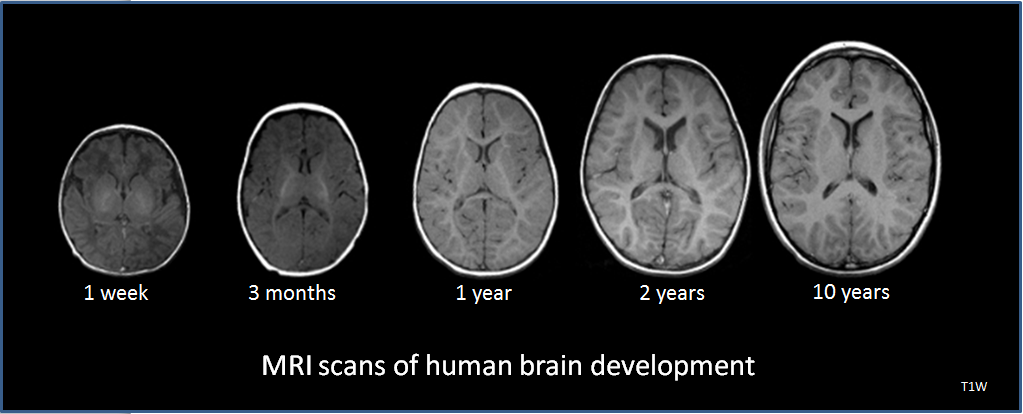
HUMANITY IN AN AGE OF TRANSITION
The Bahá’í writings offer a framework for understanding human history as fundamentally developmental, viewing humanity as passing through distinct stages of collective maturation. This perspective suggests that the behaviors, thought patterns, and perhaps even brain activity characteristic of our current era may be temporary expressions of a civilization still in the process of maturing. While this framework is rooted in Bahá’í teachings, it offers a perspective that may prove useful to anyone seeking to reconcile scientific findings about human nature with aspirations for human transformation.
Writing nearly a century ago, Shoghi Effendi described humanity’s historical trajectory in explicitly developmental terms: “The long ages of infancy and childhood, through which the human race had to pass, have receded into the background. Humanity is now experiencing the commotions invariably associated with the most turbulent stage of its evolution, the stage of adolescence, when the impetuosity of youth and its vehemence reach their climax, and must gradually be superseded by the calmness, the wisdom, and the maturity that characterize the stage of manhood. Then will the human race reach that stature of ripeness which will enable it to acquire all the powers and capacities upon which its ultimate development must depend.”16Shoghi Effendi, The World Order of Bahá’u’lláh, https://www.bahai.org/r/166959448.
Just as individuals pass through distinct developmental stages, each characterized by particular capacities, needs, and patterns of behavior, the Bahá’í writings describe humanity as undergoing a parallel collective process. The turbulence of our current era, from this perspective, reflects not the permanent condition of human nature but the particular challenges of a transitional moment. In this view, the prejudices, conflicts, and destructive patterns of behavior that seem so intractable today are to be understood as vestiges of an earlier stage of development, persisting even as new capacities begin to emerge. ‘Abdu’l-Bahá frames this transition in terms of evolving requirements: “Man must now become imbued with new virtues and powers, new moral standards, new capacities. New bounties, perfect bestowals, are awaiting and already descending upon him. The gifts and blessings of the period of youth, although timely and sufficient during the adolescence of mankind, are now incapable of meeting the requirements of its maturity.”17‘Abdu’l-Bahá, The Promulgation of Universal Peace, https://www.bahai.org/r/339508741.
This view of history is an inherently teleological one—it suggests that human civilization has direction and purpose, moving toward the realization of humanity’s highest potential. The chaos and suffering of the present are not random. They reflect our difficulty in letting go of patterns of life that once served humanity, but now hamper it. New forms of organization, new ways of relating, new capacities for cooperation and unity are struggling to be born even as older patterns resist dissolution. This framework helps make sense of a world that seems simultaneously to be falling apart and coming together, disintegrating and integrating, in a process that is as painful as it is hopeful, precisely because it is transformative.
If humanity is indeed undergoing such a transition, what does this imply for culture? The Universal House of Justice describes a process of cultural evolution already underway:
Propelled by forces generated both within and outside the Bahá’í community, the peoples of the earth can be seen to be moving from divergent directions, closer and closer to one another, towards what will be a world civilization so stupendous in character that it would be futile for us to attempt to imagine it today. As this centripetal movement of populations accelerates across the globe, some elements in every culture, not in accord with the teachings of the Faith, will gradually fall away, while others will be reinforced. By the same token, new elements of culture will evolve over time as people hailing from every human group, inspired by the Revelation of Bahá’u’lláh, give expression to patterns of thought and action engendered by His teachings.18The Universal House of Justice to all National Spiritual Assemblies, 12 December 2011, https://www.bahai.org/r/030751541.
This passage reveals a crucial insight; culture is relative not only across geography, but also across time. Human cultures are not static repositories of tradition but dynamic systems undergoing transformation. Elements of culture that reflect disunity, prejudice, dominance, and division—patterns built into the social structures and systems of earlier stages—are gradually being recognized as obsolete. New patterns reflecting emerging understandings of human oneness and interdependence are taking shape. If the brain is indeed shaped by culture, and if culture is evolving as humanity matures, then the patterns of brain activity neuroscience currently observes may themselves prove to be subject to transformation over time.
Within this framework, neuroscientific findings take on new meaning. When research identifies brain activity associated with prejudice, it may be documenting not an immutable feature of human nature, but the neural signature of cultures built on division and othering, cultures that are products of humanity’s childhood. When studies show that romantic love activates the same neural pathways as addiction, they may be revealing how brains in our current cultural moment process connection through frameworks shaped by consumerism and instant gratification. When adolescent brain development follows certain trajectories in Western research contexts, those patterns may reflect the specific educational systems, cultural expectations, parenting approaches, and social structures of societies that are themselves in transition to maturity, rather than universal laws of brain development.
The Universal House of Justice frames humanity’s current moment as one of approaching maturity: “Humanity, it is the firm conviction of every follower of Bahá’u’lláh, is approaching today the crowning stage in a millennia-long process which has brought it from its collective infancy to the threshold of maturity—a stage that will witness the unification of the human race.”19The Universal House of Justice to the Bahá’ís of Iran, 2 March 2013, https://www.bahai.org/r/394327546. In this view, neuroscientific findings can be understood as snapshots in time rather than final—as descriptions of how brains function in humanity’s collective adolescence, not as declarations of immutable human nature. Perhaps the brains of youth in future generations will mature more rapidly when nurtured through spiritual and moral education that cultivates latent capacities from an early age. Perhaps romantic love will no longer activate the same neural pathways as addiction, but will engage entirely different regions that reflect the profound significance of human connection. And perhaps, in a global society that fully embraces the oneness of mankind, our brains will no longer be conditioned to react to in-group and out-group distinctions in fear-based ways, but will instead reflect ‘Abdu’l-Bahá’s counsel: “Cleanse ye your eyes, so that ye behold no man as different from yourselves. See ye no strangers; rather see all men as friends.”20Selections from the Writings of ’Abdu’l-Bahá, no. 8, https://www.bahai.org/r/899100998.
The plasticity of the brain, its demonstrated responsiveness to cultural practices and social conditions, suggests that as humanity’s collective culture evolves toward greater expressions of oneness, justice, cooperation, and interdependence, brain function may well evolve in response. The implications of these principles for human behavior are profound. As we develop “capacities that can scarcely be glimpsed at present,”21The Universal House of Justice to the Conference of the Continental Boards of Counsellors, 30 December 2021, https://www.bahai.org/r/758524474. the patterns of brain activity associated with those capacities may bear little resemblance to those observed by science today.
TOWARD AN INTEGRATED UNDERSTANDING
These possibilities raise important questions about how we should interpret scientific findings in light of humanity’s historical trajectory. The progressive nature of science is fundamental to how we should understand any scientific finding. All research, whether from neuroscience or from particle physics, represents a snapshot in time—our best current understanding given the available methods, technologies, and conceptual frameworks. What we know today according to any body of knowledge will inevitably be refined, expanded, or revised as new evidence emerges and new questions are asked. This is not a weakness of science—on the contrary, it is its greatest strength: its capacity for self-correction and continuous, iterative progress. Neuroscience is no exception. Current findings in the field reflect the populations studied, the cultural contexts of researchers and subjects, the methodologies and tools available to us, and the interpretive lenses through which data are viewed. Recognizing this provisional character of scientific knowledge invites us to hold even the most compelling findings with an appropriate level of epistemic humility.
This progressive view of science is consistent with the historical framework through which modern neuroscience can be viewed that we explored earlier. Current neuroscientific findings can be understood as describing how brains function during humanity’s collective adolescence, reflective of the cultures, values, assumptions, and social structures that characterize the civilization within which we are currently embedded. This is not to dismiss the validity of current neuroscientific research, or to imply that current findings are incorrect—they are correct within the context they are generated. Instead, this view simply contextualizes them within a larger historical arc. It is important to note that this framework is interpretive rather than predictive. It does not claim to know precisely how brains will change in the future. We cannot observe today what neural patterns will characterize a mature civilization. Rather, it offers a lens for understanding current findings as reflections of a particular historical moment, inviting us to hold them with appropriate humility about their permanence. Understanding ourselves as a species in transition, capable of transformation and moving toward maturity, changes how we interpret scientific findings about the brain. It offers a framework that takes into account both our biological reality and spiritual possibility, suggesting that how our biology functions today need not constrain possibilities for humanity’s future.
This integrated perspective highlights the complementary roles that science and religion play in understanding human nature. Science makes descriptive statements that document and describe what currently is. Neuroscience tells us how brains currently function, what patterns of neural activity correlate with particular behaviors, and how cognitive and emotional processes unfold in the populations studied. These descriptive insights are invaluable, revealing the mechanisms through which culture, experience, and biology interact to shape human thought and behavior. But descriptive knowledge, however detailed, cannot on its own tell us what humans ought to become or what latent capacities might yet be developed. Science describes our present behavior, but it cannot tell us how we ought to behave.
Religion, by contrast, makes normative statements by articulating a vision of human potential and calling forth our latent and unrealized capacities. The spiritual teachings of the world’s great faiths have historically impelled processes of moral and social transformation, challenging people to transcend limited conceptions of self and to develop virtues and capacities that enable more mature patterns of relationship and social organization. As ‘Abdu’l-Bahá reminds us, humanity must develop “new virtues and powers, new moral standards, new capacities” suited to its emerging maturity. This normative dimension, the vision of what humanity can (and must) become, drives the cultural evolution that may, in turn, shape future patterns of brain function. This integrated understanding offers more than simply intellectual coherence. It reshapes our sense of possibility and our approach to the work of building a more unified world.

LIVING IN THE LIGHT OF POSSIBILITY
The understanding that human nature is malleable rather than fixed has profound implications for how we understand ourselves and our collective future. When neuroscientific findings are interpreted deterministically as unequivocal “proof” of hardwired traits, they can diminish our sense of what transformation is possible. Yet when situated within a teleological understanding of human history, these same findings reveal something different: not permanent features of our biology, but reflections of humanity’s current stage of maturation.
This framework invites us to approach neuroscientific findings with both humility and hope. Humility, in recognizing the limitations of research conducted primarily within Western populations and the provisional nature of all scientific knowledge. Hope, in understanding that the brain activity associated with prejudice, violence, rebellion, or other aspects of humanity’s lower nature need not represent unchangeable biological destiny. This is not to suggest that humanity’s lower nature will entirely disappear—as ‘Abdu’l-Bahá explains, the dual nature of human beings is intrinsic to our existence in the contingent world. Rather, as spiritual and cultural evolution take place, humanity’s higher nature may increasingly predominate, and become reflected in neural patterns that manifest this shift. Current patterns of brain activity identified and described by neuroscience are real, but they reflect cultures built on division, conflict, and instant gratification, cultures that are themselves undergoing transformation. As humanity develops greater capacities for unity, justice, selflessness, and cooperation, it is quite possible that brain function will adapt in ways we cannot yet fully imagine.
What does it mean to live consciously in such an age of transition? The worldwide Bahá’í community, alongside many like-minded collaborators, is engaged in a systematic process of learning about spiritual and social transformation through educational programs that cultivate moral capacities in young people, efforts to improve the material and social conditions of a community, and contributions to the prevalent discourses of society. All of this work proceeds from the basic conviction that humanity’s latent capacities can be cultivated through conscious, collective effort towards processes of spiritual and material education. Yet there is much to learn, and Bahá’ís are laboring alongside others in wider society, drawing on insights from every relevant field of knowledge, including the natural and social sciences. These fields are tasked with the difficult undertaking of describing reality even as we actively work to transform it, creating a dynamic relationship between understanding what currently is, while fostering the realization of humanity’s highest aspirations. The challenge, then, is learning how to integrate insights from diverse domains in ways that neither dismiss the scientific findings of our time, nor accept deterministic interpretations that constrain our vision of human possibility. The civilization we aim to build cannot be fully imagined by any human mind today, and yet we can work consciously toward it, sustained by the understanding that who we are today need not limit who we can become tomorrow.