
And how will you enquire, Socrates, into that which you do not know?
—Plato, Meno
Knowledge is valuable, but the knowledge that is prized above all, and which Aristotle called the “most perfect” of its modes, is wisdom.1Aristotle, Nicomachean Ethics, trans. H. Rackham (Harvard University Press, 1956), 343. Its worth, King Solomon himself tells us, is beyond rubies; when compared to wisdom, all the gold in the world is nothing but sand.2Proverbs 8:11; Wisdom 7:9. Yet, like gold and rubies, wisdom is rare, which accounts for its paradoxical aspect: as exemplified in the archetypal example of wisdom, the Judgment of Solomon, recounted in 1 Kings 3:16–28, it can seem completely incomprehensible—eluding ordinary understanding and resisting the analysis of reason.
Wisdom has always figured prominently in religious scriptures, and it is a frequent theme in the Sacred Texts of the Bahá’í Faith. In 1889 the Founder of the religion, Bahá’u’lláh, then confined as a religious prisoner of the Ottoman Empire in the prison city of ‘Akká, wrote a Tablet titled “Words of Paradise” (Kalimát-i-Firdawsíyyih), in which He extolled wisdom as
the greatest gift and the most wondrous blessing…. It is man’s unfailing Protector. It aideth him and strengtheneth him. Wisdom is God’s Emissary and the Revealer of His Name the Omniscient. Through it the loftiness of man’s station is made manifest and evident. It is all-knowing and the foremost Teacher in the school of existence. It is the Guide and is invested with high distinction. Thanks to its educating influence earthly beings have become imbued with a gem-like spirit which outshineth the heavens.3Bahá’u’lláh, Tablets of Bahá’u’lláh Revealed after the Kitáb-i-Aqdas (Bahá’í World Centre, 1978), 6.24, bahai.org/r/030537471.
‘Abdu’l-Bahá, Bahá’u’lláh’s son and successor as Head of the Bahá’í Faith, and the authorized Interpreter of His Writings, commented on the inscrutable quality of wisdom in a table talk published in 1908 in the collection titled Some Answered Questions: “How often has it happened that a wise, accomplished, and sagacious person took a course of action, and those who were incapable of grasping its wisdom objected and questioned why he said or did thus. This objection is prompted by ignorance, and the wisdom of that wise man is free and sanctified from error.”4‘Abdu’l-Bahá, Some Answered Questions (Bahá’í World Centre, 2014), 45.6, bahai.org/r/610118851. On another occasion He advised the Bahá’ís, “Know that in every movement of ‘Abdu’l Bahá, in every word He uttereth, there lieth a great wisdom. If what He doeth appeareth to be strange, this is because the wisdom is not known to the friends.”5‘Abdu’l-Bahá, Extract from a Tablet, Bahá’í Reference Library, bahai.org/r/989684892.
TWO ASPECTS OF WISDOM
In recent decades, the study of wisdom—what it is and how to get more of it—has seen a revival of interest in fields including ethics, philosophy, psychology, education, and organizational studies. In both Eastern and Western traditions, wisdom includes knowledge of the fundamental truths of the reality of things as well as how to use that knowledge in practice, or in Aristotle’s terms, sophia (theoretical wisdom) and phronesis (practical wisdom). Theoretical wisdom is the prerequisite for practical wisdom—the knowledge of the ethically right means to achieve a morally good end, one that conduces to human flourishing.6See Aristotle, Nicomachean Ethics, book 6. As philosopher Robert Nozick explains, “Wisdom is not just knowing fundamental truths, if these are unconnected with the guidance of life or with a perspective on its meaning…. What a wise person needs to know and understand” includes
the most important goals and values of life—the ultimate goal, if there is one; what means will reach these goals without too great a cost; what kinds of dangers threaten the achieving of these goals; how to recognize and avoid or minimize these dangers; what different types of human beings are like in their actions and motives (as this presents dangers or opportunities); what is not possible or feasible to achieve (or avoid); how to tell what is appropriate when; … knowing what the true and unapparent value of various things is; when to take a long-term view; knowing the variety and obduracy of facts, institutions, and human nature.7Robert Nozick, The Examined Life: Philosophical Meditations (Simon & Schuster Paperbacks, 2006), 269.
Although the wisdom of the wise can often be inscrutable to others, when the time and circumstances are right, that wisdom can become dazzlingly clear. ‘Abdu’l-Bahá once assured the Bahá’ís that the wisdom of a perplexing stipulation in the Sacred Scriptures would “erelong be made manifest as clearly as the sun at high noon.”8‘Abdu’l-Bahá, Selections from the Writings of ‘Abdu’l-Bahá (Bahá’í World Centre, 1978), 38.4, bahai.org/r/324741256. Using the same figure of speech, His grandson Shoghi Effendi, in answer to a question about a provision in ‘Abdu’l-Bahá’s Will and Testament, indicated that “whatsoever has explicitly been revealed” would “eventually become clear and evident, even as the sun in its noon-tide glory.”9In Universal House of Justice, comp., Fire and Light: Selections from the Writings of Bahá’u’lláh and ‘Abdu’l-Bahá, and from the Letters of Shoghi Effendi, bahai.org/r/151685661. But how does that happen?
We can trace the path by which wisdom that once seemed inscrutable, even defying belief, became as clear as the sun at high noon, in the parallel and sometimes intertwined history of two processes of sensemaking—one scientific and one religious—concerning the same phenomenon. Sensemaking refers to the method by which we ascribe meaning to experience in the world and, by doing so, construct social reality. Karl Weick, in defining his conception of sensemaking, describes “reality” as “an ongoing accomplishment that emerges from efforts to create order and make retrospective sense of what occurs.”10Karl Weick, Sensemaking in Organizations (Sage, 1995), 15.
The first of these two processes of sensemaking involves a sequence of events, discoveries, and controversies that would shatter established assumptions about both the physical world and the world order; the second involves efforts to understand the meaning of a passage in the Bahá’í Writings foreshadowing those same events and prescribing measures to avert the consequences. The first process began in 1896 with the scientific intuition of the French physicist Henri Becquerel, but years before he made his chance discovery, its world-historical significance and monumental consequences had already been described in the Writings of Bahá’u’lláh.
In Words of Paradise, Bahá’u’lláh discussed a number of themes in addition to wisdom, including the true nature and virtues of the human being, the foundations of social order, and the means for ensuring the security and advancement of humanity, as well as the very “preservation of the world of being” itself. In a statement that epitomizes the central theme of His social teachings, He wrote:
O ye men of wisdom among nations! Shut your eyes to estrangement, then fix your gaze upon unity. Cleave tenaciously unto that which will lead to the well-being and tranquillity of all mankind. This span of earth is but one homeland and one habitation. It behoveth you to abandon vainglory which causeth alienation and to set your hearts on whatever will ensure harmony. In the estimation of the people of Bahá man’s glory lieth in his knowledge, his upright conduct, his praiseworthy character, his wisdom, and not in his nationality or rank.11Bahá’u’lláh, Tablets of Bahá’u’lláh, 6.24, bahai.org/r/869909903.
He then warned of the danger of abandoning the principle of moderation, stating that “if a thing is carried to excess it will become a source of evil”—as evidenced by the alarming tendencies displayed by Western civilization, which was already harnessing the power of modern technology to invent ever more deadly weaponry. “An infernal engine hath been devised,” He wrote, “and hath proved so cruel a weapon of destruction that its like none hath ever witnessed or heard.”12Bahá’u’lláh, Tablets of Bahá’u’lláh, 6.30, bahai.org/r/062742596. He may have been referring to the Maxim gun: invented in 1884, it was the first automatic machine gun, could fire over five hundred rounds per minute, and would become one of the deadliest weapons in modern history.13Malcolm W. Browne, “100 Years of Maxim’s Killing Machine,” New York Times, 26 November 1985, sec. C, 1. In the Bahá’í writings, the term “infernal engine” occurs in other instances in reference to weaponry. See, for example, ‘Abdu’l-Bahá, in Star of the West 5, no. 8 (August 1914): 115–17, and Shoghi Effendi, quoted in a letter dated 7 July 1976 written on behalf of the Universal House of Justice to an individual, bahai.org/r/610082835. The “deeply-rooted and overwhelming corruptions” represented by such armaments, Bahá’u’lláh asserted, could not be expunged until the peoples of the world became reconciled and united in a common aim and a universal faith. Then He wrote: “Strange and astonishing things (asbáb-i-‘ajíbiy-i-gharíbih) exist in the earth but they are hidden from the minds and the understanding of men. These things are capable of changing the whole atmosphere of the earth and their contamination would prove lethal.”14Bahá’u’lláh, Tablets of Bahá’u’lláh, 6.31, bahai.org/r/803562132.
Today we have no trouble making sense of that statement; if we are perplexed, it is not by the statement itself—because we know it is true—but by the fact that He wrote it in 1889, decades before anyone else knew it was true. Those “things” in the earth that can lethally contaminate the atmosphere are now such an established part of humanity’s common knowledge that it is not even necessary to name them, because the answer is so obvious as to be clear as the sun at high noon. But that was not always the case.
SPIRITUALISM AND THE RADIUM CRAZE
In 1908 Bahá’u’lláh’s statement in Words of Paradise puzzled two American Bahá’í women, Helen Goodall and her daughter Ella Goodall Cooper, who had traveled to ‘Akká on a pilgrimage to meet ‘Abdu’l-Bahá. They had read this early, imprecise translation of the text: “A strange and wonderful instrument exists in the earth; but it is concealed from minds and souls. It is an instrument which has the power to change the atmosphere of the whole earth, and its infection causes destruction.”15The historical meaning of wonderful is “exciting wonder.” They asked: “Does this refer to an evil power such as psychic control? Is there some other power in the world beside God?”16Helen S. Goodall and Ella Goodall Cooper, Daily Lessons Received at Akka January 1908 (Bahá’í Publishing Society, 1908), 50. The notes of pilgrims, although of historical interest, have no authority and often represent only an approximation of the encounter and the words they record, as they are based on notes taken down from the words of the translator, whose English was often inadequate. From the context of their conversation, it is clear that they were referring to spirits of the dead exercising evil powers from beyond the grave.
Today, the very idea that psychic forces wielded by evil spirits could possibly be what Bahá’u’lláh was referring to seems naive, even simpleminded—certainly unscientific. But in 1908, the Goodalls’ interpretation was not so improbable. It even resonated with the statements of some scientists of the day. The cultural milieu of the early twentieth century was permeated by a fascination with the supernatural and occult, one of the expressions of which was spiritualism, a movement that arose in the 1840s, reflecting the spiritual ferment of the era. Though originating in the United States, spiritualism spread to Europe and around the world, including to Iran, the Ottoman Empire, and Japan. It held that contact could be made with the spirits of the dead, who would answer by tapping, or by communicating through a “medium,” or through automatic writing, and might even show themselves to the living as ethereal apparitions.
Spiritualists, far from being uneducated, anti-modern, or illiberal, tended to hold progressive views and to support causes including the abolition of slavery, women’s rights, labor reform, temperance, and socialism.17 Ann Braude, Radical Spirits: Spiritualism and Women’s Rights in Nineteenth-Century America (Indiana University Press, 2nd ed., 2001), 3. Even some prominent scientists were intrigued by the possibility of gaining access to psychic forces and communicating with spirits. Among the scientific and intellectual figures of the time who were interested in—if not seriously investigating or even convinced by—spiritualist phenomena were Alfred Russel Wallace, Henri Bergson, William James, William Crookes, and Marie and Pierre Curie. Thomas Edison attempted to build a device by which the dead could communicate with the living scientifically—without the “crude methods” of “tilting tables and raps and ouija boards and mediums.”18Austin C. Lescarboura, “Edison’s Views on Life and Death, Scientific American 30 October 1920, 446, jstor.org/stable/24991827. Spiritualism also intersected with another cultural phenomenon of the era that had a more direct connection to the topic of Bahá’u’lláh’s statement, and which was also the object of widespread misunderstanding that today seems incomprehensible: the radium craze.
Marie Curie’s discovery of radium in 1898 had set in motion an international obsession for the element. The perceptible effects of radium’s energy evoked a dimension beyond the physical—fitting neatly into the ambience of an era captivated by the idea of piercing the veil between the worlds. Other forms of radiation had been discovered, but until then only x-rays, with their ability to penetrate flesh and produce ghostly skeletal portraits, had excited much public interest. Radioactive elements such as uranium did not seem as interesting or important as radium, since they did not seem to “‘do’ anything of particular note.”19Lawrence Badash, “Radium, Radioactivity, and the Popularity of Scientific Discovery,” Proceedings of the American Philosophical Society 122, no. 3 (9 June 1978): 145. It was radium—more than a million times more radioactive than uranium—that captured the public imagination. It glowed with an eerie luminescence; it gave off heat apparently without changing; it acted on bodies with an entirely new and thrilling power that seemed to promise life, healing, and even a cure for cancer. Soon people were drinking radioactive water—laced with radium—as a cure-all that was marketed as the “elixir of life.” Radium was added to products including chocolate, cosmetics, and toothpaste (promising a “radiant smile”), and painted on items like watch dials and the buckles of bedroom slippers to make them glow in the dark.20Michel Rose and Marion Douet, “France’s 20th Century Radium Craze Still Haunts Paris,” Reuters, 19 July 2012, reuters.com/article/us-france-radium-decontamination-idUSBRE86I0AH20120719; Taylor Orci, “How We Realized Putting Radium in Everything Was Not the Answer,” The Atlantic, 7 March 2013, theatlantic.com/health/archive/2013/03/how-we-realized-putting-radium-in-everything-was-not-the-answer/273780/.

It is not hard to understand how people might draw a connection between spiritualist phenomena and this new, seemingly spectral element that displayed tangible evidence of invisible power. In Japan, according to Maika Nakao, “The concept of radium was frequently combined with spirituality, and many spiritualists were inspired by radiation and radium,” viewing it as a visible manifestation of spirit. One prominent Japanese spiritualist, she writes, “tried to prove the existence of spirit by explaining the nature of radiation.”21Maika Nakao, “Radium Traffic: Radiation, Science and Spiritualism in Early Twentieth-Century Japan,” Medical History 65, no. 1 (2021): 39, doi:10.1017/mdh.2020.47.
Making connections between radioactivity and a supernatural dimension found inspiration, if not support, in the writings of certain scientists, who had made similar speculations about x-rays.22See Simone Natale, “A Cosmology of Invisible Fluids: Wireless, X-Rays, and Psychical Research around 1900,” Canadian Journal of Communication, 36, no. 2, doi.org/10.22230/cjc.2011v36n2a2368. In 1897 the eminent chemist William Crookes, whose cathode ray tubes enabled the discovery of electrons, suggested that x-rays, which were initially thought to travel in the ether along with light and other electromagnetic waves, might be “a possible mode of transmitting intelligence.”23William Crookes, Presidential Addresses to the Society for Psychical Research, 1882–1911 (Glasgow: Society for Psychical Research, 1912), 100. Radium was something more: it was a numinous substance. The radiochemist Frederick Soddy, winner of the 1921 Nobel Prize in Chemistry, in a widely read book of lectures given in 1908—the same year the Goodalls visited ‘Akká—described radium in distinctly anthropomorphic terms and in tones of almost religious awe:
There is something sublime about its aloofness from and its indifference to its external environment. It seems to claim lineage with the worlds beyond us, fed with the same inexhaustible fires, urged by the same uncontrollable mechanism which keeps the great suns alight in the heavens over endless periods of time. This tiny speck of matter we can hold in our hands exhibits in perfect miniature many ancient mysteries, forgotten almost in their familiarity, or mistakenly and too easily dismissed as belonging and appropriate to the infinitely great dimensions of the universe.24Frederick Soddy, The Interpretation of Radium, Being the Substance of Six Free Popular Experimental Lectures Delivered at the University of Glasgow, 1908, 2nd ed. (John Murray, 1909), 37–38.
With such ideas circulating in the voice of science, the notion that powerful forces hidden in the earth could be linked to forces from “worlds beyond us” was already planted in the public imagination. It was not so illogical after all, that the first thought that occurred to the Goodalls as the most likely, or relevant, phenomenon to which Bahá’u’lláh’s text could have referred was psychic forces. That the Goodalls’ questions were framed in terms of spiritualist concepts (whether or not they gave credence to them) is evident in that they also asked ‘Abdu’l-Bahá whether spirits could influence people and take possession of their will, and what “power” was involved in automatic writing. They recorded that ‘Abdu’l-Bahá replied, to the first question, that spirits could do no such thing and, to the second, that automatic writing came from within the writer.25Goodall and Cooper, Daily Lessons, 43. But if the Goodalls expected ‘Abdu’l-Bahá to explain the passage about the strange and wonder-inspiring things in the earth in a way that confirmed their own assumptions, they would have been not only disappointed but baffled as well. They recorded in their notes that He began to talk instead about the fundamental forces of nature, saying (in the words of the Persian translator):
This is a deep and lengthy subject, but, briefly, there is, as we know, a power that composes and a power that decomposes. The world of existence is constantly revolving through the changes of building up and tearing down. When elements are attracted something is composed, and when these same elements are repelled that form is decomposed. As by the will of God the power of composition exists, so also by will of God the power of decomposition exists.26Goodall and Cooper, Daily Lessons, 51.
He went on to explain that these two forces are expressed metaphorically in religious scriptures by the Angel of Life, symbolizing the power of composition or attraction, and the Angel of Death, signifying that of decomposition or repulsion. But what, the pilgrims may have wondered, could possibly connect an instrumentality powerful enough to change the atmosphere of the earth with the forces of composition and decomposition? ‘Abdu’l-Bahá summarily dismissed the interpretation that it involved psychic forces exercised by the spirits of the dead. According to the Goodalls’ account, He explained that the souls of evil people who have died exercise no power over the living, that good is stronger than evil, and that even when those people were alive, they had very little power—how much less would they have after they were dead. And in any case, they were nowhere near this planet.27Goodall and Cooper, Daily Lessons, 51. We do not know how He explained, on that occasion, the connection between the strange and astonishing things in the earth and the physical forces of composition and decomposition, because the notes stop there.
That the forces of composition and decomposition applied to elements at the level of chemical compounds was an established scientific fact at the time. Although electrons had been discovered in 1897 (in a Crookes tube), it took some years before it was fully recognized that the atom was not the indivisible unit of matter it was long believed to be but was itself composed of even smaller particles. Frederick Soddy’s own lectures on the history of chemistry in 1900 had relied on Dalton’s theory of atoms as indivisible.28Richard E. Sclove, “From Alchemy to Atomic War: Frederick Soddy’s ‘Technology Assessment’ of Atomic Energy, 1900–1915,” Science, Technology, & Human Values 14, no. 2 (1989): 166–7. But by 1902 Soddy and Ernest Rutherford had discovered that atoms themselves were also subject to decomposition, or disintegration—a phenomenon that Marie Curie had named “radioactivity”—in which they became transformed (or, as Soddy preferred to call it, deliberately borrowing the term from alchemy, “transmuted”) into new and different elements in a violent process that released enormous amounts of energy.29In 1900 Marie and Pierre Curie described—in terms that seem to echo Bahá’u’lláh’s observation—radioactivity as “an enigma, a deeply astonishing subject” (quoted in Barbara Goldsmith, Obsessive Genius: The Inner World of Marie Curie [WW Norton, 2005], chap. 9). That would have been no surprise to ‘Abdu’l-Bahá, Who possessed a profound and prescient knowledge of the realities of things and was well versed not only in the theories of the philosophers and with Bahá’u’lláh’s statements such as “within every atom traces of the sun have been made manifest,” but also with the words of the eighteenth-century Persian mystical poet Hátif-i-Iṣfahání: “Split the atom’s heart, and lo! / Within it thou wilt find a sun.”30Bahá’u’lláh, The Kitáb-i-Íqán, par. 28, bahai.org/r/990539395; Bahá’u’lláh, The Call of the Divine Beloved (Bahá’í World Centre, 2019), 2.23, bahai.org/r/474041477. See also ‘Abdu’l-Bahá’s treatise “Tablet of the Universe” (Lawḥ-i-Aflákíyyih). He also understood the inherently incomplete and contingent character of human efforts to make sense of the world:
Mathematicians, astronomers, chemical scientists continually disprove and reject the conclusions of the ancients; nothing is fixed, nothing final; everything is continually changing because human reason is progressing along new roads of investigation and arriving at new conclusions every day. In the future much that is announced and accepted as true now will be rejected and disproved. And so it will continue ad infinitum.31‘Abdu’l-Bahá, The Promulgation of Universal Peace (Wilmette: Bahá’í Publishing Trust, 1982), no. 9, “16 April 1912, Talk at Hotel Ansonia to Bahá’í Friends of New Jersey, Broadway and Seventy-Third Street, New York,” bahai.org/r/303993171.
In His Writings and talks, ‘Abdu’l-Bahá often discussed composition and decomposition (or attraction and repulsion) as natural forces that operate at all levels of existence; He also employed these concepts in His philosophical arguments for the immaterial nature of the soul as a simple, uncompounded substance. In such arguments He used an analogy of the atom “as a constituent of organic composition,” in which context the atoms themselves do not decompose.32‘Abdu’l-Bahá, no. 96, “27 August 1912: Talk at Metaphysical Club, Boston, Massachusetts,” bahai.org/r/792446407. As ‘Abdu’l-Bahá Himself explains, in these discourses He is speaking in relative terms that depend on the context.33See ‘Abdu’l-Bahá, Some Answered Questions, 80.4–6. However, in His account of the nature of material phenomena, it is implicit that, at the most fundamental level, the atom is not the indivisible constituent of matter. If the axiom that all “forms of existence in the material universe … are the result of composition” is true, it also applies to the atom, or the atom would not be a material phenomenon.34‘Abdu’l-Bahá, Promulgation, no. 23, “24 April 1912: Talk at Home of Mrs. Andrew J. Dyer, 1937 Thirteenth Street, NW, Washington, D.C.,” bahai.org/r/376710334.
AN IMPETUS FOR PEACE
In 1910 ‘Abdu’l-Bahá set out on a series of journeys, traveling first to Egypt and then to the West, where He gave hundreds of lectures and interviews, introducing the Bahá’í teachings to audiences in cities from Budapest to San Francisco and advocating for the abolition of war and universal peace. During these travels, on several occasions He alluded to or explicitly mentioned Bahá’u’lláh’s enigmatic statement and warned about the mysterious force in the earth that could have catastrophic effects. While en route to New York on the R.M.S. Cedric, a discussion over tea turned to the topic of dirigibles and airplanes. ‘Abdu’l-Bahá is recorded as telling those present that airplanes would be used for military purposes and that “There will come to exist such instruments [of war] as to cause all the means of destruction in the past to be looked upon as children’s playthings.”35Maḥmúd Zarqání, Maḥmúd’s Diary: The Diary of Mírzá Maḥmúd-i-Zarqání Chronicling ‘Abdu’l-Bahá’s Journey to America, trans. Mohi Sobhani (George Ronald, 1998), 27. In San Francisco, while conversing with a group of Bahá’ís including the Goodalls, ‘Abdu’l-Bahá suddenly began to speak about the statement in Words of Paradise, saying that an element in the earth would be discovered that was so destructive that it could obliterate entire cities and would become an impetus for peace, as the nations would fear the destruction of humanity.36National Spiritual Assembly of the United States to Shoghi Effendi, cable dated 24 February 1946, Bahá’í World Centre Archives, Haifa, Israel.
On another occasion, in Paris, He brought up the issue when He made a point of calling on a visiting diplomat whose wife had expressed a wish to meet Him. That diplomat was Viscount Minoji Arakawa (1857–1949), the Japanese Minister to Spain. As later recounted by Lady Blomfield, ‘Abdu’l-Bahá spoke to him on topics including the importance of Japan, the abolition of war, and scientific discoveries, adding: “There is in existence a stupendous force, as yet, happily, undiscovered by man.” ‘Abdu’l-Bahá said He hoped this force would not be discovered by science until civilization became spiritualized because “in the hands of men of lower material nature, this power would be able to destroy the whole earth.”37Lady Blomfeld, “Some Memories of the Sojourn of ‘Abdu’l-Bahá in Paris, October-December, 1911,” The Bahá’í World 6: 656–7, bahaiworld.bahai.org/library/memories-of-the-sojourn-of-abdul-baha-in-paris. In 1919 He was reported as describing it as being a power like that of dynamite.38“Talks of Abdul Baha: Notes Taken by H. S. Fugeta,” [1919], 33–34.
Although today we readily understand and appreciate the wisdom of those warnings, the existence of such a force within the earth—of elements whose decomposition (which releases radioactivity) could change the whole atmosphere of the planet and cause lethal contamination—was not definitively proved until July 1945 when, in the New Mexico desert, the scientists of the Manhattan Project detonated a plutonium implosion device, demonstrating the power of the energy concealed within the heart of the atom and making Bahá’u’lláh’s statement a self-evident truth as clear as the sun at noon. In this case, uniquely, the figure of speech was literally true because there is nothing else on earth that is so much like the noonday sun; an American army general who observed the Trinity test that day wrote that the blast light had an “intensity many times that of the midday sun.”39Thomas Farrell, quoted in Alex Wellerstein, “The First Light of Trinity,” The New Yorker, 16 July 2015, newyorker.com/ tech/annals-of-technology/the-first-light-of-the-trinity-atomic-test. But until that moment, not even the scientists themselves really knew—to a certainty—what was going to happen. Before the test J. Robert Oppenheimer, director of the laboratory at Los Alamos, bet another scientist ten dollars that the “gadget” would not work. Physicist Enrico Fermi suggested, perhaps only half-jokingly, that they should place bets on whether the blast would ignite the whole atmosphere of the earth or just destroy New Mexico.40Richard Rhodes, The Making of the Atomic Bomb (Simon and Schuster, 1986), 662, 665.

In retrospect it may seem that the vast destructive power latent within the atom should have been obvious from the start. Unmistakable signs of the power of radioactivity were evident soon after the discovery of radium, but the extent of that power and its lethal effects were not yet understood. Pierre Curie deliberately exposed his arm to the element and studied the burns; Marie Curie kept some radium beside her bed as a night-light.41Nanny Fröman, “Marie and Pierre Curie and the Discovery of Polonium and Radium,” NobelPrize.org, nobelprize.org/prizes/themes/marie-and-pierre-curie-and-the-discovery-of-polonium-and-radium/. They both suffered what were only later recognized as symptoms of radiation illness, and she would die of aplastic anemia due to long-term exposure. Although we might think, from our perspective, that enough knowledge must have been available to enable people to reason out the probable consequences of radioactivity’s evident power and its dangerous nature, it is all too easy to fall into the fallacy of hindsight bias by assuming that people in the past had the knowledge that we have now.
In fact, at the beginning of the twentieth century, the prevailing scientific view of radioactivity was quite different. Radioactivity, and radium in particular, was initially perceived not as a force of decomposition and an agent of destruction and death, but as one of composition, with life-giving properties, and even as a “biological” force. According to Luis Campos, “Not only were radioactive phenomena characterized in quasi-biological ways from the earliest days, by their discoverers and by others, but radium itself … was often described as a ‘half-living’ element in scientific and popular texts alike.” As he notes, “many botanists and geneticists were eagerly remarking that radium held the key to the secret of life.”42Luis A. Campos, Radium and the Secret of Life (University of Chicago Press, 2015), 2. The signs of tissue alteration that would later be recognized as the destructive, and ultimately lethal, effects of radiation were first interpreted as its opposite and as a form of “evolution,” a term Soddy frequently used in his descriptions of radioactive decay.43Campos, Radium, 2, 5; Frederick Soddy, “Evolution of Matter,” Science and Life: Aberdeen Addresses (Dutton, 1920). The true nature, effects, and implications of the energy hidden within the atom eluded general understanding and acceptance because the very idea that the earth itself could contain a hitherto unknown source of power that could obliterate all life was radically new and unthinkable.
THE UNTHINKABLE RADICALLY NEW
Radioactivity and atomic energy were literally unthinkable because they were radically new. Since we make sense of experience and organize our knowledge by reference to our mental representation of the world, assigning meaning to new information in terms of old information (that is, information we have acquired from experience and which has been incorporated into that conceptual model), a phenomenon that is radically new is not intelligible: it does not fit into any of the categories based on prior experience that we use to interpret and make sense of information presented to the mind. Thus, paradoxically, the effort to understand an experience that is unlike anything ever encountered before is thwarted by the very process we rely on to make sense of the world. As physicist Norris Bradbury, who worked on the Manhattan Project, observed: “Most experiences in life can be comprehended by prior experiences, but the atom bomb did not fit into any preconceptions possessed by anybody.”44Quoted in Rhodes, Making of the Atomic Bomb, 674.
At the beginning of the twentieth century, there was no category in the structure of accepted scientific knowledge for an entity that possessed power of the kind or the magnitude that was hidden within the atom, just as there had been no category to make sense of the phenomenon of radioactivity itself, which, Soddy had written, “ran counter to every principle of physical science.”45Soddy, “Evolution of Matter,” 91. In a 1904 lecture he had stated that, with the discovery of radioactivity, “a new world has been opened to us … in which the atom is not the unit, in which the forces are not chemical, and in which common physical conceptions such as temperature are without meaning.”46Frederick Soddy, “The Evolution of Matter as Revealed by the Radioactive Elements,” Memoirs and Proceedings of the Manchester Literary and Philosophical Society, 48 part 2 (1904): 14. In his 1908 lectures, speaking of the nature of “atomic disintegration,” which was “sudden and explosive in character,” Soddy again alluded to its radical unthinkability as he explained that
in the complete change of one grain of radium no less than 125,000,000 calories would be evolved. The energy evolved in the change of radium is nearly a million times greater than that evolved from a similar weight of matter undergoing any change known previously to the discovery of radioactivity. By the burning of a grain of coal, for example, only about 500 calories are obtained. No wonder then that to account for the boundless energy displayed everywhere in the starry heavens proved a difficult problem for physicists, acquainted with no more energetic chemical process than the burning of coal!47Soddy, Interpretation of Radium, 151, 164.
But even after three more decades of research, expert opinion remained unconvinced as to whether atomic energy could ever be accessed: more than one prominent physicist doubted that splitting atoms could ever produce more than negligible energy, while some scornfully dismissed the very idea as not only scientifically unproven but ignorant nonsense, and rejected the possibility of weaponizing that energy as remote—or at least “absurdly premature.”48Rhodes, Making of the Atomic Bomb, 228, 281.
Soddy was one of the first scientists to understand the terrifying practical implications of the “gigantic forces” latent within the earth and in 1903 had written that “the knowledge of their existence must … make us regard the planet on which we live rather as a storehouse stuffed with explosives, inconceivably more powerful than any we know, and possibly only awaiting a suitable detonator to cause the earth to revert to chaos.”49Frederick Soddy, “Some Recent Advances in Radioactivity,” Contemporary Review 83 (1903): 720. The carnage of the First World War would present him with evidence of the devastation and death that modern technology could deliver when harnessed for military use: in 1916, on the opening day of the First Battle of the Somme, more than 19,000 British soldiers were killed—a large proportion of them by the German version of the Maxim gun.50Browne, “100 Years”; Imperial War Museums, “First Day of the Battle of the Somme,” iwm.org.uk/history/first-world-war/somme/first-day. In a lecture in 1915 Soddy raised the alarm about the potential danger of weaponizing atomic energy:
Imagine, if you can, what the present war would be like if such an explosive had actually been discovered instead of being still in the keeping of the future. Yet it is a discovery that conceivably might be made to-morrow, in time for its development and perfection for the use or destruction, let us say, of the next generation, and which, it is pretty certain, will be made by science sooner or later.51Frederick Soddy, “Physical Force: Man’s Servant or His Master?” Science and Life, 36.
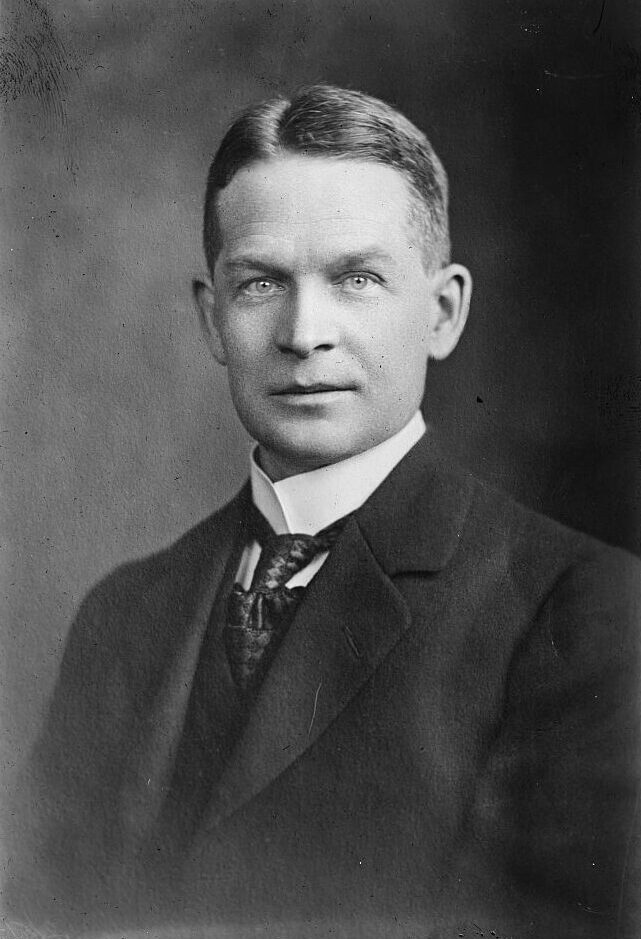
That same year, in a speech, he said: “The social effect of recent advances in physical science promises to be annihilating, unless, before it is too late, there arises an equal and compensating advance, of which there is at present no sign, in the moral and spiritual forces of society.”52Quoted in Sclove, “From Alchemy,” 179. And in 1917 he warned that if the vast energy within the atom could be tapped, war “would not be the lingering agony it is today. Any selected section of the world, or the whole of it if necessary, could be depopulated with a swiftness and dispatch that would leave nothing to be desired.”53Soddy, “Evolution of Matter,” 107.
But to many at that time, his words were hyperbolic, unscientific ravings that belonged rather to science fiction than to science. In 1928 Robert Millikan, the 1923 Nobel Laureate in Physics, told the Chemists’ Club in New York: “There is no likelihood man can ever tap the power of the atom. The glib supposition of utilizing atomic energy when our coal supply has run out is a completely unscientific Utopian dream, a childish bug-a-boo.”54Quoted in C. R. Richmond, “Population Exposure from the Fuel Cycle: Review and Future Direction.” (Oakridge National Laboratory, 1987), University of North Texas Digital Library, Office of Scientific and Technical Information Technical Reports, digital.library.unt.edu/ark:/67531/metadc1086292/. The next year, addressing the Society of Arts and Sciences, he sarcastically disparaged Soddy’s warnings, saying that “if you belong to the group … which fears the too rapid advance of science and lives in dread of the day when some unscrupulous, or careless, Dr. Faust may touch off the stupendous subatomic powder magazine and blow this comfortable world of ours into star dust, you may henceforth banish your hobgoblin and sleep in peace.…” because, as Millikan assured the audience, “there is no appreciable energy available to man through atomic disintegration.”55Robert A. Millikan, “Michelson’s Economic Value,” Science, New Series, 69, no.1793 (10 May 1929): 484–5, jstor.org/stable/1652629; emphasis in original. In 1930 he went even further out on that limb, summoning Science herself to testify against Soddy:
She has kept steadily at work since Mr. Soddy raised the hobgoblin of dangerous quantities of available subatomic energy, and has brought to light good evidence that this particular hobgoblin—like most of the bugaboos that crowd in on the mind of ignorance—was a myth.… Now the new evidence born of further scientific study is to the effect that it is highly improbable that there is any appreciable amount of available subatomic energy to tap.56Robert A. Millikan, “Alleged Sins of Science,” Scribner’s Magazine, February 1930, 121, gwern.net/doc/existential-risk/1930-millikan.pdf.
He went on to insist—somewhat incongruously for a scientist making an argument about physics—that those fearful of the consequences of atomic disintegration could “sleep in peace with the consciousness that the creator has put some fool-proof elements into his handiwork and that man is powerless to do it any titanic physical damage.”57Millikan, “Alleged Sins,” 121.
Millikan was not alone in his pessimism. According to Richard Rhodes, “by the mid-1930s the three most original living physicists had each spoken to the question of harnessing nuclear energy,” expressing doubt about the possibility—namely, Soddy’s colleague Ernest Rutherford, Albert Einstein, and Nils Bohr.58Rhodes, Making of the Atomic Bomb, 228. In 1932 Einstein said, “There is not the slightest indication that nuclear energy will ever be obtainable. It would mean that the atom would have to be shattered at will.”59Quoted in “Atom Energy Hope Is Spiked by Einstein,” Pittsburgh Post Gazette, 28 December 1934. In 1946, after it had been proven that it could indeed be done, Einstein wrote: “The unleashed power of the atom has changed everything save our modes of thinking and we thus drift toward unparalleled catastrophe…. a new type of thinking is essential if mankind is to survive and move toward higher levels.”60Quoted in “Atomic Education Urged by Einstein,” New York Times, 25 May 1946, 11.
In 1937 Shoghi Effendi, who had been appointed by ‘Abdu’l-Bahá as Guardian and head of the Bahá’í Faith, was asked about Bahá’u’lláh’s statement concerning the hidden force in the earth that could lethally contaminate the atmosphere. As it turns out, Shoghi Effendi’s response, written on his behalf by his secretary, was more scientifically accurate than the scientists’ dismissal. It said: “The instrument referred to by Bahá’u’lláh has not yet been fully discovered.”61Letter dated 9 August 1937 written on behalf of Shoghi Effendi to an individual, Bahá’í World Centre Archives, Haifa, Israel. That was true: artificial nuclear fission would not be fully discovered until the following year, 1938, and it would be another seven years until its power would be decisively demonstrated on the test site at Los Alamos. In October 1945, after atomic weapons had been used to devastate two Japanese cities, Shoghi Effendi could draw the conclusion, in response to a question, that “There is no direct reference to atomic bombs in the teachings, but many references to the powers latent within the universe; atomic force is obviously one of these powers.”62Letter dated 26 October 1945 written on behalf of Shoghi Effendi to an individual, Bahá’í World Centre Archives, Haifa, Israel. It was only then that one could use that word—”obviously”—because finally the fact that there were things in the earth that could change the atmosphere, and whose contamination would prove lethal, had become just that—obvious—like the sun at high noon. The next year, he confirmed in a letter to an inquirer: “The words of Bahá’u’lláh regarding ‘a strange and wonderful instrument …’ can, in the light of what the Master [‘Abdu’l-Bahá] said in San Francisco, be taken as a reference to the great destructive power atomic energy can be made to release.”63Letter dated 16 March 1946 written on behalf of Shoghi Effendi to an individual, in Helen Hornby, comp., Lights of Guidance: A Bahá’í Reference File, rev. ed. (New Delhi: Bahá’í Publishing Trust, 1988), 479.
The phenomenon of radioactivity—and the sheer immensity of the power within the atom—were discoveries that scientists were unprepared for, and many reacted first with the reflexive denial that greets the shock of the new and unprecedented, which does not conform to anything they know or believe to be true. Even for Millikan, the discoverer of cosmic rays, the true extent of the power hidden in the atom was outside all experience and therefore beyond belief.
MAKING SENSE
As we make sense of experience, fitting the new information into our conceptual representation of the world, the new phenomenon is initially assigned meaning in terms of the categories available in that model. This heuristic process enables understanding, but it also subtly constrains it as the categories operate as what Kenneth Burke called “terministic screens”—filtering thought so as to “direct the attention into some channels rather than others”—and excluding some directions altogether.64Kenneth Burke, Language as Symbolic Action (University of California Press, 1966), 46. Moreover, as Burke wrote,
Not only does the nature of our terms affect the nature of our observations, in the sense that the terms direct the attention to one field rather than to another. Also, many of the “observations” are but implications of the particular terminology in terms of which the observations are made. In brief, much that we take as observations about “reality” may be but the spinning out of possibilities implicit in our particular choice of terms.65Burke, Language, 46; emphasis in original.
If no adequate category exists, we may try to force the new information into what we perceive to be the closest or most relevant category available—even if it is only “bugaboo”—and even if doing so results in distortion, misinterpretation, and failure of understanding. Or we may ignore the parts that don’t fit, dismissing them as irrelevant or as meaningless noise. These futile efforts are signs that we have reached the limit of human rationality, “where,” as Nassim Nicholas Taleb puts it, “our representation of reality ceases to apply but we do not know it.”66Nassim Nicholas Taleb, The Black Swan: The Impact of the Highly Improbable (Random House, 2010), 2nd ed., ebook, chap. 1. Similar to Burke, Taleb notes that categorizing, while unavoidable, is inherently unreliable because categories, as abstractions (and thus stereotypes), are inevitably reductive, suppressing critical distinctions. Categorizing, Taleb writes, “becomes pathological when the category is seen as definitive, preventing people from considering the fuzziness of boundaries, let alone revising their categories.”67Taleb, Black Swan, chap. 1.

Soddy, Rutherford, and others, in their initial attempts to make sense of the strange new phenomenon of radioactivity—and not entirely unlike like the Goodalls in their efforts to make sense of the scriptural text—seized on what seemed to be the most relevant of the concepts and images available in the repertoire of categories that populated their representation of reality. For the Goodalls, those happened to come from spiritualism; for some scientists, including Soddy, they were drawn from alchemy, which experienced a resurgence of interest around the same time as the rise of spiritualism, as part of the prevalent fascination with the occult. Mark Morrisson, in his study of the peculiar connection between the nascent science of atomic physics and the concurrent interest in alchemy, claims that “the broad alchemical revival had an impact on the way some scientists understood and portrayed their research programs” and “obliquely helped inform … the emerging science of radioactivity and radioactive transformation.”68Mark Morrisson, Modern Alchemy: Occultism and the Emergence of Atomic Theory (Oxford University Press, 2007), 5.
Before Soddy himself came to understand the destructive power latent in the atom, he was one of those who initially conceptualized radium as having a living quality, associating it with the alchemical “philosopher’s stone,” which, he wrote, “was accredited the power not only of transmuting the metals, but of acting as the elixir of life.” He found this analogy to be
a perfect and but very slightly allegorical expression of the actual present views we hold to-day. It does not require much effort of the imagination to see in energy the life of the physical universe, and the key to the primary fountains of the physical life of the universe to-day is known to be transmutation. Is then this old association of the power of transmutation with the elixir of life merely a coincidence?69Soddy, Interpretation of Radium, 243.
The harsh reality of experience would eventually force scientists to abandon the fanciful but tragically mistaken conception of radioactivity as a benevolent, living force and replace it with a more realistic understanding of radioactivity as a process of decay and a bringer of death. But fully grasping the magnitude of the atom’s destructive power would require a strange imaginative confluence of ideas in which science and fiction influenced each other.
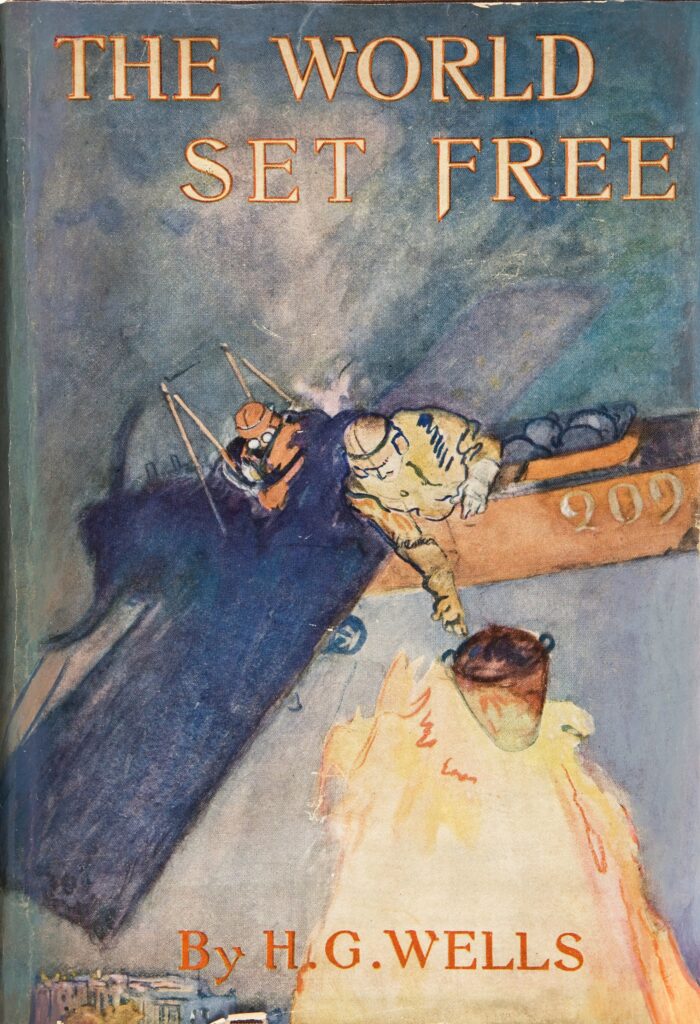
A key step in the collective process of making sense of this new phenomenon involved the writer H. G. Wells. He had read Soddy’s popular book of lectures on radium and, struck by its description of the power inherent in radioactivity, wrote a novel called The World Set Free, which he dedicated to Soddy’s book and published in 1914. The novel—in which a scientist representing Soddy speaks words taken from Soddy’s book—describes a war in which the European states use weapons against each other that Wells called—coining the term— “atomic bombs.” Wells imagined atomic weapons as black spheres with handles, which were dropped by hand out the window of an airplane to destroy entire cities by continuous explosion (the real nature of a nuclear blast was still unimaginable).70H. G. Wells, The World Set Free (Macmillan, 1914), chap. 2, sec. 3, gutenberg.org /files/1059/1059-h/1059-h.htm.
In the novel, the cataclysmic results of this war lead the nations of the world to come together to form a world state that would ensure global peace.71Sclove, “From Alchemy,” 179. Wells had heard of the Bahá’í Faith and of ‘Abdu’l-Bahá but was already a globalist by the time ‘Abdu’l-Bahá made his journey to the West, during which He lectured widely in Britain about the Bahá’í teachings including the unity of nations and universal peace. Wells comments on the phenomenon of being unable to see what later would be obvious: “Certainly it seems now that nothing could have been more obvious to the people of the earlier twentieth century than the rapidity with which war was becoming impossible. And as certainly they did not see it. They did not see it until the atomic bombs burst in their fumbling hands.”72Wells, World Set Free, chap. 2, sec. 5.
Frederick Soddy, in turn, read Wells’s novel just as World War I was beginning to display, on the battlefields of Europe, the gruesome evidence of the destructive nature of modern weapons. Against that background, reading the novel galvanized Soddy to realize that atomic energy could be used to develop even more powerful weapons than those that were already causing deaths in the tens and hundreds of thousands in mere days, and impelled him in 1915 to issue his first public warnings about the danger.73Spencer R. Weart, Nuclear Fear: A History of Images (Harvard University Press, 1988), 29.
But by 1933 even Soddy’s former colleague Rutherford appeared to have given up on the idea of accessing atomic energy in any practical way. He was reported as telling a meeting of British scientists:
We may in these processes obtain very great quantities of energy, but on the average we cannot hope to obtain energy for practical use in this way. The bombardment of the atom is a very poor and inefficient way of producing energy and anyone who is looking for a source of cheap power in the transformation of the atom, is talking pure moonshine.74A. C. Cummings, “Power Flow from Atoms Impossible,” The Calgary Daily Herald, 7 October 1933, 28. Jenkin argues, however, that Rutherford did realize, but was intentionally downplaying, the potentiality as well as the danger (John G. Jenkin, “Atomic Energy Is ‘Moonshine’: What Did Rutherford Really Mean?” Physics in Perspective 13, no. 2 [June 2011]: 128–45).
The account of Rutherford’s speech that appeared in The Times was read by the Hungarian physicist Leo Szilárd, who was then living in England. Szilárd had also read Wells’s novel, and he wondered if Rutherford just might be wrong. Ruminating on the possibility while crossing a street in London, Szilárd suddenly realized how a nuclear chain reaction could be achieved and later proved it. In 1939 he explained to Albert Einstein how atomic energy could be weaponized (Einstein said that the idea hadn’t occurred to him), and the letter they sent to President Roosevelt warning about German research toward that goal led to the creation of the Manhattan Project, and, six years later, to the detonation of the device whose light was so intense that, like the sun’s, it reflected off the moon.75William Lanouette with Bela Silard, Genius in the Shadows: A Biography of Leo Szilard, the Man behind the Bomb (University of Chicago Press, 1992), 207; Rhodes, Making of the Atomic Bomb, 672.
HOBGOBLINS AND MOONSHINE
From this account of the emergence into human consciousness of the reality of the power hidden within the atom and its implications for the future of humanity and the planet itself, we have seen that what is radically new and unprecedented cannot be properly understood by forcing it into the received categories of conceptual structures based on prior experience. If the radically new is to become intelligible, enter the body of shared knowledge, and become part of social reality, a process must take place as events unfold over time and new experiences are subjected to conscious analysis in a reflective collective enterprise of critical sensemaking. First, we instinctively try to fit the new information into the available categories in our mental representation of the world. If the new information does not fit into those categories, it will appear anomalous. If we persist in interpreting it in terms of inadequate categories, then anomalies, incoherence, and dissonance will proliferate. If we are committed to the preservation, at all costs, of the conceptual structure and its categories—whether it is that of science, of religious tradition, or of ideology—we may (like the Muslim divines who constructed implausible reinterpretations of Quranic verses to make them conform to the Ptolemaic geocentric theory that the verses actually contradicted), try to force the data to fit the theory.76See ‘Abdu’l-Bahá, Some Answered Questions, 7.14, and Tablet of the Universe, par. 22. Or we may (like William Crookes, who might have been the discoverer of x-rays had he not dismissed as a manufacturing defect the fogging that appeared on the photographic plates stored near his cathode ray tubes), misinterpret the significant unknown as an insignificant known. Misjudging the radically new by miscategorizing it can lead to catastrophe, whether by blindly embracing the toxic as tonic, as in the radium craze, or by dismissing it as hobgoblins and moonshine.
The unfolding of events over time—along with the reflective, ongoing conversation to make sense of those events—makes the knowledge publicly available and only then provides a perspective that permits reflection on the developments that led to the emergence of that knowledge and its progressive elaboration, revision, and refinement. In retrospect, it can be all too easy to think, as Thomas Huxley did on being told of Darwin’s theory of natural selection, “How extremely stupid not to have thought of that.”77Quoted in Julian Huxley, On Living in a Revolution (Harper & Brothers, 1944), 108. But at the beginning of the process, the end is not at all obvious, much less as clear as the sun at high noon—not even to (or especially not to) experts, who tend to have a vested interest in the conceptual systems, discourses, and paradigms that undergird their own claims to expertise. Even those who perceive—whether through scientific intuition, creative imagination, or divine inspiration and wisdom—a truth of the reality of things that is not yet generally known, will not be able to produce irrefutable evidence to convince all doubters, because no matter how accurate the warning or how valid the conclusion, the evidence only emerges as the consequence of a sequence of events in time and the discourse that strives to make sense of them, which has not yet taken place.
As Taleb notes, the key to avoiding the trap of “naive empiricism”—that is, reliance on inductive reasoning based on experience, which is vulnerable to confirmation bias and the fallacy of hasty conclusion—is knowledge.78Taleb, Black Swan, chap. 4. And the knowledge that is most conducive to avoiding traps of all kinds is wisdom. Thus, until events unfold, acting on faith in the counsel of the wise—whose knowledge of the realities of things enables them to see farther; to perceive relationships, implications, and consequences that others cannot; and to know the right response to every exigency, like the physician who knows the right remedy to treat the cause of an illness—would seem to be the most rational course, especially when dismissing that counsel carries a high risk of mass destruction and death or, in less dire cases, merely prolongs the suffering that the remedy was meant to cure.
In the late nineteenth century, there were others, such as Jean de Bloch (who published his six-volume work The Future of War a decade after Bahá’u’lláh had warned, in Words of Paradise, about modern weaponry), who had also concluded that future wars would be far more devastating than previous wars. Bloch was disregarded by many experts, and it was widely assumed that international developments, including the establishment of the Permanent Court of Arbitration as a result of the first Peace Conference at The Hague in 1899, and even the fearsome power of modern weapons, had made war “unthinkable.” A professor of history assured Frederick Soddy in 1900 “that there would never be another war.”79Sclove, “From Alchemy,” 178. So, people did not believe ‘Abdu’l-Bahá’s warnings that the approaching storm would be an unprecedented cataclysm for the world. In 1914, after the war had begun, He commented on why His warnings had been dismissed:
While travelling in Europe and America I met altruistic and sanctified souls who were my confidants and associates concerning the question of Universal Peace and who agreed with me and joined their voices with mine regarding the principle of the Oneness of the World of Humanity; but alas, they were very few! The leaders of public opinion and the great statesmen believed that the massing of huge armies and the annual increase of military forces insured peace and friendship among nations. At that time I explained that this theory was based on a false conception; for it is an inevitable certainty that these serried ranks and disciplined armies will be rushed one day into the heat of the battlefields and these inflammable materials will unquestionably be exploded and the explosion will be through one tiny spark; then a world conflagration will be witnessed, the lurid flames of which shall redden all the horizons. Because the sphere of their thoughts was contracted and their intellectual eyes blind, they could not acknowledge the above explanation….
… Although the ends of war were evident and manifest to the sages and scholars, they are now made clear and plain to all the people. No sane person can at this time deny the fact that war is the most dreadful calamity in the world of humanity… and that war is the most ruinous catastrophe and the most deplorable adversity.”80‘Abdu’l-Bahá, “No Sane Person Can at This Time Deny the Fact that War Is the Most Dreadful Calamity in the World of Humanity,” Star of the West 5, no. 16 (31 December 1914): 244.
Many of the themes in ‘Abdu’l-Bahá’s talks and Writings explaining the dynamics of international conflict, including the massing of military force, the accumulation of armaments, and the lack of trust among nations, closely parallel what would, in the years following the Second World War, be conceptualized in International Relations theory as the “security dilemma,” while His prescription for arms reduction, a binding system of collective security, and an international tribunal anticipate the measures that would eventually be proposed to mitigate those dynamics.
Although it was naively hoped that the Great War would be (in the words of H. G. Wells) a “war to end war,” after the guns had fallen silent the root cause of conflict still festered.81See Amín Egea, “Reading Reality in Times of Crisis: ‘Abdu’l-Bahá and the Great War,” The Bahá’í World XXXV 2006–2021 (Bahá’í World Centre, 2024), bahaiworld.bahai.org/library/reading-reality-in-times-of-crisis/; and Hoda Mahmoudi and Janet A. Khan, A World Without War: ‘Abdu’l-Bahá and the Discourse for Global Peace (Wilmette: Bahá’í Publishing, 2020). In 1919 ‘Abdu’l-Bahá was reported to have told visiting pilgrims that the peace was only a “false dawn.”82“Talks of Abdul Baha,” 33–34. Until the oneness of humanity and the ethical implications of that fact were universally recognized, there would be more war; peace conferences alone would be ineffectual. In 1920 He wrote: “The Hague Conference held before the war had as its President the Emperor of Russia, and its members were men of the greatest eminence. Nevertheless, this did not prevent such a terrible war. Now how will it be? For in the future another war, fiercer than the last, will assuredly break out; verily, of this there is no doubt whatever.”83‘Abdu’l-Bahá, Selections, 228.2. And indeed, the Second World War would not only see more devastation and death than the First, but also the weaponizing of the “stupendous force” about which ‘Abdu’l-Bahá had warned Minister Arakawa, and its use against his own country.
Was there anything that Bahá’u’lláh, a religious prisoner in a remote backwater of the Ottoman Empire, writing seven years before Becquerel’s discovery of radioactivity, could have said to audiences of the nineteenth century—or ‘Abdu’l-Bahá to those of the early twentieth (even to a representative of the government of Japan)—not merely to warn against war but to prove the existence and nature of atomic energy in a way that would have made them understand the wisdom of the warnings and take action to prevent the catastrophic consequences? In November 1918 ‘Abdu’l-Bahá wrote to a Bahá’í in Iran that He had warned the people of the West:
The entire continent of Europe hath become an arsenal for arms and munitions waiting for a spark to kindle the flame of war and make the planet earth tremble…. But as the wise Saná’í saith: ‘To speak of the subtleties of Saná’í before the foolish and the weak of mind / Is like plucking the lute for the deaf or holding a mirror to the blind.’ Thus all that should not have happened did happen and still the wayward people were not awakened or guided aright. Neither signs nor warners avail them.84‘Abdu’l-Bahá, Tablet dated 2 Rajab 1337 [3 April 1919] to an individual, Bahá’í World Centre Archives, Haifa, Israel (provisional translation). Almost as if in response, in 1922 Frederick Soddy said, “The catastrophe which has recently engulfed the world has, however, not been without its own intellectual renaissance.… at least, perhaps not all of us are now totally blind to the dangers ahead, or to the need of that impersonal but remorseless re-examination of the foundations of society, which Science has already applied to the mechanism of the physical universe” (Frederick Soddy, Banquet Speech, 11 February 2026, NobelPrize.org, nobelprize.org/prizes/chemistry/1921/soddy/speech/).
And whatever rational explanations or reasoned arguments might have been offered would also have been futile because a context within which the warning—or even the proof—could have made sense, much less be properly appreciated, did not yet exist.
In fact, in an even earlier reference to the strange and astonishing phenomenon of the power concealed within the atom, written in 1881—eight years before Words of Paradise—Bahá’u’lláh had made that very point:
Every soul hath been and will ever remain incapable of comprehending the inmost essence of divine wisdom. Understanding is in truth the most great sign in the human soul…. However, we observe that, notwithstanding his excellent rank and exalted position, man is unable to comprehend the reality of most things, for understanding is dependent upon the power of vision. If the eye doth not see the palm tree, the mind cannot comprehend the world of fruits, leaves, trees, branches, and twigs enfolded in the seed. How could the mind, before observing it, comprehend that a thing existeth in the world, a particle of which would consume the whole world, reduce it to ashes, and completely obliterate it?85Bahá’u’lláh, Tablet dated 17 Rajab 1298 (15 June 1881) to several individuals, Bahá’í World Centre Archives, Haifa, Israel. I am grateful to Omid Ghaemmaghami for bringing this passage to my attention.